About Nesta
We are Nesta, the UK's innovation agency for social good. We design, test and scale solutions to society's biggest problems. Our three missions are to give every child a fair start, help people live healthy lives and create a sustainable future where the economy works for both people and the planet.
For over 20 years, we have worked to support, encourage and inspire innovation. We work in three roles: as an innovation partner working with frontline organisations to design and test new solutions, as a venture builder supporting new and early stage businesses and as a system shaper creating the conditions for innovation. Harnessing the rigour of science and the creativity of design, we work relentlessly to change millions of lives for the better.
Find out more at nesta.org.uk
If you'd like this publication in an alternative format such as Braille or large print please contact us at [email protected]
About Innovation Growth Lab (IGL)
IGL supports the development of productive, sustainable and inclusive economies through the application of new policy ideas, data and rigorous evidence. We collaborate with policymakers, researchers, practitioners and funders to experiment and address key policy challenges in the areas of science, innovation, entrepreneurship and business.
Find out more at innovationgrowthlab.org
Authors
James Phipps (IGL)
Rob Fuller (IGL)
Wanda Mollica (IGL)
Summary
The paper presents findings from a scoping study into the potential for policy interventions that can both boost small business productivity and contribute to net zero. It was undertaken to guide the direction of further research and policy engagement by Nesta and IGL. The paper looks at the evidence on the case for supporting small-medium enterprises (SMEs) to take action on net zero; the challenges for policy interventions and role for experimentation.
SMEs as a whole make a major contribution to emissions of greenhouse gases. The UK cannot reach net zero without SMEs taking action – yet not many are adopting existing measures to reduce emissions. There is an increase in targeted support to encourage and help SMEs to reduce emissions – and calls for much greater action. The challenges involved in prompting SMEs to move towards net zero have much in common with the barriers to promoting the adoption of other technologies and management practices. Targeted policy interventions to overcome these barriers can be effective, but are not always so. The evidence base is thin, with very little information on what interventions are most effective, when, why, and for whom. The interventions being applied to support 'greening SMEs' apply similar approaches to those that have targeted growth and productivity.
For interventions to be cost effective, they need to be scalable and widely applicable. The SME population is very large, with each individual firm only accountable for a small amount of emissions. Many of the actions that have the potential to raise productivity may also support the transition to net zero. Taking this overlap into account could justify more intensive policy interventions. However, there are complications in designing and communicating policies that address both goals. SMEs are an extremely diverse group, and they differ widely in how much they contribute to emissions. There is also a lot of variation between them in the barriers they face to reducing emissions, as well as their capacities and their motivations for taking action. Measuring emissions at the business level is very challenging, making it difficult to guide the decisions of policymakers, business leaders and consumers.
Experimentation will be crucial to learning about which interventions are effective – and how to optimise their impact. In particular, experimentation funds would allow policymakers to source ideas for interventions, test them at a small scale, and then scale
up those that seem promising. There are some key challenges to address in experimenting in this area, especially determining what to use as outcome measures.
Introduction
Two of the most pressing policy questions for the UK are how to raise productivity and transition the economy to net zero. In this report, we consider why the policy response to both challenges has included targeted support for SMEs and whether those developing such interventions have access to the necessary evidence to make effective decisions.
Raising productivity and achieving net zero will require action across all areas of the economy through changes in household behaviours, infrastructure and business investment through to the direction of investments in basic science. The potential pace and scale of what can be achieved will be determined by the frontiers of research and innovation. However, the success and consequences of the transition to net zero will also be determined by whether new and existing innovations are diffused and effectively adopted throughout the economy.
Innovations can be slow to diffuse. It is widely acknowledged that a contributory factor to the UK's poor productivity is that large numbers of SMEs are slow to adopt new technologies and management practices. There is also growing recognition in the climate policy arena that there are many existing steps that SMEs are not taking to reduce their environmental impact. This has led to a surge in policy interventions.
From examining existing research, we find many similarities in the barriers and drivers to change across productivity and net zero. There is also scope for alignment in the actions that SMEs would be encouraged to take. Many would have clear and direct benefits for both net zero and productivity, although for others the outcomes for each goal might be ambiguous, or even in direct conflict.
When it comes to how to design and implement effective solutions, we find that there are many challenges to be overcome. These include a lack of robust evidence from past evaluations and insufficient data to quantify the scale of barriers and the potential gains to be realised. Existing experiments can tell us that policy interventions can make a difference, but that they do not always do so. Small decisions about programme design can be crucial. Applying a dynamic and structured learning process will help optimise interventions and establish a robust evidence base to help accelerate the transition to net zero.
Background
The paper presents findings from a Nesta discovery project undertaken by IGL. IGL explored the scope for policy interventions that can boost both small business productivity and contribute to net zero by encouraging SMEs to adopt existing innovations. This project sits within Nesta's 'sustainable future' mission and was undertaken to guide the direction of further research and policy engagement.
The topic area was chosen on the basis of a growing interest in the potential for policy interventions that could raise productivity and speed up the transition to net zero, often with a connection to digital technologies. Another driver was the observation that there is uncertainty about the scale of what can be achieved, how to measure outcomes and the best types of policy actions to take. Policy experimentation is one approach to resolving uncertainty when intervening in new areas and generating robust evidence to guide decisions. IGL has supported a large number of experiments of SME support interventions, so we sought to examine the relevance of the learning from this experience to address this new policy challenge.
We identified seven questions that we would seek to answer through a rapid evidence review.
- What do we know about the scale of SMEs' contribution to the UK's environmental impact and the potential ways to reduce this?
- How is it imagined that SMEs would reduce their environmental impact? What do we know about what works and the outcomes?
- What is the role of interventions intended to encourage SMEs to adopt new technologies, business models and management practices?
- To what extent could these changes also boost productivity and what can be learnt from experiments that have tested ways to encourage SMEs to boost productivity?
- What are the best ways to measure increases in productivity and reductions in carbon emissions in potential experiments?
- Are there existing examples that illustrate the types of solutions that could be tested?
- Are experimental approaches required to help develop, iterate, scale or validate such approaches?
The findings of this scoping study are to form the basis for further research and policy experimentation.
The case for supporting SMEs to take action on net zero
SMEs as a whole make a major contribution to emissions of greenhouse gases. The UK cannot reach net zero without SMEs taking action – yet not many are adopting existing measures to reduce emissions.
SMEs make a large contribution to the UK's economy. Using the common definition of an SME as any business with fewer than 250 employees, SMEs account for 61% of employment and 53% of private sector sales (Department for Business and Trade (DBT), 2023).
Figure 1
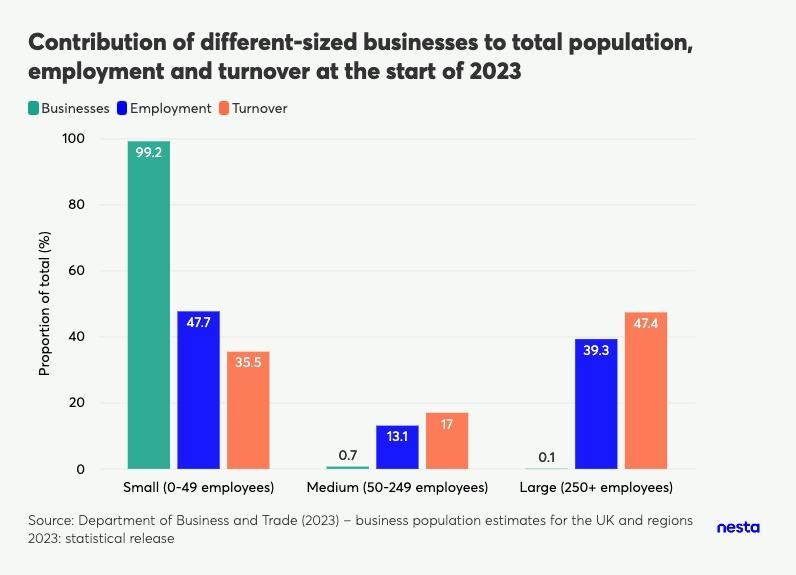
Given their aggregate contribution to economic activity, it is not surprising that SMEs also account for a large share of greenhouse gas emissions. SMEs are thought to generate around half of all emissions by UK businesses, and possibly as much as two thirds once indirect emissions are considered (British Business Bank (BBB); 2021, Sage et al., 2022). This implies that reaching net zero will require substantial reductions in emissions among SMEs.
Emissions are not evenly spread across the business population with a significant concentration among those heavily involved in the production and use of energy, fertilisers, cement, steel and the transportation system. Ultimately achieving net zero will require a large-scale transformation of these processes. Here the rate of change will be beyond the influence of most individual SMEs but will eventually result in lowering their own emissions and that of their customers. However, even in the interim, SMEs can make significant steps towards reducing their emissions by making changes in their own operations and when making decisions over their suppliers and markets they sell to. A key question for policymakers, then, is how to influence the actions of SMEs while waiting for larger-scale changes.
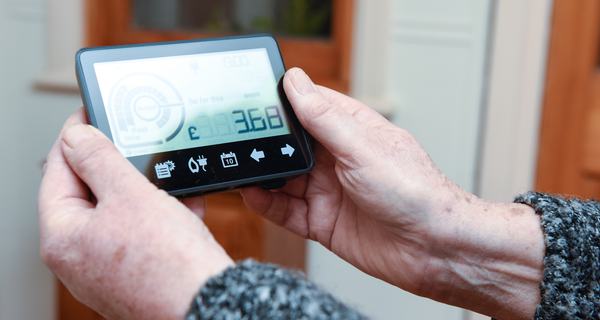
Many SMEs are setting environmental targets, making pledges to take action to reduce their emissions (SME Climate Hub, n.d. in Hampton et al., 2023). In a survey carried out in 2021, BBB found that 94% of SMEs have taken some action to reduce carbon emissions. Some had done so in an extensive manner: for example, a third of the manufacturing businesses surveyed had taken significant steps to reduce emissions, such as installing or upgrading production equipment. However, the actions taken by most businesses are as yet relatively minor – including activities such as installing a smart meter, switching energy supplier or even replacing face-to-face meetings with virtual meetings. In many cases, these actions may have been made for other reasons (such as reducing costs) rather than being driven by the desire to lower emissions. Only six percent of UK SMEs had measured their carbon footprint within the last five years, suggesting that most are not taking actions in a systematic approach guided by data.
Overall, BBB classified just under half of SMEs as 'carbon nimble' (those with low emissions who are being proactive about managing them) or 'carbon correcting' (those in energy-intensive industries but who are already taking action to reduce emissions). The remaining half of SMEs were described as 'carbon complacent' or 'carbon exposed', in that they were not yet prioritising emissions reductions (BBB, 2021). A separate survey of UK SMEs found that 61% are not currently taking action towards net zero (British
Chambers of Commerce (BCC), 2023). There is, then, a large number of SMEs that could be potential targets for policy intervention. Lack of innovation and investment towards engaging and supporting SMEs in the net-zero journey can jeopardise greening across the entire economy. As the Organisation for Economic Cooperation and Development (OECD)(2021) reports, considering the numbers, there would be no net zero without SMES.
There is an increase in targeted support to encourage and help SMEs to reduce emissions – and calls for much greater action.
As outlined by Blundel and Hampton (2021), the growing awareness of the monumental shifts required to achieve net zero has seen greater attention paid to the contribution of SMEs and the development of policy responses targeted at them. For example, the recent independent review of the UK government's net-zero plans called for a large-scale campaign to support SMEs in the net-zero transition, including providing information, resources and subsidies (Skidmore, 2023). However, despite some isolated cases, there has been marginal progress in scaling SME climate action and low levels of engagement (Hampton et al., 2023).
The challenges involved in prompting SMEs to move towards net zero have much in common with the barriers to promoting the adoption of other technologies and management practices.
While the need to assist SMEs in moving towards net zero has only recently come to receive sustained attention, the problem of low productivity among many SMEs has been a focus of policymakers' attention over a much longer period (Haldane, 2018; HM Government, 2019). Many policy initiatives have aimed at addressing this productivity shortfall by encouraging SMEs to adopt improved management practices and new technologies. The success of these efforts has been mixed and often unclear. However, this work has led to much being learnt about what prevents SMEs from adopting technologies and practices that seem likely to have potential benefits for them.
Barriers to adoption range from simple lack of awareness of the possibilities and the potential benefits of a technology, to not knowing where to seek advice, technological constraints or a lack of complementary assets that are required to take full advantage of a technology. Of course, many SMEs also face a lack of finance, technology skills, or time to invest in selecting solutions and implementing them. A common observation in
technology adoption initiatives is that when SME managers, who initially know little about the technologies available increase their level of understanding, they become more hesitant about whether they would be able to make effective use of those technologies, and do not necessarily see themselves as further along the path to adoption.
For these reasons, the 'adoption journey' can be long and complex. It is rare that supporting a business to overcome a single barrier (say, by providing information about technologies) will enable it to progress smoothly to adoption; more often, some other barrier will then become a constraint, requiring different forms of support. Even once an initial decision has been made to invest in a new technology or practice, realising the full benefits may require adjustments to existing business processes, something that can be complex to achieve in itself.
Efforts to encourage SMEs to adopt new practices or technologies to move towards net zero will face many of these same constraints. To the extent that net zero requires SMEs to take action that does not result in tangible benefits to the individual business (at least in the short term), the barriers will be even more formidable. A recent survey by BCC and Lloyds Bank found that 21% of SMEs believed that green technologies would decrease their productivity – through increasing costs or distracting managers from core business priorities – while only nine percent believed that there would be productivity benefits (BCC, 2023).
In table 1, we set out some of the likely key barriers to adoption of net-zero measures among SMEs. Supporting businesses along the adoption process is likely to require a range of interventions, which will vary depending on the needs of a particular business and will change over time as the business progresses along the adoption journey. Programmes that have been more successful in this respect have tended to combine awareness-raising and providing information about technology adoptions with more specific training or practical support during the process of selecting, testing and implementing a technology solution.
Table 1: The barriers that SMEs face in adopting net-zero measures. The barriers are divided according to origin: input market, within businesses, output markets and wider environment.
| Input markets |
Within the business |
Output markets |
| Lack of transparency among suppliers over emissions or over how emissions could be reduced |
Risk of positive impact on business performance not being realised or with a too long payback period |
Lack of demand from consumers or B2B customers in some sectors |
| Potential coordination failure: individual SMES have little influence over large suppliers |
Lack of awareness and information about effective actions and technologies |
|
| Technologies are usually developed for larger businesses, with additional costs to adapt to SME needs |
Lack of information about what other businesses are doing on net zero |
|
| Shortages of technologies or specialists to advise on or install technologies |
Difficulty of measuring current emissions or impacts on emissions, and understanding how these compare to other businesses |
|
| The minimum viable size for the profitable use of a given technology is beyond the reach of many SMEs |
Lack of time, bandwidth/ attention, skills, capacity, finance |
|
| Lack of trust in the solutions being offered, as a result of overselling or 'greenwashing' on the part of suppliers |
High cost (or high perception of cost) of taking action |
|
| Landlord-tenancy problem: owners of business premises have little incentive to make investments in more efficient heating or insulation that benefit tenants |
Uncertainty about the benefits |
|
|
Pressing demands on the business leads to net-zero actions being deprioritised |
|
|
Regulation restricts the potential for innovation |
|
Wider environment
- Limited infrastructure (eg, poor internet connectivity, lack of charging points for electric vehicles)
- Uncertainty over future regulatory requirements on emissions
- Uncertainty about how the cost of adapting will change in the future (technology cost curves)
- Risk of net zero becoming a divisive political issue, which would deter many SMEs from taking a clear position
- The structures of finance markets and support for long term investments
Targeted policy interventions to overcome these barriers can be effective, but are not always so. The evidence base is thin, with very little information on what interventions are most effective, when, why, and for whom.
Despite the large number of policy initiatives and programmes that have sought to address the SME productivity gap, evidence on the effectiveness of these interventions is limited (What Works Centre for Local Economic Growth, 2016; National Audit Office, 2020). This has begun to be addressed in recent years through the use of experimentation and rigorous evaluation. In particular, the UK government's Business Basics Programme sponsored randomised evaluations of a range of interventions. Some of these were found to have positive impacts on the use of improved management practices or in moving businesses closer to adoption of digital technologies (Roper et al., 2020; Jibril et al., 2022; Novelli and Spina, 2022; Tinelli et al., 2023). On the other hand, many of the interventions that were tested either saw little demand from SMEs or experienced implementation problems that limited their impact (Phipps and Fuller, forthcoming). Some other robust evaluations of interventions aimed at prompting change among SMEs have also been carried out in recent years, but these still cover only a very small portion of the many programmes and initiatives being implemented in this area.
With little hard evidence to build on, it is not possible to make generalisations about which types of intervention are most likely to succeed and to have the greatest impact. This is also because putting in place successful interventions is not only about finding the right high-level design, but about optimising how it is delivered. Seemingly small decisions about the design of programmes can be crucial for the success of a programme. For example, in the Business Basics Programme, a promising initiative to encourage learning between peers through an online platform saw little usage because of the difficulties in logging into and using the app. The timing and location of training sessions or
informational workshops can be a major factor in determining whether busy SME managers will participate. For these reasons, it is crucial to invest in thorough piloting of an intervention at small scale, tweaking it and iterating until a successful model is found.
The interventions being applied to support 'greening SMEs' apply similar approaches to those that have targeted growth and productivity.
A range of potential policy measures to support SMEs in moving towards net zero, grouped by delivery channel, are presented in table 2. Each intervention type could also be divided by the primary path towards net zero, for example whether benefits will be derived from product innovation (creating and commercialising a green technology or product), adoption (adopting and switching to greener production methods and technologies) or enabling (facilitating adoption elsewhere in the supply chain).
Table 2: Potential policy measures to support SMEs in moving towards net zero
|
|
| Market shaping and creating |
Demand – request progress towards net-zero standards in government procurement |
|
Regulation - eg, caps on emissions, or incorporating SMEs into the UK Emissions Trading Scheme |
|
Establishing standards for the tracking of environmental impacts at each stage of production and how this information is shared with others |
|
Supporting certification schemes for SMEs making progress towards net-zero goals |
|
Funding technology suppliers or installers to better adapt their products or services to the SME market |
| Infrastructure and institutions |
Availability of efficient office space and transport options for customers and employees |
|
Infrastructure for charging electric vehicles |
|
Recycling systems and options available for the business and their customers |
| Workforce skills |
Training for managers and employees who can then enable change within their business |
| Non-financial business support |
'Green skills' – eg, installation and maintenance of heat pumps and solar panels |
|
Openly-available support – eg, information on websites, campaigns to raise awareness and encourage action |
|
Support directed at individual businesses eg, provision of consultancy advice, in-person or group training, benchmarking and auditing of current status and referrals to further support |
| Financial support |
Targeted subsidies for making investments that are positive for net zero, eg, switching to electric vehicles, upgrading insulation |
|
Subsidies for businesses to seek advice or hire external support on moving towards net zero |
|
Provision of capital for green investments |
Given the similarities in the target population and barriers it is not unexpected that the interventions being applied to support SMEs transition to net zero apply similar methods to existing programmes targeted at growth and productivity. For example, (Skidmore, 2023) calling for the provision of information, resources and subsidies and more specifically the extension of the Help to Grow programme to cover net zero and not just management and digital. More widely there is a large number of interventions being targeted at individual businesses. Mole and Belt (2023) mapped out the net-zero support programmes available for SMEs in England, finding a vast array of programmes – a total of 282 different schemes spread across all regions.
As previously outlined, unfortunately too little is known about what makes for a successful programme even in the traditional areas of application. If an intervention has proven to be successful in one context (such as helping with the adoption of digital technologies), it cannot be assumed that it will have the same results when applied elsewhere.
What are the challenges for policy interventions?
For interventions to be cost effective, they need to be scalable and widely applicable. The SME population is very large, with each individual firm only accountable for a small amount of emissions.
While SMEs altogether account for a large proportion of greenhouse gas emissions, this is partly due to their sheer numbers: there are estimated to be approximately 5.6 million SMEs across the UK (DBT, 2023) with hundreds of thousands leaving and entering the economy each year. The emissions from most individual businesses are, therefore, relatively small. A key challenge, then, is to design interventions that can reach large numbers of SMEs cost effectively.
One approach would be through providing information, both to increase awareness and understanding of the net-zero goal and to support SMEs in taking action. Given that many SMEs have not yet accepted the need to measure and reduce their emissions, there may well be a place for general information about the importance of net zero and what broad approaches they can take, as well as the potential benefits to the business from doing so.
However, perhaps more impactful (at least in the short term) would be to provide those who are already looking to reduce their emissions with practical guidance on what steps to take. As discussed above, a lack of awareness or lack of information about solutions is likely to be a significant barrier to progress for many SMEs. Again there are similarities with the SME technology adoption problem, which many actors have attempted to address through providing information, either through workshops or other events or through websites. Unfortunately, there is little evidence that purely making general information available can produce significant change. Experience from the Business Basics Programme shows that informational websites can be valued by users if they are well designed and targeted to the businesses' needs, but getting SMEs to visit and engage with the websites in the first place can be challenging.
Information will naturally be more valuable if it is tailored to the specific needs of the business, and who provides the information may also make a difference. An interesting study was conducted among businesses in the Netherlands that had signed up to an energy-efficiency initiative, in which each business was provided with an annual report with individualised feedback on their progress. Using behavioural insights to improve the
design of emails resulted in far larger numbers of businesses downloading their annual reports – and many of those went on to consider implementing further energy-saving measures (Rosenkranz et al., 2017). Messages have also been shown to influence innovators in an experiment with grantees of the Small Business Innovation Research (SBIR) (Guzman et al., 2023).
Giving SMEs information about how they compare to their peers may also have promise. In a trial in the UK, SMEs were found to make improvements to their websites after being sent a mailing with details about how the performance of their website compared to those of their competitors (Kneller et al., 2022). In Brazil, providing an easy-to-read summary of a benchmarking report resulted in businesses being more likely to take up an offer of further support (Bruhn and Piza, 2022a; 2022b). However, in both of these studies, the control group soon caught up with the treatment group: the information only had an impact in the short term.
As highlighted earlier, even if an intervention is successful in providing information, other barriers may then inhibit an SME taking action. For this reason, it is unlikely that informational interventions alone will be sufficient to move significant numbers of SMEs towards net zero. Providing more intensive support – such as one-to-one guidance or accompaniment through the implementation process – may be much more impactful, but is clearly less scalable. Many place-based programmes in the UK have previously been funded by the European Regional Development Fund, but there remains uncertainty over future funding and how to improve on past investments.
Policymakers can also drive change through the use of regulation that can avoid the need for public spending and to target individual businesses. However, this can just shift the costs to businesses or consumers and does not avoid the need to design effective policy. Previous concerns about the impacts of regulation on smaller businesses have led to exceptions based on the size or age of the firm, it may be better to consider how to design regulations so at least some small businesses are included.
Many of the actions that have the potential to raise productivity may also support the transition to net zero. Taking this overlap into account could justify more intensive policy interventions. However, there are complications in designing and communicating policies that address both goals.
There is a lot of complementarity between the goals of increasing productivity and the transition towards net zero. Existing efforts to boost productive and growing firms, if effective, could lead to firms going on to make changes beneficial to net zero. This is partly because growing firms generate more surplus revenue that can be used for green investments. Perhaps more importantly, actions to move towards net zero can be taken more effectively and efficiently by well-run firms that are better placed to adopt and integrate new innovations, and to work with their customers and suppliers on finding novel solutions – including when the driver is caused by negative shocks.
There are also direct overlaps between specific actions. For example, a firm that becomes more productive through more advanced manufacturing processes that better respond to customer needs may also see a reduction in wasted outputs and thereby emissions. Similarly, actions with the intent to improve energy efficiency may have secondary benefits for productivity. For example, a better-insulated office space could raise employee productivity by creating a more comfortable working environment.
Green-orientated companies can also provide a more attractive employment offer and a more appealing alternative for larger companies due to the current environment regulations (Bank of Scotland, 2023). There can also be further angles to consider. Many SMEs play an important role in local communities and through their actions can help develop pleasant places to live. For example, a takeaway restaurant could support a cleaner environment by adopting systems that encourage customers to recycle.
Emphasising these multiple benefits in messaging to SMEs may make it more likely that they take action and provide more justification for any public investment. However, the complexity and layering of different goals can present challenges to those developing solutions - weighing the benefits and therefore optimal contributions to be made by the individual business, local areas and national governments (Sissons, 2023). It is also difficult to generalise about how much overlap there is between promoting productivity and reducing emissions.
Not all measures to boost productivity (measured in terms of gross value added) will be neutral or beneficial for the transition to net zero. Similarly, not all actions that cut emissions will improve productivity: the cost of investment may be greater than the savings to the particular business. The degree of alignment between the objectives will differ by the action and the characteristics of the individual business that will be taking
them. Estimating these benefits for any particular business would require access to a large amount of information, for example on the business' existing production processes, the condition of its buildings, or its tenancy or lease agreements. However, it is notable that, as mentioned above, a recent survey found that more than twice as many businesses believed that green technologies would have a negative impact on their productivity than the number who believed that these technologies would bring productivity benefits (BCC, 2023).
Even if there is information on the benefits, this messaging will only be effective if SME managers are motivated by the potential for environmental benefits as well as business benefits. This will naturally apply to some but not others. The majority of SMEs are at the beginning of the journey to net zero and it can be difficult to connect the impacts from what might be small actions they can take to the transition to net zero on a national scale. Interventions may then first require the creation of these 'values' among the business leaders and employees (Hampton et al., 2022). There are also practical challenges to communicating about two different benefits: the messaging will be more complicated and less readily absorbed by busy SME managers.
Businesses may vary in their ability to realise the potential productivity gains. For example, an SME may be able to create a business benefit from reducing emissions by including information about what they are doing in their marketing, to boost their brand. The extent to which a business can realise brand benefits from reducing emissions will depend on its target market: this is probably more possible for businesses that produce products or services for consumers than for other businesses, and more in some sectors than others. There are two further caveats to this argument. One is that it is very difficult for customers to tell from marketing materials how much action a business has really taken: a business that has taken only marginal steps towards net zero may be as effective in promoting itself as 'green' than one that has taken more substantial actions. Secondly, a business can only use green branding as a positive marketing device as long as its competitors are not doing so effectively. There will be much less brand advantage to a business from taking action to reduce emissions if many or most of its competitors are also doing so. Rather, in the longer term, as net zero becomes a new norm, it is those businesses that are not seen as taking action that will be left behind.
SMEs are an extremely diverse group, and they differ widely in how much they contribute to emissions. There is also a lot of variation between them in the barriers they face to reducing emissions, as well as their capacities and their motivations for taking action.
SMEs range in size from self-employed individuals to medium-sized businesses with more than 200 employees. They are found in all sectors of the economy. Some provide products or services direct to consumers, while others market only to other businesses. Naturally, then, the drivers of taking action to reduce emissions and the barriers to do so will vary widely.
Greenhouse gas emissions are concentrated in particular sectors of the economy: particularly the energy and mining sectors, manufacturing, agriculture, forestry and fisheries, transport and warehousing (Allas et al., 2021). Focusing on SMEs in these sectors may seem the natural place to start with interventions aimed at reducing emissions. On the other hand, many of the largest emitters will already have come under pressure to improve the efficiency of their operations – not least because of the surge in energy prices in 2021 and 2022 – which will have also had the effect of reducing emissions. It is possible that the greatest potential for emissions reductions now lies with businesses in sectors that are less energy-intensive and so have faced less pressure to change already.
Measuring emissions at the business level is very challenging, making it difficult to guide the decisions of policymakers, business leaders and consumers.
While it is known that SMEs' emissions of greenhouse gases are significant, measuring them precisely is difficult. This is true even at the macro level: estimates of the proportion of total emissions made by SMEs vary considerably, depending on which types of emissions are counted and how (BBB, 2022; Sage et al., 2022). Although the carbon reporting and measuring sector is growing, it is still very challenging for any individual business to get an accurate assessment of their own emissions.
Greenhouse gas emissions are classified according to three 'scopes'. Scope one refers to emissions made directly by the business, such as through burning gas for heating or in fuel for vehicles. Scope two emissions are those caused by generating electricity used by the business. Scope three covers all other emissions that take place as a consequence of the business' activities. This includes emissions from the extraction or production of raw materials or other inputs, emissions generated by companies to which it outsources some of its operations, emissions produced in the disposal of its waste, and emissions from employee commuting or business-related travel (World Resources Institute and World Business Council for Sustainable Development, 2004).
SMEs have a significant degree of control over their scope one and two emissions, either through their choice of equipment or their choice of energy supplier. However, firms usually have less visibility and less control over scope three emissions. This will be especially true for SMEs who will have less sway on the actions of suppliers and regulators than larger organisations. They are also more dependent on existing regulation and local infrastructure to shape the decisions of their customers.
Unfortunately, though, scope three encompasses a large proportion of emissions for many businesses. Sage et al. (2022) estimate that scope three accounted for approximately a quarter of SMEs' total UK-based emissions in 2021 (and this proportion would be higher if emissions from imported or exported goods were included). If all businesses are able to work towards net zero in their scope one emissions, this would mean that scope three emissions (which are mostly produced by other businesses) would be much less of a concern.
The lack of rigorous and consistent measures on environmental impacts also limits the market forces that could be exerted by consumers. The benefits of ‘going green' may not be achievable if a business does not have a way to signal this to consumers. This could be where regulation comes in, for example replicating something like food standards ratings or the recording of ingredients in food, but instead reflecting the energy use accounted for across production. The application of carbon pricing and trading is another approach to create the incentives for change. However, SMEs may still benefit from targeted support to respond effectively. For example, researchers David Atkin and Banu Demir Pakel are undertaking a project examining how the European Union's Carbon Border Adjustment Mechanism (CBAM) will impact on Turkish SMEs. The project intends to evaluate policies that would provide affected firms with training and financial assistance to respond to CBAM, as well as looking at the tradeoffs between environmental and growth outcomes.'
The lack of reliable and granular data on emissions also increases the risk of public policy failures. Firstly, policymakers face a challenge to estimate the scale of what can be achieved. Estimates of businesses' contribution to current emissions often rely on incomplete information and broad assumptions for how energy use is distributed across businesses within a given sector or region. It is even more difficult to estimate the potential reductions that could be achieved through the adoption of existing technologies and practices, let alone the barriers that are preventing action.
Ongoing work by the World Bank in Georgia provides an example for how an investment in detailed surveys and data collection could inform policy. With the Perseus project, supported by Bankers for Net Zero and British Business Banks, there is an even greater ambition to automate sustainability reporting for SMEs by creating a common data sharing platform. Finally, the difficulties with measurement will also hinder the evaluation of any interventions that are taken and informed decisions about the value for money. For example, a failure to accurately measure changes may lead evaluations to miss reductions that are achieved or to detect changes that haven't actually happened.
The case for experimentation
Experimentation will be crucial to learning about which interventions are effective – and how to optimise their impact.
It is clear that there are many promising ideas to support SMEs in meeting net-zero goals, but also that little is known about what approaches could be most effective or how they should be targeted. What is required, then, is a process of testing the various potential interventions to assess which have the greatest impact, and for which kinds of businesses in which situations.
Having identified 282 separate but similar programmes, Mole and Belt (2023) raise concerns about a fragmented ecosystem and suggest that a degree of centralising and harmonising support programmes seems in order. But with only 36 publishing any information on effectiveness it is unclear what approaches, if any, should be scaled.
There is a significant risk in proceeding too quickly to scale. Given the levels of uncertainty about the nature of the problem and the feasibility and effectiveness of interventions, it is important to create space to resolve the uncertainty and learn from failure. As noted earlier, Skidmore (2023) called for the creation of a Help to Grow programme for net zero. Of the two major programmes already launched under the 'Help to Grow' banner, the one supporting management practices has delivered support to thousands of businesses. But Help to Grow: Digital was closed after 15 months, having failed to reach anything near the expected scale or impact.
Figure 2
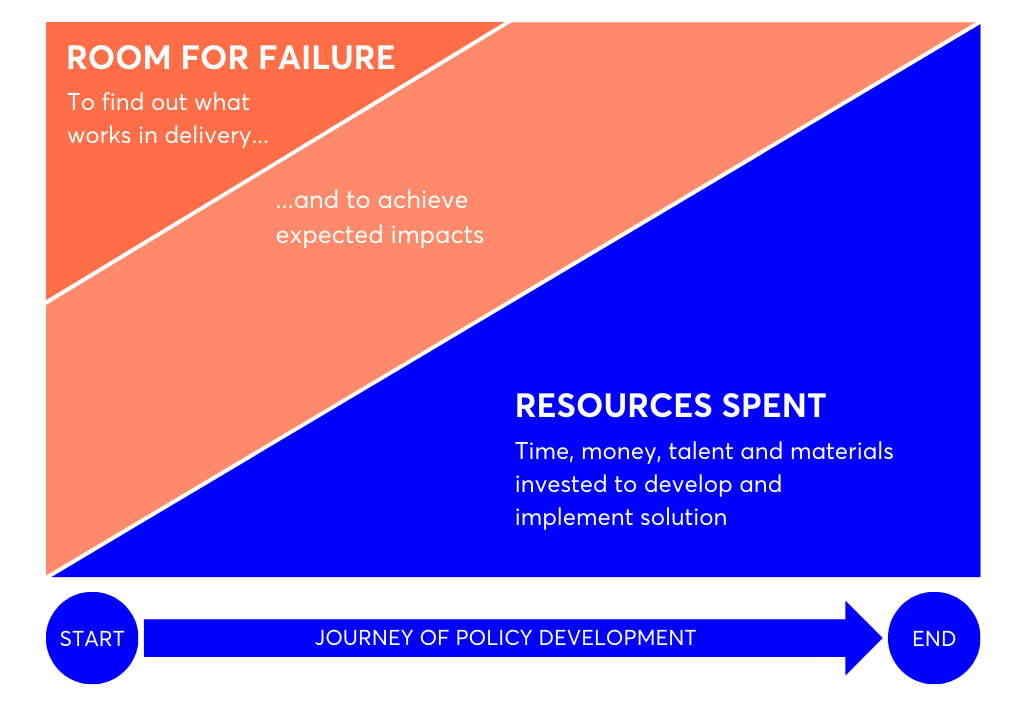
We propose using an experimental approach, carrying out systematic testing of interventions through small-scale pilots and (once the design and implementation details are reasonably mature) through larger field experiments, which would include the application of randomised controlled trials (RCTs).
An RCT involves introducing some element of randomisation into how participants are selected to take part in an intervention. For example, in some situations randomly selected businesses could be sent an offer of support; in others, a business would be asked to sign up for a pilot study and then randomly allocated between receiving or not receiving the support, or between different types of support. Randomisation helps to ensure that the groups in all 'arms' of the trial (eg, the group which received the support and the group that did not) are similar when they enter the trial, so that any differences between them that emerge later can be assumed to be an impact of the support.
There is potential to use experimentation not only to assess the impact of interventions, but also to optimise their design. One of the clearest lessons from existing evaluations of business-support programmes is that how a programme is implemented is crucially
important. The details of what type of organisation provides the support, what delivery channels and formats are used, and how engaging participants find the content can all have large impacts on the degree to which businesses will participate. If any of these details are not in place, then participation may be disappointing or the participants may take away little from the experience. Conversely, this means that making seemingly small tweaks to the way a programme is implemented can have sizeable effects on takeup and impact.
Adopting an experimental approach implies thoroughly piloting new interventions, testing and adapting the delivery until it is seen to work effectively at a small scale. Once the programme is ready to be rolled out further, rapid RCTs (or ‘A/B tests') can be used to tweak and optimise the delivery process. For example, implementers may want to test the costs and benefits of delivering support in-person as compared to online, or examine what the optimal number of contact hours to spend with each business is.
Given that so few SMES are believed to have participated in net-zero interventions, and the challenge faced with recruitment to other support programmes, rapid trials could be particularly useful in testing which types of messaging and which channels are most effective in prompting SMEs to sign up. For example, simple trials could test whether focusing promotional messages on the benefits to the business itself results in more businesses taking action than focusing on the benefits to society of moving towards net zero. This can be tested by sending different versions of an email or physical mailing to different businesses, and tracking how many click on a link for further information or support. Messaging trials like this have been carried out to assess the most effective messages in recruiting SMEs for the Growth Vouchers programme, for some of the projects under the Business Basics Programme, and for the Help to Grow: Management Course.
In spite of their promise, RCTs have so far been little used to test interventions aimed at reducing emissions (Serin et al., 2022; McKenzie, 2023).
In particular, experimentation funds would allow policymakers to source ideas for interventions, test them at small scale, and then scale up those that seem promising.
How can policymakers harness the potential to use experimentation to learn about how to support SMEs in reducing their emissions? Given the large number of potential interventions and the lack of existing evidence about what works, this is not simply a
matter of identifying a single approach (or even two or three approaches) and subjecting them to an RCT. Instead, policymakers should begin by enabling organisations to try out a range of interventions at a small scale and identify the approaches that have the most promise. Some interventions will be filtered out at an early stage, while those that show the most promise can progress to larger-scale testing.
A potential model is provided by the Business Basics Programme, a UK government initiative which made funding available to organisations to experiment with approaches to promoting the adoption of digital technologies and improved management practices among SMEs (Phipps and Fuller, forthcoming). Between 2018 and 2022, a total of £6.4 million in funding was allocated between 32 different projects, implemented by public-sector and private-sector organisations, universities and local councils. Some of the projects were small-scale proofs of concept, while others were set up as randomised trials, designed to produce robust evidence about the effectiveness of programmes that had already been piloted. Several interventions demonstrated positive results, while others proved disappointing and would need to be adapted and tested again. A similar approach was used by the European Commission to support experimentation by innovation agencies around Europe, under the INNOSUP-06-2018 programme (Cuello et al., 2022).
Experimentation funds such as these surface novel ideas while also providing the incentives for rigorous evaluation. They allow lessons to be learnt while testing at small scale, and with only a relatively low level of resources being committed. This approach represents a significant saving in cost and time against the more traditional approach in which a programme is launched at large scale, but risks not meeting its goals or having the desired impacts.
As testing progresses from initial piloting to testing some interventions in larger-scale and longer-term RCTs, the lack of reliable data on businesses' emissions will become more of a constraint. Policymakers can preempt this by investing in research into how to develop useful proxy measures of emissions.
There are some key challenges to address in experimenting in this area - especially determining what to use as outcome measures.
As we have discussed previously, measuring emissions at a business level is challenging and subject to error. This does not present an immediate constraint to using
experimentation, since the first priority would be to understand which interventions are effective (and how to make them more effective) in delivering on their immediate objectives. The short-term outcomes that an intervention is aimed at might include changing attitudes among business owners or managers or prompting them to adopt more energy-efficient technologies. Tracking these types of short-term effects is often necessary, in order to be able to learn from the results in a timely manner – whether by adjusting the intervention in response or making decisions on scaling up.
Once promising interventions have been identified, however, it is also important to understand whether – and to what extent – the changes in immediate outcomes translate into actual reductions in emissions, and how these are sustained over the longer term. In some cases, there may be clear existing evidence linking particular immediate outcomes to long-term reductions in emissions. However, since there has to date been little rigorous research on emissions reduction among SMEs it is likely that evidence on these links will be limited. For this reason, experimentation also has an important role to play at this stage. Once some interventions have been identified with promising early results, larger-scale RCTs can be used to test their impact in reducing carbon emissions.
Such experiments will need to be conducted over a timescale long enough to assess whether there are sustained reductions in emissions (probably at least two years). It is likely that they will also require tracking a larger sample of businesses than shorter-term experiments (this is largely because businesses vary widely in their carbon emissions and there is a lot of uncertainty in the measurement of emissions, so a larger sample is required to identify the effect of the intervention among the statistical noise). It is important that experimentation is used iteratively: interventions should only be scaled up to assess their long-term impact in a large-scale RCT once they have proven their effectiveness in smaller-scale trials at realising initial outcomes. Ideally these should be supported by broader data collection to help assess how changes by individual firms affect the wider market. For analysis of productivity it is important to consider the outcomes from the reallocation of resources within and between firms. This is the same for emissions. A firm that reduces its own emissions may still be operating less efficiently than its competitors.
The transition to net zero is important but complex. Through this analysis, we saw the multiple barriers that SMEs face in taking action towards this journey. This is compounded by the uncertainty through which SMEs need to navigate – a challenge also faced by those that want to support and encourage them. Although the overarching objective of
achieving net zero is clear and research has revealed that there could be overlapping benefits for both productivity and sustainability, there is a lack of evidence regarding the design of interventions, their effectiveness and how to optimise approaches. It is for these reasons that we believe better data and experimentation will be crucial to understand what businesses need, the structure of the intervention and how to use them to yield the desired results.
Endnotes
- For example, European Commission (2023) 'A Green Deal Industrial Plan for the Net-Zero Age'.
- It is likely that the concentration will be reduced if we only consider the emissions of SMEs.
- We have discussed the barriers to adoption of technologies and management practices – and evidence on what works to address those barriers – in more detail in Phipps and Fuller (2022; forthcoming).
- The categorisation follows that of Verhoogen (forthcoming), who divides drivers of change among businesses into three broad categories: those that stem from input markets, those stemming from output markets, and those arising from within the business itself. We have added a fourth category: characteristics of the wider environment in which the business participates that have impacts on adoption.
- For example, 11% of SME respondents across several OECD countries said they don't know where to start with taking action to have a positive impact on social and environmental goals in general (Sage, 2021).
- Cited as the top barrier within Sage (2022), including by those who consider sustainability a top priority.
- See De Haas and Popov (2023).
- For example, procurement policy note 06/21 on Carbon Reduction Plans is to be taken into account in the procurement of major central government contracts.
- In these cases, the actual policy measures could involve providing incentives for others to put in place the infrastructure, or facilitating the process of putting it in place (eg, through reducing permitting or planning constraints).
- Mole and Belt (2023) categorise existing targeted support for SMEs and identify three common approaches – as grant-based, comprehensive audit-based, and light-touch audit-based.
- A significant hurdle given, as will be discussed, the need to deal with the variation in need (eg, sector-specific challenges) and the track record of generating significant impact through light-touch solutions.
- For example, BBB (2021) found that only three percent of smaller businesses had both measured and set targets for reduction.
- As outlined earlier, we unfortunately know more about what can affect SME productivity than what can be done to improve it. But evidence on structural measures is considered stronger, eg, table 2 in Scur et al. (2021).
- For example, Li et al. (forthcoming, summarised in Martin and Riley, 2023) found that in response to the COVID-19 shock, better managed firms were better able to adapt, such as through more extensive use of homeworking and online sales and experiencing a smaller fall in sales.
- This would be the converse of the situation studied by Adhvaryu et al. (2020), in which replacing fluorescent lighting with LED lighting in garment factories in Bangalore saved energy while also increasing employees' productivity by reducing the level of discomfort on hot days.
- Note the number and importance of SMEs in these sectors is relatively small, with many likely to play specific roles (eg, consultants) and themselves be big energy consumers.
- One could also map productivity in a similar way, taking into account the value added upstream and downstream of the targeted business. However, this approach is less useful than for emissions as the market forces and signals (quality and price) that are expected to drive productivity are clearer.
- Project Perseus and HM Government (2023).
- Business support provision has gone through previous waves of decentralisation and centralisation. For example, the Business Support Simplification Programme in 2008 sought to squeeze over 3,000 support programmes into 30 or so nationally branded schemes.
- See Edovald and Firpo (2016) for more detail on the design and use of RCTs in innovation, entrepreneurship and growth policy.
- Mole and Belt (2023), through their mapping out of net-zero interventions available to SMEs in England, discovered that despite the significant amount of programmes, only one percent of the SME population were participants.
References
Adhvaryu, A., Kala, N. and Nyshadham, A. (2020). The Light and the Heat: Productivity Co-benefits of Energy-saving Technology. The Review of Economics and Statistics, 102(4), 779–792. doi.org/10.1162/rest_a_00886
Allas, T., Bowcott, H., Hamilton, A. and Simmons, V. (2021). Opportunities for UK businesses in the net-zero transition. McKinsey & Company. www.mckinsey.com/capabilities/sustainability/our-insights/opportunities-for-uk-businesses-in-the-net-zero-transition
Bank of Scotland (2023) From Now to Net Zero: A Practical Guide for SMEs. Bank of Scotland. www.business.bankofscotland.co.uk/assets/pdf/bos-smes-from-now-to-net-zero.pdf
Blundell, R. and Hampton, S. (2021). How Can SMEs contribute to Net Zero? An Evidence Review. Enterprise Research Centre. www.enterpriseresearch.ac.uk/publications/how-can-smes-contribute-to-net-zero-an-evidence-review/
British Business Bank. (2021). Smaller businesses and the transition to net zero. British Business Bank. www.british-business-bank.co.uk/research/smaller-businesses-and-the-transition-to-net-zero/
British Chambers of Commerce. (2023). Climate call to action: Research report. https://www.britishchambers.org.uk/policy-campaigns/green-innovation/our-impact/climate-call-to-action-research-report-with-lloyds/
Bruhn, M. and Piza, C. (2022a). Missing Information: Why Don't More Firms Seek Out Business Advice? (Finance & PSD Impact No. 61). World Bank. documents1.worldbank.org/curated/en/099554510122289264/pdf/IDU0a9d6cd340ca4f046870904b0c7dc560925fd.pdf
Bruhn, M. and Piza, C. (2022b). Missing Information: Why Don't More Firms Seek Out Business Advice? (Policy Research Working Paper No. WPS 10183). World Bank. documents.worldbank.org/en/publication/documents-reports/documentdetail/099239209152260610/idu0e92ee85905ab1043ba0a67f0ec046b5af4f7
Cuello, H., Fuller, R. and Phipps, J. (2022). Experimental innovation policy for SMEs: Findings and recommendations. Innovation Growth Lab. www.innovationgrowthlab.org/sites/default/files/pictures/experimental%20innovation%20policy%20for%20smes-EA0922535ENN.pdf
De Haas, R. and Popov, A. (2023). Finance and Green Growth. The Economic Journal, 133(650), 637-688. doi.org/10.1093/ej/ueac081
Department for Business and Trade. (2023). Business population estimates for the UK and regions 2023: statistical release. www.gov.uk/government/statistics/business-population-estimates-2023/business-population-estimates-for-the-uk-and-regions-2023-statistical-release
Edovald, T. and Firpo, T. (2016). Running randomised controlled trials in innovation, entrepreneurship and growth: An introductory guide. Innovation Growth Lab. www.innovationgrowthlab.org/guide-randomised-controlled-trials
European Commission. (2023). A Green Deal Industrial Plan for the Net-Zero Age. European Commission. commission.europa.eu/system/files/2023-02/COM_2023_62_2_EN_ACT_A%20Green%20Deal%20Industrial%20Plan%20for%20the%20Net-Zero%20Age.pdf
Guzman, J., Joohyun Oh, J., & Sen, A. (2023). Climate change framing and innovator attention: Evidence from an email field experiment. Proceedings of the National Academy of Sciences, 120(3), e2213627120. doi.org/10.1073/pnas.2213627120
Haldane, A. G. (2018). The UK's Productivity Problem: Hub No Spokes. www.bankofengland.co.uk/-/media/boe/files/speech/2018/the-uks-productivity-problem-hub-no-spokes-speech-by-andy-haldane.pdf
Hampton, S., Blundel, R., Wahga, A., Fawcett, T. and Shaw, C. (2022). Transforming small and medium-sized enterprises to address the climate emergency: The case for values-based engagement. Corporate Social Responsibility and Environmental Management, 29(5), 1424-1439. doi.org/10.1002/csr.2279
Hampton, S., Blundel, R., Eadson, W., Northall, P. and Sugar, K. (2023). Crisis and opportunity: Transforming climate governance for SMEs. Global Environmental Change, 82, 102707. doi.org/10.1016/j.gloenvcha.2023.102707
HM Government. (2019). Business Productivity Review. assets.publishing.service.gov.uk/government/uploads/system/uploads/attachment_data/file/844506/business-productivity-review.pdf
HM Government. (2023). Mobilising green investment: 2023 Green finance strategy. https://www.gov.uk/government/publications/green-finance-strategy
Jibril, H., Mensmann, M., Roper, S. and Scott, D. (2022). Evaluation of the Evolve Digital programme to promote digital adoption in family firms: A randomised control trial – Final report. Enterprise Research Centre. www.enterpriseresearch.ac.uk/publications/evaluation-of-the-evolve-digital-programme-to-promote-digital-adoption-in-family-firms-a-randomised-control-trial/
Kneller, R., Li, C. and Adem, A. (2022). Looking beyond digital adoption: A new business support experiment to open the window to a company's digital soul. Innovation Growth Lab. www.innovationgrowthlab.org/blog/looking-beyond-digital-adoption-new-business-support-experiment-open-window-company%E2%80%99s-digital
Li, W., Mizen, P., Riley, R. and Schneebacher, J. (forthcoming). Managing to adapt: Structured management practices and firm resilience.
Martin, J. and Riley, R. (2023). Productivity Measurement: Reassessing the production function from micro to macro (Working Paper No. 33). The Productivity Institute. www.productivity.ac.uk/research/productivity-measurement-reassessing-the-production-function-from-micro-to-macro/
McKenzie, D. (2023). Is there any impact evaluation evidence on government policies for green technology adoption and innovation for firms in developing countries? World Bank. blogs.worldbank.org/impactevaluations/there-any-impact-evaluation-evidence-government-policies-green-technology
Mole, K. and Belt, V. (2023). The less than 1% Club: Mapping net zero support for small businesses across England. Enterprise Research Centre. https://www.enterpriseresearch.ac.uk/publications/the-less-than-1-club-mapping-net-zero-support-for-small-businesses-across-england/
National Audit Office. (2020). Business support schemes. www.nao.org.uk/reports/business-support-schemes/
Novelli, E. and Spina, C. (2022). When do Entrepreneurs Benefit from Acting Like Scientists? A Field Experiment in the UK (SSRN Scholarly Paper No. 3894831). doi.org/10.2139/ssrn.3894831
Organisation for Economic Cooperation and Development. (2021). No net zero without SMEs: Exploring the key issues for greening SMEs and green entrepreneurship (OECD SME and Entrepreneurship Papers No. 30). OECD. doi.org/10.1787/bab63915-en
Phipps, J. and Fuller, R. (2022). Developing policies to promote SME digital adoption: A rapid evidence review (IGL Working Paper No. 22/01). Innovation Growth Lab. www.innovationgrowthlab.org/igl-working-paper-no-2201
Phipps, J. and Fuller, R. (forthcoming). Unpicking the productivity puzzle: Business Basics Programme – final report. Department for Business and Trade.
Roper, S., Jibril, H., Drummond, I. and Scott, D. (2020). Evaluation of the Cavendish Enterprise 'Business Boost' project. Enterprise Research Centre. www.enterpriseresearch.ac.uk/publications/evaluation-of-the-cavendish-enterprise-business-boost-project/
Rosenkranz, S., Vringer, K., Dirkmaat, T., Van Den Broek, E., Abeelen, C. and Travaille, A. (2017). Using behavioural insights to make firms more energy efficient: A field experiment on the effects of improved communication. Energy Policy, 108, 184–193. doi.org/10.1016/j.enpol.2017.05.056
Sage. (2021). Knocking Down Barriers: International SME Perspectives. Empowering SMEs globally to perform with impact. www.sage.com/en-us/-/media/files/company/documents/pdf/sustainability-and-society/knocking-down-barriers-international-sme-perspectives-report-2021.pdf
Sage, International Chamber of Commerce, and Oxford Economics. (2022). The climate impact of SMEs: Evidence from the UK and South Africa. www.sage.com/en-us/-/media/files/company/documents/pdf/sustainability-and-society/sage-sme-climate-impact-report-2022.pdf
Scur, D., Sadun, R., Van Reenen, J., Lemos, R. and Bloom, N. (2021). The World Management Survey at 18: lessons and the way forward. Oxford Review of Economic Policy, 37(2), 231–258. doi.org/10.1093/oxrep/grab009
Serin, E., Handler, N., Morey, L. and Munjal, A. (2022). Randomised controlled trials: Can they inform the development of green innovation policies in the UK? Grantham Research Institute on Climate Change and the Environment/Centre for Climate Change Economics and Policy. www.lse.ac.uk/granthaminstitute/publication/randomised-controlled-trials-can-they-inform-the-development-of-green-innovation-policies-in-the-uk/
Sissons, A. (2023). Solving the multi-benefit problem. Medium. acjsissons.medium.com/solving-the-multi-benefit-problem-96dfae11d366
Skidmore, C. (2023). Mission zero: Independent review of net zero. https://www.gov.uk/government/publications/review-of-net-zero
Tinelli, M., Ashley-Timms, D., Ashley-Timms, L. and Phillips, R. (2023). Impacts of adopting a new management practice: Operational Coaching™. Journal of Work-Applied Management, 15(1), 148-165. doi.org/10.1108/JWAM-12-2022-0084
Verhoogen, E. (forthcoming). Firm-level upgrading in developing countries. Journal of Economic Literature. https://www.aeaweb.org/articles?id=10.1257/jel.20221633
What Works Centre for Local Economic Growth. (2016). Evidence topic: Business advice. What Works Centre for Local Economic Growth. whatworksgrowth.org/resource-library/business-advice/
World Resources Institute, and World Business Council for Sustainable Development. (2004). The Greenhouse Gas Protocol: A corporate accounting and reporting standard. ghgprotocol.org/corporate-standard
58 Victoria Embankment
London EC4Y ODS
+44 (0)20 7438 2500
[email protected]
@nesta_uk
nesta.uk
www.nesta.org.uk
ISBN: 978-1-916699-10-6
Nesta is a registered charity in England and Wales with company number 7706036 and charity number 1144091. Registered as a charity in Scotland number SCO42833. Registered office: 58 Victoria Embankment, London EC4Y ODS.