Executive Summary
This report maps all applications made to the Big Green Challenge from 3rd sector organisations suggesting ways to achieve a low carbon future. The report analyses the different dimensions of their applications including the carbon reduction measures targeted, their innovation goals and processes. It groups the applications into 9 broad proposal types and identifies some key capabilities they were seeking to engage in making their contribution.
Chapter 1: Introduction
Challenge approaches seek to focus on outputs rather than inputs and offer a distinctive way to stimulate innovation towards a particular goal. Current UK government policy as expressed in Innovation Nation makes clear that innovation needs to be understood more widely than previously including the transfer of ideas between sectors and practices as well as products. Innovations can arise from the 3rd sector and the public sector as well as from the private sector. Innovation of all types is seen as key to achieving low carbon goals. The mapping exercise is located within this framework with its aim being to identify what can be learnt from the Big Green Challenge about the nature of community-based innovation and how such innovation can be supported and expanded.
Chapter 2: The Role of the 3rd Sector in Low Carbon Innovation
The innovative potential of the 3rd Sector is often underestimated. Despite acknowledged problems of resources which may affect the sustainability and transferability of new developments, the sector has distinctive strengths that provide innovative potential. These focus on both strong ties to existing community members and the ability to create distinctive spaces to support communities based on new values and relationships.
The former capabilities are particularly important for supporting regime innovation (finding ways to reduce carbon emissions within the current carbon-based socio-technical regime) which is acknowledged to be the focus for climate change mitigation up to 2020. The latter capability is particularly relevant for the development and support of niche innovations which can provide part of an alternative to the current carbon-based socio-technical regime. This is the focus for achieving 2050 goals. Both types of low carbon innovation can be identified currently within the 3rd sector but there is concern that it is concentrated in those organisations with an explicit environmental focus and needs to become 'mainstreamed' throughout the sector.
Chapter 3: Mapping the Challengers
The BGC was successful in attracting both established formal organisations and a sizeable number of (usually relatively young and small) un-constituted groups, showing that an interest in low carbon innovation is not just confined to parts of the sector. While the majority of pre-existing groups already had some interest in the environment and / or energy use, around a third of applications came from groups without a primary prior focus in this area, in contrast to the findings of previous studies. Different types of groups are likely to have distinctive advantages to bring to 3rd sector innovation around climate change. Environmentally-orientated and well-established groups have the advantage of relative experience and knowledge but small, informal grassroots groups are likely to bring experience of working with a specific community on other issues such as regeneration or education. Challengers were widely dispersed geographically but particular clusters (and absences) of applications merit further investigation.
Chapter 4: The Big Green Challenge and UK Climate Change Policy
Challengers' carbon reduction goals have been benchmarked against the frameworks provided by the Committee on Climate Change and Defra to provide a way of relating 3rd Sector priorities to those defined nationally. This shows Challengers acting across the range of identified measures in a way generally in line with their identified significance nationally – i.e. with the focus on energy use in buildings and transport. Challengers were distinctive in the weight they gave to waste reduction and eating local food in season. Proposals were in general willing to tackle ‘difficult' issues – for example many proposals featured micro-generation despite Defra seeing this as one of its least feasible key behaviour goals – and many included technologies the CCC assesses as not currently technically or economically feasible for widespread adoption. However measures including the adoption of low impact diets and the reduction of short haul flights which have been absent from Government campaigns also received limited attention by Challengers. Notable characteristics of Challenger approaches included a tendency for proposals to include multiple goals and for these to cross conventional categories such as transport and residential energy use. This finding combined with the high level of attention given to 'lifestyle' measures suggests that Challengers may be taking a more integrated perspective on low carbon goals than that suggested by more mainstream ways of thinking about the problem.
Chapter 5: Expected Innovation Goals
The conclusions reached in the previous chapter through an examination of the detailed carbon reduction measures which Challengers proposed to target are reinforced by looking at proposals in the round. Both regime and niche approaches to 3rd sector low carbon innovation were evident and there was a balance between proposals which focused on areas which were currently feasible (in technical, economic or behavioural terms) and thus appropriate to wide scale take up, and those which were seen to be feasible only in the near to longer term. This reinforces the view that the 3rd sector is not making a contribution in relation to a particular type of low carbon goal but rather has the potential to contribute widely. In the round BGC proposals can also be seen to be aiming at systemic change and involving a mixture of product and practice. This shows a holistic approach to the innovation goals which can address climate change issues. The finding that systemic change is most likely to be addressed at the community level suggests that 3rd sector organisations are playing a distinctive role in their approach.
Chapter 6: Proposed Innovation Processes
Considering the innovation processes proposed by Challengers provides another window into the way in which 3rd sector approaches are distinctive. Considered in the light of the innovative potential of the 3rd sector discussed in Chapter 2, the evidence suggests that Challengers were playing to their strengths in terms of proposals that envisaged working closely with communities (either directly or via intermediaries who had such close relationships) and with rich approaches to trying to change behaviour in most cases involving using action approaches often in combination with approaches to target understanding. The proposals show many Challengers engaging in an open innovation process and, in a significant number of cases, creating on-going relationships which should maintain the changes. In these ways Challengers can be seen to be proposing intensive and sustained approaches to the problem of changing lifestyles as a route to low carbon goals. This area of behaviour change has proved particularly difficult for conventional public policy to influence and 3rd sector innovation could have a very significant contribution to make. Where new approaches are arising there is a danger that they will not be taken up as widely as they deserve due to the relatively undeveloped models most Challengers proposed for passing on their ideas.
Chapter 7: Categorising the Challengers' Proposals
Nine proposals types were identified which characterise the way Challengers engaged their communities in achieving low carbon goals. They have parallels with common 3rd sector approaches but are distinctively applied to a low carbon agenda. Zone proposals broadly targeted people within a geographical area on a wide range of systemic goals; Local Projects were also geographically bounded but more focused in their carbon reduction goals and activities to achieve them; Youth Schemes worked with young people through formal institutions often with outreach to the wider community; Public Buildings proposals centred on carbon reduction in a building with meaning within a community; Enterprises were promoting a product or service within a social economy framework; in contrast Services were offering free advice or support to a target audience; Connections proposals were working with a specific community of interest; and Inventions were focused on a novel product at the research and development stage. As befits a classification of innovations the final category Originals did not have one focus but did include proposals whose novelty consisted of crossing some of the already identified types. The first 6 categories (Zones to Services) each accounted for 10-15% of proposals. Connections and particularly inventions were smaller groupings.
Proposals within each type are analysed in terms of the concepts introduced in previous chapters and are shown to represent distinct groupings in terms of the types of groups involved, the innovation goals and processes. So, for example, informal groups were most likely to be found in the locally based proposal types in contrast to those delivering services or working with young people. Those proposing Connections or Public Buildings proposal types were least likely to come from an existing environmental focus in contrast to those proposing Local Projects.
Zones and Services were most likely to have systemic goals - although zones targeted far more specific measures. In contrast Inventions and Enterprises were more likely to be product focused and singular in their goals. Services and Youth Schemes were most likely to concentrate on regime innovations; Zone proposals often featured a mixture of regime and niche measures; and Inventions, Enterprises, and, more surprisingly, Public Buildings were most likely to be niche focused.
Most proposal types had a strong focus on lifestyle changes and engaged rich approaches and multiple measures to target them as detailed in the previous chapter. Of the less common types of approaches and initiatives Connections was the proposal type that gave greatest emphasis to changing behaviour by targeting values, followed by Youth Schemes and Zones. In all these cases there was a strong social identity focus to their approaches. Public Buildings were most likely to use exemplifying initiatives when they acted as a demonstration of the value of certain approaches.
Chapter 8: 3rd Sector Capabilities with Value for Low Carbon Innovation
It is important to distinguish the ways in which the 3rd sector can make a distinctive contribution to the achievement of low carbon goals rather than simply replicating the approaches of the other sectors. Understanding the 3rd sector's strengths and the ways in which they relate to the identified problems in achieving change can ensure that this contribution is maximised. Capabilities are identified relating to engaging people in community action; reaching people on the basis of shared characteristics; creating groups where shared commitments can be made, supported and monitored; treating issues in the round and in ways that engage with everyday life; developing structures that allow for peer learning; and facilitating the development and demonstration of new approaches. Realising these capabilities and through them a distinctive contribution to low carbon goals often requires balancing issues such as breadth of reach versus the depth of engagement. The Big Green Challenge generated applications which proposed innovative ways of utilising these capabilities and resolving the issues they raise.
Chapter 9: Lessons for the Future - Conclusions and Messages for Stakeholders
Third sector groups were contributing to all areas of carbon use (e.g. domestic energy, waste, transport) so their distinctiveness should not be sought in relation to any particular carbon reduction measures. Instead their distinctiveness can be seen in the way they approached the problem of carbon reduction. Here they were seen to be drawing upon different dimensions of 3rd sector capabilities in order to address both niche and regime innovations. They were promoting systemic approaches that linked well to way people lived their lives and they focused on changing behaviour in relation to lifestyle issues in rich, multiple and on-going ways. Acting at a 'community' level (be that geographic or interest-based) outside the ‘private' world of the family but still on a meaningful scale they were making a distinctive contribution to that of actors in other sectors.
Few of the proposals involved simply disseminating existing innovations in ways that mirrored public or private sector campaigns. As such they deserve to be considered as developing innovative approaches to achieving low carbon goals. Openness was a significant feature of their innovation processes in terms of bringing together different types of expertise and allowing for a continuing sense of local (or other community) ownership and engagement. Ability to innovate in this way was not straightforwardly linked to particular types of groups but rather was something which characterised the stronger proposals. Even the more feasible regime innovation involved novel modes of interaction, engagement and local adaptation. However, the significantly new network relationships needed to realise the benefits of specific projects on a wider scale, be they regime or niche, were a feature of only a minority of proposals across all types.
The analysis of Big Green Challenge applicants has identified a range of issues which have implications for stakeholders and their engagement with 3rd sector innovation. Specific issues are identified for delivery agencies (such as the EST, Carbon Trust and energy suppliers); policy makers (at all levels); the 3rd sector itself; academics and researchers; and Nesta and other funders. In the round these focus on the way in which actors from other sectors can best engage with 3rd sector groups and ensure that they are able to make an effective contribution to low carbon innovation overall. Issues here relate to the need to frame engagement in ways that allow for the distinctive approach that the 3rd sector takes to low carbon innovation. This includes seeing issues from an end-user perspective and often in a holistic way. It also involves finding ways to relate to the often small, informal groups who are active in this area. Government, delivery agencies and funders can play an enabling role by sending clear messages about priorities which will support the activities of 3rd sector groups. However the strength of many of the approaches identified lies in local ownership of initiatives and adaption to local circumstances, so it is important not to treat 3rd sector groups as simply actors through whom top down initiatives can be rolled out. All stakeholders, including larger players within the 3rd sector can also contribute to strengthening the sector, particularly in relation to peer learning and the development of models for scalability, replicability and transferability. This could include support for learning networks, the clearer identification of diffusion routes through the sector and in general support for the development of a community of practice around 3rd sector innovation for low carbon goals.
Comparative data relating to Chapter 7 and a full Classification Schema can be found in separate appendices.
1 Introduction
1.1 Challenge-led Innovation
There has been increased interest in recent years in the development of challenge-led innovation policy. This offers a more specific focus than over-general innovation-friendly market measures, yet avoids the pitfalls of trying to 'pick winners'. Attention is directed to the reward of performance 'outcomes' rather than subsidising knowledge ‘inputs'. The model that has attracted most interest has been the offer of a 'prize' designed to induce innovation to meet a defined goal. It draws its inspiration from the past successes of such prizes in solving the measurement of longitude or the accomplishment of air travel.
The new global challenge of climate change has given rise to a series of new challenge-led prize initiatives. Some of these are defined around specific technologies: the Automotive X-prize offers $10m for a marketable low emission car, the H-prize offers $1m for advances in hydrogen storage & distribution, the Virgin Earth Challenge offers $25m for achieving large scale carbon capture. Other challenge-led prize schemes avoid specific technologies and aim, more broadly, at any significant contribution to carbon emission reductions. The FT Climate Change Challenge offers £75k for the most promising innovation to tackle climate change and the Shell Springboard offers up to £40k for an innovative low carbon business idea.
The prize as an alternative policy instrument to grants and contracts is not as straightforward as sometimes supposed. Ex post recognition is unlikely to significantly steer innovation into new directions. Ex ante inducements need to be appropriately targeted and resourced if they are to be effective (Newell & Wilson, 2005). A recent study concluded that the architecture of a prize as an 'innovation instrument' was far more diverse than generally recognised and could facilitate collaboration as well as competition between innovators (McKinsey, 2009).
The reorientation of the challenge-led approach towards societal outcomes in itself represents a key shift toward a demand side innovation policy and away from traditional supply side. The choice of outcome is critical to the type of innovation that may be induced by a challenge-led scheme. There is a tendency to translate general societal goals into specific technological objectives as the best way of implementing a challenge-led innovation strategy (Technology Strategy Board, 2008) yet the avoidance of prejudging technological solutions is the strongest appeal of these new challenge-led innovation instruments.
Current UK government innovation policy highlights the 'changing face of innovation' in a number of key respects (DIUS 2008). The forms of innovation arising from the 'exploitation of new ideas' are often new practices and new services as well as new products. These draw on novel capabilities which may be social rather than technological in nature. The ‘newness' appropriate to innovation policy is not restricted to world or national breakthroughs but embraces novelty 'to the sector or the organisation' or 'taking an idea from one context and adapting it to another'. The locations of innovation are far more diverse than traditionally acknowledged and may be found in the third sector and in public organisations as well as in profit driven business. The sources of innovation are
Chapter 1 - Introduction
frequently found to be the users of products and services rather than the conventional emphasis on producers and suppliers. The diversity of form, location and source of successful and influential innovation is enormously richer than traditionally acknowledged and this has often remained 'hidden' from view (NESTA, 2007). Innovation policy needs to address this through new instruments which promote more open and interactive modes of innovation, yet these remain undeveloped.
Current UK government climate change policy recognises the centrality of innovation for the transition to a low carbon society (Committee on Climate Change, 2008, Building a Low Carbon Economy). The features of the 'changing face of innovation' are recognised as highly pertinent for policies which seek to promote low carbon innovation. The challenge is seen as 'not the technical feasibility' of a low-carbon economy but 'making it happen' through appropriate innovation. The goals for a 21% reduction of UK carbon emissions by 2020 are seen as mainly involving innovation which is already commercially and technically feasible yet is often hindered by 'non economic barriers'. The goal of carbon reductions of 80% by 2050 is seen to involve higher commercial and technological risk which will also embrace social as well technological innovation.
It is increasingly seen that the style of low carbon innovation required to meet these targets will need to radically change the prevailing 'systems' of societal provision of shelter, mobility, food and communication. These will need innovation policies which embrace a complex mix of social and behavioural change as well as technological change (Geels, Steward, Eames, Monaghan, 2008). The achievement of such 'system innovation' will involve a diversity of stakeholders who are much closer to individual users and the public than acknowledged in the past. They may need to be nurtured in niches to explore the prospects for more pervasive transformative innovation (Steward, 2008).
The recognition of this shift in the style of innovation policy needed has been expressed in the increasing attention being given to the role of local places and communities with shared interests as new key sites for low carbon innovation. NESTA has been a pioneer of challenge-led innovation policy models through its Innovation Challenges programme established in 2006 which has explicitly engaged with third sector organisations and users to induce innovation in new practices rather than in new products. Its decision to launch an original challenge-led initiative, The Big Green Challenge, aimed at community based innovation to combat climate change provides a unique test bed for new innovation policy. NESTA's choice of a clear 'outcome' target of carbon reduction leaves communities with a large amount of flexibility in their choice of specific innovative paths to this goal.
The following chapter reviews understandings of 3rd sector innovation. It identifies the potential 'strengths' of community oriented third sector innovation as comprising two contrasting models of innovative capability which both offer distinctive opportunities compared with those available from conventional business and government organisations. The 'regime' model emphasises that community level activity offers a 'closeness' to people that is favourable to innovation which enables change within everyday practices. The 'niche' model, on the other hand, stresses that the possible 'looseness' of fit of a community with the prevailing system provides an opportunity for innovation through the experimental exploration of alternatives to the mainstream. However the review also identifies the potential ‘weaknesses' of community oriented third sector innovation. These focus on the difficulties for the establishment of continuity and the wider extension of an initially promising innovation by community organisations. These may arise from weakness in material and human resources; they may be limited by place or interest bound horizons. The emphasis on the limits to innovation in the third sector is expressed to differing degrees. The 'dissemination route' model sees the limits as fundamentally insuperable and relegates communities to a route through which innovations from elsewhere are disseminated. This view still implicitly informs much policy discussion. The 'diffusion deficit' model, on the other hand recognises that an innovation may originate at community level but that for it to be diffused more extensively needs additional capabilities to be put in place. The nature of these capabilities and how they might be provided remains underexplored.
This study analyses the variety and pattern of over 350 community proposals for low carbon innovation which were induced by this challenge. It seeks to explore how these third sector innovators address the priorities of national climate change policy and whether they express the new and neglected modes of innovating highlighted in UK innovation policy as needing more attention. The intention is to lay the basis for general interpretations of the dynamics of innovation within the third sector as well as indicating specific innovative solutions which merit wider adoption. Both of these aspirations are in accord with the mission of The Lab, recently launched by NESTA to address public service innovation in line with the 2008 Innovation Nation white paper.
Understandings of innovation and its contribution to a low carbon future are summarized in the chart at the end of this chapter.
1.3 The Big Green Challenge
The Big Green Challenge is a £1 million prize fund, launched in October 2007 to encourage and reward community-based organisations working on approaches to achieving significant reductions in CO2 emissions. The Challenge was aimed at not-for-profit organisations (whether formally constituted or not). Explicitly excluded were individuals, groups based primarily outside the UK, and public bodies (other than parish, town and community councils).
Organisations were invited to submit proposals that would lead to a measurable and substantial reduction in CO2 emissions, that were innovative, were likely to be durable, and were likely to have some wider impact in terms of being either scalable, replicable or transferable. The ideas were expected to involve the applicant's 'community' (which they were left free to define) in developing or implementing the proposal.
The application process involved a short web-based form that consisted mainly of word-limited answers to a number of broad questions asking for a description of the idea and the way it met the criteria above. Some details of the group making the application were also required.
The Challenge has been going through a number of stages between its initial launch in 2007 and its final completion in 2010. Initial entries were submitted in April 2008 and over 350 valid ideas were submitted (applicants were able to submit more than one idea so there are slightly less applicants). An evaluation of these applications led to the selection of 100 ideas where the applicants were given help to submit more detailed proposals. Further assessment rounds led to 10 finalists who have been given financial support to put their projects into practice between autumn 2008 and autumn 2009. There will be a final assessment at the end of 2009 and a twelve month follow up of the winner(s) to end of 2010.
1.4 Purpose of this Mapping Project
Detailed evaluation is taking place of the process of the Challenge (level of response, experiences of the applicants etc.). Finalists have been subject to detailed monitoring of their approaches, experiences and achievements.
In contrast this mapping project is intended to better categorise the full range of applicants to the Big Green Challenge (BGC) and analyse the approaches taken and the innovations proposed. The frameworks employed draw on existing knowledge about innovation and on successful community action on climate change. The aim of the project is to identify what can be learnt from the Big Green Challenge about the nature of community-based innovation and how such innovation can be supported and expanded. For policy makers, funders, commissioners and practitioners this will highlight their role within the process. The project aims to present the findings in an accessible and insightful manner and to identify further research and dissemination activities.
1.5 Type of Data and its Implication for the Goals of the Mapping Project
This is a rather novel project since it looks at proposals most of which never proceeded beyond their initial application, and a very small proportion of which have been given the opportunity to demonstrate their ideas. As a consequence the sample is unusually diverse and the information provided limited. Nevertheless it does provide a very interesting snapshot of proposals to reduce carbon emissions coming from the community sector.
Information provided by the initial application forms has two characteristics which are important for understanding the scope of the analysis that can be undertaken and the conclusions that can be drawn. First, the applicants were asked to submit ideas for future orientated projects. While in some cases these built on existing activities applicants were not asked to address this dimension directly. Second, the data available via the initial application form is both limited and variable. While some standardised information was sought from applicants, this often allowed considerable scope for interpretation (e.g. applicants were given a list of organisational types and were asked which described their group but they were allowed to select more than one, and terms such as social enterprise were not defined).
Most of application form consisted of narratives in response to open-ended questions and, as would be expected, the responses are of variable length and level of detail. Depending on the type of proposal, its level of development and the nature of the applicant, information which the application process sought to collect is sometimes completely absent or in many cases vague. Invariably particular data cannot be found reliably in one part of the application form, but rather needs to be assessed from the application in the round (up to 2,500 words of free text in total under 7 headings and additionally 4 limited choice questions and contact details).
The main consequence of these two characteristics is that the report primarily explores intentions, understandings and approaches to climate change from community sector organisations, rather than being able to assess fully developed proposals from a clearly specified applicant where, for example, one would expect clear information about past achievements, current partners, and plans with costs and timings. This makes it difficult to systematically address some of the issues in which stakeholders might be interested, for example an examination of the staffing, volunteering arrangements and financing requirements. Other aspects such as the maturity of the approach are also subject to interpretation.
It is increasingly recognised in innovation studies that the 'expectations' of potential innovators deserve far more attention than has traditionally been the case (Borup, Brown, Konrad, & Van Lente, 2006). The act of envisioning a future innovative path reveals important information about the current context for innovation and how it is shaped by past experiences and contemporary discourses. There is also the suggestion that the articulation of expectations and the responses elicited may contribute to the dynamics of innovation itself in practice. This analysis of proposals for low carbon innovation can therefore be viewed as an exploration of the innovation expectations of community-oriented low carbon innovation expressed by a sample of third sector groups and organizations.
1.6 Approach to the Mapping Exercise
At the core of our analysis is the climate change reduction goals sought by a particular proposal. In relation to this we have separately categorised and explored the type of innovation proposed and the processes by which they intended to achieve them.
We also look at the characteristics of the groups making the application. Collectively these allow the identification of the particular issues that characterise community activity around climate change and the specific ways in which they intend to work on these issues. Together these areas characterise the individual ideas which were proposed by Big Green Challengers (the groups making the applications). The reason for disaggregating ideas in this way is firstly to allow analysis against academic concepts in these areas, and secondly to avoid prejudging whether, say, all BG Challengers who address residential energy use are doing so in a similar way. We are therefore able to provide both an analysis of objectives and approaches using detailed classifications (described below) derived from the academic and policy literature and to provide a synthesis of the ways in which these elements come together. This allows us to address the question 'In what way can applications be considered to be innovative?'.
There is a tension between the desire to use pre-existing frameworks for classifying climate change interventions drawn from the academic and broader policy sphere and the need to avoid over-interpreting applicants' ideas in ways that stretch what can be justified by their own words (see other comments on the limitations of the data available). For example, a recent report on community initiatives in relation to climate change (Defra, 2007) noted that community organisations rarely defined what they were doing as 'behaviour change' (in the way that term is used in the policy literature) and were hostile to such a designation when it was suggested to them (even when it appeared appropriate to the researchers). We think that it is important that the analysis preserves this tension (i.e. showing links with existing frameworks but also highlighting where there is a distinctive approach, focus or interpretation) in order to bring both discussions about the contribution of community organisations within the terms of mainstream debates and to ensure that any distinctive orientations are not lost and that community organisations can be engaged with in ways that make sense to them.
Diagram showing interrelation of BG Challengers, Climate Change Reduction Goals, Innovation Indicators, and Process Indicators.
- BG Challengers
- Formality
- Group type
- Group Focus
- Size, Age
- Scope
- Origin
- Climate Change Reduction Goals
- Incorporating MACC & Defra measures
- Innovation Indicators
- Regime / Niche
- Singular / Systemic
- Product / Service, Practice
- Feasibility
- Process Indicators
- Behaviour Change
- Openness
- Relationships
- Transferability
- Maintaining the Change
1.7 Outline of the Report
Chapter 2, The Role of the 3rd Sector in Low Carbon Innovation reviews the literature in this field and outlines the findings of other studies. Chapter 3, Mapping the Challengers, discusses the nature of the sector and the type of groups that applied to the Big Green Challenge. In Chapter 4, The Big Green Challenge and UK Climate Change Policy, the climate change goals are discussed in relation to schemas derived from the policy literature.
Chapters 5 and 6 respectively look at the types of innovation goals and processes used in the proposals. Chapter 7, Categorising the Challengers' Proposals, develops a different form of more integrative analysis. It groups proposals in terms of the focal point for working with a community in relation to climate change mitigation. In aggregate it provides a novel classification of the types of activities the community sector is undertaking in relation to this issue. Within these proposal types the report discusses the different types of groups involved and the approaches (goals and processes) being suggested. Chapter 8, Third Sector Capabilities with Value for Low Carbon Innovation, returns to the sample as a whole and to the characteristics of the sector and its approaches to community innovation to assess where proposals were building on these in distinctive ways in relation to climate change mitigation. Throughout these Chapters we highlight specific proposals from the full range of applications to illustrate points in the analysis. It is important to note that our criteria for doing so are separate from those which led to particular applications being shortlisted for the final stages of the Challenge.
Chapter 9, Lessons for the Future provides some overall conclusions and identifies some lessons for major stakeholder in relation to 3rd sector innovation.
Understandings of Innovation and its Role in achieving a Low Carbon Future
What is innovation?
The most succinct definition is the 'successful exploitation of new ideas'. This captures the essence of innovation - novelty in practice - recognised by academic, policy and business experts. It requires the translation of novel thinking into either commercial or social practice. It is distinct therefore from just the 'invention' of new possibilities or the ‘imitation' of existing practices. Innovation occurs at the moment of initial successful entry of novelty into practice. Success means that 'it works'. Its subsequent pervasiveness and durability may vary enormously. Innovation is performed by specific organisations at particular moments of time. BGC specifies that applicants should show 'an innovative way to achieve carbon saving'.
Novelty is a relative concept
The 'newness' appropriate to innovation policy is not restricted to world or national breakthroughs but embraces novelty 'to the sector or the organisation' or 'taking an idea from one context and adapting it to another'. BGC guidelines state that innovativeness might involve coming up with a brand new idea, it might involve combining things in a new way, or finding new ways of making existing solutions work better.
Forms of innovation are diverse
Innovation often takes the form of new practices and services as well as new products. Novel capabilities may be social rather than technological in nature. BGC guidelines state that the best innovations need not be technical or scientific they might involve re-organising processes or the way people interact for example.
Sources of innovation are varied
Innovation may be found in the third sector and in public organisations as well as in profit driven business. The sources of innovation are frequently found to be the users of products and services rather than the conventional emphasis on producers and suppliers.
Innovation may be singular or systemic
Innovations have often been viewed in terms of singular products or services, particularly from a business management perspective. Increasingly there is interest in how these may link together as a system. System innovation is seen as a key to the radical and pervasive change needed in a transition to a low carbon society.
Socio-technical systems – regimes and niches
The provision of societal needs in mobility, shelter, food, communication can be analysed as 'socio-technical systems' arising from a mixture of social and technological innovations. The prevailing systems of our carbon intensive society are called 'regimes'. The emerging low carbon alternatives are called 'niches'. Regime innovations reduce carbon emissions in the established socio-technical system. Niche innovations offer the prospect of a transition to an alternative low carbon socio-technical system.
Commercial and technical feasibility
The potential of innovations to be taken up in a widespread fashion is their commercial and technical feasibility. The Committee on Climate Change (2008) sees the goals for a 21% reduction of UK carbon emissions by 2020 as mainly involving innovation which is already commercially and technically feasible yet is often hindered by 'non economic barriers'. Innovation is required to bring such ideas into common usage and so could include novel practices to achieve widespread changes in behaviour in line with lower carbon lifestyles. The goal of carbon reductions of 80% by 2050 is seen to involve higher commercial and technological risk which will also embrace social as well technological innovation. This will involve moving towards a non-carbon socio-technical regime. Innovations that might form part of this new regime are referred to as niche innovations.
Innovation and behaviour change
Broad changes in social or economic behaviour are much more general in scope than the situated definition of innovation employed in this study. Behaviour change innovations are specific innovations by particular organisations which may facilitate behaviour change.
2. The Role of the 3rd Sector in Low Carbon Innovation
Key Points
- The 3rd Sector has considerable innovative potential both for future orientated niche innovations and for short to medium term regime innovation.
- Third Sector organizations are traditionally seen as having characteristics which make them good at regime innovation. These focus on their strong ties with community members which make them trusted sources of information and advice, able to act on norms and habits, identify needs and test 'solutions'.
- However they have less often noted characteristics such as the ability to create a special space where a distinctive collective purpose and approach can be established and new relationships formed which are characteristics needed for niche innovation.
- Both strands of innovation are crucial for climate change mitigation: for example finding novel ways to extend the take up of low energy approaches within the home and pursuing and promoting novel micro-generation options at community and household level.
- While there is evidence of widespread action by 3rd Sector organisations there is concern that this is confined primarily to those with an existing commitment to environmental issues.
Key Concepts
- Third Sector: Organisations outside the business and public sectors. Other terms such as community / not-for-profit are used interchangeably unless specifically indicated. Our own categories for subdividing the third sector appear in the following chapter.
- Socio-technical Regimes: An approach to understanding innovation which recognises that products, services, infrastructures, institutions and relationships are interlinked and that it is thus difficult to innovate outside the regime. The current socio-technical regime is carbon-based.
- Regime Innovation: Innovations which seek to increase efficiency and effectively within the current regime.
- Niche Innovation: Innovations which are based on a different socio-technical principle (here outside the current carbon regime).
2.1 Innovative Potential of the 3rd Sector
This report maps the characteristics of a set of innovations proposed by organisations from the 3rd (not-for-profit) Sector to mitigate climate change. To provide a framework for this analysis this chapter briefly reviews theories of 3rd Sector innovation and explores current innovation from within the sector in relation to climate change.
The third sector tends to be seen as an unlikely site of significant innovative activity. With its location outside the mainstream economy, it is not viewed as subject to the pressures to innovate that drive for-profit firms (e.g. need to retain or expand market share, or increase return on investment).
Additionally the sector is believed to have weaknesses or be subject to challenges which make it difficult to innovate. These focus on issues of 'capacity' whereby community groups find it difficult to acquire and retain the skills, finance and other resources required to innovate and work with a longer term vision. They are also seen as lacking the time and 'slack' to engage in institutional learning and the wider networking needed to learn from others and share their own experiences (Mulgan et al, 2007). This is generally seen to lead to difficulties in withstanding changes to funding and policy regimes. On this view the primary role of 3rd Sector organisations might be expected to be 'filling the gaps' in the formal economy – for example, meeting the needs of those financially excluded from mainstream provision - rather than acting as innovators.
There are two points to be made in response to this argument. The first is that there are many characteristics of the sector and the way it operates which are also identified as strengths in terms of achieving change (Harris & Albury, 2009). These focus on the strength of ties to a community through which organisations within the sector are able to develop a good understanding of the needs of community members and are able to inspire higher levels of trust and commitment than would a more distant organisation. This may allow 3rd Sector organisations to attract volunteers and work more intensively than would an equivalent organisation from the private or public sectors and to achieve greater influence and impact. There are subtle differences in the ways in which these characteristics are interpreted in different accounts. For some, such close ties are primarily useful in diffusing existing innovations to a particular community; for others these links are additionally sources of new ideas and a basis for better understanding needs and testing solutions. The latter approach gives greater recognition to the potential for innovation in the work of 3rd Sector organisations.
The second counter to the characterisation of the 3rd Sector as non-innovative involves pointing out that it has been a source of radical social innovations in the past. Caulier-Grice et al (2008) note the role of civil society in the 19th C was ‘extraordinarily innovative' and it pioneered influential models of childcare, housing etc. Notwithstanding the challenges described above, they argue that civil society can create such innovations because it provides a space for beneficiaries themselves to experiment with new models, for highly motivated professionals to innovate more freely outside the state, for social movements to develop new approaches to community action, and for social entrepreneurs to combine assets in imaginative ways. Identifying community organisations as being formed around a shared set of values, which may operate against some aspect of mainstream values, can also be seen as an on-going strength in terms of the sector's ability to create change (Harris & Albury, 2009). The New Economics literature (e.g. Boyle, 1993) focuses on the opportunity to create spheres in which different value systems operate and this harks back to an older literature on utopian communities (e.g. Moss Kanter, 1972). As such organisations can act as promoters of alternative value systems and, in the broadest sense, of the possibility of living differently (something which mainstream institutions are likely to find hard to do according to writers such as Jordan & O'Riordan, 1997).
The 3rd Sector is sufficiently diverse for it not to be necessary to choose between these arguments. Instead it seems likely that both approaches might be pursued by different types of organisations or in relation to different kinds of activity. We use these two approaches to innovation, characterised respectively as 'regime' and 'niche' innovation, to provide a framework for thinking about the different ways in which community organisations might support low carbon innovation.
2.2 Third Sector as a Site for Within-Regime Low Carbon Innovations
Rather than identify a particular type of innovation, arguments made from this perspective tend to just draw on what they see as the broad characteristics of the sector and argue that they give organisations advantages in relation to ensuring wider awareness of, and commitment to, measures to tackle the causes of climate change and, in particular, to achieve wider and more sustained behaviour change. The latter is particularly important given that there are areas where well established changes could have a significant impact but are not being taken up by large sections of the population. Examples of this type of perspective can be found in the Third Sector Review (Cabinet Office, 2007) which suggests that “the third sector has a critical role in engaging, enabling and encouraging wider action on climate change and the environment. ... As trusted organisations with established and growing audiences, third sector organisations are particularly powerful communicators ...". Jackson (2005) argues that changing behaviour is difficult and that "community-based approaches to social change are becoming an increasingly important part of the landscape of sustainable development". He suggests high levels of participation, particularly in the construction of social norms which are seen as in the interests of their community, reinforced by monitoring and 'sanctions', are key to a policy approach based on small group or community management. Hale (2008) argues that "individual action of the scale necessary will only emerge through collective decisions in the networks and communities with which people have strong personal affiliations and which can give them both the motive and opportunity to act". Harris & Albury (2009) stress that working at a local level “allows for a much stronger link to behaviour change" (27). Similar sentiments can be found in other reports including that from the Sustainable Consumption Roundtable (2006) which concludes “a combination of incentives, community initiatives and local feedback will reassure people that they are part of a collective movement that's making a difference" and by Downing and Ballantyne (2007) who report a majority of the population endorsing the view 'I would do more to try to stop climate change if other people did more too'.
The empirical evidence to categorically support these claimed benefits for community activity is not extensive (Centre for Sustainable Energy and Community Development Xchange, 2007) in part because of the problems of isolating the consequences of one initiative, the lack of detailed comparative evaluation (addressed to a degree in the Brook Lyndhurst, 2009, evaluation of Defra's Environmental Action Fund), the lack of sustained funding of community projects and intervening factors such as the particular type of community. Nevertheless these arguments are consistent with the research evidence which, for example, increasingly stresses the significance of social norms and habits in determining behaviour. They are also consistent with evidence on how behaviour can be changed such as that of Cialdini (2007) who provides evidence that people are most likely to respond to messages that involve reciprocity, trustworthy expertise, and which are consistent with existing commitments they have made, are based around connections formed though similarities, common goals or working cooperatively, and which are reinforced by the behaviour of others.
It might be argued that such activities do not justify the label 'innovation' since they lack the novelty implied by that term. However what is suggested is that while the changes being aimed at may be clear, the way to achieve them is not. Organisations within the third sector have been able to develop novel ways to achieve them in contrast to attempts from other sectors. The nature of these approaches will be detailed further below and in the analysis of the proposals to the Big Green Challenge in the main body of the report.
2.3 Third Sector as a Site for Supporting Low Carbon Niche Innovations
There has been increasing interest in the academic literature in understanding innovation from a socio-technical system perspective. This stresses the wider context within which individual products and services are located, understanding their embeddedness within systems of infrastructure, public policy, links between business actors, economic relations, consumption patterns and so on. The importance of this perspective goes beyond seeing particular innovations 'in context'. In addition it points to the interdependence of parts of the system which make it easier to develop successful innovations that go with the grain of the existing regime than those that go against it. So, for example, promoting a more energy efficient petrol-driven car raises less challenges for an innovator than does one using a non-carbon based fuel or a different mode of transport.
The creation of opportunities for innovations relevant to an alternative regime to develop can be seen as vital, but also problematic on this view. The idea of protected 'spaces' where ideas can develop within a supportive framework are discussed in the literature (e.g. Kemp et al, 1998 and Geels, 2002) as a way of achieving a transition to a new regime. Once they have been sufficiently developed and tested in the niche, it is argued that such alternative socio-technical systems can in whole, or part, replace, transform or modify the dominant system.
As indicated above some commentators have pointed to the ability of the third sector to provide a place where relationships could develop which were distinct from those dominant in the financial and business sectors. The potential of the community sector to provide the context within which an alternative to the current carbon-based regime could flourish has been explored by Seyfang & Smith (2007). Seyfang & Smith (2007) discuss 'civil society arenas' within which networks of activists and organisations generate “novel bottom-up solutions for sustainable development; solutions that respond to the local situation and the interests and values of the communities involved" which they characterise as 'grassroots innovations'. The values of the community organisations (particularly a focus on quality of life and self reliance) and the social economy more broadly (particularly re-investment and volunteer input) are seen as providing a context within which innovations involving higher costs or inputs will be tolerated. “Green niches" they argue “are sustainability experiments in society in which participation is widespread and the focus is on social learning." In particular such experiments are able to provide a demonstration that an alternative way of living is possible. The claim is not that all such innovations will be significant or successful – indeed innovative diversity is seen as a necessary aspect of a niche. Nor is it necessary for groups to see what they are doing in these terms or to have any explicit intention to transfer their ideas and practices to the mainstream economy.
To fully develop an alternative to the dominant regime such innovations need to link producers and consumers in comprehensive new systems of provisions (Harris & Albury, 2009). However in practice such arrangements are more likely to be complementary: for example, local food systems supplementing supermarket purchases or time banks operating alongside services purchased from the market. Even so they can provide opportunities for learning and reflection on different approaches. However implicit in this approach is that the innovations under discussion are broadly based and integrated.
The extent to which community based innovations can be understood as providing a niche space for the development of an alternative socio-technical regime and the impact they have on dominant socio-technical regimes are explored in relation to organic food (Seyfang & Smith, 2007; Smith, 2006) and sustainable housing (Smith, 2007 and Seyfang, 2008). Their accounts and those from the wider innovation literature suggest there are some tensions here. Innovations which have compatibility with the existing regime are likely to find it easier to transfer but may, as a result, have less power to transform. In any case they will need to enrol a range of well resourced actors to make the transfer. The process can be helped if the innovation addresses an identified problem in the regime - but again this requires effective engagement with policy and other actors.
Detailed investigation of these issues in relation to food systems and sustainable housing by the authors cited above explore a range of tensions including between the skills needed to develop the niche innovations and those required to mainstream them and between achieving some transfer into the mainstream economy and preserving the characteristics that make it an alternative.
2.4 Current 3rd Sector Innovation in response to Climate Change
This section reviews current community activity around climate change issues. It looks first at the main community-orientated programmes supported by Defra and at other surveys of community activity using these to highlight the main types of activity being undertaken. It then moves on to look within the community sector at the types of organisation that appear to be particularly active in this area. The final section looks at the focus of activity, briefly reviewing some of the key areas.
2.4.1 Defra Programmes Supporting Community Innovation and Climate Change
As part of the Government's strategy for sustainable development (HM Government, 2005) funds were promised to support community activities (Community Action 2020). Details of the full range of Defra's activities in this area can be found at www.defra.gov.uk/corporate/how-do-we-work/third-sector/strategy/index.htm There have been a number of broad funding streams of which the Every Action Counts and the Environmental Action Fund (EAF) are briefly considered here.
Every Action Counts is (www.everyactioncounts.org.uk/) is led by a consortium of voluntary sector bodies and aims to provide advice and support to voluntary and community sector organisations seeking to reduce their own impact on the environment and improve their local area. It encourages organisations to pledge to look at their own impact on climate change and supports them in doing so by providing advice on assessing their current impact, actions that can be taken and ways of monitoring the changes achieved. It supports those working in the sector to make links between what their group does and climate change issues and has trained community champion volunteers who can then provide local advice and support.
The Environmental Action Fund has been supporting a range of community projects over a three year period. A review of the scheme (Brook Lyndhurst, 2009) classified the types of activity into four areas: those working to change the behaviour of individuals at a community level; those working to change the behaviour of their own organisations or the behaviour of their members; those working to increase the demand for and / or the availability of sustainable products; and those seeking to influence policy. The projects were shown to reach large numbers of people and to have success in using their connections to reach audiences effectively and to motivate people to feel that they could take action that would make a difference. A range of different models of working with communities were used and it is possible to identify the ways in which these were effective in particular circumstances. These often relied on intensive interaction such as door to door contacts and repeated calls. In some cases it was difficult for change to be achieved at this level due to the absence of wider facilities (such as public transport) which the groups had little influence over. These findings reinforce the strengths and weaknesses of the sector identified in earlier sections.
2.4.2 Overview of Activity by Environmentally-focussed Groups in Comparison to the Wider 3rd Sector
A review of community-based local environmental improvement activity in Scotland (CAG, 2003) found projects particularly working in areas of waste, sustainable energy and travel. They report high levels of 'grassroots' community initiation of projects and stress the integration of environmental action with broader themes of social justice and capacity building. These are themes that are common to many of the reports of action from 3rd sector organisations.
There are also targeted streams of funding, for example in relation to community energy and a wide range of initiatives run by charitable foundations or public bodies. It is not possible to document or review these here. The broad range of community activity is discussed in the next section.
2.4.3 Specific Areas of Activity
The focus on the actions of individual groups, even in aggregate, makes it difficult to identify the type of niche innovation discussed above. Where this dimension has been addressed it has tended to be within more traditional 'supply side' categories such as 'energy' and in relation to particular technologies. Work from this perspective is reviewed briefly below. However, it is worth noting that such categories are not necessarily the most meaningful to individuals who live their lives more holistically within the buildings and communities they inhabit. They may also not be the most relevant lens for identifying regime changes which by definition are likely to cross the boundaries of existing ways of thinking about sectors and technologies.
2.4.3.1 Energy
Clearly a lot of the community activity around energy focuses on increasing energy efficiency within the existing regime. The potential for change here is significant and it is a focus of community as well as public sector attention.
Renewable energy does however represent an area of niche innovation. It is also one which can be implemented on a variety of scales. Devine-Wright (2007) distinguishes between micro (building / household level), meso (local / community / town) and macro (power station) levels. Both the micro and meso levels go beyond simply providing an alternative source of energy to encompass links between the production and consumption of energy at a local level which may trigger greater reflection (and action on) energy use. However local energy generation facilities have often generated local opposition of the form that equates with the more parochial or negative aspects of 'community'. However Devine-Wright (2007) argues that such attitudes towards renewable technologies are not fixed but rather need to be understood as socially (rather than simply individually) contextualised and dynamic. Attachment to place can result in either positive or negative attitudes depending on the context. Perceived fairness and levels of trust are also significant but a direct or indirect financial stake (as might occur through a community generation project) while generally working in a positive direction is not a panacea for opposition. In a related article, Walker (2007) further points out that the community engagement in 'community' energy projects can be very limited – for example where the project primarily involves installing renewables in a community building.
2.4.3.2 Housing
As with energy there is a lot of activity relating to regime changes such as insulation. However there is also community activity relating to 'eco-housing' involving distinct building materials and ways of providing services (water and waste as well as energy) that could be seen as a niche area. Seyfang (2008) explores a US community based housing initiative involving a range of 'new' materials and distinctive approaches to community building. While this is successful as a system in its own right she describes a range of problems in transferring this to the mainstream due to the social, economic and cultural context in which it was developed. Issues include land purchase, norms of building density, climate, local materials and skills. These create difficulties not only for transferring the ideas to a different location but also for 'scaling up' to commercial builders where, for example the economics of self-build are not applicable.
2.4.3.3 Food
The food sector is a complex area with regard to carbon emissions. Many community activities focus on reconnecting producers and consumers within a local economy for example through farmers' markets or vegetable boxes. However this may have more to do with local economic development than creating a low carbon food system per se. Attempts to encourage more people to take up growing their own food or collectively to use green spaces within their communities can be similarly viewed.
Where the focus is on organic food then the link may appear to be clearer but schemes then often involve considerable food miles to supply a range of food. There are also interesting tensions between the development of alternative food systems within a niche and the increasing inclusion of local and organic produce within the mainstream retail sector. The latter has the advantage of making such produce available more widely and so contributing to a transformation of the current socio-technical regime. However it may make it more likely that such food is seen as an additional stream to conventional food purchases rather than leading to the adoption of alternative patterns of consumption (Smith, 2006; Smith, 2007). It is also worth noting that one strongly niche alternative to current food systems based on avoiding meat and dairy products is said to be poorly understood by the public and is largely absent from public or community actions in this area.
2.4.3.4 Transport
Many aspects of transport have proved a difficult area for community activities. On the one hand it includes issues such as discouraging people from taking short-haul flights, for example for holidays. This has been accepted as one of the most difficult 'behaviour change' areas and a number of overviews suggest it is an area that community groups have generally avoided tackling directly. At the other end it has been noted that the provision of public transport alternatives is generally outside the remit of community groups and without this there are limits to the extent to which
The area where there is niche activity relates to the use of biofuels. Here community groups are
active in relation to the production of such fuels (often in relation to waste recycling rather than
from crops) and they may also run vehicles on such a basis to demonstrate the potential of such an
approach.
### 2.4.3.5 Recycling and Waste {: #section-2-4-3-5-recycling-and-waste }
Community activity here also ranges across the regime / niche divide. In relation to the former there
is a lot of effort to ensure that less waste is produced (via reuse etc.) and where it is produced it is
recycled in ways that minimise the production of methane and other emissions. The latter may
involve niche innovations and through an integration of the collection and disposal of waste go
beyond the provision of technical facilities to encompass wider changes in the way people deal with
their waste.
### 2.4.3.6 Alternative Economies {: #section-2-4-3-6-alternative-economies }
A more holistic approach for considering niche community activity in relation to climate change is
the use of ‘complementary’ currencies such as LETS, Time Banks, and personal carbon trading
schemes. LETS have been promoted in relation to local regeneration and do not necessarily have a
focus on climate change issues (beyond a broad aim to reduce the distance consumers travel).
Similarly Time Banks provide a way to share skills and support voluntary action without a
presumption about the nature or purpose of such action. However personal carbon trading
schemes, particularly when embodied in community initiatives such as CRAG (carbon rationing
action groups) or ‘contract and converge’ schemes, could be argued to provide an alternative
economic space based on valuing carbon in a different way which could be expected to support
niche innovations (Seyfang et al, 2007). An interesting dimension here is consideration of whether
community groups such as CRAGs can provide a testing ground for the acceptability and utility of
personal carbon trading which could then be implemented on a national scale by government or
rather whether they provide the conditions necessary for such a scheme to work be it on a small or
large scale (see Howell, 2009).
## 2.5 Conclusions {: #section-2-5-conclusions }
The innovative potential of the 3rd Sector is often underestimated. Despite acknowledged problems
of resources which may affect the sustainability and transferability of new developments the sector
has distinctive strengths that provide innovative potential. These focus on both strong ties to
existing community members and the ability to create distinctive spaces to support communities
based on new values and relationships. The former capabilities are particularly important for
supporting within regime innovation. Such “intelligent application of technology ... will often be
more important than the invention of new technology” in addressing major social challenges such as
climate change (Harris & Albury, 2009: 18). This has been acknowledged in the major public policy
documents relating to climate change (discussed in a later chapter) where the short term potential
for climate change mitigation is seen to lie in finding ways to stimulate the take of already feasible
actions to reduce carbon emissions.
The latter potential of the 3rd Sector to provide a distinctive ‘space’ has been argued to be
particularly relevant for the development and support of niche innovations which can provide part
of an alternative to the current carbon-based socio-technical regime. This will be crucial for longer
term responses to the challenge of climate change.
There is evidence that both types of innovation are currently being pursued by 3rd sector
organisations in relation to climate change mitigation. Issues such as the relative lack of such activity
by ‘mainstream’ organisations (i.e. those without a prior commitment to environmental issues) and
challenges of sharing ideas more widely remain.
## 3 Mapping the Challengers {: #section-3-mapping-the-challengers }
### Key Findings
- There is enormous diversity in the sector which is not properly classified. This makes it difficult
to identify effectively types of organisation within the sector who may be pursuing particular
approaches and have distinctive capacities.
- The Big Green Challenge stimulated proposals from young (61% were under 5 years old),
independent groups providing evidence of interest in low carbon innovation from bottom-up
groups.
- Nearly 40% were BGC applicants were groups with no formal legal status (i.e. not registered
charity, company or public body). This is probably a lower proportion than in the sector as a
whole (best estimates suggest 80% by number) but nevertheless this is a notable achievement
for a novel, national initiative.
- Over 30% came from groups without a existing environmental focus; 22% had a previous energy
specific focus. This is a much higher representation of non-environmental groups than has been
found in previous studies.
- There were some notable geographical clusters of applications (Bristol, Norwich & Manchester)
in addition to the expected concentration from capital cities. This suggests the possibility of
innovative clusters of 3rd sector activity.
### Key Concepts
- **Formality Measure:** Describes the status of the group in terms of its most formal status, whether
this is legal status (charity, registered company) or for an informal group, whether it has adopted
a formal constitution.
- **Group Focus:** The focus of the group's main activity, e.g. environmental sustainability, specific
energy focus, economic regeneration, community services, education etc.
- **Autonomy / Dependency:** Whether the group is independent, affiliated to a network of similar
groups (e.g. Friends of the Earth) or a subsidiary organisation such as a local branch of a national
charity.
- **Origin of Group (Top down / Bottom up):** Whether the group was established by a group of
individuals from the ground up, or was set up by another body (a national charity, local authority
etc).
- **Group Membership Profile:** The shared identity of the group members, e.g. staff and volunteers
of a local charity, village activists/volunteers, youth group, faith group etc.
<div class="diagram-description" markdown="1">
Diagram illustrating factors related to "BG Challengers" including Formality, Group type, Size, Age, and Scope. The visual is a triangle with "BG Challengers" at the top and lines pointing to the other factors.
</div>
The focus of this report is on the proposals made to the Big Green
Challenge. However an important window into these proposals is a
clear classification of the organisational characteristics of the
applicants, the Challengers, since this provides a basis for showing
which groups are doing what and the resources they bring to their
proposals. One of the reasons for confusion about, and lack of
evidence to support, the role of community organisations in relation to
climate change (as with other areas) is the tendency to consider that
they have a set of shared characteristics. Clearly identifying them as
part of the 'third sector' does provide some basis for distinguishing them as a group from the public
and business sectors. However, there are many distinctive ways of organising and working within
the third sector which are likely to be important in understanding their capacity to innovate. This is
not to say that organisational characteristics determine whether they will be innovative, or in what
way, but it is likely to be important in exploring their intentions and likely ways of acting.
### 3.1 Ways of Categorising the Sector {: #section-3-1-ways-of-categorising-the-sector }
As the term 'third sector' suggests it is common to define community organisations in 'opposition' to
the business and public sector. As such it is not profit-making and not a branch of government. This
stress on what it is not, has often led the sector to be seen as homogeneous in its characteristics and
the issues it faces. Historically it has attracted far less attention than the business and public sectors
in terms of research and analysis. In recent years the community sector has been more prominent
but aspects, such as the large number of relatively informal organisations, continue to make it
difficult to categorise and document.
The recent review of the third sector (Cabinet Office, 2007), while stressing the diversity of the
sector, classifies it in terms of just three types of organisation: voluntary and community
organisations, social enterprises, and cooperatives and mutuals. The first category ranges from
charities with multi-million pound annual incomes to the smallest local action or recreational group.
Chanan (2004) provides a sense of the relative size of different parts of this voluntary and
community sector. He suggests that a ‘community sector’ consisting of small, low profile, fairly
informal organisations can be distinguished from the more professionally organised ‘voluntary
sector’ with the former accounting (numerically) for around 80% of the sector. However he shows
this distinction is best seen as a continuum rather than a clear divide and that it does not equate
with formal status (with for example the majority of registered charities operating on an annual
income of less than £10,000 p.a.). Neither does it provide any clear guide to the number of people
involved or contributing since those with moderate financial income normally operate with a small
paid staff whereas the low income, informal organisation are the basis for the majority of
volunteering. Other authors (e.g. Seyfang & Smith, 2007) have also found this distinction between
grassroots and professionally-led organisations within the third sector important in assessing
resources and approaches.
However, other writers do not make this distinction with Church (2005) assessing the sector as a
whole to consist of around 750,000 groups with around two-thirds being too small to link to their
local umbrella CVS group. The third sector review (Cabinet Office, 2007) identifies over 55,000 social
enterprises in 2005 but accepts that these are not necessarily distinct from those in their voluntary
and community organisation category. While the term would appear to imply a different
orientation, many charities and other VCOs who have tended to be grant funded are increasingly
presenting themselves as also having an enterprise dimension.
The significance of seeing social enterprise as an 'orientation' rather than as a legal form is apparent
from the 'new economics' literature (e.g. Boyle, 1993) and that on ‘alternative economic spaces’
(e.g. Leyshon et al, 2003) which encompass both businesses with primarily social objectives and the
reinvestment of profits, and those operating complementary currencies such as time banks which
broker exchange between volunteers.
Nor is it any easier to classify activities. To some commentators there is an overlap between
classifying groups and activities. For example, Church (2005) in an attempt to classify VCO
organisations in relation their likely action on climate change distinguishes between broadly based
network / umbrella organisations; those involved in environmental and sustainability work; those
working in related areas such as fuel poverty or the local economy; and those engaging a specific
section of the population (on the basis of demographics, identity or interest). Others have focussed
more on the type of over-arching objective addressed regardless of the detail of the subject matter
or type of group involved. Caulier-Grice et al (2008), for example, do this in relation to the objective
of 'meeting needs' and identify civil society bodies as able to identify needs; raise awareness of the
need; deliberate and reflect; meet needs directly; and put pressure on others to act differently.
Due to the lack of an agreed schema or terminology for classifying community sector organisations
this report adopts its own framework which builds on some of these key distinctions. This
framework was developed after the submission of Big Green Challenge applications and therefore
draws on, rather than directly utilising, the information provided as part of that application[^7]. In
some cases this was supplemented by web searches.
### 3.2 Categorisation of BG Challengers {: #section-3-2-categorisation-of-bg-challengers }
A multi-faceted classification has been developed which is briefly outlined below. Some of the
categories (particularly formality and focus) are more central to the analysis that follows than others
but all were used in some way. Full details can be found in the Full Classification Schema which
appears as an appendix:
- **Formality measure** - this seeks to capture degree of 'formality' of the organisation and the
way this is expressed (e.g. in legal form, constitution ...)
- **Focus** - this provides a measure of the main area of activity or interest of the organisation.
Categories include built environment, energy conservation, education & skills, sustainability
and environment. Our interest here is in whether particular innovation goals and processes
emerge from different parts of the community sector. For this reason we classify all new
groups (formed for the purpose of the BGC separately) rather than on the basis of their
intended activity.
- **Group type** - this allows us to identify whether, and if so the way in which, the organisation
is linked to other organisations – for example as a branch of a national organisation or as
part of a network of similarly constituted organisations. This gives a measure of autonomy
/ dependency and also the origin of the group – top down (established by an external
organisation, eg a council, a parent charity or company, a local strategic partnership) or
bottom up (was initiated by and grew from within the community, usually starting with a
few activists). These dimensions seemed to have a strong link with funding models (e.g.
grant, membership, trading) and so has additional utility. Within this we have captured
common specific examples of these group identities - e.g. a parent-teacher association, or a
local branch of Friends of the Earth.
- **Membership profile** captures the type of shared identity between group members. This to
some extent captures the distinction between community of interest (e.g. shared social
concern) and place-based community groups (e.g. residents). However it also allows the
identification of categories commonly used in the literature that could be indicative of
either or both (e.g. faith based or ethnic groups). This classification is also likely to give a
sense of what wider community they see themselves as part of.
These classifications have a utility beyond describing the group of BGC applicants in that they
provide routes into well-established measures relevant to organisational analysis within the
innovation literature (e.g. size, maturity, formality, autonomy).
The starting point for the report is the proposal rather than applicant. A small number of applicants
submitted more than one proposal and so the number of distinct applicants is lower than the
number of proposals. However to maintain consistency with the central analysis we are treating all
proposals as having a distinct applicant in the counts that appear in this chapter.
### 3.3 Challenger Characteristics {: #section-3-3-challenger-characteristics }
<div class="chart-description" markdown="1">
**Chart 1 – Challenger group types (315 proposals included)**
Pie chart displaying the distribution of challenger group types among 315 proposals. The largest segments are Informal group (unconstituted) at 23% and Independent not-for-profit enterprise (registered company) at 22%. Other significant categories include Constituted independent community group (12%), Public supported or core grant funded body (10%), and Local independent charity not primarily an enterprise (9%).
</div>
<div class="table-container" markdown="1">
| Challenger Group Identity | No. of Proposals |
| :------------------------------------------------------- | :--------------- |
| Independent not-for-profit enterprise (registered company) | 71 |
| Informal group (unconstituted) | 71 |
| Constituted independent community group | 37 |
| Public supported or core grant funded body | 31 |
| Local independent charity not primarily an enterprise | 27 |
| Community group affiliated to national organisation | 23 |
| Partnership crossing classes | 14 |
| National organisation, grant/donation/membership funded | 13 |
| Local group established by national parent organisation | 9 |
| Group supporting an organisation (eg PTAs) | 6 |
| Statutory body (parish or town council) | 6 |
| Local enterprise set up by parent organisation | 4 |
| Local charity supported by another local organisation | 3 |
| **Total** | **315** |
</div>
Chart 1 below shows the breakdown by group identity, based on factors affecting their level of
autonomy and formality, which is also related to their source of funding. This omits applications
containing insufficient information to determine the Challenger group's status. This detailed
classification forms the basis of the higher level breakdown into formality types, reflecting the legal
status (charity, registered company) or, for groups that are not registered entities, whether they
have a formal constitution.
#### 3.3.1 Formality {: #section-3-3-1-formality }
<div class="chart-description" markdown="1">
**Chart 2 – Challenger group formality, 311 proposals**
Pie chart showing the formality status of challenger groups. Charity represents 40% of proposals, Registered company 19%, Constituted group 18%, Unconstituted group 20%, and Public institution 3%.
</div>
<div class="table-container" markdown="1">
| Formality | No. of Proposals |
| :------------------ | :--------------- |
| Charity | 124 |
| Public institution | 8 |
| Registered company | 59 |
| Constituted group | 57 |
| Unconstituted group | 63 |
| **Total** | **311** |
</div>
A number of classifications have been used to build a picture of the groups, of which the clearest
indicator is the **Formality**. This classification is made on the basis of their most formalised legal
status, so for example if a charity is also a registered company, their charitable status takes
preference. This measure gives an indication of the way in which the groups work, whether they are
likely to employ staff and work with clear financial plans, or whether they are more ad hoc and
informal.
The applicants were asked to provide their group age, and it can be seen that the scheme attracted a
high number of young groups, with 61% aged 5 years or younger.
<div class="chart-description" markdown="1">
**Chart 3 – Challenger group ages, 319 proposals**
Pie chart illustrating the age distribution of challenger groups. The majority (49%) are 1-5 years old, followed by 21 years+ (16%), 11-20 years (14%), Brand new (12%), and 6-10 years (9%).
</div>
<div class="table-container" markdown="1">
| Age | No. of Proposals |
| :------------ | :--------------- |
| Brand new | 38 |
| 1-5 years | 158 |
| 6-10 years | 29 |
| 11-20 years | 44 |
| 21 years+ | 50 |
| **Total** | **319** |
</div>
There is correlation between age and formality: the more formal types of organisations have an
older average age, with established charities forming the majority of the 21 years+ age group, as can
be seen in Chart 4 below.
<div class="chart-description" markdown="1">
**Chart 4 – Challenger group age compared with formality, 310 proposals**
Stacked bar chart comparing the age distribution across different formality types of challenger groups (Unconstituted group, Constituted group, Registered company, Charity, Public institution). Each bar is segmented by age categories: Brand new, 1-5 years, 6-10 years, 11-20 years, and 21 years+. For example, Charities show a larger proportion of older groups (11-20 years, 21 years+), while Unconstituted groups are predominantly younger (Brand new, 1-5 years).
</div>
It is possible to identify individual groups at different stages of maturity among the Challengers:
brand new unconstituted groups, slightly more mature groups with a more formal constitution, and
registered companies that have developed from informal groups. The lack of granularity in the age
categories make it difficult to demonstrate this from aggregated data, as often these stages of
maturity can occur within the first five years. Some relationship between group age and progression
from general unfocussed grassroots campaigns to more focussed project has been identified in the
discussion on Low Carbon Local Projects (see section 7.3.2 below).
#### 3.3.2 Origin and Autonomy {: #section-3-3-2-origin-and-autonomy }
The Challenger's origin has been defined as **top down** if the
group was established by another body: a parent
organisation setting up a local branch, or a local
authority or government body setting up, and usually
providing at least some funding for, an advisory agency.
Groups with **bottom up** origins arise from within their
community, usually starting with a group of activists or
enthusiasts. The groups of bottom up origin arise
independently initially, but may affiliate themselves to a
wider network or national organisation (such as Friends
of the Earth, or the Transition Towns movement).
<div class="chart-description" markdown="1">
**Chart 5 – Challenger group origin, 315 proposals**
Pie chart indicating the origin of challenger groups. 73% are 'Bottom up', 23% are 'Top down', and 4% are 'Partnership, mixed origin'.
</div>
Groups of bottom up origin are not necessarily informal
or without legal status. Many of the registered charities
emanated from the community. These tend to be
smaller charities which were created to meet an identified local need.
Many groups with bottom up origins mature into experienced organisations. As noted above, there
is evidence of this progression among the Challengers. Successful groups that started with local
informal campaigns can be seen to establish social enterprises or find sufficient funding from grant
giving bodies to take on staff or premises, and may even register as charities. Having gained
knowledge and skills from their own experience, they move from being considered enthusiastic
amateurs to informed 'professionals'.
<div class="chart-description" markdown="1">
**Chart 6 – Challenger group origin compared with formality (legal status)**
Stacked bar chart showing the breakdown of challenger group origin (Bottom up, Partnership, Top down) across different legal formality statuses (Unconstituted group, Constituted group, Registered company, Charity). For instance, Charity groups have a significant 'Bottom up' component (70), followed by 'Top down' (47) and 'Partnership' (5).
</div>
The origin of a group influences the amount of independence it has in its own decision making, and
the groups of top down origin are less likely to have full autonomy, many being constrained by the
policies of their parent organisation. Constrained independents are groups that voluntarily affiliate
themselves to another organisation, such as a local environmental group deciding to identify
themselves with the Friends of the Earth network. In doing so, they gain an identity and support
from the parent organisation, but the group itself makes decisions about its activities and methods
of working, within the constraints imposed by the parent organisation. Autonomous sub-groups are
groups formed within a community organisation (such as a faith group) but which are not affiliated
to the parent. They retain an identity inherited from the parent body. Dependent sub-groups
include branches of organisations set up by national bodies, which take their direction and activities
from their parent group, and core grant funded bodies dependent on a parent organisation for
continued support.
<div class="chart-description" markdown="1">
**Chart 7 – Group autonomy, 315 proposals**
Pie chart illustrating the autonomy levels of challenger groups. Independent groups form the largest segment at 64%, followed by Constrained independent at 20%, Dependent sub-group at 7%, Partnership at 6%, and Autonomous sub-group at 3%.
</div>
<div class="table-container" markdown="1">
| Autonomy | No. of Proposals |
| :------------------------ | :--------------- |
| Independent | 202 |
| Constrained independent | 63 |
| Autonomous sub-group | 9 |
| Dependent sub-group | 21 |
| Partnership | 20 |
| **Total** | **315** |
</div>
#### 3.3.3 Membership {: #section-3-3-3-membership }
Many of the applicant groups have formed partnerships, but in most cases the analysis has been
based on the applicant group as the lead organisation in the partnership. In some cases, the
partnerships have been described as having equal status, and it has not been possible to classify
these in the same way. These form the Partnership group in this set.
Membership size has been taken from the Size field on the application forms
<div class="chart-description" markdown="1">
**Chart 8 – Group membership size, 320 proposals**
Pie chart showing the distribution of group membership sizes. The largest categories are 6-15 members (27%) and 16-30 members (21%), followed by 80+ (19%), 1-5 (18%), 31-50 (10%), and 51-80 (5%).
</div>
<div class="table-container" markdown="1">
| Group Size | No. of Proposals |
| :------------ | :--------------- |
| 1-5 | 57 |
| 6-15 | 88 |
| 16-30 | 66 |
| 31-50 | 32 |
| 51-80 | 17 |
| 80+ | 60 |
| **Total** | **320** |
</div>
As previously mentioned, caution needs to be used in the interpretation of the group size, and the
applicants have not been consistent in their definition of their membership numbers. Some groups
have included their supporters as well as formal 'members' leading to anomalies such as a web site
run by a small number of people concluding their group size is 80+ because they have this number of
friends in their online social network. Some charities which are funded by donations from members
have included their membership numbers, making them appear much larger than grant-funded
charities which do not have a paid membership list.
Membership profile describes the members of the Challenger group
<div class="chart-description" markdown="1">
**Chart 9 – Group membership profile, 278 proposals**
Pie chart illustrating the membership profile of challenger groups. The dominant category is Management, Staff & Volunteers of Registered Company / Charity at 57%. Other categories include Village/Town Community Volunteers (19%), Common Interest (16%), Residents of Building/Estate (3%), Youth (3%), Ethnic Group (1%), and Faith Group (1%).
</div>
<div class="table-container" markdown="1">
| Group Membership Profiles | No. of Proposals |
| :------------------------------------------ | :--------------- |
| Common interest (business, social, hobby) | 44 |
| Ethnic Group | 2 |
| Faith Group | 4 |
| Management, Staff & Volunteers of Registered
Company / Charity | 160 |
| Residents of Building/Estate | 8 |
| Village/Town Community Volunteers | 52 |
| Youth | 8 |
| **Total** | **278** |
</div>
While the profile from charities and registered companies is to be expected, it is the breakdown of
the informal groups that is more unpredictable. The analysis shows that very few faith and ethnic
groups submitted applications themselves (although there some applications from charities and
social enterprises working with faith/ethnic and disadvantaged groups). Most informal groups were
comprised of village/town activists or people with social or business links. Eight proposals were
from youth groups (discussed further in Chapter 7.4) and eight from residents' groups.
### 3.4 Challenger Activities {: #section-3-4-challenger-activities }
The Group Focus classifies the main activities of the group
<div class="chart-description" markdown="1">
**Chart 10 – Group focus, 310 proposals**
Pie chart showing the main activity focus of challenger groups. The largest category is 'Not primarily environment' (31%), followed by 'Specific energy focus' (22%), 'Environmental sustainability focus' (23%), 'Other environmental' (16%), and 'New group formed for BGC' (8%).
</div>
<div class="table-container" markdown="1">
| Group Focus | No. of Proposals |
| :-------------------------- | :--------------- |
| Specific energy focus | 69 |
| Environmental sustainability focus | 72 |
| Other environmental | 48 |
| Not primarily environment | 97 |
| New group formed for BGC | 24 |
| **Total** | **310** |
</div>
'Other environmental' includes built environment (9), farming and food production (8), transport
including cycling (11), waste, recycling and resource use (14) and wildlife (6)
The remaining groups, not primarily environmental, comprise arts, crafts and creativity (10), local
economic development (8), education (10), heritage (2), infrastructure support for CVS groups (3),
local community services (37), overseas development (1), people in target groups, eg elderly,
disabled, disadvantaged (21), resident's associations (1) and purely social groups (4)
With nearly a third of groups being classified as ‘not primarily environmental’ this is a more
optimistic picture of what is happening in the sector as a whole than that suggested by Hale (2008)
and Church (2005). As discussed in Chapter 2 they concluded that there was little activity on climate
change issues outside the already environmentally-focussed parts of the sector.
### 3.5 Challenger Location {: #section-3-5-challenger-location }
<div class="diagram-description" markdown="1">
**Figure 1 – Proposals received by post code area**
Map of the UK showing the geographical distribution of proposals by post code area, with circles indicating concentration. A large circle over London is labeled "London 55 Proposals".
</div>
Applications came from all areas of the UK, from the Outer Hebrides (Isle of Eigg), to the Isle of
Wight. An analysis by post code area (of the 330 groups which gave valid post codes) shows that 55
applications (16%) are from the six London post codes. The next largest sets came from Bristol,
Edinburgh, Norwich and Manchester. A more detailed breakdown is shown in the tables below. The
diagram illustrates the proportion of applications from each post code area (the circles are placed in
the centre of the post code region, which can extend over county boundaries, and does not identify
the exact location of the Challenger groups)
<div class="table-container" markdown="1">
| Most Popular Areas | |
| :----------------- | :-------- |
| Post code area | No. of |
| | groups |
| London, 6 areas | 55 |
| Bristol | 14 |
| Edinburgh | 12 |
| Norwich | 11 |
| Manchester | 10 |
</div>
The remaining post code areas are summarised below:
<div class="table-container" markdown="1">
| Number of groups in each post code area | Post code areas ```
The above continues campaign on day to day travel can be successful. There are of course opportunities to share cars
and to promote walking and cycling but in most cases this will not result in very dramatic changes in
people's practices.
The area where there is niche activity relates to the use of biofuels. Here community groups are
active in relation to the production of such fuels (often in relation to waste recycling rather than
from crops) and they may also run vehicles on such a basis to demonstrate the potential of such an
approach.
### 2.4.3.5 Recycling and Waste {: #section-2-4-3-5-recycling-and-waste }
Community activity here also ranges across the regime / niche divide. In relation to the former there
is a lot of effort to ensure that less waste is produced (via reuse etc.) and where it is produced it is
recycled in ways that minimise the production of methane and other emissions. The latter may
involve niche innovations and through an integration of the collection and disposal of waste go
beyond the provision of technical facilities to encompass wider changes in the way people deal with
their waste.
### 2.4.3.6 Alternative Economies {: #section-2-4-3-6-alternative-economies }
A more holistic approach for considering niche community activity in relation to climate change is
the use of 'complementary' currencies such as LETS, Time Banks, and personal carbon trading
schemes. LETS have been promoted in relation to local regeneration and do not necessarily have a
focus on climate change issues (beyond a broad aim to reduce the distance consumers travel).
Similarly Time Banks provide a way to share skills and support voluntary action without a
presumption about the nature or purpose of such action. However personal carbon trading
schemes, particularly when embodied in community initiatives such as CRAG (carbon rationing
action groups) or 'contract and converge' schemes, could be argued to provide an alternative
economic space based on valuing carbon in a different way which could be expected to support
niche innovations (Seyfang et al, 2007). An interesting dimension here is consideration of whether
community groups such as CRAGs can provide a testing ground for the acceptability and utility of
personal carbon trading which could then be implemented on a national scale by government or
rather whether they provide the conditions necessary for such a scheme to work be it on a small or
large scale (see Howell, 2009).
## 2.5 Conclusions {: #section-2-5-conclusions }
The innovative potential of the 3rd Sector is often underestimated. Despite acknowledged problems
of resources which may affect the sustainability and transferability of new developments the sector
has distinctive strengths that provide innovative potential. These focus on both strong ties to
existing community members and the ability to create distinctive spaces to support communities
based on new values and relationships. The former capabilities are particularly important for
supporting within regime innovation. Such "intelligent application of technology ... will often be
more important than the invention of new technology" in addressing major social challenges such as
climate change (Harris & Albury, 2009: 18). This has been acknowledged in the major public policy
documents relating to climate change (discussed in a later chapter) where the short term potential
for climate change mitigation is seen to lie in finding ways to stimulate the take of already feasible
actions to reduce carbon emissions.
The latter potential of the 3rd Sector to provide a distinctive 'space' has been argued to be
particularly relevant for the development and support of niche innovations which can provide part
of an alternative to the current carbon-based socio-technical regime. This will be crucial for longer
term responses to the challenge of climate change.
There is evidence that both types of innovation are currently being pursued by 3rd sector
organisations in relation to climate change mitigation. Issues such as the relative lack of such activity
by 'mainstream' organisations (i.e. those without a prior commitment to environmental issues) and
challenges of sharing ideas more widely remain.
## 3 Mapping the Challengers {: #section-3-mapping-the-challengers }
### Key Findings
- There is enormous diversity in the sector which is not properly classified. This makes it difficult
to identify effectively types of organisation within the sector who may be pursuing particular
approaches and have distinctive capacities.
- The Big Green Challenge stimulated proposals from young (61% were under 5 years old),
independent groups providing evidence of interest in low carbon innovation from bottom-up
groups.
- Nearly 40% were BGC applicants were groups with no formal legal status (i.e. not registered
charity, company or public body). This is probably a lower proportion than in the sector as a
whole (best estimates suggest 80% by number) but nevertheless this is a notable achievement
for a novel, national initiative.
- Over 30% came from groups without a existing environmental focus; 22% had a previous energy
specific focus. This is a much higher representation of non-environmental groups than has been
found in previous studies.
- There were some notable geographical clusters of applications (Bristol, Norwich & Manchester)
in addition to the expected concentration from capital cities. This suggests the possibility of
innovative clusters of 3rd sector activity.
### Key Concepts
- **Formality Measure:** Describes the status of the group in terms of its most formal status, whether
this is legal status (charity, registered company) or for an informal group, whether it has adopted
a formal constitution.
- **Group Focus:** The focus of the group's main activity, e.g. environmental sustainability, specific
energy focus, economic regeneration, community services, education etc.
- **Autonomy / Dependency:** Whether the group is independent, affiliated to a network of similar
groups (e.g. Friends of the Earth) or a subsidiary organisation such as a local branch of a national
charity.
- **Origin of Group (Top down / Bottom up):** Whether the group was established by a group of
individuals from the ground up, or was set up by another body (a national charity, local authority
etc).
- **Group Membership Profile:** The shared identity of the group members, e.g. staff and volunteers
of a local charity, village activists/volunteers, youth group, faith group etc.
<div class="diagram-description" markdown="1">
Diagram illustrating factors related to "BG Challengers" including Formality, Group type, Size, Age, and Scope. The visual is a triangle with "BG Challengers" at the top and lines pointing to the other factors.
</div>
The focus of this report is on the proposals made to the Big Green
Challenge. However an important window into these proposals is a
clear classification of the organisational characteristics of the
applicants, the Challengers, since this provides a basis for showing
which groups are doing what and the resources they bring to their
proposals. One of the reasons for confusion about, and lack of
evidence to support, the role of community organisations in relation to
climate change (as with other areas) is the tendency to consider that
they have a set of shared characteristics. Clearly identifying them as
part of the 'third sector' does provide some basis for distinguishing them as a group from the public
and business sectors. However, there are many distinctive ways of organising and working within
the third sector which are likely to be important in understanding their capacity to innovate. This is
not to say that organisational characteristics determine whether they will be innovative, or in what
way, but it is likely to be important in exploring their intentions and likely ways of acting.
### 3.1 Ways of Categorising the Sector {: #section-3-1-ways-of-categorising-the-sector }
As the term 'third sector' suggests it is common to define community organisations in 'opposition' to
the business and public sector. As such it is not profit-making and not a branch of government. This
stress on what it is not, has often led the sector to be seen as homogeneous in its characteristics and
the issues it faces. Historically it has attracted far less attention than the business and public sectors
in terms of research and analysis. In recent years the community sector has been more prominent
but aspects, such as the large number of relatively informal organisations, continue to make it
difficult to categorise and document.
The recent review of the third sector (Cabinet Office, 2007), while stressing the diversity of the
sector, classifies it in terms of just three types of organisation: voluntary and community
organisations, social enterprises, and cooperatives and mutuals. The first category ranges from
charities with multi-million pound annual incomes to the smallest local action or recreational group.
Chanan (2004) provides a sense of the relative size of different parts of this voluntary and
community sector. He suggests that a ‘community sector’ consisting of small, low profile, fairly
informal organisations can be distinguished from the more professionally organised ‘voluntary
sector’ with the former accounting (numerically) for around 80% of the sector. However he shows
this distinction is best seen as a continuum rather than a clear divide and that it does not equate
with formal status (with for example the majority of registered charities operating on an annual
income of less than £10,000 p.a.). Neither does it provide any clear guide to the number of people
involved or contributing since those with moderate financial income normally operate with a small
paid staff whereas the low income, informal organisation are the basis for the majority of
volunteering. Other authors (e.g. Seyfang & Smith, 2007) have also found this distinction between
grassroots and professionally-led organisations within the third sector important in assessing
resources and approaches.
However, other writers do not make this distinction with Church (2005) assessing the sector as a
whole to consist of around 750,000 groups with around two-thirds being too small to link to their
local umbrella CVS group. The third sector review (Cabinet Office, 2007) identifies over 55,000 social
enterprises in 2005 but accepts that these are not necessarily distinct from those in their voluntary
and community organisation category. While the term would appear to imply a different
orientation, many charities and other VCOs who have tended to be grant funded are increasingly
presenting themselves as also having an enterprise dimension.
The significance of seeing social enterprise as an 'orientation' rather than as a legal form is apparent
from the 'new economics' literature (e.g. Boyle, 1993) and that on ‘alternative economic spaces’
(e.g. Leyshon et al, 2003) which encompass both businesses with primarily social objectives and the
reinvestment of profits, and those operating complementary currencies such as time banks which
broker exchange between volunteers.
Nor is it any easier to classify activities. To some commentators there is an overlap between
classifying groups and activities. For example, Church (2005) in an attempt to classify VCO
organisations in relation their likely action on climate change distinguishes between broadly based
network / umbrella organisations; those involved in environmental and sustainability work; those
working in related areas such as fuel poverty or the local economy; and those engaging a specific
section of the population (on the basis of demographics, identity or interest). Others have focussed
more on the type of over-arching objective addressed regardless of the detail of the subject matter
or type of group involved. Caulier-Grice et al (2008), for example, do this in relation to the objective
of 'meeting needs' and identify civil society bodies as able to identify needs; raise awareness of the
need; deliberate and reflect; meet needs directly; and put pressure on others to act differently.
Due to the lack of an agreed schema or terminology for classifying community sector organisations
this report adopts its own framework which builds on some of these key distinctions. This
framework was developed after the submission of Big Green Challenge applications and therefore
draws on, rather than directly utilising, the information provided as part of that application[^7]. In
some cases this was supplemented by web searches.
### 3.2 Categorisation of BG Challengers {: #section-3-2-categorisation-of-bg-challengers }
A multi-faceted classification has been developed which is briefly outlined below. Some of the
categories (particularly formality and focus) are more central to the analysis that follows than others
but all were used in some way. Full details can be found in the Full Classification Schema which
appears as an appendix:
- **Formality measure** - this seeks to capture degree of 'formality' of the organisation and the
way this is expressed (e.g. in legal form, constitution ...)
- **Focus** - this provides a measure of the main area of activity or interest of the organisation.
Categories include built environment, energy conservation, education & skills, sustainability
and environment. Our interest here is in whether particular innovation goals and processes
emerge from different parts of the community sector. For this reason we classify all new
groups (formed for the purpose of the BGC separately) rather than on the basis of their
intended activity.
- **Group type** - this allows us to identify whether, and if so the way in which, the organisation
is linked to other organisations – for example as a branch of a national organisation or as
part of a network of similarly constituted organisations. This gives a measure of autonomy
/ dependency and also the origin of the group – top down (established by an external
organisation, eg a council, a parent charity or company, a local strategic partnership) or
bottom up (was initiated by and grew from within the community, usually starting with a
few activists). These dimensions seemed to have a strong link with funding models (e.g.
grant, membership, trading) and so has additional utility. Within this we have captured
common specific examples of these group identities - e.g. a parent-teacher association, or a
local branch of Friends of the Earth.
- **Membership profile** captures the type of shared identity between group members. This to
some extent captures the distinction between community of interest (e.g. shared social
concern) and place-based community groups (e.g. residents). However it also allows the
identification of categories commonly used in the literature that could be indicative of
either or both (e.g. faith based or ethnic groups). This classification is also likely to give a
sense of what wider community they see themselves as part of.
These classifications have a utility beyond describing the group of BGC applicants in that they
provide routes into well-established measures relevant to organisational analysis within the
innovation literature (e.g. size, maturity, formality, autonomy).
The starting point for the report is the proposal rather than applicant. A small number of applicants
submitted more than one proposal and so the number of distinct applicants is lower than the
number of proposals. However to maintain consistency with the central analysis we are treating all
proposals as having a distinct applicant in the counts that appear in this chapter.
### 3.3 Challenger Characteristics {: #section-3-3-challenger-characteristics }
<div class="chart-description" markdown="1">
**Chart 1 – Challenger group types (315 proposals included)**
Pie chart displaying the distribution of challenger group types among 315 proposals. The largest segments are Informal group (unconstituted) at 23% and Independent not-for-profit enterprise (registered company) at 22%. Other significant categories include Constituted independent community group (12%), Public supported or core grant funded body (10%), and Local independent charity not primarily an enterprise (9%).
</div>
<div class="table-container" markdown="1">
| Challenger Group Identity | No. of Proposals |
| :------------------------------------------------------- | :--------------- |
| Independent not-for-profit enterprise (registered company) | 71 |
| Informal group (unconstituted) | 71 |
| Constituted independent community group | 37 |
| Public supported or core grant funded body | 31 |
| Local independent charity not primarily an enterprise | 27 |
| Community group affiliated to national organisation | 23 |
| Partnership crossing classes | 14 |
| National organisation, grant/donation/membership funded | 13 |
| Local group established by national parent organisation | 9 |
| Group supporting an organisation (eg PTAs) | 6 |
| Statutory body (parish or town council) | 6 |
| Local enterprise set up by parent organisation | 4 |
| Local charity supported by another local organisation | 3 |
| **Total** | **315** |
</div>
Chart 1 below shows the breakdown by group identity, based on factors affecting their level of
autonomy and formality, which is also related to their source of funding. This omits applications
containing insufficient information to determine the Challenger group's status. This detailed
classification forms the basis of the higher level breakdown into formality types, reflecting the legal
status (charity, registered company) or, for groups that are not registered entities, whether they
have a formal constitution.
#### 3.3.1 Formality {: #section-3-3-1-formality }
<div class="chart-description" markdown="1">
**Chart 2 – Challenger group formality, 311 proposals**
Pie chart showing the formality status of challenger groups. Charity represents 40% of proposals, Registered company 19%, Constituted group 18%, Unconstituted group 20%, and Public institution 3%.
</div>
<div class="table-container" markdown="1">
| Formality | No. of Proposals |
| :------------------ | :--------------- |
| Charity | 124 |
| Public institution | 8 |
| Registered company | 59 |
| Constituted group | 57 |
| Unconstituted group | 63 |
| **Total** | **311** |
</div>
A number of classifications have been used to build a picture of the groups, of which the clearest
indicator is the **Formality**. This classification is made on the basis of their most formalised legal
status, so for example if a charity is also a registered company, their charitable status takes
preference. This measure gives an indication of the way in which the groups work, whether they are
likely to employ staff and work with clear financial plans, or whether they are more ad hoc and
informal.
The applicants were asked to provide their group age, and it can be seen that the scheme attracted a
high number of young groups, with 61% aged 5 years or younger.
<div class="chart-description" markdown="1">
**Chart 3 – Challenger group ages, 319 proposals**
Pie chart illustrating the age distribution of challenger groups. The majority (49%) are 1-5 years old, followed by 21 years+ (16%), 11-20 years (14%), Brand new (12%), and 6-10 years (9%).
</div>
<div class="table-container" markdown="1">
| Age | No. of Proposals |
| :------------ | :--------------- |
| Brand new | 38 |
| 1-5 years | 158 |
| 6-10 years | 29 |
| 11-20 years | 44 |
| 21 years+ | 50 |
| **Total** | **319** |
</div>
There is correlation between age and formality: the more formal types of organisations have an
older average age, with established charities forming the majority of the 21 years+ age group, as can
be seen in Chart 4 below.
<div class="chart-description" markdown="1">
**Chart 4 – Challenger group age compared with formality, 310 proposals**
Stacked bar chart comparing the age distribution across different formality types of challenger groups (Unconstituted group, Constituted group, Registered company, Charity, Public institution). Each bar is segmented by age categories: Brand new, 1-5 years, 6-10 years, 11-20 years, and 21 years+. For example, Charities show a larger proportion of older groups (11-20 years, 21 years+), while Unconstituted groups are predominantly younger (Brand new, 1-5 years).
</div>
It is possible to identify individual groups at different stages of maturity among the Challengers:
brand new unconstituted groups, slightly more mature groups with a more formal constitution, and
registered companies that have developed from informal groups. The lack of granularity in the age
categories make it difficult to demonstrate this from aggregated data, as often these stages of
maturity can occur within the first five years. Some relationship between group age and progression
from general unfocussed grassroots campaigns to more focussed project has been identified in the
discussion on Low Carbon Local Projects (see section 7.3.2 below).
#### 3.3.2 Origin and Autonomy {: #section-3-3-2-origin-and-autonomy }
<div class="chart-description" markdown="1">
**Chart 5 – Challenger group origin, 315 proposals**
Pie chart indicating the origin of challenger groups. 73% are 'Bottom up', 23% are 'Top down', and 4% are 'Partnership, mixed origin'.
</div>
The Challenger's origin has been defined as **top down** if the
group was established by another body: a parent
organisation setting up a local branch, or a local
authority or government body setting up, and usually
providing at least some funding for, an advisory agency.
Groups with **bottom up** origins arise from within their
community, usually starting with a group of activists or
enthusiasts. The groups of bottom up origin arise
independently initially, but may affiliate themselves to a
wider network or national organisation (such as Friends
of the Earth, or the Transition Towns movement).
Groups of bottom up origin are not necessarily informal
or without legal status. Many of the registered charities
emanated from the community. These tend to be
smaller charities which were created to meet an identified local need.
Many groups with bottom up origins mature into experienced organisations. As noted above, there
is evidence of this progression among the Challengers. Successful groups that started with local
informal campaigns can be seen to establish social enterprises or find sufficient funding from grant
giving bodies to take on staff or premises, and may even register as charities. Having gained
knowledge and skills from their own experience, they move from being considered enthusiastic
amateurs to informed 'professionals'.
<div class="chart-description" markdown="1">
**Chart 6 – Challenger group origin compared with formality (legal status)**
Stacked bar chart showing the breakdown of challenger group origin (Bottom up, Partnership, Top down) across different legal formality statuses (Unconstituted group, Constituted group, Registered company, Charity). For instance, Charity groups have a significant 'Bottom up' component (70), followed by 'Top down' (47) and 'Partnership' (5).
</div>
The origin of a group influences the amount of independence it has in its own decision making, and
the groups of top down origin are less likely to have full autonomy, many being constrained by the
policies of their parent organisation. Constrained independents are groups that voluntarily affiliate
themselves to another organisation, such as a local environmental group deciding to identify
themselves with the Friends of the Earth network. In doing so, they gain an identity and support
from the parent organisation, but the group itself makes decisions about its activities and methods
of working, within the constraints imposed by the parent organisation. Autonomous sub-groups are
groups formed within a community organisation (such as a faith group) but which are not affiliated
to the parent. They retain an identity inherited from the parent body. Dependent sub-groups
include branches of organisations set up by national bodies, which take their direction and activities
from their parent group, and core grant funded bodies dependent on a parent organisation for
continued support.
<div class="chart-description" markdown="1">
**Chart 7 – Group autonomy, 315 proposals**
Pie chart illustrating the autonomy levels of challenger groups. Independent groups form the largest segment at 64%, followed by Constrained independent at 20%, Dependent sub-group at 7%, Partnership at 6%, and Autonomous sub-group at 3%.
</div>
<div class="table-container" markdown="1">
| Autonomy | No. of Proposals |
| :------------------------ | :--------------- |
| Independent | 202 |
| Constrained independent | 63 |
| Autonomous sub-group | 9 |
| Dependent sub-group | 21 |
| Partnership | 20 |
| **Total** | **315** |
</div>
#### 3.3.3 Membership {: #section-3-3-3-membership }
Many of the applicant groups have formed partnerships, but in most cases the analysis has been
based on the applicant group as the lead organisation in the partnership. In some cases, the
partnerships have been described as having equal status, and it has not been possible to classify
these in the same way. These form the Partnership group in this set.
Membership size has been taken from the Size field on the application forms
<div class="chart-description" markdown="1">
**Chart 8 – Group membership size, 320 proposals**
Pie chart showing the distribution of group membership sizes. The largest categories are 6-15 members (27%) and 16-30 members (21%), followed by 80+ (19%), 1-5 (18%), 31-50 (10%), and 51-80 (5%).
</div>
<div class="table-container" markdown="1">
| Group Size | No. of Proposals |
| :------------ | :--------------- |
| 1-5 | 57 |
| 6-15 | 88 |
| 16-30 | 66 |
| 31-50 | 32 |
| 51-80 | 17 |
| 80+ | 60 |
| **Total** | **320** |
</div>
As previously mentioned, caution needs to be used in the interpretation of the group size, and the
applicants have not been consistent in their definition of their membership numbers. Some groups
have included their supporters as well as formal 'members' leading to anomalies such as a web site
run by a small number of people concluding their group size is 80+ because they have this number of
friends in their online social network. Some charities which are funded by donations from members
have included their membership numbers, making them appear much larger than grant-funded
charities which do not have a paid membership list.
Membership profile describes the members of the Challenger group
<div class="chart-description" markdown="1">
**Chart 9 – Group membership profile, 278 proposals**
Pie chart illustrating the membership profile of challenger groups. The dominant category is Management, Staff & Volunteers of Registered Company / Charity at 57%. Other categories include Village/Town Community Volunteers (19%), Common Interest (16%), Residents of Building/Estate (3%), Youth (3%), Ethnic Group (1%), and Faith Group (1%).
</div>
<div class="table-container" markdown="1">
| Group Membership Profiles | No. of Proposals |
| :------------------------------------------ | :--------------- |
| Common interest (business, social, hobby) | 44 |
| Ethnic Group | 2 |
| Faith Group | 4 |
| Management, Staff & Volunteers of Registered
Company / Charity | 160 |
| Residents of Building/Estate | 8 |
| Village/Town Community Volunteers | 52 |
| Youth | 8 |
| **Total** | **278** |
</div>
While the profile from charities and registered companies is to be expected, it is the breakdown of
the informal groups that is more unpredictable. The analysis shows that very few faith and ethnic
groups submitted applications themselves (although there some applications from charities and
social enterprises working with faith/ethnic and disadvantaged groups). Most informal groups were
comprised of village/town activists or people with social or business links. Eight proposals were
from youth groups (discussed further in Chapter 7.4) and eight from residents' groups.
### 3.4 Challenger Activities {: #section-3-4-challenger-activities }
The Group Focus classifies the main activities of the group
<div class="chart-description" markdown="1">
**Chart 10 – Group focus, 310 proposals**
Pie chart showing the main activity focus of challenger groups. The largest category is 'Not primarily environment' (31%), followed by 'Specific energy focus' (22%), 'Environmental sustainability focus' (23%), 'Other environmental' (16%), and 'New group formed for BGC' (8%).
</div>
<div class="table-container" markdown="1">
| Group Focus | No. of Proposals |
| :-------------------------- | :--------------- |
| Specific energy focus | 69 |
| Environmental sustainability focus | 72 |
| Other environmental | 48 |
| Not primarily environment | 97 |
| New group formed for BGC | 24 |
| **Total** | **310** |
</div>
'Other environmental' includes built environment (9), farming and food production (8), transport
including cycling (11), waste, recycling and resource use (14) and wildlife (6)
The remaining groups, not primarily environmental, comprise arts, crafts and creativity (10), local
economic development (8), education (10), heritage (2), infrastructure support for CVS groups (3),
local community services (37), overseas development (1), people in target groups, eg elderly,
disabled, disadvantaged (21), resident's associations (1) and purely social groups (4)
With nearly a third of groups being classified as ‘not primarily environmental’ this is a more
optimistic picture of what is happening in the sector as a whole than that suggested by Hale (2008)
and Church (2005). As discussed in Chapter 2 they concluded that there was little activity on climate
change issues outside the already environmentally-focussed parts of the sector.
### 3.5 Challenger Location {: #section-3-5-challenger-location }
<div class="diagram-description" markdown="1">
**Figure 1 – Proposals received by post code area**
Map of the UK showing the geographical distribution of proposals by post code area, with circles indicating concentration. A large circle over London is labeled "London 55 Proposals".
</div>
Applications came from all areas of the UK, from the Outer Hebrides (Isle of Eigg), to the Isle of
Wight. An analysis by post code area (of the 330 groups which gave valid post codes) shows that 55
applications (16%) are from the six London post codes. The next largest sets came from Bristol,
Edinburgh, Norwich and Manchester. A more detailed breakdown is shown in the tables below. The
diagram illustrates the proportion of applications from each post code area (the circles are placed in
the centre of the post code region, which can extend over county boundaries, and does not identify
the exact location of the Challenger groups)
<div class="table-container" markdown="1">
| Most Popular Areas | |
| :----------------- | :-------- |
| Post code area | No. of |
| | groups |
| London, 6 areas | 55 |
| Bristol | 14 |
| Edinburgh | 12 |
| Norwich | 11 |
| Manchester | 10 |
</div>
The remaining post code areas are summarised below:
<div class="table-container" markdown="1">
| Number of groups in each post code area | Post code areas
<a id="paragraph-7" href="#paragraph-7" class="section__global-number">7</a>The categories offered to applicants in the first section of the BGC application form were investigated but
proved not to be a suitable basis for the classification of organisational forms needed for this analysis.
Despite including questions about the size of the organisation, its age, type of organisation and scope of
activities and a measure of formal identity, the questions were in some cases measuring multiple dimensions
(e.g. the same question was used for groups to say how many members they had and for organisations to say
how many staff and volunteers worked for them. It was often not clear which figure they had given nor what
criteria they were using to define them) or allowed multiple answers which crossed conventional categories
(e.g. most charities also classed themselves as social enterprises).
Chapter 4 - The Big Green Challenge and UK Climate Change Policy
- Marginal Abatement Cost Curves (MACC): Classification used by the Committee on Climate Change (Dec 2008) to provide an assessment of the level of emissions reduction which a range of measures could deliver at a given point in time, against a projected baseline level of emissions. They show how much CO2 each measure could save (the level of abatement potential) and the associated cost per tonne of CO2.
- Defra Headline Behaviour Goals: Measures identified by Defra as ones which will have an impact on carbon reduction goals. They were chosen to cover the main areas of consumption and have been further analysed in terms of the actions people are already taking and their relative ability and willingness to do more.
This Chapter describes the classifications applied to the Big Green Challenge Proposals (full details of coding can be found in the Classification Schema that appears as an appendix). We outline below the way the framework has been applied to the classification of the total sample of valid applications to the Big Green Challenge. We also document some findings in relation to these classification areas.
4.1 Classification of the Carbon Reduction Measures
Each proposal has been coded to reflect the frequently multiple ways in which they proposed to reduce carbon emissions. To ensure a strong engagement with policy approaches to carbon reduction we have utilised (and where necessary developed) the classifications contained in two key policy reports: ‘Building the Low Carbon Economy' (Committee on Climate Change, 2008) and 'A Framework for Pro-Environmental Behaviours' (DEFRA, 2008).
This provides a framework which is a synthesis of the 'marginal abatement cost' (MAC) categories employed by the Committee on Climate Change and the ‘behaviour goals' (BG) used by DEFRA. The MAC categories tend to be technological in orientation. They also include some 'non-technological' categories but rather inconsistently. They are a mix of producer and user categories. The BG categories by contrast take a very broad perspective on what can be called behavioural changes by the individual consumer (for example, including a range of 'one off' purchasing decisions which within other literatures would be classed as product adoption).
From the perspective of community based innovation it would be preferable to focus on carbon-use categories which are meaningful from an end-user / consumer activity perspective (e.g. dwelling, travelling, associating). However such a schema does not exist currently and so we are working with an aggregation of measures from different approaches which address these end uses as far as possible. The MACC scheme is complex and multi-level and the data is reported below to reflect this, at 'top level' (the main emissions categories, e.g. residential energy use, non-residential energy use etc), at 'mid level' (which has been used for most of the analysis below) and at a further 'detailed' level which subdivides, for example, micro-generation into the different power sources (wind, biomass, photovoltaic etc) to allow a more in-depth analysis of certain measure types. Each proposal has been coded to include as many measures as are appropriate.
Just under a fifth of the proposals analysed (61 of 320) were not specific about the detailed reduction measures they were aiming at. These tended to be general campaigns to raise awareness or to change people's practices across the board. (Others had one or two specific measures and then a 'general awareness' element which is why this appears in more than 61 ideas). The mid-level charts below (Chart 12 and Chart 13) show the popularity of specific measures. Proposals normally contained multiple measures so this chart is a breakdown of the 775 specific measures included in the 259 proposals.
Before looking in this detail, Chart 11 below shows the breakdown by top level categories used by the Committee on Climate Change, based on the 259 proposals which gave detail of their specific carbon reduction goals. At this level each proposal can only have one goal relating to Waste (but they might also have a goal relating to, say, residential energy use). Thus it is saying that, for example, of all the top level goals proposed, 17% related to Waste. Overall it shows a broadly-based and mainly balanced set of goals within the proposals. The proportion of goals relating to energy use in non-residential buildings is perhaps unexpected and will be explored further in the discussion of proposal types.
The detailed definitions of these categories can be found at the end of the Classification Schema but in summary the main top level categories are as follows:
Residential buildings Energy Use: includes all energy management and efficiency measures, lights and appliances, all forms of renewable heat and micro-generation and other ‘eco-design' principles.
Non-Residential Buildings Energy Use: as above.
Transport Technologies: includes electric cars and biofuels as a transport fuel (defined as supply side measures by the Committee on Climate Change).
Transport Use: includes eco-driving, modal shift to different transport options, provision such as bus and cycle lanes, and public transport provision (demand side measures).
Agriculture and Food: includes lifestyle dietary changes to reduce impact including meat and dairy balance and food miles issues, agriculture issues such as waste to energy, and changes in production methods of crops and livestock to reduce emissions.
Land Use: includes re-forestation and other increases in plant cover.
Waste: includes lifestyle measures such as re-use, repair, re-sale, less packaging, and all forms of waste management.
Chart 11 - Top level carbon reduction goals, 259 proposals. Excludes proposals categorised as general awareness measures only.
(A pie chart illustrating the breakdown of top-level carbon reduction goals by percentage for 259 proposals. Key categories include: Residential Energy Use (19%), Non-residential Buildings Energy Use (21%), Transport Use (13%), Transport Technologies (6%), Combined Energy Schemes (5%), Energy use in Industry (0%), Agriculture and Food (11%), Land Use, Land Use Change & Forestry (5%), Waste (17%), Aviation & Shipping (1%), and Measure not on schema (2%).)
Chart 12 - Mid level carbon reduction measures within top level carbon reduction goal categories, 259 proposals
AD - Anaerobic digestion (on farms)
| Carbon Reduction Measures |
Count of Measures |
| Measure not on schema |
13 |
| Residential Energy Use |
103 |
| Non-residential Buildings Energy Use |
115 |
| Energy use in Industry |
2 |
| Combined Energy Schemes |
29 |
| Transport Technologies |
32 |
| Transport Use |
75 |
| Agriculture and Food |
63 |
| Land Use, Land Use Change & Forestry |
27 |
| Waste |
93 |
| Aviation & Shipping |
6 |
(This chart presents mid-level carbon reduction measures, showing quantities within top-level categories. Categories are broken down into specific measures with associated counts. For instance, under 'Waste', measures include 'Lifestyle measures' (65), 'Wet waste treatment' (16), 'Other measures' (28), and 'Waste water' (13). 'Residential Energy Use' includes 'Heating' (29), 'Insulation' (54), 'Eco-building' (15), 'Lights & appliances' (41), and 'Renewable heat & microgeneration' (59). 'Non-residential Buildings Energy Use' shows 'Energy management measures' (48), 'Lights, appliances' (31), 'Renewables & microgeneration' (75), and 'Eco-building' (22). 'Transport Use' is broken into 'Eco-driving' (3) and 'Modal shift' (71), with 'Land use' (4) and 'Network access' (6) also present. 'Transport Technologies' shows 'Cars, Vans, HGV' (8) and 'Biofuels' (22). 'Agriculture and Food' includes 'Lifestyle dietary changes' (57), 'AD' (3), 'Livestock' (2), and 'Crop & soil' (14). A separate table provides the 'Count of Measures' for each top-level carbon reduction category, such as 'Non-residential Buildings Energy Use' (115) and 'Residential Energy Use' (103).)
Chart 13 - Mid level carbon reduction measures showing number of proposals mentioning each measure, 775 measures, 259 proposals
(A horizontal bar chart detailing the number of proposals mentioning various mid-level carbon reduction measures. Measures are ordered by frequency, from 'Non-residential renewable heat & microgeneration' (75 mentions) down to 'Eco-driving enforcement' (1 mention). Other frequently mentioned measures include 'Transport modal shift' (71), 'Waste, lifestyle measures' (65), 'Residential renewable heat & microgeneration' (59), 'Lifestyle dietary changes' (57), 'Residential insulation measures' (54), 'Residential energy lifestyle measures' (51), 'Non-residential energy management measures' (48), 'Residential lights & appliances' (41), and 'Non-residential lights & appliances' (31). Less common measures include 'Eco-driving' (2), 'Non-residential energy efficiency measures' (2), and 'Eco-driving enforcement' (1).)
Obviously the extent to which any particular measure appears prominent depends on the extent to which a particular top level category has been sub-divided. This particularly affects the renewable energy category which can be further broken down by source of power used, as shown below. This shows the most popular fuel to be biomass, although many of the proposals listed more than one potential power source:
| No. of proposals including residential renewable heat/micro-generation |
59 |
| No of these not specifying the power source |
18 |
| Number of detailed measures in remaining proposals |
|
| Biomass |
22 |
| Wind power |
17 |
| Solar water heating |
13 |
| Photovoltaic generation |
10 |
The transport modal shift measures included using bicycles, walking or public transport as a replacement for cars – air travel was mentioned specifically in only three proposals, and eco-driving in just two.
Broadly speaking, the measures selected by BG Challengers correspond to government priorities regarding climate change, by focussing on energy use in buildings and transport. The Committee on Climate Change Report (2008) provides an analysis of the relative emissions from different end use sectors (figure 4, page xxiii, Executive Summary). A slightly modified version of this is reproduced as part of the chart below (the bars represent figures from the Committee's report) with the proportion of BGC proposals which address these sectors superimposed (represented by the line).
Chart 14 - Focus of carbon reduction measures compared with UK 2006 emissions by DECC End User sector
(A combined bar and line chart comparing carbon reduction measures with UK 2006 emissions. The left Y-axis shows a scale from 0 to 250, and the right Y-axis shows percentages from 0% to 30%. Bars represent MtCO2e for various sectors (Business: 211, Industrial process: 18, Residential: 156, Transport: 158, Agriculture: 52, Land Use Change: 22, Waste management: 22). A line graph overlays this, showing the 'Proportion of Proposals' for each sector (Business: 26%, Industrial process: 0%, Residential: 24%, Transport: 17%, Agriculture: 11%, Land Use Change: 5%, Waste management: 17%).)
This shows Challengers addressing all the main areas of emissions and in proportions that show a reasonably good match with their relative importance for GHG reductions in the significant categories of energy use in buildings and transport. There is deviation however, where BG Challenger priorities differ from government policy in the areas of Waste and Agriculture/Land Use where BG Challengers feature consumption of locally grown food very highly. Although this latter measure is considered by policy makers to have limited potential to reduce carbon emissions, BG Challengers see it as a major concern, relating it to food miles and transport emissions as well as wider environmental issues relating to organic growing methods, preservation of wildlife habitats and species diversity.
Again, the data does not allow us to estimate the degree of impact these proposals would achieve were they to be implemented, but nevertheless do show that the BGC was able to stimulate ideas from 3rd Sector organisations which reflect publicly identified priorities.
It is significant that while dietary changes appeared in 22% of the applications (57 mentions), almost all of these were about eating local food in season, and only six mentioned changing dietary habits to lower emissions ('adopting a low impact diet') and only two (including an application from the Vegetarian Society) specifically mentioned eating less meat. Environmental bodies have identified significant potential for reducing carbon emissions via this measure but it has not had priority within government campaigns such as Act on CO2. It may be that the absence of a clear public message explaining the relevance and importance of low impact diets discouraged Challengers from pursuing it.
Overall the findings demonstrate the widespread nature of ideas proposed by the BG Challengers. In terms of the two broad approaches to 3rd sector innovation identified in Chapter 2, the prominence of micro-generation shows that Challengers were very active in this niche area. As indicated above, within the other main categories (transport modal shift and lifestyle dietary changes) which potentially encompass both niche and regime measures the focus was on the regime ones.
4.1.1 Multiple Goals
Another significant feature of the BG Challenge proposals was the number including goals from multiple categories. While 108 of the proposals which included detailed measures were focussed on just one main goal category (e.g. residential energy use, transport use), the remaining 151 (58%) had measures from two or more categories. The number of proposals including between 2 and 7 carbon reduction categories is shown in the table opposite.
| No. of carbon reduction goal categories |
No. of proposals |
| 1 |
108 |
| 2 |
65 |
| 3 |
44 |
| 4 |
26 |
| 5 |
14 |
| 7 |
2 |
4.2 Mapping the Challengers against Climate Change Committee Mitigation Measures
Using MACC and Behaviour Goal classifications allow the significance of the choice of goals and measures by BG Challengers to be assessed in relation to specific concerns (e.g. level of CO2 potentially targeted, relative cost, feasibility, public acceptability). In this section we look at this in relation to the MAC approach and in the next section move on to the BG approach.
The MACCs are produced on a sectoral basis as shown in the example below for the residential sector (Figure 2). The width of each bar represents the amount of abatement potential available from the measure (in MtCO2). The total width of the MACC shows the total CO2 savings available from all measures. The height of the bar represents the unit cost of the measure (the cost per tonne of CO2 saved). Measures are ranked according to their unit cost. More cost effective measures are on the left hand side and below the x axis; these measures save money as well as CO2 (for example, better insulating homes saves on fuel bills).
Using these measures we are able to classify BGC applications to show their focus on these different types of measures and, by grouping them, whether they concentrate on well established and cost-saving measures or more expensive or speculative ones (Chart 15 which includes only measures included on the MACC chart). This chart has been modified by extending the columns to allow easier comparison with the MACC measures, to get a stronger sense of their relationship.
Comparing the graphs in this way needs to be treated with caution. It is particularly important to be aware that while an idea might be targeting an area of energy use which has great potential for reduction we are not able to quantify the numbers (in this case of households) they can be expected to reach . Nevertheless it does demonstrate that a significant proportion of ideas which relate to domestic energy do so through a focus on well established measures which are seen to have clear cost-saving potential (left hand end). However we also have a significant number of measures targeted at the middle areas of the MACC (and also ones at the right hand end).
These findings can be re-examined in relation to the Proposal types (Chapter 7) and the process categories (Chapter 6) to see whether BG Challengers are approaching these goals and measures in distinctive ways or with particular 'advantages' or whether they are they simply replicating mainstream public policy approaches.
Figure 2 - Residential Sector MACC – Technical Potential in 2020
(figure 6.10, p. 221, CCC, 2008)
(A complex marginal abatement cost curve (MACC) diagram for the residential sector. The x-axis represents MtCO2 from 0 to 110, and the y-axis represents cost per tCO2 from -250 to 1,200. Various mitigation measures are shown as bars of varying width and height, indicating their abatement potential and cost. Examples include "Solid wall insulation," "Reduced household heating by 1°C," "Residential biomass (off-gas grid)," "Photovoltaic generation," and "Solar water heating." A legend describes different types of measures, such as "Lifestyle Measures," "Renewable Heat and Microgeneration," "Heating Measures," "Lights and Appliances," and "Insulation Measures." Measures below the x-axis represent cost savings, while those above represent costs. The chart shows the technical potential in 2020.)
Chart 15 - Number of BGC measures falling in each of the MACC categories (number represented by height of column)
(A bar chart showing the number of Big Green Challenge (BGC) measures falling into different MACC categories. The y-axis on the right indicates the "No. of Ideas" from 0 to 60. Categories include "Heating Measures" (29), "Lights & Appliances" (41), "Lifestyle Measures" (51), "Insulation Measures" (54), "Biomass" (40), "Wind Power" (34), "Photovoltaic Generation" (28), and "Solar Water Heating" (31). The chart visually represents the distribution of BGC measures across these categories, with insulation measures and lifestyle measures being the most frequent.)
4.3 Mapping the Challengers against Defra Behaviour Change Measures
Defra have mapped their Behaviour Goal classification against data showing the percentage of the population who are willing and / or able to act on a particular issue (Figure 3 below from (Defra, 2008, p.7). This allows us to carry out an analogous exercise to that carried out for the MACC measures above and benchmark the BGC proposals against the Defra behaviours.
Figure 3 - Defra 2008
(A 2x2 matrix diagram titled "Defra Behaviour Measures" mapping "Ability to Act" (y-axis: Low to High) against "Willingness to Act" (x-axis: Low to High). Each quadrant contains various eco-friendly actions:)
-
Top-Left (High Ability to Act, Low Willingness to Act):
- Who is willing to do what
- Adopt lower impact diet
- Avoid unnecessary flights (long haul)
- Use car less for short trips
-
Top-Right (High Ability to Act, High Willingness to Act):
- High ability and willing
- More responsible water usage
- Better energy management
- Waste less
- Increase recycling
-
Bottom-Left (Low Ability to Act, Low Willingness to Act):
- Low ability and unwilling
- Install microgeneration
-
Bottom-Right (Low Ability to Act, High Willingness to Act):
- Willing to Act
- Buy energy efficient products
- Install insulation
- Eat more food that is locally in season
- Use more efficient vehicles
The size of the circles in the Chart indicates the number proposals targeting that particular behaviour goal (the actual numbers are also given in the Chart key above). The first point to note is that proposals are addressing all areas and significant numbers are targeting those behaviours that Defra assesses to be the most difficult to influence. This is particularly apparent in relation to domestic micro-generation which Defra assess to be lowest on 'ability' and among the lowest in relation to 'willingness' of all its behaviour goals. It is interesting that the community sector appear to have reached a different conclusion about the viability of this issue as a focus for action.
Chart 16 - Proposals mapped to Defra behaviour measures: ability to act vs willingness to act
(A bubble chart mapping Defra Behaviour Measures based on "Ability to Act" and "Willingness to Act." The size of the circles indicates the number of proposals targeting that particular behaviour goal. The chart is accompanied by a table detailing the measures and their proposal counts:)
| Defra Behaviour Measures |
No. of Proposals |
Key |
| Install domestic microgeneration through renewables |
58 |
(red) |
| Eat food locally in season |
57 |
(orange) |
| Install insulation products |
54 |
(yellow) |
| Better energy management & usage |
50 |
(light green) |
| Use car less/seek alternatives for short journeys (<3 miles) |
50 |
(dark green) |
| Increase recycling and segregation |
47 |
(light blue) |
| Buy energy efficient products |
44 |
(dark blue) |
| Buy/use more efficient (low carbon) vehicles |
24 |
(purple) |
| Waste less food |
17 |
(grey) |
| Adopt diet with lower climate change impacts |
6 |
(darker grey) |
| More responsible water usage |
6 |
(light pink) |
| Reduce non-essential flying (short haul) |
3 |
(dark pink) |
However BGCers are not tackling all the 'difficult' issues to this extent. In particular very few proposals tackle short haul flying or, as already noted, low impact diets. The wider literature reviewed did stress that these were areas the community sector has been reluctant to engage with. It may be that clearer public campaigns would help 3rd sector action here. However, the absence of such messages may reflect the view that such issues are currently 'too difficult' to target.
Many proposals are within the top right quadrant of the chart which Defra define as behaviours that the majority of the population are both willing to act on and are able to act on. Nevertheless it is acknowledged that in practice they are not adopted by significant numbers of people. Do community organisations have distinctive innovative solutions to this problem (and to tackling appropriately the issue - be it willingness or ability – that appears to be the problem in relation to particular types of behaviour)? These issues are reflected on throughout the analysis and specifically returned to in Chapter 8, 3rd Sector Capabilities with Value for Low Carbon Innovation.
4.4 Conclusions
Challengers' carbon reduction goals have been benchmarked against the national frameworks provided by the Committee on Climate Change and Defra to provide a way of relating their priorities against those defined nationally. This shows Challengers acting across the range of identified measures in a way generally in line with their identified significance nationally - as shown by the focus on energy use in buildings and transport. Challengers were distinctive in the weight they gave to waste reduction and eating local food in season. Proposals were in general willing to tackle 'difficult' issues – for example many proposals featured micro-generation despite Defra seeing this as one of its least feasible key behaviour goals - and many included technologies the CCC rates as not currently technically or economically feasible for widespread adoption. However measures including the adoption of low impact diets and the reduction of short haul flights which have been absent from Government campaigns also received limited attention by Challengers. Notable characteristics of Challenger approaches included a tendency for proposals to include multiple goals and for these to cross conventional categories such as transport and residential energy use. This finding combined with the high level of attention given to ‘lifestyle' measures suggests that Challengers may be taking a more integrated or holistic perspective on low carbon goals than that suggested by more mainstream ways of thinking about the problem.
5 Expected Innovation Goals
Key Findings
- Considering innovation goals at the level of the BGC proposals provides an overview of what Challengers were hoping to achieve in terms of breadth of change and level of development needed. It also shows the extent to which the different 3rd Sector innovation approaches were being pursued.
- 50% of proposals involved a niche element, 50% were within the current carbon regime only, showing a balance between both modes of 3rd Sector innovation.
- 58% of proposals went beyond technologies or behaviour goals judged to be currently feasible (either in technological, economic, or behavioural terms). This shows Challengers going beyond targeting well established and clearly acceptable approaches.
- Nearly 60% of the proposals were systemic. Of these 40% were proposing inter-linked changes at the community level (rather than say the household). This is distinctive from public and industry campaigns which tend to be targeted at the individual consumer or at behaviour within the home.
- Only 22% of proposals thought a product sufficient to achieve carbon reduction goals; meaning nearly 80% saw the need for some element of behaviour change (most frequently linked to a product change). This shows 3rd Sector organisations tackling a dimension where there is acknowledged to be a need to find new approaches.
- The minority of proposals that did feature products only were however much more likely to involve niche innovations. The emergence of such products without associated practices may be a barrier to the emergence of an alternative socio-technical regime.
Key Concepts
- Regime / Niche: Whether the carbon reduction goals of a proposal are located in the existing carbon-based regime ('regime'), or are based on niche measures that are likely to be part of a future non-carbon regime ('niche').
- Singular / Systemic / Multiple : Whether the carbon reduction goals are part of an interlinked chain of changes (systemic), or stand-alone measures (singular), or multiple (unlinked measures).
- Feasibility: The extent to which the carbon reduction goals are ready for widespread adoption assessed by whether they are considered to be able to contribute to carbon reduction in the short, medium or long term. This is based on the position of the constituent measures on the MACC scales, and on the Defra Behavioural Goals matrix.
- Product / Practice for this purpose, distinguishing between cases where change is primarily achieved via product or service (involving a purchase / adoption decision) or a practice (involving a commitment to change, and sustain that changed, behaviour).
Considering innovation goals at the level of the BGC proposals – as opposed to the more detailed goals which were the focus of the previous chapter – provides an overview of what Challengers were hoping to achieve in terms of breadth of change and level of development needed. It also shows the extent to which the different 3rd sector innovation approaches were being pursued.
In relation to each particular BGC proposal we have applied further classifications deriving from the innovation literature .
The application of these categories may involve an aggregate view of the nature of the measures which make up the idea. It also allows us to link to wider understandings of the issues associated with different approaches such as their scale and point of impact, the type of actors they will need to mobilise, and so on.
Expected innovation goals are considered in this chapter separately from the details of the innovation process (considered in the next chapter). This avoids prejudging whether a type of innovation goal is always pursued in a particular way.
The Chapter first considers the extent to which proposals were contained within the current carbon regime or alternatively, at least in part, involved measures that developed alternatives to fossil fuel use. This distinction does not map straightforwardly onto the extent to which the proposals are seen as currently able to be widely introduced (how technologically developed, affordable or acceptable they are). This is therefore considered separately. The next key distinction is whether the proposal intends to act on a single issue or alternatively includes a number of measures. Where these are linked changes (systemic) it is of particular interest since it indicates a proposal likely to have a more holistic impact. Related to this is the extent to which the change simply involves buying a product or alternatively making some behavioural or lifestyle changes.
5.1 Regime / Niche
Categorising proposals in this way allows them to be linked to the two approaches to 3rd sector innovation. Since regime changes are expected to make the major contribution to climate change mitigation up to 2020 this further locates the type of contribution Challengers expected to make. The classification is based on the main measures proposed giving an overall profile for each proposal. Chart 17 shows an even division between proposals that stay within the
Chart 17 - Regime / niche, 320 proposals
(A pie chart illustrating the breakdown of 320 proposals by "Regime," "Niche," and "Both" categories. The chart shows that 50% of proposals fall under "Regime," 29% under "Niche," and 21% under "Both," indicating a balance between existing carbon-based measures and future non-carbon alternatives.)
current regime, and those that propose measures outside this regime (usually renewable energy sources or transport biofuels). This shows fifty per cent of Challengers made proposals that were within-regime only. As already discussed these may nevertheless involve important innovations which could make a substantial contribution to climate change mitigation. The other 50% had at least a niche element (including around a fifth of all proposals combining the approaches). Niche innovations may provide longer term routes out of current carbon dependency. Linking niche and regime changes together could be a way of making niche changes more evident and likely to be accepted (although there are issues about the circumstances needed for niche innovations to become established). How these various approaches to innovation are manifested in different types of proposal is described in Chapter 7.
It is important to note that this is a more narrow use of the term 'niche' than was used in the discussion of niche innovation spaces. Here we are just looking at the location of the proposal. Whether it appears in the context which is likely to allow it to contribute to a new socio-technical regime is a wider question which is considered in part below and further in the next chapter.
Contrasting Regime and Niche
Niche - Community Renewable Energy (262):
A proposal to work with communities to develop locally-based renewable energy systems.
Regime - The 40% Hyde Farm Household (604):
increasing the uptake of basic energy saving measures including: energy audits, draught proofing, insulation, heating controls, low energy lighting and simple behavioural changes, through community action.
5.2 Current / Near-term Feasibility
There is some correlation between whether a proposal involves regime or niche changes as just discussed and whether it is currently able to be widely adopted. However since some regime innovations are still a long way off and other niche ones are relatively well established this dimension is worth considering separately.
Chart 18 - Feasibility timescales, 317 proposals
(A pie chart showing the feasibility timescales for 317 proposals. "Current" accounts for 42%, "Near term" for 37%, and "Future" for 21%, indicating a significant focus on immediate and short-term viable innovations.)
The extent to which an innovation is based on something already reasonably well developed is of interest because it has implications for the rate and predictability with which it is likely to be widely adopted. In contrast a less established innovation is likely to require more input and time before it will be widely adopted and is more unpredictable in its outcome. The novelty need not be entirely technical but may involve a new combination of measures. 'Re-innovation' is a term used to highlight the fact that some innovations are not particularly new in technical terms (e.g. producing power via windmills) but may still involve a significant change in the terms of changes to current dominant ways of producing power. In this, and other ways, even when an innovation is technically proven it may have features relating to cost, compatibility with other systems, or wider acceptability which are likely to slow its take-up.
5.3 Singular or Systemic
BGC ideas have been classified on a 3-fold feasibility scale (current, near term and future) derived in part from the MACC / BG classification systems on which we have built the classification of carbon reduction measures. This allows a classification of novelty which applies equally to technological and behavioural change; a future orientated innovation may be a very novel technology or a very novel behaviour goal (or occasionally a mix of the two). This notion of feasibility is not a judgement of the ability of an individual proposal to deliver its goals (e.g. in terms of how well thought through its methods were). Rather it is looking at whether the policy bodies who are promoting action in these areas have identified them as the main focus for short term change (because they are involve either the adoption of well established, cost effective technologies or are behaviours that rate relatively highly in terms of willingness and ability to act); or are seen as clearly on the agenda but not as straightforward or obviously cost / effective currently; or are not part of the current agenda for reasons of cost, technical feasibility or behavioural unacceptability.
Just over 40% of proposals were judged to be currently feasible and over 90% of these were judged to involve regime only changes. These may nevertheless be innovative if they identify novel ways to pursue these innovation goals (discussed in the next chapter). Where this is based on the characteristics of 3rd sector organisations then this could be an important contribution the sector can make to short term emission reductions. Over a third were classified as near term feasibility. These include many ideas which are currently technically feasible but are considered to be either not cost effective or in other ways to be low in terms of acceptability. They included both regime and niche proposals with around three-quarters including at least an element of niche. Just over a fifth of proposals related to innovations which are not part of the current policy agenda. These were overwhelmingly niche only. They are of interest in that their successful development might well involve the creation 'niche spaces' where they can be supported.
Chart 19 - Singular / Systemic profile, 320 proposals
Pie chart showing the breakdown of proposals:
* Systemic: 54%
* Singular: 32%
* Multiple: 9%
* Systemic Vertical: 5%
In innovation terms this is an indicator of whether the proposal is seen as 'standalone' (singular) or whether it represents a system of interlinked changes. This is likely to be important in terms of the scale of impact and the range of actors involved. Depending on the nature of the interlinked measures it may also be an important indicator of an attempt to create some broader 'lifestyle' change in relation to carbon reduction or to combine measures that may indicate a transition to a new approach to the current carbon economy. As such they may also be more effective at instilling broader norms of ‘pro-environmental' behaviour as opposed to simply adherence to one particular changed practice.
The distinction between 'interlinked' changes where for example the technologies and practices involved are relevant to a broader shared goal (an approach which is likely to be relatively significant in innovation terms) and a series of innovations which have no intrinsic connection is captured by the contrast between the 'systemic' and 'multiple' categories.
Where ideas were considered systemic they were further divided into ones which were systemic in a 'vertical' sense (usually linking changes along a supply chain, often linking producers and consumers) and, more commonly, those that were ‘horizontal' (sharing a focus). In the latter case the level at which the systemic ideas were targeted – e.g. household, building / site, community. (Note: horizontal systemic are just labelled systemic on the charts). Chart 19 shows all proposals categorised in this way. The nearly 60% of proposals categorised as systemic in some ways is a positive indication that Challengers were tending to approach climate change mitigation in a rounded way which might be expected to have a greater impact than a singular focus. As discussed earlier, holistic action around, say, one's home may well make more sense to people than separate messages about turning the lights off, putting in insulation, recycling, etc.
The proportion of vertical systemic innovations, while small, is of particular interest in relation to the creation of opportunities for niche innovations to be supported since they create relationships which make it more likely the innovation will become established. Proposals with this characteristic are particularly prominent in one proposal type and are discussed at Section 7.9: Low Carbon Connections.
Chart 20 - Breakdown of systemic proposals, 195 proposals
Pie chart showing the breakdown of systemic proposals:
* Community: 40%
* Building/Site: 14%
* Household: 13%
* Organisation: 10%
* Supply chain: 7%
* Mixed: 9%
* Other Individual: 2%
Chart 20 shows the level at which the (horizontal) systemic proposal operated. The 40% of proposals that had a community focus is notable. It means that these proposals went beyond the household level to include issues such as transport or land use. This is likely to be distinctive from the approach of public campaigns by government which tend to focus on people in relation to their individual homes and purchases. The Building / Site category often refers to proposals which focused on some form of public building. Some of these had strong 'out-reach' dimensions based on models of community engagement and thus intended their proposal to lead to wider systemic changes. This is issue is picked up on in Section 7.6: Low Carbon Public Buildings.
Chart 22 - Domestic insulation, 54 proposals
Pie chart showing the breakdown of proposals for domestic insulation:
* Systemic: 85% (46 proposals)
* Singular: 6% (3 proposals)
* Multiple: 9% (5 proposals)
Chart 21 - Individual journey planning, 50 proposals
Pie chart showing the breakdown of proposals for individual journey planning:
* Systemic: 62% (31 proposals)
* Singular: 28% (14 proposals)
* Systemic Vertical: 4% (2 proposals)
* Multiple: 6% (3 proposals)
Some carbon reduction goals were much more likely than others to appear as part of a systemic proposal. This can be shown in relation to Domestic Insulation measures and Individual Journey Planning. Chart 22 shows that only 3 of the 54 proposals mentioning insulation in the home are concerned solely with this measure. In contrast Individual Journey Planning (reducing car use) is more likely to be the subject of a focussed proposal with 14 of the 50 proposals involving just this measure. A number of these were targeted proposals to encourage cycling. There may be issues here, as signalled in Section 2.4.3.4 Transport, about the areas where it is difficult for community sector projects to act systemically. For example a more systemic proposal would need to link such journey planning to increases in public transport, improved urban planning, more home-working and so on. As discussed in a later chapter, some types of proposal were also far more likely to be systemic than others.
Contrasting Singular and Systemic Proposals
Village to Train, Bicycle Track & Ferry (556): Encouraging commuters to travel to the station by bicycle, instead of car, by building a direct cycle track and ferry from the village. A singular proposal including a product (the cycle lane, carbon reduction measure 'bus and cycle lanes') and an element of practice (encouraging residents to cycle to the station, carbon reduction measure ‘individual journey planning')
Carbon Partners (449): A systemic proposal from the Development Education Centre (South Yorkshire) working with local schools twinned with schools in Africa. This involves supporting pupils and schools in calculating and then reducing their carbon footprint, using links with schools in developing countries to establish a 'contract and converge' scheme that makes the connection between climate change and climate justice, while providing a framework for behavioural changes by the school, the children and their families.
5.4 Product / Service or Practice
Innovations are often thought of solely in terms of 'products' (consumer or business goods or industrial equipment). However changed practices can also be innovative and may be particularly important in the type of 'lifestyle' changes often cited in relation to climate change mitigation. 3rd Sector organisations have been identified as having potential strength in relation to changing behaviour which would be required in such innovations.
A non-exclusive classification was applied to the carbon reduction goals in terms of whether they involved a new product or service (e.g. an energy monitoring device and its adoption) and / or a new practice - either involving some individual changed behaviour (e.g. recycling food waste) or a new 'business' model where what is new is less the individual elements but rather the way they are being put together (e.g. a Web 2.0 based system which facilitates car sharing). Apart from the issues raised above, the distinction is useful because products and practices are likely to involve different models in terms of the generation, adoption and diffusion of ideas. They also raise different issues in terms of whether, and if so how, the change is sustained. Proposal which include a 'practice' element were considered to require some form of 'behaviour change' to be successfully implemented. The way they intended to do this is considered further in overview Section 6.4 and more specifically in relation to particular proposal types in Chapter 7.
Chart 23 - Product only, practice only, and product / practice proposals, 320 proposals
Pie chart showing the breakdown of proposals by product/practice:
* Product Practice: 53%
* Practice: 26%
* Product: 21%
BGC proposals are distributed between the product / practice categories as shown in the chart above. Only around a fifth of proposals featured products alone. This suggests that relatively few in the sector believed that some novel new product was the answer to the problems of climate change. Interestingly only around a quarter were practice only leaving the majority involving a mixture of product and practice. This suggests a recognised role for new technologies but often in combination with wider changes in behaviour (or a recognition that adopting a technology will not necessarily have the effects claimed by producers without wider changes in behaviours and practices). This linking of product and practice changes within the proposals may be the basis of a distinctive innovative approach to climate change issues by 3rd sector organisations.
The extent to which different areas of community activity involve different mixes of product and practice is explored more systematically in relation to the Proposal Types in Chapter 7. However the following charts provide examples of the different broad approaches taken to tackling the same carbon reduction goals and the way this varies between two of the common areas of activity: Individual Journey Planning (which relates to using a car less), and Residential Renewable Energy. This gives an indication of the extent to which Challengers appear to be taking similar / distinctive approaches to particular areas.
There are 50 proposals which include Individual Journey Planning, of which 29 include reducing car journeys as part of a general carbon reduction project, and 21 where Transport is the main theme. Of these the great majority focus on the behavioural change element (practice). Most also incorporate a 'product' part (e.g. creating cycle lanes, maps of footpaths or providing information leaflets on public transport options). There were no proposals featuring products alone. However products did feature in relation to other Transport measures (see box below).
Chart 25 - Residential renewable energy, practice / product profile, 59 proposals
Pie chart showing the breakdown of proposals for residential renewable energy:
* Product Practice: 64%
* Product: 22%
* Practice: 14%
Chart 24 - Individual journey planning, 50 proposals
Pie chart showing the breakdown of proposals for individual journey planning:
* Product Practice: 78%
* Practice: 22%
Product Proposals, Transport
Apart from promoting car sharing, which is frequently mentioned, there are just a few applicants offering to set up transport schemes. Some go further than car sharing and promote car clubs.
Few offer to provide the actual transport although there are some interesting ideas among these, such as using a canal to transport biomass fuel to the proposed community power station (All Saints Community Heat & Power Project, 174), and the Green School Bus (578) in which children can charge their laptops and mp3 players from the photovoltaic panels on its roof.
One Rural Community Council proposes providing bicycles to people living in rural areas as a means of transport for getting to work (Bicycles to Work, 527), and another group uses a horse and cart (The Big Green Pledge, 541).
In contrast, 13 of the 59 proposals including Residential Renewable Energy (biomass, solar, wind, water) are purely about the product: installing equipment in the home or setting up community energy supply facilities. Such proposals had low levels of community engagement (see further discussion in the next chapter). In the remaining 46, the proposals also involve changing people's practices (switching off lights, recycling more waste, being more energy aware). In some cases there was a strong link to the alternative energy provision indicating much higher levels of community engagement. Four of the proposals are purely about practice - these are proposing education about lower carbon energy options rather than actually installing the equipment.
Returning to the issue of the extent to which niche innovations are being generated in a supportive context, the Chart below compares practice and product proposals in relation to the regime / niche classification. This raises some concern in that it shows that niche proposals were far less likely to associated with a level of practice than were regime ones. This may mean novel products being developed without sufficient community engagement of the form that could affect its take-up and success. If so this would not be a problem confined to the 3rd sector since a noted criticism of much business-based innovation has been its tendency to rely on 'push' approaches and give insufficient weight to market 'pull' factors.
Chart 26 - Comparing Practice and Product-only with Regime / Niche
Horizontal bar chart comparing Practice and Product-only proposals with Regime / Niche classification.
Practice:
* Regime: 148
* Both: 65
* Niche: 39
Product only:
* Regime: 11
* Both: 3
* Niche: 54
5.5 Conclusions
The conclusions reached in the previous chapter through an examination of the detailed carbon reduction measures which Challengers proposed to target are reinforced by looking at proposals in the round. Both regime and niche approaches to 3rd sector low carbon innovation were evident and there was a balance between proposals which focused on areas which were currently feasible (in technical, economic or behavioural terms) and thus appropriate to wide scale take up, and those which were seen to be feasible only in the near to longer term. This reinforces the view that the 3rd sector is not making a contribution in relation to a particular type of low carbon goal but rather has the potential to contribute widely. In the round BGC proposals can also be seen to be aiming at systemic change and involving a mixture of product and practice. This shows a holistic approach to the innovation goals which can address climate change issues. The finding that systemic change is most likely to be addressed at the community level suggests that 3rd sector organisations are playing a distinctive role in their approach.
6 Proposed Innovation Processes
Key Findings
- Considering Innovation Processes at the level of BGC proposals provides an overview of how Challengers were intending to achieve the changes they were aiming for. It can highlight the ways of working on climate change issues that are distinctive to 3rd Sector organizations.
- Over 50% of proposals were significantly or very open. Those whose feasibility was future orientated were the most open. This shows the sector wanting to work with others and develop their proposals to particular contexts.
- Of those proposals which sought to change behaviour (79% of total) over 85% aimed to do this via some form of action or experience and 42% used a rich approach which targeted the actions, understandings and values of those addressed by the proposal. This may be particularly useful in tackling habitual behaviour.
- Around a third of Challengers were tightly embedded in the community in which they intended to deliver their proposal and worked directly with recipients; around 30% planned to work through intermediate groups and individuals to engage with recipients. These models have different strengths in terms of depth and reach.
- 40% of proposals embedded local ownership of the change by some continuing involvement for the Challenger or another community group. This is a distinctive way in which 3rd sector groups can try to ensure that changes are not transitory.
- Models of how the proposal ideas could be transferred, replicated or scaled-up were generally undeveloped with just over half the proposals relying on informal methods. This figure was much higher for proposals where the challenger was embedded in their community. This would seem to confirm the claimed weakness of the sector in this regard.
Key Concepts
- Openness: The degree to which the innovation process is distributed among a range of different actors with creative input to the process.
- Way behaviour change to be achieved: Non-exclusive categorisation based on whether the proposal intends to act via inputs to understanding; highlighting / changing values or norms; and or via participating in experiences or practices. Interventions also classified in terms of whether they were about engaging, enabling, exemplifying and / or encouraging (Defra's 4E framework).
- Proposed Network relationship with Audience: Set of broad models to indicate intended way of working highlighting whether direct or via intermediaries and strength of relationship.
- Existing Relationship with Audience: Whether Challengers were intending to work with those with whom they had an existing relationship (of various strengths).
- Maintaining the Change: Whether it was expected that the change could be maintained by those affected or required some continuing input.
- Transferability: Whether the idea was intended to be diffused more widely by informal means or by a more structured process either through networks, growth or takeover.
Diagram illustrating the phases of innovation, with key indicators. The central concept is "Process Indicators". These indicators are linked to:
* Behaviour Change
* Relationships
* Maintaining the Change
This chapter focuses on the way Challengers were intending to work with others to develop their ideas, encourage their take up and pass them on. We refer to this as the process dimension of innovation and use these phases as the primary way of organising the material. However, this does not imply a linear approach to innovation (where innovation is seen in terms of ideas which have been created in a scientific laboratory and are then ‘pushed' out to end consumers). Instead, as will be explained below, we see innovation as an open and interactive process with ideas being shaped from a variety of directions and actors. As such we use network models to underpin the innovation concepts used.
In addition to concepts deriving from the innovation literature use is made of models of behaviour change (drawn from the psychology and policy literature), models of community engagement (drawn from the community action literature) and models of replicability, scalability and transferability (drawn from the 3rd sector and business literature). Community Engagement, in its broadest sense, relates to all stages of the innovation process. This is therefore discussed first and related to two other broad concepts from the innovation and organisational literature: communities of practice and social learning. These are picked up again in relation to the innovation phases when appropriate. Models of behaviour change relate primarily to the 'adoption' phase of the process and models of replicability, transferability and scalability relate primarily to the diffusion stage.
6.1 Cross-cutting Themes: Community Engagement, Communities of Practice and Social Learning
Accounts of the value of people acting together at community level in comparison with the options available to individuals alone have stressed that the former has the potential to shape available options to a much greater extent than the latter. This is sometimes framed as a contrast between 'citizenship' versus ‘consumer' models whereby the former takes a role in shaping the options whereas the latter simply chooses between those presented to them (Seyfang, 2008; Shove, 2004).
However others have wanted to look more closely at community level action to probe the relationship between the group initiating the change and the community they are seeking to work with or benefit. This is often explored through ideas relating to community engagement. Discussions draw on Arnstein's (1969) model for mapping different levels of participation (ranging from none through pseudo to full). This is a hierarchical model ranging from 'manipulation' and 'therapy' as forms of 'non-participation'; through 'informing', 'consultation', 'placation' as forms of 'tokenism'; to 'partnership', 'delegated power' and 'citizen control' as forms of 'citizen power'. The model was developed to address the ways in which power was shared with, or ceded to, excluded citizens by public authorities (the power holders) in relation to political and economic processes.
However Arnstein's model has been used in other contexts and specifically adapted to allow wider analysis of the degree of involvement / participation used by those (including community groups) seeking to deliver a service or achieve a particular change. Wilcox's (1994) model is widely used and consists of five levels: information, consultation, deliberation, collaboration, partnership. Wilcox also downplays the normative dimensions of Arnstein's model (which attributes greater value to increasing levels up the ladder) by suggesting that different levels of participation may be appropriate to different types of problem / activity or to different types of community. Caulier-Grice et al (2008) represent a similar concept as a single dimension based on the degree to which participants are active (rather than passive) in defining their needs and exercising power over the solutions. These models are most obviously applicable in the context of an external often professional group working with a relatively disempowered community to put in place what they believe is an appropriate ‘solution'.
If the issue is seen less as about the extent to which power is withheld or ceded and instead considers the way in which knowledge is created and shared, then a number of other models and approaches become relevant. In particular those models which focus on learning and consider either how knowledge can be shared between those more or less experienced (communities of practice) or, in cases where the type of problem and its potential solution are less clear cut, how groups can learn together (social learning). Neither of these models is specific to the community sector but both have been applied in community settings. So, for example, Lave & Wenger (1991) and Wenger (1998) analyse the ways in which people develop their competence in a particular area by being associated with, and increasingly embedded in, a community based on those with expertise in a particular area of practice. This approach was used by Liff et al (2002) to explore the way in which people became internet users (as opposed to simply learning a particular technique such as use of a search engine) through their interactions in community IT facilities. Social learning refers not simply to the importance of learning in a social context (including the experience of how others behave as just discussed) but also to reflection on the assumptions about what is learned and the contexts in which learning occurs (e.g. Argyris & Schon, 1978; Seely Brown & Duguid, 2002). This has been argued by Collins & Ison (2006) to be an appropriate way of analysing groups working on issues of water resource management where neither the nature of the problem nor its resolution is agreed.
All these concepts are relevant to an analysis of the source of ideas (e.g. do they just come from the initiating group or are innovations also shaped by wider community members through their identification of needs and appropriate responses), their adoption or take-up (is the model for encouraging take up and use pre-defined by the initiating group or will it be determined in consultation with the community and members encouraged to use it in ways that are appropriate to them), and diffusion (does the group keep control over the ideas or do they support its take up and wider diffusion by other groups).
6.2 Development, Adoption and Transfer of Innovations
This section briefly reviews the concepts relevant to the analysis of the Challenges' proposals. Since we draw on a range of different literatures and approaches this also touches on the relationships between the concepts used and the reasons for their inclusion.
6.2.1 Development of Innovation
Traditional approaches to innovation saw new ideas as originating from inventors, often operating in a research and development context of one organisation, and then emerging into the business sector to be promoted by entrepreneurs and then taken up by consumers. Interactive models stress the additional importance of market demand in the development of new products and services. However this has still tended to be seen in terms of demand for products with particular characteristics to which innovators then respond.
A more distinctive approach has explored the extent to which innovation can be seen as a distributed process which crosses the boundaries of any individual organisation. This has been explored via the distinction between closed versus open innovation: that is the degree to which the innovation process rests with one organisation or is shared between different actors. Chesbrough (2003) explores this primarily from the perspective of the innovative firm, discussing the significance of incorporating inputs from external actors and allowing the development of nascent ideas outside the firm. This may involve changed business models to facilitate these processes.
Other writers (e.g. Von Hippel, 2006) have focused more centrally on the role of users (those who benefit directly from using a product or service) in the innovation process rather than producers (whose benefit comes via selling the innovation). This can range from users cooperating in the development of an innovation (such as in the open source software movement) through to the more diffuse ways in which the forms of take up, rejection and use of technologies by users can shape their further development (Oudshoorn & Pinch, 2003). This end of the discussion merges into more complex models of adoption than are found in the traditional innovation literature.
These approaches do not signal a lack of interest in inventors or entrepreneurs but rather stress the need to understand their location in a wider network, requiring analysis of their roles and relationships with other actors. Beveridge & Guy (2005) discuss these issues in relation to media interest in individuals termed, 'eco-preneurs', promoting green innovations.
These ideas are explored in relation to BGC proposals through the use of the concept of 'openness' which gives an indication of the extent to which actors apart from the Challenger group had a creative input to the innovation proposed (i.e. beyond simply interaction with others in relation to its adoption). The other actors in the network can make a variety of contributions including specialist, technical knowledge, design or production skills, or modifying the proposal to a particular context. As noted above these categories of knowledge input are not necessarily held by distinct actors who are formally qualified or located in particular types of institutions and particularly in a community setting might be expected to include users. Fully open innovations do not reach a fixed end point but rather remain subject to further development by actors other than the originating group. So although this concept is discussed in relation to the source of innovations it can be seen that it also has implications for the adoption and diffusion phases.
6.2.2 Adoption and Transfer of Innovations
6.2.2.1 Understanding of Product Adoption from the Innovation Literature
The focus within the traditional innovation literature has been on the take up of new products across a population. This has been seen to involve early adopters and then the take up within the population at large to a point where the product reaches a saturation level and adoption stabilises over time (or declines as it is displaced with another product). This process has often been studied in retrospect in terms of the way the innovation was promoted, the infrastructural changes needed, the characteristics of early adopters, the speed with which it was more widely adopted and so on (Rogers, 2003). Those interested in the active promotion of emerging innovations have focused more on understanding the ways in which users can be persuaded to take up new products and services. This could focus on the range of issues discussed above, taking into account all dimensions of the socio-technical system including any need for infrastructural changes (e.g. current discussions about the need for street-based electricity points before the adoption of electric cars is likely to increase significantly). Studies based on this approach to adoption are most common in relation to products whose purchase can be charted. For those innovations which have a strong 'practice' element (that is ones whose adoption involve people changing their lifestyle or behaviour to a significant extent instead of, or as well as, simply buying or installing a product) this understanding tends to be supplemented by a more explicit consideration of the factors which lead to (or are intended to lead to) 'behaviour change'.
6.2.2.2 Understanding of Behaviour Change from Psychology and Policy Literature
From the perspective of this analysis our interest is not in the determinants of behaviour per se but rather on the processes that might lead to changes in behaviour. In analysis of BGC proposals we aim to highlight the way they intended to achieve behaviour change and, through this, what might be distinctive and innovative about 3rd sector approaches.
This provides a route through the vast literature covering both the factors that underpin behaviour and of ways of promoting behaviour change (reviews can be found in Jackson, 2005 and Darnton, 2008). Early approaches focused on seeing behaviour as the outcome of rational choices which could be influenced by information. However the limits of this model to provide a complete explanation have been recognised, particularly in relation to habitual or deeply engrained behaviour. For the purpose of this report we concentrate on three broad approaches to attempting to change behaviour: those which focus on a person's understanding, their values or their actions. As is detailed in the reviews each of these areas involves multiple dimensions. So for example addressing understanding can include providing more information on what one can do, how to do it, why it is important to do it, and what the consequences of not doing it would be. Addressing values is also a complex area and can include engaging with current beliefs and social identity or in other ways conveying a message of what ought to be done (injunctive norms) or providing information about the practices of other significant groups of people (descriptive norms). Focusing on actions via, say, participation in community activities can be particularly relevant to engrained behaviours or habits. There are links here to the discussions about communities of practice and social learning referred to above. These different approaches to changing behaviour can be used in parallel, and indeed may need to be, to be effective. BGC proposals which were seen to involve a practice element were coded on one or more of these approaches.
At a more pragmatic level, policy discussions have focused on detailing the types of initiatives that could be pursued, preferably along multiple dimensions, to stimulate behaviour change. The model most widely referred to is Defra's 4Es diamond (Defra, 2008). These are Enable (which covers the provision of information, skills or materials / infrastructure); Engage (via personal contacts, networks, forums, community actions, campaigns / opinion formers); Exemplify (via some form of demonstration effect); and Encourage (via either positive or negative incentives). Since Challengers tended to describe what they were going to do (rather than expound a theory of change) this proved an additional useful way of classifying their approaches. Also useful for thinking about these issues is Prendergrast et al's (2008) model that spans the external, internal and social factors influencing behaviour through to the 'drivers' of change (finance, effort, habit, cognition and norms) through to the options for addressing these and the potential tools for doing so. They apply this model to a number of current policy issues including climate change.
Since this literature is used primarily to understand behaviour at the individual level and this level has also been the focus of public policy interventions it is worth reflecting on its transfer to the 3rd sector context. It may be that approaches and activities have different meanings in this context. So, for example, tackling behaviour via the way a person understands the issue at stake, or how they can address it, is analysed in terms of the provision of information about different options and the consequences of decisions or through some types of education / training. It is usually seen as acting on people's rational decision-making processes and might be expected to be a 'top down' process when it is part of say a media campaign. However, in a community setting, it might involve a more deliberative or participatory dimension that could signal a higher level of community engagement and hence a rather different way of bringing about change. Similarly social learning or communities of practice approaches involve changing understanding but do so in a social and interactive setting. Where these can be seen as people working together to understand a situation and develop collective solutions they are more likely to be classified as involving 'action' on our framework.
In relation to 'values' the main elements stressed in the literature relate to either building on existing norms and values or creating new ones (including via information about the norms and behaviours of others). We have incorporated within this the concept of a person's social identity as a member of a community which seemed particularly relevant to 3rd sector activities.
In relation to changing people's behaviour through actions and experiences this could be expected to be a key part of community sector approaches. It might involve what in the learning literature is known as 'learning by doing' and was touched on above in the community of practice approach. It could also include opportunities to share experiences or to see how others do things. While these might be classified as simply an opportunity to provide information its inclusion within a community action is likely to have a very different effect on norms and habits than a leaflet through the door since it shows how others are doing things (and that they are doing it). This also relates to innovation literature on users which stresses the stage of adoption involved in re-interpreting ('domesticating') a product or activity within one's own lifestyle (e.g. Berker et al, 2006).
6.2.2.3 Understanding relationships between innovators and ‘Audience' via Types of Network Relationship
Since only a minority of proposals to the Big Green Challenge were solely about products we have focused our analysis of adoption on these behaviour change related measures. The exclusion of product innovations from the analysis of way adoption is promoted is not intended to suggest that such proposals did not need to address adoption issues. However there were very few products at the stage of launching to a community at large. Instead the product focussed BGC proposals tended to be at the research and development stage (where the issues to be analysed relate primarily to the development and testing of their ideas). In cases where the product was ready (or the applicant felt it was ready) for more widespread take up then these tended not to be consumer products but were instead some form of community-based ‘installation' to, say, produce renewable energy in a novel way. In these cases one is looking less at a marketing strategy to persuade people to buy the product but rather at strategies to gain the support of local councils and communities to gain planning permission, funding and so on. The issues relating to these types of proposal are discussed in a later chapter as proposal types Low Carbon Enterprises (Section 7.7) and Low Carbon Inventions (Section 7.10).
The most apparent characteristic of community action in comparison with the private domestic sphere is that it involves engaging with others with whom one has no direct family ties. One dimension of this has been interest in the types of bonds people have with each other in community groups. Clearly this varies between types of groups and often between different members of the same group, but at issue is the potential for strong bonds based on reciprocity, on-going interaction and shared values which were highlighted in an earlier chapter as key to the innovative potential of 3rd sector organisations.
The increased emphasis on the importance of interactions and relationships in the innovation process has been accompanied by growing interest in explanations based on social networks. One strand in this has explored the importance of place-based, face to face relationships in contrast with internet mediated ones. Another approach has explored the role of strong bonding ties which reinforce the frequency and depth of 'in-group' communication compared with weak bridging ties which allow connections to be made between networks and concludes that both are important but have distinctive roles within the innovation process. These approaches to innovation overlap with wider concepts about community which draw on notions of social capital and social identity.
Some of these dimensions have been captured in relation to BGC proposals with a series of inter-related classifications. We can distinguish some broad models of network relationships based on the proposed relationship between the challengers and the final target audience, and whether this is envisaged as direct or indirect (through intermediaries), personal or remote, and on-going or infrequent. A number of broad network types were applied to this relationship and these are described and illustrated below. It has also been possible to estimate whether their existing relationships matched the intended model (i.e. the nature of their current engagement with these groups / individuals). Earlier caveats about the quality of the data in the initial applications need to be remembered here – but in aggregate it may provide some insights into the readiness / 'maturity' of Challengers to carry out the type of projects they were suggesting and about the balance between in-depth engagement and wider reach.
6.2.2.4 Transfer of Innovations
There is a final potential network relationship to be considered which relates to the way the change is to be maintained. This is particularly significant in relation to changed practice or behaviour where it might be relatively easy to 'lapse' back into earlier habits. Proposals which relied on the change being maintained by the person / group affected were distinguished from cases where some on-going role in maintaining the change was intended to be undertaken by the Challenger themselves or another group at community level.
Another dimension of network relations is the routes by which an innovation might be spread more widely to new markets or be taken up by different producers. In conventional business terms this tends to occur either through the growth of the original innovator or by them selling their idea or business to another (usually larger) concern. These models are being challenged to some extent by the concept of open innovation discussed above. As signalled earlier it is also important to consider the type of innovation involved with the process anticipated to be more complex in relation to ideas that lie outside the dominant regime.
As identified in an earlier chapter the 3rd sector is often characterised as being weak with regard to diffusion and applicants where explicitly asked to address the ways in which their ideas might be transferable, replicable or scalable. Common explanations for the weakness of the sector in this area tend to focus on lack of resources (including time) by participants or a lack of a wider interest or vision of how their situation relates to that of others. Accepting these types of explanations suggests that the problem lies primarily with the 3rd sector groups rather than being an inherently difficult problem. As such it is common within the community literature to attempt to resolve the issue via identifying and publicising 'good practice' examples or models.
However this might be to underestimate the degree to which the success of those identified as displaying good practice depends on the dynamics of a specific community, of the particular characteristics of the community group and its members, a consideration of context or the different circumstances of 'leader' versus 'follower' organisations. Leat (2003) argues that replication (broadly meaning the ability of the project to succeed elsewhere) is actually a highly complex process which depends on there being a well understood model to replicate, confidence that it is worth replicating, communication of the model in the right form to the right people, adoption by champions who can promote it to others, implementation in organisations with appropriate capacity and resources, and the ability to sustain itself.
Mulgan et al (2007) present the problem rather differently by modifying a model of how ideas are spread in a business context. They provide a spectrum of models based on different levels of control retained over 'what, who, where and how' diffusion occurs. This ranges from 'uncontrolled diffusion' where the idea is allowed to spread informally through 'directed diffusion' which can include promotion through formal networks, and various loosely controlled scaling up mechanisms such as federations, licensing or franchising (this probably comes closest to Leat's model described above); through takeover by a more powerful organisation to finally organisational growth. They explore the appropriateness of these different models in terms of issues relating to the innovating organisation and the context. These concerns mirror issues discussed in the business literature in relation to the growth of small firms or the development of an initial innovation to a more widely available product / service and within the innovation literature in relation to whether an innovation is seen to be able to be spread by 'copying' or via adaptation (either in its technical or social aspects). The four stage model proposed by Mulgan et al is applied to BGC proposals since it appears to be the most comprehensive.
None of these approaches explicitly addresses the problem of moving innovations which are associated with different socio-technical system out of their protected niche. Since the literature discussed earlier stressed the need for the development of linked changes embedded in wider changes in the institutions and relationships needed to support the emergent regime then it is not really possible to analyse this at the level of individual proposals. However evidence of links between proposals as might be identified by the transferability mechanisms described above could be indicative of this aspect.
6.3 Sources and Development of BGC Proposals
This section looks at the ways in which Challengers envisaged their proposals being shaped by other actors. These might include input at the early stages before an idea was seen as ready for wider adoption or it might be more integrated into adoption and focus on the local adaptation necessary in order for it to be appropriate to particular context or set of users.
6.3.1 Openness
Chart 27 - Openness, 319 proposals
Pie chart showing the breakdown of openness of proposals:
* Significant input: 41%
* Limited input: 36%
* Dispersed, on-going: 13%
* No external input: 10%
The BGC proposals were classified to highlight the creative input from actors other than the Challenger using a four point scale ranging from no external input, though limited input, significant input, and at the openness extreme those which involved dispersed, on-going involvement. This relates to input in relation to the development of the innovation rather than interactions with others per se.
Chart 27 shows that few of the innovations were completely closed (no external input). Even in these cases there were some where this lack of external input was balanced by a diverse Challenger group.
The proportion which is completely open is also quite limited a finding that might have been affected by the Challengers' desire to show they had a clear idea. The 40% which were classified as involving a significant input are likely to involve either a substantial role for actors at a particular level (e.g. designers or users) or the involvement of a range of different types of actors. In contrast those shown as involving limited input were probably only involving one type of external actor. Overall the data indicate community innovators are to a large extent wanting to work with others to develop their ideas.
The way these different degrees of openness are expressed varies with the type of proposal. There is correlation between the openness of the type of proposal and the feasibility timescale as shown in Chart 28.
Chapter 6 - Proposed Innovation Processes
Chart 28 - Comparing openness with feasibility

This shows, as might be expected, the most future orientated proposals tended to be most open. This is particularly noticeable in the Low Carbon Inventions proposal type (Section 7.10) where some of the long term research and development proposals are featured. Most of these Challengers are looking for external support in bringing their idea to fruition, in contrast with the more closed Low Carbon Local Projects proposal type (Section7.3) where the Challengers tend to be more self-contained and focussed on their clearly defined objectives.
Nevertheless, as can be seen from the Chart, half of those proposals which focussed on a currently feasible measure combined this with an approach involving at least a significant input from others. These are likely to include proposals that would score well on traditional community engagement measures in the form of working with their community to develop the proposal to suit local needs or conditions.
Openness
Two different approaches to working with schools to reduce their carbon emissions:
Sustainable Schools (204) is an example of a proposal with limited external input. This is a scheme to support schools implementing the National Framework for Sustainable Schools, by rolling out an established programme. There is openness in the delivery, in that the schools can adapt the model in their own way by "identifying their own pathways and solutions”. However, the product itself is pre-defined, including training modules for teachers and a clear methodology incorporating Action Plans and reduction targets.
Envision Challenges (719) is a more open proposal, to run an annual school challenge in which teams from different schools undertaking projects of their own choosing on sustainable consumption and climate change. The Challengers support and work with the teams, but the projects are very much school-led and involve young people in their planning and delivery. Teams are monitored against each other, but come together at the end of the year to celebrate everyone's achievements.
6.4 Approaches to Adoption and Transfer within BGC Proposals
6.4.1 Way in which Proposals addressed Behaviour Change
The approximately 80% of proposals that involved a practice element were analysed in terms of their approach to changing behaviour and the specific measures proposed to achieve this.
The following Chart shows a very rich use of approaches with over 40% of the proposals seeking to tackle behaviour using all three of the broad means identified earlier. The strength of multiple approaches could be seen in their ability to tackle difficult areas such as well-established habits in a sustained way. Most common are action approaches, appearing in 87% of practice-based proposals. This reinforces the view that Challengers were for the most part seeking to do something with their community rather than just deliver something to them (indicating higher levels of community engagement). This is also the approach used most often on its own. This could involve cases where groups were just trying to enrol people in some new practice (say a form of recycling) without feeling it was necessary for them to understand why this contributed to addressing climate change or to define themselves as a person who does not waste things. Some theorists of behaviour change would argue that a change achieved in this way is unlikely to be sustained but it might be if became habitual. Alternatively some proposals were just stressing the importance of experiencing something (e.g. a communal bike ride) as a way of stimulating a behaviour change.
The proposals are also very commonly acting on people's understanding (74%) but almost always alongside some other approach. An approach based on values was used least frequently, but was still a substantial aspect of the proposals. There were a number of different sub-themes here which included highlighting the environmental values within currently held beliefs (for example within faith groups), trying to create new norms around community identities such a resident of a particular street or village, and raising awareness of the norms of others in one's community.
Chart 29 - Proposals which achieve change via understanding, action or values (or some combination). Note these are Practice-only proposals (79% of all proposals, 253 proposals)

There is a correlation between the breadth of the innovation goals targeted by the proposal (those classified as systemic in Chapter 5) and the richness of the approach to trying to change behaviour which can be seen in the chart below.
Chart 30 - Comparing action, understanding, value combinations with systemic / singular

Proposals were also classified in relation to the type of interventions they proposed (using Defra's '4Es') and the analysis in Figure 4 again shows a very rich approach with almost all the proposals including at least one 'enable' and one 'engage' measure.
Figure 4 - Proportion of Practice proposals that involve different elements of the Defra 4E initiatives
- Enable (97%)
- Waste collection services
- Provision of cycle lanes; bike loan schemes
- Advice centres; help with grant forms
- Installation of community micro-generation; formation of ESCos
- Encourage (33%)
- Competitions with prizes: smart meter readings
- Training courses in environmental sustainability, with qualifications
- Contract and converge schemes
- Exemplify (29%)
- Eco-refurbishment of village halls
- Energy saving measures in schools
- Trials: demonstration of energy saving over a short time or by a single street
- Web sites of community successes
- Engage (96%)
- Social networking; community meetings
- One-to-one dialogues
- Community action and campaigns
- Village bike rides; social events
- Community leaders/opinion formers
The Defra approach stresses the value of a package of action to achieve change and so again this can be seen as a positive finding. The diagram gives some examples of how these were applied in BGC proposals and the boxes give some examples of proposals which used them in different combinations
The way these forms of intervention came together into 'packages' can best be seen in relation to the proposal types discussed in the next chapter.
Enabling and Engaging
Local Motion (618): want to make their local area a UK model for how a community based around a busy road can undergo modal shift from car use to sustainable transport.
Enables: providing information (transport maps and travel plans), equipment (community bicycles), and skills (cycle training). Engages: by community action (public bike rides), networks and personal contact (door to door travel plans). Action orientated: participating in the bike rides and training courses.
Enabling, Engaging, Encouraging and Exemplifying
Save Our World Ginger Group (732): Setting up a network of Ginger Groups in schools, aimed at saving energy in the school by educating children and teachers, and providing a Fund for energy saving measures such as insulation. The emphasis is on providing resources for schools to do things they cannot fund themselves.
Enables: by providing information on how schools can save energy, and finance through a fund sharing structure. Encourages: with positive incentives (prizes for schools achieving 60% reductions). Engages: by community action (school management teams working together) and by forums (plays). Exemplifies: as the school demonstrates energy savings to parents and the wider community.
Incorporates Action, Understanding and Values
6.4.2 BC Challenger to Audience Model (Network Relationships with Targets)
To get a broad feel for the sample as a whole we have classified all proposals in terms of how the Challengers proposed relating to their identified community via some simple models illustrated as follows:
In Model A there are strong direct relationships between the Challenger (represented as the centre circle) embedded in the community (lighter surrounding circle). Here the Challenger is interacting with target groups and / or individuals within the same community. They are likely to have multiple relationships with at least some of the actors with whom they are interacting. They are likely to stay involved with their community in the longer-term.
Model A - Direct, strong ties with target audience

Model B - Direct, weak ties with target audience

In Model B there are direct, 2-way relationships but they are likely to be weaker (more on a single dimension, less shared characteristics). The innovator is shown as 'external' to the community (not embedded within it). They may still have significant links to the community but are in a position where they are more likely to disengage once the project is over.
Model C involves a direct relationship to groups and individuals in the community but this time on a remote or one-way basis. This is closer to a more classic 'marketing model' where the innovator, again external to the community, delivers a project to the community rather than interacts with them.
Model C - Direct, remote or one-way ties with target audience

Model D - Indirect relationship between Challengers and target audience

Finally Model D sees the Challenger reaching the community via intermediaries. This mediated relationship can involve different sub-models depending on the type of relationship which are intended to be in place between the Challenger and the intermediary and the intermediary and the end targets. Such relationships can be weak or strong giving 4 sub-models of this type. As a result, the relationships between the innovator and the intermediaries and between the intermediaries and the final targets could be either strong or weak (in network terms). For example an innovator may recruit a number of intermediaries who are seen to hold positions of community leadership and train them to go on to work with their communities (a weak-strong combination) or they could recruit enthusiasts without a current base in the community who then go on to try to recruit more individuals (weak-weak).
Direct relationships may well indicate a higher level of community engagement with the Challenger (although this is not exclusively the case). Chart 31 shows that two-thirds of the proposals were intended to operate in this way. However mediated relationships have the potential advantage of wider reach and around a quarter were classified as intending to work in this way. Only a small proportion (8%) suggested approaches involving direct one-way relationships. This shows 3rd sector organisations building on their identified strength of working closely with community members either directly or through bodies that had such connections.
Chart 31 - Target audience relationships, 318 proposals

It is important to note that proposals were classified on the basis of the way it appeared that the project was intended to run.
Proposals were also classified in terms of the relationships they appeared to have already established with the communities they were proposing to work with. The results in Chart 32 show that nearly half of the proposals were based on working with a community where they had no
Chart 32 - Current state of relationships between Challengers and target audience, 289 proposals

established relationships. There is clearly a balance to be struck between consolidating existing relationships and reaching out to new groups and individuals in the community where the former may build on depth and make it more likely the project can be delivered but the latter ensures that the project is engaging new participants. There is also no reason why a project cannot establish new relationships if they have entry points into the community and are able to engage in extended activity. However many of the claimed strengths of the community sector are based on claims to existing strong relationships.
The relationships between intended and actual models of engagement can be seen by comparing the network types against the relationships in place. Chart 33 shows this for the direct relationship models. It is broadly in line with expectations (i.e. the embedded relationships show the highest proportion of existing strong relationships in place and the remote model is mainly targeting people with whom they have no established connection). However it is interesting that that proposals working with a direct embedded model were not solely planning to work with their existing contacts and indeed included a significant number of speculative relationships (this could be where, for example, an existing environmental interest group that had previously worked with its members only was planning to engage the whole community). It is also worth noting that some direct but weak model proposals had reasonably strong relationships in place (these might be well established ‘umbrella' organisations such as Rural Community Councils which have a history of working with local community organisations such as Parish Councils on a range of projects). The audience relationships between grassroots groups and proposals that are professionally led are further explored in section 7.5, Zones, Local Projects and Youth Schemes: Grassroots and Professionally Led.
Chart 33 - Comparing existing and proposed audience relationship

6.4.3 Ways Challengers Expected the Change to be Maintained
This is a way of assessing how the idea is to be continued (where that was deemed necessary). This can be important for assessing whether the project is likely to have a lasting impact. This is considered in terms of the way this was expressed by the Challenger themselves. Chart 34 shows that around 40% of cases the Challenger envisaged the on-going involvement of a community sector actor (either themselves or a, normally, newly created one). This is a much higher level of on-going support than one might expect to see from the usually time-limited campaigns initiated from the public or private sector around climate change issues. This may be particularly important, as identified in Section 2.2, as a way of addressing the norms and habits that make changing behaviour so difficult.
Chart 34 - Change maintained by... 288 proposals, excludes 20 with discrete changes where no maintenance is required

There is no strong relationship between this aspect of process and the extent to which the proposal was systemic or not (see previous chapter) other than that the vertical systemic proposals were the type most likely to be maintained by the Challenger. Where community groups were expected to maintain the change the proposals had a higher level of openness than the average. This is not a surprising conclusion but does show the role that some on-going involvement can have in allowing the innovation to continue to adapt to circumstances.
Continuity
Many of the professionally led proposals see community champions as the way to ensure sustainability of the changes. Community Catalysts (183): a rural community council wish to fund a project officer for a year to work with community volunteers to refurbish village halls which will act as exemplars for the community as a whole. The community champion will "be the key to ensuring that the project is sustainable beyond the one year period".
The extent to which these different approaches were proposed and were intended to work will be discussed in relation to particular proposal types (Chapter 7) where they show clearer variation and it is easier to explain through examples. One dimension of particular interest in terms of wider concepts of types of community organisations has to do with whether the Challenger is a grassroots or professionally-led body. This is analysed across a number of proposal types in Section 7.5.
6.4.4 Approaches to Transferring BGC Approaches
As part of Challenge process applicants were told that they needed to demonstrate that their ideas could have a wider impact. They were asked to show it was one or more of the following: replicable (able to be repeated), transferable (able to be used in a different context) or scalable (able to grow). These provided a way for applicants to discuss how they anticipated that their proposals would be taken up by those beyond 'their community' (i.e. those the challengers thought they could have an impact on within their immediate proposal).
Chart 35 shows the way proposals were classified in terms of their approach to this issue. The large number of proposals (around half) which took this 'undirected' approach could be identified as a weakness of community innovators in terms of their ability to transfer or replicate their ideas. In many cases it did appear that the Challengers were only interested in the scale of the project that they had conceived. They were not acting in a proprietary way and often said that they were happy for other groups to visit them however they did not appear to be interested in actively spreading their approach. There were a small number of cases however where this model did not imply a lack of thought or interest in transferring their experiences and in contrast involved a well thought through means of spreading their idea through networks of like-minded people in an accessible way.
Chart 35 - Mode of Transferability, 316 proposals

Further analysis in Chart 36 shows that registered companies (which tend to be social enterprises) are more likely to plan organisational growth, although even here this only accounted for around a third of the group. There is a significant minority with similar intentions within the un-constituted group. They may well have been cases where the expectation was of setting up some form of enterprise model in the longer term. Directed diffusion which covers a wide range of options of retaining some link with, if not control over, the idea via some shared identity is easiest for organisations that are already part of some network of organisations doing similar things (although the strategy could include the creation of such a network). Takeover was not a popular strategy by any of the types of groups but was apparent in cases where the Challenger simply felt they had a good idea that was best pursued either commercially or within the public sector by somebody better equipped than them to do so. However, Undirected Diffusion was the largest single approach within all types of Challengers and particularly prominent among the Constituted groups.
Chart 36 - Mode of transferability compared with Challenger group formality

A comparison of the network model and the mode of transferability shown in the Chart below reinforces some of these strengths and weakness and some of the expectations about which type of organisation might have the least developed ideas about diffusion. Here we can see clearly that those Challengers who were embedded in their community were least likely to have developed a strategy for transferring their model to others. Those with a more distant relationship were more likely to have a strategy in this regard but, as we have seen above, were less likely to have the relationships in place to allow them to deliver the original project.
Chart 37 - Target audience models compared with modes of transferability

6.5 Conclusions
Considering the innovation processes proposed by Challengers provides another window into the way in which 3rd sector approaches are distinctive. Considered in the light of the innovative potential of the 3rd sector discussed in Chapter 2, the evidence suggests that Challengers were playing to their strengths in terms of proposals that envisaged working closely with communities (either directly or via intermediaries who had close relationships) and with rich approaches to trying to change behaviour, in most cases involving using action approaches often in combination with approaches to target understanding. The proposals show many Challengers engaging in an open innovation process and in a significant number of cases creating on-going relationships which should maintain the changes. In these ways Challengers can be seen to be proposing intensive and sustained approaches to the problem of changing lifestyles as a route to low carbon goals. This area of behaviour change has proved particularly difficult for conventional public policy to influence and 3rd sector innovation could have a very significant contribution to make. Where new approaches are arising there is a danger that they will not be taken up as widely as they deserve due to the relatively undeveloped models most Challengers proposed for passing on their ideas.
7 Categorising the Challengers' Proposals
Analysis of 320 applications identified nine categories of proposal based on the way in which the challengers intended to tackle climate change issues. This chapter looks at these categories in detail. The nine proposal types are as follows:
| Proposal Type |
Main Characteristics |
| Low Carbon Zones |
- The aim of converting a geographical community to a lower carbon zone |
| Geographical communities |
- Targeting all or most people within that bounded area |
| as a whole |
- A varied set of reduction measures |
| 44 proposals |
- A varied set of activities |
| Low Carbon Local Projects |
- Geographically bounded area |
| Focussed projects within a |
- Focus on a single subset of activities or reduction measures (in contrast to the multiple activities/measures in the Zones proposals) |
| geographical community |
|
| 47 proposals |
|
| Low Carbon Youth Schemes |
- Proposals which focus on children and young people through formal institutions |
| Children in education and as |
- Often as a way of reaching a wider community |
| household members |
|
| 39 proposals |
|
| Low Carbon Public Buildings |
- Carbon reduction in one or more buildings that are important within their community setting either |
| A building that has meaning |
- because they have intrinsic historic or cultural significance, or |
| for its community |
- because of the way in which they are used by the public |
| 35 proposals |
|
| Low Carbon Enterprises |
- A product or service to sell |
| Not-for-profit social |
- Strong focus on the business model and the core product, as well as the social benefit |
| enterprises |
- 'Commercial' element of the proposal, i.e. people will pay for the product or service |
| 46 proposals |
|
| Low Carbon Services |
- Offering a product or service that helps people to reduce their carbon emissions in some way, either financially, by advising, by networking with others, or by providing products that help assist behavioural changes |
| Finance, advice, tools, |
- Products and services are provided free of charge to the target audience |
| network support, training |
|
| provision |
|
| 34 proposals |
|
| Low Carbon Connections |
- Working with a specific sector or common interest group rather than a geographically bound community (although some are also located within a single village, town or work space) |
| Target audience defined by |
|
| common interest |
|
| 25 proposals |
|
| Low Carbon Inventions |
- A clearly identified product |
| Products rather than |
- Proposals are in the 'idea' or 'research and development' stage |
| projects |
|
| 15 proposals |
|
| Low Carbon Originals |
- Diverse goals that cut across other categories, or |
| Proposals that cannot be |
- Different ideas which do not fit into any of the previous categories |
| grouped with those in other |
|
| categories |
|
| 35 proposals |
|
Key Findings
- Proposals can be grouped into 9 broad types in answer to the question ‘How are 3rd Sector Organisations seeking to engage communities in carbon reduction?' As such they are not defined by the source of emissions targeted or by the techniques used. They are described individually in the sections but here some links are highlighted.
- Two proposal types were defined specifically around communities of place (Zones and Local Projects); others included many proposals with a strong place-based element (Public Buildings, Youth Schemes). However a proposal type based on communities of interest (Connections) was also identified.
- Three proposal types relate to activities in the mainstream (public and private sector) economy (Enterprises, Services, Inventions) but approached from a distinctive social economy model. These can be contrasted with more ‘traditional' forms of community action (Zones, Local Projects, Youth Schemes).
- The 'scale' of proposals (e.g. the numbers / range of people targeted) varied in all proposals types but some that seem by definition to have a limited impact may use network links to have a wider impact. This is most evident in relation to the Public Buildings type but also applied to significant numbers of proposals within other types (particularly Youth Schemes and Connections).
- A different dimension of 'scale' can be seen in the range of carbon reduction measures addressed. Some (particularly Local Projects, Enterprises & Public Buildings) tended to be more focused on a specific set of measures (although except for the latter of varying types depending on the nature of the project / enterprise) whereas others (Zones, Youth Schemes) took a more wide-ranging approach and were most likely to involve systemic changes (also present in Services). These are likely to have distinctive strengths and weaknesses. Connections had the largest grouping of vertical systemic proposals.
- There are some cross-cutting distinctions within and between Proposal Types. The most significant affecting 3 types (Zones, Local Projects and Youth Schemes) is between proposals that are initiated from within the community (grassroots) versus those proposed by an external body (professionally-led). The former are more likely to be able to build on strong existing links with their community and are more likely to stay involved or in other ways embed the change locally but may have less ‘sophisticated' strategies for changing behaviour.
- Professionally led proposals are more likely to address carbon reduction measures in line with national policy, focussing on energy reduction in buildings and transport use. Informal groups are more likely to include waste reduction and locally grown food in addition to energy and transport measures. This may reflect wider awareness of the policy context.
- Two proposal types (Services and Youth Schemes) focussed largely on within regime changes. Public Buildings were most likely to focus on niche changes (or a mixture of regime and niche) followed by the more expected dominance of this type of proposed change with the Enterprise and Invention types. This positioning of youth schemes and public buildings suggest the pitfalls of making assumptions about where different types of innovation will occur.
- Local Projects were most likely to be carried out by groups with an existing environmental focus. Public Buildings were most likely to bring groups new to environmental issues into action on climate change. Different proposal types may provide distinctive opportunities for engaging different parts of the 3rd sector or to promote their interaction.
- Inventions were the most open proposal type followed by Zones. This suggests that the engagement of a range of actors may be seen as valuable not only for the development of technical ideas but also for developing local adaptations. Local Projects were the least open but in consequence were clearly focused and specified.
Key Concepts
- Professionally led and grassroots: This refers to the relationship between the Challenger group and community that is the object of the proposal:
- Professionally led projects are proposed by groups that are external to their target community, e.g. Regional Energy Agencies proposing to work with schools, or charitable bodies such as Age Concern proposing to work with their target groups, such as the elderly or people with disabilities. This does not relate to the origin or, necessarily, the nature of the Challenger group itself. In some cases the BG Challengers started as bottom up, grassroots groups and are now proposing to work with another organisation or community.
- Grassroots proposals are those where the Challengers are embedded within the community they intend to work with, e.g. a school proposing its own carbon reduction project, or a group of community activists aiming to reduce carbon emissions within their own village.
7.1 The Framework
The Challenge attracted an enormous variety of proposals. The previous chapters have considered the sample as a whole in terms of the types of applicants, the carbon reduction goals they were seeking, the characteristics of the innovations they were proposing and the processes involved in developing and delivering them. Throughout we have given examples from the proposals but looking in detail at particular features of applications and applicants still risks losing sight of what these Challengers were proposing to do in the round. It is also apparent that the diversity of goals and approaches means it is not possible to say that community sector innovations are overwhelmingly of a particular type or work in a particular way.
This Chapter considers proposals in the round to provide an answer the question 'What are the main ways community sector organisations are seeking to act on climate change issues?' In doing so we have sought to retain the link with the way emissions are to be reduced (e.g. it is not just that communities are working through networks but rather about what they are hoping to achieve through that approach). We also aim to give a sense of the way community organisations frame their interventions (i.e. we have not just grouped proposals about say micro-generation but are rather seeking to capture the different types of context where working on micro-generation is undertaken). In a broad sense this can be seen characterising the type of project within which Challengers were seeking to engage their community. This level of analysis has also proved most useful in identifying clusters of proposals that are distinctive from the sample as a whole in terms of the concepts explored in Chapters 3 to 6.
7.1.1 Methodology
The starting point was not a set of abstract, pre-determined categories but rather an inductive grouping of sets of proposals that would allow them to be compared and contrasted in a more structured way. They are grouped by what might be called the 'community focus' of the proposal: in particular in a way that highlights the principal activity linking goals, audience and challenger group.
It was possible to develop categories into which most proposals could be uniquely placed. Nevertheless there were a number of cases where the proposal is genuinely too diverse or different to fit into one of the main categories and where attempting to allocate them on the basis of a 'best fit' approach would have diluted the categories and led the analysis to be less meaningful. These have instead been placed together as a group. It is important to note that while, by definition, it will be less easy to say things about the characteristics of this group it nevertheless contains proposals that may be of particular interest precisely because they are integrating approaches that other groups treat as distinct, or because they are doing something very different from others within the sector.
This analysis has created 9 proposal types. Seven of these are reasonably well balanced in terms of numbers and contain between 33 and 47 cases in each. There are two smaller categories with the
smallest containing 15 proposals. In all cases these groups are on the small side for quantitative analysis (although they are significantly larger than the empirical base of many existing assessments of the field). As such this data is best used to identify trends and broad distinctions rather than as a way to pursue the detail of all the categories explored in previous chapters.
The analysis is based on the initial applications. Detailed project plans (where available for applicants who reached round 2) were consulted for clarification occasionally, but where the detailed plan indicated differences from the initial application, the classification has been based on the intention as expressed in the original proposal.
The classification fields used in this section have all been explained in previous chapters (and are detailed in the classification schema). Where summary charts which appear in those chapters are useful as comparison points, the reader is referred back to them.
7.1.2 Structure of the Chapter
The summary table at the beginning of the chapter briefly introduces the Proposal Types and explains their focus and key elements. It provides a quick overview of what they are, and how they differ, that the reader may find useful as a reference point for the detail of the sub-sections.
The chapter looks at each Proposal Type in turn at a detailed level. In all cases the material is organised into sections relating to: Climate Change Goals; Challenger Group types; Project Processes; and Examples. Within these sections all dimensions have been fully analysed and compared. However for reasons of length and readability identical charts are not shown in each section. Presented in each section are the key aspects where that particular Proposal Type differed from the trends shown in earlier chapters for the sample as a whole.
A separate Appendix contains a more detailed comparison of the Proposal Types and comprehensive charts comparing the Proposal Types within each of the dimensions used for analysis.
After the first three proposal types there is a comparative section (7.5) because a cross cutting theme emerged which divided proposals within a type and linked proposals across these three types. This relates to whether the Challengers involved were currently operating as grassroots or professionally-led organisations. Looking at these groups across three proposal types increases the size of the sample and their distinctive characteristics. It highlights important insights into the different ways distinct types of groups propose to carry out similar types of projects.
Following this detailed consideration of each type the chapter briefly summarises these main areas and compares the Proposal Types (section 7.12).
7.2 Low Carbon Zones
Geographical communities as a whole
44 proposals
- The aim of converting a geographical community to a lower carbon zone
- Targeting all or most people within that bounded area
- A varied set of reduction measures
- A varied set of activities
Fourteen per cent of all proposals (44 applications) fall into this category, which is the most homogenous of the Proposal Type categories. The common focus is on geographical place with the aim of showing the contribution it can make to reducing carbon emissions. The centrality of place is often emphasised via the name of the project incorporating the name of the village or town that the Challenger intends to work with.
Clearly doing something where one lives, or concentrating one’s efforts and seeing the results on a meaningful scale, are common features of community sector action on a wide range of issues. It is an approach which could be expected to provide a strong basis for engagement and action around existing and new social groups which would then be able to draw in additional members or reach new audiences via existing connections, say between parents with children at the same school or those participating in the same leisure activity. It also provides a backdrop for comparing one’s own practices against those of others in a similar position which can be important for acting on norms and habitual behaviour.
7.2.1 Climate Change Goals
It is part of this approach that action will tackle a wide range of sources of carbon emission to reduce the impact of the 'zone' as a whole. Almost all the proposals in this type were systemic (40 out of 44) and, as can be seen from the Chart, over two-thirds of these were working at the community level (i.e. measures wider than just those applicable within households). It is precisely this collection of wide-ranging action that is seen in policy documents as being needed for the UK to reach 2020 carbon reduction goals.
31 of the proposals had sufficient detail to map their intentions to specific carbon reduction measures, and the breakdown of these measures is shown below (the comparison chart for the sample as a whole appears in Section 4.1, Chart 11). The remaining 13 did not mention specific reduction measures, but rather involved general awareness raising, or assumed that the terms 'carbon reduction' and 'carbon neutral' would be sufficient to describe the range of measures they intended to take. The main differences here with the total sample is the increased focus on residential energy, and perhaps more surprisingly a lower focus on non-residential energy.
Chart 38 - Carbon reduction goals, Low Carbon Zones, 104 measures across 31 proposals. Excludes proposals categorised as general awareness measures only
This pie chart shows the distribution of carbon reduction goals.
* Residential Energy Use: 27%
* Transport Use: 16%
* Waste: 15%
* Agriculture and Food: 14%
* Non-residential Buildings Energy Use: 13%
* Transport Technologies: 7%
* Combined Energy Schemes: 5%
* Land Use, Land Use Change & Forestry: 3%
Drilling down to see the most popular measures:
| Carbon reduction measures within main carbon reduction goal categories, 123 measures, 31 proposals |
Count of Measures |
| Insulation measures |
21 |
| Renewable heat & micro generation |
18 |
| Lifestyle measures in the home (behavioural change measures) |
17 |
| Transport modal shift (reducing car use) |
17 |
| Lifestyle dietary changes (all involve eating more locally grown food) |
15 |
| Lights & appliances (domestic products) |
14 |
| Lifestyle measures, waste (recycling, re-use, reducing packaging and reducing food waste) |
12 |
| Heating measures, domestic (eg installing more efficient boilers) |
9 |
After residential energy use, the most popular areas is transport, specifically reducing personal car use. None mention air flight or changing to a more radical low emission diet (eating less meat). Most mention cycling or car share schemes, and two suggest the creation of specific cycle routes. This shows a similar pattern to all proposals but with somewhat more emphasis on domestic issues.
Although all the proposals in this category had a Practice dimension there were cases were these were combined with Products and Services including setting up community energy supply schemes, local waste collection and recycling services, and shared allotments.
As would be expected by the wide-ranging focus and the emphasis on reducing emissions in the short to medium term there were very few proposals with niche only measures in this category. However perhaps more surprising is that half the proposals contained both niche and regime measures. The niche measures mainly related to renewable energy for domestic use. The wider literature reviewed earlier suggested that niche innovations would have difficulty surviving within the dominant regime without a 'protective' context. It would be interesting to consider the extent to which domestic renewable energy is being supported in the context of such proposals.
7.2.2 Challenger Group Types
Most of these groups were less than five years old (and many appear to be more recently formed), but all were in existence prior to the Big Green Challenge, and their proposals are to further their existing aims. This is consistent with the scenario presented at the beginning of this section. Over half of the groups are informal and there is a majority of grassroots proposals (36) over professionally led, externally initiated (8). This feature is analysed further at Section 7.5.
Chart 39 - Challenger group formality profiles: Low Carbon Zones compared with average across all proposals
This bar chart compares the formality profiles of challenger groups for Low Carbon Zones and all proposals.
- Zones:
- Charity: 12
- Public institution: 2
- Registered company: 5
- Constituted group: 17
- Unconstituted group: 7
- All:
- Charity: 124
- Public institution: 8
- Registered company: 59
- Constituted group: 57
- Unconstituted group: 63
The x-axis represents percentages from 0% to 100%.
The professionally led were a mixture of charities (sustainability, regeneration and community services) with a mixture of intentions, many seeing it as an adjunct to their main work. The informal grassroots groups were more energy focussed, most specifically created as climate change or environmental sustainability groups.
Chart 40 - Low Carbon Zones, grassroots and professionally led, 44 proposals
This pie chart shows the breakdown of proposals by leadership type for Low Carbon Zones:
* Professionally Led: 18%
* Grassroots: 82%
Most of the groups themselves grew from their own communities (34 of the groups with a known origin). They include existing community or residents' associations or existing environmental groups, but there is a town council, a group of businesses, a development trust, a heritage trust, and a community interest company proposing a project based around an online carbon measuring tool, with an annual competition to find the most successful groups/businesses/village in the community.
The remaining are projects initiated by groups serving the community, such as charities for disadvantaged groups (including Age Concern, Groundwork, and Action for Sustainable Living). Although these are described as professionally led, they are still very much embedded in and have strong ties with the communities they serve.
Chart 41 - Zones, group focus, 43 proposals
This pie chart illustrates the group focus for Low Carbon Zones.
* Energy Conservation & Renewable Sources: 30%
* Environment and Sustainability in General: 30%
* Local Community Services: 21%
* Built Environment: 7%
* Economic Development, Local: 5%
* Infrastructure - support for CVS groups: 3%
* People in Target Groups: 2%
* Resident's Interest: 2%
The size of the area covered by the proposals varies from a group of five households in a remote area of Wales, to the whole Isle of Wight. Most proposals are based on a Parish or Borough, or similar level.
Chart 42 - Zones group focus, compared with average across all proposals
This bar chart compares the group focus for Low Carbon Zones with the average across all proposals.
- Zones:
- Specific energy focus: 13
- Environmental sustainability focus: 13
- Other environmental: 3
- Not primarily environment: 14
- All:
- Specific energy focus: 69
- Environmental sustainability focus: 72
- Other environmental: 48
- Not primarily environment: 97
- New group formed for BGC: 24
The x-axis represents percentages from 0% to 100%.
7.2.3 Project Processes
7.2.3.1 Behaviour Change
This is one of only two Proposal categories where all the proposals were deemed to include a Practice element and thus requiring behavioural change measures (the other being Services). There is considerable emphasis on changing people's behaviours, and the number of proposals including strategies relating to all three of the main behavioural change categories, Action, Understanding and Values, is higher than the average across all behavioural change proposals (61% compared with 44% of all Practice proposals).
Chart 43 - Zones, comparing modes of behavioural change with the average across all proposals
This bar chart compares modes of behavioural change (Action, Understanding, Values) for Low Carbon Zones (44 Proposals) against All Practice (250 Proposals).
- Action:
- All Practice: ~85%
- Low Carbon Zones: ~90%
- Understanding:
- All Practice: ~75%
- Low Carbon Zones: ~95%
- Values:
- All Practice: ~50%
- Low Carbon Zones: ~70%
The y-axis represents percentages from 0% to 100%.
Looking at the 'Four E' measures in detail, there is a greater than average reliance (across all proposals) on enabling by providing information rather than by providing materials or specific skills, and where encouragement is used it is more likely to be positive than negative: competitions, celebrations of achievement, and in particular, financial support (through assistance with grant funding).
Chart 44 - Zones, comparing modes of behaviour change (Four E's) with the average across all proposals
This bar chart compares modes of behaviour change (Enable, Encourage, Engage, Exemplify) for Low Carbon Zones (44 Proposals) against All Practice (250 Proposals).
- Enable:
- All Practice: ~95%
- Low Carbon Zones: ~95%
- Encourage:
- All Practice: ~35%
- Low Carbon Zones: ~30%
- Engage:
- All Practice: ~90%
- Low Carbon Zones: ~90%
- Exemplify:
- All Practice: ~30%
- Low Carbon Zones: ~30%
The y-axis represents percentages from 0% to 100%.
7.2.3.2 Openness and Relationships
These proposals are more open than the average across all proposals, but the difference is not great, and there is a great deal of variation between proposals. Grassroots Challengers may be more open in terms of allowing participants to shape proposal (equivalent to the higher levels of community engagement). In fact participants often became enrolled in close networks with the Challenger so that at time the distinction between those ‘delivering' the project and those who were its 'targets' is blurred. In contrast professionally-led groups sometimes had stronger network links to other outside-community bodies who provided inputs to shaping their proposal.
Common Strategies
- Packages: many carbon reduction measures, many strategies
- Information, advice centres: easy energy savings in the home
- Neighbour networks
- Transition Town models
- Engaging people in the cause: public meetings and events
- Motivation through feedback: carbon measurements by households
- Group schemes: cooperative purchasing, car share, shared allotments
- Pledges and commitments
As might be expected, grassroots groups stressed their closeness to their target audience. A comparison between grassroots and professionally led proposals is covered in section 7.5 below.
7.2.3.3 Sustaining and Transferring
As these Low Carbon Zone projects are more likely to focus on individual or household behavioural changes it is not surprising that the majority expect the change in behaviour to be sustained by their audience - the main point of their projects is, broadly speaking, to change people's ways. However, there is some continuing Challenger group involvement envisaged in the grassroots projects, whereas the Professionals all intend to step back when the project is complete, leaving either a separate group of community activists, or the individuals and target households themselves, to maintain the change.
Chart 45 - Zones, transferability compared with average of all proposals
This bar chart compares transferability for Low Carbon Zones (Professionally Led and Grassroots) with the average of all proposals.
- LC Zones: Professionally Led:
- Directed: 3
- Growth: 1
- Takeover: 4
- LC Zones: Grassroots:
- Directed: 40
- Undirected: 31
- All proposals:
- Directed: 76
- Growth: 69
- Undirected: 162
The x-axis represents percentages from 0% to 100%.
Only where there are physical components or a continuing service to be maintained (for example community energy supply or waste collection services) is there likely to be an intention to provide some on-going input. Grassroots groups tended not to have developed ideas about how to make their ideas and experiences available to others as is shown in Chart 45. However as discussed in Section 6.4, this is a problem that is widespread in the sector.
7.2.4 Examples to Illustrate Different Approaches
The data hides the more interesting aspects of these community level projects. Although they have similar overarching goals in terms of reducing the carbon footprints of their neighbourhood, the methods employed are varied, and are harder to capture as data, particularly as each proposal involves a range of different techniques tackling a range of climate change measures.
To provide some sense of this we can contrast a few examples. Firstly two relatively small scale and highly targeted proposals which were both aiming to reduce emissions associated domestic energy but in very different ways:
- 60.60.60 (413): A package of 'Victorian House Specific Energy Efficiency' activities, from Sash box window refurbishment, under floorboard insulation, and solid wall insulation. Aiming to create an identity for the householders and building on their pride in their homes to create unified action.
- Genffordd CHP (429): A small hamlet in remote location planning to contract with a local farmer to grow and treat biofuels ready for combustion. These will be used in an innovative method to produce both heat and electricity for distribution to members' households.
A different contrast focuses on the use of particular techniques:
- Greening the Canary (553): Suggested lots of different techniques which included pledges, special events, green 'credit cards' (to record and reward actions'), advisors and help lines. They had experience with these techniques which they were bring to a community via strong mediated links
- The Big Climate Pledge Challenge (637): This was based a single technique (making pledges) but they built on this in terms of a broad range of activities to encourage people to sign their pledges and providing support and guidance to accompany the campaign.
7.2.5 Overview
This proposal type was mainly proposed by grassroots, informal groups. The majority had a pre-existing energy or sustainability focus but a significant minority had a background in economic development of community services. They tended to have systemic approaches often at community level. There approaches were largely open. Proposals from grassroots groups had strong ties to their target audience but undeveloped thoughts about sharing their ideas and learning more widely, although the transition town movement was a focal point for some. They had rich approaches to behaviour change and multiple initiatives for engaging people and achieving change. Professionally led proposals aimed to work through intermediaries with grassroots characteristics.
7.3 Low Carbon Local Projects
Focussed projects within a geographical community
47 proposals
- Geographically bounded area
- Focus on a single subset of activities or reduction measures (in contrast to the multiple activities/measures in the Zones proposals)
Fifteen per cent of all proposals (47 applications) fall into this category. It is closely allied to the Low Carbon Zones, in that they are run by community groups and generally intend to involve the surrounding geographical community. They are distinguished from the previous proposal type by their focus on one specific measure or group of measures, rather than carbon reduction across the board.
Again the focus on 'projects' is a common feature of community action. It may be associated with community coming together to achieve something for themselves. As such it provides a strong basis for campaigning, organising events, measuring progress and achieving specific outcomes. It has the advantage over some other forms of community action of having (or at least appearing to have) an end point. This may be important in recruiting people to the project and sustaining interest by a wider audience. The downside of this could be that gains are not sustained or transferred and that relationships and learning developed around a specific project are not available to a future one
7.3.1 Climate Change Goals
Looking at the carbon reduction goals as a whole, these proposals address a similar range of goals as the Zones, but without the diversity within each application, and a much smaller proportion of 'non-specific' measures reflecting the greater focus of these projects.
The main focus of the applications breaks down into: 9 proposals about transport; 7 relating to food and food waste; 6 proposals about energy use; 6 about renewable energy; 6 concerned with growing, processing and using biomass (for heat, power or transport fuel); 2 relating to reducing non-food consumption, including re-using and recycling; 3 with general awareness proposals; 1 offsetting scheme; and 7 involving mixed measures around a specific focus (e.g. a carbon watchers club).
As in the Zones proposals, there is a focus on lifestyle measures around energy use in the home, transport modes, local food and reducing waste. There are a number of applications featuring energy from waste or from locally grown biomass, with a ‘lifecycle' approach: growing or collecting, processing and using the end product as an energy source for homes or transport.
This does seem to be a distinctive type of proposal with an implied strong self-sufficiency dimension - individuals using waste products rather than relying on councils or energy authorities. Another common feature is taking control of energy in order to become more independent and self-sufficient. This seems to link back to earlier notions of self-sufficient communities and as such may be about more than carbon reduction – e.g. uncertainty and personal energy security. Mulgan (2007) has identified this as a likely wider trend in developments in civil society and pointed out that it may have a downside in terms of insularity and competition between communities.
This category also has a larger percentage of Product proposals than the previous type. Nine proposals (19%) are product only, 13 (28%) are practice only, and 25 (53%) combine product and practice. The more concentrated nature of these proposals results in more classified as singular, but many incorporated systemic changes within the scope of the project. An example of a systemic project would be Edinburgh Community Backgreens Initiative (209) who intended to work with tenements to use green spaces for green purposes, such as food growing, composting, and micro-generation facilities
The greater focus on these proposals, in comparison with the previous type, means that, while they have a similar proportion of within-regime only innovations, there are a much higher proportion of niche only proposals. Again it would be of interest to consider how niche innovations can be supported in this context.
7.3.2 Challenger Group Types
Challengers with proposals in this type fall into the same Grassroots and Professionally Led categories as the Low Carbon Zones proposals. There were 33 projects proposed by groups within the community, and 14 from organisations serving that community.
Chart 46 - Low Carbon Local Projects, challenger group focus, 45 proposals
This pie chart illustrates the challenger group focus for Low Carbon Local Projects.
* Environment and Sustainability in General: 36%
* Energy Conservation & Renewable Sources: 24%
* New Group (no previous focus): 9%
* Local Community Services: 9%
* Transport: 9%
* Built Environment: 7%
* People in Target Groups: 2%
* Economic Development, Local: 2%
* Food, Food Production, Farming, Organic Gardening: 2%
Proportionally there were fewer Challengers with a non-environmental focus and although focussed on a similar range of interest, there is a little more variation than found in the Zones groups (Chart 46).
Chart 47 - Comparing group focus for Low Carbon Local Projects and Low Carbon Zones
This bar chart compares the group focus for Low Carbon Local Projects and Low Carbon Zones.
- Low Carbon Zones:
- Specific energy focus: 13
- Environmental sustainability focus: 13
- Other environmental: 3
- Not primarily environment: 14
- Low Carbon Projects:
- Specific energy focus: 11
- Environmental sustainability focus: 16
- Other environmental: 8
- Not primarily environment: 6
- New group formed for BGC: 4
The x-axis represents percentages from 0% to 100%.
Compared with Zones, there is an even greater proportion of informal groups, and more were involved in environmental concerns other than energy (hence the focus on transport and the built environment), and fewer involved in more general economic development and community services.
Chart 48 - Comparing group formality for Low Carbon Local Projects and Low Carbon Zones
This bar chart compares the group formality for Low Carbon Local Projects and Low Carbon Zones.
- Low Carbon Zones:
- Charity: 12
- Public institution: 2
- Registered company: 5
- Constituted group: 17
- Unconstituted group: 7
- Low Carbon Projects:
- Charity: 12
- Public institution: 3
- Registered company: 3
- Constituted group: 20
- Unconstituted group: 9
The x-axis represents percentages from 0% to 100%.
One significant finding is that a number of these proposals are from groups that appeared to have already undertaken Zone-style projects and are now looking to extend their current activities by adding a more focussed element. Although there are some groups that are brand new, there are more that have grown from existing grassroots initiatives. A top level analysis of group age does not reveal this, as many of the groups are less than 5 years old, but a detailed study of the individual applications from 33 grassroots groups within this proposal type (table below) reveals that, of the 25 groups aged 1-5 years, 6 are genuinely new groups proposing their first project, and the others are all extensions of existing projects started 2 to 5 years before their application.
| State of Group at Point of Application to BGC |
No. of Groups |
| Genuinely new group |
6 |
| Running a Low Carbon Zones project but very new |
1 |
| New to climate change but not new group |
3 |
| New partnership of more mature groups |
1 |
| Running a Low Carbon Zones project |
9 |
| Existing group with another focus |
8 |
This is interesting since it invites reflection over whether what appears as breadth and ambition of the Zones projects could also, in some cases be seen as a sign of lack of maturity or over ambition about what can be achieved at this level.
7.3.3 Project Processes
7.3.3.1 Behaviour Change
Looking at the methods of initiating behavioural change, the more product-focussed proposals and the generally smaller number of measures seen in proposals of this type could account for the finding that proposals tended to try to change behaviour more through 'action' approaches and less via 'understanding'.
Chart 49 - Comparing modes of behavioural change (action, understanding, values) Zones, Local Projects and average across all proposals
This bar chart compares modes of behavioural change (Action, Understanding, Values) for Low Carbon Zones (44 Proposals) and Low Carbon Projects (38 Proposals) against All Practice (250 Proposals).
- Action:
- All Practice: ~85%
- Low Carbon Zones: ~90%
- Low Carbon Projects: ~80%
- Understanding:
- All Practice: ~75%
- Low Carbon Zones: ~95%
- Low Carbon Projects: ~40%
- Values:
- All Practice: ~50%
- Low Carbon Zones: ~70%
- Low Carbon Projects: ~65%
The y-axis represents percentages from 0% to 100%.
The Four E's profile is similar to the average, but slightly more emphasis on Encouragement, and negative motivators in particular (although the numbers are very small). The methods employed include negative branding of images in a campaign to encourage more careful purchasing decisions (You Are What You Buy, 153) and a group aiming to increase car parking charges (combined with more positive actions to encourage park and ride and alternative transport provision, Tyddewi Parcio Eco, 275).
Chart 50 - Comparing modes of behaviour change (Four E's) Zones, Local Projects and average across all proposals
This bar chart compares modes of behaviour change (Enable, Encourage, Engage, Exemplify) for Low Carbon Zones (44 Proposals) and Low Carbon Projects (38 Proposals) against All Practice (250 Proposals).
- Enable:
- All Practice: ~95%
- Low Carbon Zones: ~95%
- Low Carbon Projects: ~95%
- Encourage:
- All Practice: ~35%
- Low Carbon Zones: ~30%
- Low Carbon Projects: ~35%
- Engage:
- All Practice: ~90%
- Low Carbon Zones: ~90%
- Low Carbon Projects: ~90%
- Exemplify:
- All Practice: ~30%
- Low Carbon Zones: ~30%
- Low Carbon Projects: ~20%
The y-axis represents percentages from 0% to 100%.
7.3.3.2 Openness and Relationships
There is a tendency for these proposals to be less open in terms of their input from other organisations and individuals. This perhaps again derives from their clearer focus with less uncertainty about what they wanted to do and how. However a downside of this could less attention to community engagement issues.
Chart 51 - Comparing openness for Zones and Local Projects
This bar chart compares openness for Low Carbon Zones and Low Carbon Projects.
- Low Carbon Zones:
- No external input: 1
- Limited input: 14
- Significant input: 24
- Dispersed, on-going: 5
- Low Carbon Projects:
- No external input: 5
- Limited input: 24
- Significant input: 16
- Dispersed, on-going: 2
The x-axis represents percentages from 0% to 100%.
As for the Zones proposals, the relationship models, and modes of transferability and maintenance vary more with the type of group making the proposal than with the proposal type. (See Section 7.5 below)
Common Strategies
- Online carbon footprint measurement/recording tools
- Grow locally, use locally - food, biomass fuel...
- Funding for continuing/ extending existing work
- Community action
- Community champions
- Self-sufficiency (food, community owned energy supply)
- Group identity: weight watchers, loyalty cards (for local food buyers), energy club
7.3.3.3 Sustaining and Transferring
With slightly less emphasis on behavioural change than the Zones projects, there is a corresponding reduction in the number of proposals where the change must be maintained by the individual. The profile is still dependent on the challenger type – whether they are professionally led (more likely to hand over to community activists) or grassroots. These comparisons are made in detail in Section 7.5 below
7.3.4 Examples to Illustrate Different Approaches
Again a variety of methods and strategies are employed to achieve these reduction goals.
Projects varied in their breadth, for example:
- Carbon Watchers (468): a club based on the Weight Watchers concept whereby a small group can compare their domestic energy use over a period of time, share tips and support each other (this analogy with Weight Watchers was mentioned in other proposals but this proposal had this as its central concept)
- You Are What You Buy: (153): A local campaign which aims to reduce consumption by residents and visitors to their town, thus reducing transport emissions, manufacturing of goods, and the use of plastic bags and packaging. Employing a wide range of behaviour methods but particular trying to work on norms and values (you are what you buy) to establish a different type of consumer identity.
On their carbon reduction measure, for example:
- Food waste separation and recycling in communities in the Northwest (246): Providing kitchen food waste collection and processing scheme utilizing special microbes (EM powder) that will help recycle food into useful compost without odours.
- Tyddewi Parcio Ec (275): Offering alternative methods of transport, stressing the fun aspects, including:- walking; bicycles, tricycles, quad-cycles, electric transport (recharged from renewable sources), rickshaw taxis
- Virtual Farmers' Market (300): to facilitate the distribution of local food and drink from producers and allotment owners to consumers in the city, reducing emissions at every stage of the food chain. (Order online the exact food and drink wanted and it will be delivered to the doorstep)
And on their techniques, for example:
- One Planet Living in Sutton (551): focusing on a small number of households (40 homes) within a geographical area, who will compete as two teams of 20, one set using just physical measures to reduce emissions, the others using only behavioural measures. The competition itself will be used as an exemplar to demonstrate to the wider community how emissions can be reduced. The application also tries to establish new norms via the theme of One Planet Living.
- Transition Penrith: Lower Carbon for a Better Community (737): Their proposal incorporates activities for communities mainly based on shopping and transport, and a separate project focussed on businesses which relates to the economic (and energy security) benefits of taking action using a vulnerability audit. There is a norm reinforcing element through 'loyalty cards' with benefits for high local spend, public transport use, and celebrating 'local heroes' in newspapers.
7.3.5 Overview
This proposal type was also dominated by grassroots groups but in this case with a higher proportion environmentally orientated groups including those without an energy focus. They tended to be more focussed in terms of carbon reduction goals than the zones type (from which a number had emerged) and less systemic. The focus varied depending on the project but included food / biomass fuel links and a significant self sufficiency dimension. They were strongly focused on action approaches to behaviour change and initiatives included some targeted measures around group identity such as loyalty cards and groups supporting members' energy reduction.
7.4 Low Carbon Youth Schemes
Children in education and as household members
39 proposals
- Proposals which focus on children and young people through formal institutions
- Often as a way of reaching a wider community
Twelve per cent of all proposals (39 applications) focussed on young people. While most were in schools this definition has been widened here to bring those involving Scouts, Guides and Woodcraft Folk groups within this proposal type.
There are a range of reasons for community sector organisations to work with young people. At its broadest they are a group who can be expected to be looking for interests and activities and are thus available to be enrolled in particular causes. The education dimension is somewhat different. Since they are receiving education this provides a clear route via which messages can be delivered either formally through the curriculum or more informally through clubs. Young people are also often seen as ambassadors for new ways of doing things and who may be more idealistic about what can be achieved than many older people. They are also seen as at a stage in their lives when their behaviours and values are not yet 'set' and as such may be particularly susceptible to behaviour change messages.
These aspects take on a particular twist in climate change discussions where the injunction to consider the world that will be left for one's grandchildren is frequently invoked. In this context it is interesting to see a group of proposals focuses on this area
7.4.1 Climate Change Goals
Fifteen of these proposals were not specific about the carbon reduction measures, concentrating on general awareness raising and changing lifestyles. These were more likely to come from the Professionally Led organisations, as can be seen from the breakdown of Practice only measures.
Chart 52 - Low Carbon Youth Schemes, product and practice; comparing professionally led and grassroots proposals
This bar chart compares product and practice proposals for professionally led and grassroots Low Carbon Youth Schemes.
- Professionally Led schemes:
- Product: 1
- Practice: 17
- Practice - Product: 9
- Grassroots schemes:
- Product: 1
- Practice: 4
- Practice - Product: 7
The x-axis represents percentages from 0% to 100%.
Of the remaining 24, 18 include energy use in their buildings (schools, scout huts), either general regime based measures (switching off lights, switching to low energy equipment), or, in 11 cases, looking at renewable energy options. All but two of these more specific proposals including behavioural change elements, and the two that were product based were both about the installation of renewable energy. In general, these proposals tended to be less radical and stay within the current carbon regime than most of the other proposal groups.
Chapter 7.4 - Low Carbon Youth Schemes
| Carbon reduction measures |
Count of proposals |
| Energy management measures (carbon regime) |
12 |
| Renewable heat & micro generation, non-residential |
11 |
| Lifestyle measures, waste |
11 |
| Lifestyle dietary changes |
10 |
| Lights & appliances, non-residential buildings |
7 |
| Transport modal shift (using car less) |
7 |
| Residential measures, lifestyle changes in the home |
6 |
Chart 53 - Low Carbon Youth Schemes, systemic levels, 25 proposals
These proposals tend to have more systemic projects than the average across the whole set (64% compared with 54%). The systemic level varied, some involving only the school or youth organisation (with a general intention that the children would spread the message wider), and some had a wider level involving their surrounding community, more overtly stressing the use of the children as ambassadors. Challengers often invoked 'pester power' as rationale for this approach.
The emphasis is on Practice rather than Product, with 50% being primarily about behavioural changes, and most of the rest a mixture of product and practice (just 2 are product only). Perhaps ironically, given the focus on education, there is a very high proportion of only regime innovations in this proposal type.
7.4.2 Challenger Group Types
A third of the proposals are proposed by the schools / youth groups themselves (‘self-initiated') and two thirds are projects devised by organisations aiming to work with schools. The Professionally Led (which might better bet called 'externally initiated' in this category) were primarily charities, with a mix of youth, development and energy focus, while the grassroots were mostly the schools or youth bodies themselves or parent teachers associations (the informal groups). The three ‘new groups' are partnerships or experienced individuals coming together specifically for the proposed project – quite the opposite of ‘inexperienced'. Four were initiated by children themselves.
Chart 54 - Low Carbon Youth Schemes, grassroots and professionally led, 39 proposals
There is a much higher than average number of partnerships in this section, with 25% of the applications being from external organisations working in partnership with schools or youth groups. All are about spreading the message through learning.
Many refer to the Sustainable Schools movement promoted by the DCSF (Department for Children, Schools and Families) and the Eco-Schools awards programme .
Chart 55 - Youth Schemes, challenger group formality
|
0% |
10% |
20% |
30% |
40% |
50% |
60% |
70% |
80% |
90% |
100% |
| Professionally Led schemes |
16 |
4 |
2 |
1 |
3 |
|
|
|
|
|
|
| Grassroots schemes |
2 |
5 |
1 |
4 |
|
|
|
|
|
|
|
|
|
|
|
|
|
|
|
|
|
|
|
- Charity
- Constituted group
- Public institution
- Registered company
- Unconstituted group
Grassroots projects and their originators include five Parent Teacher Associations, one Community Association and one Residents Association working with their local schools, three groups comprising adults and youth (including a science class), and two proposals submitted by children themselves.
Chart 56 - Youth Schemes, challenger group focus
|
0% |
10% |
20% |
30% |
40% |
50% |
60% |
70% |
80% |
90% |
100% |
| Professionally Led schemes |
7 |
4 |
4 |
8 |
3 |
|
|
|
|
|
|
| Grassroots schemes |
2 |
2 |
8 |
|
|
|
|
|
|
|
|
|
|
|
|
|
|
|
|
|
|
|
|
- Specific energy focus
- Environmental sustainability focus
- Other environmental
- Not primarily environment
- New group formed for BGC
There is an emphasis on partnership working, not just between the professionally led organisations and the schools, but with partnerships between expert groups including The Geographical Association and Roehampton University (204) and, involving several environmental and education charities; Gener8tion4Action (369) and Bristol Natural History Consortium (652) among others.
7.4.3 Project Processes
7.4.3.1 Behaviour Change
These take a noticeably more holistic approach to behaviour change than the average, probably reflecting the higher number of Professionally Led proposals. (See section below comparing grassroots and professionals.) They do score more highly on Values overall than other proposal types. As indicated at the beginning of this section this is an important dimension of youth work. So a number of projects explicitly made links between a low carbon future and children as our future.
Chart 57 - Comparing modes of behaviour change (action, understanding, values) Zones, Local Projects, Youth Schemes and average across all proposals
The proportion of proposals combining all three approaches to changing behaviour: Action, Understand and Values, is similar to the profile found in the Low Carbon Zones proposals. It is hard to say whether this reflects the more systemic natures of these proposals (each doing more things so more likely to incorporate more measures) or whether, in the case of Youth Schemes it is because there are more professionals involved (see the section comparing grassroots and professionally led proposals).
Chart 58 - Combinations of behaviour change approaches Zones, Local Projects, Youth Schemes
|
0% |
10% |
20% |
30% |
40% |
50% |
60% |
70% |
80% |
90% |
100% |
| Low Carbon Zones |
27 |
10 |
1 |
2 |
2 |
2 |
|
|
|
|
|
| Low Carbon Youth Schemes |
22 |
8 |
3 |
2 |
2 |
|
|
|
|
|
|
| Low Carbon Projects |
9 |
8 |
9 |
1 |
9 |
1 |
|
|
|
|
|
- Action Understanding Values
- Action Understanding
- Action Values
- Understanding Values
- Action only
- Understanding only
- Excludes 'Product Only' proposals
Looking into the Four E's, while the overall profile is similar to the average across all proposals, there are variations in the detail. These proposals are slightly more likely to engage through networks (centred around the school). This refers to the common approach of introducing children to issues to do with climate change and then encouraging them to take these ideas, or projects associated with them, home to enrol family and friends. As mentioned above projects often thought they had particular abilities in this area but it is also worth noting in purely network reach terms that children are boundary span between the formal public world of education and the private family sphere. These proposals were also more likely to involve community actions, and there is more emphasis on providing skills.
Chart 59 - Comparing modes of behavioural change (Four E's) Zones, Local Projects, Youth Schemes and average across all proposals
- Pester power
- Children are Our Future: impressing positive behaviours
- Measuring devices: practical tools providing feedback on energy use
- Games and competitions: annual school challenge
- Relating climate change to other parts of the curriculum (science, maths, geography)
- Making and doing: film-making, clothes from recycled cloth
- Growing your own: school vegetable patches and orchards
- Making connections: e.g. fashion show to climate change in the developing world
- Learning programmes: for teachers and children
7.4.3.2 Openness and Relationships
The more open proposals in this section tended to come from professionally led groups (which is not always the case, see section 7.5 below).
All intended to involve the children, but the degree to which they would be taking responsibility seemed to vary considerably, and in many cases it was not possible to make a judgement on this from the applications.
The relationship models, behavioural change measures, transferability and maintenance profiles of this set of proposals break down by Grassroots and Professionally Led in much the same way as the Zones and Projects proposals and are discussed further below. In general the Professionally Led had less strong relationships with their target audiences.
Chart 60 - Youth Schemes, openness
|
0% |
10% |
20% |
30% |
40% |
50% |
60% |
70% |
80% |
90% |
100% |
| Professionally Led schemes |
10 |
15 |
2 |
|
|
|
|
|
|
|
|
| Grassroots schemes |
1 |
7 |
4 |
|
|
|
|
|
|
|
|
- No external input
- Limited input
- Significant Input
- Dispersed, on-going
7.4.3.3 Sustaining and Transferring
Challengers with Professionally-led proposals were more likely to expect the change to be maintained by their audience (usually the teachers, children and parents), but they had given more thought to transferability of their proposal, and how it could be taken forward after the end of the project.
In some senses this problem is distinct in the context of working with young people since one has a continuing turnover of the target audience.
7.4.4 Examples to Illustrate Different Approaches
In general, the goals of the proposals in this group are focussed more than average on changing people's behaviours - to educate both children and the wider community in the reasons for climate change and the methods of reducing it. There is often a significant additional aim of reducing carbon emissions from the school buildings themselves, but this is always linked, in some cases more strongly than in others, to the education of their children. (The one application from a school that does not make this link is included in the Public Buildings category).
Examples of different approaches:
- An example of an in-school project proposed by children themselves involved attaching reminder notes to indoor plants to bring home the sustainability message as the plants were cared for in the school (Galashiels Academy Science Club, 283).
- An approach to neighbourhood outreach that went beyond simply conveying messages was proposed by Carbon Neighbours (650) who intended to use a small (inexpensive) laptop that the children pass around their neighbours to measure energy use in their street (extending 'pester power' beyond the home).
- Carbon Partners (449): The most far reaching of these child-focussed projects was a 'contract and converge' scheme, where schools in south Yorkshire were twinned with schools in a developing part of southern Africa. They would compare their carbon footprints, and their life styles, and operate a type of offsetting scheme where the English schools would send funds to the African schools based on the difference between their carbon footprints. It builds ideas about 'carbon justice' into a school link project.
Showing that learning does not just have to be about information there were a number of proposals that involved young people in practical actions. Examples include:
- Keep Cool (652): Gave autonomy to the youth themselves, recruiting teams of 7 to 19 year olds to run reduction projects in their own neighbourhoods. A team is to be recruited who will plan and run an initial event, attracting more young people to form their own teams. The Challenger group will be giving support and some direction, but the emphasis is on youth being in control.
- Another (Recycled Fashion Shows, 589) described the recycled fashion workshop, in which students collect old material and clothes from charity shops, boot sales, recycling facilities, and fashion new clothing while learning about the source of textiles and issues around crops, working conditions, fair trade and global warming.
- Pupils being involved in the creation of eco-gardens growing their own food and using compost created from their own kitchens (EcoGarden, 626).
7.4.5 Overview
This proposal had twice as many professionally led proposals than grassroots ones. There was a high proportion of general awareness raising rather than specific measures and the measures were more likely to be regime only than other proposal types. There was a strong use of networks with Challengers working through schools to reach wider communities through the children's families or neighbours. Professionally led proposals were more open here and these groups were also likely to have clearer ideas about ways of transferring their approach to others. Unsurprisingly educational programmes (for teachers as well as children) featured high in terms of initiatives but there was also a lot of practical action.
7.5 Zones, Local Projects and Youth Schemes: Grassroots and Professionally Led
7.5.1 Comparing Processes
Before moving on to the next proposal type this section has been inserted to highlight a dimension to the 3 proposal types already discussed. That is grassroots and professionally led bodies tackling the same type of project in rather different ways. This was seen to be a particular issue for these proposal types rather than for the sample as a whole. Grassroots organisations can be expected to have strong links to their communities and a good understanding of context. Professionally led bodies are likely to have more experience, more expertise in community approaches, and be better resourced. They may also resist the label of outsiders often having grown from grassroots organisations themselves. This section looks at how these issues played out in relation to 3 proposal types.
The split between grassroots Challengers, who emanate from the community they are targeting, and professionally led Challengers, organisations external to the target community (including government sponsored energy advice centres, rural community councils and development charities) is distinct from the group's origin as discussed in Section 3.3.2 This is a classification of their current orientation in relation to the target audience of the proposal, and in many cases the professionals started as bottom up grassroots groups and have experience in the process of activating a community and running a local project. Many of the charities and grant funded energy-focussed organisations developed in this way, gaining their expertise through practical experience.
Three categories have been classified in this way, Zones, Local Projects and Youth Schemes, in order to look at the similarities and differences between their approaches. There are far more professionally led organisations proposing youth schemes than there are in the Zones and Projects categories.
Chart 61 - Comparing grassroots and professionally led proposals; Zones, Local Projects and Youth Schemes
|
0% |
20% |
40% |
60% |
80% |
100% |
| Low Carbon Youth Schemes |
27 |
12 |
|
|
|
|
| Low Carbon Projects |
14 |
33 |
|
|
|
|
| Low Carbon Zones |
8 |
36 |
|
|
|
|
- Professionally Led
- Grassroots
Of the 17 professionally led Youth Scheme proposals, eight of the challengers already have a youth focus, the other nine are selecting to work with youth, apparently because they see this as an effective focus for their work on climate change. This unequal split of professionally led/grassroots proposals has a bearing on the results for each of the proposal categories in some respects. The data indicate that the professionally led projects are more likely to have a considered mix of activities involving a range of behavioural change measures – either as a result of their wider knowledge and experience of what comprises an effective campaign or simply because they are more experienced at writing funding applications (or, most likely, both). But the professionally led lack the close ties with their target audience exhibited by the grassroots organisations. This is not an unexpected result. However, the degree to which the Challengers were open to collaboration was more dependent on the type of project proposed than the type of group making the proposal. The more general, wider project types - Zones and most Youth Schemes - tended to be more open and involve more input from others than the focussed Projects. It appears that the more the Challengers were clear and directed in aim, the less they needed input from others.
7.5.1.1 Target Audiences
These Target Audience Relationships charts show proposals in the Zones, Local Projects and Youth Schemes categories. The first illustrates the strength of existing relationships between the Challenger group and their intended audience. The second shows the intended model, with the professionally led far more likely to be working with mediators - local activists to be used as a conduit to reach their intended audience of the wider public.
Chart 62 - Existing relationships between challenger groups and target audiences
The success of the professionally led projects depends on their ability to recruit and work with suitable intermediaries.
|
Established |
Speculative |
Total |
| Grassroots* |
50 |
23 |
73 |
| Professionally Led* |
19 |
28 |
47 |
| Total |
69 |
51 |
120 |
*Numbers relate to number of proposals with sufficient information for classification
Chart 63 - Intended relationship between challenger groups and target audience
|
0% |
20% |
40% |
60% |
80% |
100% |
| Professionally Led |
3 |
17 |
3 |
26 |
|
|
| Grassroots |
48 |
20 |
3 |
9 |
|
|
- Direct, strong
- Direct, weak
- Direct, one-way
- Mediated
7.5.1.2 Behaviour Change
From the evidence provided in the applications, the grassroots groups tend to be less sophisticated in their behavioural approaches. They propose a less rounded combination of Action / Understanding / Values and Enable/Engage/Encourage/Exemplify measures. On the whole, the professionals had thought through more clearly, or had more experience of, the type of activities that were likely to be effective where changing people's lifestyles and attitudes were concerned. Grassroots proposals were more likely to propose focusing on providing information and less on directly changing people's attitudes . The differences in the numbers coded Action, Values, Understanding, is not great see Chart below, but it is on the combination of these measures where the difference is more obvious (following Chart). As can be seen from these charts, there were many exceptions to this trend. The two proposals from Scottish islands, Barra and Vatersay SEEM Project (710) and Isle of Eigg (384) are both good examples of strong grassroots organisations, both long standing and, presumably because of their isolated location, with strong community links. These are both well rounded proposals with a strong sense of shared values and community participation.
Chart 64 - Comparing modes of behavioural change (action, understanding, values), professionally led and grassroots proposals
- Professionally Led (47 Proposals)
- Grassroots (72 Proposals)
Chart 65 - Combinations of behavioural change approaches, grassroots and professionally led proposals
|
0% |
10% |
20% |
30% |
40% |
50% |
60% |
70% |
80% |
90% |
100% |
| Professionally Led (46 Proposals) |
AUV 26 |
9 |
4 |
2 |
5 |
|
|
|
|
|
|
| Grassroots (73 Proposals) |
AUV 32 |
17 |
9 |
3 |
9 |
3 |
|
|
|
|
|
- Action Understanding Values
- Action Understanding
- Action Values
- Understanding Values
- Action
- Understanding
Chart 66 - Comparing modes of behavioural change (Four E's), grassroots and professionally led proposals
- Professionally Led (47 Proposals)
- Grassroots (72 Proposals)
A more detailed breakdown of measures shows the emphasis placed by grassroots groups on information provision, public meetings (forums) and personal contact. Professionally led are more able to provide training and skills, and positive incentives (they are better placed to offer support with grants, for example). The professionally led are more likely to engage at a community rather than an individual level, and rely on the use of the contacts which their intermediary activists have in the community. There were actually different approaches to intermediaries with some groups treating the intermediary as a conduit to a target group (e.g. as a route for distributing information) whereas others were working much more closely with the intermediary group as a route to the latter group delivering a project on the ground.
Chart 67 - Detail of behavioural change approaches, grassroots and professionally led proposals
- Grassroots (72 Proposals)
- Professionally Led (47 Proposals)
7.5.1.3 Sustaining and Transferring
The professionally led proposals gave more thought to the transferability of their project. In many cases they were submitting plans for a pilot, with a clear roll-out intended, either by extending their own activities to other youth groups (eg the Energesis Trust, 396, putting together a learning programme for delivery at schools), or by using their own networks to pass on their methods to other groups (eg the Woodcraft Folk, 422, planning a national Low Carbon Camp that local groups could emulate on a smaller scale). Few of the grassroots groups had any serious plans to extend their ideas outside their immediate target audience. They were all open to their idea being taken up by others, but they saw it as their role to deliver change in their patch, and the responsibility of others to use this example if they wished.
Chart 68 - Transferability Professionally led proposals more likely to include provision for diffusion of the idea, or for growth of the activities of their own organisation
|
0% |
20% |
40% |
60% |
80% |
100% |
| Profesionally Led |
16 |
14 |
19 |
|
|
|
| Grassroots |
8 |
22 |
67 |
|
|
|
- Directed
- Growth
- Takeover
- Undirected
The Professionals are also more likely to step back once the project is running, assuming (presumably) that the change will be maintained by the targets themselves, or by their intermediary group. Grassroots groups are more likely to stay involved, but where the project is about individual behaviour change then this is generally left to the individual to keep up their new practices after the end of the project.
Chart 69 - Maintaining the change
|
0% |
20% |
40% |
60% |
80% |
100% |
| Profesionally Led |
5 |
7 |
35 |
|
|
|
| Grassroots |
15 |
15 |
48 |
|
|
|
- Challenger Group
- Community group
- Individuals
7.5.1.4 Openness
With openness, the pattern changes, and there is no significant difference between the professionally led and the grassroots groups. It has been found that in the geographically bound community proposals, whether aimed at youth or adults, the more focussed the aim of the project, the less likely the Challenger group is to involve others in the decision making and planning.
Chart 70 - Openness, comparing Zones, Local Projects and Youth Schemes
|
0% |
10% |
20% |
30% |
40% |
50% |
60% |
70% |
80% |
90% |
100% |
| Low Carbon Zones |
1 |
14 |
24 |
5 |
|
|
|
|
|
|
|
| Low Carbon Projects |
5 |
24 |
16 |
2 |
|
|
|
|
|
|
|
| Low Carbon Youth Schemes |
1 |
17 |
19 |
2 |
|
|
|
|
|
|
|
- No external input
- Limited input
- Significant input
- Dispersed, on-going
There are several possibilities about why this should be, and it is difficult to judge from the existing data. Speculating, it could be that with a more focussed approach there are simply fewer possible organisations or people available to work with. However, these Project proposals do tend to be extensions or add-ons to existing projects, so it is possible that these groups are more experienced and feel less need to work with others, or prefer being independent.
Looking at the relationship between project openness and the origin of the group (which does not necessarily correlate with the grassroots/professionally led division of the proposals as many organisations with a bottom-up origin turn into ‘Professionals' after a time), there is a relationship with the groups of grassroots origin more likely to be submitting a proposal which is open in nature. The organisations set up by parents or authorities tend, on average, to be less open. Comparing group age and group formality, there is a slight tendency for the older groups' proposals to be less open. The effect might be more pronounced if the number of 'new' groups formed by experienced professionals forming new alliances was taken into account, but there are probably too many other similar factors within each category to come to any firm conclusions based on the aggregated data.
Chart 71 - Openness, comparing groups of top-down and bottom-up origin
|
0% |
20% |
40% |
60% |
80% |
100% |
| Top down origin |
6 |
37 |
23 |
5 |
|
|
| Bottom up origin |
23 |
74 |
97 |
35 |
|
|
- No external input
- Limited input
- Significant input
- Dispersed, on-going
Similar analysis has been done for other parameters and there is no difference between grassroots and professionally led proposals in terms of the types of carbon reduction measures they include, or in the split between regime / niche or feasibility timescales.
7.5.2 More In-depth Comparison of two Proposals using Network Mapping
As the previous analysis has shown there are some broad distinctions between the approaches of grassroots and professionally led organisations. Obviously these will not apply to every particular proposal from a group of either type. However it is only at the level of an individual proposal that it is possible to illustrate the specific relationships that were in place and those that were intended to be put in place.
The following illustrations of two applications to the Big Green Challenge demonstrate some of the distinctions discussed in this section. Both are based on Challengers that reached the 2nd round of the Challenge and so were seen as strong applications (and also provided additional information on which this analysis draws).
The first (based on London Sustainability Exchange - LSE - running a project in Brixton – with some anonymisation in the diagram below) is from a relatively new regional infrastructure body working with an established but still informal grassroots organisation. The latter has been meeting regularly but has not been involved in an extensive set of projects or activities. LSE say that they are applying on behalf of the local group and intend to build capacity to facilitate them to deliver it (and to be able to take forward further stages, presumably). They have established links to the local authority and other social enterprises which allow them to propose projects run by or involving these bodies. They are proposing to deliver established training on carbon reduction activities to volunteers from a housing estate who then apply this learning in their own households before receiving further training in how to cascade their learning to others via a viral marketing approach. The volunteers are engaged in relatively instrumental way (financial incentives, suggestions that the skills they gain might enhance employment opportunities). However they do intend that as a group they should develop strong ties with the local grassroots group and be involved in that way with project development. Surprisingly they do not specify the application of this learning to other communities, focusing instead on expanding the relatively small scale household project to other neighbourhoods in the same community. They propose other initiatives which are intended to be high profile for the external business community but this is more about leveraging inward investment than it is about providing examples for others to copy. Nevertheless inherent in their remit is the likelihood that learning from this project will be applied elsewhere.
The second (based on Transition Town Totnes) is from a fairly young grassroots organisation but one that is fairly mature in formal terms (e.g. registered business status, some paid staff). They have already undertaken a series of projects with key bodies within their community but have limited links outside. These links extend beyond other voluntary sector organisations to include both public and private sector organisations. Their project is to extend these connections in relation to a particular project of establishing a number of teams but also to extend their reach by establishing teams based in new locations / around distinct social networks (particularly neighbourhood based). They have some established material to share with these teams but not a pre-established plan of action. They plan to support the teams with team building / working issues, to involve them collectively in their core activities including talks, films etc. and to provide them with training opportunities. However they see it as vital that groups themselves decide what they are going to do and how they are going to work (including the way in which they engage with the materials and resources provided). Their approach can be characterised as social learning whose central feature is an open approach to the problem and its solution rather than the transfer of knowledge. This grassroots group does have a community of practice approach to diffusing their idea via a virtual network of organisations trying to carry out similar initiatives.
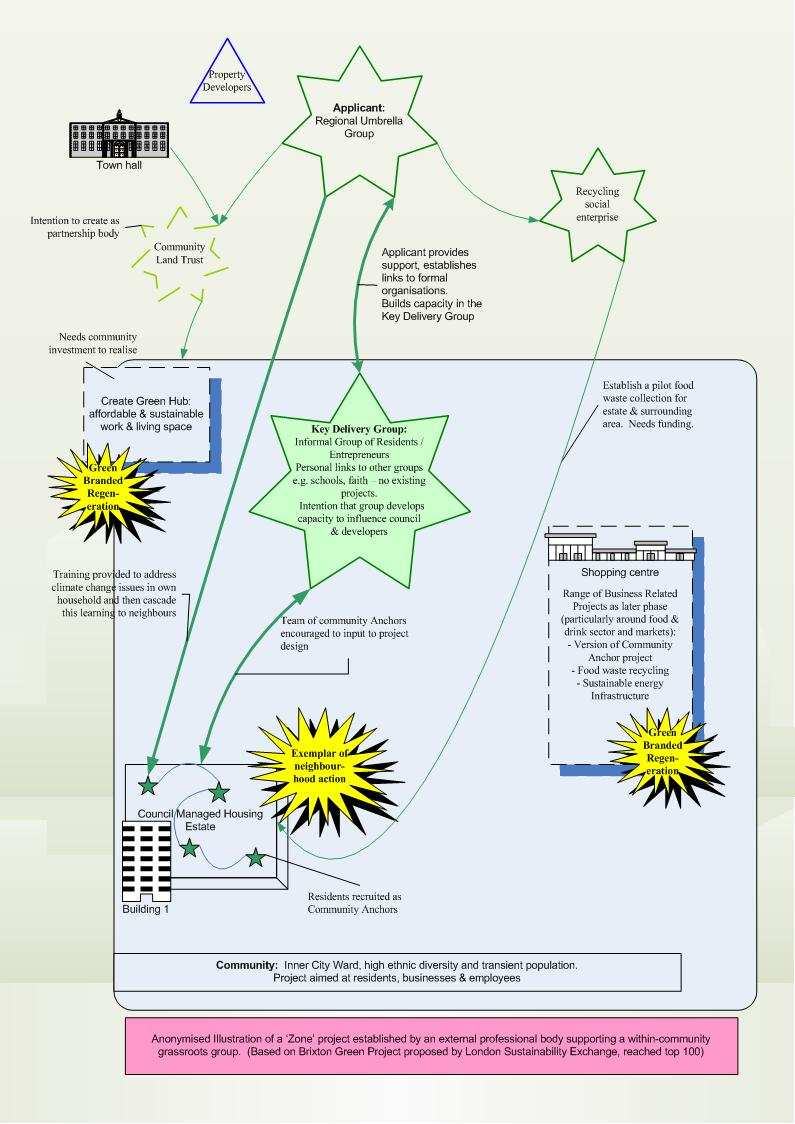
Community: Inner City Ward, high ethnic diversity and transient population. Project aimed at residents, businesses & employees
Anonymised Illustration of a 'Zone' project established by an external professional body supporting a within-community grassroots group. (Based on Brixton Green Project proposed by London Sustainability Exchange, reached top 100)
7.6 Low Carbon Public Buildings
A building that has meaning for its community
35 proposals
- Carbon reduction in one or more buildings that are important within their community setting either
- because they have intrinsic historic or cultural significance, or
- because of the way in which they are used by the public
Eleven per cent of all proposals (35 applications) fall into this Proposal Type. They focus on carbon reduction and energy use in one or more buildings that are important within their community setting, either because they have intrinsic historic or cultural significance, or because of the way in which they are used by the public.
This definition has been stretched a little to include one ship, and some that also include a wider site such as a country park.
Chart 72 – Low Carbon Buildings, proportion of functional and special buildings, 35 proposals
The breakdown between these types is shown in the chart. These two types of buildings have some clear distinctions in terms of forms of engagement that are likely to be undertaken. However the common focus on the structure of one or more public buildings was felt to override this.
Diagram showing a pie chart with two segments: "Special Public Buildings 40%" and "Functional Public Buildings 60%".
Public buildings are important features of community life both in terms of places to meet and may (particularly in the case of smaller buildings like village halls) be run by prominent individuals or groups in the community. But they are also important as signifiers of place – particularly when they are linked to the history of their location. They may well have personal associations in relation to parties, family activities, places where one became involved with other members of the community. In the case of a grander building it may have a prominence outside its immediate community for visitors to the area.
Changes in such buildings are likely to be noticed by their regular users who can easily be informed about them. Since they are public places they also afford the opportunity to exchange experiences about their relevance to one's own life. Innovative changes in significant buildings may also be a source of pride within the community. All these dimensions may well lead community action on climate change centred on public buildings to have much wider significance than it would at first appear to warrant.
7.6.1 Climate Change Goals
Given that the focus of this proposal type is on a building it is not surprising that they all have an element of Product which was based on changes or additions to the physical structure or contents of the building. Most did also have a practice element but 13 proposals (37%) did not involve significant behavioural change goals.
The Special Buildings category includes installing hydro electric power in a historic mill, converting a historic ship to be a combined heritage centre/sustainability showcase, restoring a historic old school building, renovating a seaside pier, and providing a new purpose for an old cutlery factory. In the more general category there are churches and community halls, clubrooms and schools. The category includes both renovations of existing buildings, and new buildings constructed using eco-building principles, and incorporates water saving and re-use measures, as well as reductions in energy use.
All but one of the proposals include the reduction of energy use in the building (the exception being a more focused proposal to introduce a grey water scheme to a major public building). Some extend their project to cover residential buildings in their local area, either using the public building as an example of how reductions can be achieved, or by the use of the building as an advice centre (or in many cases, both of these). Four of the projects put the advice centre aspect at the centre of the proposal, either building from scratch or converting an existing building for this purpose.
Chart 73 - Low Carbon Buildings, proportion of proposals involving practice (behaviour change) and product-only, 35 proposals
Pie chart with two segments: "Practice Product 63%" and "Product 37%".
Many incorporate transport reductions, either because they are providing a local resource that will minimise the need for transport (shops, services, or just a social centre), or as part of their overall strategy by converting related vehicle fleets to electric vehicles, or by providing eco-friendly transport for their visitors (such as the historic ship conversion project which incorporates a river ferry to provide transport for visitors between the ship and the town centre).
Chart 74 - Low Carbon Buildings, feasibility, 34 proposals
Pie chart with three segments: "Future 29%", "Current 24%", and "Near term 47%".
There are projects that stay within the carbon regime, but there is a majority of niche projects that incorporate renewable energy sources and biofuels. This proposal type has the second highest proportion of niche only proposals (second only to the inventions) and was the highest combined niche and niche / regime proposals of all the types. This is a very interesting finding in relation to buildings that are often regarded as mundane and in relation to projects that may be seen as only being on a small scale with limited impact.
Most of proposals are systemic and by definition at the level of the building or buildings that are the subjects of the Idea. There is one whose main impact has been judged to be systemic at the ‘household' level planned to result from the demonstration of efficiency measures in the community building. That does illustrate one of the characteristics of this proposal type: while the focus is on the building primarily there is a significant secondary target of emission reduction by people in the surrounding community as a result of the demonstration effect. The degree to which this is articulated varies, from very weak to a very strong part of the application.
The functional building projects all want to add carbon reduction features to an existing building or to build a new centre. Some are very specific (an offsetting scheme to add photovoltaic cells to school roofs throughout the area), others more general involving a range of equipment (from basic insulation measures to more ambitious renewable schemes incorporating photovoltaic, wind and biomass combined with heat pumps.)
There is more variety in the Special Buildings projects, from small scout huts to large eco-buildings, and major conversions of historic and iconic sites. These special buildings include:
- Estates: A country park in Northern Ireland and an Estate in Scotland
- A ship
- An old corn mill, aiming to demonstrate hydro electric power can be generated from its feed water
- A scout hut (an eco-hut!)
- Two historic school buildings
- A derelict factory (former cutlery factory)
- A historic pier in a Victorian resort town
- A major public building in the heart of London
These are not just building renovation projects. They aim to show what is possible at a local level. For example, the corn mill (Heron Corn Mill Hydro Project, 247) has a strong mission to demonstrate the historical importance of water power to the community. This also has an interesting community engagement strategy based on social and artistic activities which integrated with new technology installed.
The ship is to be located in Belfast's old ship building port (Lagan Legacy Green Ship Maritime Heritage Centre, 224). Again the historic link is not seen as an obstacle to thinking about the future but rather an intrinsic part of it.
7.6.2 Challenger Group Types
The high proportion of 'not primarily environment' groups is a result of many Challengers being the owners or tenants of the buildings, and it does seem that the primary motive of many is to renovate the building, rather than reduce carbon emissions per se. This is reflected in the formality profile: 71% are registered charities.
Chart 75 - Buildings, challenger group formality, 35 proposals
Pie chart showing challenger group formality with segments: "Unconstituted group 9%", "Registered company 9%", "Constituted group 11%", and "Charity 71%".
Chart 76 - Buildings, challenger group focus, 34 proposals
Pie chart showing challenger group focus with segments: "New group formed for BGC 3%", "Specific energy focus 12%", "Environmental sustainability focus 9%", "Other environmental 6%", and "Not primarily environment 70%".
There are some proposals from external organisations that are targeting community buildings in general within their area: a Rural Community Council, for example, with a scheme to install measures at important buildings in village within their area, and a development charity with a similar aim in a deprived rural area.
7.6.3 Project Processes
7.6.3.1 Behaviour Change
As this proposal category has a higher proportion of Product only projects, it is important to remember that the behavioural measures are applied to the subset of projects with an element of behavioural change, about 3% of the proposals (22). Overall, these were higher on Understanding and Action, with less emphasis on Values, despite the opportunities offered by an important physical resource.
Chart 77 - Modes of behavioural change (action, understanding, values) Low Carbon Public Buildings compared with the average across all proposals
Bar chart comparing "All Practice (250 Proposals)" and "Low Carbon Public Buildings (22 Proposals)" across "Action", "Understanding", and "Values" categories.
Bar chart showing two bars for each category (Action, Understanding, Values). For Action, the first bar is 82% and the second is 73%. For Understanding, the first bar is 72% and the second is 75%. For Values, the first bar is 58% and the second is 38%.
Chart 78 - Modes of behavioural change (Four E's), Low Carbon Public Buildings compared with the average across all proposals (practice proposals only)
Bar chart comparing "All Proposals (250)" and "Buildings (22 Proposals)" across various "Four E's" categories: Enable - provide information, Enable - provide materials/infrastructure, Enable - provide skills, Encourage - positive incentives, Encourage - negative motivators, Engage - community actions, Engage - forums, Engage - media campaigns/opinion formers, Engage - networks, Engage - personal contact, Exemplify.
Bar chart showing two bars for each of the "Four E's" categories, with values ranging from 0% to 100%.
7.6.3.2 Openness and Relationships
In the Four E's categories, these building focus projects are much higher than average on exemplification (using the building as a model for the surrounding community is a recurring theme), and low on Encourage. The higher than average Information Provision measure reflects the number of proposals intending to use their buildings as place where people could get advice on carbon reduction. This was a central measure in four proposals, and a subsidiary measures in others, giving a purpose for the building over and above its original or main function (and providing a reason to fund what could be a straight forward renovation project).
Common Strategies
- Fitting out buildings as exemplars: demonstrating how energy reduction measures can be installed in homes
- Supplementing the demonstration with advice and information
- Measuring and reporting on the result
- Heritage, culture and history of iconic buildings: civic pride
- Niche measures and new techniques
- Providing local resources and services: reducing the need to travel
- Community centres as a focus for networking and social bonding
There does not seem to be any direct relationship between the openness of the proposal and the focus of the proposal on buildings. It would be interesting to discover if there is a contrast between the proposals submitted by owners of the building, and proposals from external professionals, in relation to openness (and other criteria) but with only six external applicants, the numbers are too small to enable any conclusions to be drawn. There is, however, a case for concluding that the proposed projects around these physical structures are well embedded in their geographical communities – the Challenger groups are far more likely to have an existing relationship with their target audience than the average over all proposals (79% compared with 53%). This allowed Challengers to reflect on the role of the building within the community in explaining the impact of the project.
Chart 79 - Established compared with speculative target audiences, Low Carbon Buildings compared with average over all proposals
Bar chart comparing "All Proposals (289)" and "Low Carbon Public Buildings (29 Proposals)" for "Established" and "Speculative" target audiences.
Bar chart showing two bars for each category (All Proposals, Low Carbon Public Buildings). For All Proposals, Established is 52% and Speculative is 47%. For Low Carbon Public Buildings, Established is 72% and Speculative is 28%.
7.6.3.3 Sustaining and Transferring
The majority of these proposals are discrete projects to refurbish or build one or more specific buildings, with the additional features of providing a community resource or providing an exemplar for others to follow. There is, consequently, little attention given to how the central idea can be taken up by others. In the externally driven proposals, such as that of a Rural Community Council to work with village activists in a number of locations (Community Catalysts, 183), the approach is to develop a toolkit and methodology that can be used by other villages, and the intention is to continue to promote the conversion of community buildings in other rural settlements after the initial pilot. In most other cases, and in all Special Building cases, the development of the identified building is the end point of the proposal. Where an advice centre or other community resource has been created, it is most often the implied intention of the Challenger group to continue to manage the resource, or to develop it as a self-sustaining social enterprise, but often this is not discussed in the application. In the majority of cases it seems that the Challengers are expecting the existence of the building to be sufficient to continue to have an impact after the project is ended. There are very few suggestions for a directed diffusion of the innovation, in common with other geographical community projects - the profile is very similar to Carbon Reduced Zones and Projects.
Chart 80 - Low Carbon Public Buildings, mode of transferability, 34 proposals
Pie chart showing modes of transferability with segments: "Undirected 79%", "Directed 18%", and "Growth 3%".
These are six examples of Challengers proposing a form of directed diffusion. All six are part of strong national or regional networks: two Community Associations, a Rural Community Council, a Transition Town, a church and a Community Development Trust. For example:
- Puff (128): A Community Association, with a proposal to install renewable energy equipment in their village hall, then extending this to provide power for the school and whole village. Included in the project is provision of information to managers of other similar stone buildings, with advice on retrofitting them with renewable energy systems (both web based and at the resource centre) based on actual energy readings from the project. They make provision for diffusion of their project to other communities through a development trust.
7.6.4 Examples to Illustrate Different Approaches
In looking at the range of behavioural change mechanisms, we have excluded the proposals labelled as Product only, leaving 22 with an intended aim of behavioural change. Even with the product only category removed, this Proposal type does not come out overall as well as some other types in terms of behaviour change. In particular, the Values element is not engaged by many despite the opportunities to use the iconic value of the building, which some of the Ideas do very well. Similarly some proposals embraced the need for community engagement much more effectively and imaginatively than others.
- Llanidloes Energy Solutions (728) have a proposal to renovate a number of community buildings which is centrally linked both to wider regeneration via appeals to the town's historic status and to widening the climate change mitigation impact by making links to emissions from the wider community.
7.6.5 Overview
- Small Prints (138) is a proposal to Implement a series of identified measures at 7 community facilities, in a deprived area in Northern Ireland. They intend to measure the carbon reductions achieved and use this as evidence to persuade other community organisations and then individuals to consider their carbon footprints. This is targeted at a deprived community where climate change and environmental concerns are said to be not high on the agenda.
Proposals of this type were most likely to be submitted by the owners or occupiers of the buildings and as such there were few with a pre-existing energy or sustainability focus and few informal groups. There was a product and energy focus to the proposals but with high niche content. This mainly consisted of renewable energy sources. They had strong ties with their local community but did not always exploit these to achieve wider reach for their ideas. The focus tended to be on fitting out buildings according to eco-principles and then letting visitors know about it but their role as demonstration projects (Defra's exemplifying approach) was distinctive and included utilising the extent to which they were valued by their communities.
7.7 Low Carbon Enterprises
Not-for-profit social enterprises
46 proposals
- A product or service to sell
- Strong focus on the business model and the core product, as well as the social benefit
- 'Commercial' element of the proposal, i.e. people will pay for the product or service
Fourteen per cent of all proposals (46 applications) fall into this Proposal Type. These are social enterprises where a central part of the proposal was creating a core business. Very many of the Challengers described themselves as social enterprises when ask on the application form to identify their organisational form. However the defining characteristic here is not that designation but the type of activity they were proposing. The common feature is a commitment to climate change and environmental sustainability as well as the success of their product, and in some cases there is also an interest in community development and the provision of local employment.
The enterprise model has only relatively recently become central to community sector approaches. It has been promoted both by current government policy and by the public sector more broadly as a basis for establishing partnerships that include the delivery of services by community sector organisations. It has also been a response to the problems of grant regimes and the desire to establish some more secure foundation for continuing activities. Some charities have long had a trading arm whose profits could supplement their charitable activities but this model rather refers to an enterprise which is both economically viable and directly fulfilling a social purpose and yet also be used to invest in or cross subsidise other community activities
7.7.1 Climate Change Goals
The proposals have been sub-divided by the type of business as there are similarities between the carbon reduction goals of businesses offering the same type of product.
| Enterprise type |
No. of proposals |
Detail |
| Energy supply |
10 |
3 wind, 3 water, 2 biomass and 2 mixed |
| Waste collection and disposal |
8 |
3 general waste collection, 3 food waste for biofuels, 2 using waste wood for fuels |
| Re-use and recycling |
7 |
Specific: computers, electrical equipment, furniture (2), building materials. 2 general |
| Food - growing and retail |
6 |
Shops, restaurants, and 2 farms growing & selling food |
| Building & construction |
2 |
Both building eco-homes |
| Consultancy services |
2 |
Both advice services for SMEs |
| Offsetting scheme services |
2 |
|
| Transport - cycling |
2 |
Training, bike rental |
| Other (various one-off proposals) |
7 |
Including nappy laundering, low carbon travel, woodland burials |
For the purposes of this analysis a social enterprise is defined as an organisation or group with primarily social objectives, funded mainly by trade rather than donations and grants, and which reinvests any profits in the business or in furthering its social aims.
All the proposals in this category, by definition, have a product or service element since this is what forms the basis of their carbon reduction goal. Over half also incorporate an element of behavioural change (practice), for example by encouraging and enabling recycling or linking energy supply to a wider carbon reduction message.
Chart 81 - Low Carbon Enterprises, proportion of proposals involving practice (behaviour change) and product-only, 46 proposals
Pie chart with two segments: "Product 46%" and "Practice Product 54%".
The goals are much more focussed than most other categories, reflecting the core business proposal, with a less varied set of carbon reduction measures. These goals are predictable from the type of business, and so are not detailed here. Energy supply enterprises aim to reduce carbon emissions from residential and non-residential energy use, cycling services (training and bike loan) aim to change behaviours to reduce car use, and so on.
Where they are systemic it is still within the context of a single business idea. Low Carbon Gap Years (641), for example, considers reduction measures running through the travel experience: transport, accommodation, and activities; here the level is the individual. Other Ideas have more vertical measures, considering the emissions of their suppliers and their customers as well as their own business processes. (To a certain degree all these Ideas are potentially systemic over the supply chain but this is not generally articulated in the application)
There is an even split between Ideas staying within the carbon regime, and those moving out to niche areas, but again this is mostly dependent on the type of enterprise: energy supply is, obviously, based around renewable sources. Wider discussions about niche products suggest they are likely to find it difficult to launch commercially within the dominant regime. The discussion in Section 2.3 suggested that one role that community innovators might play was to support niche innovations. However the advantages suggested there were based on protection from the normal commercial competition and this condition may be at best only partially satisfied in a social enterprise.
7.7.2 Challenger Group Types
Over half (55%) are already established social enterprises (some with charitable status), either expanding their product or introducing a new one. Of the rest, 20% are informal groups with no existing constitution hoping to set up an enterprise, and the rest are mostly charities not currently set up as social enterprises, with only 4% active constituted community groups (compared with 18% over all proposals - presumably because these very informal groups are already committed to community action and campaigns rather than entrepreneurial approaches).
Chart 82 - Low Carbon Enterprises, challenger group formality, 46 proposals
Pie chart showing challenger group formality with segments: "Unconstituted group 20%", "Charity 35%", "Registered company 41%", and "Constituted group 4%".
As might be expected entrepreneurial groups are more likely to be independent rather than associated with a parent or a network of organisations (81% compared with 64% of all proposals) and more likely to have grown from within the community, rather than being the idea of an external or supporting organisation.
7.7.3 Project Processes
7.7.3.1 Behaviour Change
This category of Ideas are focussed on providing a product or service, so not are not surprisingly less likely to consider behavioural change measures. However, they were a feature in over half (25 of the 46) of the proposals. There is a stress on changing behaviour via actions or experience but other approaches were also included in some applications. Of course, those offering a consultancy or advice service as their business model are all offering a mechanism for behavioural change and this sub-group are responsible for increasing the proportion of proposals taking an Understanding focussed approach. The cycling groups were also offering a mechanism to encourage lifestyle change, although these tended to focus on leisure cycling rather than a replacement mode of transport.
Common Strategies
- Providing training and qualifications, including NVQS
- Cooperative buying and working
- Using profits to fund other activities: bog land restoration, training for disadvantaged, home eco-refurbishments...
- Using available local resources: local waste as biofuel, canals for transporting bulk materials, energy from wind and water, food from the land, insulation from sheep's wool; waste products
- Providing work and work experience for disadvantaged groups
- Paid workers as well as volunteers
Again just looking at the 54% of Ideas in this category that incorporate practice as well as product, the mix is more towards Enabling measures (providing infrastructure and the means for their customers to change their practices). All 25 included this element - above average for all proposals. In the other 'E' categories these proposals were below average, and only 7 proposals had three of the E measures (none incorporated all four). Comparison charts for the sample as a whole can be found in the Appendix to this report.
7.7.3.2 Openness and Relationships
This category has much in common with the Local Projects category; each proposal having a clear focus on a small number of carbon reduction goals, in contrast to the Zones, and Youth categories, where a range of goals are covered and the emphasis is on behavioural change. While proposals in the Public Buildings category focus on reducing carbon in non-residential buildings, the Projects and Enterprises categories have a more diverse set of goals within each category as a whole. It might be expected, therefore, that there will be some similarity in the processes in these two categories, with the differences arising from the types of challengers and the importance of trading outcomes to the success of the enterprise schemes. This is the case looking at the Openness of the proposals, where the data reflects the tendency for more focussed groups, whether running projects or running a social enterprise, to be more closed and less likely to be working with others.
Chart 83 - Openness, comparing proposal types, Zones, Local Projects, Youth Schemes, Buildings and Enterprises
A stacked bar chart comparing openness across Low Carbon Zones, Low Carbon Projects, Low Carbon Youth Schemes, Low Carbon Public Buildings, and Low Carbon Enterprises. Categories of openness are "No external input", "Limited input", "Significant input", and "Dispersed, on-going".
Stacked bar chart illustrating percentages of different openness levels for various project types. The legend indicates:
- No external input (darkest segment)
- Limited input (medium segment)
- Significant input (lighter segment)
- Dispersed, on-going (lightest segment)
One additional aspect that affected openness was the need for technical help with their proposal, resulting in a more open project. This was evident with the more highly technical energy supply companies, than with the low tech businesses of food growing and retail, but the numbers are so small that it is difficult to draw any further conclusions from a comparison of the business types.
Whether these Challengers had an existing relationship with their target audience depends on whether they were growing an existing service (extending their customer base), or starting a new service. Some were offering additional services to existing customers and this was seen by the applicants as a marketing advantage. There is, however, a greater proportion of speculative audience than in other categories – that is the nature of business.
Chart 84 - Comparing established and speculative target audiences, by proposal types
Bar chart comparing "Established" and "Speculative" target audiences across "All Proposals (289)", "Low Carbon Zones (39 Proposals)", "Low Carbon Projects (43 Proposals)", "Low Carbon Youth Schemes (38 Proposals)", "Low Carbon Public Buildings (29 Proposals)", and "Low Carbon Enterprises (42 Proposals)".
Bar chart showing two bars for each proposal type. "Established" audience is represented by a darker bar and "Speculative" by a lighter bar. The chart shows varying proportions of established vs. speculative audiences across different proposal categories.
There were very few (but some) indirect and weak audience relationship models – this profile is again very similar to the Projects profile, and the two proposal types have a lot in common in this respect.
7.7.3.3 Sustaining and Transferring
As enterprises there is a clear sustainability intention stated in the applications in this category. Where there is a product or service to sell, the business will continue to ensure the carbon reductions are maintained, and where there is behavioural change intended in their customers, they expect their customers to maintain this change but will be available for further support if required. However where Challengers are trying to move their activity from a grant funded context to an enterprise model there is a question over whether they will be able to establish the financial basis to allow them to continue to deliver the service.
Mode of Transferability is an aspect where the Enterprises differ greatly from the Projects. While these two categories have some comparable processes during the project, at the end of the project the social enterprises are far more likely to expect to keep going themselves, the business being sustained (more or less) by the income it is generating, which is, after all, the point of a social enterprise. What is more surprising is the number of 'undirected' in this category. These do not particularly correlate to the type of activity. There is some correlation to the type of group - generally the existing social enterprises have apparently thought this through more and see it as a way of growing their business, but the newer, informal groups hoping to set up a social enterprise are less likely to have considered what happens when the project ends. In all cases, the tag of 'undirected' refers to the group's lack of a clear alternative strategy for expanding their proposal or passing it on to others. It should be noted that this is not solely a problem for the community sector. Many accounts of commercial SMEs tell a similar story.
Chart 85 - Comparing target audience relationship models, Enterprises and Local Projects
Bar chart comparing "Low Carbon Enterprises", "Low Carbon Projects: Professionally Led", and "Low Carbon Projects: Grassroots" across various target audience relationship models: Direct, Strong; Direct, Medium; Direct, Weak; Mediated.
Stacked bar chart showing target audience relationship models for different project types. The legend indicates:
- Direct, Strong (darkest segment)
- Direct, Medium (medium-dark segment)
- Direct, Weak (medium-light segment)
- Mediated (lightest segment)
Chart 86 - Enterprises, modes of transferability, 45 proposals
Pie chart showing modes of transferability with segments: "Undirected 33%", "Directed 34%", "Takeover 2%", and "Growth 31%".
The 'Directed' diffusion Ideas are projects where a business has been set up and used as an exemplar for others to follow. An example is Power from the Landscape (201). They proposed creating a community energy company, generating local hydro-electric power from an old water mill, but their main aim was to allow other mill-owners to follow this example rather than focussing on sustaining the social enterprise (although they probably intended to do both).
7.7.4 Examples to Illustrate Different Approaches
Much of this analysis illustrates the difference between focussed projects, whether in the context of a business model, a voluntary community effort or a grant funded 'professional' organisation such as an energy advice agency. In general there is more singularity, less openness, more product and less behavioural change, but there are plenty of exceptions to this general rule
It is very difficult to highlight different business models or at funding models at this level since applicants were not asked to comment on either directly at this stage (there is more information for those that reached Round 2 of the Challenge). Indeed it requires a level of interpretation to determine whether an enterprise model is actually intended in some cases and certainly to reach any conclusion about whether it was a viable one. For this reason we are not highlighting this aspect of these proposals. The link between this Proposal type and some of the Projects type has been highlighted. It may well be that some proposals would move (in both directions) across this divide over time depending on funding regimes and market factors.
Instead we highlight some interesting examples that go further than most to integrate their social and environmental goals within an enterprise model:
- One of the energy supply wind farm projects (Grass Roots Renewables, 355) intends to use the commercial profit from the wind farm to promote other renewable-energy projects, biodiversity and community development, with the wider aim of developing sustainable rural communities. This project extends to peat land restoration, increasing woodland cover, and promoting eco-tourism as a means of sustaining the area economically as well as environmentally.
- Three Green Valleys (390) has a similar model, using the profits from hydro electric power, generated by the fast flowing local rivers, to protect and restore upland peat bogs and valley forests (carbon sinks, adding a second dimension to the carbon reduction), and to encourage market gardens and community growing schemes to provide local food.
- Used Cooking Oil Alliance (653), proposing the conversion of waste from prison kitchens into transport biofuels, incorporates training courses and qualifications for its workforce in the prisons, providing renewable fuel for the prison service and local community, and contributing to offender training and resettlement needs.
7.7.5 Overview
The focus was on the way the proposal was intended to operate so the groups involve some charities as well as formal social enterprises. All involved a product element and nearly half were product only. They were more likely to be focused on single carbon reduction goals than the average. They included niche proposals focussed on energy supply and biofuels and more regime ones focused on recycling and food growing. As might be expected they had a clearer idea than most of how to spread their idea and often this involved a growth strategy. There was a tendency for proposals to be closed and not strongly networked but there were contrasting examples based on vertical systemic ideas over the supply chain and some higher tech examples utilised technical input to the development of their ideas.
7.8 Low Carbon Services
Finance, advice, tools, network support, training provision
34 proposals
- Offering a product or service that helps people to reduce their carbon emissions in some way, either financially, by advising, by networking with others, or by providing products that help assist behavioural changes
- Products and services are provided free of charge to the target audience
Eleven per cent of all proposals (34 applications) fall into this type. Many offer to support and promote inter-personal networking as a means of informing and engaging people with climate change issues. Some are based on physical meetings but the majority use internet facilities and web sites. Others propose to deliver training programmes, set up an advice service, or support other organisations with practical help or funding. Many are proposed by social enterprises, but the applications here differ from those in the previous type in that they are seeking funding to provide the service as part of their social aims, rather than to start or grow the business. In some cases the proposal combines more than one service – e.g. most of the web network proposals see this as a medium for distributing advice. The figures above show the breakdown in relation to the primary service offered.
| Service type |
No. of Proposals |
| Training |
3 |
| Finance |
3 |
| Advice |
7 |
| Product |
3 |
| Physical network |
6 |
| Web network |
12 |
Providing services is a well established community sector activity taking a variety of forms from the well established formal charities to the more local and informal approaches. In its more traditional forms it might be seen as not having high levels of community engagement in that in terms of assuming knowledge of the needs of the community and how to deliver them. All this seems very far away from the provision of say a Web 2.0 based network on low carbon living.
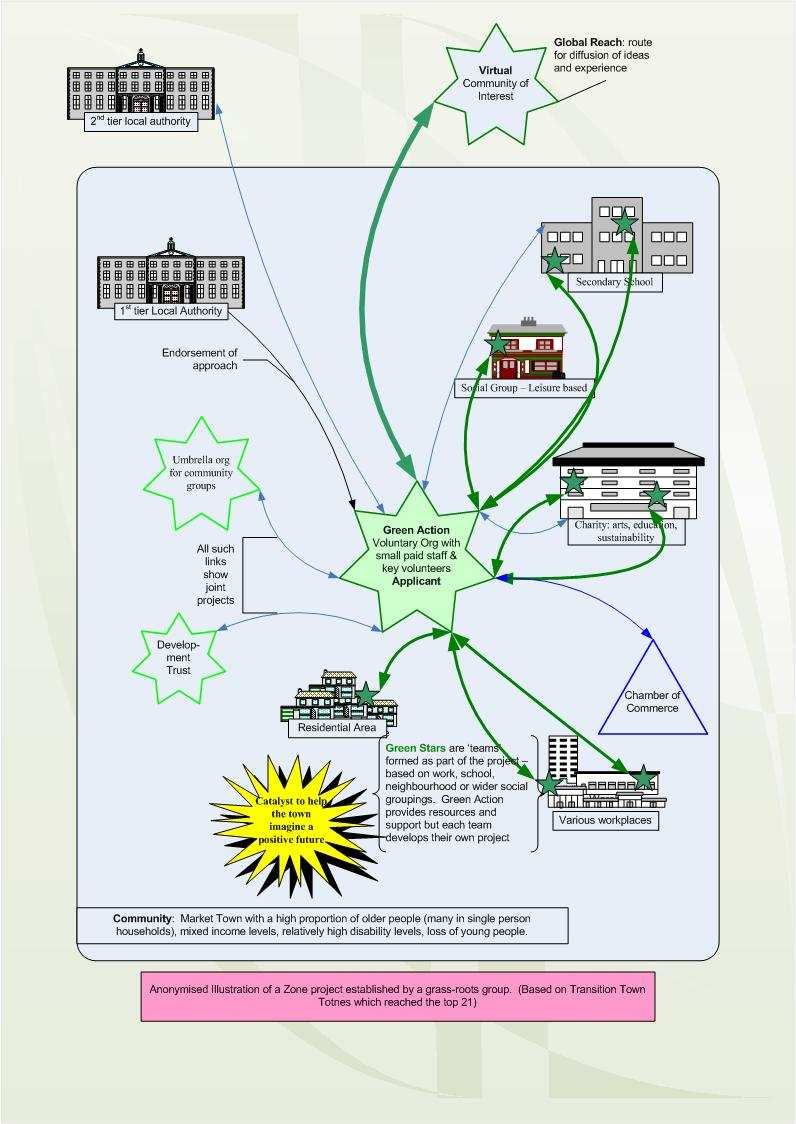
7.8.1 Climate Change Goals
These proposals are all primarily about supporting changes in behaviour, so many were not specific about which range of carbon reduction measures they were aiming to address. 20 of the proposals fell into this category. Of the remaining 14, the majority focussed on two specific areas: energy use (either residential or non-residential depending on their target audience) and transport (reducing car use). There were none focused specifically on waste or recycling. Only one tackled multiple measures: a Rural Community Council offering support for a range of activities including community shops and community energy projects (The Rural Community Carbon Network, 485).
Chart 87 - Low Carbon Services, proportion of proposals involving practice (behaviour change) and product-only, 34 proposals
Pie chart with two segments: "Product Practice 62%" and "Practice 38%".
One related to aviation (One World UK, 750) offering, a networking service to replace international travel with a form of video conferencing and one to food (Buy Local, 713) a web based application for calculating the carbon emissions associated with food purchases).
7.8 Low Carbon Services
7.8.2 Challenger Group Types
These projects are not in the vanguard of climate change technologies – they are providing help and support for mostly regime measures (the highest proportion of any proposal type) with just a small amount relating to renewable energy. The general awareness raising may, of course, also extend to awareness of renewable resources, but they have not been coded on this unless the applicants specifically mentioned other measures. So overall it would appear that the intention is promote a within regime approach to climate change mitigation.
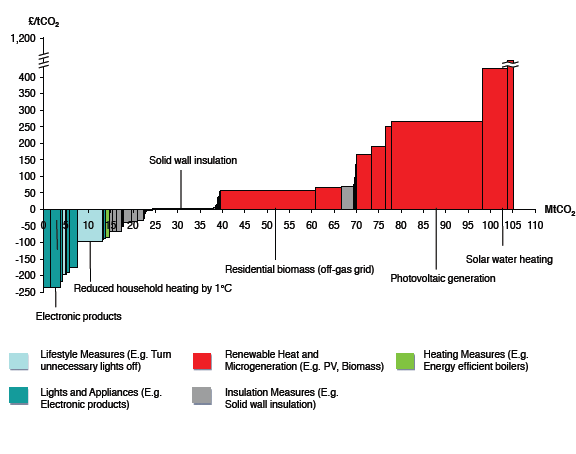
Chart 88 – Services, regime / niche profile, 34 proposals
- Both: 15%
- Niche: 9%
- Regime: 76%
Many of the proposals from Energy Agencies and nationally funded bodies appear in this section, as these are the organisations with the expertise to offer as a service to communities. There are four Energy Advice Centres and three Community Councils.
The majority of Challengers (79%) are registered companies or charities. The informal groups were all offering networking services.
Many of these are capacity raising initiatives, offering to support other voluntary and community organisations (7 applicants specifically mention assisting other established community groups or social enterprises).
Chart 90 – Services, challenger group formality, 33 proposals
- Unconstituted group: 21%
- Registered company: 30%
- Charity: 49%
7.8.3 Project Processes
7.8.3.1 Behaviour Change
These services are primarily about supporting change either in groups (Voluntary and Community groups including informal grassroots organisations, social enterprises and SMEs) or by individuals. The profile of the proportion of behavioural change mechanisms (Action, Understanding, Values) is close to the average across all Proposal categories, with the number of behavioural change mechanisms varying with the type of service and how it is being offered. Training, for example, would be expected to focus on Understanding. Where an Idea offering advice has not been coded as Understanding it is providing information only, and not (at least in the application) providing a mechanism for developing understanding of the information.
The profile is in keeping with previous findings: experienced organisations tend to be associated with a broader range of behavioural measures, whereas a more focussed project tends to incorporate a narrower range.
Common Strategies
- Training courses
- Using the web & developing web tools; wikis, social networking, second life, carbon measuring, data collection and aggregation
- Supporting other organisations; providing the expertise
- Communication; meetings, conferences, CRAGs and Carbon Cafes, web forums
- Support tools: bike loans, energy measuring devices
- Helping to find funding; credit loan schemes, local offsetting
Chart 91 - Combinations of behavioural change approaches (action, understanding, values), Zones, Local Projects, Schemes and Services
|
AUV |
AUV |
AUV |
AUV |
AUV |
AUV |
| Low Carbon Zones |
27 |
10 |
12 |
2 |
2 |
|
| Low Carbon Projects |
9 |
8 |
9 |
1 |
9 |
1 |
| Low Carbon Youth Schemes |
22 |
8 |
3 |
2 |
2 |
|
| Low Carbon Services |
13 |
8 |
3 |
1 |
5 |
4 |
Legend:
* ■ Action Understanding Values
* ■ Action Understanding
* ■ Action Values
* ■ Understanding Values
* ■ Action only
* ■ Understanding only
Excludes 'Product Only' proposals
7.8.3.2 Openness and Relationships
There is a tendency for greater openness with these proposals, in contrast to the other focussed proposal types Enterprises and Projects. This is enhanced by the inclusion of proposals offering network services which are, by their nature, more open to involving others. If these networking services are removed, the profile is much closer to that of the Low Carbon Enterprises.
Chart 92 - Openness, comparison of proposal types
|
No external input |
Limited input |
Significant Input |
Dispersed, on-going |
| Low Carbon Services |
3 |
9 |
16 |
6 |
| Low Carbon Zones |
14 |
24 |
5 |
|
| Low Carbon Youth Schemes |
17 |
19 |
2 |
|
| Low Carbon Public Buildings |
6 |
10 |
11 |
8 |
| Low Carbon Enterprises |
8 |
17 |
17 |
4 |
| Low Carbon Projects |
5 |
24 |
16 |
2 |
Service proposals are quite likely to be using an indirect audience relationship model. Around half of them are proposing to deliver the behavioural changes by the use of intermediaries such as community action groups (again reflecting the nature of the Professionally Led approach). The relationships with their target audiences are likely to be speculative – like Enterprises they must first attract their 'customers'.
7.8.3.3 Sustaining and Transferring
These service providers are also more likely than average to have considered their future intentions, although not necessarily how these will be funded. The majority are either proposing a directed diffusion (the intermediary groups carrying the service on by themselves, particularly in the case of networks) or the service will stay with the company and become part of their offering.
Chart 93 - Low Carbon Services, mode of transferability compared with group formality
|
Directed |
Growth |
Undirected |
| Unconstituted group |
2 |
5 |
|
| Registered company |
6 |
3 |
1 |
| Charity |
6 |
8 |
2 |
One example, Community Renewable Energy (CoRE) (262) has a very clear diffusion strategy. Their aim is to support renewable de-centralised energy schemes by providing expertise and practical help, in return for which they would retain a share in the ensuing social enterprise which would, in turn, fund the establishment of more community owned renewable energy systems.
7.8.4 Examples to Illustrate Different Approaches
The difficulty with offering a service is getting people to take it up. The weakest proposals in this category have not given much thought about how they will attract people in the first place, and keep them engaged. Thus a service may be strong on enabling measures but these will not be effective if they have not engaged anyone. This can be a problem for web sites, training provision and advice services.
Some examples illustrate the way some Services had identified ways of addressing both initial and ongoing engagement with their proposed service:
- Social identity: One online community intends to promote contract and converge schemes, linking people of central Asian ethnic origin with projects in Asian communities (Desi Climate Network, 693). This proposal had a strong cultural dimension and emphasised this as a shared bond and a reason for acting.
- Competition: turning the carbon measurement web tools into competitions to see who can save most. Carbonbook (259): This is a proposal for a web network that aims to overcome the problem of attracting people to the site by using networks of existing web-friends, leveraging the advantage of existing stronger ties. Groups of friends then compete against each other utilising suggestions, collecting and comparing carbon measurements, leading to league tables and awards.
- Peer Support: Carbon Rationing Action Groups (CRAGs) (274): This is a proposal for face to face networking, and emphasises the strength of working together as a motivational tool, but also utilises competition (between individuals and groups), feedback (by measuring carbon emissions) and, very strongly, peer pressure. Each CRAG is autonomous and sets its own agenda for carbon reduction goals, but is affiliated to the wider CRAG network, where the system of credit rations is administered and monitored (using web tools). CRAG groups overdrawn as a unit are expected to donate the money to a charitable cause.
- Community Action: Meadows Ozone Green Loans (176) is providing funding for energy saving measures in homes, via a credit loan scheme. This is a particularly open partnership proposal working with local groups and a credit union, all contributing a mix of expertise, contacts, funding and financing. They are engaging the target audience through action – joining the scheme and using the funding to improve their homes - but this is backed up with wider information and encouragement in the form of rewards for regular payments into the scheme (Christmas cash back payments).
7.8.5 Overview
There were two distinct types of groups here. Those offering conventional finance, advice, support or training tended to be professional organisations (including regional energy agencies). In contrast there was a different type of group offering network services. They tended to be informal unconstituted groups. The latter often use web-based methods involving social networking. These were very open, whereas the others were more the norm for all proposals. Proposals were mainly regime based and focussed on home energy and transport.
7.9 Low Carbon Connections
Target audience defined by common interest
25 proposals
- Working with a specific sector or common interest group rather than a geographically bound community (although some are also located within a single village, town or work space)
This was one of the smaller Proposal types accounting for only 8% of applications (25). This is a diverse set of applications, grouped by a community based on some form of shared interest (as opposed to the geographical community). The communities involved include farmers, academics and festival-goers / organisers. (Obviously the extend to which / ways in which these groups see themselves as, or are constituted as having common interests is uncertain). A sub-set of nine projects set at the work places of the applicants is included in the 25. These are all from charities aiming to employ carbon reduction methods to their own organisations. The broad types of interests involved are shown in the table below.
| Community Group |
No of Proposals |
| Work (staff) |
9 |
| Universities |
4 |
| Industry specific |
4 |
| Designers |
3 |
| Festivals |
2 |
| Farmers |
2 |
| Other |
1 |
|
|
|
Two aimed at students, two at academics |
|
Music, Event management, Clothing, Construction |
|
|
|
|
|
Owners of old water mills |
In traditional community terms we might include here hobby or special interest groups, pressure groups, trade unions and professional associations. Such groups may organise locally, nationally or internationally with various degrees of formality. They may be powerful forums for developing and sharing expertise and providing support to their members. In some circumstances they can also be powerful campaigning or lobbying groups.
7.9.1 Climate Change Goals
The range of carbon reduction measures is similar to the average across all proposals with the exception of a greater number of measures in non-residential buildings, as a result of the number of business sector target audiences included in this category. There is a higher than average focus on practice measures over product, but within each proposal a range of measures is covered, so it is closer to the Zones category in terms of the number of carbon reduction measures.
The only distinguishing feature is the number of vertically systemic proposals, where the measures extend across a supply chain. In fact, most of these could be said to be systemic both horizontally and vertically. A typical example is Julie's Bicycle (748), which, taking the music industry as their community of interest, aims to "Pilot, evaluate, measure and roll-out a CO2 saving programme for writers, performers, DJ's, creators and their supply chains.” The festival projects include energy saving at the festivals themselves, transport to the event, food at the event and focus on awareness-raising to affect behaviours in the home also. One of the festival applications, The Big Green Pledge (541) includes a proposal for a horse and cart to provide one mode of transport. One of the two farming-related proposals, Movement for Carbon Sequestering Food (202) is a proposal to set up a national award scheme for food growers, which promotes reductions through the food production cycle: growing crops with high sequestration values, water recycling, anaerobic digestion of waste, and low emission transport. More than half of the proposals in this type are either niche only or a mixture of regime and niche. This is significant since a supply chain context is thought to be particularly supportive for the development of alternatives to current regimes.
Chart 94 – Low Carbon Connections, singular / systemic, 25 proposals
- Singular: 28%
- Systemic Vertical: 20%
- Multiple: 8%
- Systemic: 44%
Chart 95 – Low Carbon Connections, product and practice, 25 proposals
- Product Practice: 44%
- Product: 20%
- Practice: 36%
Seven projects aimed at specific industries mix general awareness-raising and systemic, lifestyle measures. The clothing industry project D2S (402) takes in delivery mechanisms, manufacture, recycling of waste materials, and consumer choice with a series of suggestions to tackle reductions in each stage, from computer programs showing the customer how they will look in the clothes they order, to feedback mechanisms based on customer measurements and requirements so manufacturers can design specifically for their customer base, reducing waste.
There are just five Product only proposals, three of which are work-based (converting buildings, equipment and transport), and the other two are for micro-generation using renewable energy sources: one in farms, the other among owners of old water mills. The rest include elements of lifestyle changes.
The group of nine applications from organisations planning internal projects (work-place based) has distinctly separate characteristics from the other proposals in this category. The target audience are staff and volunteers of the applicants themselves. They vary in the carbon reduction measures they will employ; some focus on reducing energy in their buildings (including installing renewable sources), others on their transport (considering converting their fleets to biofuels) and some propose both. They are all concerned with doing their work more efficiently, or using more climate-friendly equipment, but not in changing their patterns of transport or work. All but three include changing staff attitudes and behaviour as a significant part of their aims. One example, Power from Reed (186) from a wildlife trust, ties in their work on conserving reed beds with a proposal to use the waste reeds to fuel a biomass heating system at their headquarters, and to create briquettes with the surplus for sale to the public for use in wood burning stoves. A significant feature of this is proposal is the preservation of the reed beds themselves, conserving a carbon sequestering resource and an important wildlife habitat at the same time.
7.9.2 Challenger Group Types
There is a greater proportion of registered companies and charities in this category than over the whole data set, with just six of the applications from informal groups. Many of these were organisations from within the sector: student groups targeting students, academics aiming to implement measures within Higher Education institutions. The Challenger groups tackling specific sectors are, therefore, essentially 'grassroots' in that they have emerged from within their own community.
The exceptions are the workplace based proposals, where the Challenger organisation is aiming to change the behaviours of its own staff. (This is based on the impression that these applications have emanated from the management of these organisations, which appears to be the case but is not always explicit in the applications.) The workplace applications are all from registered charities: large organisations with over 30 staff that have been in existence for at least 10 years.
Chart 96 - Connections, challenger group formalities
|
Charity |
Registered company |
Constituted group |
Unconstituted group |
| Sectors and Groups |
2 |
7 |
9 |
3 |
| Single organisation (work-based) |
2 |
3 |
3 |
|
7.9.3 Project Processes
7.9.3.1 Behaviour Change
As regards strategies for behavioural change, present in 20 of the applications, these Connections proposals do have a better than average range of the Four 'E's (Engage, Encourage, Enable, Exemplify) and a high number combining Action, Understanding and Value measures compared with the full data set. Bearing in mind that only proposals with behavioural change as a carbon reduction goal are included in this calculation, it is perhaps surprising that this category has the highest proportion of Action/Understanding/Values combined of all the proposal categories. This is possibly related to the systemic nature of most of the proposals (the Zones are the second highest Action/Understanding/Values and these are also highly systemic). Having decided on a scheme to reduce carbon emissions in a particular sector, the Challengers aim to tackle emissions in all parts of the sector, and the different emission goals are tackled with different strategies. Taking each element of the proposal, it is less likely that all behavioural change mechanisms will be brought to bear on a single goal.
Chart 97 - Combinations of behavioural change approaches (action, understanding, values), comparing Zones, Local Projects, Youth Schemes, Services and Connections
|
AUV |
AUV |
AUV |
AUV |
AUV |
AUV |
| Low Carbon Zones |
27 |
10 |
12 |
2 |
2 |
|
| Low Carbon Projects |
9 |
8 |
9 |
1 |
9 |
1 |
| Low Carbon Youth Schemes |
22 |
8 |
3 |
2 |
2 |
|
| Low Carbon Services |
13 |
8 |
3 |
1 |
5 |
4 |
| Low Carbon Connections |
14 |
3 |
2 |
1 |
|
|
Legend:
* ■ Action Understanding Values
* ■ Action Understanding
* ■ Action Values
* ■ Understanding Values
* ■ Action only
* ■ Understanding only
Excludes 'Product Only' proposals
There was a strong 'insider' element to the approaches adopted whereby Challengers feel they know how their sector works and devise strategies on that basis. For example, students understand the challenges of living away from home for the first time, and use this as a starting point for embedding energy consciousness into the life style of their target audience of fellow students. They also know that competition between groups and including social aspects are effective techniques for this sector. Committed organic food growers understand both the supply chain and the processes involved in agriculture, so can identify opportunities for carbon reduction and the implications for the people involved. At least, this is the reasoning within the applications. There is a related matching of activities with the characteristics of the sector. Designers (the subject of three proposals) are given activities to do, academics focus on knowledge sharing (through conferences and dialogues), and students are in competition with each other.
There are many examples of alliances; people from different companies or organisations within the sector coming together to form a voluntary action committee. This also has strong niche characteristics as a way of changing the embedded practices of the current sector.
Common Strategies
- Measures along the supply chain
- Capitalising on the value of existing networks
- Putting one's own house in order: making changes at work places and within one's own circle
- Greening the industry from within
- Collaboration within a business sector; open source
- Match the method to the audience (action for activists, understanding for academics...)
7.9.3.2 Openness and Relationships
The proposals made by groups intending to work entirely with their own organisations were considered to be largely closed. Most were open with regards to working with their staff, but not with other outside organisations or individuals, with one exception. The exception is the wildlife trust, who include a strong element of engaging visitors to their sites in the work that is being done to preserve wetlands, and working with the local residents of their area, encouraging them to see their wetlands as a resource of value for people as well as wildlife. The sector proposals are generally much more open, planning to work with the many organisations and groups that fall within their sphere of interest. Here networks play an important role in the success of the proposed projects. In the majority of these proposals, the relationships with their intended audience were already in place.
Chart 98 - Openness, proposal types compared
|
No external input |
Limited input |
Significant Input |
Dispersed, on-going |
| Low Carbon Connections: Work Places |
3 |
5 |
1 |
|
| Low Carbon Connections: Sectors/Groups |
6 |
6 |
4 |
|
| All Other Proposals |
27 |
105 |
124 |
38 |
Chart 99 - State of existing relationships with target audiences, comparing Low Carbon Connections with the average of all proposals
- All Proposals (289): Established 52%, Speculative 48%
- Low Carbon Connections (24 Proposals): Established 72%, Speculative 28%
7.9.3.3 Sustaining and Transferring
These proposals are polarised more than average into changes maintained by the innovator, and the largely behavioural changes which must be maintained by the targets. In the former, the Challengers are making an assumption that they will be able to continue their role, to ensure the change is maintained. This is quite reasonable in some cases the larger charities operating on a traditional mixed funding strategy can be expected to sustain their activities – but some may not have considered an ongoing sustainability of their proposal after the project ends. It could rely on the continued commitment of a small number of individuals. (This is not to say that if the activities cease the project will not have been worthwhile, but is a common problem encountered by voluntary and community organisations which receive short term funding.) None of the proposals see the responsibility being passed to an intermediary group, which contrasts with many of the Professionally Led projects in other categories – most of these Challengers are the equivalent of Grassroots groups within the context of their target community.
Chart 100 - Maintaining the change, Low Carbon Connections compared with all other proposals
|
Innovator |
Community group |
Target Individual or group |
| All Other Proposals |
56 |
53 |
157 |
| Low Carbon Connections |
7 |
|
15 |
The mode of transferability profile is in keeping with this reasoning. The Challenger groups apparently see their activities continuing at the end of the project (but have not necessarily considered how this will be achieved).
Chart 101 - Mode of transferability, Low Carbon Connections compared with all other proposals
|
Growth |
Directed |
Takeover |
Undirected |
| Low Carbon Connections: Work Places |
2 |
7 |
|
|
| Low Carbon Connections: Sectors/Groups |
10 |
1 |
1 |
4 |
| All Other Proposals |
59 |
73 |
8 |
151 |
7.9.4 Examples to Illustrate Different Approaches
- Collaboration is a strong theme. One application, Open Design Network (368) uses the model taken from the open source software movement, to propose a web-based open source design tool – a site where designers could work together on producing low energy, low waste designs with intention spreading new design, innovations, and communications that are not economically feasible within the current business model. Other applications mention open access and the use of collaborative tools on the Internet.
- Promoting the Local Production and Consumption of Farm Energy (596): The Farm Energy Project has been set up by a farmer/environmentalist and an expert in marketing sustainability, with the aim of persuading farmers, and then helping them, to establish micro-generation on their land, using the natural resources available to them, and selling this on to the national grid. They have a clear strategy for using firstly their own contacts within their local farming community and National Farmers Union, and then the close ties within the farming community as a whole to spread the innovation. They stress a very practical, no-nonsense approach based on their expert technical knowledge and their understanding of the economics of farming, which will presumably give them credibility.
- Greener Festivals (137): This proposal aims to reduce carbon emissions caused by music festivals, both during the festival and from travel to and from the festivals, and promote awareness of green issues to the festival going public. It is a good example of a vertically and horizontally systemic idea, involving the supply chain and the customers, as well as linked horizontal changes by the festival organisers themselves. One of the few in this category to be including intermediaries (the festival organisers) to reach other targets (the suppliers and customers).
7.9.5 Overview
These proposals focus on a community of interest and as such tend to be proposed from within the community. This could include groups of professionals but also a high proportion of companies and charities. A number of the latter were proposing workplace based changes to their own organisation. Such proposals were often very closed in contrast to the open and collaborative nature of the rest. There were a high number aiming for growth strategies including those who were aiming to green their communities from within. They were high on using rich approaches to behaviour change utilising actions values and understanding in combination.
7.10 Low Carbon Inventions
- Products rather than projects
- A clearly identified product
- Proposals are in the 'idea' or 'research and development' stage
- 15 proposals
Less than 5% of proposals fell into this Proposal Type (15 applications). These are proposals which are focussed on developing a new product/technique. That is not to say that there are no new products, or products used in different ways, in other proposals in the context of a wider project. However, these Invention proposals are all about the product, and how this in itself will help to reduce carbon emissions. As such, they have a tendency to give sparse information on how they expect their product to be taken up. In fact of the proposals that were not included in this analysis because they gave insufficient information to provide a basis for coding, most would fall into this category. The proposals included in this category are those which provided enough detail and not necessarily those which are technically more or less feasible as inventions.
Chart 102 - Low Carbon Inventions, product only and product with practice, 15 proposals
- Practice Product: 20%
- Product: 80%
All of these are categorised as Product ideas, and only three have elements of behavioural change incorporated in the proposal.
7.10.1 Climate Change Goals
Most (73%) of these are looking at carbon reduction methods considered, according to the MACC categorisations, to be long term proposals. Ten are looking at niche products, and the other five are looking at technical adjustments within the current carbon regime. In terms of niche ideas becoming established the large number of proposals of this type which did not address this issue is of concern.
As each idea is basically aimed at one form of reduction, there is not the variety of measures within each application that is found in other categories. They are almost all singular reduction measures.
Where more than one measure has been allocated to the proposal it is because the single invention results in two areas of carbon reduction. For example, a product for refilling personal containers results in less waste (re-using the container) and less packaging on the materials sold; a device for calculating carbon emissions from travel is aiming to reduce both road transport and international flights.
Chart 103 - Inventions, feasibility timescales, 15 proposals
- Current: 7%
- Near term: 20%
- Future: 73%
Chart 104 - Carbon reduction goals for Low Carbon Inventions, 21 measures over 15 proposals
- Aviation & Shipping: 1
- Land Use, Land Use Change & Forestry: 1
- Waste: 3
- Agriculture and Food: 2
- Transport Use: 2
- Transport Technologies: 3
- Energy use in Industry: 1
- Non-residential Buildings Energy Use: 3
- Residential Energy Use: 2
- Measure not on schema: 3
This section has the largest number of measures 'not on schema', including using compressed air to fuel cars, animal feed to reduce animal emissions, hydro power from Archimedean screws, a more efficient solar battery, a new design of car, and a method of algal photosynthesis to produce fertiliser and increase sequestration through vegetation cover.
Seven of the applications relate to small scale renewable energy (four wind, one water, two solar power), although one of these is to produce a different type of transport fuel (compressed air). Two others relate to transport but are very different: one proposing a new transport technology (narrow vehicles) and the other using new technologies to provide walkers and cyclists with information about their routes (designed to increase people's confidence allowing them to cycle/walk rather than take the car). Two relate to agriculture: one of which is to fund supply of a herbal extract that reduces methane emissions from animals, and the other a more technical research project into the use of sea nutrients to provide a fertile growing medium without the emissions associated with normal fertilizers.
7.10.2 Challenger Group Types
There is a roughly even split between groups with a 'good idea' that they want to promote (seven proposals, often from groups of family and friends, but including a Scout troupe and a community association) but with no track record or apparent project plan included in the application, and applicants with some track record behind their proposal (eight groups, including academics, architects, long-standing environmentalists, and a charity already using their Bokashi composting technique and wanting to promote its use). The actual legal status of three of these groups is unknown.
Chart 105 - Inventions, challenger group formality, 12 proposals
| Unconstituted group |
Charity |
Registered company |
| 6 |
3 |
3 |
7.10.3 Project Processes
7.10.3.1 Behaviour Change
As only three of the fifteen proposals in this category are classified with an element of behavioural change, these are not tabulated as in other sections. The three involving an element of Practice are products designed to remove barriers or provide facilities for people to change their normal practices: by removing barriers or providing an incentive to cycling and walking, and providing facilities for re-use of containers. These products are therefore designed to support and maintain the behavioural change.
Common Strategies
- A good idea looking for a backer
- Research and development aims
- Strong product focus, weak on process
7.10.3.2 Openness and Relationships
Taken as a whole, these Invention ideas are particularly open. The Challengers have invented something, and (presumably) are looking for help with marketing, manufacturing and/or distributing their product. The degree to which this is articulated in the application varies, from specifically looking for collaborative partners (eg Carbon Mootral, 321), to no consideration at all as to how their Idea could be made a reality.
There is a high level of speculative relationships in this category - only two of the Challenger groups already have contact with their customer base and these are very weak, or have presumed to be weak in the absence of evidence to the contrary.
7.10.3.3 Sustaining and Transferring
There are different approaches to how the Challengers see their idea being taken forward once it has been developed (which in this category seems to equate to the end of the project). Some are simply putting forward their invention and hoping someone will recognise its potential and take it over. Five groups are planning social enterprises around their product (growth), and others do not seem to have considered this question at all, but are entirely focussed on their own research and development efforts.
7.10.4 Examples to Illustrate Different Approaches
These proposals are really too diverse to give meaningful examples. The following give a sense of some of the more developed ideas.
- Land Based Cultivation of Sea Algae (714): Using algae combined with sea nutrients to produce a fertile growing medium that can convert derelict land to land suitable for growing crops. This is a project at the research and development stage. They are already working with others (including a school) to test the viability and have a strategy to scale up production.
- Big Hannah and More (524): Testing (to prove effectiveness) and then promoting an in vessel composting system that will allow households and businesses (hotels, greengrocers etc) to turn waste cooked food into effective garden compost. The system is called the Bokashi method. This is from a charity working with disadvantaged on local sustainability projects, and they have been piloting their composting system with householders in their area. They need for obtain health and safety approval of the system to move to the next stage.
- Songlines (512) proposes the use of new technologies to provide information direct to mobile phones about cycling and walking routes - a mixture of text, visual and audio based on the position of the user detected by GPS. The aim is to remove the fear of getting lost or entering an unsafe area, so encouraging people to switch from their cars.
7.10.5 Overview
There were a mix of highly informal groups (often just friends or family) and others based on experts including academics and environmentalists. Proposals were mainly for niche products with long term feasibility covering a range of carbon reduction goals. They tended to be highly open but low on behaviour change measures. The experts were hoping to grow a social enterprise whereas many of the informal ones seemed to want their idea to be taken up by someone else.
7.11 Low Carbon Originals
Proposals that cannot be grouped with those in other categories
35 proposals
- Diverse goals that cut across other categories, or
- Different ideas which do not fit into any of the previous categories
Ten per cent of all proposals remaining (33 applications) and are not included in any of the Proposal types above because they do not have enough common features to make a useful comparison with them. As a result, they do not have much in common between themselves, although they could be further subdivided into smaller clusters of proposals with similar aims. For example, there are three applications for Mobile Exhibition/Advice centres which are quite similar to each other. They are based on a marketing theme (so do not fit in the Services) and are neither social enterprises nor geographically bound projects. Another group of two proposals are to build entirely new settlements using eco-building principles. Seven proposals are for campaigns to bring about specific changes (promoting the idea of installing green roofs on new buildings, supporting the setting up of car clubs, green pledge campaigns and others).
Chart 106 - Low Carbon Originals, challenger group formality
A pie chart showing the distribution of challenger groups:
* Unconstituted group: 37%
* Charity: 33%
* Registered company: 24%
* Constituted group: 6%
In other cases, such as Faith, Climate Change and Birmingham (175) the proposals are too rich and varied to be able to select a single category. This particular proposal has elements in common with Connections (working with a particular community, but in this case several communities all with their own characteristics) with Buildings (many of the faith community projects are focussed on their places of worship), or with Projects (except that it is not one single project but a set of projects, each with its own characteristics). That this particular example has reached the final, stresses that this Proposal type does contain some very strong applications whose originality is precisely the reason why they do not fit into the main groupings.
Living Buildings - Local Links (360) posed related categorisation problems, in that this was a set of projects involving buildings owned by local businesses, the staff of the businesses, youth and faith groups.
Back 2 Earth, from Hackney City Farm (373) includes 60 separate steps towards carbon reduction in the local community. In this respect it could be classified as a Low Carbon Zone, but the starting point is the farm itself, using their own buildings and activities as exemplars for their visitors, as well as extending their activities to the local community by taking workshops to local schools, demonstrations in housing estates, parks and community buildings.
All three have a different, unique mix of project aims, carbon reduction goals and project processes that can only be discussed on a one-by-one basis.
There are very few informal but constituted groups within this diverse set of proposals. The professionally led proposals tend to be either multi-faceted projects with a sophisticated set of objectives, or less diverse but more unusual proposals which are, simply, different from all the rest. An example of the latter is the proposal from the Vegetarian Society (Vegetarian & Vegan Foundation project, 739) one of the very few mentions of low impact diets (in the sense of eating less meat and other foods associated with high carbon emissions along the food chain, rather than the commonly included focus on eating locally grown vegetables to reduce food miles).
Common Strategies
- Campaigns: stopping, persuading, telling...
- Multiple approaches; combining several projects under one umbrella
- Hooks, gimmicks and logos
- Original ideas
Those from unconstituted groups are less thought through, with some just suggesting an idea with very little to indicate how they would promote it. These, however, are in the minority.
Looking for common strands, while the number of campaign and marketing oriented proposals is too small to constitute a useful analytical group, it is useful to compare their processes and techniques.
Target 16 Degrees (196): A marketing campaign to persuade people to turn down their central heating thermostats, starting with a concentrated campaign in their home town.
The Green Bag Project (308): Reducing packaging, and spreading a wider word about sustainability, this group propose providing a toolkit for local activist groups based around the concept of a Green Bag which carries the logos of local sponsoring businesses. Centred round a web site, this is giving support to existing groups, and presumably encouraging new groups by giving them a focus for their first campaign.
Both have central logos to give the campaign identity and visibility around a physical object that the 'converted' wear/carry to spread the word – a jumper and a bag. Each represents the theme of the campaign (keeping warm without using energy, using less packaging) as well as being a form of badge to indicate identification with the group, and a talking point. Each will use information channels (web sites, local leafleting, media campaigns). Where Target 16 is a direct campaign in a local area, Green Bag is more ambitious, aiming to use intermediaries to carry a wider message, and use the hook of local sponsorship of the bags as a gateway to reach local businesses. It also promotes networking of activist groups, and uses the concept of pledges that go with the distribution of bags to the general public.
The three mobile advice centres are very similar to each other in their aim to bring the message to where people are rather than wait for people to come to them. They are precise about where the public will be: supermarket car parks, festivals and open air events, schools and community buildings. All three are established organisations with a sustainability agenda. They are, basically, campaign devices a way of attracting attention and distributing information.
Your Streets - My Streets - Our Streets (707): Using the idea of sensory maps, produced largely (but not exclusively) by children who record their sensory experiences on their walks to school (smells of flowers, sounds of animals and birds). The maps are a campaign tool to persuade people that walking is a preferable mode of transport to taking the car. In parallel, they plan to use signs along the road side to remind people how bad car travel can be (queues, pollution). This is one of a few proposals that aim to make a transport modal shift more attractive rather than stressing the carbon emissions and feelings of guilt about driving.
Solar Powered Touring Cinema (639): This is a travelling information 'show' involving films, activities and workshops, backed up by an interactive web site pertaining to environmental issues. It has much in common with the mobile advice centres, but is much more interactive and potentially engaging.
7.11.1 Overview
It is difficult to generalise about this diverse category but it did include a number whose originality consisted in crossing two or more of the other proposal types.
7.12 Conclusions: A Comparison of the Proposal Types
The proposal types are based on a shared approach to engaging with a community in relation to carbon reduction goals. Within this they contain considerable diversity in terms of other factors considered in this report. Nevertheless some comparative points can provide some broad sense of how the types related to each other. The detailed analysis that underpins this account is presented as an Appendix.
7.12.1 Types of 3rd Sector Organisation Involved
In terms of the type of challenger group making the proposal their level of formality (which at least for groups with a bottom-up / independent origin we would expect to provide a rough indication of age, scale of operation in terms of area, numbers of people engaged, likelihood of seeking external funds) links to some of the proposal types an expected way. So informal groups (constituted and un-constituted) tend to focus their activities within clear geographical areas - the Zones and Local Projects proposals. In line with this explanation, where Local Projects were proposed by groups external to that community the Challenger making the proposal was more likely to be a formal group (charity or not-for-profit company). Where the proposal involved engaging with young people (youth schemes) or offering advice (including financial), as would be expected by the issues raised by these type of activities, the Challengers making the proposals were more likely to have a formal legal structure. The Public Buildings proposals were most likely to be proposed by (non-environmental) Charities - in this case because they were normally the owners of the building. Not all the Enterprise proposals were from social enterprises however – early stage ones were often from informal groups.
Challengers who came from a clear community of interest (Connections proposals or in a different sense the Public Buildings) were least likely to have an existing environmental focus. Local Project proposals with their tighter focus were most likely to be made by groups with an environmental focus. In some cases there was a link with formality: for example Zone proposals were made both by informal environmentally focussed groups and by more formal groups (e.g. Development Trusts and Parish Councils) with existing interests in community services or economic regeneration.
7.12.2 Carbon Reduction and Innovation Goals
Apart from the obvious connections between non-residential energy use and the Public Buildings and (the often school-based) Youth Scheme proposals, and a focus on residential energy in the local Zones proposals, the spread of carbon reduction measures is fairly evenly distributed across the proposal types. Neither was the number of different measures a good differentiating factor, partly because some categories (particularly 'awareness raising' and some lifestyle ones) are very broad and because the inclusion of a measure does not give an indication of the relative emphasis it received in the proposal. All proposal types other than inventions have a strong focus on practice goals which require behaviour change (strongest for Zones, Services and Youth Schemes) even when this would not be obvious from their name e.g. Public Buildings.
Systemic proposals were most common in the Services and Zone proposal types but they varied significantly in the number of measures targeted with the services concentrating on broad awareness raising whereas the Zone proposals intended to address many more specific measures. The more 'business-focussed' proposal types Inventions and Enterprises were, by contrast, highly singular with a focus on a product or core business activity.
7.12.3 Innovation Processes
Overall the BGC proposals divided equally between exclusively regime proposals and those with at least a niche element, however this was not the case within all proposal types. The finding that Services focused mainly on regime changes is not surprising since they involved giving people advice about what they can do now (but it may indicate an aspect of the problem identified in the literature about niche innovation relating to the difficulty of such developments entering the mainstream). The relative lack of niche innovation goals in the Youth Schemes is perhaps more surprising but may relate to the short-term nature of engaging with children at a particular educational point. Zones proposals are more evenly divided between regime and niche, but rarely feature exclusively niche measures. This suggests an interesting contrast with Service proposals in terms of how people might be introduced to niche ideas. Exclusively niche measures feature in Enterprises (focussed around renewable and transport fuel technologies) and, less predictably, in Public Buildings (largely renewable energy). At the far end of the scale, Inventions are looking to the future and devising new tools and products, mostly outside the current carbon regime.
Openness is a measure of the extent to which other actors were involved in the innovation and the most open of the proposals were those in which the Challengers were specifically looking for assistance to fill a skills gap – Local Projects requiring technical assistance, and Inventions requiring marketing and development support. Otherwise Zones and Services were rather more open than closed. In the case of the Zones this may result from engagement in multiple activities involving many different people and agencies. Some professionally led Local Projects were rather closed and this seemed to result from a Challenger having a clear idea of what to do, and the skills and experience to carry it out, and so not seeing the need to involve other actors. This may be to underestimate the value of local adaptation and ownership of changes that could come through more extensive engagement.
Overall the proposals had 'rich' approaches to trying to change behaviour in that many worked in multiple ways. Proposals from the Zones, Connections and Youth Schemes types have high numbers of proposals combining approaches which targeted understanding, action and values in their approach. However, since these assessments were based on an overview of each proposal in the round these approaches may not have been used in relation to the same carbon reduction goal (significant because the Zones proposals were doing a wide number and variety of things and the Connections proposals were often involved with different kinds of actors). However in relation to the Youth Schemes proposals, it did seem to result more from Challengers' culture and experience working in and with the education sector, and taking a more informed learning approach.
The least common, but still significant, approach to changing behaviour was via values. The Connections proposal type gave the approach the greatest emphasis – where it involved building on a strong community identity found in this category. Youth Schemes, and, to a slightly lesser extent, Zones were also significant here again focusing on a shared identity of people at a particular life stage and people who lived in a particular place. This is a distinctive approach to building new norms on the basis of existing community membership. It is perhaps surprising that Public Buildings have a relatively low number of proposals taken this approach given the stress placed in these proposals on providing an exemplar for how energy saving measures can be implemented in buildings which are at the heart of a community. As such many were perhaps missing what could have been an important strand to their approach.
In relation to the more detailed intervention measures used, almost all proposals had an engagement and an enabling dimension. Within these, the detailed approaches vary between proposal type for the most part as would be expected with, for example, the locally based proposal types putting more emphasis on engagement through personal contacts, forums and actions and ones less likely to have a clear location (Connections) stressing engagement through networks. Less common in terms of intervention focus was exemplifying where public buildings were particularly strong (largely on the basis that their experience could be conveyed to those visiting them). Encouragement measures can be both positive (e.g. recognition and rewards) and negative ('shaming'). Youth Schemes featured relatively highly on both whereas Zones proposals rarely featured negative encouragements (despite this being at least historically a feature of the way bounded communities kept their members within accepted norms). Connections proposals had distinctive versions of encouragement measures in the form of sector awards and peer recognition.
In terms of how Challengers proposed to engage with their communities we have distinguished between direct and indirect models. Professionally-led projects within the Youth Schemes and Services proposals were often based on an indirect model where the Challengers would work with a community group to reach their intended final audience. In Youth Schemes, this was usually the staff of the school, or the children themselves taking the message to their families. In this and other cases the mediating group had strong links to the community and so this is likely to be an effective way of an external group working with a community. The strength of the relationship between the Challenger and the mediating group was more variable and this may be important in terms of whether the proposal engages the enthusiasm of, and provides support to, capable mediators. The geographically based Zones were mostly planning to work directly with their target audience - often to the extent that they did not see any strong distinction between themselves and the wider community.
These were the ways they intended to work; in contrast their existing relationships give an indication of the extent to which they had such relationships already in place. There are a number of issues to note here. It is perhaps to be expected that proposals requiring ‘customers' (Enterprises, Services and Inventions) are least likely to have existing relationships (although some were able to build on their current customers). As regards the strength of the existing relationships between Challengers and target communities at the start of the projects there is a tension between strength and reach. Public Buildings and Youth Schemes tended to already have stronger relationships in place via existing 'users' to deliver their proposal whereas Zone proposals tended to have an established strong relationship with some residents but be intending to extend that to residents with whom they had limited contact to date, thus leading to an extension of their reach but based on less established relationships.
In the categories where informal groups predominate, Zones, Local Projects and Public Buildings, there was less strategy for diffusing or replicating the ideas. More formal groups offering professionally led Services and Youth Schemes were looking for growth or had built in plans for a directed diffusion of their ideas. Services in particular saw the potential for growth of their provision. Only Inventions had a significant proportion hoping for a takeover of their idea.
8 3rd Sector Capabilities with Value for Low Carbon Innovation
Key Points
Third sector capabilities provide a way of highlighting the distinctive contribution that the sector can make to low carbon innovation. Six issues are identified which draw on such capabilities. Their specific contribution to low carbon goals is identified as are the issues which groups need to resolve to fully realise the capability and contribution. Examples of BGC applications which utilised this approach in an innovative way are then identified.
- Doing Things Together: this utilises a collective event as a way of encouraging people to take action. It gives people a reason for doing something at a particular point in time and makes them feel part of a collective effort. This could be important for the well known but less often acted upon low carbon goals. To work well it needs to be engaging and replicable. It is more easily applied to one-off activities than to those where the change needs to be sustained.
- Reaching the Parts Others Can't Reach: this is based on the ability to use shared links and characteristics to engage those who are hard to reach or difficult to persuade of the need to achieve low carbon goals. It could also be used to convey novel or 'difficult' messages. Approaches need to recognise the specific characteristics of the community and to sustain the enthusiasm of the initiating group.
- Increasing the Visibility of Personal Behaviour: providing a context in which the shared values and the achievement of goals can be supported and scrutinised. Important for achieving sustained change in the often private areas of low carbon living. Need to balance drawing in and retaining members with a significant level of commitment.
- Acting Holistically: starting from lifestyles as they are lived can be the basis of an integrated approach which, in contrast to a long list of actions, strengthens understanding of, and commitment to, a low carbon lifestyle. Need to achieve breadth without diluting complex messages and ensure the underpinning connections and values are clear.
- Local not Parochial: the need to learn from other groups about successful 3rd sector low carbon action is an important counterbalance to the recognised benefits of closeness to particular communities. Federated structures can facilitate peer learning in a way that retains the strengths of local autonomy but needs to provide reasons to become members.
- Developing and Demonstrating: developing new socio-technical regimes is the key to achieving longer term low carbon goals. The 3rd sector provides a context for the emergence of new ideas and relationships but there is a need to find distinctive ways to assemble appropriate resources and find ways of balancing the development of niche ideas and their engagement with the mainstream regime.
Chapter 2 identified two broad modes of 3rd sector innovation (regime and niche) which could contribute to low carbon goals. These built on different 3rd sector characteristics and can be seen as having primary relevance to identified public policy goals for 2020 and 2050 respectively. In the Chapters that followed it was clear that both these approaches were present in Big Green Challenge applications and more in-depth analysis explored the ways Challengers were pursuing these goals and how they were involving others in their approaches. Chapter 7 identified a number of routes by which Challengers engaged communities in low carbon innovation and the diversity of approaches within these types.
In this chapter the report returns to the sample as a whole and to the broader issues relating to the sector's characteristics, advantages, and challenges. It asks what the distinctive 3rd Sector contribution to addressing climate change is, and how it can add value to existing approaches from other sectors. It highlights six distinctive contributions and within each seeks to identify specific 3rd sector capabilities, their relevance to carbon reduction goals, and the issues which organisations need to resolve to fully utilise this capability and make their contribution. This may involve recognising what is needed to make the approach work well, resolving certain tensions or balancing different aspects. Examples are given of Challengers who appeared to have innovative ideas in relation to these issues .
So this Chapter is less about documenting the overall make-up of proposals and more about pointing to some strong examples (and in some cases absences) of ways in which 3rd Sector capabilities can be utilised to make a particular contribution to low carbon goals.
8.1 Doing Things Together
8.1.1 Distinctive Innovative Capability
One of the distinctive features of 3rd Sector organisations is their active engagement of people outside the private domestic sphere at a level that is likely to make them feel more part of some collective endeavour than they do when addressed as an individual by public or commercial campaigns. Once engaged, doing something with other people or with support from others may well make the action more feasible and worth doing than when it is contemplated in isolation. Many of the Challengers built on this potential with the vast majority of proposals that involved some practice dimension, trying to achieve change through action or experience.
3rd Sector organisations have a specific capability in this sphere because they are ‘on the ground' and as such are well placed to identify an appropriate form of participation and to undertake practical aspects such as planning and running events. They are likely to have well established ways of encouraging participation through their links to local venues and other groups, their ability to publicise the action in the wider community and so on. In network terms this can be expressed as creating a context for interaction and the links (potentially strong and weak) to draw people in to it.
8.1.2 Contribution to Low Carbon Goals
Familiar examples of community activities of this type would be litter picks, village fetes, charity runs and other fund-raising events. They are most likely to be local, relatively small scale activities but they can be scaled up by networking dispersed events (e.g. a national day of action composed of local events).
Government policy acknowledges that there are a set of fairly well understood measures which, if widely implemented, could make a significant contribution to climate change mitigation in the short to medium term. These are what we have termed regime changes and include energy efficiency measures in the home, reducing car and air travel, and changes to diet. Many of them are cost neutral or would even save money for those adopting them. They often involve little in the way of new technologies but do involve people changing their everyday practice in relation to the technologies they use.
Yet it is clear that these measures are not being taken up as widely as needed even when surveys report that people are 'willing and / or able' to do so (see section 4.3) resulting in what has been termed a 'value-action gap'. Surveys discussed in Chapter 2 also report that many people say that they do not feel that their actions can make a difference and that they would be more likely to act if they knew others were doing so too. In contrast to the provision of more information of what one ought to do, engaging people in specific activities could be expected to be a way of actually supporting them to take action at that time. Examples that would fall into the category of clearly identified (and generally widely known) actions that need to be taken up more widely are installing insulation and using the car less for short journeys.
8.1.3 Issues to be Resolved to fully Realise Capability and Contribution
This type of activity is often embedded in an 'event' (i.e. context for doing something different). This works well because it is a reason for engaging at that point rather than any other time (and so helps to turn intentions into actions). However to 'work' the event needs to be sufficiently engaging. Even then it is likely to be missed by many people, because it takes place at a particular place and point in time. It also seems an approach more appropriate to things which can be characterised as relatively one-off changes rather than ones that need to be sustained over time: in terms of the examples given above it can be expected to be better at getting action on installing insulation that it will be at getting people to use their cars less. These characteristics need to be recognised in the design and choice of focus.
In terms of familiar ways in which community action is undertaken one would expect it to be initiated by local grassroots organisations. As such it was often seen in the locally based proposal types discussed in the previous chapter (e.g. Zones and Local Projects). But it could be carried out by a community without local links provided they had another type of strong connection and professionally-led groups could facilitate or support grassroots groups in terms of organisation, activities and so on.
8.1.4 Examples of Innovative Proposals
In terms of the examples considered, installing insulation has the advantage of being close to a 'one-off' activity but might not be the obvious focus for an engaging event. Two proposals illustrate that it is possible to rise to this challenge. The 40% Hyde Farm Household (604) integrated a whole series of measures in their neighbourhood-based ‘Draught Busting Saturday' events which included pre-purchased materials that could be bought on the spot, practical demonstrations and training, and local trades people at hand for those who did not want to pursue the DIY options: allowing people to go straight home from the event to put their newly acquired skills and materials into practice. Another project literally planned to go out onto the street to engage people and promote their information and help. They planned to set up their stall in a particular street and, to attract interest and attention, they would include thermal image pictures of the houses where they were located so that the residents could both see the scale of the problem and receive highly targeted advice and help (Climate Friendly Streets, 645). Both these examples show 3rd Sector organisations engaging in well tailored and specific ways with actions which seem likely to increase the probability that people will actually move from a feeling that they ought to do something to actually doing something. They incorporate an engaging take on what might be seen otherwise as a boring, if worthy, subject. They are also events that could be easily replicable in other locations or at other times.
Community bike rides were the most common event proposed to try to change practices in relation to car use. These may well make people feel that cycling can be an enjoyable leisure activity and may increase their confidence in using a bicycle. However the link to an on-going commitment to use alternatives to the car for regular journeys such as shopping or travel to work does not seem strong. In contrast there were a small number of proposals that aimed to achieve a more sustained modal shift in transport used for regular journeys by providing elements of a more on-going event. One example was the proposal to make a new dedicated cycle route from a village to the nearest train station (across fields and via a ferry) which would be much shorter and hence a more appealing cycle ride than the current road route. Since it was primarily aimed at London commuters it was expected that this would have a collective journey element (Village to Train, Bicycle Track & Ferry, 556). Another proposal was to create a fun and alternative cycling movement for women (Bitch on Wheels, 668). This aimed to dispel some of the negative images around cycling to work by identifying stylish and functional clothing and peer support including opportunities to meet up socially. Perhaps the most extensively conceived proposal of this type treated routine 'school run' journeys in a way more familiar for recreational walking by drawing attention to positive features that would be encountered. This took the form of developing highly localised sensory walking maps compiled by children to highlight the smells, such as blossom, that would be experienced along the way. The proposal was to combine these with regularly updated street signs which could alert motorists to the smells they were missing and remind them of the negative aspects of their journey (such as the time it would take to go a short distance) or offer alternatives such as lift sharing (Your Streets - My Streets - Our Streets,707).
8.2 Reaching the Parts Others Can't Reach
8.2.1 Distinctive Innovative Capability
While 3rd Sector organisations may sometimes lack formal resources they are recognised to bring a wealth of commitment and energy to their activities via volunteers and supporters. This allows them to undertake some types of activity that would not be viable for actors from other sectors if they had to fully fund the inputs required. Furthermore community organisations are able to build on existing connections and relationships as residents in the same neighbourhood, friends, co-workers, members of the same interest group and so on, to get a hearing for their message. These links may also help them to give messages appropriate to the context and may make their suggestions more trusted, or for other reasons more likely to be followed. This means that the capability is not just about network contacts, or their strength, but also about using the shared characteristics that underpin the links to shape the content of what is conveyed. Sharing experiences and achievements with people like oneself uses networks to add value to the message as well as just being a route to get to the audience.
Community groups acting in this way often extend advice, achievements and support routinely shared with family and friends, more widely across a community. As such well established 3rd sector activities like Open Gardens and Neighbourhood Watch can be seen as examples.
8.2.2 Contribution to Low Carbon Goals
The intensive effort, extensive reach, and 'rich' message that characterise this approach would seem to make it a particularly appropriate method to engage people who are characterised as 'hard to reach'. Market segmentation approaches adopted by Defra and others recognise that while some sections of the population will quickly adopt new practices, others will remain very difficult to persuade.
As such one would expect to see this approach as particularly appropriate to specific segments of the population rather than in relation to particular low carbon goals. However if it is interpreted as primarily addressing those who are the last to accept products and practices that the majority have already adopted, then it would be possible to identify a specific set of goals.
An alternative way of considering the potential is to see it as a way of engaging some people in novel or difficult messages or ideas that are unlikely to be accepted as a result of less intensive engagement.
8.2.3 Issues to be Resolved to fully Realise Capability and Contribution
It is worth noting that while extensive reach is one of the most commonly claimed strengths of 3rd sector organisations, it will not necessarily hold true of all those who identify themselves as such. The ability to reach across a community cannot be assumed even with intensive effort and enthusiasm. The diversity and stability of the community and the characteristics of the community group can all be important here. Groups varied in their approach to community engagement (as described in Section 6.1), and indeed were often not explicit about this. However this is likely to be a key factor in an organisation's ability to work successfully in this way in some communities. Where national campaigns or professionally-led proposals seek to work through community based groups or individuals as intermediaries to deliver their projects it would be particularly necessary to assess this dimension. Although, on the positive side, the involvement of an external body can also be a way of engaging people in the community who might not want to identify with something run solely by current local activists.
There is another side to the strength of intensive engagement in that organisations can over-stretch the good will of their supporters and suffer from 'burn out'. This may again be a particular problem for externally initiated projects if they just rely on local people to disseminate their ideas without allowing enough scope to shape the approach locally. However it is always likely to be an issue especially in the absence of some positive internal group features and activities.
8.2.4 Examples of Innovative Proposals
There were a number of proposals which encapsulated the network element of the message as well as the reach by sharing their experiences around home energy reduction. These included suggestions for 'Open Houses' or 'eco-tours' where community members could be invited into someone's homes to see low energy light bulbs, smart meters or other devices in situ. In Home Energy Parties this was combined with a more action approach whereby products could be demonstrated and sold. In other cases intermediaries living in particular areas were trained in energy reduction approaches and then expected to pass on their experiences more informally (e.g. Brixton Green, 356).
An example of a project that relied on local people to do the intensive and extensive work of 'selling' the idea but did so in way that provided support and also local shaping was the Big Green Bag project (308). This aimed to substitute re-usable bags for plastic ones, as a focus for more general awareness raising about resource use. The initiating group provided a pack with generic information about how the project could be funded (via local sponsors) and produced. It further coordinated the grassroots groups' achievements and wider activities via a website. However a central feature of the project was that groups should produce an original image that would be printed as a logo on the bag to personalise it to that community. It is likely that this would have a significant impact in leading the wider community to identify with the campaign and, for example, in helping children to persuade their family to use a bag that they had helped design.
There were examples of applying this 3rd sector capability to ideas which have a lower level of public familiarity. These include a novel approach to recycling food waste which involved treating it within the household and door to door collection within a neighbourhood. The proposal claimed that people were more likely to respond positively to this suggestion if it came from a community groups rather than from people in business suits (Big Hannah and More, 524). A rather different example involved intensive community engagement in relation to an urban wind power proposal. Here the suggestion was to create an iconic design appropriate to its setting. This was intended to generate debate about renewable energy within cities and, through community consultations and forums, create a sense of ownership and commitment to sustainable design and challenge prejudice and misinformation about renewable energy based on wind (Power in the City, 542).
Showing that extensive networks do not need to be based within a locality, Carbonbook (269) was a proposal that worked 'virally' through friendship networks using a Facebook type of social networking application. This was intended to appeal to young 'technically-savvy' people who were thought not to be interested in earnest green rhetoric (and as such were ‘hard to reach') but could be engaged by competition and prizes. The proposal included the measurement of the footprint of a group of friends, tailored email advice on reductions, measurement at the end of the period and a reward for the group making the greatest reduction. It is the way this proposal builds on existing network relationships that makes it a strong example of the use of this 3rd sector capability and distinct from those proposing to set up a website with advice on very similar matters but with no clear strategy of how to engage an audience for their message.
8.3 Increasing the Visibility of Personal Behaviour
8.3.1 Distinctive Innovative Capability
If one makes a decision to do something about behaviour which is primarily in the private sphere then, however much one intends to keep it, it is easy for that resolve to slip without anyone holding you to account. In contrast being a member of a 3rd sector group that is formed on the basis of a shared commitment or set of values means there is a 'public' context where that pledge can be held to account. Thus, in contrast to the community action described in 8.1 above, this is an approach that is strongly directed at maintaining behaviour. In broader terms it can be seen as the underpinning of both religious (and other ‘intentional') communities that agree to live their lives in line with certain principles and practices and of, say, alcoholics anonymous where members meet together to reinforce each others' commitment.
In contrast to the previous two capabilities, this is not built on a community already in existence as a result of location or interest. Instead it is a new association based on strong ties deriving from shared norms or values. Public campaigns have attempted to use this approach by getting people to sign up to pledges. However the advantage the 3rd sector group has here is that the commitment is tied in to specific personal relationships and there is scrutiny over members' adherence to the commitment that they have made. In this and other ways the 3rd sector group is likely to be able to give a stronger sense of being part of some collective commitment. They may also be able to engage novel forms of 'rewards' (and possibly punishments) to sustain this commitment.
8.3.2 Contribution to Low Carbon Goals
As the literature on changing behaviours reviewed in Chapter 2 made clear, one of the problems that needs to be addressed is habitual behaviour. Much of what we do is not consciously thought through on each occasion but rather follows embedded practices. The significance of this is that even when people fully intend to change their behaviour it is very easy for them to fail to do this in practice or to lapse back into earlier habits after a short period. This problem is exacerbated in relation to low carbon goals because much of the habitual behaviour being targeted (e.g. leaving equipment on standby) is located within the home and thus not subject to wider scrutiny. Public campaigns have tried in general ways to raise the profile of these issues and make them more salient (by, for example, stressing the financial savings to be made). There are also technical devices, such as meters showing real time energy use, which try to make the financial consequence of the decision to leave on, or switch off, equipment more visible on an on-going basis. In addition, businesses, and indeed community groups, have been encouraged to make public commitments to address such issues in their own practice.
This suggests this capability is primarily important to 2020 goals: getting people to live more carefully within the current regime. However this is also an important capability for living according to alternative principles so it can also be expected to be relevant to the development of niche goals.
8.3.3 Issues to be Resolved to fully Realise Capability and Contribution
Since this approach involves people choosing to come together there are issues about how to enrol them and how to maintain their membership (so in contrast to the two previous approaches this is less about a 3rd sector group reaching out through its activities and more about persuading people to become part of the group itself). In the form of self help groups, people have to make that choice voluntarily and while this may be a powerful basis for maintaining the commitment it is also likely to exclude those who for whom the issue has not reached this level of priority in their lives. As such there are tensions to be resolved in this approach between 'depth' and ‘breadth’. Peer pressure as a way of maintaining commitment is likely to be most effective where relationships are strong and where commitment to shared values has developed. But this may conflict with engaging a wider range of people who are not prepared to be involved to this extent. If the development of such norms of behaviour can occur within existing contexts where people interact then this may lead to wider enrolment – but this may dilute the strength of the approach.
If the approach just involves people committing to doing something difficult and being held to account when they fail then it is likely that people will drop out over time. Addressing this may need to involve some more positive elements that are fun or otherwise enjoyable to members. This could include the types of rewards that mark members' achievement of the goals they have committed to.
People are also more likely to stick to ‘rules' that they have had a part in formulating. As such involvement in a group which has at least some degree of local autonomy may be important in maintaining commitment. However this dimension may be in tension with the ability to develop a wider movement and for learning between groups to develop.
8.3.4 Examples of Innovative Proposals
There were a number of proposals which involved groups based on commitment to low carbon living. CRAG (Carbon Rationing / Reduction Action Groups) are groups where members agree to be bound by an annual carbon credits which are added to their personal account and used up as they consume carbon in whatever form. As discussed in Section 2.4, this can also operate as a personal carbon trading account within the group and if, at the end of the year, the group's total debt outweighs its credit the group as a whole is overdrawn - creating a fund which can be used to support local charities or carbon reducing activities. In the model proposed to the Big Green Challenge (CRAG, 274) each group has a degree of autonomy over how they operated this model, a dimension that with its implications of high community engagement could well support high levels of commitment. However CRAGs with such high levels of peer scrutiny and 'enforcement' may have limited appeal to the average person and are unlikely to engage those without high prior commitment. Another proposal, Carbon Watchers (468) adopted an approach based on weight watchers by getting people to bring their meter readings to regular meetings. They also included provisions to recognise that for some people (type of property or household) the task might be more or less easy and arranged trade-offs. By focussing more narrowly on domestic energy use (rather than the inclusion of ‘difficult' areas such as air travel) this proposal might engage more people, although with less impact on carbon reduction goals.
Some proposals did try to build the idea of intentional, commitment-based groups onto some existing arena in which people already interacted as a way of enrolling more initially uncommitted people. An example of this is the proposal by Transition Town Totnes (235) to work with groups of people who already had some social connection (e.g. neighbours, friends, work colleagues) to support their understanding of climate change issues and encourage them to reach their own decision about what issues they wanted to commit to and in what ways they wanted to pursue them. Both CRAGs and the Transition Town movement achieve an important balance between local determination and some wider network for peer learning.
A different approach to extending membership based on an individual sharing their commitment with members of their (possibly uncommitted) personal network can be seen in the proposal Carbon Pledges (268). This involved individuals obtaining ‘sponsorship' to reach a commitment to reduce their carbon footprint. Although this mirrors a traditional fundraising strategy this aspect was not central here. The emphasis was more on providing a reason to engage friends and family in one's personal commitment and its achievement and providing a reason for discussing it with them.
An approach to creating commitment within an existing network was suggested in the Big Mother Programme (733) which was aiming to work with students in rented accommodation (a recognised difficult area within which to achieve low carbon action). Education about low carbon living was provided as were various 'aids' (e.g. smart meters and other equipment, local vegetable boxes). But to build a sense of a group committed to low carbon goals they proposed a social networking site which would reinforce the desirability of being a housemate in a Big Mother household and allow such households to compete against each other.
This element of fun and positive 'rewards' for achieving the goals to which the group is committed can be seen more widely in the proposals. Often the rewards were primarily symbolic rather than materially significant. In the example above, the application did suggest seeking donations from local businesses so that prizes could be awarded but it was the competitive element rather than any such prizes that seemed to be central. A similar emphasis on public commitments and achievements rather than substantive rewards can be seen in the proposal New Caledonian Woodlands Planet Pledge Project (187) where involvement in environmental conservation projects was linked to getting people to make a pledge to reduce their personal carbon emissions. Conservation volunteers were encouraged to join a 'planet pledge club' which provided them with support to monitor and reduce their emissions. If they met their target their reward was that a native species tree would be planted in one of the Challenger's new woodlands on their behalf. Occasional events can also be a way of maintaining commitment (and contrariwise of introducing some on-going element into the 'events' approach). These ideas could just be seen as recognition that wider public policy mechanisms such as tax breaks and fines are not options generally available to community groups. However they could, alternatively, be seen as more imaginative ways to reinforce positive norms and behaviour. The general absence of negative sanctions in proposals can also be seen as an assessment that positive approaches are more effective ways of maintaining voluntary commitment.
The niche potential of this 3rd sector capability can be seen in the CRAG proposal but was also present in some of the proposals which were focussed more on an industry sector or professional group. The Movement for Carbon Sequestering Food (202) aimed to establish standards covering all elements of production including delivery to end consumers. These could then form the basis of externally validated industry awards and be an important signal to buyers (along the lines of organic labelling). The Open Design Network (368) proposed an 'open source' platform where designers could collaboratively produce low energy and low waste designs for products with inputs from other stakeholders. The proposal would also strengthen the eco-design strand within the profession.
8.4 Acting Holistically
Making Low Carbon Living Part of Everyday Life
8.4.1 Distinctive Innovative Capability
In the discussion above there were some proposals which were moving away from enrolling people in a new network towards developing new norms in an existing network based on some other principle (e.g. living or working together). This next capability starts from this latter end and shares some elements with it but is distinctive enough to be considered separately. Its starting point is normal lifestyles as they are lived. This involves taking the perspectives of individuals, households and communities and understanding their interconnections. Third sector organisations have a distinctive capability here since they are coming from that shared perspective and on that basis should be able to convey more integrated and relevant messages. In contrast government departments and industry sectors tend to approach problems from their own distinctive frames of reference. This may lead to a fragmentation of messages as experienced by end users.
In addition, an integrated message should form a stronger basis for the creation of new underlying norms of behaviour than would multiple fragmented messages. As such it is more likely to lead to the development of an approach to life that can be applied to new circumstances as they arise.
8.4.2 Contribution to Low Carbon Goals
As the previous chapters have highlighted, when one looks at low carbon goals through a community lens the ways in which the problem is framed by policy actors often seems to have limited relevance. It is not usual for people to think about their lives in separate compartments labelled energy, transport, waste, and so on. Nor are they likely to think about their lives in terms of the supply-side inputs or outputs implied by such terms. A more integrated approach which started from the way people lead their lives could reduce the extent to which low carbon goals are seen as long lists of separate changes to be made.
This could be important in terms of raising people's overall consciousness of environmental issues which would then be a good basis for addressing habitual behaviour. It can also be the basis for establishing new norms and sense of identity around environmental issues. The strength of this approach over focusing on single issues is that it is more likely to be sustained over time and, as a wider value system, can be applied in new circumstances where there are no immediate messages about appropriate behaviour or may be as a spur to tackling ‘more difficult' or less appealing areas like air travel.
8.4.3 Issues to be Resolved to fully Realise Capability and Contribution
There may be a tension in such an approach between the breadth of coverage (which addresses the issue of integration and broad engagement with current realms of practice) and the depth of understanding and focus needed to tackle any particular aspect effectively. This may be evident in the relative merits of the Zones and Local Projects proposal types referred to in the previous chapter. The balance may need to vary depending on the complexity of the message to be conveyed. So for example broadly-based proposals often included a local food dimension which addresses the issue of 'food miles' (providing it forms a significant rather than an additional element of diet) but not necessarily the more difficult to convey assessment of the energy involved in food production methods (even when 'in season' is added) or the proportion of meat and dairy products within the diet.
There may also be a risk of a scattergun approach whereby multiple issues which are connected are addressed but the common underpinning is not stressed so the initiative may still come across as a long list rather than underlying principles. Similarly the development of wider values of following a green lifestyle cannot be assumed to develop just as a result of broad initiatives and so benefits may only be realised if sufficient attention is given to this dimension.
8.4.4 Examples of Innovative Proposals
There were a large number of proposals that seemed to be based on this approach which were identified in an earlier chapter as systemic – particularly at the community level. This aspect has also been identified in evaluation exercises relating to the BGC which have pointed to 'packages of measures' as a distinctive characteristic of many of the applications and a way in which proposals might be innovative. It is difficult to assess how integrated such initiatives were likely to be in practice on the basis of short proposals. However some proposals did incorporate an integrative goal or coordinating committee which could be a way to ensure that connections between individual measures received attention. Examples include Climate Friendly Parish (195) where holistic initiatives were seen as part of achieving this status and the dimension was highlighted by similar efforts in nearby locations; Sustainable Moseley Cutting CO2 (266) where the integration occurred through a 'community action plan'; and Isle of Eigg (384) who were able to integrate around the goal of becoming a ‘carbon-neutral island'.
There is a similar issue around the 'value' dimension. A large number of proposals sought to engage some aspect of social identity, such as holding particular religious beliefs, being a young person or being a resident of a particular place, with green values. Examples included identifying children as custodians of the future of the planet as part of their future; highlighting concern for the future of the planet as a spiritual value; and more prosaically associating pride in the place where one lives with showing that it met sustainability goals. However the extent to which this dimension was integrated with, rather than existed alongside, the activities proposed is more difficult to pin down. Faith, Climate Change and Birmingham (175) was distinctive in a number of ways. It aims to work with a number of existing faith-based communities to link their religious values to environmental concerns but a key dimension of this was specific activities related to places of worship. Llanidloes Energy Solutions (728) has a related approach to integration with its proposal to renovate a number of community buildings which played a central part in the town's historic prominence. This takes buildings which have significance for the history of the town but which are now seen as liabilities and allows them to make a contribution within a town committed to a future low carbon identity. Among the youth scheme proposals ones which allowed those involved to have a strong role in determining the initiatives undertaken are also likely to be significant in achieving this integration between values and activities. Raising the Green Flag (193) is an example of a strong proposal from this perspective with its emphasis on young people managing groups to achieve carbon reduction in their schools and wider lives which have relevance to their lives and where they feel ownership of the actions.
8.5 Local not Parochial
Exchanging Learning about Low Carbon Living
8.5.1 Distinctive Innovative Capability
A widely recognised strength of 3rd sector organisations is that they are close to their local communities. A potential downside of this strength is that they may not have the breadth of vision and wider engagement to learn from each other, to support emerging groups, and to demonstrate the combined significance of their activities. A distinctive 3rd sector capability which combines the benefits of local autonomy with those of peer learning can be seen in the existence of federated structures to link local groups. While federated structures can obviously be found in other sectors the characteristics of the 3rd sector are likely to make high local autonomy less problematic than in other contexts.
Examples within the 3rd sector would include Friends of the Earth and the Women's Institute. They allow local groups to recognise their shared interests, concerns and approaches, may provide some centralised expertise and suggested shared foci of activities and yet allow members to adapt what they do to local circumstances and concerns.
8.5.2 Contribution to Low Carbon Goals
A problem identified in this report has been the under-developed models Challengers had for transferring their ideas to other communities. This could be termed a 'diffusion gap' and particularly related to innovations coming from small organisations. Another manifestation of this issue is that some Challengers who were working at a very local level appeared not to have a high awareness of what had been achieved in other places or to recognise that their community had similar features to other communities who were trying similar initiatives. Wider engagement within some form of federated structure could address both these issues and provide a route to a form of scalability.
More specifically this approach recognises the importance of expertise to the achievement of goals. This not only applies to the specific expertise relating to, say, sources of emissions and ways to reduce them. It also recognises that successful ways to achieve carbon reduction are not straightforward to identify and replicate and often involve adaptation on the ground. As such it is vital to both share experience and to allow for local experimentation.
The contribution of such bodies is not simply for the 3rd sector groups who join them. A federated organisation can additionally play a role in demonstrating their collective achievement to government and other bodies. Without this there is a danger of the distinctive contribution of the 3rd sector being underestimated and hence inadequately supported.
8.5.3 Issues to be Resolved to fully Realise Capability and Contribution
Larger organisations from within the 3rd sector or from other sectors sometimes attempt to address the problem of making what are believed to be effective models of action more widely available by diffusing their approach to grassroots organisations. This addresses part of the problem but can risk undermining the benefits of local engagement at the same time. As such there is a need to provide support without over-determining the appropriate solution.
To realise the benefits of this approach groups on the ground need to recognise that they would benefit from wider expertise and sharing experiences with others. Lack of resources and extensive demands on their time and energy can be an impediment to this. There may also be a problem of seeing one's own approach as part of a wider picture or to put it more positively, that groups found it easier to think about concrete actions in a specific place. This may seem to be an odd problem in relation to climate change which is recognised to be a global issue, but many local applicants to the BGC did seem to be more concerned with doing something for their area than with seeing themselves as a part of a wider movement achieving something for the planet. It is possible that this was one downside of the competitive model of the Challenge whereby groups were encouraged to highlight their distinctiveness rather than their similarities.
8.5.4 Examples of Innovative Proposals
The emergence of federated organisations may arise from one or more groups with a strong approach promoting its generic characteristics more widely. This could be seen as having occurred with the Transitions Towns movement. A number of applicants to the BGC identified themselves as being members of, or linked to this movement. A similar argument could be made in relation to the CRAG approach. Both these groups are providing a strong model to guide other groups wanting to build on the experience of others. However there were a lot of proposals within, for example, the Zone type that would not fit within the Transition Town philosophy or approach. The Rural Community Carbon Network (485) sought to create a virtual network of rural groups pursuing low carbon initiatives. This was less prescriptive about approaches and stressed the peer learning dimensions. The virtual dimension could be seen to address the problem of the resource limitations faced by small groups which prevent them from networking. However it may not give groups a strong enough basis for participating.
On a more specific level in the proposal Fruit trees - carbon offset you can eat (225) the Challengers wanted to share their experience of encouraging children to plant fruit trees but also wanted to network both the orchards (into one Children's Orchard) and the groups who had created it (into a fruit-based social networking site!). Renewable Energy Demonstrator site (622) wanted to use a demonstration project based on new methods to create energy from existing water mills to develop a wider network of owners of such sites who could benefit from this learning. There was an absence of proposals from existing national federated organisations with a strong environmental dimension (although there were proposals from individual branches of, for example, Friends of the Earth). Some 3rd sector workplaces were planning to diffuse low carbon approaches between their different work sites using this type of approach but not generally more widely.
In terms of persuading groups that they would gain something by federating there were a couple of proposals that combined the offer of a centralised service with unstructured peer networking opportunities. The Green Bags proposal discussed above in section 8.2 can be seen in this light as can Greener Festivals (137) which provided generic advice on low carbon solutions to independent festival organisers and a website where organisers and the wider public could exchange ideas and approaches.
8.6 Developing and Demonstrating
Showing the Way to Low Carbon Approaches
8.6.1 Distinctive Innovative Capability
The possibility of the 3rd sector providing a site for the development and demonstration of niche approaches was introduced in Chapter 2. At a more detailed level what is needed for these niche ideas to develop within the sector and emerge to have an impact on the existing socio-technical regime? The innovative capability here seems to be about an ability to provide the resources necessary for the approach to develop and prove its utility. To some extent the way in which this can be done depends on the particular resources needed but 3rd sector organisations were seen to have some protection from the need to deliver short term financial results for example. It also has the advantage of being a space where people are not bounded in their thinking through being located in existing sectors or institutions. This makes it more likely that niche ideas will emerge which cross the boundaries of current ways of organising.
There is also a need to combine this protective space with an engagement with the mainstream regime. This would appear to require some form of visibility for the idea and some engagement with those new to the approach. There is a tension between the idea of a protected space and this form of engagement but the fact that the 3rd sector largely coexists, and interacts, with other sectors as well as the public at large suggests that this is likely to occur.
8.6.2 Contribution to Low Carbon Goals
In the longer term 2050 low carbon goals recognise the need to develop alternatives to the carbon-based socio-technical regime rather than just look for efficiencies within it. These need not be entirely novel ideas but are rather likely to involve the further development of transport fuels based on biomass and forms of renewable energy generation. It can also involve changes which are less new technology or product-based but instead involve the wider development and adoption of low carbon lifestyles.
8.6.3 Issues to be Resolved to fully Realise Capability and Contribution
There is likely to be a tension to be resolved between the need for a protected space for development of new ideas and the need for visibility and engagement with a wider audience. This has been discussed in the literature reviewed in Chapter 2 which highlighted for example the trade-offs involved in getting wider acceptance of organic food within the mainstream supermarket system.
There are also likely to be difficulties in accessing financial or technical expertise and resources to allow for the development of ideas in the absence of normal financial returns expected by venture capitalists in the commercial sector or by individuals with specialist skills.
8.6.4 Examples of Innovative Proposals
It was clear that some Challengers did have novel ideas but did not know how to go about getting them developed or marketed. Often they were keen for someone else to take on this task and as such it is possible to see one aspect of 3rd sector innovation as providing an idea bank for others in the sector or more widely to take forward.
Three proposals at the research and development stage had engaged interesting resource support. Land Based Cultivation of Sea Algae (714) was developing an approach using algae combined with sea nutrients to produce a fertile growing medium that can convert derelict land to land suitable for growing crops. They had involved a school as well as other actors to test the viability of the idea. Compressed Air Zero Carbon Energy (185) was aiming to set up a wind turbine to power a compressor which could produce compressed air which would then be used to power a prototype car. Development of this idea for widespread adoption would clearly need significant resources. They planned to develop a demonstration turbine and vehicle which would be promoted locally. They intended this to generate enthusiasm from local people which might then lead to pressure on the commercial sector to take the idea seriously. Carbon Mootral (321) had developed a food additive to reduce emissions from livestock and planned to work with a dairy herd association to test the product and gain sponsorship from a commercial organisation. This package of resources and support might not have been so readily available if they had not been planning to distribute the product free through a community interest company.
Some organisations consisting of members of a particular profession or occupation made proposals which provide an interesting way in which individuals currently within existing sectors and businesses can nevertheless develop new structures to develop alternative approaches. Examples from the design profession and the food production sector were described in section 8.3.4 above.
The use of some form of alternative currency such as a personal carbon allowance has been considered as a way of framing alternative lifestyles with lower carbon impact. The way these might operate is not familiar to most people despite their inclusion within political discussions and use by small self selected groups. Aspects of this model were proposed for wider use by a number of Challengers with a regeneration focus in the form of a LETS scheme or Loyalty cards. These were intended to encourage people to buy locally (hence contributing to one dimension of low carbon living) and where they operate alongside the ability to purchase in the normal way they can bring ideas to the attention of those who might not have the interest to seek them out. One example was a proposal called Transition Penwith: lower carbon for a better community (737) which included a smart loyalty card for local food producers and purchasers, with rewards for high users and increased business for producers.
A surprising type of demonstration for niche innovations (normally centring on forms of renewable energy) were proposals based on public buildings undergoing some form of low carbon renovation or new build (see Section 7.6). These public buildings had a number of advantages in this regard. First they attracted people for reasons other than their green credentials: for example for meetings, recreation or as tourist attractions. Such visits provided opportunities (which were recognised to varying extents by Challengers) to extend learning about low carbon solutions that would not otherwise have been encountered at first hand. Second, because they were often seen as significant buildings for the community the demonstration they offered may well generate a deeper engagement for those who use it than do more normally designated 'demonstration projects' (becoming exemplars rather than examples). It may be that the scale of the buildings or the sources of funds they were able to attract or the longer term orientation of their owners meant that such solutions were seen as more viable here than they were in a domestic setting. Stretching the definition of a building a bit, an interesting proposal of this type was Lagan Legacy Green Ship Maritime Heritage Centre (224) which involved refitting and restoring a ship using eco-design principles and renewable energy sources, to be a heritage centre for the ship building area of Belfast. By linking past and future activities in the area they had a context for promoting different ways of living to visitors alongside specific carbon reduction measures.
8.7 Conclusions
It is important to distinguish the ways in which the 3rd sector can make a distinctive contribution to the achievement of low carbon goals rather than simply replicating the approaches of the other sectors. Understanding the 3rd sector's strengths and the ways in which they relate to the identified problems in achieving change can ensure that this contribution is maximised. Capabilities were identified relating to engaging people in community action; reaching people on the basis of shared characteristics; creating groups where shared commitments can be made, supported and monitored; treating issues in the round and in ways that engage with everyday life; developing structures that allow for peer learning; and facilitating the development and demonstration of new approaches. Realising these capabilities and through them a distinctive contribution to low carbon goals often requires balancing issues such as breadth of reach and depth of engagement. The Big Green Challenge generated applications which proposed innovative ways of utilising these capabilities and resolving the issues they raise.
9 Lessons for the Future – Conclusions and Messages for Stakeholders
9.1 Overall Conclusions
Third sector groups were contributing to all areas of carbon use (e.g. domestic energy, waste, transport) so their distinctiveness should not be sought in relation to any particular carbon reduction measures. Instead their distinctiveness can be seen in the way they approached the problem of carbon reduction. Here they were seen to be drawing upon different dimensions of 3rd sector capabilities in order to address both niche and regime innovations. They were promoting systemic approaches that linked well to way people lived their lives and they focused on changing behaviour in relation to lifestyle issues in rich, multiple and on-going ways. Acting at a 'community' level (be that geographic or interest-based) outside the ‘private' world of the family but still on a meaningful scale they were making a distinctive contribution to that of actors in other sectors.
Few of the proposals involved simply disseminating existing innovations in ways that mirrored public or private sector campaigns. As such they deserve to be considered as developing innovative approaches to achieving low carbon goals. Openness was a significant feature of their innovation processes in terms of bringing together different types of expertise and allowing for a continuing sense of local (or other community) ownership and engagement. Ability to innovate in this way not straightforwardly linked to particular types of groups but rather was something which characterised the stronger proposals. Even the more feasible regime innovation involved novel modes of interaction, engagement and local adaptation. However, the significantly new network relationships needed to realise the benefits of specific projects on a wider scale, be they regime or niche, were a feature of only a minority of proposals across all types.
9.2 General Messages to Stakeholders
- This analysis of applications to the Big Green Challenge has identified proposal types (summarised at the beginning of Chapter 7) which characterise the community focus of 3rd sector organisations proposing to act in relation to the problem of climate change. It provides an indication of what typical projects on climate change proposed by 3rd sector organisations look like. One significant characteristic is that they reflect established & meaningful approaches to community practices rather than the technological or sectoral categories used in public policy. In the light of this government, industry and delivery bodies need to think about the ways they frame their engagement with 3rd sector organisations if they want to benefit from their input and ideas. For example calls for proposals within existing Departmental or Industry framings may miss many relevant and important 3rd sector approaches.
- Working with a community for many applicants meant more than working with individuals or households within a community but rather involved acting with wider groups of people (e.g. residents of a village; teachers and children at a school). Delivery agencies, government bodies and industry more normally direct their messages to individuals and households (e.g. via a media campaign aimed at the public at large). There are positive reasons for acting at this community 'mid-level' in terms of addressing norms, sharing experiences and keeping people on board with commitments and interest (see chapter 8 sections 8.1 to 8.4) but this will require public bodies to work in partnership with 3rd sector organisations.
- Many of the Challengers were very small, highly local, informal groups (chapter 3, section 3.3). Most of these groups had limited ideas of how to work on a larger scale and some little interest in doing so. Many were not organisations with any form of legal status. Such groups are not the usual partners for large public, private, or even 3rd Sector, organisations. Stakeholders will need to find novel ways of involving and supporting them to realise their contribution.
9.3 Issues for Delivery Agencies (EST, Carbon Trust, Energy Suppliers etc)
- The highly systemic nature of approaches by third sector initiatives (sections 5.3 and 7.2) may be at odds with the more specific focus that is common for delivery agencies. A systemic approach would appear to be closer to how people live their lives and can embed an approach to low carbon living that will be important for future sustainability (section 8.4). As such delivery agencies should consider the way their programmes are framed to allow scope for such approaches.
- Capital investment programmes can have significant valued added impact in the wider community in terms of learning and encouragement to take up similar changes. Public buildings (be they be of specific historic and tourist interest or simply functional buildings) are significant points of public engagement (places at the heart of the community) either as places to visit, to hold meetings, attend recreational activities, educational courses etc. or because they play a particular role in terms of how the community defines itself and what it values. Grant funding is central to the refitting, renovation or rebuild of such public buildings to either increase energy efficiency, install forms of micro-generation based on renewable sources, and or to utilise other eco-design elements. Because it involves change in a single building the expectation might be that this is an activity with limited opportunities for wider community engagement. However this study has shown wider impact can be achieved (section 7.6). For such added value to be maximised funders should consider linking capital to additional funded community engagement activities which go beyond simply publicising what has been done and instead supports wider change in the surrounding community which will continue after the capital part of the project is completed.
- 3rd Sector organisations have rich and imaginative approaches to the problem of how to change behaviour. These often involve bringing private behaviour into a more public context, at a level, and in ways, that are meaningful for a particular community (section 6.4.1). Competitions, becoming part of a support group, connections with belonging to a particular community, community actions etc. can all be important ways of engaging people persuading them to act, and maintaining change over time. These may offer novel and more effective alternatives to public information campaigns but it is important to recognise that such approaches are locally developed (chapter 8). To benefit from, and support, such initiatives delivery agencies need to create an enabling framework within which local groups can devise their own approaches, rather than expect such groups to simply deliver an over-centralised, branded approach that the agency develops.
9.4 Issues for Policy Makers
- The challenge led model of innovation appears to be successful in eliciting systemic types of innovation which are recognised as very important for a low carbon economy but which have proved very difficult to generate at national or sectoral level. Innovation Nation recognises the need for innovation in the 3rd sector (as well as other sectors) but to support this requires the identification of new categories for thinking about 3rd sector actors and activities rather than trying to impose existing technical or sectoral categories within the sector. The BGC shows the potential exists for a challenge approach to work in the 3rd Sector. There is scope for further consideration of the form it could take and the type of support needed to pursue it (chapter 1).
- The BGC was successful in generating a large response from a wider range of 3rd sector organisations than are normally active on such issues. These included groups without a prior background in environmental issues who are likely to be able to engage new audiences in distinctive ways (chapter 3). This suggests that calls for climate change initiatives can engage all parts of the sector if they are framed appropriately. This needs to be considered either through the promotion of calls via broadly based innovation focussed bodies (as opposed to explicitly environmental strategy focused ones) or through the way calls are framed and disseminated.
- Providing further opportunities for 3rd sector groups to work on lifestyle / behaviour change issues could make a very significant contribution to achieving identified behaviour change goals where Government has found it difficult to persuade the public to embrace the changes which are acknowledged to be crucial for achieving 2020 climate change mitigation goals (chapter 4, chapter 6 section 6.4).
- The adoption of lower impact diets and reductions of short haul flights received less attention in proposals than other key low carbon goals (section 4.3). These are areas where government has not given strong messages or made them the subject of mainstream campaigns in the way that domestic energy management has been. Government identifying and promoting key messages in these and other areas may make a significant contribution to encouraging 3rd Sector groups to act on them.
- There are some areas of service delivery (most obviously some waste recycling initiatives) which are likely to contribute to a reduction in carbon emissions and which local authorities could contract out to 3rd sector organisations. Involving such organisations could be advantageous because they have extensive reach and are able to act as trusted and persuasive messengers. This could maximise participation and minimise drop outs. Third Sector organisations often achieve this via intensive efforts as well as building on existing connections (section 8.2). Actors from other sectors may bid for such work without the ability or intention to carry it out in this way. To allow 3rd Sector organisations to add value to the process it is important that contracts are framed in way which include social objectives and processes rather than be made subject to narrowly drawn financial criteria.
- One difficulty in categorising and evaluating the contribution of 3rd Sector organisations to climate change mitigation is the lack of carbon-use categories which are organised around end-user activities. The development of such a classification system (and its cross-mapping onto the CCC and Defra classifications) would provide a better focus for understanding 3rd Sector contribution and highlighting this (chapter 2).
9.5 Issues for the 3rd Sector
- Umbrella organisations and other larger players in the 3rd sector can help to identify ‘diffusion routes' and opportunities to scale up the projects of smaller players. The findings from this report identify the difficulties that many 3rd Sector actors have in scaling up projects or transferring them to other organisations (section 6.4.4). It is important that these routes allow for the diversity, creativity and local ownership of bottom-up projects which were all seen to make an important contribution, rather than seek to extract some ideal model that is simply handed back down to communities.
- There is a need to provide stronger networking opportunities between organisations in the sector which allow for information exchange and learning between small groups trying to do similar things or between those who have done similar projects in the past. These should allow for direct interaction to recognise the importance of local specificity and experience of process as well as outcomes (section 8.5). This could take the form of a community of practice on 3rd sector led innovation on climate change.
- Non-environmental groups from the 3rd sector working on low carbon issues could benefit from the more specific expertise and longer experience of the environmental part of sector. Discussion of the proposal types (chapter 7) could be one way for environmental groups to identify the type of projects which might particularly benefit from their contribution and the types of groups they would need to link up to provide this.
- There are important tensions that 3rd sector organisations need to consider, and find ways to resolve, in developing their work on climate change. These include tensions between in-depth engagement with particular groups of people versus the reach of their activities; and the importance of local specificities and ownership versus more standardised approaches that might be more easily scaled up to have a wider impact (chapter 8). There is no ideal resolution to these issues but rather a need to understand, and where possible address, the likely strengths and weaknesses of the approach taken and the types of context in which they could make the best contribution.
9.6 Issues for Academics / Researchers
- The 3rd sector has not been classified in a comprehensive way which captures its diversity and its significance for capabilities and ways of organising (section 3.1). Making progress on an agreed framework would contribute to a stronger understanding of the 3rd sector and its ways of working and could inform evaluation exercises of programmes aimed at the sector.
- Further analysis of the two modes of 3rd sector innovation identified here (chapter 2) could help to clarify the innovative potential of the 3rd sector, the added value it can contribute to different types of change, and the circumstances under which this is likely to be realised.
9.7 Issues for Nesta / Funders
- The challenge approach is a good way of generating a diverse range of innovative proposals addressing a particular problem. However it does raise problems for comparing and assessing applications (section 1.5). This needs to be born in mind when developing such programmes in terms of the nature and form of information requested from applicants.
- Oversubscribed grant-funding programmes do not normally offer much by way of learning to unsuccessful applicants, nor do they necessarily contribute to the learning of the funding body. This novel analysis of all BGC applicants suggests that wider use of such an exercise could allow the identification of common approaches and distinctive elements which would provide applicants with clearer insights into their strengths and weaknesses, and help funders to spot emerging issues and understand the way their call was interpreted.
- The key proposal types identified as characterising BGC applications (chapter 7), and the type of groups proposing them, should form the basis for a dissemination strategy through which Nesta could share the achievements of the finalists more widely with the sector.
- The identification of key proposal types (chapter 7) could also form the basis for establishing learning networks whereby groups (of different sizes, types and levels of formality) could exchange experiences and ideas. This could contribute to addressing the identified diffusion problems in the sector (section 6.2.2, section 8.5). Alternatively this could be the basis for allowing similar types of projects to link up and be in a position to compete for funding for a project with a wider impact than would normally be possible for small groups acting independently. Such activities need to be funded and need expertise in facilitation to avoid larger groups dominating.
- The report identified that groups who had experience with some types of proposal (most notably Zones) then moved on to other approaches (in this case to Local Projects) (section 7.3.2). Understanding such developments could provide funders with a way of identifying the types of programmes that might be more appropriate to new entrants or more experienced groups and to support their development from one phase to another ('next step' funding).
- Strengths of 3rd Sector contribution to low carbon innovation include being open to engagement with a variety of actors and on-going maintenance of changes instituted (chapter 6). To realise these benefits funders need to ensure that programmes are framed to highlight these issues and that resources are included for such activities.
- Issues of scalability and transferability remain problematic for 3rd sector organisations. Under issues for the 3rd sector above some suggestions have been made for activities that would address this. Funding programmes could provide such opportunities as part of their funded activities – rather than expect this problem to be solved by individual actors. Alternatively consideration could be made to funding co-ordinating bodies or activities directly as discussed above as a Community of Practice on 3rd sector led innovation on climate change.
10 Glossary of Classification Terms Used
A full list of terms used in the classification is included in the Classification Schema appendix
Autonomy / Dependency – whether the group is independent, affiliated to a network of similar groups (e.g. Friends of the Earth) or a subsidiary organisation such as a local branch of a national charity
Behaviour Goals (BG) – measures identified by Defra as ones which will have an impact on carbon savings and therefore link to climate change mitigation. They were chosen to identify a range of low / high impact and easy / hard behaviours some of which could potentially engage large numbers of people and others which might be targeted on particular population groups
Proposal Types – an outcome of the analysis which groups proposals in terms of their focus for achieving carbon reduction allowing further discussion of types of groups and approaches
Big Green Challengers (BG Challengers / Challengers) – the group making the application. This is subject to further classification into types of group
Carbon Reduction / Climate Change Goals – these are the broad areas via which the proposal seeks to address the task of reducing CO2 emissions
Carbon Reduction / Climate Change Measures – a sub-division of climate change goals identifying the more detailed approach. Where possible these are benchmarked against mainstream policy frameworks (MACCs and Defra Headline Behaviour Goals). The measures are part of a three level hierarchy, grouped below top level Carbon Reduction Goals, as mid level measures and detailed measures
Defra Behaviour Goals – see Behaviour Goals
Feasibility (near-term, mid-term, long-term) – indicates how established the carbon reduction goals are based on whether they are considered to be able to contribute to carbon reduction in the short, medium or long term. This is based on the position of the constituent measures on the MACC scales, and on the Defra Behavioural Goals matrix
Focus (of Challenger group) – a classification of the group based on their main activities and whether they are currently focussed on climate change issues, wider environmental issues, or some other non-environmental activity
Formality (of Challenger group) – the legal status of the group (charity, registered company) or, if the group is not a recognised legal entity, whether it has a formal constitution
Four E's – the four headline approaches to behavioural change in Defra's model of intervention measures in their Framework for Pro-Environmental Behaviours
Goals – see Climate Change Goals
Grassroots – see Professionally Led / Grassroots
MAC / Marginal Abatement Cost – a classification used by the Committee on Climate Change (Dec 2008) to provide an assessment of the level of emissions reduction which a range of measures could deliver at a given point in time, against a projected baseline level of emissions. They show how much CO2 each measure could save (the level of abatement potential) and the associated cost per tonne of CO2
Mode of Transferability – the method by which a proposal would be extended to a wider audience, eg by growth of the original Challengers, by takeover or directed diffusion to other groups, or by emulation by other groups
Niche – see Regime / Niche
Openness – the degree to which the innovation process is distributed among a range of different actors with creative input to the process
Origin of Group (Top down / Bottom up) – whether the group was established by a group of individuals from the ground up, or was set up by another body (a national charity, local authority etc)
Profile (of Challenger group) – the shared identity of the group members, e.g. staff and volunteers of a local charity, village activists/volunteers, youth group, faith group etc
Processes – an umbrella term for the way the proposal is intended to be carried out. It is subject to further classification
Product / Service or Practice – for this purpose, distinguishing between cases where change is primarily achieved via product or service (involving a purchase / adoption decision) or a practice (involving a commitment to change, and sustain that changed, behaviour)
Professionally Led / Grassroots – this refers to the relationship between the Challenger group and community that is the object of the proposal:
Professionally led projects are proposed by groups that are external to their target community, and are proposing to work with target groups
Grassroots proposals are those where the Challengers are embedded within the community they intend to work with
Proposal – overview of what is being proposed capturing both the climate change reduction measures and the way they are intended to be achieved (i.e. synthesis of goals and processes)
Regime / Niche – whether the carbon reduction goals of a proposal are located in the existing carbon-based regime (‘regime'), or are based on niche measures that are likely to be part of a future non-carbon regime (‘niche') such as biofuels and other renewable energy sources
Singular, Multiple or Systemic – this is used in relation to the carbon reduction measures and whether they are part of an interlinked chain of changes, or stand-alone measures (singular, or multiple, unlinked measures)
Socio-technical Regimes – an approach to understanding innovation which recognises that products, services, infrastructures, institutions and relationships are interlinked and that it is thus difficult to innovate outside the regime. The current socio-technical regime is carbon-based
Third Sector / Community Sector/ Voluntary and Community Sector / Not-for-Profit Sector / Social Enterprises – unless otherwise specified the report uses these terms interchangeably to refer collectively to organisations outside the business and public sectors. Our own categories for subdividing third sector Big Green Challenge applicants appears elsewhere
Transferability – see Mode of Transferability
11. References
- Argyris, C. & Schon, D. (1978) Organisational Learning: a theory of action perspective, Addison Wesley.
- Arnstein, S. (1969) ‘A ladder of citizen participation', Journal of the American Institute of Planners, 35: 216-24. Available from http://lithgow-schmidt.dk/sherry-arnstein/ladder-of-citizen-participation.html
- Berker, T., Hartmann, M., Punie, Y., & Ward, K. (eds) (2006) Domestication of Media and Technology, Open University Press.
- Beveridge, R. & Guy, S. (2005) ‘The rise of the eco-preneur and the messy world of environmental innovation', Local Environment, 10, 6, 665-676.
- Borup, M., Brown, N., Konrad, K., Van Lente, H. (2006) 'The Sociology of Expectations in Science and Technology', Technology Analysis and Strategic Management 18(3/4), 285-298.
- Boyle, D. (1993) 'What is the New Economics?' New Economics Foundation.
- Brook Lyndhurst (2009) ‘Environmental Action Fund (EAF): A review of sustainable consumption and production projects', Defra.
- CAG Consultants (2003) 'Evaluation of Community-based local environmental improvement activity in Scotland', Report prepared for Forward Scotland.
- Cabinet Office (2007) 'The future role of the third sector in social and economic regeneration: final report' Cm 7189.
- Cialdini, R. (2007) 'Which messages spur citizens to protect the environment? The secret impact of social norms', Speech to the RSA.
- Caulier-Grice, J., Mulgan, G. & Vale, D. (2008) ‘Discovery, Argument & Action : how civil society responds to changing needs', Young Foundation, available from www.youngfoundation.org.uk/publications/reports/discovery-argument-action-how-civil-society-responds-changing-needs-march-2008
- Centre for Sustainable Energy and Community Development Xchange (2007) ‘Mobilising Individual behavioural Change through Community Initiatives: Lessons for Climate Change', Defra.
- Chanan, G. (2004) 'Community Sector Anatomy', Community Development Foundation, available from www.nsfund.org.uk/POOLED/articles/bf_aboutart/view.asp?Q=bf_aboutart_124480
- Chesbrough, H. (2003) Open Innovation: The new imperative for Creating and Profiting from Technology, Harvard Business Press.
- Church, C. (2005) 'Local Action, Global Impact?: a report on the engagement of the voluntary and community sector in work on climate change', Community Development Foundation and Defra.
- Collins, K. & Ison, R. (2006) ‘Dare we jump off Arnstein's Ladder? Social learning as a new policy paradigm', available from http://oro.open.ac/8589/
- Committee on Climate Change (2008) Building the Low Carbon Economy – The UK's Contribution to Tackling Climate Change, TSO.
- Darnton, A. (2008) 'Reference Report: An overview of behaviour change models and their users', GSR Behaviour Change Knowledge Review, available from www.gsr.gov.uk/downloads/resources/behaviour_change_review/reference_guide.pdf
- Defra (2008) 'A framework for pro-environmental behaviours', OPSI, available from www.defra.gov.uk/evidence/social/behaviour/pdf/behaviours-Jan08-report.pdf
- DIUS (2008) Innovation Nation, available from www.dius.gov.uk/innovation/innovation_nation
- Devine-Wright, P. (2007) 'Reconsidering public attitudes and public acceptance of renewable energy technologies: a critical review' School of Environment and Development, University of Manchester, available from www.sed.manchester.ac.uk/research/beyond_nimbyism/
- Downing, P. & Ballantyne, J. (2007) ‘Tipping point or turning point? Social marketing and climate change', Ipsos Mori Social Research Institute.
- Geels, F. (2002) ‘Technological transitions as evolutionary reconfiguration processes: A multi-level perspective and a case-study', Research Policy, 31, 8-9, 1257-74.
- Geels, F., Steward, F., Eames, M., & Monaghan, A. (2008) 'Feasibility of Systems Thinking in Sustainable Consumption and Production Policy', DEFRA.
- HM Government (2005) Securing the Future: Delivering UK Sustainable Development Strategy, HMSO.
- Hale, S. (2008) 'The New Politics of Climate Change: why we are failing and how we will succeed', Green Alliance.
- Harris, M. & Albury, D. (2009) The Innovative Imperative, Nesta.
- Howell, R. (2009) ‘The experience of carbon rationing action groups: Implications for personal carbon allowance policy', UK Energy Research Centre, University of Oxford.
- Jackson, T. (2005) ‘Motivating Sustainable Consumption: A review of evidence on consumer behaviour and behavioural change', ESRC Sustainable Technologies Programme, available from http://sdrnadmin.rechord.com/wp-content/uploads/motivatingscfinal_000.pdf
- Jordan, A. & O'Riordan, T. (1997) ‘Social Institutions and Climate Change: Applying Cultural theory to practice’, CSERGE Working Paper GEC 97-15, available from www.uea.ac.uk/env/cserge/pub/wp/gec/gec_1997_15.htm
- Kemp, R., Schot, J. & Hoogma, R. (1998) ‘Regime shifts to sustainability through processes of niche formation: the approach of strategic niche management', Technology Analysis and Strategic Management, 10, 2, 175-95.
- Lave, J. & Wenger, E. (1991) Situated Learning: Legitimate Peripheral Participation, Cambridge University Press.
- Leat, D. (2003) Replicating Successful Voluntary Sector Projects, Association of Charitable Foundations.
- Leyshon, A., Lee, R. & Williams, C. (2003) Alternative Economic Spaces, Sage.
- Liff, S., Steward, F. & Watts, P. (2002) ‘New Public Places for Internet Access: Networks for practice-based learning and social inclusion' in Woolgar, S. (ed) Virtual Society?: technology, cyberbole, reality, Oxford University Press.
- London 21 (2008) ‘Thirty-three ways forward? Climate Change in London: action by Local Government', Survey by the London 21 Network.
- McKinsey (2009) ‘And the winner is... ', Capturing the promise of philanthropic prizes', McKinsey.
- Moss Kanter, R. (1972) Commitment and Community: Communies and Utopias in sociological perspective, Harvard University Press.
- Mulgan, G. (2007) ‘Futures for Civil Society', Inquiry into the Future of Civil Society in the UK and Ireland, Carnegie UK Trust.
- Mulgan, G., Ali, R., Halkett, R. & Sanders, B. (2007) In and Out of Sync: the challenge of growing social innovations, Nesta.
- NESTA (2007) Hidden Innovation, available from www.nesta.org.uk/hidden-innovation-report/
- Newell, R.G. & Wilson, N.E. (2005) ‘Technology Prizes for Climate Change Mitigation', Discussion Paper 05-33, Resources for the Future, Washington.
- Oudshoorn, N. & Pinch, T. (eds.) (2003) How Users Matter: the co-construction of users and technology, Massachusetts Institute of Technology.
- Prendergrast, J., Foley, B., Menne, V. & Issac, A. (2008) 'Creatures of Habit? The art of Behavioural Change', The Social Market Foundation.
- Rogers, E. (2003) Diffusion of Innovations, Free Press.
- Seely Brown, J. & Duguid, P. (2002) The Social Life of Information. Harvard Business School Press.
- Seyfang, G. (2008) 'Grassroots Innovations in Low-carbon Housing', CSERGE working paper ECM 08-05. Available from www.uea.ac.uk/env/cserge/pub/wp/ecm/ecm_2008_05.htm
- Seyfang, G., Lorenzonic, I. & Nye, M. (2007) ‘Personal Carbon Trading: Notional concept or working proposition? Exploring theoretical, ideological and practical underpinnings', CSERGE Working Paper EDM 07-03.
- Seyfang, G. & Smith, A. (2007) 'Grassroots Innovations for sustainable development: towards a new research and policy agenda', Environmental Politics, 16, 4, 584-603.
- Shove, E. (2004) 'Changing Human Behaviour and Lifestyle: A challenge for sustainable consumption?' in Reisch, L. & Ropke, I. eds. The Ecological Economics of Consumption, Edward Elgar.
- Smith, A. (2006) 'Green Niches in Sustainable Development: the case of organic food in the United Kingdom', Environment and Planning C: Government and Policy, 24, 439-58.
- Smith, A. (2007) 'Translating Sustainabilities between green niches and socio-technical regimes' Technology Analysis and Strategic Management, 19, 4, 427-50.
- Steward, F. (2008) Breaking the Boundaries, NESTA.
- Sustainable Consumption Roundtable (2006) ‘I will if you will: towards sustainable consumption', Sustainable Development Commission and National Consumer Council.
- Technology Strategy Board (2008) ‘Connect & Catalyse: A strategy for business innovation', available from www.innovateuk.org/ourstrategy.ashx
- Von Hippel, E. (2006) Democratising Innovation, MIT presss.
- Walker, G., Hunter, S. Devine-Wright, P., Evans, B. & Fay, H. (2007) ‘Harnessing Community Energies: Explaining and Evaluating Community-based Localism in Renewable Energy Policy in the UK', Global Environmental Politics, 7, 2.
- Wenger, E. (1998) Communities of Practice: Learning, Meaning and Identity, Cambridge University Press.
- Wilcox, D. (1994) The Guide to Effective Participation, Partnership Books, available from www.partnerships.org.uk/guide/stance.htm