Nesta is the UK's
innovation foundation
An independent charity, we help people and organisations bring great ideas to life. We do this by providing investments and grants and mobilising research, networks and skills.
www.nesta.org
©Nesta 2014
Bloomberg Philanthropies' mission is to ensure better, longer lives for the greatest number of people. The organization focuses on five key areas for creating lasting change: Public Health, Environment, Education, Government Innovation, and the Arts. Bloomberg Philanthropies encompasses all of Michael R. Bloomberg's charitable activities, including his foundation and his personal giving. In 2013, Bloomberg Philanthropies distributed $452 million. For more information, please visit bloomberg.org.
Design
SEA
CC BY NC SA
Contents
- Foreword
- Introduction
- The i-teams
- Behavioural Insights Team
- Centre for Public Service Innovation
- Centro de Innovación Social (Centre for Social Innovation)
- Fonds d'expérimentation pour la jeunesse (Experimental Fund for Youth)
- Investing in Innovation Fund (i3)
- 3 Types of i3 grants
- La 27e Région
- 6 Principles of The Friendly Hacker
- Mayor's Office of New Urban Mechanics (MONUM)
- MindLab
- Footnotes
- Background
- What it does
- MindLab's Process Model
- Young people and personal finance
- Impact
- Interesting features
- Nesta Innovation Lab
- Background
- What it does
- Stages of Innovation
- Nesta Innovation Lab in numbers
- Impact
- Nesta Standards of Evidence
- Interesting Features
- New Orleans Innovation Delivery Team
- Background
- What it does
- Impact
- The Four Steps of the Innovation Delivery Model
- Interesting features
- New York City Innovation Zone (iZone)
- Footnotes
- The New York City Innovation Zone (iZone)
- Impact
- Seven national key results areas (NKRA) for the Government Transformation Programme (GTP)
- PEMANDU's path to transformation
- PS21 Office
- PS21 Office (PS21)
- Seoul Innovation Bureau (서울혁신기획관)
- Sitra
- The Australian Centre for Social Innovation (TACSI)
- Background
- What it does
- TACSI's innovation tools
- Impact
- Interesting features
- VINNOVA
- Background
- What it does
- VINNOVA's model of supporting innovation in procurement
- Impact
- Interesting Features
- What we have learnt about the i-teams
- Approaches to measuring impact
- How to create an i-team
- Here we summarise some of the main lessons from our study and provide some pointers to anyone wanting to set up a new i-team.
- 1. The type of i-team you create should be driven by your ultimate goal – whether it's to generate specific solutions, engage citizens, grow innovation capacity in the public sector, or encourage system level change
- 2. Forge strong links to executive power inside government, leveraging internal and external partnerships, resources and insights, to achieve goals
- 3. Build a team with a diverse mix of skills and a combination of insiders and outsiders to government
- 4. Develop a lean funding model for the team itself, and attract secure funds from partners for implementation
- 5. Continually demonstrate and communicate the i-team's unique value
- 6. Employ explicit methods, drawing on cutting edge innovation skills and tools, alongside strong project management to get work done
- 7. Have a bias towards action and aim for rapid experimentation, combining early wins with longer term impacts
- 8. Be clear on handovers early on, tasking implementation and delivery to government
- 9. Relentlessly measure impacts, quantify successes and be sure to stop what isn't working
- 10. Celebrate success and share credit
- Endnotes
- Acknowledgements
Foreword
James Anderson

"There's no reason for every city to start its efforts from scratch."
James Anderson
Lead, Government Innovation Programs
Bloomberg Philanthropies
From city halls to public agency front lines, governments are thinking more and more about how to create innovative solutions to their most pressing problems. It makes sense given the challenges governments face – dwindling budgets, increased citizen expectations, morphing societal needs.
But there's something beyond that happening, too. Government officials at every level are increasingly thinking of innovation as a process. And, increasingly, as an essential capability they wouldn't want to govern without.
It's a notion Mike Bloomberg has always taken to heart. As mayor, he used special teams to develop and then deliver new approaches on issues ranging from climate change to poverty to education. Two of these teams – the Center for Economic Opportunity and the iZone – are profiled in this report. As a philanthropist, he's built on this legacy by spreading effective models that local leaders can use to generate and implement bold ideas. Bloomberg Philanthropies' most significant investment in this area supports cities' use of the Innovation Delivery Model, which combines rigorous data analysis, best-in-class idea generation techniques, and strong performance management. No city has showcased the Model's potential more clearly than New Orleans, also featured herein.
When we hear from city officials about innovation, they often come with questions. What kinds of resources are needed? Are there certain approaches best suited to our local needs? Is there a reliable method one that produces better ideas more often? What are the costs and benefits of these approaches?
We loved partnering with Nesta to begin answering these questions. The fact is that innovation practice in city and national government is spreading and evolving. Still, best practices are emerging and successful teams tend to share particular attributes. We need to be more diligent in capturing these lessons and sharing them; there's no reason for every city to start its efforts from scratch.
Perhaps the most important question for local leaders to ask is how to make innovation the norm rather than the exception. How can they establish a routine practice that enables them to consistently and effectively prepare for the biggest challenges of tomorrow? As this research reveals, it requires dedicated capacity, specific skills and methods, and consistent political support. Here you will find some of the ways these elements have been combined successfully by government leaders.
We hope you enjoy the report and benefit from its findings. Even more, we encourage you to report back as your own i-team takes root. We still have much to learn.
Geoff Mulgan

"All governments need institutions to catalyse innovation."
Geoff Mulgan
Chief Executive, Nesta
You might think that governments at every level have little choice but to innovate. They face intense fiscal pressures and demands from citizens who want governments not only to tackle complex problems, but also to be as effective at using new technologies as the best businesses.
Yet in much of the world public sector innovation continues to be organised haphazardly, with disparate short-term initiatives, and the odd consultancy report or conference rather than focused effort.
The best mayors and ministers recognise this, and know that, however brilliant they are, they need better ways of generating new ideas: better ways of tapping the brainpower not just of their staff but of the communities and businesses they exist to serve and support; and better ways of helping new ideas flower.
That's where i-teams come in. There are brilliantly innovative public servants all over the world. But the natural stance of bureaucracies is to stifle ideas. Bureaucracies exist to bring predictability and order. Indeed that's one of their strengths. Cities and nations where everything was in flux would be a nightmare to live in. But predictability isn't enough. Without energetic and systematic innovation, stability turns into stagnation.
That's why all governments need institutions to catalyse innovation. As this report shows a new generation of innovators is taking shape around the world. They're all different from each other, but there are some common themes from the emphasis on citizen insight and data, to rapid learning by doing.
Not all of this is new. There have been excellent innovation teams in governments in the past – from examples like Minnesota in the USA, to Amsterdam in Europe, and New York's Center for Court Innovation. The UK's Social Exclusion Unit in the late 1990s was very like today's i-teams, involving many outsiders, using rapid prototyping, a strong emphasis on data, and holistic solutions, and achieving impressive results, like dramatic cuts in street homelessness.
Not all i-teams have succeeded. The Helsinki Design Lab couldn't find the patronage or resources it needed to survive. Australia's DesignGov didn't survive a pilot phase. Yet despite these false starts, there are now more live examples than ever before, doing important work at scale, and i-teams are becoming smarter about the tactics and alliances they need to thrive.
The caricature thinking which says that public servants are by their nature hostile to innovation is out of date. But public organisations need help, skills and better processes if they are to resist the tendency to inertia.
Hopefully this report will not only provide inspiration; it will also provide guidance on the building blocks that a new generation of mayors and ministers can use to solve problems faster and more effectively.
Introduction
Governments have pioneered some of the greatest innovations in modern history. Driven by entrepreneurial and visionary leadership, city and national governments are capable of amazing things.
But while governments can be pioneering and innovative, they can also struggle to find the space and time to invest in the future when they are responsible for delivering the services that people rely on today. Too often, hard pressed executives focus on the performance of the current system, mainstream budgets sustain incumbent approaches, and bureaucracies reject experimentation and change.
Smart political leadership recognises this tendency and creates the structures, capabilities and space needed to allow innovation to happen. These are the i-teams: the innovation teams, units and funds that are helping transform governments around the world.
Our objective has been to learn from the new practices being developed and implemented by city and national governments around the world – to understand their different approaches, their successes and their limitations. We wanted to create a field guide for political leaders and executives who have the vision to innovate and need to create the capacity to make it happen. Most of all, we wanted to learn from the practitioners who are shaping a rapidly evolving field.
This report tells the stories of 20 teams, units and funds established by governments and charged with making innovation happen. They work across the spectrum of innovation – from focusing on incremental improvements to aiming for radical transformations.
These teams take different approaches, but all are part of a movement that is building momentum fast, and that is bringing knowledge and practices developed in other fields into the heart of public service. By drawing on the disciplines of design and user engagement, open innovation and cross- sector collaboration, and mobilising data and insights in new ways, the i-teams are creating a new kind of experimental government.
To find the 20 i-teams featured in this report we undertook an extensive horizon scan and talked to a wide range of experts. The main criteria for selection were that the team was not just an idea – it had already been established and was demonstrating impact. The 20 hail from developed and emergent economies, countries of varying sizes, and all levels of government, from the city, regional to national level.
We have only featured innovation units, teams and funds that are inside, set-up by, or funded by government. We recognise that this excludes many non-governmental organisations (NGOs) and institutions that are actively supporting public and social innovation, but we wanted to focus our research on what governments are doing, enabling us to make direct recommendations to public sector leaders.
We recognise that innovation teams often have limited lifespans, either because of changes in political leadership resulting in a loss of patronage or because their ideas and expertise become mainstreamed. We have deliberately featured those that are currently active.
At the moment, the greatest concentration of i-teams is in Europe and North America, but the number in Asia is rising fast. There are fewer in Africa, where the leading innovation organisations tend to be NGOs, and beyond the scope of this study.
We are conscious that there are many examples of i-teams that haven't made it into this report. Their exclusion is not intended as a comment on the quality of their work or the impact they are achieving, but instead reflects the space available in this study. We hope that this report can be the beginning of a conversation about i-teams in government, and can help to surface examples of other great i-teams around the world.
The research has involved more than 80 interviews with the i-teams, their patrons and partners, as well as site visits, observations and surveys. We have analysed information about their resources, strategies, operations, team structures and skills, impact and approaches to measurement, and their culture and capabilities. Alongside primary research, we undertook six months of desk research, reviewing a wide range of secondary sources and literature.
Based on our analysis, the activities of i-teams fall into four categories:
1 Creating solutions to solve specific challenges These i-teams focus on solving high priority problems, and developing usable and scalable solutions, often in collaboration with colleagues in government agencies. These i-teams are developers and creators of innovations.
2 Engaging citizens, non-profits and businesses to find new ideas These i-teams focus on opening up government to voices and ideas from outside the system, often adapting the open innovation and challenge-led approaches more commonly seen in the private sector and making use of strong communications and engagement strategies. These i-teams are enablers, creating the conditions for innovations from outside government to thrive.
3 Transforming the processes, skills and culture of government These i-teams focus on transforming the way that government approaches innovation, often through consultancy services and training, as well as through secondments and placements, to develop the skills and mind-sets of mainstream government departments. These i-teams are educators, providing the insights and knowledge needed to empower others inside government to innovate.
4 Achieving wider policy and systems change These i-teams focus on bringing about transformation, looking beyond specific interventions to the wider policy context and complex systems that need to change, for example in healthcare, energy or education. These i-teams are architects, creating the designs and blueprints that others can follow.
Most of the i-teams featured in this report work across several of these categories, deploying different methods and capabilities relevant to the focus and mode of operation required.
Although they vary significantly in context, size, structure and strategy, we have identified six key elements common across all of the 20 i-teams, these are shown in the table on the opposite page.
Throughout the report, we highlight how each i-team prioritises different combinations of these features to create results and the lessons others can take from their approaches.
Key Elements of i-teams
- Leadership: How the team is led and managed, including by the team's director, and political sponsorship and buy-in
- Team: The size, skill set, dynamic and culture of the staff, as well as specific recruitment and staff development strategies
- Methods: The tools, techniques, and approaches that the team uses, as well as the outputs produced
- Resources: How the team is financed, including leveraging funds from external sources, as well as how resources are allocated and spent
- Partnerships: The key relationships with government, and external agencies, groups, and citizens
- Impact measurement: The use of data to inform strategy development, as well as evaluation frameworks to measure impact
The lessons learnt
There are ten main lessons from our study summarised here, with further details and pointers for anyone wanting to set up an i-team in Chapter 4.
- The type of i-team you create should be driven by your ultimate goal – whether that goal is to generate specific solutions, engage citizens, grow innovation capacity in the public sector, or encourage system level change.
- Forge strong links to executive power inside government, leveraging internal and external partnerships, resources and insights, to achieve goals.
- Build a team with a diverse mix of skills and a combination of insiders and outsiders to government.
- Develop a lean funding model for the team itself, and attract secure funds from partners for implementation.
- Continually demonstrate and communicate the i-team's unique value.
- Employ explicit methods, drawing on cutting edge innovation skills and tools, alongside strong project management to get work done.
- Have a bias towards action and aim for rapid experimentation, combining early wins with longer term impacts.
- Be clear on handovers early on, tasking implementation and delivery to government.
- Relentlessly measure impacts, quantify successes, and be sure to stop what isn't working.
- Celebrate success and share credit.
The i-teams
The following are the i-teams profiled in this report:
- Barcelona Urban Lab
- Behavioural Insights Team
- Centre for Public Service Innovation
- Centro de Innovación Social
- Fonds d’expérimentation pour la jeunesse
- Investing in Innovation Fund (i3)
- La 27e Région
- Mayor's Office of New Urban Mechanics
- MindLab
- Nesta Innovation Lab
- New Orleans Innovation Delivery Team
- New York City Innovation Zone (iZone)
- NYC Center for Economic Opportunity
- Open Mexico
- Performance Management & Delivery Unit (PEMANDU)
- PS21 Office
- Seoul Innovation Bureau
- Sitra
- The Australian Centre for Social Innovation (TACSI)
- VINNOVA
Who are the i-teams?
This diagram is a world map showing the geographical distribution of the featured i-teams. Circles indicate locations:
The Americas
- Centro de Innovación Social (Bogotá)
- Investing in Innovation Fund (i3) (Washington D.C.)
- Mayor's Office of New Urban Mechanics (Boston)
- New Orleans Innovation Delivery Team (New Orleans)
- New York City Innovation Zone (iZone) (New York City)
- NYC Center for Economic Opportunity (New York City)
- Open Mexico (Mexico City)
Europe & Africa
- Barcelona Urban Lab (Barcelona)
- Behavioural Insights Team (London)
- Centre for Public Service Innovation (Pretoria)
- Fonds d'expérimentation pour la jeunesse (Paris)
- La 27e Région (Paris)
- MindLab (Copenhagen)
- Nesta Innovation Lab (London)
- Sitra (Helsinki)
- VINNOVA (Stockholm)
Asia & Australasia
- Performance Management & Delivery Unit (PEMANDU) (Kuala Lumpur)
- PS21 Office (Singapore)
- Seoul Innovation Bureau (Seoul)
- The Australian Centre for Social Innovation (TACSI) (Adelaide)
Location in Government
City
- Barcelona Urban Lab
- Mayor's Office of New Urban Mechanics
- New Orleans Innovation Delivery Team
- New York City Innovation Zone (iZone)
- NYC Center for Economic Opportunity
- Seoul Innovation Bureau
Regional
- La 27e Région
- The Australian Centre for Social Innovation (TACSI)
National
- Behavioural Insights Team
- Centre for Public Service Innovation
- Centro de Innovación Social
- Fonds d'expérimentation pour la jeunesse
- Investing in Innovation Fund (i3)
- MindLab
- Nesta Innovation Lab
- Open Mexico
- Performance Management & Delivery Unit (PEMANDU)
- PS21
- Sitra
- VINNOVA
Date Launched
1967
* Sitra
1995
* PS21
2001
* Centre for Public Service Innovation
* VINNOVA
2002
* MindLab
2006
* NYC Center for Economic Opportunity
2008
* Barcelona Urban Lab
* Fonds d'expérimentation pour la jeunesse
* La 27e Région
2009
* Performance Management & Delivery Unit (PEMANDU)
* Nesta Innovation Lab
* The Australian Centre for Social Innovation (TACSI)
2010
* Behavioural Insights Team
* Investing in Innovation Fund (i3)
* Mayor's Office of New Urban Mechanics
* New York City Innovation Zone (iZone)
2011
* Centro de Innovación Social
* New Orleans Innovation Delivery Team
2012
* Seoul Innovation Bureau
2013
* Open Mexico
Barcelona Urban Lab
"An opportunity for entrepreneurs and innovators to develop real pilots in real places with real citizens."
Josep Pique, CEO, Office of Economic Growth, Barcelona City Council
Where they are based
Barcelona, Spain (population of Barcelona: 1.6 million)
Location in government
City government
Mission statement
"Urban Lab is a tool to facilitate the use of public spaces in the city of Barcelona to carry out tests and pilot programs on products and services with an urban impact. The idea is to use the city as an urban laboratory."
What they do
Work with businesses to design and launch prototypes
What defines them
Urban experimentation
Size of team
3
Annual spend
£185,000 (2013)
Launched
2008
Example of impact
Supported 16 pilots to date, with many turning into businesses in Barcelona and other cities around the world.
How can entrepreneurs with ideas to improve urban life test them in a city environment? Barcelona Urban Lab was created in response to this challenge. It opened up the city as a site for experimentation, enabling entrepreneurs to pilot products and services.
Background
In 2008, the city of Barcelona created the Barcelona Urban Lab with the goal of turning the city into an urban laboratory. The Urban Lab is part of 22@ Barcelona, a project to convert 200 hectares of industrial land in the city centre into a district that fosters innovation through new collaborations among the public, private and not-for-profit sectors.
What it does
At its simplest, the Barcelona Urban Lab enables businesses to run pilots and experiments in real urban settings. Pilots must be aligned with the objectives and priorities of Barcelona City Council, demonstrate benefits to the public and have an ability to solve unanswered needs. The Urban Lab focuses on new products and services, not those already in the market, and requires that all costs of testing to be covered by the company.
The Urban Lab aims to achieve four main objectives:
- Foster business innovation in 22@ Barcelona
- Enable companies to test innovative products and services so that if they prove their value they can subsequently be commercialised
- Grow the pipeline of innovative products and services that can be procured by the city
- Create new products and services that improve urban life for the citizens of Barcelona.
All of the Urban Lab's projects are on streets and in open spaces, and most involve the use of sensors. For example, Urbiotica is experimenting with sensors to measure waste levels in public bins to make waste collection more efficient. In partnership with the city and the provider of waste management, Urbiotica has installed sensors on bins along Barcelona's Avenue Diagonal.
The Urban Lab sees itself as a gateway for companies to approach the City Council about running pilots or experiments that can improve the city. Companies with ideas for a pilot submit a proposal to the Urban Lab Board, which is comprised of staff from 22@ Barcelona and representatives from City Hall.
How the Urban Lab works in practice: a company's experience
Marc Fàbregas, CEO of Zolertia, one of the companies in the Urban Lab, describes its involvement, "We wanted to install microphones and sensors on the lamp posts to measure noise and sound. The Urban Lab introduced us to the department at the City Council in charge of the lamp posts and they helped us set it up".
Zolertia was also introduced to the department in charge of noise control in the city, who helped with refining the prototype. Following this, Zolertia worked directly with the Urban Lab technicians responsible for the city's lamp posts to install their microphones along the city's Rambla de Prim.
The image shows a city street with buildings and streetlights, with an overlay that reads "The Bitcarrier Urban Lab pilot uses sensors to automate traffic decisions".
Image courtesy of Barcelona Activa (Barcelona City Council)
Interesting features
The Urban Lab uses open innovation methods with the twin goals of achieving better outcomes for citizens and supporting commercially successful local businesses. By using the urban environment as a platform for innovation, the Urban Lab has found a way to create value without a significant investment of taxpayer resources.
Whilst many Urban Lab projects are trying to find solutions to a specific challenge, like parking congestion or air pollution, others are much more exploratory. The Urban Lab highlights the importance of these projects in expanding understanding amongst civil servants of the potential application of new technologies and how these can help reveal unknown urban challenges (and their potential solutions).
One example is a noise and sound measurement project by Zolertia. In this project, there was no clear challenge related to sound and noise, but from the pilot the city identified a number of potential applications, such as better understanding of noise pollution around bars and restaurants and the impact of measures to reduce it.
Methods
The Urban Lab uses open innovation methods with the twin goals of achieving better outcomes for citizens and supporting commercially successful local businesses. By using the urban environment as a platform for innovation, the Urban Lab has found a way to create value without a significant investment of taxpayer resources.
Whilst many Urban Lab projects are trying to find solutions to a specific challenge, like parking congestion or air pollution, others are much more exploratory. The Urban Lab highlights the importance of these projects in expanding understanding amongst civil servants of the potential application of new technologies and how these can help reveal unknown urban challenges (and their potential solutions).
One example is a noise and sound measurement project by Zolertia. In this project, there was no clear challenge related to sound and noise, but from the pilot the city identified a number of potential applications, such as better understanding of noise pollution around bars and restaurants and the impact of measures to reduce it.
Resources
The Urban Lab has developed a low cost model, mobilising the assets of the city to encourage private sector investment in innovation. The only direct cost associated with running the Urban Lab is an annual spend of just under £185,000, which funds the staff.
Impact
To date, the Urban Lab has helped to launch 16 pilots. Of those, Barcelona's Office for Economic Growth estimates that 90 per cent have gone on to develop a business based on their pilot project.
One of the main areas of impact is helping Barcelona-based businesses to grow, but some projects have already created international demand. For example, Bitcarrier, a company specialising in sensor technologies, piloted a traffic sensor network in the Urban Lab in 2012, which help automate traffic decisions for the city and allowed city traffic managers to make smarter decisions. Bitcarrier has since sold this solution to cities around the world, including Panama City and Nice.
To date, none of the businesses have become vendors to the city of Barcelona and most have left the city to locate in other cities in Spain or internationally. This reflects one of the main challenges of this approach to open innovation.
The Urban Lab measures its impact through the number of pilots it generates, and their duration, public satisfaction with the pilots, the number of pilots purchased in Barcelona or other cities, as well as company performance, such as growth and turnover of employees. The Urban Lab assesses impact using administrative data, user feedback surveys and cost effectiveness analysis.
Behavioural Insights Team
Where they are based
London, UK (population of UK: 65 million)
Location in government
National government
Mission statement
"To help organisations apply behavioural insights in order to support people to make better choices for themselves and society”
What they do
Design trials to test policy ideas that could help solve government problems
What defines them
Behavioural economics and randomised controlled trials (RCTs)
Size of team
32
Annual spend
£1m (2014) from UK Cabinet Office, with additional consultancy revenue expected from the private and social sectors, as well as international governments
Launched
2010
Example of impact
Achieved government savings of around 22 times the cost of the team in the first two years of operation
"Creating services which are easier to use and more effective."
David Halpern,
Chief Executive, Behavioural Insights Team
Interesting Features
Partnerships
Impact measurement
The Behavioural Insights Team (BIT) is the world's first government unit dedicated to applying insights from behavioural science to policy challenges. Over four years, the team has implemented low cost, high impact changes in fields as diverse as taxation, healthcare, employment and environmental sustainability. The Team also pioneered the use of randomised controlled trials (RCTs) as part of implementing policy change across government.
Background
The Behavioural Insights Team (BIT) was launched in 2010, but its story started in the early 2000s when BIT's founder David Halpern worked in the UK Government Prime Minister's Strategy Unit and co-authored a series of papers about behaviour and culture change.
Nothing much happened as a result of those early papers, but the ideas were picked up again in 2009, when the then Head of the Civil Service, Gus O'Donnell, commissioned the Institute for Government to produce a report on how insights from behavioural science could improve outcomes in different policy domains at a significantly lower cost than conventional policy tools. The resulting MINDSPACE report provided a blueprint for policymakers who wanted to apply knowledge from the behavioural sciences.
Professors Richard Thaler and Cass Sunstein popularised the idea of behavioural economics in their book Nudge. The newly elected Prime Minister, David Cameron, asked David Halpern to create a team at the heart of government to put the ideas from MINDSPACE and Nudge into practice. BIT — often referred to as the "nudge unit" — was created in the UK Government Cabinet Office, reporting directly to a board chaired by the Cabinet Secretary, with an additional office inside Number 10.
BIT operated a classic ‘skunkworks' model, working with government departments on specific commissions, but deliberately maintaining a low profile as it developed and honed its method.
As BIT started to show results from its early projects on tax, debt collection and employment, demand for the team's work grew across UK Government and the wider public sector, as well as internationally and from non-profits and commercial businesses. In 2012, the Team launched its first international collaboration with the government of New South Wales in Australia, where BIT now has a team led by one of the original UK team members.
The increased demand for BIT's work and the potential to achieve much greater impact ultimately led to the decision to spin the Team out of government, with BIT becoming an independent social-purpose company in 2014. The UK Government is a shareholder and important strategic client for BIT, maintaining a continuity of service, but the Team now has the flexibility and capacity to work internationally, and with private companies and non-profits.
Government Innovation Group
BIT was established within the UK Cabinet Office, and formed part of the Government Innovation Group, a division of the central department, that has been responsible for leading innovation across the UK Government since 2010.
With teams like the Government Digital Service, Centre for Social Action and the Centre for Social Impact Bonds, the Government Innovation Group has spawned a wide range of units, teams and institutions that are at the forefront of innovative government practice.
What are behavioural insights?
Ideas from across behavioural economics, psychology and social anthropology that help explain how individuals make decisions, and how they respond to options. BIT uses these ideas and thinking to redesign policy and interventions, helping support citizens to make better decisions for themselves and society.
What it does
BIT applies insights from academic research in behavioural economics and psychology to public policy and services. It undertakes policy development, advises on the best ways of running trials, supports organisations in developing behavioural insights capabilities, and delivers workshops and training for civil servants in the UK and around the world.
The Team is organised around areas of impact – including health and well-being, education and environmental sustainability – with a Principal Adviser responsible for overseeing the team's work in each field. It is supported by a research function that manages the development and execution of trials.
The EAST framework
The EAST framework is a simple four-step process to guide policymakers and practitioners to design and adapt services that are easier and more pleasant for citizens to use, while being cheaper and more effective. Here is a summary:
1 Make it Easy
Make the option the default, and reduce the 'hassle' factor of taking up the service. Simplify the messages, breaking down complex goals into easier actions.
2 Make it Attractive
Attract attention by using images, colours or personalisation, or by designing rewards and incentives.
3 Make it Social
Show that the majority already perform the desired behaviour to encourage others to do the same; and tap into the power of networks so that behaviours are encouraged through mutual support and peer-to-peer.
4 Make it Timely
Prompt people when they are likely to be most receptive, and consider the immediate costs as we are more influenced by those that take effect immediately than those delivered later.
The EAST framework, launched in 2014, is the result of BIT systematically developing and documenting its approaches.
BIT has developed a four-step methodology for its work:
* Define the outcome: consider the behaviour to be influenced, timeframe, and plan for reliable measurement
* Understand the context: design interventions after the situations and perspective of the people involved have been considered
* Build the intervention: the EAST framework is used to help guide this phase, helping apply behavioural science to solution development (see text box).
* Test, learn and adapt: measure and evaluate the intervention, through approaches such as RCTs.
Randomised Controlled Trial (RCT) process
(Source: Behavioural Insights Team (2012) 'Test, Learn, Adapt: Developing Public Policy with Randomised Controlled Trials.')
A diagram illustrating the Randomised Controlled Trial (RCT) process. A large population is split into two groups by random lot: Intervention and Control. Outcomes are measured for both groups and compared.
"Trials are really, really cheap when you're already measuring the outcome and you've already got the systems in place."
Owain Service, BIT
The EAST framework helps the Team to design interventions that draw upon and benefit from behavioural science. In most projects, the Team focuses on the “small details” of policy, as David Halpern, BIT's Chief Executive says, “these small details turn out to be incredibly consequential and actually very rich territory for doing both experimentation and policy change”.
One of BIT's most famous projects involved making minor changes to tax letters sent out by the UK Government. By simply changing letters to say that most people in their local area had already paid their taxes, they were able to boost repayment rates by around 5 percentage points. This trial is part of a range of interventions that have collectively helped bring forward over £200 million in additional tax revenue to HMRC, the UK's tax authority. The only cost associated with the intervention was the time of the Team to structure the trial and collect the data.
Different variations of the text message, testing whether more personalised messages or messages stating the amount owed would have a better effect. They found that messages prompting payments ten days before the bailiffs were due doubled the proportion of payments, avoiding the need for further intervention.
In another project, BIT is working with Jobcentre Plus (the UK's national network of services for unemployed people) to improve the success rate of people finding employment. Again, the Team spent time in a Jobcentre learning from the lived experience of staff and customers.
They observed that jobseekers have to complete up to nine forms, with many waiting two weeks for their details to be processed before they could see an advisor and discuss their options. The Team worked with a job centre in Essex to create a new approach, with each client discussing his or her plans for getting back to work with an advisor on their first visit to the job centre, as well as changing the format of the meeting to look at future progress, rather than a retrospective discussion about the past job search. This approach helped jobseekers plan for the coming weeks and make specific commitments about their job search activity.
In another project the Team focused on how to reduce the number of people failing to pay their court fines on time. Two members of the Team spent time with the Courts Service to better understand the process and shadowed a bailiff seizing property from the homes of people who had failed to pay their fines. They noticed that the homes visited by the bailiffs would often have a stack of unopened post, including their final reminder payment letters, which meant that many were not expecting the bailiffs to visit. As Owain Service, Managing Director, BIT, said, “if you're sat in your office that's not something that you would think about, but it's quite an obvious problem to solve”.
It was one of the court-appointed Fine Support Officers who helped to develop the solution. This officer mentioned that he would send text messages to inform clients he was working with that "the bailiffs are coming round in a few days' time – you might want to pay up". He felt it was effective, but lacked the structures and support to properly test it.
Taking this idea, BIT worked with the Court Service to run a controlled trial to measure the effect of prompting people with text messages. The Team applied insights from academic studies to generate
During the first trial, 2,000 people were randomly allocated to either the first floor of the Jobcentre, where they would receive the new service, or to the ground floor, where they received the standard service. Those receiving the new approach were significantly less likely to still be on benefits 13 weeks after first visiting the Jobcentre.
After this pilot, the Team wanted to scale up the new Jobcentre support offer. To help spread the new approach, the Team involved the Jobcentre staff who were involved in the original trial, starting with a trial in a cluster of Jobcentres, and then added more a few weeks later, and repeated this until eventually all the Jobcentres in the trial had a small team of people training colleagues on the new approach. This started in Essex county, and eventually spread across the rest of England.
'JobCentre Plus' by HelenCobain is licensed under CC BY 2.0

Impact
BIT aims to achieve impact in three ways:
* Improve outcomes for individuals and society in fields including healthcare and wellbeing, education, energy, and sustainability
* Reduce costs to taxpayers by improving the effectiveness of public service transactions and preventing unnecessary demands on public services
* Increase the effectiveness of government and public services through the wider adoption of behavioural insights and evidence-based approaches to policy making.
To scope projects, the Team draws on ethnographic techniques, and then utilises low-cost RCTs to test the effectiveness of solutions. These trials often draw on existing administrative data to reduce the cost of data collection.
The table below shows the outputs and outcomes measured, and the impacts achieved, in three of BIT's projects.
| Reduce Fraud, Error and Debt: tax trials |
Applying Behavioural Insights to Organ Donation |
Redesigning the employment services and support provided by UK Jobcentres |
| Key Outputs |
Key Outputs |
Key Outputs |
| More people paid their tax on time |
Increased the number of citizens signing the organ donor registration |
Decreased the number of people claiming Jobseeker's Allowance (JSA) |
| Key Outcomes |
Key Outcomes |
Key Outcomes |
| £200m brought forward to the Exchequer in 2013 |
100,000 extra registrations in one year |
Increase in employment compared to the control group (in the pilot phase jobseekers in the treatment group were significantly more likely to be off benefits 13 weeks after signing on) |
| Key Impacts |
Key Impacts |
Key Impacts |
| HMRC changing its approach to tackling outstanding debts |
Year-on-year improvements in organ donation |
The Department for Work and Pensions has changed how it sets up Jobcentre interventions |
Interesting features
Partnerships
After four years as a unit inside the UK Government, BIT span out of government in 2014 to become an independent social purpose company. The new company is jointly owned by management and staff, the UK Government and Nesta, the UK's innovation foundation. The Team continues to work closely with UK Government and public services, but now has the ability to work internationally and with private companies and non-profits.
Impact Measurement
BIT has pioneered the use of RCTs across government. It has done so by honing a lower-cost approach, more closely resembling A/B testing used by technology businesses than clinical trials used in healthcare. This lower-cost model involves making incremental changes and drawing on existing data collection systems. As Owain Service explained, “trials are really, really cheap when you're already measuring the outcome and you've already got the systems in place”.
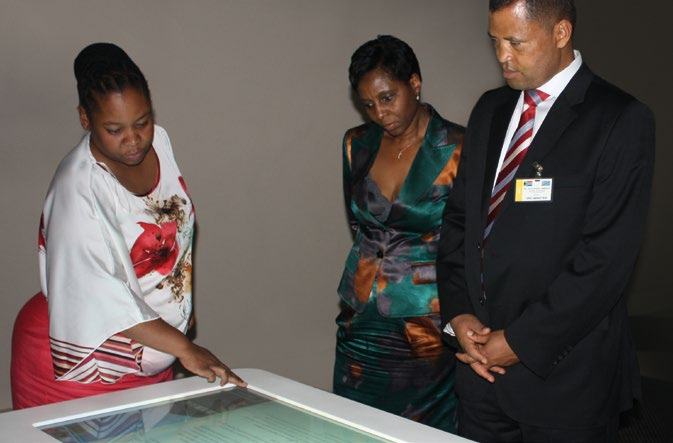
South African ministers visiting the MMIC. Image courtesy of Centre for Public Service Innovation
Centre for Public Service Innovation
Where they are based
Pretoria, South Africa (population of South Africa: 52 million)
Location in government
National government
Mission statement
"The function of the Centre for Public Service Innovation is to entrench a culture and practice of innovation in the public sector through a) research and development; b) unearthing, demonstrating, sharing and rewarding innovation; c) testing, piloting, incubating and supporting replication and d) partnering with public, private, academic, and civil society sectors"
What they do
Identify, develop and promote solutions for government problems
What defines them
R&D, incubation and awards
Size of team
20
Annual spend
£1.3 million
Launched
2001
Example of impact
The Multimedia Innovation Centre showcases innovative ideas and methods, with 1,000 public officials visiting in 2013.
"To create an innovation culture across the South African Government"
Interesting Features
Partnerships
Leadership
The Centre for Public Service Innovation (CPSI) is part of the South African Government and is tasked with creating a culture and practice of innovation to help overcome government challenges, ranging from improving hospital services through to reducing crime. CPSI aim to improve service delivery through research and development, incubating innovations, and forging private sector partnerships.
Background
The Centre for Public Service Innovation (CPSI) was created in 2001 by the South African Government to develop partnerships with foundations and the private sector to drive innovation in government, and to provide the minister of Public Service Administration with independent, diverse, and forward-looking research findings and advice on service delivery. When originally established, CPSI was a not-for-profit agency funded by foreign aid and operated with a small staff, and all project delivery was outsourced. In 2008, a new operating model was developed and CPSI transitioned back into central government as an in-house team.
What it does
CPSI supports innovation across the entire South African Government. It encourages departments to approach with problems and challenges they are facing. It then helps to solicit and develop possible solutions. There are four elements to the CPSI model:
- Research and development to investigate and recommend sustainable models and solutions for innovative service delivery.
- Incubation, testing, piloting and demonstrating innovative solutions for the public sector.
- Promoting innovation by identifying and promoting innovative solutions being developed through award programmes, and helping spread these across the public sector.
- Programme management to provide corporate support, including managing the shared services arrangement with CPSI's principal department, the Department of Public Service and Administration (DPSA).
2013 Innovator of the Year Award winners Image courtesy of Centre for Public Service Innovation

CPSI also facilitates collaboration between the government, the private sector, non-governmental organisations (NGOs) and academic institutions. One example is the Honeydew Policing Cluster Nerve Centre. This initiative began when the cluster commander of six police stations was experiencing a number of challenges, including high crime rates, and realised that thoroughfare routes enabled criminals to commit crimes and quickly evade detection. The districts approached CPSI for help. CPSI brought together experts from the police and commercial technology sector to develop and test possible solutions. The resulting Nerve Centre, equipped with a dashboard to aggregate intelligence information with CCTV surveillance, helps to draw links across datasets and disseminates information more effectively. Microsoft and MTN, a mobile phone company, are the private sector partners providing the technological capabilities, attracted by the opportunity to test and pilot in a real life setting. CPSI is in the process of evaluating the impact and, if successful, the plan is to roll out the model to other areas in South Africa.
Another element of CPSI's work is sharing innovation methods and ideas. This is managed by their Multi-Media Innovation Centre (MMIC), an innovative learning facility for public servants. The Centre aims to act as a neutral space, taking civil servants out of their everyday working environments and exposing them to innovation case studies, tools and methods. By 2013, three years into the MMIC's operation, the Centre had been visited by over 1,000 public servants from a number of departments and institutions, including the Department of Correctional Services, the South African Revenue Services, the South Africa Police Services, the North West Environmental Department, Gauteng Department of Rural Development and Agriculture, and Ekurhuleni, Johannesburg and Tshwane metros.
Over time, the MMIC has expanded to become an international hub for decision-makers and implementers to interrogate challenges and an incubator of new innovations. As part of this work, the MMIC has hosted an array of international visitors: from the India-Brazil-South Africa Partnership (IBSA), the Australian Public Service Commission, Kenya, the Democratic Republic of Congo, Singapore, the World Bank, Microsoft USA and working groups of the Conference of African Ministers for Public Service.
The case studies presented in the MMIC aim to highlight cutting edge innovation ideas and methods. To collate these examples, CPSI runs an Innovation Award, receiving around 150 entries each year from across the national government, the nine provincial governments, municipalities and other public entities. CPSI aims to build a repository of innovation practices from across the country, and to celebrate the success of individuals, teams and departments. Submissions are presented in CPSI's 'Ideas that Work' Journal, with finalists receiving certificates, training and support to further develop or replicate the project.
CPSI also runs an annual conference, bringing together 500 government practitioners to share best practices and explore where innovations can be replicated and scaled. CPSI is currently planning an evaluation to assess if sharing these examples has an impact on their replication.
There are indications that the CPSI Awards help finalists attract funding for their solutions. One example is a 2008 finalist project, a diabetic retinal screening project in Cape Town, which after winning received over £1 million from Cape Town city government for expansion into the surrounding rural areas.
The award is starting to have an impact on internal government culture. The 2013 winning project came from a government agency in which the leadership has actively encouraged staff to innovate and enter the competition, recognising and rewarding this internally, with other departments now inspired to follow suit and regularly enter too.
Impact
CPSI measures its impact on a project-by-project basis. Prior to testing and piloting, CPSI collects baseline data, both quantitative and qualitative, with an appropriate methodology developed by the R&D unit. Methods typically include administrative data, focus groups, participant observations, qualitative interviews, questionnaires, and cost-benefit analysis.
The table below shows how CPSI structures the outputs and outcomes in two of their projects:
| Annual Innovation Awards |
Policing Nerve Centre to enable real time policing |
| Key Outputs |
Key Outputs |
| Number of entries received and rewarded |
Multi-year project to develop integrated policing for local conditions and dynamics |
| Key Outcomes |
Key Outcomes |
| Received 100 entries, which are evaluated, identifying those for sharing and possible replication |
Improved real-time policing ability, resulting in reduced crime |
| Key Impacts |
Key Impacts |
| At least two finalist projects were replicated |
Evaluation still in progress |
Interesting features
Partnerships
CPSI acts as a broker and convener of networks, with a strong focus on corporate engagement. For each project, CPSI works with government to identify the root causes of an issue. They then set up a stakeholder team drawn from the public, private, and academic sectors to explore potential solutions and develop appropriate funding models. The private sector's role can vary depending on the project, from sponsor to direct collaborator. In most instances, the corporate partner will approach CPSI with a solution, through the Innovation Platform, in the hope that CPSI will help the company to test and showcase its innovation. CPSI manages these collaborations to ensure any Intellectual Property (IP) issues are dealt with, often using nondisclosure agreements to protect both parties.
Leadership
When CPSI was established by the South African Government in 2001, it was as a non-profit organisation. In 2008, CPSI was incorporated into government, although the team has kept its physical offices outside of government and retained its branding and identity. CPSI found that the move into government has enabled the team to better foster cooperation across the South African Government, and to continue to leverage outside partnerships.
'One Laptop Per Child' by Ryanne Lai is licensed under CC by 2.0

Centro de Innovación Social (Centre for Social Innovation)
Where they are based
Bogotá, Colombia (population of Colombia: 47.1 million)
Location in government
National government
Mission statement
"The Centre for Social Innovation of the National Agency to Overcome Extreme Poverty (ANSPE) works with partners inside and outside of government to generate innovative and scalable solutions for those living in extreme poverty across Colombia.“
What they do
Work directly with communities to develop new solutions to reduce poverty
What defines them
Engaging citizens and external partners
Size of team
16
Annual spend
£2.3m (2013) (£1.4m from government, and £0.9m from other sources)
Launched
2011
Key achievement
The Centre for Social Innovation has leveraged 60 per cent of its government funding in private, international, and from other public institutions, to develop its pilot projects.
"Focused on social innovation to benefit the most vulnerable people in Colombia."
Natalia Currea Dereser,
Centro de Innovación Social
Interesting Features
Team
Resources
The Centro de Innovación Social (Centre for Social Innovation) is dedicated to improving the quality of life for people facing extreme poverty across Colombia. Drawing on government data and through leveraging resources from private, public and international partners, the Centre works directly with communities across the country to develop and scale innovative solutions.
Background
The Centre for Social Innovation was created in 2011 as part of the newly formed National Agency to Overcome Poverty (ANSPE) with the remit to apply social innovation to tackle extreme poverty. It is the first innovation unit of its kind in Colombia, and was described by another government agency as “doing things that no one else will dare to do”.
What it does
The Centre for Social Innovation's work is driven by data. It develops projects that respond to the priorities identified by ANSPE's poverty indicator database. These cover a broad range of areas that impact on poverty, from education to family dynamics.
Projects tend to cost between £48,000 to £158,000 and are funded through public-private partnerships and in collaboration with other public bodies. All projects are developed with the communities in the areas identified as having high levels of poverty, and are always delivered by the Centre for Social Innovation team in collaboration with partners. The team works directly with these communities in the geographic areas where challenges are identified; reflecting its belief that successful solutions “empower the people that are going to receive them". The Centre uses structured methods of citizen engagement, including design thinking, social cartography - a method to map issues in a geographic area - and positive deviance, where the team seeks out individuals in a community who are able to generate effective solutions.
One of the projects is to develop computer games that will empower children aged seven to 12 to make positive changes for their families and communities. The games focus on specific issues such as health, nutrition, or issues in their family life, such as preventing child abuse, and were downloaded more than 40,000 times in 2013. One of the pilots is in Chia, a town just outside of Bogotá, the country's capital, where ANSPE's data highlighted that the community was experiencing problems with malnutrition and complex family dynamics. To help develop a response, the Centre is running pilot programmes with 175 families to identify and test the most effective interventions in partnership with the organisation One Laptop per Child. Another project, developed in Antioquia, a department of Colombia, is installing innovative water filters to ensure access to clean water, in alliance with the EPM Foundation.
Once pilots have been developed and shown to be effective, the Centre for Social Innovation plans for the successful models to be replicated across Colombia. The Centre is already working with the relevant government departments to plan for future transition so that they are ready to implement and deliver these solutions at scale.
The Centre for Social Innovation is focused on disseminating and sharing ideas to build the social innovation community in Colombia. As part of this, the project Hilando is mapping innovations and innovators across the country, helping connect challenges with solutions and fostering the exchange of best practice and knowledge.
The Centre is currently developing 33 pilot projects in the areas of housing improvement, nutrition, health, income and employment, family life, and banking and savings.
A programme to improve public health Image courtesy of Centro de Innovación Social

Impact
As all projects are still in the pilot stage, the Centre for Social Innovation is currently planning its formal evaluation strategy and has not yet generated impact data. To develop this evaluation strategy and measure its impact on reducing poverty, the Centre for Social Innovation is creating qualitative and quantitative baseline indicators. It plans to bring in external experts in order to achieve the best and most rigorous multidisciplinary measurement approach.
Alongside developing these evaluation frameworks to track their projects, the Centre for Social Innovation team is receiving training on the theory of change and monitoring and evaluation processes from partners in the Department for National Planning, and the Multilateral Investment Fund of the Inter-American Development Bank.
Interesting features
Team
The Centre for Social Innovation provides government with a dedicated team for innovation and applying novel methods to problem solving. There are 16 staff members, half of whom work on project development and management, five of whom focus on diffusion, knowledge management and research, and three staff members support the rest of the team's operations. Around a third of the team has a background in government, while all the others previously worked in the private sector. This is a deliberate recruitment strategy to inject a new dynamic into government. As well as explicitly recruiting from the private sector, the team also brings diverse skills, many of which are unique to the Colombian Government, including an anthropologist, a sociologist, and a designer who work alongside lawyers, public managers, and business managers. Nazly Frias from the National Planning Department credits this "unique” team as enabling them to "really think outside the box and to try to do things differently”.
Resources
The Centre for Social Innovation leveraged 60 per cent of its government budget in external funds in 2013 and by 76 per cent in 2012. This was made possible by the Centre being part of the Pioneers for Social Innovation Alliance, a partnership of about 15 companies contributing to a dedicated social innovation fund. There is an agreement in place that enables government and the alliance of companies to jointly select topics to work on, and once project areas are agreed, the Centre for Social Innovation co-funds their delivery. As well as enabling the Centre for Social Innovation to leverage additional resources, the Pioneer's fund has helped the team navigate the complexities of Colombia's Government procurement processes, which have been described as “very, very complicated”, enabling projects to be more easily and quickly developed.
'Paris' by Christian Scheja is licensed under CC by 2.0

Fonds d'expérimentation pour la jeunesse (Experimental Fund for Youth)
Where they are based
Paris, France (population of France: 66 million)
Location in government
National government
Mission statement
"The Fonds d'experimentation pour la jeunesse is designed to promote student success and improve the social and professional integration of young people under 25 years of age."
What they do
Funding experimental youth programmes and their evaluation
What defines them
Rigorous evaluation, particularly randomised controlled trials (RCTs)
Size of team
12
Annual spend
£37.8 million (2013) (£30.8m from government, and £7m from other sources)
Launched
2008
Example of impact
Supported more than 554 projects and experiments, which have served an estimated 498,000 young people.
"The fund aims to inspire evidence-based policies related to youth."
Mathieu Valdenaire,
Fonds d'expérimentation pour la jeunesse
Interesting Features
Impact measurement
Resources
Fonds d'expérimentation pour la jeunesse, or the Experimental Fund for Youth, was set up to help the French Government understand which services improve young people's educational achievement and social and professional integration. Having funded 554 experimental projects and 295 evaluations since 2008, the Fund is helping to demonstrate the value of applying rigorous methodologies, such as randomised controlled trials (RCTs), to assessing policy impact.
Background
In December 2008, a law initiated by the French Government created the legal framework for establishing the Experimental Fund for Youth. In March 2009, the Ministry of Youth convened a group of experts to analyse the situation of young people in France and make joint propositions for building new youth policies. One of the primary findings was that interventions should focus on 'transitions' for youth, defined as a path between the end of mandatory school (at 16 years old) and social and professional stability. To understand which initiatives and policies would be most effective, the group called for Parliament to regularly review youth policies and to develop an experimental method to guide social policy development.
What it does
The Experimental Fund for Youth characterises itself as a “public policy laboratory financing innovative interventions for young people, implemented at a small scale and evaluated rigorously, with the aim to influence future public youth policy”. The fund supports the mainstreaming of experimental, particularly randomised, methodologies into the policymaking process to help promote student achievement and improve the social and professional integration of young people.
Support from the Fund partly covers the cost of developing new experiments within services related to youth with the rest being covered by the organisation in charge of delivering the service. Each experimental project is evaluated by an independent evaluation team.
Examples of current evaluations include studying the impacts of providing young people with a driving license at reduced cost to improve their job opportunities and exploring whether volunteering increases young people's chances of finding a job.
The Fund holds open calls for proposals, with 16 held to date. Each call is focused on a specific youth-related theme, such as reducing school drop-out rates. Proposals can come from NGOs, public institutions, schools, universities or local authorities. The Fund convenes The Scientific Council, which includes academic researchers, to give guidance on the calls for proposals, particularly on issues related to evaluation methodologies.
Proposals are reviewed by a committee of experts on the specific focus of the call, before being put before the Management Council, which includes representatives from government, and external financial contributors, which makes the final selection of projects. Once projects are selected, the fund oversees the delivery of the experiments and their evaluations, and disseminates the results.
One trial explored the impact of reducing the costs of obtaining a driving licenses on young people's job opportunities. 'Driver's License - Teen driver' by State Farm is licensed under CC BY 2.0

Impact
Between 2009 and 2013, the Experimental Fund for Youth ran 16 calls for proposals, and received more than 1,700 applications. These have led to 554 experimental projects, which are set to generate 295 evaluation reports. The Fund estimates that 498,000 young people have benefited from the projects they have helped develop and evaluate so far.
Within these trials there is often a mix of both quantitative and qualitative research methods. For smaller programmes that are not being tested at a sufficiently large scale, evaluators may use only qualitative methods, but the Fund makes clear that this is not an assessment of impact, as this would require a control group to form part of the evaluation design.
Interesting features
Impact measurement
The central feature of the Experimental Fund for Youth is its rigorous approach to impact measurement, undertaking RCTs wherever possible to test the effectiveness of different interventions. As well as helping demonstrate which solutions are working, the Fund has helped build capacity across the academic and corporate evaluation community to undertake randomised evaluations of this kind, as well as helping to stimulate demand for evidence, particularly generated through RCTs, across government.
Resources
A mix of private and public money supports the Fund's innovation experiments and evaluations. The fund has a budget of £189 million over 2009 to 2014 (equivalent to £37.8m per year). Whilst the majority of funding comes from government, the fund was designed to be endowed with contributions from the state and private organisations. A result of this is that the fund has attracted private financial contributions of around £35 million to date, from business and philanthropic organisations.
Investing in Innovation Fund (i3)
High school students develop their math and science skills as part of an i3 backed programme.
Image courtesy of U.S. Department of Education
"Creating a real innovation pipeline, that starts off with lots of ideas, figures out whether they are actually impactful and then provides resources for them to go to the next level."
Jim Shelton, Deputy Secretary, U.S. Department of Education
Where they are based
Washington D.C., USA (population of USA: 314 million )
Location in government
National government
Mission statement
"To provide competitive grants to expand innovative practices that are demonstrated to have an impact on improving student achievement or student growth, closing achievement gaps, decreasing dropout rates, increasing high school graduation rates, or increasing college enrolment and completion rates."
What they do
Grant funding for education programmes
What defines them
Awarding grants against a rigorous standards of evidence framework
Size of team
10
Annual spend
£82 million (2013) ($135 million, with an additional anticipated private sector match of £9.7m ($16m) to be secured by July 2014)
Launched
2010
Example of impact
During 2013, i3 ran its fourth competition, selecting 25 programmes to receive more than £82 million
Interesting Features
- Impact measurement
- Partnerships
The Investing in Innovation Fund (i3) is a competitive grants programme to improve student achievement and attainment through investing in proven interventions. Funding is awarded based on the strength of grantees' evidence on education outcomes, with evidence assessed against a rigorous three tier framework.
Background
From the beginning of the Obama Administration in 2008, senior officials at the Office of Management and Budget (OMB) were planning several initiatives to advance the use of evidence based programme models. The i3 Fund was launched in 2010 as part of the American Recovery and Reinvestment Act. The Fund is structured with a deliberate focus on growing and spreading innovations, as Jim Shelton, Deputy Secretary at the Department for Education, and the architect of i3, noted, "in the private market the incentives drive people to borrow, steal, [and] pay for people's ideas and spread them as quickly as possible. Those incentives are not as powerful in the social sector. In fact they're quite the opposite. There are many incentives to distinguish yourself as unique, and not repeat what someone else has already done".
What it does
The i3 Fund is situated in the Office of Innovation and Improvement within the US Department of Education, with grants distributed nationally. The main aim is to expand the implementation of innovative practices that are demonstrated to have an impact on student achievement, achievement gaps, drop-out rates, high school graduation rates, or college enrolment and completion.
i3 defines innovation as having two dimensions, and these form the criteria for grantees to meet in order to be eligible for a grant. First, the intervention has to be significantly better than the status quo, and second it has to be something that is scalable.
i3 funding is allocated as 'competitive' grants. Eligible grantees are non-profit organisations working in partnership with either one or more Local Education Agencies (LEA) or a consortium of schools.
Competitions are held annually, and in order to be eligible, applicants must:
- Improve achievement for high-need students
- Serve kindergarten-through-grade-12 students
- Have a record of achievement
- Demonstrate that a private sector partner will match funds
- Meet the relevant evidence standard for the grant type
3 Types of i3 grants
|
Development |
Validation |
Scale-up |
| Funding available per grant |
Up to £1.8m ($3m) |
Up to £7.3m ($12m) |
Up to £12.2m ($20m) |
| Evidence required |
Evidence of promise or strong theory |
Moderate evidence of effectiveness, with two options: |
Strong evidence of effectiveness, with two options: |
|
• There is the potential for efficacy for at least some participants and settings |
Option 1
At least one study that meets What Works Clearinghouse (WWC) standards, involving a measure of strength of causal conclusions; a statistically significant favourable impact on a relevant outcome; and includes a large sample that overlaps with populations or settings that would be served in the proposed intervention, providing a measure of generalisability |
Option 1
At least one study that meets WWC standards, involving a measure of strength of causal conclusions; a statistically significant favourable impact on a relevant outcome; and includes a large and multi-site sample that overlaps with populations and settings that would be served in the proposed intervention, providing a measure of generalisability |
|
• Evidence of promise refers to available empirical evidence to support the theoretical links between the component and at least one relevant outcome |
Option 2
At least one study that meets WWC standards, involving a measure of strength of causal conclusions; a statistically significant favourable impact on a relevant outcome; includes a large sample and a multi-site sample that overlaps with populations or settings that would be served in the proposed intervention, providing a measure of generalisability |
Option 2
At least two studies that meets WWC standards, involving a measure of strength of causal conclusions; a statistically significant favourable impact on a relevant outcome; and include large and multi-site samples that overlap with populations and settings that would be served in the proposed intervention, providing a measure of generalisability |
|
• Strong theory means a rationale for the proposal, including a logic model |
|
|
| Scaling required |
To the level of scale identified in the application |
To the national or regional level |
To the national level |
There are three types of grants available, 'Scale up' grants, 'Validation' grants and 'Development' grants. The amount and criteria for each grant is detailed in the table above.
A team of 10 people manage the Fund; all based within the Office of Innovation and Improvement. Team members help to design, run and oversee each competition and support each cohort of grantees. They typically spend 50 to 60 per cent of their time focused on designing and running new grants, with the rest of their time dedicated to learning from grantees, helping them stay on track and overcome barriers, and helping to mobilise additional resources.
Other programme teams in the Office of Innovation and Improvement typically manage a few competitive grant programmes, whereas the team working on i3 is solely dedicated to the fund. This enables managers to work more closely with grantees and foster connections between their programmes. The aim is to "help the grantees learn from each other, [and for the team] to learn how we build learning communities amongst similar grantees so they can accelerate the pace of their learning and disseminate the learning of those grantees to the field more quickly." Due to the Department of Education's structure and decision making power, the i3 team does not select grantees themselves; instead, an external review panel makes all selection decisions.
One initiative that received an i3 Validation grant is the Virginia Initiative for Science Teaching and Achievement (VISTA). VISTA is a student-centred programme to improve science education, and has served more than 250 elementary school teachers. The grant provides coaching and research-based teaching coursework for secondary school science teachers, with the objective of building the infrastructure to support intensive science teacher professional development across the state of Virginia. The i3 grant is also funding a randomised controlled study to gauge the impacts of the VISTA programme on outcomes for both teachers and students.
"Fail quickly, learn your lessons and move forward."
Nadya Chinoy Dabby, Department of Education
"Apparatus of support" for grantees
As well as financial support, a wider package of support is provided to grantees, including a monthly phone call with their designated programme officers for the first year.
If things go well, the frequency of their calls decrease, but their designated member of the i3 team is on hand to act as a 'one stop shop' for advice and guidance. Grantees also have access to two sets of external experts.
The first are third party evaluation experts, partnered with grantees, helping support and troubleshoot the evaluation. The second set of experts focuses on technical support and facilitation. They help grantees think through issues like recruiting, scaling, and communicating with the media. The i3 team and external experts are focussed on ensuring grantees learn from each other, sharing lessons, stories, and connecting grantees.
Another i3 grantee is the National Math and Science Initiative (NMSI) which seeks to improve college readiness through preparing teachers; waiving student exam fees; upgrading classroom equipment; and holding additional Saturday study sessions for students. During the 2012-13 school year, the 13 schools supported by NMSI's grant partner, the Colorado Legacy Foundation saw a 70 per cent increase in Advanced Placement scores, increasing college readiness.
During 2013, i3 ran its fourth funding competition, selecting 25 programmes to receive more than £82 million to expand innovative practice. As in previous years, the majority of grantees were in the Development category with 18 awards. The remaining seven grantees were in the Validation category.
During 2012 and 2013, i3 did not fund any programmes in the Scale-up category. Instead, the Fund selected a higher number of the best Validation and Development applications, with the aim of growing a diverse portfolio of grantees. i3 hopes that over time the Development and Validation grantees will build a more rigorous evidence base to increase the number of Scale-up applications in future competitions.
A previous evaluation of i3 highlighted that focusing on both innovation and evidence of what works in education could be problematic for the fund and exclude more radical innovation. The evaluation noted, "at its heart, the i3 program had two important goals that were fundamentally in tension: 'innovation', which implies new ways of doing things; and 'scale', in which things that have been demonstrated to work are replicated and disseminated. To create real change, both innovation and scale are required, but implementing them well requires different decision-making and support systems, as well as different people and matching processes. For example, requiring a 'proven track record' may have shut out applicants that could have delivered more truly break-the-mould innovations".
i3 appears to be helping focus national attention on the need for innovation in education, and increasing recognition of the role that government plays. As Nadya Chinoy Dabby, the Department of Education's Assistant Deputy Secretary for Innovation and Improvement, notes, "fail quickly, learn your lesson and move forward is very much part of our American ethos around innovation, [yet] it is absolutely not a common ethos in the education world"
Impact
The goal of i3 is to improve the educational outcomes for K-12 students. Grantees have their programme impact assessed through an independent evaluation. The methods are determined by the level of application, and include assessing progress against a logic model or theory of change, experimental methods, such as randomised controlled trials (RCTs), and the use of administrative data. Grantees are required to make the results of these evaluations publically available.
Alongside requiring and supporting specific evaluations for each grantee, the i3 Fund also tracks its performance at an aggregate level against three performance measures. The data for each of the following three measures is collected by grantees and provided to i3 during an annual performance review:
- The percentage of grantees that reach their annual target number of students as specified in their application
- The cost per student served by the grant
- The percentage of grantees that have ongoing evaluations which are providing high-quality implementation data and performance feedback, assessed against the number of evaluations meeting the WWC evidence standards.
Interesting features
Impact measurement
A key feature of the i3 is its standards of evidence framework, which enables the Fund to support projects with strong evidence, as well as those with less evidence but strong potential. RCTs are conducted on several of the largest i3 grants. This rigorous use of evidence in the allocation of funding is innovative in itself; such a stringent use of evidence at the centre of funding decisions is not often seen in many other government initiatives.
Partnerships
Another interesting features of the design of i3 is the requirement for matched funding. This was introduced partly to leverage taxpayers' dollars with philanthropy and other sources of capital, but also in recognition that securing co-investment builds cross-sector relationships that support the work and help assure that the innovation is worth backing. There have been additional benefits from engaging the philanthropic community. Jim Shelton says the engagement has helped created a "secondary market", with foundations funding promising interventions that missed out on i3 support, helping build closer working relationships between government and philanthropy.
La 27e Région
"Transforming administrations requires not only new methods, but also new kinds of alliances able to generate radical reflexivity from within. That is what we call Friendly Hacking."
Stéphane Vincent, Director, La 27e Région
Where they are based
Paris, France (population of France: 66 million )
Location in government
Regional government
Mission statement
"La 27e Région explores new ways to improve the design and implementation of public policies. In partnership with the Regions, it implements programmes of action research, which mobilise methods from the humanities, design services and social innovation."
What they do
Provide a consultancy service to government to design new services
What defines them
The Friendly Hacker methodology
Size of team
7
Annual spend
£0.6 million (2013) (£0.4m from government, £0.2m from other sources)
Launched
2008
Example of impact
La 27e Région has helped to design more than 20 social innovation pilots across 9 French Regional Governments
Interesting Features
La 27e Région works with French Regional Governments to increase their capacity to innovate, helping them to tap into the potential of social innovation through working with citizens on the design and delivery of public services. To date, the team has launched 20 projects in nine different regions across France, and since 2003 has started to work with Central Government, counties and metropolitan areas.
Background
Created in 2008, La 27e Région aims to increase French Provincial Governments' capacity to innovate. The founders of La 27e Région, which includes Presidents from French Regional Governments and former civil servants, wanted to explore and demonstrate how public administration could more effectively draw on a culture of co-creation and user-centered design.
The focus on Regional Government, which in France has responsibility for high schools, universities, research, economic development, transportation, culture and tourism, was a deliberate choice. The Director of La 27e Région, Stéphane Vincent, says, "with regional Governments we thought it would be easier than working for the national government and more challenging than working with cities. We find it a very interesting middle level to work with."
In the early stages, La 27e Région projects were designed to demonstrate proof of concept for the service design and social science approaches utilised by the team. For the first three years, La 27e Région was incubated within another not-for-profit organisation, the French think-tank, Next-Generation Internet Foundation (FING). In 2011, La 27e Région moved out of the 'incubation' at FING and became a formal non-profit organisation.
What it does
La 27e Région has a core team of seven employees with an additional 40 design and sociologist associates spread across France. From its base in Paris, it operates as an innovation lab for the 26 French Regional Administrations.
The core aim of La 27e Région is to create a culture that supports social innovation and enables civil servants to develop user-driven models. This focus is a direct response to the New Public Management (NPM) approach that dominated French public administration throughout the 1990s and 2000s. La 27e Région believe the NPM approach helped make public services more efficient, but did not allow civil servants to tap into the potential of involving service users in public service design and delivery.
La 27e Région runs two programmes, Territoires en Résidences (The Residencies) and La Transfo (The Transformation), which are currently being piloted with four regions. Across both programmes, regional governments and other local authorities co-fund the projects, with the La 27 Région team acting as a partner to government, rather than as a delivery agent or subcontractor.
6 Principles of The Friendly Hacker
The Friendly Hacking concept (see text box) is at the heart of the La 27e Région model, outlining six principles to help challenge civil servants' existing understanding of public services. This challenge can initially make some civil servants feel uncomfortable, but Stéphane Vincent notes, "we've got many testimonies of top managers in the beginning saying 'well, I don't know what you are doing or what you want me to do, I know my staff, I know my users', then we help them to use a new approach and they use it, and nearly every time something happens and they say, 'well, I see things differently now'."
The Residencies programme enables La 27e Région to develop and test out its methods and build legitimacy with regional governments, with sixteen run to date across nine regions of France. In each Residency, La 27e Région deploys service designers, social researchers and urban planners to work with regional civil servants. Together they find new ways of developing projects through using ethnographic, co-design and prototyping methods. Residencies focus on a diverse range of issues, such as how to repurpose a disused railway station or how to upgrade libraries for the future. The railway station project was near Nevers in the Region of Burgundy, and involved researchers and civil servants camping in the station for a week to get a better sense of the local community and how they were using and thinking about the site.
1 Being both inside and outside
Immerse civil servants together with the La 27e Région team in the area, communities and services it is trying to understand, such as a school or train station, for intense periods of time. This approach gives insiders (the civil servants) and outsiders (people who use services) a different perspective.
2 Being both neutral and activist
Find the right balance between being neutral (e.g. everyone can participate, all opinions are valid) and being an activist promoting particular values (such as freedom of speech, democracy, or the importance of citizen participation). In all of its contracts with regions, it emphasises that it is a partner and not a subcontractor.
3 Doing before thinking
Advocate high levels of experimentation and prototyping before scaling-up solutions.
4 Engage multiple stakeholders
Recognise that no single organisation has all the answers or capacity to drive change. Always try to include multiple stakeholders from diverse backgrounds, from both within and outside of public services.
5 Use design thinking
To mobilise people around what can often be quite hard change projects, the La 27e Région team will always seek to deploy design skills to develop prototypes and scenarios that can help illustrate what future services and policies could like.
6 Capture learning
Document as much of the process as possible through blogs, short films and research papers. This creates lessons for future 'hacking' projects about successes and failures from past projects.
The Transformation programme builds on the insights and lessons generated from Residencies to create sustainable solutions and to explore the feasibility of the regional government creating its own social innovation lab.
One Transformation project was in the Champagne- Ardenne region. La 27e Région worked with 12 civil servants from the region for 18 months to build their social research and service design skills. Once finished, the regional government began creating a permanent lab for the region, supported by the hiring of a permanent service designer for the regional administration.
Impact
To date, La 27e Région, as part of the Residencies and the Transformation programmes, has designed and run 20 social innovation projects across nine French regions. While The Transformation programme is still ongoing, La 27e Région estimates that, on average, six pilots are created in each residency, with at least one of these turning into a long-term project for the regional government to implement and deliver.
La 27e Région reflects on the process of its projects, but does not measure the impact of its work beyond measuring the number of pilots it generates. The team reflects on its process throughout, continuously observing and learning from the government officials it works with, and going forward plans to develop more rigorous methods for measuring their impact on innovation skills and capacity in government.
Interesting features
Leadership
Although La 27e Région is an independent organisation, it has developed strong ties to regional government through its governance and funding structures. The La 27e Région Board consists of four presidents and four vice presidents from eight different regions in France. In addition, La 27e Région receives £41,000 annually from the Association of French Regions (ARF). This ensures that La 27e Région's work is aligned with government priorities and helps to foster buy-in from senior stakeholders, which provides useful leverage in overcoming regional barriers and difficulties.
Team
La 27e Région has a networked and multidisciplinary team of more than 40 associates across France who are contracted to contribute specific expertise, including sociology, urban planning, design and social research. This networked staffing model helps the team adapt to shifting demand. The La 27e Région Board and the French Association of Regional Governments insisted on this networked approach; they made it clear that they did not want La 27e Région to grow into another typical administrative body.
Mayor's Office of New Urban Mechanics (MONUM)
"Creating a context in which risks can be taken to enable and sustain a culture of innovation"
Nigel Jacob, Co-chair, MONUM
Where they are based
Boston, USA (population of Boston: 636,500 )
Location in government
City government
Mission statement
"The Mayor's Office of New Urban Mechanics is Boston's civic innovation group. We partner with entrepreneurs inside and outside of City Hall to explore better ways to serve and collaborate with people. We do this by running discrete experiments, understanding their impact, scaling what works and learning from what doesn't."
What they do
Develop pilots that engage citizens, civil servants, academia and others in government problem solving
What defines them
Technology-led civic engagement
Size of team
5
Annual spend
£0.5m (£0.3m from government and £0.2m from external sources )
Launched
2010
Key achievement
MONUM's Citizen Connect mobile app is used by residents to report problems such as graffiti to City Hall, with around 300 cases across Boston reported each week. The app has been replicated by other cities across the nation.
Interesting Features
- Partnerships
- Methods
- Resources
The Mayor's Office of New Urban Mechanics (MONUM) aims to accelerate the pace of innovation in Boston City Government. The small team facilitates and strengthens connections between entrepreneurs and government, acting as the 'front door' for city innovators. Using a rapid prototyping methodology, they work with innovators to pilot quickly and cheaply, developing solutions for city challenges in a matter of weeks.
Background
The Mayor's Office for New Urban Mechanics (MONUM) was launched in 2010, at the start of Boston Mayor Menino's fifth term. It was the result of the Mayor's growing interest in accelerating the pace of innovation within the city administration, gaining him the nickname, The Urban Mechanic.
MONUM was created to enable busy City Hall staff members to run innovation projects, often done in collaboration with external entrepreneurs and internal government policy experts. This ability to focus exclusively on innovation projects was something that existing senior managers, consumed with the day-to-day work of government business, couldn't easily do. MONUM has survived a change of mayoral leadership; Mayor Martin Walsh, the new Mayor of Boston, has deepened the City's investment in the program and expanded its role in the city.
The seeds for MONUM were sown before it was launched. The two co-heads, Nigel Jacob and Chris Osgood, worked in Boston City Government for three years prior to starting MONUM, giving them deep connections with individuals across the departments, and providing them with a "good sense of where there were some really compelling opportunities" for innovation. They focused on this subset of existing partners, innovators and entrepreneurs within the city departments. Chris Osgood remarks, "was terrific is that we worked with them, showed success, [so] more departments became interested" leading to MONUM engaging with a wider range of departments, "so we just saw this as a way of accelerating and supporting those entrepreneurs who are already ready to go".
What it does
MONUM has been described as the Office of Research and Development for the City of Boston. Its team of five staff, with a range of skills, focuses exclusively on new experimental approaches to delivering services with and for residents. When describing its approach, Chris Osgood quotes the urban planner, Jane Jacobs, who wrote, "Cities have the capability of providing something for everybody, only because, and only when, they are created by everybody." MONUM's core idea is to engage and empower residents and City Hall to partner to collaboratively transform the city.
Their work is divided across four 'labs':
- The Streetscape Lab, which - in partnership with the Public Works & Transportation Departments - focuses on making Boston's streets more green, smart, multi-modal and awesome.
- The Transparency & Engagement Lab, which - in partnership with a range of departments - focuses on deepening trust and collaboration between city residents and city staff by increasing engagement and transparency.
- The Education Lab, which - in partnership with the Boston Public Schools - explores new tools for parents, educators and students.
- The New Economy Lab, which - in partnership with a range of departments - experiments with new ways to improve the business climate of Boston.
Urban Mechanics Fellowship: creating a culture of innovation
To ensure there is a flow of highly skilled staff with entrepreneurial flair in City Hall, MONUM recruits top graduates through City Hall's New Urban Mechanics programme and appoints them as direct advisors to the mayor.
There are two strands to this, a summer programme which enables those in graduate school to work on a small government project over eight weeks, and a year-long fellowship programme for graduates with experience in the public and private sector.
After their placement in the mayor's office, city departments are keen to take the Fellows on, with around 90 per cent of Fellows staying on in city government.
Since its creation, MONUM has run around 50 experiments, with a strong focus on using technology as a means of engaging the public. In each lab, the team builds partnerships with relevant city staff, constituents, academics, entrepreneurs, and non-profits to design, develop and evaluate pilots. The team does not apply a structured framework or method to project development; instead, it acts as a network broker and facilitator, with its level of involvement in each project varying. The MONUM process is shown below.
The MONUM Process
The diagram illustrates the flow of the MONUM process through three main stages:
- Source Ideas
- Goal: Identify entrepreneurs inside and outside government with original ideas for City service delivery
- Support and Study Projects
- Goal: Pilot high potential ideas with maximum public impact and minimal public cost
- Scale & Share
- Goal: Scale most effective pilots and share findings with other cities
Projects include Citizens Connect, a mobile app for residents to upload photos and messages of problems like graffiti, and send these directly to the relevant person at City Hall. Residents can track the issue they report and receive a notification when it is fixed, as well as tracking other reported problems in their area. There has been a rapid uptake of this channel as well as the companion phone and web channels, with 2.5 million issues being reported. Boston has a population of less than 1 million, so this indicates that there are people using the system many times, reporting around 300 cases a week.
One resident said, "When I call City Hall I think I'm complaining, if I send in a problem I feel like I'm helping". Citizens Connect has been successful in reporting and resolving problems, leading to a positive impact on the delivery of services.
Another project is Street Bump, an app that detects and maps rough patches of roadway. Users have the app running on their smart phones as they drive around the city. It detects and reports issues in the road surface back to City Hall, helping city government to plan road maintenance. An interesting finding is that potholes are not the major problem. Instead, sunken manhole covers and other castings are the most significant cause of bumps along Boston's streets. This information helped the City's Public Works Department broker a new collaboration with the utility companies both to repair the worst existing castings and to experiment with new repair materials that may last longer. While it is refining the app's algorithms in partnership with area universities, Boston is also in discussions with cities around the world, including London, about how to adapt the technology to deploy it internationally.
MONUM has a great deal of flexibility to allocate both time and resources to new experiments, and to work with a range of partners from across city government, residents, local universities, individual entrepreneurs, start-ups and large businesses. Their experiments are quick, with pilots being undertaken cheaply, in an iterative way, to learn and create value. MONUM aims to have a working beta version of the solution within a few months, with an urgency to test and get feedback on what is being developed.
"We never really want to be engaging in total blue sky work that can never fit with the existing operations."
Chris Osgood
The team typically receives at least one request a day from external entrepreneurs. While many are relevant to MONUM's labs, most do not align with government needs. Occasionally, however, MONUM receives "a gem". One such story is Marie Duggan, a mother of a severely autistic child who has worked with the MONUM team to develop AutiKnow, an app to help support children with autism.
The majority of the support MONUM offers to most innovators is non-financial, including coaching, connections with researchers, developers and others who can help advance the idea, and links to other key players in city government.
With the smaller subset of ideas that become projects, MONUM usually plays a significantly hands-on role. The team works with departments across City Hall to help scale and implement solutions. MONUM has found this scaling phase challenging, encountering issues in ensuring that departments have the ability, time and resources to integrate the innovation into existing operations.
Ensuring innovations can be incorporated into the pre-existing structures and operations of government have raised interesting questions about how radical MONUM can be. Chris Osgood notes, "we always want to be sure that we're pushing the envelope, but there's this delicate balance between going too far into fundamentally new areas, and at the same time making sure that if they are successful there is a way of incorporating them into city operations. So, we never really want to be engaging in total blue sky work that can never fit with the existing operations".
MONUM's model recognises that not all supported projects will succeed. That is why the office structures its experiments "in a short and smart and low investment way" enabling it to quickly learn lessons. Despite this high appetite for experimentation and risk, Nigel Jacob notes that his colleagues "don't have the freedom to do stuff that's off topic", and they don't have the licence to run projects unless there is an experiment behind tracking progress. In essence, all the work must help them "understand better how we can be a better city".
Impact
MONUM has had a number of impacts, including:
- Citizen Connect has enabled 70,000 neighbourhood issues to be reported by residents, empowering them to improve the condition of their neighbourhoods. A number of cities in Massachusetts and across the country have now adopted similar products.
- Street Bump is providing Boston City Hall with new intelligence on the state of the roads, with over 1,250 problems identified and fixed through a new partnership with utility companies. Early results show that Street Bump could lower the cost of road inspection.
MONUM has two categories for measuring impact, a set specific for the team overall, and a set specific for each project. For the team overall they track how many entrepreneurs they meet with, also using this as a proxy for how well they are sourcing new ideas; how many projects are supported; how many projects are documented to show how well they are disseminating and sharing their work; how many projects are formally evaluated; and how many projects are scaled. For individual projects, measures include the depth of civic engagement, with MONUM seeking an external research partner to undertake the evaluation. Across both categories MONUM uses administrative data, user feedback surveys, focus groups, participant observations, qualitative interviews, and questionnaires.
To support impact measurement, MONUM has two key partnerships with universities. The first is with Harvard University as part of the Boston Area Research Initiative, in which a range of social scientists, psychologists, scientists and economists study behaviour change in the areas where solutions are deployed. The second research collaboration is with Emerson College and is focused upon action and participatory research methods. In these research partnerships, the academics are not contractually obliged to report on data and receive no financial benefits from evaluating the MONUM programmes, providing the research findings with additional credibility.
Interesting features
Partnerships
MONUM's position in the Mayor's Office helps to ensure that it is aligned with both executive priorities and the needs and issues across city departments. The founders were from City Hall and already had strong networks and relationships with colleagues, which provided the foundations for building a broad base of support and trust across city departments. They work hard to be seen as a source of resources, expertise and support to help departments achieve their goals.
Methods
The key successes behind the MONUM method are the dedicated staff, its position in the Mayor's office, and its lean, partner-driven approach. The first allows the internal capacity to take on experimental projects; the second allows for those projects to have some degree of risk; the third allows that risk to be well managed.
MONUM's use of communications is also key to its method. The team is credited with helping protect risk-takers by managing relationships with the Mayor, media, peers, employees and the public. If a venture is falling short of its goals, the team steps in quickly to help the innovator "navigate and manage and message". Rather than it being a one-off exercise, this translation role between the different partners is a key part of MONUM's work.
Resources
MONUM receives funding from a range of sources. Salaries of core staff are paid by City Hall, alongside funding from the city government to provide risk capital. Additional programme funding is secured through grants. For example, the State of Massachusetts grant-funded the development of Commonwealth Connect, while private foundations, such as the MacArthur Foundation and Bloomberg Philanthropies, fund more thematic programmes with partners. If an agency comes directly to MONUM with a challenge, the team helps think through exactly what is required, and offers advice on how a solution could be developed, with the agency ideally providing some of the funding.
Rather than thinking about the resources just available within Boston's government, such as budgets and human capital, MONUM looks to the city at large and leverage resources through assembling a network of partners who can take on these challenges. Tapping into the capabilities of entrepreneurs, researchers, non-profits, government officials, and others enables a very different set of resources and perspectives to be brought into the work of departments. As Nigel Jacob notes, "as much as we are housed in government, we're very much an urban innovation lab".
MindLab
"Stimulating the dialogue in Denmark on transforming our public sector and creating a different interplay between the state and local level."
Christian Bason, Director, MindLab
Where they are based
Copenhagen, Denmark (population of Denmark: 5.6 million )
Location in government
National government
Mission statement
"MindLab works with its owners to create change which generates the desired value for citizens, businesses and society"
What they do
Engage civil servants and citizens in identifying problems and developing policy recommendations
What defines them
Human-centered design (HCD)
Size of team
12
Annual spend
£1 million (2012) (£0.9m from Danish government, and £0.1m from other sources)
Launched
2002
Key achievement
MindLab's project to help businesses to find the right industry code for registrations demonstrated a 21:1 return on investment in savings to government and businesses
Interesting Features
Based in the Danish Central Government, MindLab is tasked with bringing a human-centred design approach to public sector challenges. MindLab draws on the perspectives of citizens, businesses and government staff to redesign services around their experiences.
Background
MindLab was launched in 2002 by the Danish Ministry for Business Affairs as an internal incubator for invention and innovation. The permanent secretary's inspiration for MindLab was Skandia, a Swedish insurance company, which created a similar innovation lab, the Skandia Future Centre. Another source of inspiration was prominent business school academics wanting to know what role innovation played within the Ministry for Business Affairs. The existence of an in-house lab holding such a vision of creativity was in itself innovative and unique for the Danish Government.
As it has developed, MindLab has embraced human-centred design (HCD) as its method for innovation. MindLab has expanded its remit to work with other ministries. These strategic partnerships with new government departments are a deliberate attempt to create more systematic change, arising from the view that public sector innovation does not come from a single project, but instead needs to be sustained and spread through cross-cutting partnerships.
From National to City Government
As well as working with Danish central government, MindLab is now collaborating with the Municipality of Odense. This is a strategic move to increase the scale of impact across the government.
Odense views itself as a platform for experimentation for innovations that can be rolled out across the hundred or so other municipalities of Denmark. This partnership enables Odense to tap into the methods and expertise of MindLab, and enables a rethinking of the governance structure between local and central government.
What it does
MindLab is now owned by three ministries – the Ministry of Business and Growth, the Ministry of Education and the Ministry of Employment – as well as one local authority, Odense Municipality. MindLab provides an innovation lab function for its work across employment, education, business and growth, and government modernisation.
Across each of these areas, MindLab has three strategic objectives:
1 Public sector innovation
MindLab will strengthen the outcomes of public policies through systematic insight into the perspective of citizens and businesses, and active involvement of the stakeholders which can turn new ideas into practice.
2 Change capacity
MindLab will build knowledge about new approaches to public problems. This knowledge shall enhance the owners' competencies to take courageous change initiatives.
3 Visibility and legitimacy
MindLab will work actively to qualify the public sector innovation agenda and to share the owners' role as co-creators of one of the world's leading innovation environments.
To meet these objectives, MindLab develops projects and change programmes in collaboration with each of its government owners. Human-centred design methodologies, and an ethos of listening to and learning from users, are the central elements of MindLab's work. To understand user experiences, MindLab draws on a range of techniques and methods, interviewing users, applying various workshop formats to structure group discussion, asking users to narrate their experience by taking photographs or keeping a diary, as well as undertaking ethnographies with MindLab staff living alongside service users for a period of time. These insights are then collated to be communicated back to the ministries, and in some instances are used to prototype potential solutions. The diagram below shows the MindLab process.
MindLab's Process Model
(source: MindLab website)
A circular diagram representing the MindLab's Process Model. It is divided into four main quadrants, each with sub-points, following a flow:
- Analysis
- Identifying insights
- Visualisation
- Pattern recognition
- Synthesis
- Ideation
- Concept development
- Selection
- Creating
- Prototyping
- Testing
- Implementing
- Knowing
- Project scoping
- Challenging the problem
- Citizen-centred research
In one project, MindLab worked with the National Board of Injuries to try and improve the re-entry of young victims of industrial injury back into the workforce. MindLab used ethnographic research to reframe the question and understand the issues from the perspective of service users. This involved MindLab visiting seven young people and discussing their experiences. From these observations, MindLab found that young people experienced different types of bureaucracy depending on the service, that they used, from healthcare to social work, and that they often struggled to understand the forms, letters, and questionnaires sent to them, and were often frustrated by the red tape that they experienced when trying to get back to work.
These insights were presented back to staff at the National Board of Industrial Injuries, with one project manager commenting, “The videos showed us that much of what we believe to be the case looks completely different through the eyes of the victim of an industrial injury. Our awareness of the reality experienced by someone who has suffered an industrial injury was significantly sharpened as a result."
MindLab used the research to work with staff from the National Board of Industrial Injuries, leading to a reframing of the agency's core mission, from just managing legal case processes to focusing much more heavily on employment outcomes for citizens. Against this background, four specific ideas and solutions were developed, helping simplify how services are communicated and making it easier for young people to re-enter the workforce.
Another MindLab project involved getting businesses involved in the development of proposed reforms to the food industry. The Danish Government recognised the food industry as a future growth sector, but one that was highly regulated. As part of its work with the Ministry of Business and Growth, MindLab interviewed four companies to understand their experiences of current legislation. The insights were presented by MindLab at a government growth meeting, helping the government consider the experiences of companies on the ground when developing future policy.
Another project involved MindLab working with the Danish Business Authority to help businesses navigate the "labyrinth” of bureaucracy when trying to register their industry code. Too often, start-ups registered incorrectly, resulting in statistical errors, taking up government time to resolve, and leading to erroneous company inspections. As a result of the collaboration, the Business Authority launched a new website to simplify this process. This project resulted in a 21:1 return on investment.,
Young people and personal finance
In recognition that young Danes' knowledge of personal finance is poor, the Ministry of Taxation, Employment and Economic Affairs approached MindLab for help. MindLab interviewed students, teachers, education experts and government officials to understand the situation.
These interviews generated five new insights into what young people think about finance and the intentional and unintentional choices they make that affect their financial circumstances.
The result was concrete suggestions on how the ministry could communicate economics, tax and employment information in a way that is relevant to young people, as well as specific suggestions on the information secondary schools provide to students in these areas.
Alongside providing a research and design facility, the MindLab office is also purposefully designed to act as a physical space for cross-government collaboration, providing what they call a safe space for experimentation. MindLab regularly host events, including seminars and workshops.
As part of MindLab's objective to change government culture, it previously ran courses with civil servants to help increase the use of design methods. Despite demand from colleagues in government, MindLab recognised that these courses did not lead to a sustained change in the culture. As a result, training has been reframed; instead of a standard curriculum, the training is bespoke and embedded into each project. This helps to structure and focus the training around the demands of the challenge that a ministry is experiencing.
As a result of MindLab's work, the Ministry of Employment is now reviewing how it creates and implements policy, and is drawing on MindLab's methodology in its future policy implementation strategy. MindLab is dedicating a large amount of resource to work with the ministry to support this change by putting design principles into the mainstream culture of decision-making and policy implementation. Similarly, MindLab is working closely with the Ministry of Education to support a new Implementation Secretariat, sharing experiences from the Employment Ministry and co-developing an Implementation Academy for policymakers.
Impact
MindLab focuses on measuring the value created for its partners, assessed against four factors:
- Creating new knowledge that is useful for the organisation
- Giving the organisation a new understanding of its challenges and possibilities
- Contributing to changes in policies, services and/or strategies
- Contributing to the implementation of new solutions
Impact measurement of projects is predominantly qualitative. In addition, MindLab undertakes a questionnaire, usually supplemented with qualitative interviews, with the departments and collaborators partnered with on projects to gain an understanding of their experience of working with MindLab, and to assess whether the organisation has changed policy or ways of working as a result.
To track their overall progress, MindLab collects quantitative information for reporting to their governance board, including hours spent on each project, number of citizens or businesses involved, and the activities carried out in relation to each project. This management information helps the board to manage and allocate MindLab's resources.
The table below shows the outputs and outcomes measured by MindLab's project to make it easier for businesses to register.
New industry code website
|
Streamlining permitting process (part of the Customer Service priority detailed above) |
GIS zoning layer update (part of the Customer Service priority detailed above) |
NOLA FOR LIFE target areas (part of the Public Safety priority detailed above) |
| Key Outputs |
Simplified and standardised procedures for large-scale building projects |
Updated the GIS zoning layer to make it a reliable dataset |
Targeted policing and interventions in neighbourhoods with the highest historic violent crime rate |
| Key Outcomes |
Reduced average wait time for permit delivery by 62% |
Reduced the average time spent reviewing zoning requests by the City Planning Commission each week by 92%, saving approximately 150 hours of staff time per week |
37% fewer murder victims and 33% fewer shooting victims in NOLA FOR LIFE target neighbourhoods compared to 2012 |
| Key Impacts |
Commercial building projects are able to be completed faster, and citizens' time is saved |
Citizens' rezoning requests are processed faster, and the City saves significant staff time that can be reallocated to other tasks |
Citizens are safer; longstanding cultural cycle of violence is interrupted |

Interesting features
Methods
MindLab has a very clear focus on a central method of human-centred design (HCD): an approach that helps link the perspective of the end user to government decision making. HCD provides a clear structure for projects, whilst also creating an identifiable brand for MindLab. To help maintain a robust methodological foundation for its work, MindLab takes on a number of professional academic researchers on secondment, bringing to MindLab the latest thinking of ethnography, anthropology and other relevant fields. The post-doctorate (Ph.D.) work conducted at MindLab has provided legitimacy for its work, as well as enabling reflection and improvements to its projects and ways of working.
Leadership
MindLab's Governance Board is made up of the permanent secretaries from each parent ministry and the Chief Executive of Odense Municipality. The board agrees to MindLab's annual work programme, ensuring that MindLab are focused on priorities for their sponsors, and that allocate the team's time to specific tasks, with 80 per cent of their time pre-committed and the remaining 20 per cent left open for flexible and ad hoc requests. The aim is both to provide complete transparency in how resources are allocated and to move from “projects to partnerships”, working collaboratively over a longer period to effect greater change.
Team
The MindLab team includes a mix of skills that reflects the organisation's ethos and method, including social research, design, public administration, project management, organisational development and creative facilitation. There is a strong emphasis on hiring people who are adept at working with both citizens and colleagues in the ministries. Christian Bason, Director of MindLab, emphasises how important recruiting the right team has been to MindLab's success: “we've been fortunate in being able to create a blueprint for who we wanted and why”. The team is relatively stable, with the majority working at MindLab for over six years, developing deep craft knowledge and close relationships with civil servants.

Nesta Innovation Lab
"To incubate and scale disruptive innovation for the public good"
Helen Goulden, Executive Director, Nesta Innovation Lab
Where they are based
London, United Kingdom (population of United Kingdom: 65 million)
Location in government
National government
Mission statement
"Supporting innovators to develop ideas that can solve big social challenges"
What they do
Challenge prizes, practical programmes and grant funds combined with wider policy and systems change
What defines them
Connecting social innovators, front line public services and policy makers
Size of team
65
Annual spend
£15.4 million (2013/14) (£4.9m from government, £10.5m from other sources)
Launched
2009
Example of Impact
The People Powered Health programme developed new approaches for managing long-term health conditions that have the potential to save the health system in England £4.4bn. These innovations are now being adopted at scale.
Interesting Features
- Partnerships
- Resources
- Methods
Nesta Innovation Lab works with individuals and organisations to generate, develop and test radical new ideas to address social problems. Through developing and applying leading edge innovation practices and methods, it supports innovators in the public, private and social sectors, and links innovative projects to advocacy and policy change to transform whole systems.
Background
Nesta is the UK's innovation foundation with a mission to support innovation for the public good. Established in 1998 by central government, Nesta transitioned to an independent charity in 2012. Nesta is backed with an endowment originally provided from the UK National Lottery and works through a combination of research, investments, networks, grant funding and practical support to innovators.
The Innovation Lab was launched in 2009. Originally called the Public Services Lab, it was rebranded in 2013. Over that time it has grown from six to 65 people and has developed a wide-ranging portfolio that brings together different disciplines to advance innovation in priority fields.
What it does
The main focus of the Innovation Lab's work is supporting the creation of new ideas and helping promising innovations to reach and benefit more people. They combine this with a focus on wider policy and systems change to enable more and better ideas to flourish.
The Innovation Lab supports innovators working in fields like health and ageing, opportunities for young people, public service reform and digital arts and media. They consciously work with organisations from different sectors, from front line public services and early-stage social entrepreneurs to government agencies, established non-profits and commercial businesses. This creates the risk of being spread too thin, but being able to straddle different sectors and disciplines is seen as essential to the Innovation Lab's model.
The interdisciplinary approach is reflected in the leadership and make-up of the team, with staff from central and local government, non-profits, consultancy, social enterprise and commercial backgrounds. The team is co-led by Philip Colligan, a former senior official with 12 years' experience in central and local government, and Helen Goulden, who has a background advising global businesses and government on digital innovations.
The Innovation Lab works through three main approaches:
- Grant funds supporting a portfolio of innovations that work towards a common goal
- Challenge prizes applying open innovation to social problems
- Practical programmes cohorts of organisations supported through a structured innovation process to develop and implement innovations that address a shared goal
One example of a grant fund is the Digital Makers Fund which backs ideas that get young people involved in activities like coding. The fund is a partnership between Nesta, the Nominet Trust, Mozilla Foundation and Autodesk and invests in the growth of programmes like Code Club, a network of after school coding clubs for children aged nine to 11 run by volunteers. Over two years the Digital Makers Fund has awarded grants to 14 organisations totalling £520,000, to date enabling more than 30,000 young people to access opportunities to get practical experience of digital making.
Alongside the Digital Makers Fund, the Nesta Innovation Lab launched the Make Things Do Stuff campaign that brings together organisations committed to getting more young people involved in digital making to engage with policy-makers, teachers, parents and young people.
An example of a larger grant fund is the Centre for Social Action Innovation Fund, a £14 million fund to help grow the impact and reach of innovations that get citizens more involved in the delivery of public services. The fund, which is a partnership with the UK Government Cabinet Office, provides bigger awards to later stage innovations that have the potential to reach many more people.
In its first year, the Centre for Social Action Innovation Fund made 20 grants totalling over £5 million, helping projects spread to over 500 new locations reaching an additional 128,000 beneficiaries, engage more than 30,000 new volunteers and increase the evidence of their impact.
The Nesta Innovation Lab's second approach is challenge prizes. Nesta has a track record of applying open innovation to social problems, including through the Big Green Challenge one of the world's first social challenge prizes that in 2010 awarded £1 million to community projects that reduced carbon emissions.
The Innovation Lab built on that experience to launch the Centre for Challenge Prizes which uses competitions to stimulate new solutions to social and environmental challenges. In partnership with the UK Government's Open Data Institute, the centre is running a series of prizes to find solutions that mobilise public data to address challenges in fields like crime and justice, education and energy. They bring together industry experts and data providers with start-up and early-stage companies to create financially sustainable businesses with a social purpose.
The challenges start with an intensive research and engagement phase to ensure that they are well designed and respond to real public needs. Once the challenge opens, teams respond with their ideas and the most promising are selected to take part in a creation weekend where the best three ideas receive a £5,000 grant plus incubation support and the chance to compete for a £40,000 prize.
The winner of the Crime and Justice challenge was Check that Bike, an open data service available on smart phones that enables cyclists to check whether a second hand bike they want to buy is stolen.
Stages of Innovation
(Source: Nesta)
A circular diagram showing the 'Stages of Innovation' process. The steps are numbered and arranged in a clockwise direction:
- Opportunities and Challenges
- Generating Ideas
- Developing and Testing
- Making the Case
- Delivering and Implementing
- Growing and Scaling
- Changing Systems
Nesta Innovation Lab in numbers
In 2013/14 the Innovation Lab ran 30 funds, challenges and programmes across its priority fields and covered all parts of the UK. From a total 3,341 proposals, the team awarded grants to 69 innovations, with an average value of £145,000, and continued to provide practical support to an additional 70 innovations that had received grants in previous years. They held 102 events reaching 4,624 delegates with a major focus on developing innovation skills and their web pages received over 450,000 page views.
The third approach is programmes, which bring together cohorts of similar organisations which are supported through a structured process to develop and implement innovations that address a shared goal.
These programmes emphasise the development of innovation skills and involve training public servants in methods that can be used at the different stages of innovation, like ethnography and rapid prototyping in the early stages and supporting them to develop business models and scaling strategies at the later stages.
People Powered Health was a programme focused on long-term health conditions. Over 18 months the Innovation Lab worked with teams of doctors, hospitals, community organisations and patients in six locations to design and implement new approaches that actively engaged patients, communities and social networks in managing conditions like diabetes.
The teams were supported to co-create and prototype the solutions with patients, as well as develop robust business cases to win support for implementation. The findings demonstrated the potential for the interventions to deliver significantly better outcomes for patients and £4.4 billion in savings to the health system in England. The programme ended in 2012 and the Innovation Lab has continued to work with policy makers, national health organisations and patient groups to take the ideas to national scale.
Impact
The Innovation Lab measures long term impact across four dimensions:
- Creating new solutions that solve specific social challenges
- Supporting innovations to reach and benefit more people
- Effecting wider policy and systems change
- Increasing capacities to innovate
One persistent challenge is how to measure impact in the short term when backing early stage and disruptive innovations that often take years to demonstrate results. To combat this, the Innovation Lab interventions have a theory of change that sets out the long-term goals and metrics alongside short-term indicators against which they can track progress.
The Innovation Lab also uses Nesta Standards of Evidence as a framework for understanding whether innovations are having the intended impact (see diagram above). As Helen Goulden noted, “It's really important to have a nuanced approach to evidence, most innovations will take time to develop and expecting too much too soon kills innovation. But that can't be an excuse for lazy thinking.”
Nesta Standards of Evidence
Level 1
You can describe what you do and why it matters, logically, coherently and convincingly
Level 2
You capture data that shows positive change but you cannot confirm you caused this
Level 3
You can demonstrate causality using a control or comparison group
Level 4
You have one or more independent replication evaluations confirm these conclusions
Level 5
You have manuals, systems and procedures to ensure consistent replication
Interesting Features
Partnerships
Although Nesta is now an independent charity it continues to work with government departments and agencies. Over half of the Innovation Lab's work is designed and co-funded with government bodies; one of the Lab executives serves as Government Advisor on Social Innovation and the team includes several staff members on secondment from government.
Being outside government also enables the Innovation Lab to have a much broader set of collaborations, including with other foundations, philanthropic organisations, corporations and other mainstream funders.
These partnerships are important in providing additional resources to support innovation, but are also critical to the Innovation Lab's ability to make a difference on a national scale; providing access to policy makers, funders and brands that can help innovations enter the mainstream.
Resources
Funding is one of the main things the Innovation Lab does, providing grants to what are often early stage ideas. The leadership is clear that they aren't just a grant giving organisation and strive to “act more like an investor, working alongside the ventures and teams we back to leverage our knowledge, networks and other assets to help them succeed”. That practical support can cover everything from help with recruitment, skills development, and advice on financial and business models, connecting to potential customers or collaborators, finding mentors and supporting evaluations.
In all their grants, money is staged to manage risk, with lower awards for earlier stage ideas and more significant grants to innovations that have a longer track record and better evidence of impact.
Methods
Nesta Innovation Lab has developed distinctive methods to go beyond interesting pilots and projects and influence wider systems change. With People Powered Health, the team started by analysing the broader systemic challenges of shifting healthcare towards more peer-support, social prescribing and prevention, engaging key decision-makers in these discussions. They then chose experiments on the ground that could demonstrate the building blocks of a transformed system, and brought together stakeholders to consider the implications for issues such as workforce development, finance and technology. The team then brings together a coalition of organisations that can help maintain momentum, in the case of People Powered Health this lead to the development of the Coalition for Collaborative Care. And finally, they work with policy makers at a national level to change key policies. This ability to iterate between micro experiments and macro policy conditions, practical demonstrations and advocacy, has become increasingly important as they tackle more complex challenges.

New Orleans Innovation Delivery Team
"Dedicated capacity for innovation and delivery has transformed the way we solve big problems in New Orleans"
Mayor Mitch Landrieu
Where they are based
New Orleans, Louisiana, USA (population of New Orleans: 0.4 million)
Location in government
City government
Mission statement
"To apply the Innovation Delivery Model to develop and implement innovative solutions to high priority issues facing the city"
What they do
They work with government agencies to redesign services and tackle specific challenges
What defines them
The Four-Step Innovation Delivery Model
Size of team
8
Annual spend
£0.7m (2013)
Launched
2011
Example of impact
New Orleans' public safety efforts led to a 19% reduction in the number of murders in 2013 compared to the previous year; 2013 saw the fewest murders in New Orleans since 1985, and the lowest murder rate the city has seen since 1999.
Interesting Features
New Orleans' Innovation Delivery Team was established by Mayor Mitch Landrieu to provide the city with the capacity and expertise to systematically innovate and develop solutions to top mayoral priorities. Serving as an in-house consultancy, New Orleans' Innovation Delivery Team is currently one of five in the United States supported by Bloomberg Philanthropies.
Background
In 2011, just one year into Mayor Mitch Landrieu's first term as mayor of New Orleans, he secured one of five inaugural grants from Bloomberg Philanthropies to hire and fund an Innovation Delivery Team. The purpose: to bring rigour, extra horsepower, and a set of tested tools and techniques to the business of innovation in government. The Innovation Delivery Model, provides a structured and deliberate approach to innovation, combining data and analytical insight with design principles in a rigorous way; the Model helps cities generate, test and implement “smart solutions to tough problems" for “dramatically better municipal policy".
New Orleans secured its spot in the programme due to the fact that it's a large American city, has a strong executive governance, and has leadership committed to shaking things up and trying new things. When the team was fully staffed and ready to begin work, Mayor Landrieu had more than two years remaining in his first term in office and an aggressive innovation agenda focused on reducing the city's murder rate – the mayor's highest priority – and improving customer service.
What it does
The New Orleans Innovation Delivery Team is a unit that develops and delivers new approaches in top mayoral priority areas. The team of eight, led by a director and reporting directly to Mayor Landrieu, includes data analysts, project managers and policy analysts with a mix of experience in private consultancy and the government sector. The Innovation Delivery Team works exclusively on two or three priority areas at a time, a deliberate tactic to maintain focus on producing tangible, meaningful results in an accelerated timeframe.
Mayor Landrieu charged his Innovation Delivery Team with two of his greatest first-term priorities: "reducing violent crime and improving customer service, delivering a better quality of life for our residents."
Innovation Delivery Teams remain actively engaged from idea generation through initiative planning, implementation, and the measurement of results. Once priority areas are tasked, the Innovation Delivery Team uses a four-step model to generate and implement innovative solutions.

Step one – Investigate the problem: the first stage involves exploring the problem in-depth, with meetings held with leaders across city hall, as well as interviews and observations with stakeholders in the wider community, to help reflect upon and understand the problem. The effective use of data is a major element of this stage, with the Innovation Delivery Team exploring existing data to help understand the problem and identify trends or patterns.
Step two – Generate new ideas: once the problem has been defined, potential solutions are sought using techniques like idea competitions, expert roundtables, end-user interviews and brainstorming to solicit ideas from government departments, citizens, and other stakeholders.
The Innovation Delivery Team also looks outside its own city, scanning for best practices across the U.S. and around the world. The goal of this "horizon scanning" is to explore whether there are potential solutions being used elsewhere, either in the public or the private sector, that have application to the problem the Team is trying to solve at home.
Step three - Prepare to deliver: at this stage in the process, the Team filters down the list of potential solutions to those with the strongest likelihood of delivering results, sets targets for each initiative, and works with the relevant department heads to develop an implementation plan.
Step four - Deliver and adapt: at this stage, much of the work of implementation is being led by the relevant city agencies. The Innovation Delivery Team is responsible for monitoring progress and pushing for results. It also sets up “stocktakes” and other routine meetings to keep track of progress and adjust strategies as necessary. Gradually, the Team hands over responsibility for on-going implementation to the "sponsors” and “owners” in the relevant agencies.
Each city receiving an inaugural grant from Bloomberg Philanthropies employed the Innovation Delivery Model to achieve impact, implementing the four key steps while customizing and adapting to their own context. In New Orleans, the Team was charged by the Mayor with tackling the imperative issue of public safety. In particular, the Team set out to make dramatic reductions in the murder rate. New Orleans had long held the unwelcome distinction of being the most murderous city in the country. For five consecutive years between 2008 and 2012, New Orleans had the highest murder rate of any United States city with a population greater than 250,000 people. In 2011, New Orleans' murder rate was nearly 20% higher than that of the next highest city.
The Team started by deeply analysing existing data, interviewing stakeholders, conducting focus groups, and reviewing best practices in other cities. Team members worked collaboratively with the Mayor's staff to research historical trends in crime and policing in other cities, cross-referencing crime data to other data sets such as population density, as well as identifying successful violence prevention strategies from other jurisdictions. In addition, the Team collaborated with the police department to thoroughly analyse the specific circumstances of each murder that occurred in the city within the last three years. This deep dive into data surfaced several core realizations, including that the majority of murders in the city resulted from disputes among groups, and that a relatively small, identifiable set of people were responsible for most acts of violence.
To support the generation of new, innovative solutions to this problem, the Innovation Delivery Team convened a working group of experts on public safety and murder reduction; five of the leading national experts worked for a full-day with the Mayor and the Team to weigh the issues and consider appropriate responses. The Team also reviewed existing strategies in other cities around the country, and engaged local partners in health and education to draw out new ways of thinking about the problem. The Team held focus groups with young men in its target population (African-Americans between the ages of 16 and 24) to understand the motivation behind their actions and, to hear their ideas about the kinds of interventions that might be most effective.
Coming out of these activities, the New Orleans Team identified a basket of potential initiatives, and worked with its agency partners to prioritise a set of eight with the highest potential for impact. The initiatives were rolled out in May 2012. From there, the Team helped drive and manage a disciplined delivery process. They organized frequent check-ins with a broad group of partners, and reviewed the various moving pieces of the murder reduction strategy at regular "stocktakes" with senior leaders in city hall. The Team collaborated with city partners to continuously and reliably monitor progress to stated targets. In this way, they were able to diagnose challenges in delivery and respond, before initiatives were allowed to fail.
As a result of these efforts, New Orleans has dramatically impacted the murder rate. In 2013, there were 156 murders, representing a 19% drop when compared to 193 from the year before. This was the lowest annual total in New Orleans since 1985. The murder rate in 2013 dropped to 42 victims per 100,000 people, the lowest rate the city has seen since 1999. Among the cohort of U.S. cities that recorded the highest murder rates in 2010, New Orleans was one of only five cities that saw a reduction in the murder rate between 2012 and 2013.
In New Orleans, the other initial priority for the Team was improving customer service for residents in the city. In particular, the Team was focused on implementing better, leaner systems to support licencing and permitting processes, and improving citizens' experience conducting a range of transactions with the city.
The Team reduced the time to issue commercial building permits from more than four weeks to less than eleven days; reduced average customer wait times by over 70%; and reduced the number of special event application types from 15 to 1, streamlining what had been a complicated and onerous bureaucratic process.
Impact
The Innovation Delivery Team has had impacts including changing culture of government, engaging citizens in decision making, creating costs savings for government, and improving services for residents and businesses. The table below shows the outputs and outcomes measured in three of the New Orleans Innovation Delivery Team's initiatives.
The Team puts in place metrics and targets for all priorities and initiatives at their outset. The New Orleans Team developed performance dashboards to help systematically track progress and impact, and they use routine “stocktakes" with Mayor Landrieu and other senior leadership to monitor the data and ensure everyone is held accountable for results.
The Four Steps of the Innovation Delivery Model
A flow diagram illustrating 'The Four Steps of the Innovation Delivery Model', with an arrow indicating a return to Step 1 after substantial progress.
- Investigate the problem
- Generate new ideas
- Prepare to deliver
- Deliver and adapt
Once substantial progress is made, return to Step 1 for a new priority.
Interesting features
Leadership
Mayor Landrieu developed the Innovation Delivery Team to deliver on commitments early in his first term in office and is continuously engaged in the work of the Team. The engagement of the Mayor was key to the New Orleans' Innovation Delivery Team's ability to work rapidly across different priority areas; it signalled the importance of the work, and enabled the Team to leverage the Mayor's influence when needed to help overcome barriers.
Team
The Innovation Delivery Team is focused on problem solving and providing the support and guidance for agencies and departments to undertake innovation and longer-term delivery. They have focused on hiring staff with generalist knowledge so the Team is agile and able to quickly shift to diverse policy areas as new priorities are identified, with specific subject knowledge leveraged from existing experts inside and outside government. A mix of hires from both private consultancy and government policy backgrounds has brought a balance of diversity in experience and perspective to think creatively, while understanding how municipal governments work.
Methods
At the heart of the Innovation Delivery Team approach is the four-step Innovation Delivery Model developed by Bloomberg Philanthropies. This Model underpins the New Orleans i-team's ways of working, providing a clear structure for innovation and helping make its offer clear to the rest of government.
As well as providing a guiding structure for innovation, the Model aims to be flexible to enable teams to apply it in different ways to suit various situations and still achieve results. As the director of the New Orleans Innovation Delivery Team, Charles West , says, “the Innovation Delivery Model provides a critical framework for taking on big challenges and delivering results. We've been able to take that framework, and make it our own, fine tuning it to work in New Orleans.”
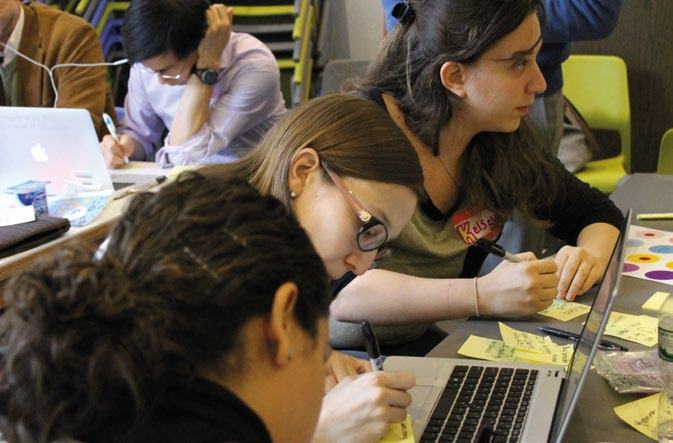
New York City Innovation Zone (iZone)
"...working in schools, working in external markets, and driving systemic reform"
Andrea Coleman, former CEO, iZone
Where they are based
New York City, USA (population of NYC: 8.3 million)
Location in government
City government
Mission statement
"In 2010, the New York City Department of Education (NYCDOE) launched the Innovation Zone (iZone), a dedicated Office of Innovation that would support schools in personalizing learning to accelerate college and career readiness among our students. Having started with 81 schools, the iZone now includes 300 schools from across the city."
What they do
Developing, funding and advising government and schools on innovations in education
What defines them
User-centred design
Size of team
40
Annual spend
£9.1 million (with £6.4 million from government and £2.7 million from other sources)
Launched
2010
Example of impact
iZone's iLearn programme is projected to save £6.6m ($10.8m) by 2015
Interesting Features
- Impact measurement
- Partnerships
The New York City Innovation Zone (iZone)
The New York City Innovation Zone (iZone) is a community of schools committed to personalising learning around the needs, motivations and strengths of each child, with the aim of accelerating college and career readiness. The iZone acts as an incubation lab for the city’s education department, working directly with over 300 schools, a range of companies and others in the education market, and the wider city government to influence policy reforms and to test and develop solutions that improve educational attainment across New York City.
Background
The iZone was set up in 2010 by Mayor Bloomberg and the then chancellor of the New York City Schools system, Joel Klein. Education reform in the city had started eight years earlier after NYC public schools had experienced decades of poor performance. During the first wave of reforms, Children First, the administration, sought to create more leadership, autonomy, and accountability at school level.
As a result of Children First, graduation rates increased by more than 40 per cent, bringing the city-wide graduation rate to 67 per cent. City Hall recognised that there was still some distance to go before all students successfully graduated ready for college and careers. The response was an innovation strategy, emerging as the Office of Innovation, and the establishment of the iZone, the first dedicated innovation initiative of its kind in the USA. Rather than replacing Children First, iZone worked alongside it. Andrea Coleman, the former CEO, noted that the iZone "attempted to create the space and promote innovation, skills and methods that would prompt and yield promising solutions that had the potential to radically move the needle as it relates to college and career readiness for our students”.
Since its establishment, the iZone has expanded its focus from the design and testing of personalised learning models to also address some of the system level barriers that prevent diffusion of effective approaches.
What it does
The iZone acts as an incubation lab for the Department of Education in New York City. It works on three levels, supporting innovation in schools, creating and stimulating external markets, and fostering wider systemic innovation, such as through policy reforms. Currently working with 300 schools, the iZone plans to continue expansion to include other schools across New York City in 2014.
The iZone develops initiatives with schools to promote ‘personalised learning’, an approach that utilises ideas, technologies and tools that work best for individual schools and their students. A good example is School of One, a programme that creates a customised timetable for each student, tailored to their learning needs, and best utilising teacher time (see text box for more details).
Schools in the iZone are held to the same levels of accountability on success metrics, such as attainment, as all other schools in New York. This scrutiny requires the iZone to support the schools to be creative and innovative, and to help them manage the risks involved with balancing innovation and sustaining high performance.
School of One
School of One strives to solve the issue of all children requiring different types of support in order to learn effectively.
Drawing on a complex set of algorithms that analyse each student's understanding of materials from each lesson, a customised schedule is created for the student to follow the next day. This schedule determines the learning modality, such as teacher-led instruction, student collaboration, or virtual instruction, as well as allocating the amount of teacher time to best leverage their expertise.
Challenges are the central method for encouraging iZone schools to innovate. Schools help set the challenges, and are involved in developing, testing and scaling solutions. An example is The Essential Allies Challenge to increase family engagement in support of student achievement. Schools are invited to design and prototype solutions that improve the relationship between schools and families. Following prototyping, schools that meet the benchmarks are eligible to receive up to $15,000 in funding for the continued design and implementation of their innovations.
Challenges, such as open calls and hackathons, are also used to grow the external technology sector, helping the iZone leverage expertise in developing software solutions that meet learning needs. An example is the Gap App Challenge, involving software developers creating games or programmes that help schools improve attainment in mathematics. The twelve winning entrants of 2013 are now working in a number of schools to pilot and test their products.
The third strand of the iZone's work involves 'systems level' change, whereby the iZone works to influence policy to foster innovation in schools. One example is the iZone's collaboration with the city's student enrolment team in the School Choice Design Challenge to help streamline the process for the 80,000 eighth grade students applying to the city's more than 700 high school programmes each year. From interviewing the enrolment team, families, students and school staff, the iZone team recognised that searching through a 600 page guidance book on the comparative merits of different schools was overly complicated. To develop alternatives, the iZone set the challenge for technology companies to compete in designing user-friendly tools for students and their families to use when selecting a high school. Six separate applications were developed and refined and will be promoted to families during the school enrolment season.
Impact
iZone's objective is to accelerate students to college and career readiness. The iZone is committed to using data to measure impact and to analyse outcomes at the classroom, school, market, and policy levels. Evaluation is tailored to each individual initiative, drawing on a range of methods, proportional to the stage of the innovation. Prototypes are quickly and cheaply tested, while the later stage innovations receive more intensive evaluation. The methods include:
- Educational return on investment (eROI) - a framework to estimate the outcomes from an investment compared to the likely outcomes in other settings, using inputs of cost and student/teacher outcomes. This helps iZone answer the following questions: is it lowering the cost to innovate; is it faster and cheaper; and do schools get what they need much more quickly and effectively?
- Administrative data – enabling the iZone to compare the performance of iZone schools to other NYC schools by using standardised government data, such as on assessment scores or graduation rates.
- Design-based evaluation – helping determine the 'how and why' of an intervention, through determining which inputs influence which outcomes.
- Formal trials, such as randomised controlled trials (RCTs) - approaches that measure an intervention's impact by comparing outcomes of the intervention group to a control group. These more in-depth methods are reserved for the big bet' solutions, those later stage innovations that have already demonstrated positive impact in prior, lower cost testing.
iZone uses these data sources, and in particular eROI, to determine which interventions should be scaled or further evaluated. The table opposite shows the outputs, outcomes and impacts for three iZone initiatives.
| | Gap App Challenge
Here are the seven national key results areas (NKRA) for the Government Transformation Programme (GTP):
- Addressing the rising cost of living (led by Deputy Prime Minister)
- Reducing crime (led by Minister of Home Affairs)
- Fighting corruption (led by Minister in the Prime Minister's Department, in charge of Law)
- Improving student outcomes (led by Minister of Education)
- Raising living standards of low-income households (led by Minister of Women, Family and Community Development)
- Improving rural basic infrastructure (led by Minister of Rural and Regional Development)
- Improving urban public transport (led by Minister of Transport)
PEMANDU has been given a mandate by the Prime Minister to initiate change in the Malaysian Government, and works closely with the ministries in charge of the areas covered by the GTP to make this happen. It helps teams across government with designing and implementing projects. While PEMANDU will review and report on progress, the successful delivery of GTP programmes are the responsibililty of the departments and teams that work with PEMANDU.
PEMANDU identified which parts of the public sector to target by conducting a series of extensive consultations, including a number of public surveys, as well as analysing Malaysian media to identify the most recurrent topics and issues related to public services. This led to the development of seven national key results areas (NKRA) for the GTP (see text box).
Having defined these key areas, the next step was to define how to achieve success and impact within each one. To start this process, PEMANDU organised a series of 'labs'. Over 250 of the best civil servants from Malaysian Government, including policemen, teachers, transport staff, and senior managers, spent around seven weeks working across each target area.
The ultimate aim of the labs was to develop new programmes and services that could help the minister achieve NKRA results, along with detailed plans for implementation. In the past, good ideas and initiatives struggled with making it up through the ranks. Prime Minister Idris Jala made clear that the lab approach started from the fundamental belief that, given the right context and support, civil servants would have the skills and capacity to develop innovative solutions.
Jala has explained how one of the key features of the labs is that they don't recognise existing hierarchies within ministries and agencies.
“I always believe that people actually know the solutions. The good ideas are already there, and people know these ideas, but the reason we don't move from ideas to results is because there are technical, political, administrative, process, and system hurdles.”
One of the labs has sought to develop solutions to reduce crime in Kuala Lumpur. The lab team knew that there were 2,892 police working across 501 geographical sectors in Kuala Lumpur. The team mapped every incidence of crime that took place in Kuala Lumpur over the previous two years and found that most of the crimes were committed in 11 hot spots. Their proposed solution was to redeploy 2,892 police to focus on those hot spots. This initial pilot proved a success and resulted in the redeployment of 20,000 policemen to primarily focus on 55 hot spots in just 12 months — the most significant redeployment of police in Malaysia's history, which resulted in a 35 per cent drop in reported street crime within one year.
PEMANDU developed programmes with the Ministry of Education to close educational gaps.

Other programmes focused on building the skills of civil servants to deliver better public services. In education, one idea was the restructuring of teacher training to close educational gaps, which has led to 300 teachers being trained to improve their work with children who have learning difficulties, and 3,494 private pre-school teachers trained on improving their delivery of pre-school education.
Based on the lab findings, feedback from surveys and open days where the unit shared its ambitions with the Malaysian public, PEMANDU was able to publish the GTP Roadmap report, which outlines the implementation plan and ambitions for the GTP.
Chris Tan, Director, of PEMANDU explains how a key success factor is the unit's ability to constantly monitor progress. He said, “the real secret is in the follow-through, in the systems used to monitor progress and senior buy-in to the process”.
The ability to connect very specific targets and indicators to the ideas and implementation plans that have been agreed in the lab sessions, and the Prime Minister's support for the GTP, also helps alleviate most of the challenge that the PEMANDU team encounter when pushing civil servants on implementation.
PEMANDU manages a dashboard that holds data on each ministry's progress. Progress is monitored and scorecards are updated on a weekly basis. This allows the team to rigorously monitor performance.
Every week, Idris Jala chairs a meeting with his PEMANDU Directors and the delivery teams from the respective ministries, with the sole purpose of discussing any emerging problems with implementation and progress in the ministries.
If ministries are falling behind, Idris Jala has the opportunity to elevate the conversation to the responsible minister. Every six months, the dashboards are shared among all cabinet ministers. This helps to drive internal competition; no one wants to be seen as falling behind.
PEMANDU also convenes an international panel of experts from the World Bank, IMF, Transparency International, and other governments from around the world to review progress on an annual basis. To test the NKRA impact captured internally, they have commissioned the consultancy Price Waterhouse Coopers to undertake an external review of progress.
The diagram illustrates PEMANDU's path to transformation, starting from a "Transformation Engine" which leads to "It operates differently Doing (action)", then to "It becomes a totally different organization Being (character)", ultimately achieving "To achieve Big Fast Results".
Impact
PEMANDU operates with a single measure of success — to what extent projects contribute to Malaysia becoming a high-income economy, as classified by the World Bank. Using these World Bank measures, the PEMANDU team has set the goal of achieving £9,111 gross national income (GNI) per capita by 2020. The economic progress is currently ahead of schedule with the current income just below £6,074.
On a micro level, PEMANDU measures its impact through levels of adoption of interventions by government and external audiences, changes in culture and level of innovation skills and capacity within government, and cost savings and improvement of outcomes against the NKRA.
To track these impacts, PEMANDU uses administrative data, user feedback surveys, and questionnaires. Each year, PEMANDU publishes an annual report outlining achievements under each NKRA, such as the number of teachers trained and kilometres of road built.
Highlights of the impact of PEMANDU's work on the GTP include:
- Supporting law enforcement to achieve a 35 per cent drop in reported street crime within one year
- A survey conducted by Transparency International's Global Corruption Barometer 2010 showed that 48 per cent of Malaysians felt that the government's efforts in fighting corruption were effective — a significant increase from 28 per cent in 2009
- In rural areas, approximately two million people benefited from projects that provided potable drinking water, extended electrical service, built roads, and restored housing
Interesting features
Leadership
Established by the Prime Minister and based within his department, one of the key features of PEMANDU is the strong buy-in its work has from senior political leadership. This makes it easy for PEMANDU to elevate implementation issues with involved ministries to the Prime Minister, and to easily coordinate efforts across government. To further strengthen its links to the political leadership, PEMANDU is governed by a board of politicians, chaired by the minister in charge of National Unity and Performance Management.
Partnerships
PEMANDU builds strong partnerships with the ministries across the Malaysian Government responsible for delivering the NKRAs. Each ministry has dedicated staff – many of whom attended the original lab sessions – to work closely with PEMANDU on implementing the initiatives. The PEMANDU team will often work in the respective ministries, as Tan notes, this ensures “that people do what they say they were going to do, and they deliver on what they say they are going to deliver, at the target budget, within the target timeframe”.
Methods
PEMANDU grounds its work on the Big Fast Results method, an approach that was originally developed in the private sector. The method helps monitor progress of large scale interventions. PEMANDU often receives visits from other governments interested in Big Fast Results, and the team is working closely with Tanzania and India on their efforts to implement the approach.
PS21 Office
Key Facts about PS21 Office:
- Where they are based: Singapore (population of Singapore: 5.4 million)
- Location in government: Central government
- Mission statement: "PS21 is the Change Movement of the Singapore Public Service. It encourages every public officer to be open to change, and to find better ways, ideas and possibilities to bring about improvement and innovation in their individual work or the work of the public service."
- What they do: Manage staff idea schemes, awards and prizes across government
- What defines them: Staff-led innovation
- Size of team: 43
- Annual spend: Not provided
- Launched: 1995
- Example of impact: An evaluation of PS21 estimated that over a year it generated 520,000 suggestions from staff, of which approximately 60 per cent were implemented, leading to savings of around £55 million.
“Staff suggestions were floated up to the senior management of each agency for consideration. When the senior management started to see good ideas coming up from the ground they started paying attention.”
Tay Choon Hong, Director, PS21 Office
Interesting Features
Icons representing "Leadership" and "Methods".
PS21 Office (PS21)
PS21 Office (PS21) is a team within the Public Service Division of the Singapore Prime Minister's Office responsible for driving change and innovation in the Singaporean Public Service. Launched in 1995, PS21 started from the government's desire to develop more employee-centered public management with the overarching aim of "preparing public services for the 21st century". PS21 has implemented a range of government programmes focusing on improving policy and service delivery, encouraging cross-agency collaboration and recognising public service innovation.
History
In 1995 the former Head of the Singaporean Civil Service, Lim Siong Guan, felt that the country's public service needed to have an agenda in place to help the country address emerging challenges to Singapore, such as economic competition, geopolitical shifts and demographic changes. Lim argued that, “the public service must go from being a mere service provider and regulator to being a catalyst for change.” PS21 was created in response to a mandate to drive change across the entire public sector.
When first launched, PS21 applied a top-down approach to change, with clear requirements for participation and compliance imposed on every government agency. However, PS21 faced resistance and critique from public agencies, that the initiatives were too prescriptive. Taking on board this feedback, PS21 has given agencies more flexibility in executing initiatives.
The most significant shift happened in 2008 when PS21 decentralised its approach and made individual ministries responsible for articulating and implementing the requirements for staff participation. While acknowledging the limitations of the initial top-down driven approach, Tay Choon Hong, Director at PS21, maintains that making participation mandatory at the beginning was a necessary ‘shock to the system', which brought staff-driven innovation on the agenda and kick-started the development of a new mindset amongst public officers.
What it does
PS21 has been described as the most comprehensive administrative reform to be introduced in Singapore, working on a wide range of initiatives to improve the quality and efficiency of public services and to boost innovation. At the heart of the PS21 movement is the ambition to improve the capacity of public officers to develop ideas and solutions that 'future-proof the Singaporean public services.
The PS21 team consists of 43 people and is funded directly through the Public Service Division in the Prime Minister's Office where the team is based. One of the teams' primary tasks is to develop and implement programmes directly aimed at involving and recognising public officers in increasing levels of innovation in public services.
One of the most prominent initiatives introduced under PS21 is the Staff Suggestion Scheme (SSS) (see text box) — a method for public officers to suggest ideas for public service improvement. In a single year SSS was estimated to have generated 520,000 suggestions for public service improvement. Other initiatives from PS21 include working with all ministries on getting staff to set up mandatory Work Improvement Team (WIT) projects — teams of public officers who are working together to collaboratively develop innovation projects.
One example involved a fighter jet engineer in the Singaporean Army who came up with a more effective way of scanning fighter jets for ‘leaks' after having seen how his son's optician used UV lights to scan for scratches to the cornea. His idea was to use the same technology to scan aircrafts, a method now widely used by the army.
Staff Suggestion Scheme
The Staff Suggestion Scheme (SSS) creates an opportunity for any public officer to directly submit ideas to improve public services. Once submitted, ideas for improvement are sent to a Central Steering Committee which is chaired by a Permanent Secretary, where they are vetted and considered for implementation.
Before the SSS, one of the big barriers to idea generation had been the hierarchy in each agency, where a senior manager's approval could make or break an idea. Alongside its primary focus of increasing the flow of ideas to improve public services, PS21 sees the scheme as a commitment to public officers, that every idea is welcomed and that every idea counts.
The next iteration of the scheme is a mobile app titled Post 'n' Poll that allows public officers to nominate ideas, which can then be voted on by all 139,000 public sector employees via the government's intranet.

The Post 'N' Poll app lets any civil servant report an issue or suggest an idea.
In another example, Chinese language teachers at Guangyang Primary School developed the Teaching Mandarin Through Kinesthetic Intelligence project. The teachers created a new teaching method using simple hand and body movements to represent the different strokes of the Chinese characters and pupils were taught to ‘act out' the strokes and form Chinese words in teams, which helped students increase their learning. The project was rolled out in the school through the entire lower primary level in 2012.
In addition to directly implementing programmes and processes that make it easier for public officers to nominate and develop their ideas, PS21 also runs the annual PS21 Excellence in Continuous Enterprise and Learning (EXCEL) Awards and Convention, which aims to promote and disseminate insights on innovation activities taking place across the public sector. It does this by awarding annual gold, silver and bronze awards to projects and individuals that 'exemplify the spirit of innovation'. For PS21, EXCEL is seen as the visible symbol of innovation in the public service.
Every year PS21 facilitates a process where all ministries can submit proposals that represent the work they have been doing on innovation. Before deciding which project to nominate, each ministry runs its own mini ExCEL fair or convention to identify the best projects to put forward. These projects then compete at a public service-wide level.
Projects are assessed based on three main criteria: level of innovativeness, impact and alignment with the thrust of public sector transformation. The selection process is managed by a committee consisting of a mix of heads of services and mid-level project managers and is currently chaired by the Permanent Secretary for the Ministry of Law. (See box text for one of the 2013 winning projects - Ageing in Place).
PS21 also publishes a bi-monthly magazine, Challenge, which promotes change and innovation initiatives that are taking place across the public service. The magazine is circulated to about 23,000 public officers while the online version has around 67,000 unique visitors. An email featuring highlights from every new issue is also sent to all 139,000 public officers.
In addition to its focus on enabling more staff-driven innovation, PS21 also supports initiatives aimed at improving the efficiency of public services. It develops service standards and guidelines to support agencies in delivering quality public services. It is also building up a network of service practitioners across agencies through regular sharing sessions, newsletters and an online community. The office also works closely with partners in the Civil Service College to run training programmes for public officers on communicating effectively with customers and coordinating with fellow officers to deliver integrated services.
PS21 does not provide any funding for projects, as these are typically sponsored by the departments and ministries in which they are based. Where projects need funding outside what the 'host' ministry can offer, PS21 will assist project teams in requesting additional funding from the Ministry of Finance.
PS21 EXCEL Gold Award Winner 2013 - Ageing in Place
The Ageing in Place project was awarded an EXCEL gold award in 2013 for its development of a high potential health innovation. Initiated under the Ministry of Health, the project provides holistic post-hospital discharge support for patients and carers in their homes. The rationale for Ageing in Place came within a year of the opening of Khoo Teck Puat Hospital in July 2010, as the hospital faced more demand for subsidised beds than it could meet.
Faced with the reality that Singapore is one of the fastest ageing societies in Asia, a team started hot-spotting high consumers of bed days to identify opportunities for intervention. A group of about 400 patients with three or more admissions in a six-month period, consuming about 9,000 bed days (equivalent to 1.5 wards) was identified.
The team conducted home visits to identify needs and unarticulated problems that caused these patients to become high consumers. Initial findings showed a big discrepancy in care provision between hospital and home, and studies showed that 70 per cent of health determinants such as medical, social, environmental and behavioural were modifiable.
The team went on to set up the programme, which focused on deployment of community nurses to provide post-discharge care in the patients' homes, personalised care plans, and nursing posts located in community centres to provide basic nursing support for early intervention. Results of the first 400 patients completing a six month period of care showed the average admission rate dropped from 3.6 times to 1.2 times per patient after the intervention.
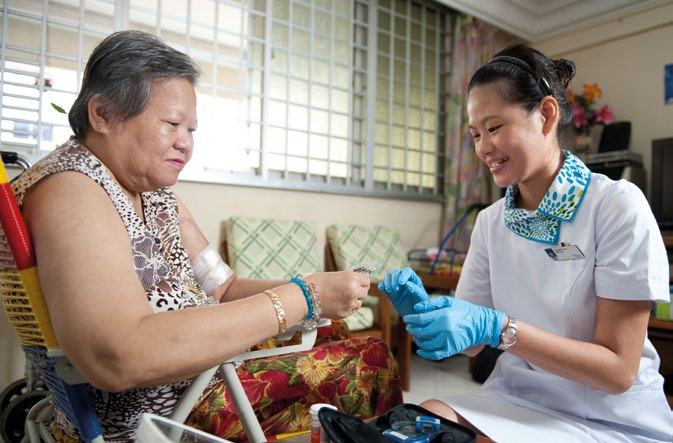
Impact
The three main indicators PS21 looks at when trying to understand the impact of its initiatives are the extent to which it has achieved a culture change in public services, impact on consumer satisfaction from PS21 initiatives and number of attendees in PS21 events, such as the ExCEL awards. These are tracked via internal surveys and research.
Studies of the PS21 movement in its early years provide an estimate of its financial impact. A study examining the period from April to December 1999 revealed WITs developing 14,228 projects, which were estimated to have generated savings of approximately £40 million. Alongside this, public officers used the SSS to contribute more than 520,000 ideas, of which approximately 60 per cent were implemented, leading to savings of around £55 million. The total cost savings from the WITs by 2002 was estimated to be £78 million.
Interesting features
Leadership
PS21 was initiated and driven by the Head of the Singaporean Civil Service, Lim Siong Guan. Reflecting on the development of the PS21 and the wider PS21 movement, Tay Choon describes how he sees the ownership and drive from Lim Siong Guan, the Head of the Civil Service, as one of the most important factors behind the success of PS21, “He took it upon himself as Head of the Civil Service to embody change. Year after year, through many platforms, Mr Lim reminded officers of the need to change and not just change for change sake, it's change for the purpose of making the public service much better”. Building on this, much of the success of the PS21 movement today can be found in the ability to connect ideas from frontline staff with heads of services, thereby getting senior public officers to champion new ideas for improvement.
Methods
Whilst many of the leading examples of public service innovation models we look at in this report focus on involving citizens in developing new ideas and insights to redesign or develop new public service models, PS21 provides an interesting example of the potential in creating systemic interventions that tap into the knowledge and creative potential in public officers. The staff suggestion and WIT schemes provide two examples of creating functions within government that enable more creation and better flow of ideas from public officers while the ExCel award and Challenge magazine seek to reward and incentivise participation in these and other public innovation schemes.
Seoul Innovation Bureau (서울혁신기획관)

Key Facts about Seoul Innovation Bureau:
- Where they are based: Seoul, South Korea (population of Seoul: 10.4 million )
- Location in government: City government
- Mission statement: "Using social innovation to improve citizens' lives"
- What they do: Engaging citizens online and offline to understand problems and generate solutions for governments to develop and adopt
- What defines them: Citizen-led innovation
- Size of team: 58
- Annual spend: £5 million
- Launched: 2013
- Key Achievement: Applying the social media tools used in the mayor's political field campaign to day-to-day government, rapidly increasing citizen engagement
Creating the world's first Social Innovation City
Interesting Features
Icon representing "Methods".
Seoul City Hall is undergoing rapid change. Led by a mayor on a mission to revolutionise the policy-making process, the city government is embarking on extensive civic engagement to help identify and solve challenges.
Background
South Korea is renowned for its rapid innovation and economic development over the past 30 years, yet government innovation is a nascent field, seen as counter-cultural and radical by many, which means it is often blocked or avoided.
Despite these challenges, Seoul Mayor Park Won-Soon is progressing with plans to turn Seoul into an innovation-led Sharing City, engaging citizens in the radical redesign of public services. To achieve this vision, Mayor Park created the Seoul Innovation Bureau. It is said to be the first city-level government structure of its kind anywhere in Asia.
From radical outsider to Seoul Mayor
Mayor Park Won-Soon had no experience in politics before taking office, having never been a politician or member of any of South Korean's political parties. Instead, he had a career as a public prosecutor and human rights lawyer, as well as the founder of a community foundation, a social enterprise and a think tank. His election slogan was to become a mayor who "truly changes the life of citizens", striving to be the world's first Social Innovation Mayor.
What it does
Reporting directly to the Mayor, the Seoul Innovation Bureau is a cross-departmental innovation unit with 58 staff members and an annual budget of £5 million. The overriding principle of the Bureau is that citizens are the main catalysts and sources of innovation, whether that be in identifying problems, clarifying issues or generating solutions. The Bureau team captures and orchestrates this knowledge and insight.
Establishing Seoul as the world's first Sharing City was a key priority for the Mayor. The advancements in online technologies and mobile phones have made it easier for the city to engage with citizens and companies, and to create the platforms for resources to be shared. To advance the Sharing City agenda, the Seoul Innovation Bureau oversees a range of projects to tap into dormant assets across the city, ranging from housing to hammers. Projects include:
- Tool Kit Centres that offer communities a shared space stocked with infrequently used items such as tools and suitcases for residents to borrow so that they don't have to individually buy and store them. Subsidies are available to encourage residents to create and manage one in their neighbourhood.
- The Generation Sharing Household service matches elderly people who have spare residential space with students in need of a place to live. In exchange for housing, students help out their elderly housemates with day-to-day tasks, such as shopping and cleaning.
- The Sharing Bookshelves project creates small libraries in apartment blocks to enable neighbours to share books.
- Open Closet was established to provide job seekers with appropriate clothes for an interview. Open Closet enables people to loan suits to job hunters, with the additional option to provide advice and guidance to candidates.

Citizens don't just contribute resources; they are also seen as the main driver of government innovation. Seoul Innovation Bureau involves residents in many aspects of decision making, for example, in budget decisions, where 250 residents were randomly selected to decide how £16.3m of the city's £607.4m budget should be spent. Citizens are also seen as a source of innovative ideas. The Seoul Innovation Bureau created an online portal established to solicit these ideas, with citizens able to vote on entries, prompting City Hall to explore those receiving the most votes every three months.
Offline, the Seoul Innovation Bureau works with departments across City Hall to support them to host listening workshops with citizens and policy makers to discuss particular topics. More than 6,000 of these have been held - allowing the government to hear from more than 600,000 citizens. There is also a newly established speaker's corner in City Hall for residents to record a video on any topic, which is then uploaded onto the Seoul City website. The Innovation Bureau also works with departments to create a temporary City Hall offsite, such as in a specific community or area of the city, enabling government staff to become immersed helping them to better understand the issues affecting residents.
The Seoul Innovation Bureau's remit is to solicit ideas and to then work closely with agencies across City Hall to put them into practice. Ideas from citizens that have been implemented include an automatically updating travel card for public transport. Another was a 'Pregnant Ladies First' badge, suggested in response to pregnant women being denied seats on public transport, leading to City Hall distributing these for women to wear when travelling throughout the city.
Impacts
The Seoul Innovation Bureau attempts to achieve impact in two areas:
- Engaging citizens: soliciting ideas and suggestions for improving public services
- Changing the culture of government: increasing the adoption of suggested changes and improvements by the relevant agencies and departments across City Hall
The Bureau does not currently have an evaluation strategy in place for recording impacts of its individual programmes, but it does record levels of activities and outputs. For instance, with Sharing City Seoul, it is measuring the increase in the number of 'sharing' companies and initiatives, as well as recording the number of residents attending events and workshops and suggesting ideas both online and offline. With its second objective of changing government culture, it views this as a longer term process, anticipating that it will take many years to see a marked shift in the workings of government.
Interesting features
Methods
The move toward a social innovation-led government is a departure from the cultural and bureaucratic norms of South Korean Government. One of the Bureau's key tools is social media. Mayor Park is applying the social media tools used in his political field campaign to day-to-day politics to help rapidly increase citizen engagement. Mayor Park himself is also active online, with over one million followers on Twitter and Facebook, and often directly answering enquiries from citizens.
Alongside engaging citizens through social media, the Seoul Innovation Bureau hosts policy workshops before decisions are made, invites ideas through its new portals, and promotes transparency by publishing all mayoral conversations and other decisions and discussions online.
Sitra

Key Facts about Sitra:
- Where they are based: Helsinki, Finland (population of Finland: 5.4 million )
- Location in government: National government
- Mission statement: "Sitra is building a successful Finland for tomorrow's world."
- What they do: Influencing government policy, designing prototypes and backing new ventures
- What defines them: A combination of impact investment, research and practical programmes
- Size of team: 110
- Annual spend: £22.1 million (2012)
- Launched: 1967
- Example of impact: Sitra estimates that its work on sustainable energy has led to around £1 billion in savings for the Finnish government
"...a change agent in society which is taking risk on behalf of the public and private sectors.”
Mikko Kosonen, President, Sitra
Interesting Features
Icons representing "Methods", "Resources", and "Leadership".
Sitra is Finland's innovation agency, and is endowed with public funding to enable experimentation and innovation in a range of sectors, from healthcare to sustainable energy. Their endowment has enabled them to work flexibly, helping transform government policy to successfully impact the Finnish economy and society.
Background
Sitra is one of the oldest publically funded innovation organisations in the world. It was founded in 1967 as an organisation of the Bank of Finland to honour the 50th anniversary of Finland's independence. In 1991, it transformed into an independent fund that reports directly to the Finnish Parliament.
Since it was set up in 1967, Sitra's mission has evolved. Until the early 1980s, Sitra focused on financing technological research and development. With the emergence of public funding agencies serving this purpose, Sitra shifted its focus to supporting venture capital activities in Finland (which did not exist at the time). In the mid-2000s, the venture capital market in Finland had developed to such an extent that Sitra once again decided to shift its focus toward its current mission, namely social innovation and systemic change.
What it does
Sitra's mission is to "build a successful Finland for tomorrow's world", with a particular focus on pioneering sustainable well-being, through achieving three strategic objectives:
- Creating incentives for meaningful care and for advancing new operating models and business operations for well-being
- Creating the conditions for a resource-wise, carbon-neutral society and for business operations advancing towards this goal
- Advancing sustainable well-being and employment based on new funding and operating models
Sitra employs 110 people, with primary funding from its endowment, which totaled £535 million in 2012. The endowment provides nearly £24 million a year, with all project funding and investment expenditure approved by Sitra's board.
Mikko Kosonen, Sitra's president, describes how it funds work in areas that other public and private sector funders often steer clear of, saying “the public sector tends to avoid risks and companies tend to invest in short-term initiatives. Sitra aims to serve as the risk taker for the public and private sectors to show that change can happen and it can be very positive”.
Sitra roughly splits its resources and activities between two types of projects, with half spent on innovation programmes that incorporate research and practical experiments such as Taltioni (see text box) and the other half invested in early stage companies.
With their innovation programmes, there are three main phases:
- The first phase uses different research techniques, from desk research to action based research such as ethnography to understand trends, opportunities and challenges within a given area, such as healthcare or community development.
- Insights from the research are used to develop scenarios or prototypes that illustrate how challenges and regulatory hurdles might be overcome. In the second phase, Sitra works with the stakeholders of the new service, such as local communities, institutions, and industry bodies, to turn prototypes into practice.
- In the final phase Sitra collects the key findings and results, presents them to relevant stakeholders and audiences, finds an exit-partner to continue the ‘concept-proven' activities and spreads the new ways of thinking and operating further in the society.
One example is From NIMBY (“not in my back yard”) to YIMBY ("yes in my back yard"), a project that explored how to increase community participation in shared decision-making, resulting in the development of Brickstarter, a crowdsourcing platform for citizen participation.
Taltioni - a practical programme experimenting with new approaches to healthcare
Funded, created and promoted by Sitra, Taltioni is an online service platform and database containing information about the health and well-being of Finns.
Taltioni was created to help shift the focus in healthcare from treating diseases to promoting better health and well-being. The platform enables patients to store and share any information related to their health, including vaccination data, laboratory test results, blood pressure measurements and even personal wellbeing information such as a jogging and diet diary.
Patients can share these data with their healthcare providers, caregivers and family members to provide a whole picture of their health with ample background data. Patients can use the site tools to monitor their own health and well-being independently and to create personal health programmes that are easily accessible and monitored by both the patient and healthcare provider.

Impact
Building on the insights from experiments and research, Sitra organises training and development sessions for leaders from across Finland. The overarching aim is to explore the structural and cultural changes required in Finland to foster longer-term sustainable development into the practices and management of economic policy.
The second area of Sitra's work is investments. In 2012, Sitra's investment portfolio included 32 companies across a range of sectors, from sustainable energy to biotechnology, all aiming to achieve substantial social impact along with a financial return on the investment. Examples from their investment portfolio include renewable energy companies AW Energy which is developing wave energy solutions; Savosolar, which works on solar energy; and biotech companies, such as FIT Biotech, which develops new vaccines.
Sitra's overarching goal is to positively improve Finnish economy and society. Some of the strongest evidence of impact is the uptake of its research in government policy and in public service delivery. One example is the Ministry of Employment and the Economy using Sitra's research to address barriers in the uptake of solar energy and other renewable resources amongst citizens and enterprises. Another example is Sitra's programmes that explore the development of biodynamic and local food businesses; lessons from which have informed the Finnish government's local food development programme.
In addition to influencing policy, Sitra has achieved impact through scaling new services and practical programmes. For instance, its Health Service Voucher has been adopted by more than 100 Finnish municipalities. Another example is their work in sustainable energy and energy efficiency. Collectively, Sitra's energy programmes are estimated to have saved Finland £1 billion.
Sitra's key indicators are determined individually for each project, and may include the level of adoption of interventions by government and external audiences, changes to policy and legislation and the extent to which projects have delivered cost savings in government and achieved public or consumer satisfaction, and the number of new businesses and pilots generated. Due to its focus on energy and the environment, Sitra also puts a strong emphasis on tracking indicators in this area, such as reduction in CO2 emissions and energy consumption.
Sitra's progress is tracked using a customised “steering panel", in which each project has an explicitly stated outcome and impact goals. These goals are analysed on a quarterly basis, at project completion, and three years after project completion to understand what lasting impacts have been created. The methods used are a mix of administrative data, user feedback surveys, focus groups, qualitative interviews, questionnaires or surveys, progress against a logic model or theory of change, and external expert reviews.
Interesting features
Methods
As mentioned above, Sitra's mission is to build a successful Finland for tomorrow's world'. The organisation has evolved over the 47 years since it was established, successfully reinventing itself to adapt to changes in society and economy to ensure that it remains relevant.
There have been three main periods of reinvention. After originally focusing on financing technological research and development, in the 1980s Sitra recognised that public bodies were emerging to serve this need so it shifted its focus towards supporting venture capital activities, which at the time did not exist in Finland. In the mid-2000s, as the venture capital market matured, Sitra once again shifted its focus, this time to its current focus on social innovation and systemic change.
Sitra's ability to reinvent its purpose and focus onto emerging needs is often referred to as one of its key characteristics. An evaluation in 2012 concluded that “throughout Sitra's existence, its role has been to make new initiatives and to launch reform support processes by acting as a pioneer in social innovation. At the same time, it has become essential to abandon old operating models and content, as other actors have entered the fields opened up by Sitra”
Resources
With an endowment of £535 million, of which it spends between £20- and £30 million each year, Sitra has the financial capacity to take on large and complex projects, such as its work on healthcare reform or renewable energy solutions. This capacity was emphasised in an analysis of Sitra programmes, which highlighted that Sitra can ‘take initiatives and act as a forerunner for new institutional or organisational innovations', which puts it in a unique position within the Finnish innovation ecosystem.
Leadership
Mikko Kosonen, President of Sitra, emphasises that the governance structure of Sitra is one of the most interesting features. Sitra's main board is made up of senior civil servants, including permanent secretaries, and leading academics. Alongside this, Sitra has a supervisory board made up of Members of Parliament from the Supervisory Council of the Bank of Finland, which monitors Sitra's operations and financial performance.
This creates a governance structure which is both closely aligned and overseen by government officials, enabling Sitra to stay relevant to political priorities, but with the freedom to deliver new experimental activities without budgetary delays.
The Australian Centre for Social Innovation (TACSI)

Key Facts about The Australian Centre for Social Innovation (TACSI):
- Where they are based: Adelaide, Australia (population of Australia: 23.2 million)
- Location in government: Regional government
- Mission statement: "To build the innovation capacity of Australia's social change sector and help tackle our toughest problems."
- What they do: Practical programmes, challenge prizes and training
- What defines them: Co-production
- Size of team: 27
- Annual spend: £2.2 million (£1.5m from government, £0.7m from other sources)
- Launched: 2009
- Example of impact: An evaluation of TACSI's Family by Family programme found it had a 90 per cent success rate in improving family life.
“Our role is to take organisations in Australia on a journey towards becoming high-impact social innovators.”
Carolyn Curtis, CEO, TACSI
Interesting Features
Icons representing "Team", "Partnerships", and "Methods".
Footnotes:
The Australian Centre for Social Innovation (TACSI) is a social innovation lab with a mission to tackle some of Australia's most pressing economic, social, environmental and cultural challenges. It attempts to do this by "cracking open the current systems at crisis points" , through designing new services and solutions in partnership with citizens and service users.
Background
TACSI was established in 2009 as an independent not-for-profit organisation with £3.3 million grant seed-funding from the South Australian Government. The original idea came from the South Australian Premier Mike Rann, and his creation of the Adelaide Thinkers in Residence, a project providing a means of generating new ideas for the state. Geoff Mulgan, current CEO of Nesta, was the thinker in residence between 2007 and 2008, and used his residency to focus on ways of making practical social change by transforming innovative ideas into lasting action. He recommended that “a new institution to act as a catalyst for innovation in South Australia and beyond” was created, prompting the launch of TACSI.
Brenton Caffin, founder and former CEO of TACSI, described how the process of setting up TACSI involved six years of engaging stakeholders and finding inspiration from organisations like MindLab in Denmark, Kennisland in the Netherlands and Participle, the Design Council and the Young Foundation in the UK.
The seed-funding for TACSI expired in 2013 and the organisation has since then evolved into a self-sustaining not-for-profit organisation, funded through grants and contracts with partners in the social, private and public sectors.
What it does
TACSI focuses its activities on two main areas. The first is on 'doing' — working on practical projects that solve problems for three segments of citizens: families, older people and indigenous Australians. The second focus is on taking the learning from practical projects and using it to build the capacity of organisations inside and outside of government involved in delivering public services to work on social innovation.
All of TACSI's work is guided by a belief that co-production, where citizens and professionals work together to co-design and co-deliver projects, holds the key to solving social challenges. The seed-funding from the South Australian Government enabled TACSI to test out its methods and approaches in projects such as Family by Family (see box text) and use these to convince the public sector of the value in, and potential of, investing in social innovation projects.
In the design and implementation of projects, TACSI relies on a number of methods and tools from business and management, design thinking and social sciences (see diagram opposite).
While each project is tailored to the specific context and social challenge that the project is trying to address, all projects begin with extensive research, using ethnographic methods to observe and understand service users and their lived experiences. Insights from this research are used by TACSI as the building blocks to redesign an existing service or create a new one.
To understand the feasibility of the new service, the team develops prototypes of new solutions and tests them out a on a small scale with service users and public service partners. In its projects, TACSI spends significant resources on identifying what needs to change in order for the new prototype service to be implemented.
Design
- Rapid Ethnography
- Guided Interviews
- Experience Prototyping
- Paper Prototyping
- Visual Methods
Business
- Business Model Canvas
- Lean Start-up
- Theory of the Business
- Job-to-be-done
- Strategic Choice Framework
Social Science
- Program Logic
- Realist Evaluation
This involves working closely with the stakeholders that 'own' the public services that TACSI is designing new prototypes for, such as social care providers, identifying what it would take for them to take the project from prototype to mainstream service. This includes identifying if and how old services could be decommissioned to enable the commissioning of the new service.
This process of implementation was originally called Radical Redesign, however, Carolyn Curtis, CEO, TACSI, says that it have since abandoned this name as 'radical' dissuaded public service partners collaborating on the project.
Family by Family was the first solution designed and delivered by TACSI. The project is a new model of family support designed with families to address the growing demand on crisis services and the increasing number that are unable to manage chronic stress and isolation.
TACSI worked with more than 100 families to tackle the problem of stress causing family breakdowns. This enabled TACSI to identify causes of crisis and isolation and potential solutions. These led to prototyping and later scaling the Family by Family network, where families that have experienced and overcome hardships and grievances are trained and paired with other families currently in stress but eager to make improvements.
One of the insights from its work with stakeholders in charge of delivering main stream services was the need for TACSI to provide clear evidence of the impact of its work. In 2009, Australia had experienced a 51 per cent increase in the number of children removed from their families and placed in out-of-home care since 2005, providing the financial and moral drive for the Family by Family project. TACSI worked with external evaluators who have estimated that for every £1 invested in Family by Family, it generates £7 of savings by keeping children out of state care. This was one of the primary reasons behind the South Australian Government funding TACSI with £1.53 million in 2013 to grow and expand the service over the next three years.
In 2010 TACSI ran the Bold Ideas Better Lives Challenge, which set out to identify some of Australia's most successful social innovations, by asking the question "what do you think the big problems are facing our society and how do you think we can solve them?" TACSI received 258 proposals and ultimately eight winners shared £547,000 of funding along with mentoring support from TACSI. There were two goals for TACSI's challenge prize: first, to identify the most promising social innovations and support these to grow and second, to provide a quick way for TACSI to map the Social Innovation Community to “get a sense of what was out there", without being restricted to a particular sector, domain or issue.
In addition to its work on designing services, TACSI uses its research to inform policy development. TACSI is currently working with a number of Commonwealth agencies to identify opportunities to improve transitions from care and custody into adulthood. To understand what can be done, TACSI is working with 18 to 21 year olds who have exited care or custody and live in the greater Adelaide area, to understand their hopes and goals for the future and to see how services can help or hinder their progress.
Image caption: Family by Family is TACSI's most successful programme. Image courtesy of The Australian Centre for Social Innovation (TACSI).
Impact
The Family by Family initiative provides the most tangible example of TACSI's impact in achieving its goal of redesigning services. To calculate the impacts of Family by Family, TACSI worked with Community Matters, an evaluation company, and found a 90 per cent success rate in improving family life for those in the programme, generating significant cost savings, estimated at saving £7 to government for every £1 invested in it. The data from the evaluation of Family by Family helped TACSI receive an additional £1.5 million funding in 2013 from the South Australian Government to help grow the programme.
Beyond individual programme evaluations exploring service redesign, TACSI have found it challenging to measure their impact on wider culture change in public services, and the extent to which TACSI is influencing the spread of co-production across government. Carolyn Curtis notes, “It's relatively easy to build and measure short term satisfaction through participation in workshops. It's much harder to change and measure long term behaviour of people and the systems. When we work out how, we'll be clearer on what are the interim indicators of success”.
Interesting features
Team
When setting up the organisation in 2009, one of the early challenges was a lack of service design and co-production skills in Australia. To address this TACSI recruited staff internationally, bringing in service designers from the UK to help get the first projects off the ground and build the service design and co-production skills within the newly formed TACSI team.
Partnerships
Although it operates as an independent not-for-profit organisation, a key feature of TACSI is its strong partnership with government. TACSI's initial seed funding from government and the political support from the South Australian Government was crucial in getting the organisation off the ground and helped it develop proof of concept for its methods. An additional £1.5 million investment from the South Australian Government has helped further grow TACSI's flagship programme, Family by Family.
Methods
At the core of TACSI's methods and approaches is a belief "that social policy and programs can't be tested in laboratory conditions the way a vacuum cleaner or a new drug can". To address this challenge, TACSI, with inspiration from social sciences as well as design and business thinking, developed a co-production methodology to develop solutions directly with service users and those responsible for delivering them.
VINNOVA
VINNOVA is Sweden's innovation agency, funding a large portfolio of R&D collaborations between companies, universities, research institutes and the public, helping boost the innovation capabilities of the Swedish public and private sectors.
"We are supporting companies and organisations that would like to test out new ideas of how they can become more innovative" Charlotte Brogen, CEO, VINNOVA
Where they are based
Stockholm, Sweden (Population of Sweden: 9.7 million )
Location in government
National government
Mission statement
"VINNOVA aims to strengthen Sweden's innovativeness, aiding sustainable growth and benefiting society."
What they do
Influencing government policy through research, funding R&D, and backing new ventures
What defines them
Cross-sector collaboration
Size of team
200
Annual spend
£450 million (2013) (£225m from government, and £225m from other public and private sources )
Launched
2001
Example of impact
In 2013, VINNOVA supported more than 2,400 projects to promote collaboration between companies, universities, research institutions and the public sector across 11 strategic areas .
Interesting Features
Background
VINNOVA was established in 2001 by the Swedish Government, as a government agency working under the Ministry of Enterprise, Energy and Communications. It was created as a merger of a number of existing public agencies and funds responsible for R&D funding, which the government decided to bring into one organisation. In recent years, VINNOVA has increased its focus on providing funding for initiatives that increase the public sector's innovation capacity.
What it does
VINNOVA's overarching mission is 'the promotion of Sweden's innovation capacity for sustainable growth'. It aims to promote collaboration between companies, universities, research institutes and the public sector. It has 200 employees and an annual budget of £225 million that was used in 2013 to support 2,400 projects across 11 strategic areas.
The majority of VINNOVA's activities are concentrated on providing R&D funding across 11 strategic areas, which are defined by the Swedish Government. These strategic areas include finding new solutions to meet the challenges of a rapidly growing elderly population and exploring leadership and organisational processes than can support and develop innovation capacity. Some of the programmes involve funding research. Others involve organisations applying for funds for their development projects.
Based within government, a large proportion of VINNOVA's projects are delivered in partnership with public sector organisations. Projects include Attract which supports the building of sustainable attractive housing in cold climates; another project, in collaboration with Gothenburg Hospital, explores ways to reduce blindness in infants. Across the portfolio, 58 per cent of funding is spent on collaborations with universities and research organisations, and 28 per cent on funding companies. The remainder of funding is spent on funding projects with public and third sector partners.
In addition to funding from the Swedish Government, a large proportion of VINNOVA's funding comes from the European Commission. VINNOVA has set up a department in Brussels which helps broker relations between European funding and potential partners in Sweden, including academics and entrepreneurs.
What is particularly interesting about VINNOVA is how, as a traditional R&D funding agency, it has increased funding for initiatives that build the public sector's innovation capacity. This includes a commission from the Swedish Government to create a strategic work programme on using procurement as a driver for more public innovation, exploring how government can aide innovation and growth as a buyer and consumer, and taking an active role in creating new markets and enabling new business ideas. Innovative Procurement X is one of the initiatives supported as part of this project to demonstrate how public sector demand can actively drive the development of innovative products and services.
VINNOVA's model of supporting innovation in procurement
Innovation Centres
- Capture ideas from individuals and companies
- Promote creativity
- User-driven innovation
- Creating projects
Testbeds
- Does it work?
- Does it provide value?
- Validate and demonstrates
- Create generic implementation models
Innovation Procurement
- Identify innovation needs
- Challenge the industry
- Respond to the needs of your organization
- Create new markets
Led by Inköp Gävleborg, a Swedish company owned by the Gävleborg county government, Innovative Procurement X is funded by VINNOVA to explore new ways of procuring meals for the elderly. Inköp Gävleborg and its local government partners are using participatory research with the elderly to understand how meals could be improved, with the aim of creating new models for procurement. By 2015, lessons from Innovative Procurement X and similar projects supported by VINNOVA will be developed into more generic tools to support governments using procurement as a driver for innovation.
Another area of VINNOVA's work is helping to promote the commercialisation and spread of ideas in the health system. Through funding their Innovation Centres and Test Beds programme, VINNOVA is supporting health professionals to develop and test out ideas within county councils and municipalities.
VINNOVA has a wide range of programmes underway in a number of policy areas. This prompted The Organisation for Economic Co-operation and Development (OECD) to comment in 2012 that VINNOVA is a “bold and risk taking actor" in the Swedish innovation system. Yet the OECD also said the broad portfolio is a potential weakness, with a risk of spreading its resources across too many areas. OECD compares VINNOVA to TEKES, the Finnish Funding Agency for Innovation in Finland and The Austrian Research Promotion Agency (FFG) in Austria. These organisations have similar remits, but significantly higher budgets per capita.
Impact
Previous studies show how VINNOVA's long term work on innovation policy is helping define new fields of research, while also supporting and helping expand programmes developed through collaborations between companies and universities. VINNOVA tries to measure the impacts of projects it funds, but emphasises that this is often very challenging, particularly as many projects may show impact many years after the funding from VINNOVA has ended. Going forward, VINNOVA is seeking to develop a framework for more systematically measuring project impacts.
Interesting Features
Resources
With a yearly budget of £225 million from the Swedish Government, VINNOVA has a large financial capacity to initiate projects and drive change at scale. All VINNOVA-funded projects must be co-financed by at least the same amount.
Partnerships
Building on its experience of funding R&D projects delivered by universities and private businesses, VINNOVA is now building strong partnerships inside government to help develop new solutions. These partnerships are developing as part of VINNOVA's work to test and scale innovative ideas in health, and then their work to explore how government procurement can drive innovation.
What we have learnt about the i-teams
When setting up an i-team, a government must decide how large it should be, where it should be "positioned" within government, what resources it needs, what approaches and methods it should adopt, who it should partner and collaborate with, and how it should measure its impacts. Looking across the 20 i-teams we studied, there are interesting patterns and trends that can help to guide these decisions.
Methods
All i-teams use a range of methods. Some i-teams build their identity and philosophy around the application of a particular method, such as MindLab's use of human-centred design, La 27e Région's "Friendly Hacker" method, Performance Management and Delivery Unit (PEMANDU)'s "Big Fast Results", or the New Orleans Innovation Delivery Team's application of the four-step Innovation Delivery model to a range of city challenges.
What distinguishes i-teams is that they generally adopt approaches that are unique within government. For instance, The Australian Centre for Social Innovation (TACSI) and Centro de Innovación Social (Centre for Social Innovation) predominantly draw on user-centred design methods, such as art-based tools or ethnographic methods. Open innovation methods are also commonly used, with challenge prizes being a key feature of the work of New York City Innovation Zone (i-Zone) and Nesta Innovation Lab, whereby solution providers outside of government win awards, recognitions or contracts for their intervention. Awards are also used by the Centre for Public Service Innovation and PS21 Office (PS21) to recognise and celebrate innovation efforts by civil servants, helping to share innovative ideas across government.
Citizen engagement is both a mission and a method for stimulating innovation across a number of i-teams, most strongly seen in the Seoul Innovation Bureau and the Mayor's Office of New Urban Mechanics (MONUM). In both instances, social media is a key engagement tool. A commitment to open innovation and transparency is common, such as with Open Mexico publishing all dashboards publically online to enable citizens to hold government departments accountable.
Interestingly, only MindLab and the Centre for Public Service Innovation describe their office space as being important to their work. Both believe that neutral space, which is literally and metaphorically apart from the day-to-day of government, helps to engage civil servants to promote more creative ways of thinking, whilst the other i-teams do not identify their working space as part of their innovation toolkits.
The methods used by the i-teams are vital to making their offer clear. Their work by definition is experimental, novel and often contrasting to the ways in which wider government operates. A striking number of the i-teams have tried to clearly communicate how they work, and the processes and issues they engage in, helping to engage partners, make their offer clear – and crucially, help demystify the innovation process.
What they do
i-teams use a range of tools, and undertake a mix of activities, such as training, grant giving or evaluation. They typically draw on a more diverse and unique set of tools than those in wider government. The diagram below shows the mix of activities that each i-team undertakes.
Number of activities undertaken by the i-teams
|
Citizen Engagement |
Consulting |
Evaluation |
Grant Giving |
Idea Development |
Idea Generation |
Investing for Returns |
Policy Change |
Training |
Other |
Data not provided |
| Barcelona Urban Lab |
X |
|
|
X |
X |
X |
|
X |
|
|
|
| Behavioural Insights Team |
X |
X |
X |
X |
X |
X |
|
X |
X |
|
|
| Centre for Public Service Innovation |
X |
X |
X |
X |
X |
X |
|
X |
X |
|
|
| Centro de Innovación Social |
X |
X |
X |
X |
X |
X |
|
X |
X |
|
|
| Investing in Innovation Fund (i3) |
X |
|
X |
X |
X |
X |
X |
|
|
|
|
| Fonds d'expérimentation pour la jeunesse |
X |
|
X |
X |
X |
X |
X |
|
|
|
|
| La 27e Région |
X |
X |
|
|
X |
X |
|
X |
X |
|
|
| Mayor's Office of New Urban Mechanics |
X |
X |
X |
|
X |
X |
|
X |
X |
|
|
| MindLab |
X |
X |
X |
|
X |
X |
|
X |
X |
X |
|
| Nesta Innovation Lab |
X |
X |
X |
X |
X |
X |
X |
X |
X |
|
|
| New Orleans Innovation Delivery Team |
X |
X |
X |
X |
X |
X |
|
X |
X |
|
|
| New York City Innovation Zone |
X |
X |
X |
|
X |
X |
|
X |
X |
|
|
| NYC Center for Economic Opportunity |
X |
X |
X |
X |
X |
X |
X |
X |
X |
|
|
| Open Mexico |
X |
X |
X |
X |
X |
X |
|
X |
X |
|
|
| PEMANDU |
X |
X |
X |
X |
X |
X |
|
X |
X |
|
|
| PS21 |
X |
X |
X |
|
X |
X |
|
X |
X |
|
|
| Seoul Innovation Bureau |
X |
X |
X |
X |
X |
X |
|
X |
X |
X |
|
| Sitra |
X |
X |
X |
X |
X |
X |
X |
X |
X |
|
|
| TACSI |
X |
X |
X |
X |
X |
X |
|
X |
X |
|
X |
| VINNOVA |
X |
X |
X |
X |
X |
X |
|
X |
|
|
|
What i-teams create and produce
As well as using a range of methods, the i-teams also vary greatly in the different types of outputs they generate. Written documents continue to be one of the primary currencies of government, but none of the i-teams rely exclusively on simply writing recommendations. Instead, all try to influence change more directly and are associated with bringing new ideas to life. Their outputs can be grouped into the following six categories, with many producing more than one:
- Designing prototypes
A large proportion of the i-teams, including the Mayor's Office of New Urban Mechanics, the NYC Center for Economic Opportunity (CEO), Nesta Innovation Lab and TACSI, design and test new prototypes. Their aim is to test models that can be adopted by government.
- Backing new ventures
Some of the i-teams invest for a financial return by creating new enterprises. Sitra has a dedicated venture arm that creates and backs a portfolio of health and clean-tech companies, while the Centre for Public Service Innovation has a dedicated incubation space for growing businesses.
- Evaluating programmes
The primary aim of funds like Investing in Innovation (i3) and the Fonds d'expérimentation pour la jeunesse (Experimental Fund for Youth), as well as units like iZone and the Center for Economic Opportunity, is to understand the impact of innovative programmes. All of these use rigorous evaluation to identify which innovations should be scaled up.
- Policy influence through research
All of the i-teams do research of some form, from the Seoul Innovation Bureau's workshops to understand consumer insights and help reframe issues and challenges, to VINNOVA's horizon scanning to understand emerging fields and the Behavioural Insights Team's use of randomised controlled trials (RCTs) to test ideas. As well as using this research to develop and inform their own work, i-teams also use it to produce broader recommendations and guidance to government.
- Skills-building and changing government culture
Many i-teams strive to create a culture more conducive to innovation in government by running workshops, conducting training sessions, and helping other civil servants to design pilots. La 27e Région's work on the La Transfo (The Transformation), whereby they work with staff to build innovation labs within regional government, is a leading example.
- Communications and marketing
Some of the i-teams systematise and spread innovations by documenting the development of specific solutions, promoting these to a wide audience, and crediting the government officials responsible. For instance, the Centre for Public Service Innovation publishes the Innovations that Work journal, detailing innovation practice and efforts in specific areas of government, and PS21 has a bi-monthly magazine circulated to 23,000 civil servants to showcase and highlight work underway.
Size of Team (Number of People)
The chart illustrates the size of teams for various innovation entities. Sizes range from 5 members (Mayor's Office of New Urban Mechanics) to 200 members (VINNOVA), with several organizations clustered around 12-40 members. Notably, PEMANDU has 135 members, and Seoul Innovation Bureau has 110.
Size and skills of the i-teams
The size of the i-team is linked to the scope and breadth of its mandate. There is great variation in the team size, ranging from five team members in the Mayor's Office of New Urban Mechanics up to 200 team members in VINNOVA.
A team with experience in both the private and public sector is an important feature of the i-teams. Most, if not all, of the i-teams leaders have experience both in government and outside. This mix of insider and outsider knowledge extends to the core team, with staff actively recruited with private or not-for-profit experience, as well as prior knowledge of government. For both leaders and their teams, this diverse experience helps contribute fresh ways of thinking, with sufficient inside experience to know how to navigate government and engage elected leaders.
There are a number of key skills that many i-teams rely on. Some of these skills are relatively new and also unique compared to typical public sector skillsets. La 27e Région's multidisciplinary team combines social research and design; the Mayor's Office of New Urban Mechanics includes experts in technology development and coding; Sitra has staff with venture experience; and MindLab's team includes anthropologists. Some i-teams, including the Nesta Innovation Lab, New Orleans Innovation Delivery Team, Centre for Social Innovation, and PEMANDU, deliberately recruited a mix of staff with backgrounds in the public, private and not-for-profit sectors to help bring different perspectives to government. There are also more traditional skills that are core to the i-teams, including strong project management, data analytics, and communications.
The degree of freedom i-teams have to recruit talented individuals depends on their relationship with government, and the HR systems in place. Some are based within government and are confined to hiring from the existing civil service pool, which can be limiting. However, some, like the New Orleans Innovation Delivery Team, have been enabled to navigate around these internal processes and hire talented people from outside government. The i-teams that operate at arms-length or independently from government, such as Sitra and Nesta, have much greater freedom in recruiting.
Another recruitment challenge has been finding the required skills locally. TACSI and PEMANDU, for example, had to recruit internationally to secure people with the necessary skills. Other i-teams invested time and resources in building skills internally, helping to create a cohort of new professionals.
Funding per year* (£)
|
Budget from Government (per year) |
Budget from other sources (per year) |
Total |
| Barcelona Urban Lab |
£0.2m (2013) |
|
£0.2m |
| Behavioural Insights Team |
£1m (2014) |
|
£1m |
| Centre for Public Service Innovation |
£1.3m (2013) |
|
£1.3m |
| Centro de Innovación Social |
£2.3m (2013) |
|
£2.3m |
| Fonds d'expérimentation pour la jeunesse |
£37.8m (2013) |
|
£37.8m |
| Investing in Innovation Fund (i3) |
£91.7m (2013) |
|
£91.7m |
| La 27e Région |
£0.6m (2013) |
|
£0.6m |
| Mayor's Office of New Urban Mechanics |
£0.5m (2013) |
|
£0.5m |
| MindLab |
£1m (2012) |
|
£1m |
| Nesta Innovation Lab |
£15.4m (2014) |
|
£15.4m |
| New Orleans Innovation Delivery Team |
£0.7m (2014) |
|
£0.7m |
| New York City Innovation Zone (iZone) |
£9.1m (2013) |
|
£9.1m |
| NYC Center for Economic Opportunity |
£60.7m (2014) |
|
£60.7m |
| Open Mexico |
£1.2m (2014) |
|
£1.2m |
| Performance Management and Delivery Unit (PEMANDU) |
£7.3m (2011) |
|
£7.3m |
| PS21 |
Will not disclose |
|
|
| Seoul Innovation Bureau |
£5m (2014) |
|
£5m |
| Sitra |
£22.1m (2012) |
|
£22.1m |
| TACSI |
£2.2m (2014) |
|
£2.2m |
| VINNOVA |
£450m (2013) |
|
£450m |
* Figures rounded to one decimal place
Funding from government and other sources
Government is the primary source of funds for the i-teams, and the levels of funding vary greatly. For example, Barcelona Urban Lab spends £0.2 million a year, while VINNOVA has an annual budget of £187 million. The level of funding is not indicative of whether the team works at a national or regional level, but it does influence how it works, a point we return to later. Funding mechanisms fall into four overlapping categories:
- Direct government funding
Many i-teams, including Barcelona Urban Lab, NYC Center for Economic Opportunity, the Centre for Social Innovation, the Mayor's Office of New Urban Mechanics, MindLab, PEMANDU, and Seoul Innovation Bureau are funded like any other government team or agency, with funding for staff costs covered by their host departments. In most instances, the team members are employed directly as civil servants.
- Contract funding from government
Other i-teams, such as TACSI, receive grants from government sponsors, while La 27e Région has service contracts with individual French regional governments.
- Endowment
Sitra and Nesta Innovation Lab are examples of organisations whose primary funding comes through publically funded endowments. The organisations use a proportion of their endowments each year to fund their work.
- Fundraising outside government
At least half of the i-teams leverage funding from external sources, such as philanthropic foundations, corporate partners, or matched funding as an explicit requirement when awarding funding to external organisations.
The total financing for most i-teams is often a hybrid. As an example, 23 per cent of the funds supporting the Experimental Fund for Youth came from private contributions. The iZone and Centre for Social Innovation have dedicated funding vehicles that help government to leverage funding from external sources. Other i-teams have an explicit strategy for matching funds, such as the Nesta Innovation Lab, which seeks to match expenditure from the endowment.
The i-teams use money in various ways. One group, including Seoul Innovation Bureau, MindLab, New Orleans Innovation Delivery Team, and the Behavioural Insights Team, spend their allocated funding on staff costs, with their support to government as intellectual input and human capital. Another group of i-teams, including the Nesta Innovation Lab, NYC Center for Economic Opportunity, and Mayor's Office of New Urban Mechanics, provide funding directly to support innovators, both inside and outside government. The package of support typically mixes finance with technical assistance in areas such as business planning or evaluation design.
Focus and role in the innovation process
While all the i-teams promote and enable innovation in government, they focus their efforts on different stages of the innovation process.
The majority of teams focus on the early stages of the innovation process exploring opportunities and challenges, generating ideas and developing and testing these. Typically, i-teams that are responsible for more stages of the innovation process receive higher levels of funding. For instance, the smaller i-teams like Barcelona Urban Lab, La 27e Région, and the Mayor's Office of New Urban Mechanics focus on exploring and developing new ideas, but don't have responsibility for implementing pilots. Some – including the New Orleans Innovation Delivery Team and the NYC Center for Economic Opportunity – take responsibility for growing, scaling and spreading new approaches. Larger i-teams with more resource and which are independent from government, like Sitra and Nesta Innovation Lab, work to scale these innovations and influence the wider systems.
Other i-teams, like the Experimental Fund for Youth, and, to a certain extent, the Investing in Innovation fund (i3), focus on what could be perceived as a market failure. They specifically support the evaluation of innovations in order to help build a case for the implementation, growing and scaling of new types of effective practice in government.
Proximity to executive power
| Based in and agenda set by President or Mayor's Office |
Based within the government department or agency which manages them |
Co-owned, with more than one department setting the agenda |
Independent entity but agenda set by and wholly funded by government |
Independent organisation with government funding, but autonomy to set own agenda |
| Mayor's Office of New Urban Mechanics |
Barcelona Urban Lab |
Behavioural Insights Team |
Center of Public Service Innovation |
Nesta Innovation Lab |
| New Orleans Innovation Delivery Team |
Centro de Innovación Social |
MindLab |
La 27e Région |
Sitra |
| NYC Center for Economic Opportunity |
Fonds d'expérimentation pour la jeunesse |
VINNOVA |
|
TACSI |
| Open Mexico |
Investing in Innovation Fund (i3) |
|
|
|
| PEMANDU |
New York City Innovation Zone (iZone) |
|
|
|
| PS21 |
|
|
|
|
| Seoul Innovation Bureau |
|
|
|
|
Location in government and proximity to executive power
An i-team's proximity to government and executive leadership is a question of mission and mandate. Some of the i-teams are physically based in the mayor's or president's office, with their agenda directly set by their executive leader. These include the Mayor's Office of New Urban Mechanics and NYC Center for Economic Opportunity. Although their mission is not one of radicalism, the work they do is radical compared to what else is happening in government, with their closeness to government providing cover and legitimacy for experimentation.
In direct contrast are those like Nesta Innovation Lab which are at the other end of the spectrum, with their independence from government, enabling greater freedom to set their agenda to enable more radical innovation in their work.
Others, such as Centre for Social Innovation and the iZone, are based in a government department or agency to actively support their wider mission, while others, like MindLab and VINNOVA, are co-owned by more than one department. La 27e Région and Centre of Public Service Innovation are based outside of government, but have their agenda set by or are wholly funded by government.
i-teams create a safe space for governments who want to do things differently. The spectrum of proximity to government has different pros and cons in affecting their ability to do this. Being close to government leadership provides greater opportunity to stay abreast of political priorities and a greater chance of affecting them. Proximity to leadership also gives i-teams authority and legitimacy to galvanise engagement across the government, as well as providing protection to try new things and take risk. Yet ‘closeness' may also constrain an i-team's ability to experiment and think radically, particularly true if the team is tied to a risk adverse government.
Being too closely associated with the political sponsor also creates challenges when power shifts. To some extent every i-team has to renew its mandate, though over time this becomes easier. Sitra has been in existence for more than 45 years, MindLab has also survived changes in national political leadership, while the Mayor's Office of New Urban Mechanics and NYC Center for Economic Opportunity were both closely tied to their past political sponsors and survived when this leadership changed. It will be interesting to see whether those, like Seoul Innovation Bureau and PEMANDU, which are inextricably linked with their current respective mayor and president who established them, stay in existence when their sponsors leave office.
There can also be movement in an i-teams proximity to government. For instance, both Nesta Innovation Lab and the Behavioural Insights Team started out as government entities. Today, Nesta is entirely independent as a charitable foundation and the Behavioural Insights Team is an independent venture, with the UK government as a shareholder. In contrast, the Centre for Public Service Innovation moved the other way. It was originally established as a not-for-profit, but it has since moved back to being an arms-length agency of the central South African Government.
Partners and collaborators
None of the i-teams are responsible for public service delivery; instead each team works closely with agencies across government, and with external partners, to fund or support new solutions, with implementation tasked to the relevant government partner.
Partnerships inside government are often crucial. The Mayor's Office of New Urban Mechanics explicitly seeks out innovators across Boston, Seoul Innovation Bureau and New Orleans Innovation Delivery Team involve civil servants early in projects to ensure that they are prepared to take on new ideas, and Open Mexico takes this a stage further and recruits innovators from across government to deliver digital projects.
Those operating independently of the public sector, like Nesta Innovation Lab, La 27e Région and TACSI, also seek to build strong, collaborative relationships with government.
Relationship management turns out to be a crucial skill. It's not enough for ideas to be good; they must have champions and supporters in order to achieve impact.
Appetite for risk and failure
The process of innovation inevitably brings both success and failure. It's not always easy to acknowledge when projects aren't working. Attitudes towards taking risk and acknowledging failure appear to be influenced by culture and geography. U.S. teams are most at ease in recognising failure; in Europe, this is less accepted; and in Asia and Latin America, risk is explicitly said to not be accepted. The boldest acceptance of failure is in New York City. When Mayor Bloomberg launched NYC Center for Economic Opportunity, he acknowledged that a number of the team's projects would fail, providing explicit political cover for risk taking.
Approaches to measuring impact
| i-team/Lab |
Administrative data |
Assessing progress against a logic model or theory of change |
Cost benefit analysis |
Cost effectiveness analysis |
Experimental methods, such as randomised controlled trials (RCTs) |
Focus groups |
Participant observations |
Qualitative interviews |
Questionnaires or surveys |
User feedback surveys |
Other |
None. We do not measure impact |
Data not provided |
| Barcelona Urban Lab |
X |
|
|
|
|
|
|
|
|
X |
|
|
|
| Behavioural Insights Team |
X |
|
|
|
X |
|
X |
X |
X |
|
|
|
|
| Centre for Public Service Innovation |
X |
|
X |
|
|
|
|
|
|
|
|
|
|
| Centro de Innovación Social |
X |
|
|
|
|
|
X |
|
|
|
|
|
|
| Investing in Innovation Fund (i3) |
X |
X |
|
|
X |
|
|
|
|
|
|
|
|
| Fonds d'expérimentation pour la jeunesse |
|
|
|
|
|
|
|
|
|
|
|
|
X |
| La 27e Région |
|
|
|
|
|
|
X |
X |
|
|
|
|
|
| Mayor's Office of New Urban Mechanics |
X |
|
|
|
|
X |
X |
X |
X |
X |
|
|
|
| MindLab |
X |
X |
|
X |
|
X |
X |
X |
X |
|
|
|
|
| Nesta Innovation Lab |
X |
X |
X |
X |
X |
X |
X |
X |
X |
X |
|
|
|
| New Orleans Innovation Delivery Team |
X |
X |
|
|
|
|
X |
X |
X |
X |
|
|
|
| New York City Innovation Zone |
X |
X |
X |
X |
X |
X |
X |
X |
X |
X |
|
|
|
| NYC Center for Economic Opportunity |
X |
X |
X |
X |
X |
X |
X |
X |
X |
X |
|
|
|
| Open Mexico |
|
|
|
|
|
|
|
|
X |
|
|
|
|
| PEMANDU |
X |
|
|
|
|
X |
|
|
X |
|
|
|
|
| PS21 |
|
|
|
|
|
|
|
X |
X |
X |
|
|
|
| Seoul Innovation Bureau |
|
|
|
|
|
|
X |
X |
X |
|
|
|
|
| Sitra |
X |
X |
X |
|
|
|
X |
|
X |
X |
|
|
|
| TACSI |
|
|
|
|
|
X |
X |
X |
|
|
|
|
|
| VINNOVA |
|
|
|
|
|
|
|
|
X |
|
|
|
|
There is a growing recognition that impact measurement is a vital part of government, with robust data needed to ensure outcomes are being met and money is being spent well. Yet it was an interesting finding that impact measurement has not always been a core feature of many i-teams.
All of the i-teams use a range of qualitative and quantitative methods to develop and scope their work, with some of these also using these methods to measure impacts.
Although all the i-teams use research methods, only half of the i-teams currently measure the impacts of individual projects in terms of outcomes and savings. Throughout the report, we have highlighted teams that have robust impact measurement as a central part of these i-teams. For instance, iZone, the Investing in Innovation fund (i3), and the NYC Center for Economic Opportunity, regularly undertake large, complex trials to test different interventions, Nesta Innovation Lab uses a Standards of Evidence framework, whilst the New Orleans Innovation Delivery Team and Open Mexico use dashboards to track and communicate progress.
Yet for many, impact measurement remains a challenging activity. Some i-teams reported lacking the skills internally or the resources to fund evaluation. For other i-teams, their funders and partners resist measuring impact, not viewing it as a core part of the i-team's work, or not thinking it is useful or needed.
For those that do impact measurement well, it is seen as a core and essential part of the innovation process, helping demonstrate progress, highlight success, and prove their value to others. There is much that can be learnt from those leading the field, by drawing on the methods they are developing and using.
There are also broader lessons for both i-teams, and government sponsors to help encourage more and better impact measurement. These recommendations include the need to create standard definitions for results and outcomes to enable easier comparison of results, for data management systems to reduce the burden of data entry and increase the facilitation of real time flow, and the development and spread of innovative methodologies that enable real-time data capture.
How to create an i-team
Here we summarise some of the main lessons from our study and provide some pointers to anyone wanting to set up a new i-team.
1. The type of i-team you create should be driven by your ultimate goal – whether it's to generate specific solutions, engage citizens, grow innovation capacity in the public sector, or encourage system level change
We found four rather different priorities for i-teams. Some i-teams aim to solve specific problems linked to the leader's priorities. A second group prioritises involving citizens and businesses in open innovation, which means that how the team works is as important as the results it achieves. A third group aims to build the innovative capabilities of the civil service, which points to a longer term approach, more below the radar, and more tied into official processes rather than political ones. Finally, a fourth option is to seek to change whole systems, linking changes in policy, business models, technology and behaviour. i-teams can pursue multiple aims, but you are much more likely to succeed if you're clear from the start which is your priority.
2. Forge strong links to executive power inside government, leveraging internal and external partnerships, resources and insights, to achieve goals
i-teams thrive best with close ties to their authorising powers - Prime Ministers, ministers, Mayors, or in some cases senior officials. These ties lend visible authority to the team's work and enhance credibility and influence. They make it easier to overcome barriers. But i-teams also need to use influence as well as power, building partnerships and persuading people why they should collaborate and engage. Crucially they need plenty of guile to navigate the complexities of power.
Example
Nesta Innovation Lab is now an independent charity but continues to work closely with government, with over half it's work designed and co-funded with government.
Example
PEMANDU is based within the Prime Minister's department and reports directly to the Malaysian President.
3. Build a team with a diverse mix of skills and a combination of insiders and outsiders to government
The people in the i-team obviously make all the difference. Too many consummate insiders and you risk low ambitions and incrementalism. Too many brilliant outsiders and it may be hard to shift the system. So the key is to combine insiders and outsiders, merging sufficient charisma to generate energy and excitement, with strong management skills to push ideas into implementation. The leaders of i-teams need to understand the rhythms of government; they can always bring in design and other skills to support them. As well as recruiting from business, non-governmental organisations (NGOs) and academia, and from other countries, i-teams can also use networks of associates to be drawn on for particular projects, including specialists in fields like ethnography, data, social psychology or citizen experience. But often there isn't a ready supply of innovation experts out there - be ready to train people on the job.
Example
Centro de Innovación Social (Centre for Social Innovation) deliberately hired a mix of staff with experience in the private and NGO sectors.
Example
The Australian Centre for Social Innovation (TACSI) recruited service designers internationally due to a lack of available talent in Australia.
4. Develop a lean funding model for the team itself, and attract secure funds from partners for implementation
Money matters. i-teams can have their own budgets, but often work better if they have to unlock departmental or agency budgets to fund projects. Some successfully leverage corporate or philanthropic funding - which gives them added clout, and a handful have secured endowments, which allows them to act much longer term. The key is to mobilise funds elsewhere in the system rather than trying to accumulate large budgets - which risks giving the rests of the system an excuse for disengaging.
Example
Centro de Innovación Social (Centre for Social Innovation) is part of the Colombian Alliance of Funding Pioneers to leverage corporate funding, helping side step complex government procurement to more easily develop programmes.
Example
Barcelona Urban Lab has developed a low cost model, with all costs to run pilots covered by the companies involved.
5. Continually demonstrate and communicate the i-team's unique value
i-teams are most likely to be seen as valuable if they bring unique expertise and knowledge that isn't available elsewhere in the system, as well an ability to unlock money and mobilise political capital. They need to bring distinct insights, for example into public attitudes and aspirations, and create a culture that is visibly different to the surrounding bureaucracy – experimental, risk taking, data driven, entrepreneurial, and open. The value i-teams bring needs to be communicated to help survive changes in political leadership there'll be plenty of vested interests keen to see them fail.
Example
Sitra has reinvented the organisation and its purpose three times throughout the fund's lifespan to stay relevant to current challenges to Finland.
Example
Open Mexico is developing an Open Dashboard to communicate government's progress to the public, inviting scrutiny and debate.
6. Employ explicit methods, drawing on cutting edge innovation skills and tools, alongside strong project management to get work done
i-teams are more likely to survive if they use methods that are clearly distinct from the normal practices of the bureaucracy. An explicit way of working helps make the team's offer clear and demystifies the process of innovation. There are plenty of methods to choose from, including design and data, stage-gated funding and open innovation. Be pragmatic about which ones are most useful, and be sceptical of the evangelists, since often the most successful methods are hybrids of different approaches. Despite their diversity many of the i-teams share some common approaches, such as moving fast from ideas to demonstrable small scale prototypes, plenty of measurement and data, and using platforms or challenges to help draw ideas in. All i-teams need to continually develop their methods, setting aside time to reflect to keep them fresh, relevant, and effective.
Example
New Orleans Innovation Delivery Team has a structured four-step model to apply to all solution development and implementation.
Example
The Behavioural Insights Team has applied low cost randomised controlled trials (RCT) to a range of policy areas.
Example
MindLab uses its office space as a way to engage government officials to innovate outside of their day-to-day work.
7. Have a bias towards action and aim for rapid experimentation, combining early wins with longer term impacts
All i-teams should have a bias towards action. New i-teams should move fast to achieve early wins, choosing issues where the chances of rapid progress are high, and avoiding unnecessary controversy. This will build confidence and legitimacy in the team's work and ability, and avoid setting the i-team up to fail.
When starting out i-teams may need to be incubated in an existing organisation to provide a base and back office functions, rather than being set up entirely from scratch. Some of the i-teams have lasted a long time, but most have a limited lifespan. The chemistry that makes them work is hard to sustain. The most common unnecessary mistake is to set unrealistically demanding timescales. But it's not necessary to set up i-teams as permanent capacities. Setting an initial timescale of three to five years can helpfully focus attention on proving their worth.
Example
The Mayor's Office of New Urban Mechanics (MONUM) has a rapid prototyping methodology, developing solutions in a matter of weeks.
Example
La 27e Région uses a three month rapid creation process, pairing civil servants with researchers and service designers to generate pilots to solve a government challenge.
8. Be clear on handovers early on, tasking implementation and delivery to government
Once problems are identified and new solutions developed, there need to be clear off ramps to ensure they are incorporated into mainstream delivery. Identify your relevant partners in government early on, and plan for budgets, and legal changes, ideally with named staff responsible for delivery. Track handovers, and continue to monitor delivery to make sure project impacts are sustained as the innovation grows.
Example
Barcelona Urban Lab have dedicated civil servants across government as their partners to develop pilots with businesses in the city.
Example
Seoul Innovation Bureau solicits ideas from citizens and works with the relevant agencies across city hall to put them into practice.
Example
Fonds d'experimentation pour la jeunesse funds the evaluation of projects, helping government select the most successful to adopt and scale.
Example
VINNOVA supports local government partners to develop new ways of buying innovative services.
9. Relentlessly measure impacts, quantify successes and be sure to stop what isn't working
i-teams thrive best if they are clear about what they're trying to achieve with a detailed logic model or theory of change. Measurable results can be crucial to winning over sceptics – especially if savings can be quantified. Earlier stage innovations need different proof points than more developed ideas, and the work is bound to be a mix of sprints and marathons, with small triumphs communicated confidently to provide a narrative while bigger impacts inevitably take much longer to achieve. Admit when a project is not working and end it. This is just as important as scaling projects that work: it will build credibility and focus scarce resources on what's effective.
Example
The New York City Innovation Zone (iZone) uses mixed evaluation methods that are proportionate to the stages of innovation.
Example
The Investing in Innovation Fund (i3) uses standards of evidence to help include promising interventions alongside those with stronger evidence, and allocates funding accordingly.
Example
The NYC Center for Economic Opportunity (CEO) actively decommissions ineffective or redundant programmes to free up resources to be used elsewhere.
10. Celebrate success and share credit
There's a famous saying that "it's amazing what you can achieve if you don't care who gets the credit". i-teams need to celebrate their impact, and create credit for their main sponsors. Tying in leading officials into the team's success helps to make them champions, and allows them to share some of the glory. But i-teams are likely to succeed best if they create credit for lots of their other stakeholders too, including other officials, partner organisations, people on the frontline and the public. Shared credit is the single best guarantee that projects and programmes will be sustained, and ultimately delivers more rewards to the sponsors too.
Example
Performance Management & Delivery Unit (PEMANDU) holds annual music festivals, promoting its work and celebrating success stories between the acts.
Example
Centre for Public Service Innovation runs award programmes to celebrate and promote innovative ideas across the South African government.
Example
PS21 organises the annual ExCel awards for the best staff-driven innovation project in the Singaporean public service.
Endnotes
Barcelona Urban Lab
1Nesta interview with Josep Pique, CEO, Office of Economic Growth, Barcelona City Council, 6 September 2013
2Population of Barcelona, January 2013 as cited in Adjuntament de Barcelona, Estadistica. Available online: http://www.bcn.cat/estadistica/angles/dades/tpob/ine/a2013/index.htm#inicio [Last accessed 9 May 2014]
3Confirmed in email correspondence with Nesta, February 2014, converted from €225,000, conversion: €0.822143 to £1, as exchange rate on 21/01/2013, taken from: http://www.xe.com/currencyconverter/full/
4Adjuntament de Barcelona (2010) 22@ Barcelona: 10 years of economic growth. Available online: http://www.22barcelona.com/content/view/887/90/lang,en/ [Last accessed 26 March 2014]
5Nesta interview with Marc Fàbregas, CEO, Zolertia, 6 September 2013
6Urbiotica Barcelona22@ Innovation District. Available online: http://www.urbiotica.com/experience/waste-collection/ [Last accessed 26 March 2014]
7Further details about Bitcarrier are available online: http://www.bitcarrier.com/barcelona [Last accessed 9 May 2014]
8Confirmed in email correspondence with Nesta, February 2014, conversion: (Euro) 0.822143 to £1, as exchange rate on 21/01/2013, taken from: http://www.xe.com/currencyconverter/full/
Behavioural Insights Team
9Nesta interview with David Halpern, Director, Behavioural Insights Team, May 2014
10Population of UK (2012), Office of National Statistics. Available online: http://www.ons.gov.uk/ons/taxonomy/index.html?nscl=Population [Last accessed 15 May 2014]
11Confirmed in email with Owain Service, Managing Director, Behavioural Insights Team to Nesta, 14 May 2014
12Confirmed in email with Owain Service, Managing Director, Behavioural Insights Team to Nesta, 14 May 2014
13Civil Service World (2013) 'Transparency chief Paul Maltby on his new innovation role.' Available online: http://www.civilserviceworld.com/transparency-chief-paul-maltby-on-his-new-innovation-role [Last accessed 16 April 2014]
14Dolan, P., Hallsworth, M., Halpern, D., King, D. & Vlaev, I. (2010) 'MINDSPACE: Influencing behaviour through public policy', Institute for Government. Available online: http://www.instituteforgovernment.org.uk/publications/mindspace#sthash.81xTklsf.dpufhttp://www.instituteforgovernm http://www.instituteforgovernment.org.uk/publications/mindspace [Last accessed 16 April 2014]
15Cabinet Office (2012) 'Government's nudge unit goes global.' Available online: https://www.gov.uk/government/news/governments-nudge-unit-goes-global [Last accessed 16 April 2014]
16The Behavioural Insights Team (2014) 'EAST: Four simple ways to apply behavioural insights.' Available online: http://behaviouralinsights.co.uk/sites/default/files/BIT%20Publication%20EAST_FA_WEB.pdf [Last accessed 16 April 2014]
17Nesta interview with David Halpern, Director, Behavioural Insights Team, April 2014
18Hallsworth, M., List, J.A., Metcalfe, R.D. & Vlaev, I. (2014) 'The Behavioralist As Tax Collector: Using Natural Field Experiments to Enhance Tax Compliance', NBER Working Paper No. 20007, Issued in March 2014, NBER Programs. Available online: http://www.nber.org/papers/w20007 [Last accessed 15 May 2014]
19For further details on the tax letter programme see https://www.gov.uk/government/news/behavioural-insights-could-save-millions-of-pounds [Last accessed 16 April 2014]
20Nesta interview with Owain Service, Managing Director, Behavioural Insights Team, April 2014
21Haynes, L., Green, D.P., Gallagher, R., John, P. & Torgerson, D.J. (2013) 'Collection of Delinquent Fines: An Adaptive Randomised Trial to Assess the Effectiveness of Alternative Text Messages', May 20, 2013. Available online: http://e-gap.org/wp/wp-content/uploads/EGAP9_Haynes_et_al.pdf [Last accessed 20 May 2013]
22Behavioural Insights Team (2012) 'Applying Behavioural Insights to Reduce Fraud, Error and Debt.' Available online: https://www.gov.uk/government/uploads/system/uploads/attachment_data/file/60539/BIT_FraudErrorDebt_accessible.p df [Last accessed 16 April 2014]
23Behavioural Insights Team (2013) 'Organ donor registrations: trialling different approaches.' Available online; https://www.gov.uk/government/uploads/system/uploads/attachment_data/file/267100/Applying_Behavioural_Insights_to_Organ_Donation.pdf [Last accessed 16 April 2014]
24Details of the pilot are available online - http://blogs.cabinetoffice.gov.uk/behavioural-insights [Last accessed 16 April 2014]-with a full report of the UK-wide trial forthcoming
25Nesta interview with Owain Service, Managing Director, Behavioural Insights Team, April 2014
Centre for Public Service Innovation
26Population of South Africa in 2011, as cited on Statistics South Africa. Available online: http://beta2.statssa.gov.za/ [Last accessed 8 May 2014]
27Nesta interview with Pierre Schoonraad, Centre for Public Service Innovation, converted from ZAR22,500,000, conversion using ZAR0.0560357 to £1, as of 21/01/2013, taken from http://www.xe.com/currencyconverter/full/
28For further details on the Police Nerve Crime Cluster: South African Police Service (2013) 'Leveraging innovation as a catalyst for enhanced public service productivity.' Available online: http://www.cpsi.co.za/conferences/2013/Reddy.pdf. [Last accessed 17 April 2014] [1] Mail&Guardian (2013) 'Technology helps find innovative solutions.' Available online: http://mg.co.za/article/2013-11-22-00-technology-helps-public-service-find-innovative-solutions [Last accessed 17 April 2014]
29Mail&Guardian (2013) 'Technology helps find innovative solutions.' Available online: http://mg.co.za/article/2013-11-22-00-technology-helps-public-service-find-innovative-solutions [Last accessed 17 April, 2014]
30Mail&Guardian (2013) 'Technology helps find innovative solutions.' Available online: http://mg.co.za/article/2013-11-22-00-technology-helps-public-service-find-innovative-solutions [Last accessed 17 April, 2014]
31Mail&Guardian (2013) 'Technology helps find innovative solutions.' Available online: http://mg.co.za/article/2013-11-22-00-technology-helps-public-service-find-innovative-solutions [Last accessed 17 April, 2014]
32CPSI generate and manage content for the Public Sector Innovation Journal 'Ideas that Work.' This journal recognises the importance of knowledge management in innovation
33Discussed in email correspondence with Nesta, 13 January 2014
34Discussed in email correspondence with Nesta, 13 January 2014
35Discussed in email correspondence with Nesta, 13 January 2014
36Details on CPSI's awards are available online: www.cpsi.co.za/awards.php [Last accessed 15 April 2014]
37For further details on the Innovation Exchange see Open Innovation Exchange, (2014). Available at: http://openix.theinnovationhub.com//. [Last accessed 15 April 2014]
Centro de Innovación Social
38Nesta interview with Natalia Currea Dereser, Centro de Innovación Social, September 2013
39Population of Colombia (2013) as cited on World Population Statistics. Available online http://www.worldpopulationstatistics.com/colombia-population-2013/ [Last accessed 14 May 2014]
40Budget confirmed via email with Natalia Currea Dereser, Centro de Innovación Social, 9 May 2014. Total budget of £2,283,037 in 2013, comprised of £1,425,459 government funding, and £857,578 leveraged externally, converted from US$2,346,790.27 and US$1,411,864.19 respectively, converted using $(US)0.607408 to £1, as exchange rate on 21/01/2013, taken from: http://www.xe.com/currencyconverter/full/
41Budget confirmed via email with Natalia Currea Dereser, Centro de Innovación Social, 9 May 2014
42Nesta interview with Natalia Currea Dereser, Centro de Innovación Social, Colombian Government, September 2013
43Nesta interview with Nazly Frias, National Planning Department, Colombian Government, December 2013
44Nesta interview with Nazly Frias, National Planning Department, Colombian Government, December 2013
45Values confirmed via email with Natalia Currea Dereser, Centro de Innovación Social, 9 May 2014. Converted using $ (US) 0.607408 to £1, as exchange rate on 21/01/2013, taken from: http://www.xe.com/currencyconverter/full/
46Nesta interview with Natalia Leal Puentes, Centro de Innovación Social, September 2013
47Nesta interview with Natalia Leal Puentes, Centro de Innovación Social, September 2013
48For details on Hilando see http://hilando.gov.co/ [Last accessed 9 May 2014]
49Nesta interview with Nazly Frias, National Planning Department, Colombian Government, December 2013
50Budget confirmed via email from Natalia Currea Dereser, Centro de Innovación Social, 9 May 2014
51Nesta interview with Nazly Frias, National Planning Department, Colombian Government, December 2013
52Nesta interview with Nazly Frias, National Planning Department, Colombian Government, December 2013
Fonds d'expérimentation pour la jeunesse
53Presentation by Mathieu Valdenaire, former Head of Evaluation and Results Dissemination Unit, Experimental Fund for Youth Direction de la Jeunesse, de l'Education Populaire et de la Vie Associative-Fonds d'expérimentation pour la jeunesse) at the International Workshop "Evidence-based Innovation: the Role of Evaluation and Social Experiments" Barcelona, 26 September 2013
54Population of France (2013), as cited on World Population Statistics. Available online: http://www.worldpopulationstatistics.com/france-population-2013/ [Last accessed 14 May 2014]
55Confirmed in email correspondence with Nesta, May 2014, conversion: (€) 0.822143 to £1, as exchange rate on 21/01/2013, taken from: http://www.xe.com/currencyconverter/full/. The total budget is EUR 230 million euros (£189.1m) across 5 years; we have taken an average for each year
56Based on presentation by Mathieu Valdenaire (DJEPVA-FEJ) at the International Workshop. Evidence-based Innovation: the Role of Evaluation and Social Experiments. Barcelona, 26 September 2013.
57Gurgand, M. (2008) Experimental Fund for the Youth. Available online: http://www.povertyactionlab.org/sites/default/files/documents/2%20Presentation%20Marc%20Gurgand%20FEJ.pdf [Last accessed 31 March 2014]
58B. Crépon Crest, J-Pal Europe and The Abdul Latif Jameel Poverty Action Lab. Available online: https://www.povertyactionlab.org/sites/default/files/Session%202%20-%20Youth%20and%20Social%20Cohesion.pdf [Last accessed 1 April 2014]
59Presentation by Mathieu Valdenaire, former Head of Evaluation and Results Dissemination Unit, Experimental Fund for Youth Direction de la Jeunesse, de l'Education Populaire et de la Vie Associative-Fonds d'expérimentation pour la jeunesse) at the International Workshop "Evidence-based Innovation: the Role of Evaluation and Social Experiments" Barcelona, 26 September 2013
60Presentation by Mathieu Valdenaire, former Head of Evaluation and Results Dissemination Unit, Experimental Fund for Youth Direction de la Jeunesse, de l'Education Populaire et de la Vie Associative-Fonds d'expérimentation pour la jeunesse) at the International Workshop "Evidence-based Innovation: the Role of Evaluation and Social Experiments" Barcelona, 26 September 2013
61Puttick, R. (2011) Ten Steps to Transform the Use of Evidence, Nesta UK. Available online: http://www.nesta.org.uk/library/documents/TenStepsBlog.pdf [Last accessed 1 April 2014]
62Confirmed in email correspondence with Nesta, May 2014, conversion: (€) 0.822143 to £1, as exchange rate on 21/01/2013, taken from: http://www.xe.com/currencyconverter/full/. The total budget is EUR 230 million (£189.1m) across five years; we have taken an average for each year.
63Confirmed in email correspondence with Nesta, May 2014, conversion: (€) 0.822143 to £1, as exchange rate on 21/01/2013, taken from: http://www.xe.com/currencyconverter/full/
Investing in Innovation Fund (i3)
64Nesta interview with Jim Shelton, Deputy Secretary at the U.S. Department of Education, September 2013
65Population of USA in 2013, as cited in http://www.worldpopulationstatistics.com/population-of-new-york-city-2013/ [Last accessed 8 May 2014]
66Provided in email correspondence to Nesta, May 2014; conversion: (US) 0.607408 to £1, as exchange rate on 21/01/2013, taken from: http://www.xe.com/currencyconverter/full/
67Haskings, R. & Baron, J. (2011) 'Building the connection between policy and evidence: the Obama evidence based initiatives', in Puttick, R. (ed.) Using Evidence to Improve Social Policy and Practice, Nesta UK. Available online: http://www.nesta.org.uk/publications/using-evidence-improve-social-policy-and-practice [Last accessed 9 May 2014]
68Interview with Jim Shelton, Deputy Secretary, U.S. Department of Education, September 2013
69Interview with Jim Shelton, Deputy Secretary, U.S. Department of Education, September 2013
70Nesta interview with Jim Shelton, Deputy Secretary, U.S. Department of Education, September 2013
71Nesta interview with Jim Shelton, Deputy Secretary, U.S. Department of Education, September 2013
72Office of Innovation and Improvement (2013) 'Video Series Reveals How i3 Science Project is Unfolding'. Available online: http://www.ed.gov/edblogs/oii/2013/12/video-series-reveals-how-i3-science-project-is-unfolding/ [Last accessed 15 April 2014]
73Colorado Legacy Foundation (2013) 'Program to close achievement gap celebrates record gains'. Available online: http://colegacy.org/2013/11/program-to-close-achievement-gap-celebrates-record-gains/ [Last accessed 15 April 2014]
74Exchange rate on 21/01/2013, taken from: http://www.xe.com/currencyconverter/full/
75U.S. Department of Education (2013) 'U.S. Department of Education Announces Highest-Rated Applications for Investing in Innovation 2013 Competition'. Available online: http://www.ed.gov/news/press-releases/us-department-education-announces-highest-rated-applications-investing-innovatio. [Last accessed 15 April 2014]
76Discussed in email correspondence with Nesta, 5 February 2014
77Peterson, J & K. Smith (2011) 'Supporting and Scaling Change: Lessons from the first round of the investing in innovation (i3) program.' Available online: http://www.edweek.org/media/belwetherreport-37i3.pdf [Last accessed 15 April 2014]
78Nesta interview with Nadya Chinoy Dabby, the Department of Education's Assistant Deputy Secretary for Innovation and Improvement, U.S. Department of Education, September 2013
79Haskings, R. & Baron, J. (2011) 'Building the connection between policy and evidence: the Obama evidence based initiatives', in Puttick, R. (ed.) Using Evidence to Improve Social Policy and Practice. Nesta UK, p42
80Interview with Jim Shelton, Deputy Secretary, U.S. Department of Education, September 2013
La 27e Région
81Nesta interview with Stephane Vincent, Director, La 27e Région, 29 August 2013
82Population of France (2013), as cited on World Population Statistics. Available online: http://www.worldpopulationstatistics.com/france-population-2013/ [Last accessed 14 May 2014]
83Confirmed in email correspondence with Nesta, November 2013, conversion: (€) 0.822143 to £1, as exchange rate on 21/01/2013, taken from: http://www.xe.com/currencyconverter/full/
84Nesta interview with Stephane Vincent, Director, La 27e Région, 29 August 2013
85Jégou, F., Vincent, S., Thevenet, R. & Lochard, A. (2013) 'Friendly hacking into the public sector: co-creating public policies within regional governments.' Available online: http://www.slideshare.net/27eregion/friendly-hacking-into-public-sector [Last accessed 16 April 2014]
86This relationship is formalised in a contract signed between La 27e Région and its regional government partners before any project which specifies the process, political backing of the project and the necessity of open source documentation. La 27e Région see the contract as a powerful tool in maintaining the right project synergies throughout the project
87Nesta interview with Stephane Vincent, Director, La 27e Région, 29 August 2013
88Confirmed in email correspondence with Nesta, November 2013, conversion: (€) 0.822143 to £1, as exchange rate on 21/01/2013, taken from: http://www.xe.com/currencyconverter/full/
Mayor's Office of New Urban Mechanics
89Nesta interview with Nigel Jacob, Co-chair, Mayor's Office of New Urban Mechanics, 9 October 2013
90Population of Boston (2013), as cited in U.S. Census Bureau, U.S. Department of Commerce. Available online: http://quickfacts.census.gov/qfd/states/25/2507000.html [Last accessed 14 May 2014]
91Total budget over two years: $1,800,000 ($1,000,000 from government, and $800,000 from external sources), average taken for one year. MONUM's budget is a mixture of foundation, city and other public funding. In addition to staff salaries, the office has drawn on foundation and public grants totalling over $800,000 over the last two years, which have gone to either the city or to partners. In addition, the office has used just under $1 million in capital funding over that time period for work on specific projects. Budget confirmed via email with Chris Osgood, Co-chair, MONUM, 19 May 2014
92Mayor Menino was the longest serving mayor in Boston's history
93Nesta interview with Nigel Jacob & Chris Osgood, Co-chairs, Mayor's Office of New Urban Mechanics, 9 October 2014
94Government Innovators Network, Harvard University Kennedy School of Government (2014). Available online: http://www.innovations.harvard.edu//showcase.html?id=2849471 [Last accessed 15 April 2014]
95Nesta interview with Chris Osgood, Co-chair, Mayor's Office of New Urban Mechanics, 9 October 2014
96MONUM Overview (2013) Civic Design for Civic Technology. Available online: http://www.slideshare.net/nsjacob/monum-overview-new [Last accessed 15 April 2014]
97Nesta interview with Nigel Jacob & Chris Osgood, Co-chairs, Mayor's Office of New Urban Mechanics, 9 October 2014
98As quoted by Chris Osgood at CityLab, October 2013
99Baldwin-Phillipi, J. et al. (2014). Design Action Research within Government: A Guide. (DARG, Engagement Lab, MONUM, MacArthur Foundation). Available online: http://engagementgamelab.org/pdfs/darg.pdf. [Last accessed 15 April 2014]
100Autiknow was developed by a team from Technology for Autism Now, a non-profit focused on using technology to improve the lives of people with autism spectrum disorder (ASD) and those around them. Further details about Autiknow is available online: http://autiknow.com/ [Last accessed 14 May 2014]
101Nesta interview with Chris Osgood, Co-chair, Mayor's Office of New Urban Mechanics, 9 October 2014
102Nesta interview with Nigel Jacobs, Co-chair, Mayor's Office of New Urban Mechanics, 9 October 2014
103Information provided in Nesta's i-team Impact Survey, 12 May 2014
104Information provided in Nesta's i-team Impact Survey, 12 May 2014
105This symbiotic relationship, whereby City Hall receives dedicated research support, and academics are given access to real life challenges, is quite novel, and a different government-academia relationship to that seen in other i-teams in Europe and elsewhere
106Nigel Jacobs quoted in Georges, G., Glynn-Burke, T. & McGrath A. (2013). Improving the Local Landscape for Innovation Part 2: Framework for an Innovative Jurisdiction. Available online: http://www.innovations.harvard.edu/cache/documents/28496/2849663.pdf. p. 18. [Last accessed 15 April 2014]
107Nesta interview with Nigel Jacob, Co-chair, Mayor's Office of New Urban Mechanics, 9 October 2014
MindLab
108Nesta interview with Christian Bason, Director, MindLab, July 2013
109Population of Denmark in 2012, as cited in The Official Website of Denmark, http://denmark.dk/en/quick-facts/facts/ [Last accessed 9 May 2014]
110Confirmed by MindLab in email to Nesta, May 2014. Conversion 0.822143E to £1 as of 21/01/2013, taken from http://www.xe.com/currencyconverter/full/
111Vibeke Cartensen, H, & Bason, C. (2012) Powering Collaborative Policy Innovation: Can Innovation Labs Help? "The Innovation Journal: The Public Sector Innovation Journal." Vol. 17, No. 1, Article 4, p.7
112MindLab (2014) 'The History of MindLab.' Available online: http://www.mind-lab.dk/en/about_mindlab/the_history_of_-mindlab [Last accessed 15 April 2014]
113Nesta interview with Runa Sabroe, Project Manager, MindLab, August 2013
114MindLab (2014) About MindLab. Available online: http://www.mind-lab.dk/en/about_mindlab [Last accessed 15 April 2014]
115Further details about MindLab's strategy and values are available online: http://www.mind-lab.dk/en/about_mindlab/strategy_and_values [Last accessed 9 May 2014]
116MindLab (2014) 'The History of MindLab.' Available online: http://www.mind-lab.dk/en/about_mindlab/the_history_of_-mindlab [Last accessed 15 April 2014]
117MindLab (2012). 'MindLab Result Report 2011-12: From insight to change.' Available online: http://www.mind-lab.dk/assets/856/_RSRAPPORT_ENG_013.pdf [Last accessed 15 April 2014]
118MindLab has method cards available for download, see MindLab (2014). Methods. Available online: http://www.mind-lab.dk/en/methods. [Last accessed 15 April 2014]
119MindLab (2013) 'When little things make a big difference'. Available online: http://www.mind-lab.dk/en/cases/when-little-things-make-a-big-difference [Last accessed 17 April 2014]
120For further details about MindLab's work with young people and their personal finance, see http://www.mind-lab.dk/en/cases/unges-oekonomiske-forstaaelse [Last accessed 17 April 2014]
121MindLab (2013) 'Dialog promotes growth team's recommendations to the government'. Available online: http://mind-lab.dk/en/cases/dialog-promotes-growth-teams-recommendations-to-the-government [Last accessed 15 April 2014]
122MindLab (2013) 'New industry code website reaps rewards for the authorities and businesses'. Accessed online: http://www.mind-lab.dk/en/cases/nyt-branchekodesite-hoester-gevinster-baade-hos-myndigheder-og-virksomheder [Last accessed 17 April 2014]
123MindLab (2013) 'New industry code website reaps rewards for the authorities and businesses'. Accessed online: http://www.mind-lab.dk/en/cases/nyt-branchekodesite-hoester-gevinster-baade-hos-myndigheder-og-virksomheder [Last accessed 17 April 2014]
124Review of project by Helsinki Design Lab. Available online: http://www.helsinkidesignlab.org/peoplepods/themes/hdl/downloads/Legible_Practises.pdf [Last accessed 9 May 2014]
125MindLab interview with project manager, details available on the MindLab website: http://mind-lab.dk/en/cases/nyt-branchekodesite-hoester-gevinster-baade-hos-myndigheder-og-virksomheder [Last accessed 9 May 2014]
126For more details, see Bason, C. (2010). Leading Public Sector Innovation: Co-creating for a better society. 1st ed. The Policy Press, UK
127Case study in forthcoming Bason (ed., 2014) Design for Policy
128Review of project by Helsinki Design Lab http://www.helsinkidesignlab.org/peoplepods/themes/hdl/downloads/Legible_Practises.pdf [Last accessed 9 May 2014]
129MindLab interview with project manager, details available on the MindLab website: http://mind-lab.dk/en/cases/nyt-branchekodesite-hoester-gevinster-baade-hos-myndigheder-og-virksomheder [Last accessed 9 May 2014]
130Nesta interview with Christian Bason, Director, MindLab, July 2013
131Nesta interview with Jesper Christiansen, Research Manager, MindLab, July 2013
132Nesta interview with Christian Bason, Director, MindLab, July 2013
133Nesta interview with Christian Bason, Director, MindLab, July 2013
Nesta Innovation Lab
134Interview with Helen Goulden, Executive Director, Nesta Innovation Lab, April 2014
135Population of UK (2012), Office of National Statistics. Available online: http://www.ons.gov.uk/ons/taxonomy/index.html?nscl=Population [Last accessed 15 May 2014]
136Further details about the Nesta Innovation Lab available online: www.nesta.org.uk [Last accessed 15 May 2014]
137Further details about Digital Makers available online: http://www.nesta.org.uk/project/digital-makers [Last accessed 15 May 2014]
138Further details about the Centre for Social Action Innovation Fund available online: http://www.nesta.org.uk/project/centre-social-action-innovation-fund [Last accessed 15 May 2014]
139Nesta (2010) 'Big Green Challenge Final Evaluation Report'. Available online: http://www.nesta.org.uk/publications/big-green-challenge-final-evaluation-report [Last accessed 15 May 2014]
140Further details about the Centre for Challenge prizes available online: http://www.nesta.org.uk/sites/default/files/the_business_case_for_people_powered_health.pdf [Last accessed 15 May 2014]
141Nesta (2013) 'Business Case for People Powered Health'. Available online: http://www.nesta.org.uk/sites/default/files/the_business_case_for_people_powered_health.pdf [Last accessed 15 May 2014]
142Puttick, R. & Ludlow, J. (2013) 'Standards of Evidence: an approach to balance innovation with the need for evidence', Nesta UK, http://www.nesta.org.uk/publications/nesta-standards-evidence [Last accessed 16 May 2014]
143Interview with Helen Goulden, Executive Director, Nesta Innovation Lab, April 2014
New Orleans Innovation Delivery Team
144Interview with Mitch Landrieu, Mayor, City of New Orleans
145Population of New Orleans in 2012, as cited in United States Census Bureau. Available online: http://quickfacts.census.gov/qfd/states/22/2255000.html [Last accessed 9 June 2014]
146This funding includes grant funding from Bloomberg Philanthropies along with matching funds to support the team. Additional city funds are used to implement the Innovation Delivery Team's recommendations, but these are not regarded as part of the Team's budget
147NYU Wagner Innovation Labs (2012) 'Getting to Innovation: How Cities are Rethinking Municipal Governance', p.1; Available online: http://wagner.nyu.edu/files/labs/NYUWagner-BloombergIdeation1.pdf [Last accessed 16 April 2014]
148Mike Bloomberg (2011) 'Bloomberg Philanthropies to Fund Innovation Delivery Teams in 5 Cities.' Available online: http://www.mikebloomberg.com/index.cfm?objectid=28464D06-C29C-7CA2-FB0C8CA-243578BE3 [Last accessed 16 April 2014]
149Mike Bloomberg (2011) 'Bloomberg Philanthropies to Fund Innovation Delivery Teams in 5 Cities.' Available online: http://www.mikebloomberg.com/index.cfm?objectid=28464D06-C29C-7CA2-FB0C8CA-243578BE3 [Last accessed 16 April 2014]
150Katie Appel Duda, Government Innovation Team at Bloomberg Philanthropies speaking at CityLab 2013
151For details on how to structure these engagement techniques see p. 33 - 39 of Bloomberg Philanthropies (2014) Transform Your City Through Innovation: the Innovation Delivery Model for making it happen. p. 33-39; Available online: http://www.bloomberg.org/db/bloomberg_dragonfly/da90277ec06184fabbb72df8c75d8a4c/IDT%20Playbook%20full.pdf [Last accessed 16 April 2014]
152The Times-Picayune (2014) 'New Orleans murders fall again in 2013.' Available online: http://www.nola.com/crime/index.ssf/2014/01/2013_new_orleans_murder_rate_d.html [Last accessed 9 June 2014]
153Interview with Charles West, Innovation Delivery Team Director, City of New Orleans
New York City Innovation Zone (iZone)
154Population of New York in 2013, as cited in http://www.worldpopulationstatistics.com/population-of-new-york-city-2013/ [Last accessed 8 May 2014]
155Confirmed in email correspondence with iZone, May 2014. Converted from $15,0000 ($10,5000 government funding and $4,500 other sources) Currency converted using $ 0.607408 To £1 as on * as of 21/01/2013, taken from http://www.xe.com/currencyconverter/full/
156Data provided in Nesta Impact Survey, February 2014. Currency converted using $ 0.607408 To £1 as on * as of 21/01/2013, taken from http://www.xe.com/currencyconverter/full/
157Historically, the school system was governed by a Board of Education, and when Mike Bloomberg was elected Mayor the city transitioned governance under the Mayor, a trend also seen across the USA. This meant that the Mayor was able to appoint the Chancellor, who acts as the day-to-day manager of the system
158Interview with Andrea Coleman, former CEO, Office of Innovation, NYC Department of Education, July 2013
159Interview with Andrea Coleman, former CEO, Office of Innovation, NYC Department of Education, July 2013
160Interview with Andrea Coleman, former CEO, Office of Innovation, NYC Department of Education, July 2013
161For more information about the Essential Allies Challenge see: http://www.izone360.org/essential-allies.html [Last accessed 14 January 2014]
162New Schools Venture Fund (2007) Available online: http://www.newschools.org/venture/school-of-one [Last accessed 15 April, 2014]
163For more information on the NYC School Gap App Challenge see: http://vimeo.com/72068230 [Last accessed 15 April 2014]
164For more details on the Schools Choice Design Challenge see: http://izonenyc.org/?project=innovate-nyc-schools [Last accessed 15 April 2014]
165Waters, M. (2013) 'Grading the Innovate NYC Experience How NYC teachers helped this Boston-based startup refine its product.' Available online: https://www.edsurge.com/n/2013-12-03-grading-the-innovatenyc-experience [Last accessed 15 April 2014]
166Medlock, L. (2013) 'Innovate NYC Schools Aims to Connect Educators & Entrepreneurs Second phase of Gap App Challenge focuses on 'how' things get done.' Available online: https://www.edsurge.com/n/2013-10-17-innovatenyc-aims-to-connect-educators-entrepreneurs [Last accessed 15 April 2014]
167Data provided in Nesta Impact Survey, February 2014
168Data provided in Nesta Impact Survey, February 2014. Currency converted using $ 0.607408 To £1 as on * as of 21/01/2013, taken from http://www.xe.com/currencyconverter/full/
NYC Center for Economic Opportunity
169Nesta interview with Kristin Morse, former Executive Director, NYC Center for Economic Opportunity, July 2013
170Population of New York in 2013, as cited in http://www.worldpopulationstatistics.com/population-of-new-york-city-2013/ [Last accessed 8 May 2014]
171Confirmed in email correspondence with Nesta, May 2014, conversion: ($)0.607408 to £1, as exchange rate on 21/01/2013, taken from: http://www.xe.com/currencyconverter/full/
172Confirmed in email correspondence with Nesta, 14 May 2014
173NYC Center for Economic Opportunity (2011) 'Local and National Impact'. Available online: http://www.nyc.gov/html/ceo/downloads/pdf/annual_report_2012.pdf [Last accessed 15 April 2014]
174Confirmed in email correspondence with Nesta, May 2014, conversion: (US) 0.607408 to £1, as exchange rate on 21/01/2013, taken from: http://www.xe.com/currencyconverter/full/
175Quoted by Linda Gibbs, Deputy Mayor for Health and Human Services, New York, CityLab, 2013
176Of those that have been decommissioned, six were one-time investments, four were pilots that ended, two had their content changed and seven were deemed to be weak programme models or poorly executed. Based on a slide from Linda Gibb's CityLab 2013 presentation
177For more details about CUNY ASAP see: http://www.cuny.edu/academics/programs/notable/asap/about.html [Last accessed 15 April 2014]
178The City University of New York (2014) 'Accelerated Study In Associate Programs'. Available online: http://www.cuny.edu/academics/programs/notable/asap/about/evaluation.html. [Last accessed 15 April 2014]
179The City University of New York (2014) 'Accelerated Study In Associate Programs'. Available online: http://www.cuny.edu/academics/programs/notable/asap/about/evaluation.html. [Last accessed 15 April 2014]
180For further details on CEO's involvement in the Social Innovation Fund see: http://www.nyc.gov/html/ceo/html/sif/sif.shtml [Last accessed 8 May 2014]
181NYC Center for Economic Opportunity (2014) 'Community Partners (CBO Outreach)'. Available online: http://www.nyc.gov/html/ceo/downloads/pdf/appendixb_cbooutreach.pdf. [Last accessed 15 April 2014]; CEO (2007). 'Community Based Organization Outreach.' Available online: http://www.nyc.gov/html/ceo/downloads/pdf/appendixb_cbooutreach.pdf. [Last accessed 15 April 2014]
182Riccio, J.A., Dechausay, N., Greenberg, D.M., Miller, C., Rucks, Z. & Verma, N. (2010) 'Toward Reduced Poverty Across Generations: Early Findings from New York City's Conditional Cash Transfer Program', MDRC, U.S. Available online: http://www.mdrc.org/publication/toward-reduced-poverty-across-generations [Last accessed 8 May 2014]
183Friedman, J. (2013) 'Learning from cross-disciplinary impact evaluation: the Family Rewards CCT program in New York City', World Bank Blogs. Available online: https://blogs.worldbank.org/impactevaluations/learning-from-cross-disciplinary-impact-evaluation-the-family-rewards-cct-program-in-new-york-city [Last accessed 17 April 2014]
184NYC Center for Economic Opportunity (2012) 'CEO Strategy Update: Nursing Career Ladder', August 2012. Available online: http://www.nyc.gov/html/ceo/downloads/pdf/nursing_evaluation_120925.pdf [Last accessed 15 April 2014]
185City of New York (2013) 'Mayor Bloomberg and Deputy Mayor Gibbs Announce Pilot Expansion Of Earned Income Tax Credit As New Antipoverty Initiative'. Press Release, 9 May 2013. Available online: http://www1.nyc.gov/office-of-the-mayor/news/157-13/mayor-bloomberg-deputy-mayor-gibbs-pilot-expansion-earned-income-tax-credit-new [Last accessed 6 May 2014]
186Riccio, J.A, Dechausay, N., Greenberg, D.M., Miller, C., Rucks, Z. & Verma, N. (2010) 'Toward Reduced Poverty Across Generations: Early Findings from New York City's Conditional Cash Transfer Program'. Available online: http://www.mdrc.org/publication/toward-reduced-poverty-across-generations [Last accessed 7 May 2014]
187NYC Center for Economic Opportunity (2009) 'Learning Independence for Empowerment (LIFE) Transitions Program Community Component: Final Program Assessment Report'. Available online: http://www.nyc.gov/html/ceo/downloads/pdf/ltp_final_report_20100310.pdf [Last accessed 17 April 2014]
188Friedman, J. (2013) 'Learning from cross-disciplinary impact evaluation: the Family Rewards CCT program in New York City', World Bank Blogs. Available online: https://blogs.worldbank.org/impactevaluations/learning-from-cross-disciplinary-impact-evaluation-the-family-rewards-cct-program-in-new-york-city [Last accessed 17 April 2014]
189NYC Center for Economic Opportunity (2007). 'Community Based Organization Outreach'. Available online: http://www.nyc.gov/html/ceo/downloads/pdf/appendixb_cbooutreach.pdf. [Last accessed 15 April 2014]
190Further details on the poverty measure can be found here: http://www.nyc.gov/html/ceo/html/poverty_research/poverty_research.shtml [Last accessed 15 April 2014]
191For NYC Center for Economic Opportunity's impact evaluations see: nyc.gov/CEO [Last accessed 7 May 2014]
192Quoted by Linda Gibbs, Deputy Mayor for Health and Human Services, New York, CityLab, 2013
193As detailed in Metis Associates (2011) 'Innovation and Success: Qualitative Assessment of the NYC Center for Economic Opportunity's Transition of Proven Programs to City Agencies'. Available online: http://www.nyc.gov/html/ceo/downloads/pdf/successful_programs_report.pdf [Last accessed 15 April 2014]
194Quoted by Linda Gibbs, Deputy Mayor for Health and Human Services, New York, CityLab, 2013
195Nesta interview with Kristin Morse, former Executive Director, CEO, July 2013
Open Mexico
196Open Government Partnership Action Plan 2013-2015 Mexico: a renewed partnership. Available online: http://pa2015.mx/en/ [Last accessed 9 May 2014]
197Population of Mexico in 2013 as cited in World Population Statistics. Available online: http://www.worldpopulationstatistics.com/mexico-population-2013/ [Last accessed 9 May 2014]
198Coordination of National Digital Strategy is an area of recent creation, with budget allocation from this year. There is no specific allocation for team Open Mexico. According to the Expenditure Budget of the Federation 2014, National Digital Strategy Coordination is assigned a total expenditure of 25,849,136 pesos. Of which 12,925,238 pesos are "personal service", 12,900,891 pesos for "operating expenses" and to 23,007 pesos in "other current". Confirmed via email with Nesta, 1 May 2014. Available online: http://www.apartados.hacienda.gob.mx/presupuesto/temas/pef/2014/temas/tomos/02/r02_reurgfpp.pdf. [Last accessed 9 June 2014] We have converted this as $0.0456568* as of 21/01/2013, taken from http://www.xe.com/currencyconverter/full/
199The Open Dashboard will be available online during 2014: http://datos.gob.mx/
200For further details on Reconstruccion MX see http://www.presidencia.gob.mx/fonden/
201México, Presidencia de la República (2014). Available online: www.presidencia.gob.mx/FONDEN [Last accessed 15 April 2014]
202Un Gobierno Abierto (2014). Available online: www.datos.gob.mx [Last accessed 15 April 2014]
203Alianza para el Gobierno Abierto (2013) Alianza para el Gobierno Abierto Plan de Acción 2013-2015 México. Available online: Pa2015.mx [Last accessed 15 April 2014]
204Nesta interview with Chris Tan, Director, PEMANDU, 29 October 2013
205Population of Malaysia, 2010, as cited in Department of Statistics, Malaysia. Available online: http://www.statistics.gov.my/portal/index.php?option=com_content&id=1215 [Last accessed 9 May 2014]
206The Sun Daily, 1 November 2010, Idris Jala clarifies use of PEMANDU operating budget. Available online: http://www.thesundaily.my/node/136751 [Last accessed 9 May 2014] Conversion: (MYR) 0.182723 to £1, as exchange rate on 21/01/2013, taken from: http://www.xe.com/currencyconverter/full/
207The Economic Transformation Programme (ETP) was launched in September 2010. Its goal is to attract US$444 billion in investments and create 3.3 million new jobs. The GTP was launched in September 2009 with the primary objective to transform the delivery and efficiency of public services in Malaysia
208Daly, E, Singham, S, (2011) 'Jump-Starting Malaysia's Economy: An Interview with Idris Jala' McKinsey Quarterly (October available online at http://www.mckinsey.com/insights/public_sector/jump-starting_malaysias_growth_an_interview_with_idris_jala [Last accessed at 3 April 2014]
209One exercise involved consultants quantifying column space dedicated to individual news items
210Government Transformative Programme. 'Annual Report 2012'. Available online: http://www.PEMANDU.gov.my/gtp/annualreport2012/ [Last accessed 3 April 2014]
211Daly, E., Singham, S., (2011) 'Jump-Starting Malaysia's Economy: An Interview with Idris Jala McKinsey Quarterly' (October 2011). Available online: http://www.mckinsey.com/insights/public_sector/jump-starting_malaysias_growth_an_interview_with_idris_jala [Last accessed 3 April 2014]
212Daly, E., Singham, S., (2011) 'Jump-Starting Malaysia's Economy: An Interview with Idris Jala McKinsey Quarterly' (October 2011). Available online: http://www.mckinsey.com/insights/public_sector/jump-starting_malaysias_growth_an_interview_with_idris_jala [Last accessed 3 April 2014]
213Daly, E., Singham, S., (2011) 'Jump-Starting Malaysia's Economy: An Interview with Idris Jala McKinsey Quarterly' (October 2011). Available online: http://www.mckinsey.com/insights/public_sector/jump-starting_malaysias_growth_an_interview_with_idris_jala [Last accessed 3 April 2014]
214Supporting evidence for this can be found in PEMANDU's Government Transformative Programme 'Annual Report' 2012. Available online: http://www.PEMANDU.gov.my/gtp/annualreport2012/ [Last accessed 3 April 2014] and Preliminary Report: Malaysia Education Blueprint 2013-2025 (2012). Available online: http://www.moe.gov.my/userfiles/file/PPP/Preliminary-Blueprint-Eng.pdf [Last accessed 16 April 2014]
215Nesta interview with Chris Tan, Director, PEMANDU, 29 October 2013
216This review, while identifying some exceptions on the figures, shows progress in the samples they selected, validated findings on overall progress on achieving the NKRA. Supporting evidence for this can be found in PEMANDU's Government Transformative Programme 'Annual Report 2012'. Available online: http://www.PEMANDU.gov.my/gtp/annualreport2012/ [Last accessed 3 April 2014] and Preliminary Report: Malaysia Education Blueprint 2013 - 2025 (2012). Available online: http://www.moe.gov.my/userfiles/file/PPP/Preliminary-Blueprint-Eng.pdf [Last accessed 16 April 2014]
217GNI targets converted from USD to GBP using (US)0.607408 to £1, as exchange rate on 21/01/2013, taken from: http://www.xe.com/currencyconverter/full/
218Jabatan Perdana Menter Government Transformative Programme. Annual Report 2012. Available online: http://www.PEMANDU.gov.my/gtp/annualreport2012/upload/Eng_GTP2012_AR_Full.pdf [Last accessed 23 April 2014]
219This is excluding impact on the ETP
220Iyer, D. (2011) 'Tying Performance Management to Service Delivery: Public Sector Reform in Malaysia, 2009-11' p.11 Available online: http://www.princeton.edu/successfulsocieties/content/data/policy_note/PN_id160/Policy_Note_ID160.pdf [Last accessed 14 May 2014]
221Government Transformative Programme, 'Annual Report 2012'. Available online: http://www.PEMANDU.gov.my/gtp/annualre-port2012/ [Last accessed 3 April 2014]
222Government Transformative Programme, 'Annual Report 2012'. Available online: http://www.PEMANDU.gov.my/gtp/annualre-port2012/ [Last accessed 3 April 2014]
223Nesta interview with Chris Tan, Director, PEMANDU, 29 October 2013
PS21 Office
224Nesta interview with Tay Choon Hong, Director (Services), PS21 Office, 13 September 2013
225Population of Singapore (2013), Department of Statistics, Singapore. Available online: http://www.singstat.gov.sg/statistics/latest_data.html#14 [Last accessed 13 May 2014]
226Quah, J.S.T. (2010), Chapter 8 Implementing PS21 in the Singapore Civil Service, in Quah, J.S.T. (ed.) 'Public Administration Singapore-style' (Research in Public Policy Analysis and Management, Volume 19), Emerald Group Publishing Limited, pp.147-170
227Quah, J.S.T. (2010), Chapter 8 Implementing PS21 in the Singapore Civil Service, in Quah, J.S.T. (ed.) Public Administration Singapore-style (Research in Public Policy Analysis and Management, Volume 19), Emerald Group Publishing Limited, pp.147-170
228Quah, J.S.T. (2010), Chapter 8 Implementing PS21 in the Singapore Civil Service, in Quah, J.S.T. (ed.) Public Administration Singapore-style (Research in Public Policy Analysis and Management, Volume 19), Emerald Group Publishing Limited, pp.147-170
229Nesta interview with Tay Choon Hong, Director (Services), PS21 Office, 13 September 2013.
230Quah, J.S.T. (2010), Chapter 8 Implementing PS21 in the Singapore Civil Service, in Quah, J.S.T. (ed.) Public Administration Singapore-style (Research in Public Policy Analysis and Management, Volume 19), Emerald Group Publishing Limited, pp.147-170
231Quah, J.S.T. (2010), Chapter 8 Implementing PS21 in the Singapore Civil Service, in Quah, J.S.T. (ed.) Public Administration Singapore-style (Research in Public Policy Analysis and Management, Volume 19), Emerald Group Publishing Limited, pp.147-170
232While SSS and WITS are still adopted by some public agencies, they are no longer mandatory.
233For further details about the Challenge see: http://www.challenge.gov.sg [Last accessed 16 May 2014]
234Based on 2013 figures, provided by PS21, 7 May 2014.
235Converted from S$84 Million using exchange rate 0.475176 (as of 21/01/2013, taken from http://www.xe.com/currencyconverter/full/)
236Converted from S$115 Million using exchange rate 0.475176 (as of 21/01/2013, taken from http://www.xe.com/currencyconverter/full/)
237Converted from $165 Million using exchange rate 0.475176-(as of 21/01/2013, taken from http://www.xe.com/currencyconverter/full/)
238Quah, J.S.T. (2010), Chapter 8 Implementing PS21 in the Singapore Civil Service, in Quah, J.S.T. (ed.) Public Administration Singapore-style (Research in Public Policy Analysis and Management, Volume 19), Emerald Group Publishing Limited, pp.147-170
239Nesta interview with Tay Choon Hong Director (Services), PS21 Office, 13 September 2013
Seoul Innovation Bureau
240Population of Seoul City as cited in World Population Statistics. Available online: http://www.worldpopulationstatistics.com/seoul-population-2013/ [Last accessed 9 May 2014]
241Confirmed in email to Nesta, 5 May 2014. Converted from 8,725,000,000 KRW, * as of 21/01/2013, taken from http://www.xe.com/currencyconverter/full/
242Kim, J et al. (2013) 'A Seoul City's social innovation strategy: A model of multi-channel communication to strengthen governance and citizen engagement'. Paper written for Social Frontiers Research Conference, 2013
243Johnson, C. (2013) 'Is Seoul the next great sharing city?' Available online: http://ourworld.unu.edu/en/is-seoul-the-next-great-sharing-city/ [Last accessed 15 April 2015]
244Johnson, C. (2013) 'Is Seoul the next great sharing city?' Available online: http://www.shareable.net/blog/is-seoul-the-next-great-sharing-city [Last accessed 15 April 2015]
245Global Giving (2013) 'Open Closet: Sharing Suits and wills makes more valuable society'. Available online: http://www.globalgiving.org/donate/14097/open-closet/info/ [Last accessed 15 April 2014]
246Data confirmed by Seoul City Hall in email correspondence, 2 May 2014. Figures converted from $51 million and $1 billion using $ (US) 0.607408 to £1 as of 21/01/2013, taken from http://www.xe.com/currencyconverter/full/
247Korea4Expats.com (2012) 'Pregnant ladies first badge'. Available online: http://www.korea4expats.com/article-pregnant-women-badge.html. [Last accessed 15 April 2014]
248A Social Media Centre has been established to help deal with the enquiries, and to use social media as a means to get urgent information to residents, for instance about weather or transport.
Sitra
249Population of Finland, 2011, cited on Statistics Finland. Available online: http://www.stat.fi/ajk/tiedotteet/2012/tiedote_012_2012-12-11_en.html [Last accessed 12 May 2014]
250Nesta email correspondence with Janne Peljo, Analyst, Sitra, 30 April 2014. Exchange rate on 21/01/2013, taken from: http://www.xe.com/currencyconverter/full/
251Sitra http://www.sitra.fi/en/about-sitra [Last accessed 3 April 2014]
252Ramboll Management (2012), 'Actions and visions for social change: Sitra's evaluation 2002-2011', p.31
253Sitra's values its endowment in Euros. In 2012 the Euro value of Sitra's endowment was €651 million, converted to pounds using exchange rate 0.822143 (0.822143 * 651 = £535.22)
254Cited http://www.sitra.fi/julkaisut/Toimintakertomus/2012/Sitra_Boardreport2012.pdf [Last accessed 3 April 2014], £s converted at xe.com on 19/11/2012, exchange rate = 1 Euro = £0.835855
255Nesta interview with Mikko Kosonen, President, Sitra, 9 August 2013
256Sitra 'From NIMBY to YIMBY: New cultures of local decision making'. Available online: http://www.sitra.fi/en/projects/nimby-yimby-new-cultures-local-decision-making [Last accessed 3 April 2014]
257For further details on Brickstarter, see http://brickstarter.org/ [Last accessed 4 April 2014]
258For further details on WaveRoller, see http://www.aw-energy.com/ [Last accessed 4 April 2014]
259For further details on Savosolar, see http://www.savosolar.fi/ [Last accessed 4 April 2014]
260FIT Biotech http://www.fitbiotech.com/ [Last accessed 4 April 2014]
261An example of Sitra's influence is the fact that many of the central ideas in Finland's new broad-based innovation strategy originated from Sitra's innovation programme during 2004-2006. Taloustieto Oy (on behalf of the Ministry of Education and the Ministry of Employment and the Economy) (2009) 'Evaluation of the Finnish National Innovation System-Full Report', Helsinki University Print http://books.google.co.uk/books?id=qXod4zK-P7v8C&pg=PA25&dq=sitra&hl=en&sa=X-&ei=b2pAUvegEq3Y0QXox4GgDw&redir_esc=y#v=onepage&q=sitra&f=false [Last accessed 4 April 2014]
262Ramboll Management (2012) 'Actions and visions for social change: Sitra's evaluation 2002-2011'.
263Ramboll Management (2012) 'Actions and visions for social change: Sitra's evaluation 2002-2011', p.8
264Taloustieto Oy (on behalf of the Ministry of Education and the Ministry of Employment and the Economy). (2009) Evaluation of the Finnish National Innovation System-Full Report. Helsinki University Print.
265Taloustieto Oy (on behalf of the Ministry of Education and the Ministry of Employment and the Economy) (2009) 'Evaluation of the Finnish National Innovation System-Full Report', Helsinki University Print
The Australian Centre for Social Innovation (TACSI)
266Nesta interview with Carolyn Curtis, CEO, TACSI, 28 February 2014
267Population of Australia 2013, Australian Bureau of Statistics. Available online: http://www.abs.gov.au/ausstats/[email protected]/mf/3101.0 [Last accessed 13 May 2014]
268Confirmed in email correspondence with Nesta, May 2014, conversion: (AUD) 0.534812 to £1, as exchange rate on 21/01/2013, taken from: http://www.xe.com/currencyconverter/full/
269Nesta interview with Brenton Caffin, former Chief Executive, TACSI, August 2013
270Conversion: $(AUS) 0.534812 to £1, as exchange rate on 21/01/2013, taken from: http://www.xe.com/currencyconverter/full/
271Nesta interview with Brenton Caffin, former Chief Executive, TACSI, August 2013
272Mulgan, G. and Adelaide Thinker in Residence (2008) 'Innovation in 360 Degrees: Promoting Social Innovation in South Australia'. Available online: http://thinkers.sa.gov.au/lib/pdf/Mulgan_Final_Report.pdf [Last accessed 4 April 2014]
273Nesta interview with Carolyn Curtis, CEO, TACSI, 13 March 2014
274Nesta interview with Carolyn Curtis, CEO, TACSI, 13 March 2014
275The Australian Centre for Social Innovation (TACSI) (2010) 'Bold Ideas, Better Lives Challenge', p3. Available online: http://www.tacsi.org.au/assets/Projects/Challenge/TACSI-Challenge-Paper-01.pdf [Last accessed 4 April 2014]
276The Australian Centre for Social Innovation (TACSI). Family by Family. Available online: http://www.tacsi.org.au/solutions/family-by-family/ [Last accessed 14 May 2014]
277Community Matters Pty Ltd (2012) 'Family by Family Evaluation Report 2011-12'. Available online: http://www.tacsi.org.au/assets/Documents/Publications/Family-Project/TACSI-FbyF-Evaluation-Report-2012.pdf [Last accessed 4 April 2014]
278Converted from $(AUS) 0.534812 to £1, as exchange rate on 21/01/2013, taken from: http://www.xe.com/currencyconverter/full/
279The Australian Centre for Social Innovation (TACSI) (2013) $2.8 Million Announced to Help SA Families Thrive. Available online: http://www.tacsi.org.au/assets/2.8m-announced-to-help-families-thrive.pdf [Last accessed 4 April 2014]
280TACSI shortlisted eight projects from the 258 applications-Aged care digital life styles: a project improving the quality of life in aged care facilities by engaging elderly people with technology; Around you: a project using events, activities, online services and mobile devises to connect people with their local neighbourhood in order to build a community; Employment pathways for deaf students: creating access to employment for the hearing impaired through the development of workplace tools, technology and training; Hello Sunday morning: a project addressing Australia's binge drinking culture and encouraging individuals to take responsibility and change their drinking behaviour; Renew Australia: placing creative, social and cultural initiatives in empty or disused buildings to re-engage people with underutilized urban areas.
281TACSI (2010). Bold Ideas, Better Lives Challenge. Available online:http://www.tacsi.org.au/assets/Projects/Challenge/TACSI-Challenge-Paper-01.pdf. [Last Accessed 14 May 2014]
282Community Matters Pty Ltd (2012) 'Family by Family Evaluation Report 2011-12'. Available online: http://www.tacsi.org.au/assets/Documents/Publications/Family-Project/TACSI-FbyF-Evaluation-Report-2012.pdf [Last accessed 4 April 2014]
283Converted from $(AUS) 2.8 million, using $(AUS) 0.534812 to £1, as on 21 January 2013, taken from http://www.xe.com/currencyconverter/full/ cited in http://www.tacsi.org.au/publications/blog/family-by-family-growing/ [Last accessed 9 June 2014]
284Community Matters Pty Ltd (2012) 'Family by Family Evaluation Report 2011-12'. Available online: http://www.tacsi.org.au/assets/Documents/Publications/Family-Project/TACSI-FbyF-Evaluation-Report-2012.pdf [Last accessed 4 April 2014]
285The Australian Centre for Social Innovation (TACSI) (2013) $2.8 Million Announced to Help SA Families Thrive. Available online: http://www.tacsi.org.au/assets/2.8m-announced-to-help-families-thrive.pdf [Last accessed 4 April 2014]
286Carolyn Curtis, CEO, TACSI, email correspondence to Nesta, March 2014
287The Australian Centre for Social Innovation (TACSI) (2014) 'A new tool set for social innovation'. Forthcoming publication, shared with Nesta 13 March 2014
VINNOVA
288Nesta interview with Charlotte Brogen, CEO, VINNOVA, 16 August 2013
289Population of Sweden in 2014, as cited in Statistics Sweden. Available online: http://www.scb.se/en [Last accessed 9 May 2014]
290Confirmed in email correspondence with Nesta, May 2014, conversion: SEK 0.0935708 to £1, as exchange rate on 21/01/2013, taken from http://www.xe.com/currencyconverter/full/
291In addition to its core budget, VINNOVA leverages external funding of around 100% matched funds from public or private partners in most projects.
292VINNOVA (2013) 'Arsredovisning VINNOVA' (2013). Available online: http://www.vinnova.se/upload/EPiStorePDF/vi_14_03.pdf [Last accessed 4 April 2014]
293Confirmed in email correspondence with Nesta, May 2014, conversion: SEK 0.0935708 to £1, as exchange rate on 21/01/2013, taken from http://www.xe.com/currencyconverter/full/
294VINNOVA (2013) 'Arsredovisning VINNOVA' (2013). Available online: http://www.vinnova.se/upload/EPiStorePDF/vi_14_03.pdf [Last accessed 4 April 2014]
295VINNOVA (2012) 'Arsredovisning' (2012) p 13. Available online: http://www.vinnova.se/upload/dokument/Om_VINNOVA/Anslag_budget/VINNOVA_%C3%85rsredovisning_2012.pdf [Last accessed 4 April 2014]
296VINNOVA (2012) 'Arsredovisning' (2012) p 13. Available online: http://www.vinnova.se/upload/dokument/Om_VINNOVA/Anslag_budget/VINNOVA_%C3%85rsredovisning_2012.pdf [Last accessed 4 April 2014]
297VINNOVA (2013) 'Arsredovisning VINNOVA (2013). Available online at annual report 2013-http://www.vinnova.se/upload/EPiStorePDF/vi_14_03.pdf [Last accessed 4 April 2014]
298OECD (2012) 'Reviews of Innovation Policy: OECD Reviews of Innovation Policy'. Available online: http://books.google.co.uk/books?id=sT-jsUDYCGzoC&pg=PA265&lpg=PA265&dq=vinnova+public+sector+innovation&source=bl&ots=sXtkaleapM&sig=wMLuypvZt0Cd-fApEO6CJAG_xliM&hl=en&sa=X&ei=B-8kqU82DOY_LOAWDroDYCQ&ved=0CIIBEOgBMAc#v=onepage&q=vinnova&f=false [Last accessed 4 April 2014]
299VINNOVA (2008) 'VINNOVA's 'Focus on Impact: A Joint Approach for Logic Assessment, Monitoring, Evaluation and Impact Analysis'. Available online: http://www.vinnova.se/upload/EPiStorePDF/va-08-01.pdf [Last accessed 4 April 2014]
300Elg, L. and Håkansson, S. (2012) 'Impacts of Innovation Policy: Lessons from VINNOVA's Impact Studies'. Available online: http://www.vinnova.se/upload/EPiStorePDF/va-12-01.pdf [Last accessed 4 April 2014]
Acknowledgements
We are incredibly grateful to Bloomberg Philanthropies, our research partner who supported the project and provided incredibly insightful input and guidance. They have helped shape and guide the project, sharing their own experiences of public sector innovation in the USA, and from around the globe. Particular thanks to James Anderson, Matt Segneri and Cristina Guido.
Our warmest thanks to the staff of the i-teams, without whom this research would not have been possible. They generously gave their time to share their experiences and insights, openly sharing rich lessons from attempting to change innovation practice in their host and partner governments. The i-teams willingly made introductions to their colleagues in government and to other experts in their wider networks, helping provide a fascinating perspective into their work.
Thanks to our colleagues at Nesta, particularly Geoff Mulgan, Jo Casebourne and Stian Westlake who all provided thoughtful comment, critique and guidance throughout. Thanks also to Sophie Reynolds, Henry Lane, Georgina Smerald, and Francesca Sanders who provided research and administrative support at different stages of the project.
Over the course of this project we have spoken to numerous experts in the UK and internationally, some of them are researchers or commentators, others are working in innovation teams, and some were planning to create new i-teams in their city or national government. There are too many to name here, but we thank them all for sharing their successes, lessons and experiences.
As ever, all errors and omissions remain our own.
Ruth Puttick, Peter Baeck & Philip Colligan
Nesta
1 Plough Place
London EC4A 1DE
[email protected]
twitter.com/nesta_uk
facebook.com/nesta.uk
Nesta is a registered charity in England and Wales with company number 7706036 and charity number 1144091. Registered as a charity in Scotland number SCO42833. Registered office: 1 Plough Place, London, EC4A 1DE.
ISBN number
978-1-84875-153-8
Nesta... Bloomberg Philanthropies