Annex 1: a note on methodology
Country clusters
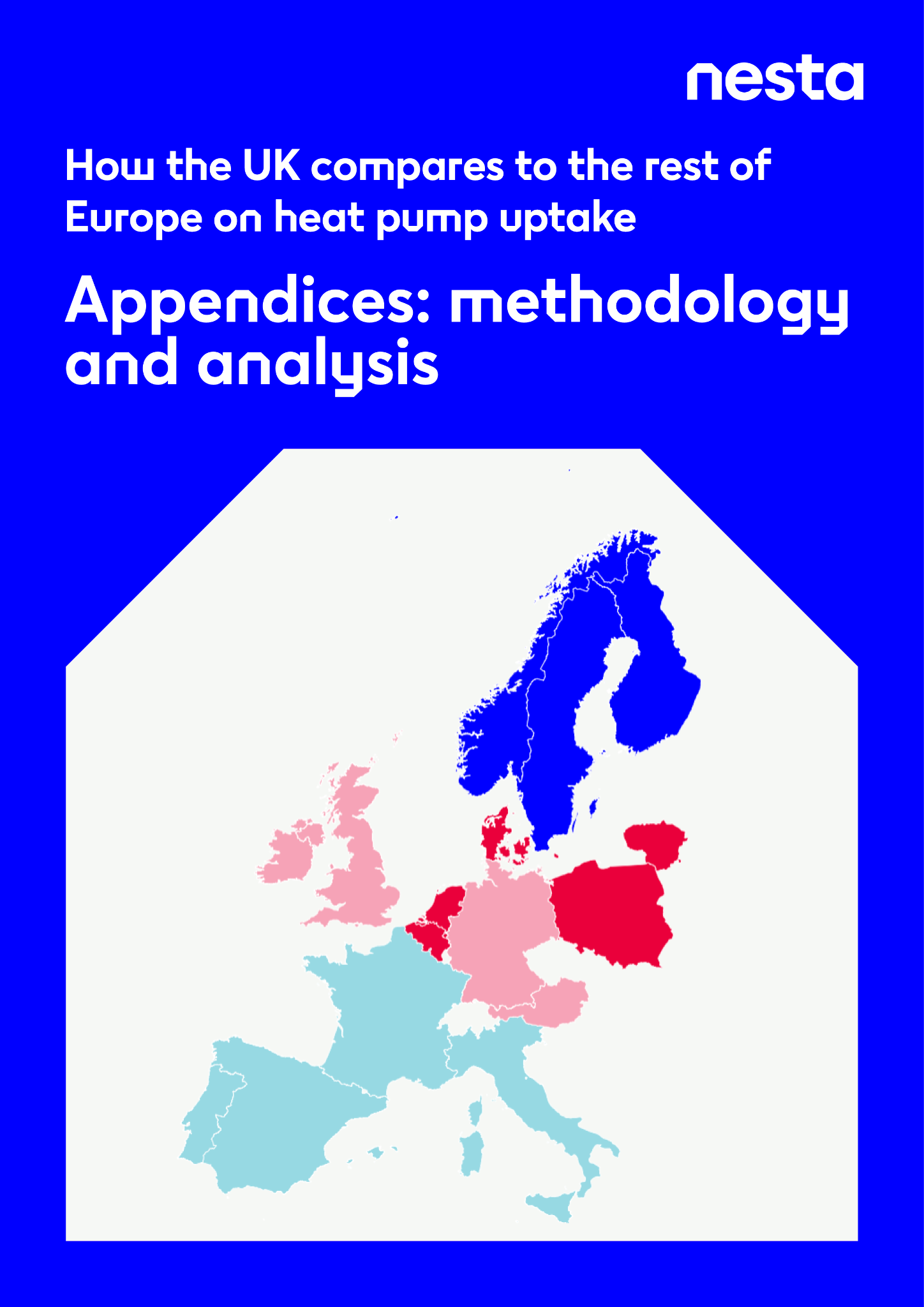
To understand the different heat pump trajectories countries have followed, we have categorised them into four main clusters. These clusters aim to be used as a persona-type method to summarise and synthesise the insights we have gathered. The country clusters are not a perfectly accurate representation of the heat pump trajectory of every country.
To create these clusters, we mapped the heat pump installations in the 17 countries examined since 2011. We purposefully decided to distinguish between the heat pump types as different heat pumps may be used for various purposes. For example, southern European countries like Spain, Italy, and Portugal install many reversible air-to-air heat pumps which are mainly used to provide space cooling. Air-to-air heat pumps are also dominant in Scandinavian countries; however, they are mainly used to provide space heating.
Simple numerical comparisons are complicated because of the differences between the countries. The clusters aim to highlight this complexity and create a profile of the characteristics of each cluster.
Due to the country differences mentioned, we have used different characteristics to create the profile of each cluster. Some of these include geography, pace of installation, and predominant type of heat pump.
Data
For the purposes of this project, we have used heat pump sales data collected by EurObserv'ER which is a consortium dedicated to the monitoring of the development of renewable energies in the European Union. EurObserv'ER has monitored heat pump data in the EU since 2011. At the time of writing, the latest available data was for 2021. More information on EurObserv'ER data and limitations can be found on the Heat Pump Barometers on the EurObserv’ER website. A few things to note here:
- EurObserv'ER data on heat pump sales are for the residential and tertiary sectors. Not all heat pumps are installed in households. Based on this data, calculating the % of heat pump sales per household is not entirely accurate because it includes some heat pumps installed on tertiary properties. However, we believe that a large majority of heat pumps are installed in the residential sector. It is indicative that from the 2021 heat pump census in France, only 6% of heat pumps were installed in the tertiary sector.
- Heat pump sales numbers are not comparable between countries. Not all heat pumps are installed for the purpose of space heating and there are significant differences between countries. For example, air-to-air heat pumps are the majority of installations in countries like Italy, Portugal, Spain, Norway, Sweden, and Finland. In the first three, they are mainly used as air conditioning units and are not the primary heating source. For the Scandinavian countries, air-to-air heat pumps are mainly used for space heating as the primary heating source.
- EurObserv'ER depends on self-reported data from each country. There might be differences in the way each country accounts for the number of heat pumps.
The gas and electricity price data are from Eurostat and are specific for domestic consumers. They also include taxes and levies. This is because countries apply different taxes and levies on gas and electricity that are passed on to consumers and therefore affect the relative cost of electricity to gas that might encourage or discourage heat pump uptake. Eurostat provides bi-annual data on electricity and gas prices. We have averaged those to create a single yearly price for each country.
Both EurObserv’ER and Eurostat stopped providing data for the UK after 2019, so alternative sources have been used thereafter.
To determine the penetration of the gas grid for each country we used data from Eurostat, from 2020, on the share of fuels in the final energy consumption in the residential sector for space heating. This is not the same as the percentage of households which are heated by gas. But it can be used as a proxy to understand the penetration of the gas grid and how important gas is in each country to heat people's homes.
Annex 2: detailed analysis of the country clusters
1. Heat pump powerhouses
Countries: Finland, Norway, Sweden
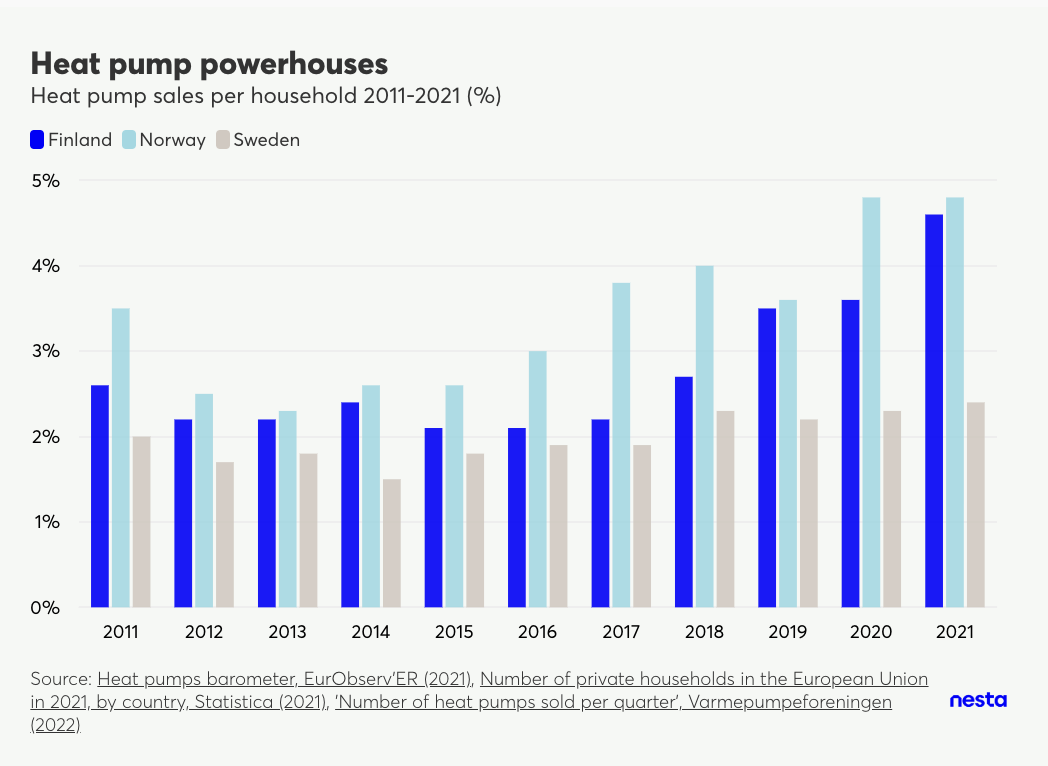
Europe's "heat pump powerhouses” are countries in Scandinavia with cold climates. These countries have a long tradition of heat pumps, and today, in all three countries, heat pumps play a crucial role in home heating. According to data from 2020, Norway had installed heat pumps in 60.4% of households, followed by Norway and Finland with 42.7% and 40.8%.
The predominant type of heat pump installed in those countries is air-to-air heat pumps used primarily for space heating. Compared to other European countries in this study, since 2011, the heat pump powerhouses have had a higher-than-average pace of heat pump installations.
Heat pump powerhouses traditionally were reliant on oil and electric-resistant heating systems. The gas grid never took off in those countries, and historically many heating systems have been dry, not wet, as is most common in the UK. Both those aspects have made it easier to overcome some of the path dependency and inertia created following the existence of an extensive gas network.
2. Heat pump coolers
Countries: Italy, Spain, Portugal, France
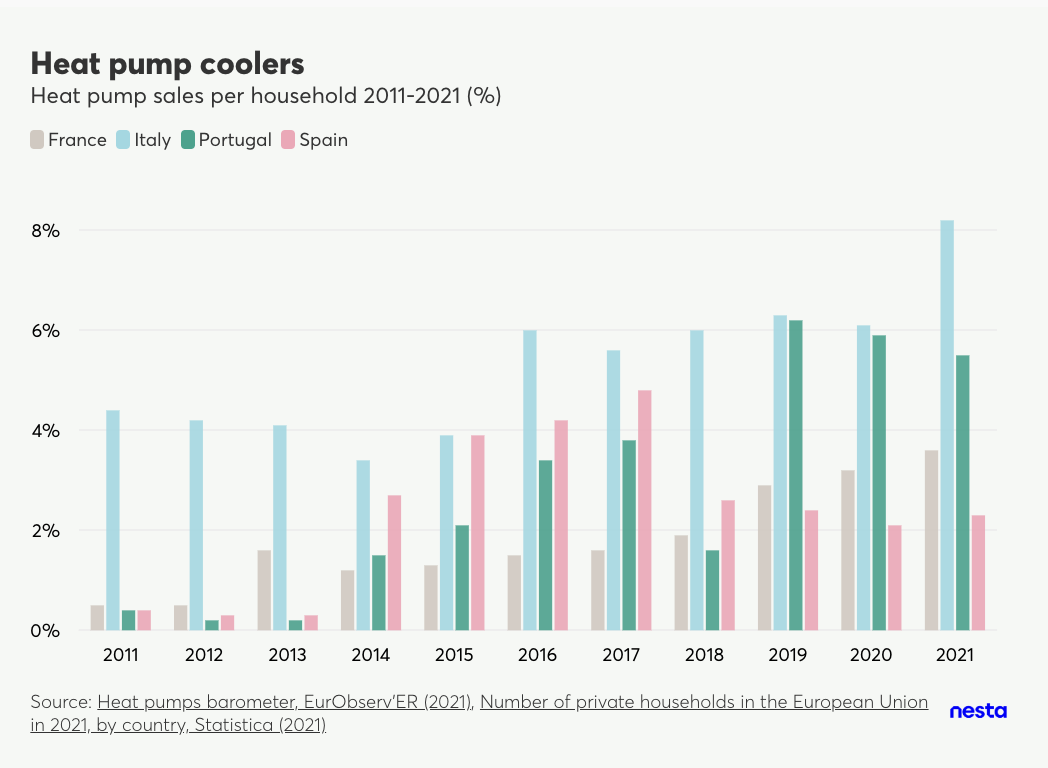
The “heat pump coolers” are countries primarily in Southern Europe with warmer climates (at least large parts of those countries). Heat pumps have experienced a boom over the past few years. However, most heat pumps installed have been air-to-air heat pumps whose primary function is cooling. According to the EHPA, only about 9.5% of air-to-air heat pumps in Italy are installed in properties without any alternative heating source.
Especially in Portugal, Italy, and Spain, the share of air-to-water heat pumps is negligible, whereas, in France, it has been rising for the past few years.
3. Heat pump surgers
Countries: Netherlands, Belgium, Lithuania, Poland, Denmark
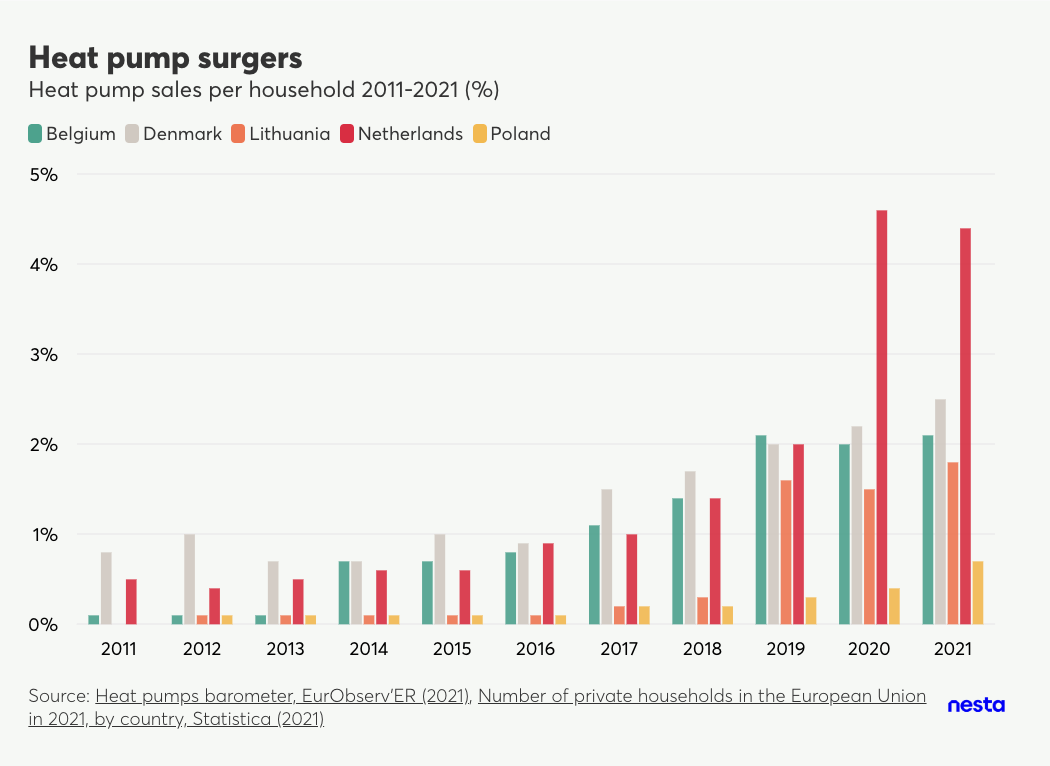
The “heat pump surgers” are countries which have recently significantly increased the number of units sold. Some countries have doubled and even tripled the number of units sold within three years. Given that none of those countries is in southern Europe, the primary function of most of the heat pumps installed is space heating. However, we do not have relevant data to approximate the breakdown between heating and cooling.
There is a mix of both air-to-air and air-to-water heat pumps installed. For example, the growth in Poland has been fueled primarily by air-to-water heat pumps, while in Denmark, Belgium, and the Netherlands, it is primarily thanks to air-to-air heat pumps.
Countries like the Netherlands and Belgium have a well-established gas grid, while others like Poland and Slovenia are less reliant on gas.
4. Heat pump latecomers
Countries: UK, Czechia, Germany, Ireland, Austria
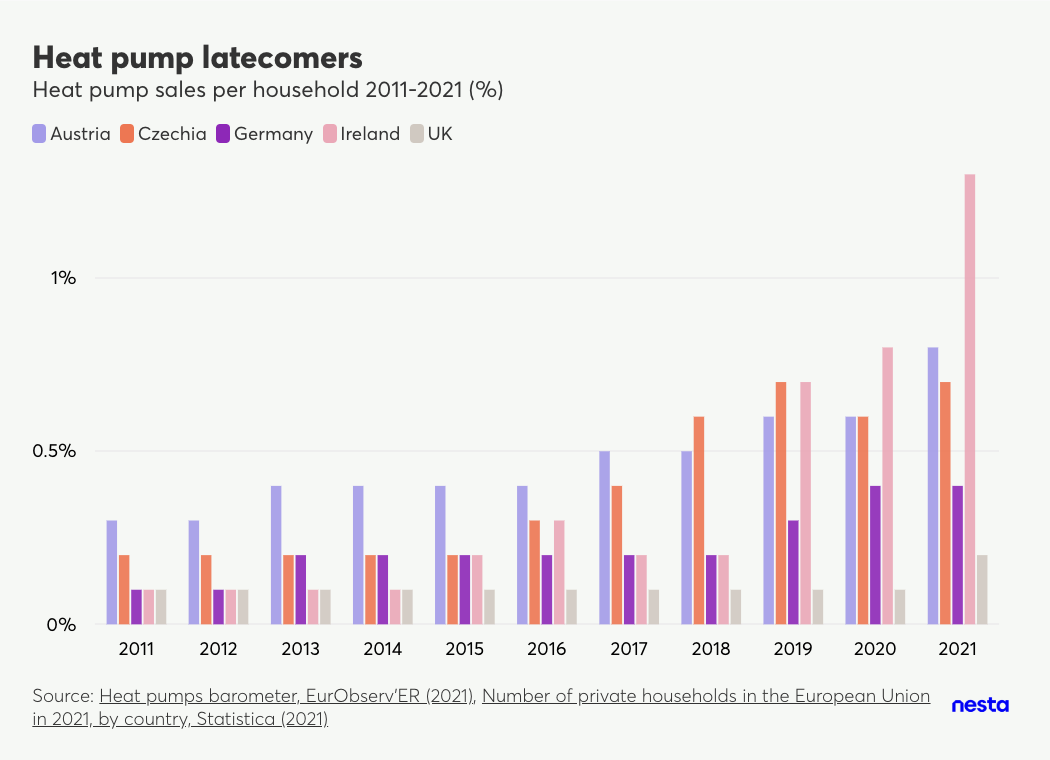
"Heat pump latecomers" are countries which have experienced a steady increase in the number of heat pumps sold over the past few years but are still lagging behind other countries. The increase in the number of units sold in those countries has been steady rather than booming year-on-year as in the case of the heat pump surgers.
The increase in the number of units sold is mostly thanks to air-to-water heat pumps. The penetration of air-to-air heat pumps is lower. The fact that air-to-water units are more difficult to install than air-to-air might be one of the reasons why those countries have experienced a more steady rise than a sudden boom.
The UK has been placed in this category. With less than 0.2% of households getting a heat pump per year, it has the slowest heat pump rollout in all countries examined.
Annex 3: country by country analysis
Heat pump powerhouses
Finland
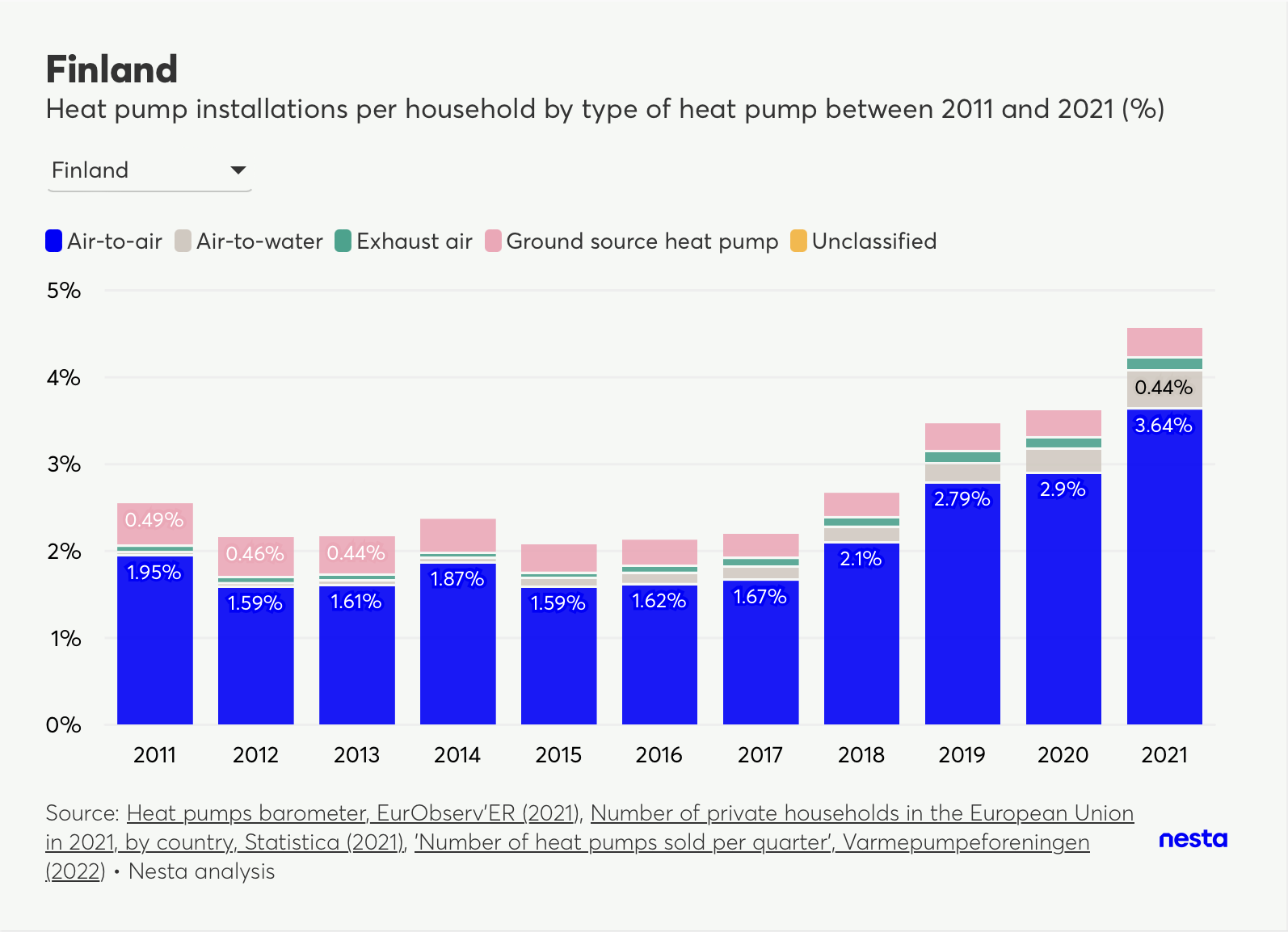
- Absence of a gas grid, historical reliance on oil for heating, high prevalence of district heating.
- Air-to-air heat pumps are dominant as most buildings do not have hydronic systems.
- The average price of electricity for 2011-2021 (0.163 € per kW) is lower than the average of the 17 countries (E17) used in this study (0.208 € per kW).
1980s: in response to the oil crises, GSHPs started being developed. But due to problems and subsequent falling oil prices, less than 10,000 heat pumps were installed in that decade.
1999: the Finnish Heat Pump Association (SUPLU) was formed to raise awareness, develop standards, and train installers.
2003: subsidies for replacing oil heating systems were introduced and were subsequently removed. Today, the grant for heat pump installation is up to €4,000. Also, 45-60% of the costs are tax-deductible.
2004 - present: heating oil taxes more than doubled.
2014: heat pumps must be installed in every new home built.
Norway
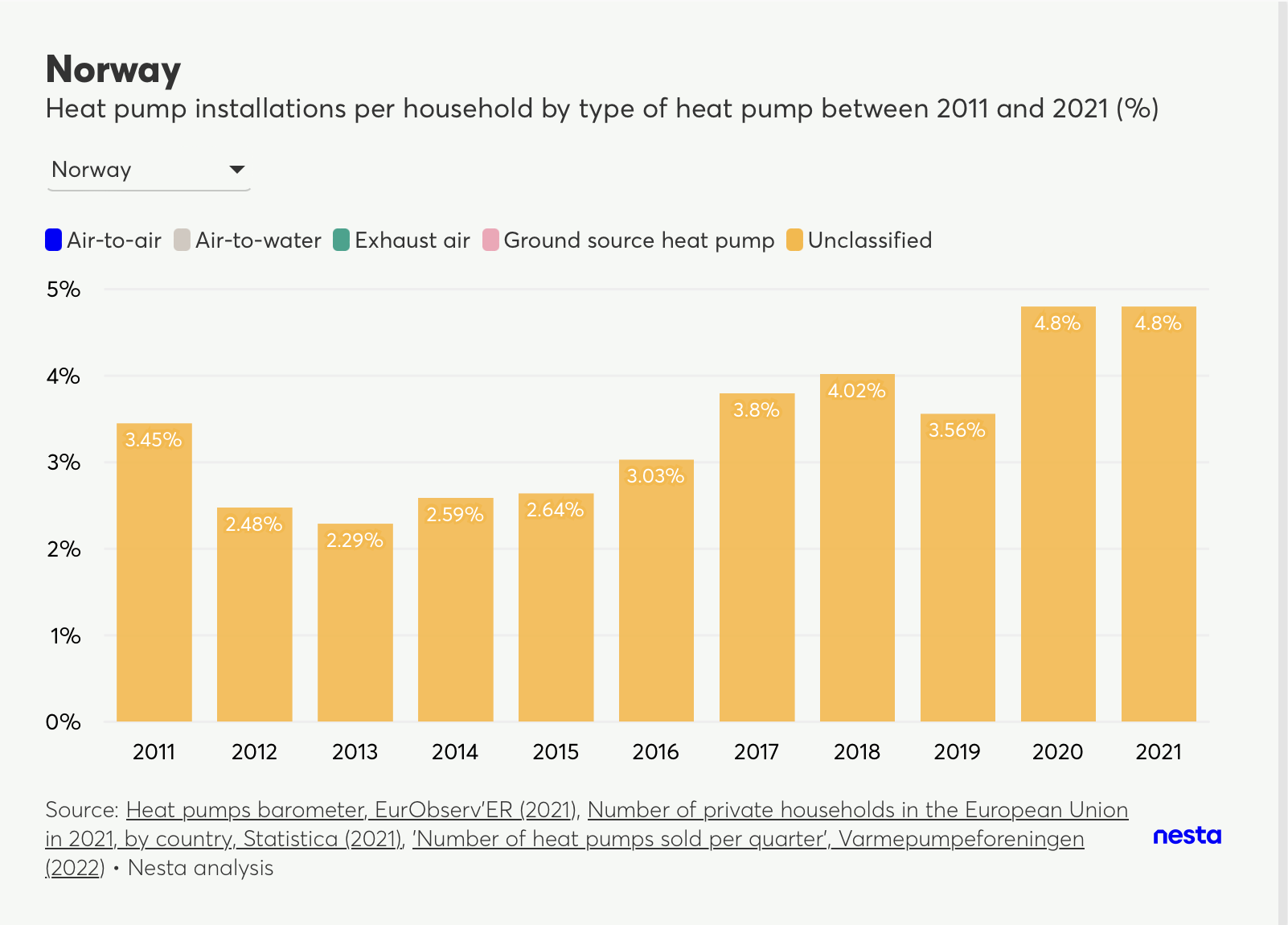
- Absence of a gas grid.
- Air-to-air heat pumps are dominant as most buildings do not have hydronic systems.
- The average price of electricity for 2011-2021 (0.176 € per kW) is lower than the average of 17 countries (E17) used in this study (0.208 € per kW).
1970s: oil crises, heat pumps start appearing but remain very niche (less than 10,000 units had been installed by 2005).
2003: electricity prices hiked and the government began offering a cashback programme for installing a heat pump to move people away from regular electric heating which was very common.
2008 - present: Enova national subsidy scheme started that supports energy efficiency and renewable energy generation technologies in the residential sector. The level of support has varied in the period, at the time of writing (June 2023), air-to-air and air-to-water were no longer subsidised because they have become ubiquitous.
Early 2010s: oil heating infrastructure was banned from being installed in newbuilds
2012-2020: C02 levies on fossil fuels increased.
2016: all fossil fuel heating systems were banned from being installed in newbuilds.
2018-2019: incentives to get a heat pump were doubled for that year to assist people in replacing oil boilers with heat pumps.
2020: restrictions and a ban on the sale of oil to heat buildings - total ban on oil (kerosene) for heating, not just new system installations.
Sweden
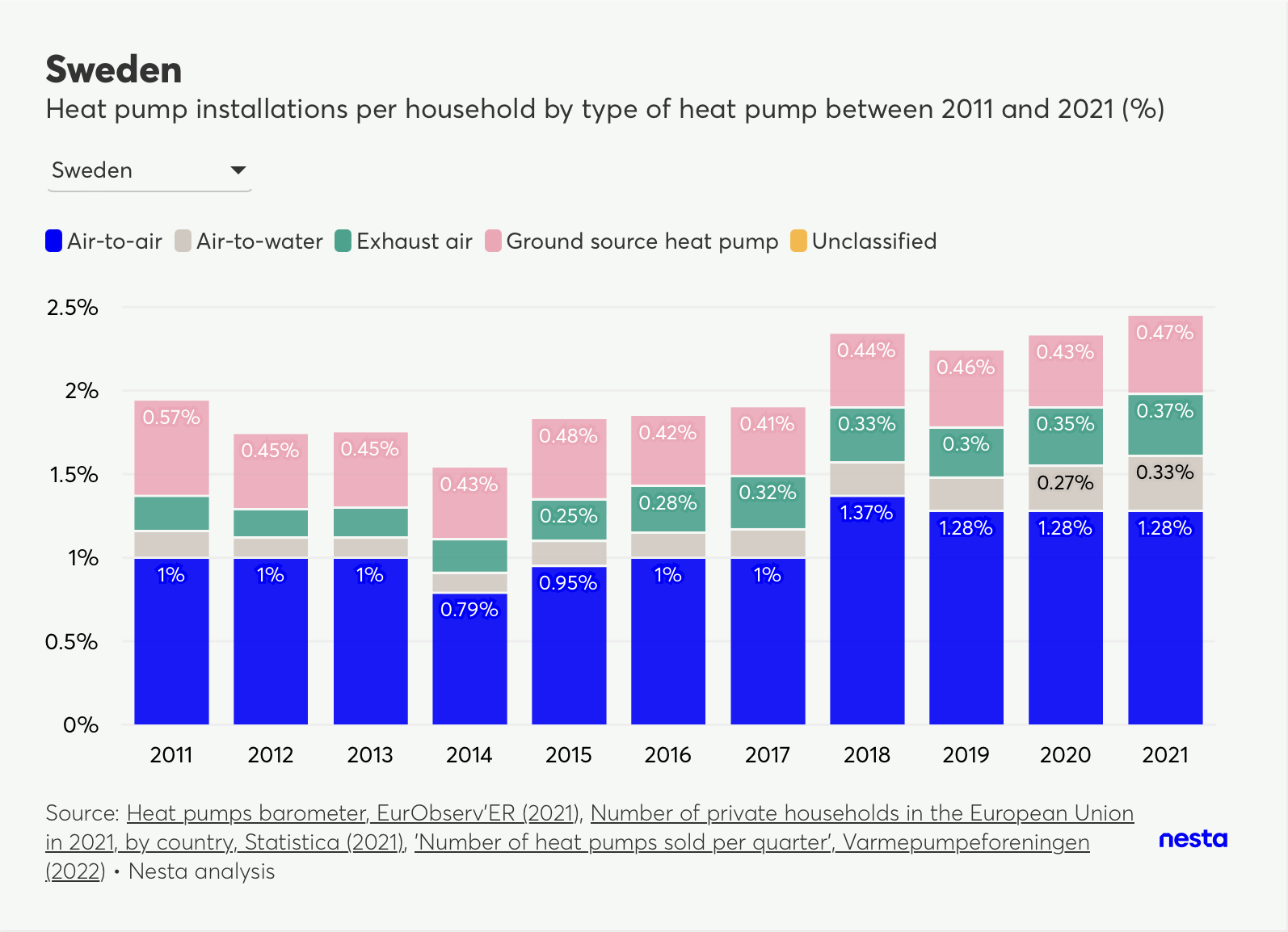
- Absence of a gas grid, historical reliance on oil for heating, high prevalence of district heating.
- Air-to-air heat pumps are dominant as most buildings do not have hydronic systems.
- The average price of electricity for 2011-2021 (0.202 € per kW) is lower than the 18 countries (E18) used in this study (0.208 € per kW).
Late 1970s - early 1980s: short heat pump boom following the oil crises and the Swedish government's investments in heat pump R&D. By the mid-1980s the boom had faded away.
1991: introduction of a carbon tax, a tax levied on non-sustainable fuels based on their carbon content.
2009 - present: tax rebate on 30% of a heat pump's labour costs offered (not overall costs, just labour costs), or up to €4,300 approximately per person per year.
2020: phasing out of fossil fuels for heating.
2023 - present: subsidy for single-family homes with direct-electric heating to help them upgrade their heating and hot water to a more efficient heating system like a heat pump and their home's energy efficiency performance. The grant can be used to cover 50% of the cost, or up to 5,150€ approximately and needs to be split equally between the heating source and home energy performance upgrade (at the time of writing this subsidy was in the consultation phase and had not been implemented yet).
Heat pump coolers
France
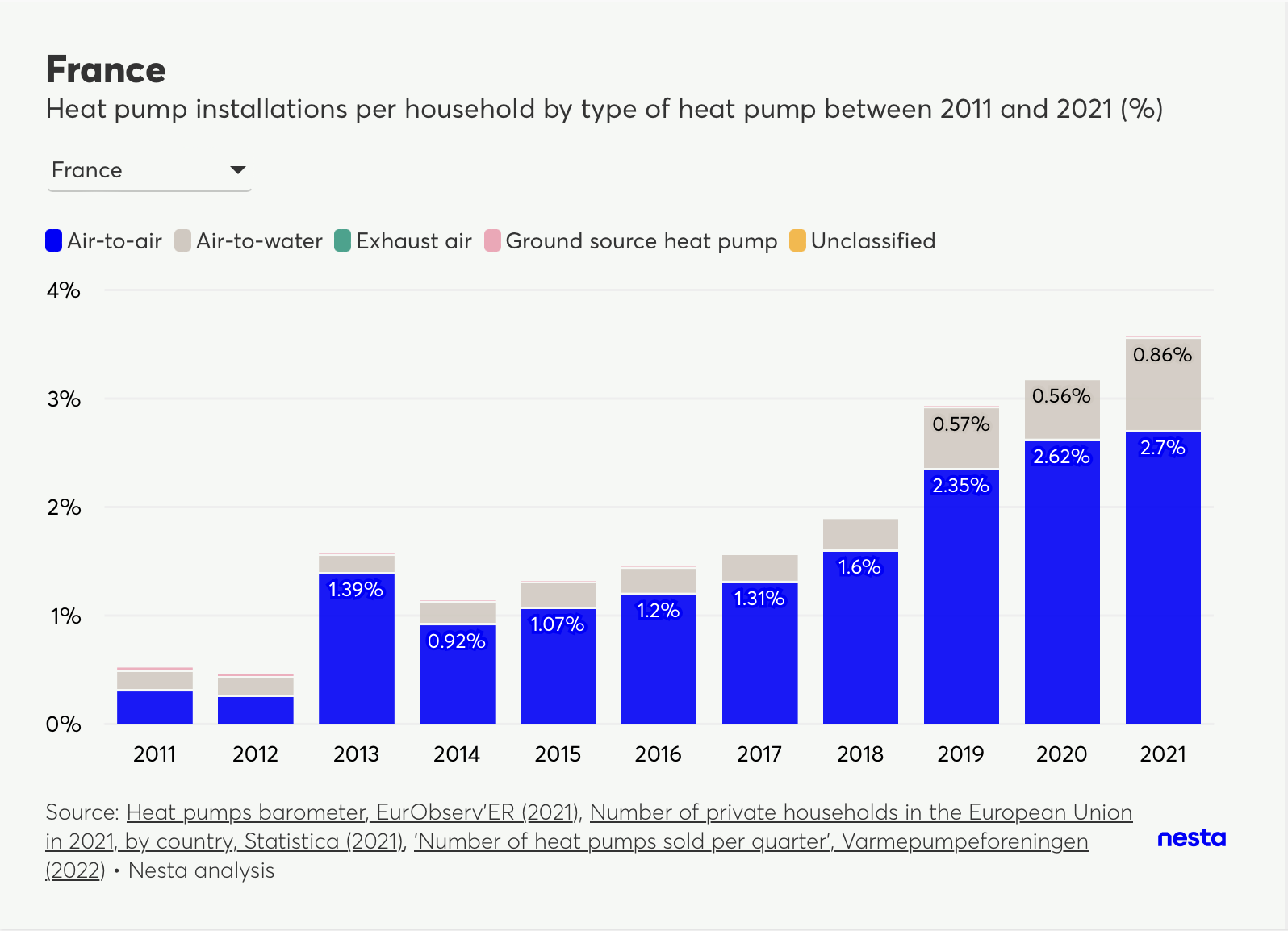
- A mixture of heating types with about 42% residential and non-residential buildings heated by gas.
- Lower than average electricity to gas ratio. In France, between 2011 and 2021 electricity was 2.4 times more expensive than gas, while the European average was 3.1 times.
- The primary type of heat pumps installed is reversible air-to-air heat pumps whose primary function is space cooling, not heating.
2009 - present: Eco-PTZ zero-interest loan scheme introduced to finance energy upgrades for people's primary residences. Heat pumps can be installed through Eco-PTZ. Different amounts can be issued depending on the works undertaken.
2020 - present: MaPrimeRénov' subsidy scheme to perform energy efficiency retrofit projects. The amount issued depends on the household's income bracket.
2022: oil boilers banned in all buildings (old and new).
2023: ban on gas boilers in new buildings.
Italy
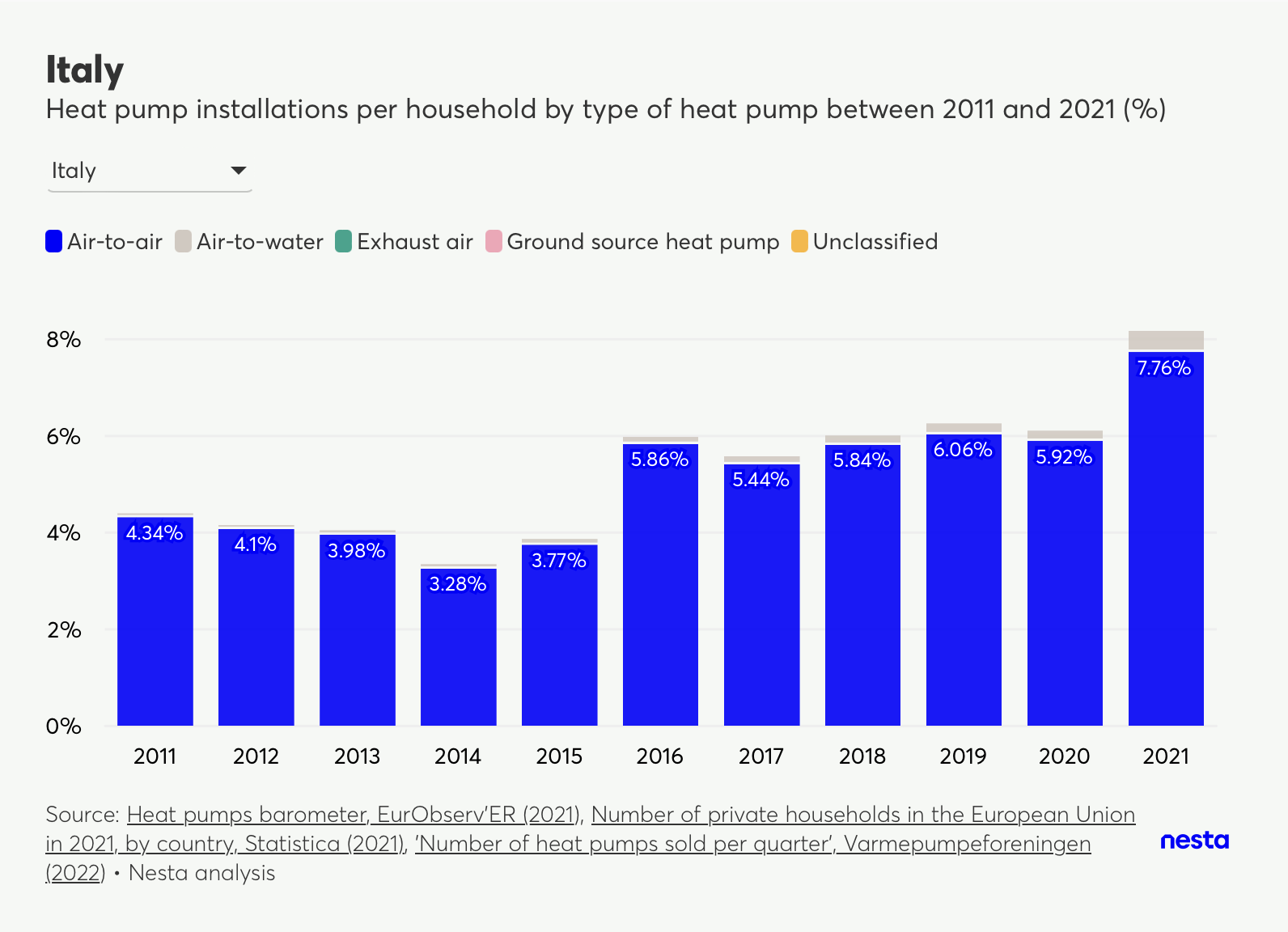
- Gas in 2020 had a 59.9% share in the final energy consumption in the residential sector for space heating.
- Between 2011 and 2021, electricity was 2.7 times more expensive on average than gas, compared to 3.1 times more expensive in other European countries for the same period.
- The primary type of heat pump installed is reversible air-to-air heat pumps whose primary function is space cooling, not heating. EHPA assume that only for 9.5% of air-to-air heat pumps installed in Italy their primary function is heating
2012 - present: Ecobonus scheme providing tax reductions of up to 65% of the total cost on energy efficiency improvements of existing buildings.
2020 - present: Superbonus scheme offering tax rebates worth up to 110% on the costs of upgrading homes, such as installing a heat pump. The subsidy was reduced in 2023 to 90% of the cost of works and will be further reduced to 70% in 2024 and 65% in 2025.
2022 - present: Obligation for all new or renovated buildings to cover their needs with at least 60% renewable energy.
2029: proposed EU-wide end to the sale of fossil fuel boilers, Italy voted against the proposal in the 2023 vote.
Portugal
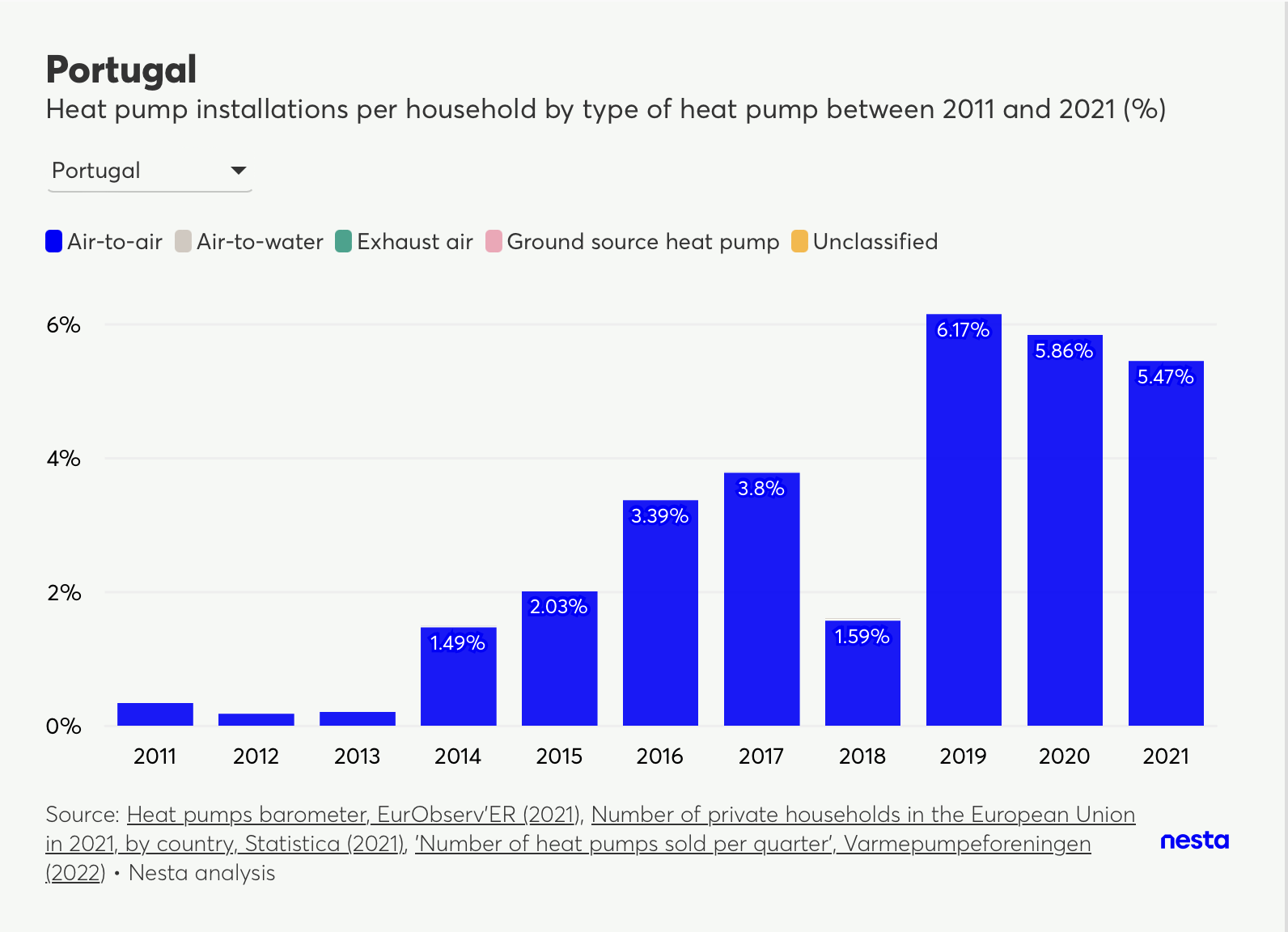
- Gas in 2020 had a 1.8% share in the final energy consumption in the residential sector for space heating. Central heating in Portugal is very rare as most people heat their homes with pellet stoves, air conditioners, and traditional electric heaters.
- Between 2011 and 2021, heat pumps boomed by 1421%, rising from 13,642 units installed in 2011 to 207,536 in 2021. Almost all of those were air-to-air heat pumps with a reversible function to provide cooling. We assume that most of those units provide space cooling; it is unclear how many are used for space heating.
2018-2021: Casa Eficiente 2020 (Efficient House 2020) provided loans on favourable terms to improve the energy efficiency performance of existing housing.
2020 - present: Programa de Edifícios Mais Sustentáveis (More Sustainable Buildings Programme) provides subsidies to improve the energy efficiency of buildings. The subsidies cover a percentage of the costs and have an upper limit, both of which differ depending on the energy efficiency improvement chosen. For heat pumps 85% of costs are subsidised, or up to €2,500.
2029: proposed EU-wide end to the sale of fossil fuel boilers.
2030: 49% target for renewable heating and cooling (compared to 41% for 2020) powered by solid biomass and heat pumps.
Spain
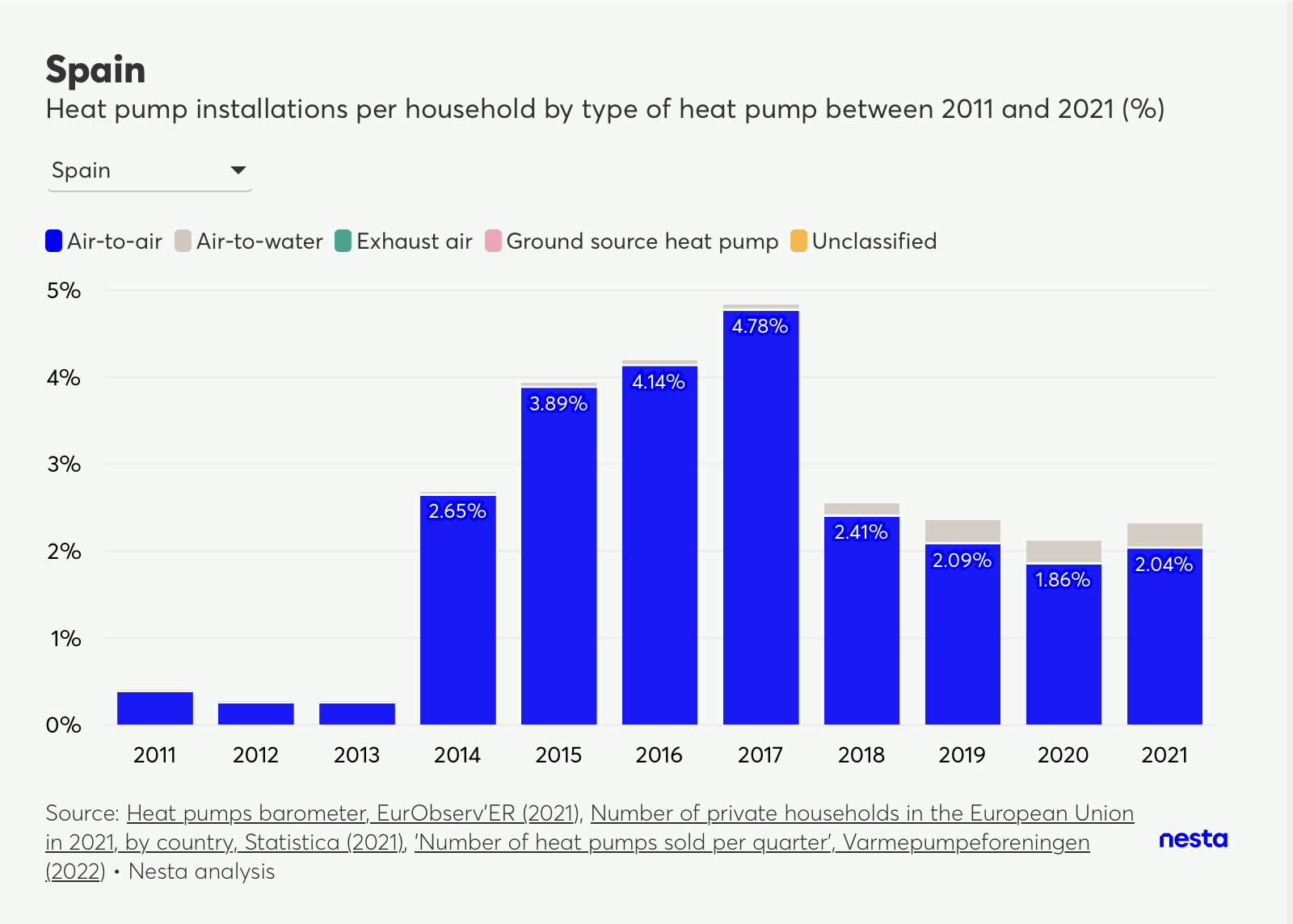
- Gas in 2020 had a 27.4% share in the final energy consumption in the residential sector for space heating.
- Most heat pumps installed in Spain are reversible air-to-air heat pumps which provide both cooling and heating. It is unclear how many of these units are used for space heating.
2021-2023: Para Energías Renovables en autoconsumo, almacenamiento, y térmicas sector residencial - RD 477/2021. PRTR (For Renewable Energies in self-consumption, storage, and thermal residential sector - Royal Decree 477/2021) provides funding to improve residential sector building efficiency. Aerothermal heat pumps (air-to-air heat pumps are excluded) are funded at €500/kw, and up to €3,000 per home.
2029: proposed EU-wide end to the sale of fossil fuel boilers.
Heat pump surgers
Belgium
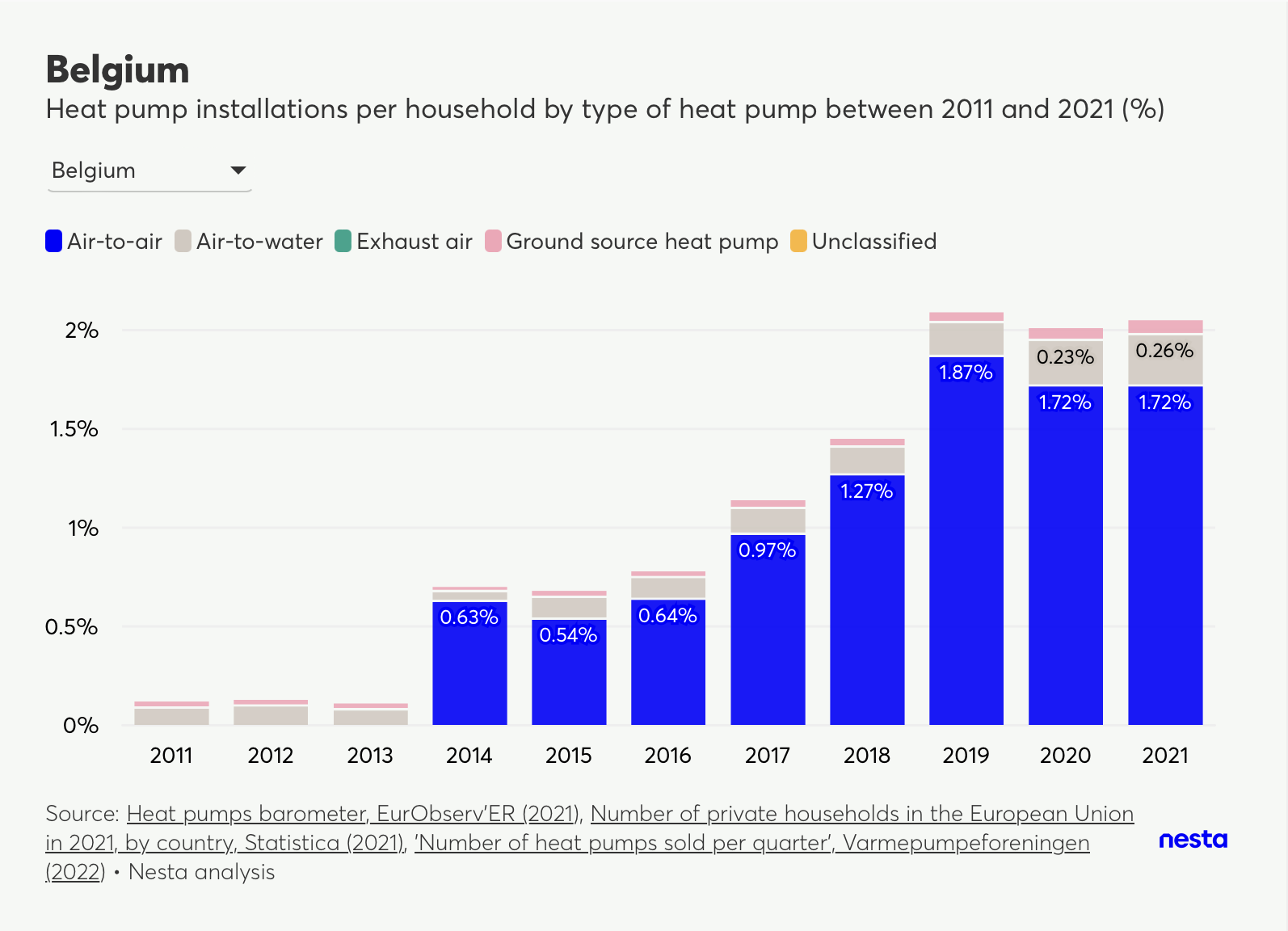
- Between 2011 and 2021, electricity was 4.3 times more expensive on average than gas, compared to 3.1 times more expensive in other European countries for the same period. That is the second highest cost of electricity relative to gas in Europe after Germany and is a strong disincentive in the transition to heat pumps.
- Gas in 2020 had a 44.1% share in the final energy consumption in the residential sector for space heating.
- Home heating policy is largely decentralised. Flanders, Brussels, and Wallonia have set individual targets and subsidy schemes to encourage heat pump adoption.
- Varying levels of subsidies for heat pumps in Flanders, Brussels, and Wallonia. Grants for air-to-water heat pumps range between €1,000 and €6,000. The level of the subsidy may depend on the individual's income bracket.
2021: Flanders banned new connections to the gas grid for large buildings.
2022: Flanders banned oil boiler installations for new buildings and renovations.
2025: gas connection banned for all new buildings.
2030: gas and oil will be phased out nationally.
Denmark
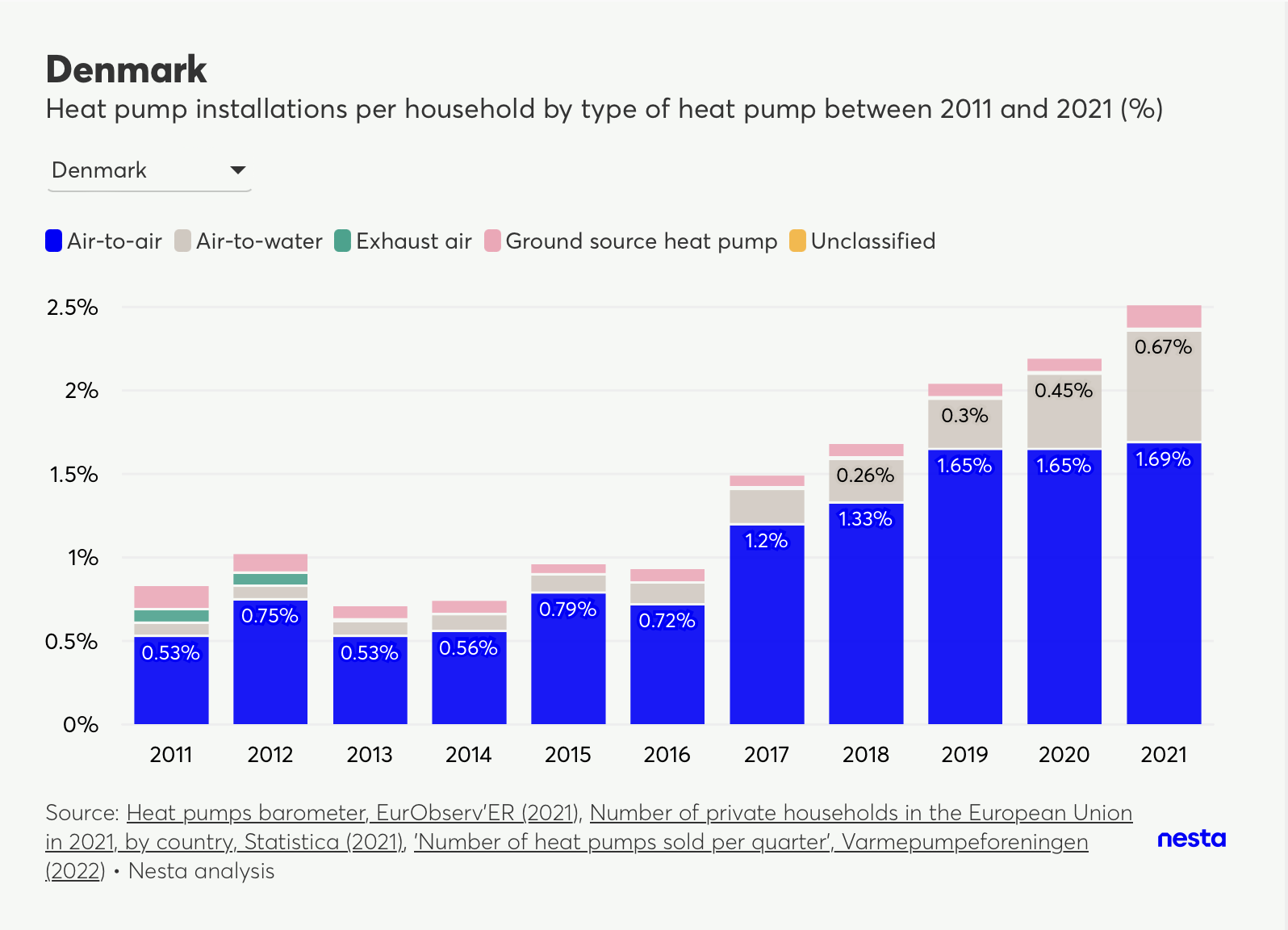
- Gas in 2020 had a 17.2% share in the final energy consumption in the residential sector for space heating. District heating covered more than 50% of heat demand.
- Between 2011 and 2021, electricity was 3.4 times more expensive on average than gas, compared to 3.1 times more expensive in other European countries for the same period.
1977: introduced tax on oil which created incentives to switch to alternatives.
2010-2011: oil boiler scrappage scheme. Participants scrapping their oil boiler received a cash grant.
2013: banned oil and gas boiler installations in new buildings.
2020-2026: Bygningspuljen (Building pool) is a scheme that opens several times each year and offers funds to people who want to switch from oil, gas, or wood pellet boilers to heat pumps. The subsidy is fixed at 20% of the market price and is approximately in the range of €1,700 - €3,300.
2020 - present: Skrotningsordningen (Scrapping scheme) for oil and gas boilers. It is also known as a ‘heat pump subscription' as it allows people to pay a fixed monthly amount instead of buying a heat pump upfront. The grant is given to the energy service provider that owns, instals, and maintains the heat pump and is passed indirectly to consumers.
2028: by then, convert 30-50% of the homes heated by gas to district heating. The maximum grant is €3,350 approximately, a maximum of 45% of the cost when replacing an oil or gas boiler and 30% when replacing a wood pellet.
2030: by then, convert the remaining 50-70% of homes heated by gas and unsuitable for district heating to heat pumps. Also, the aim is that by 2030, oil for heating will account for less than 2% of household energy consumption.
2035: by then, all heating supply to buildings will be from renewable sources.
Lithuania
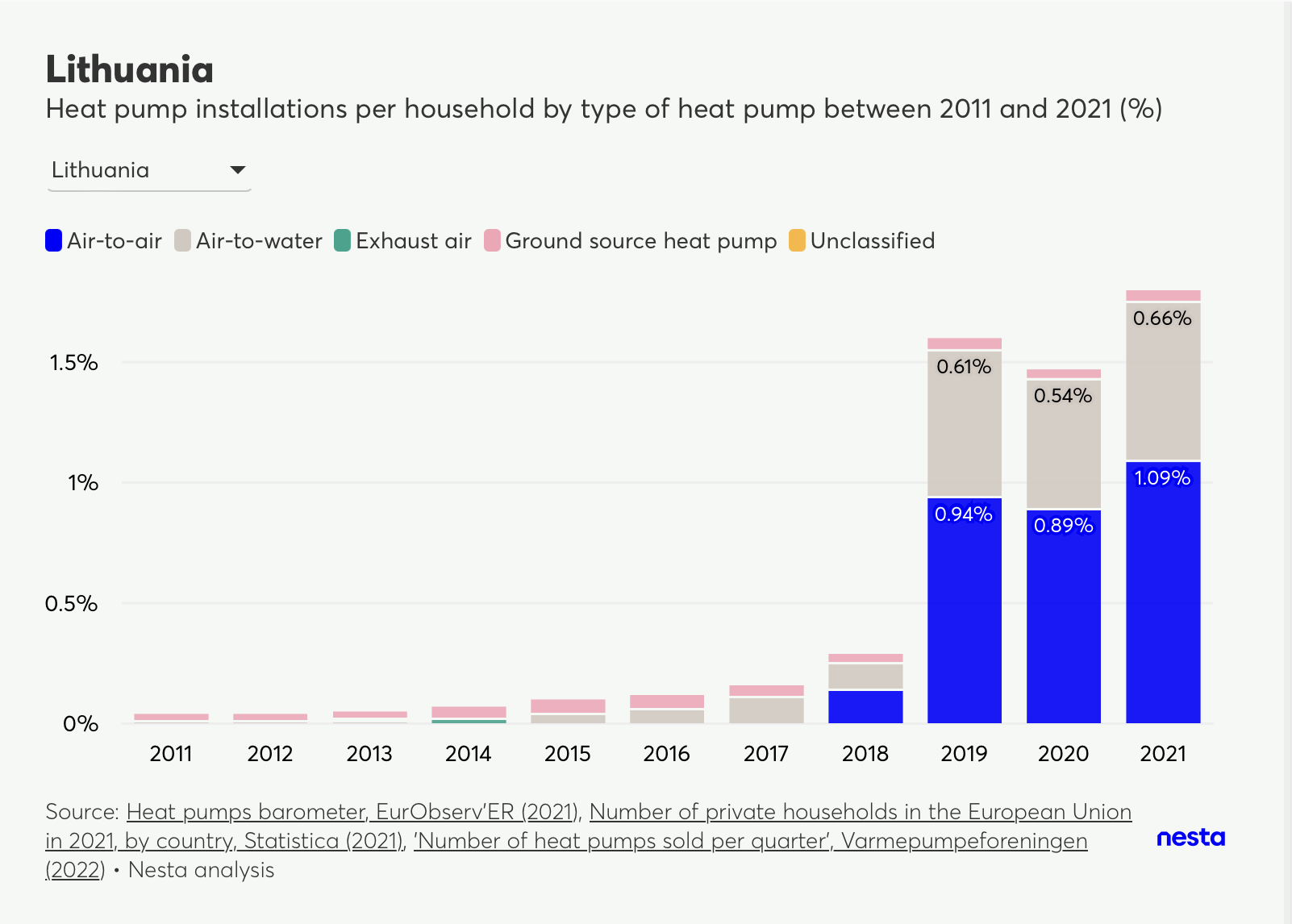
- Gas in 2020 had an 11.9% share in the final energy consumption in the residential sector for space heating.
- Between 2011 and 2021, electricity was 2.9 times more expensive on average than gas, compared to 3.1 times more expensive in other European countries for the same period.
2019 - present: APVA grant covering 50% of the cost of heat pump installation when replacing a fossil fuel system, and up to €14,500 (this grant is expected to continue, but no further rounds of funding have been announced at the time of writing).
2023: Vilnius phased out coal for heating.
2025: proposal to ban the solid fossil fuels like coal, lignite, and peat used for heating and other purposes.
Netherlands
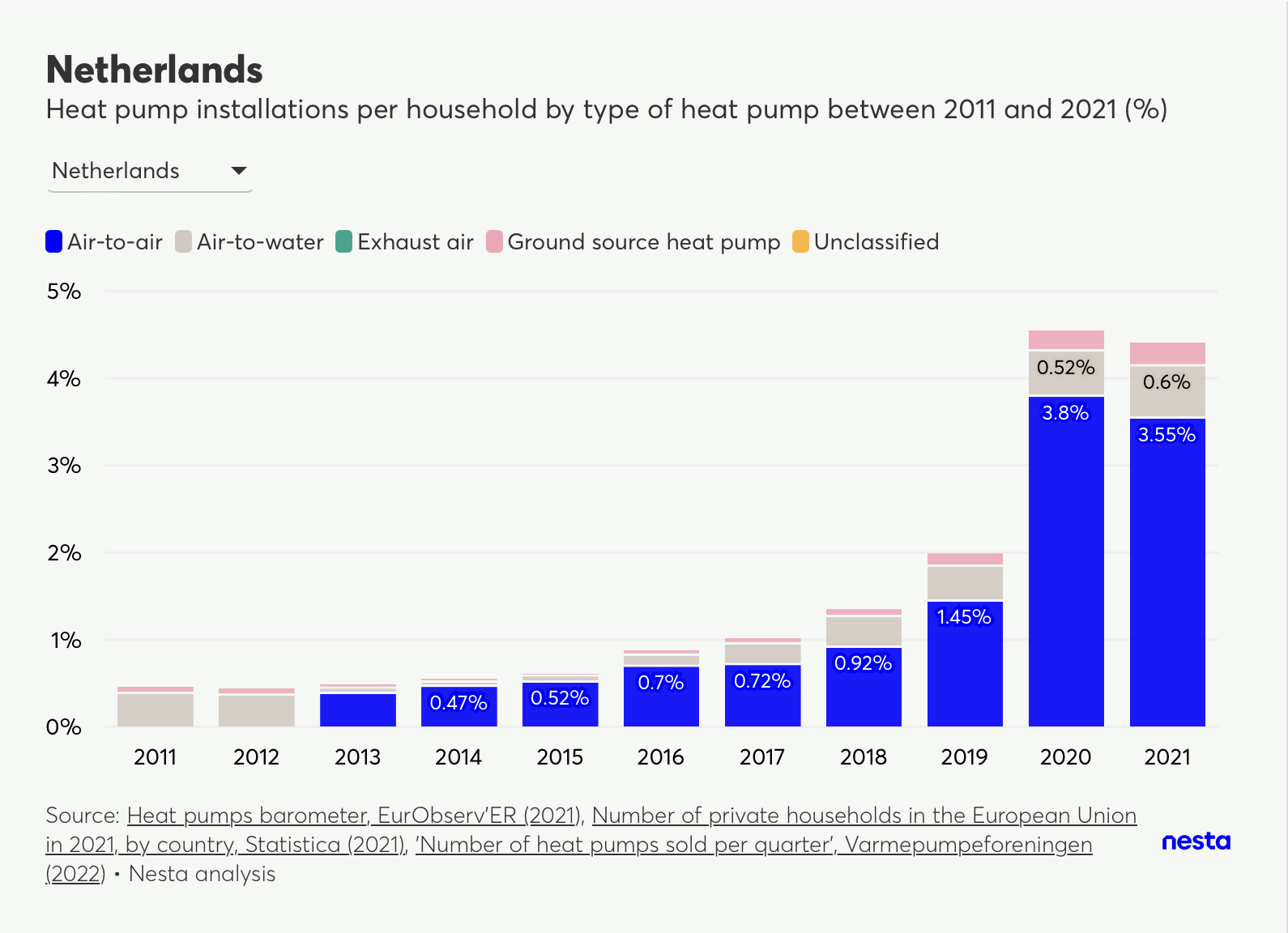
- The Netherlands has the highest penetration of the gas grid (even more so than the UK). Gas in 2020 had an 83.9% share in the final energy consumption in the residential sector for space heating.
- Between 2011 and 2021, electricity was 2.1 times more expensive on average than gas, compared to 3.1 times more expensive in other European countries for the same period.
2016-2030: Investeringssubsidie Duurzame Energie - ISDE (Investment subsidy for sustainable energy and energy saving) provides subsidies to improve the energy efficiency performance of buildings. The level of subsidy ranges between €1,950 and €5,100 depending on the type of heat pump.
2018: banned connections to the gas grid for new buildings.
220: all new buildings are expected to cover at least 50% of their energy demand from renewable sources.
2026: hybrid heat pumps will be the minimum standard for new and existing buildings.
2029: proposed EU-wide end to the sale of fossil fuel boilers.
Poland
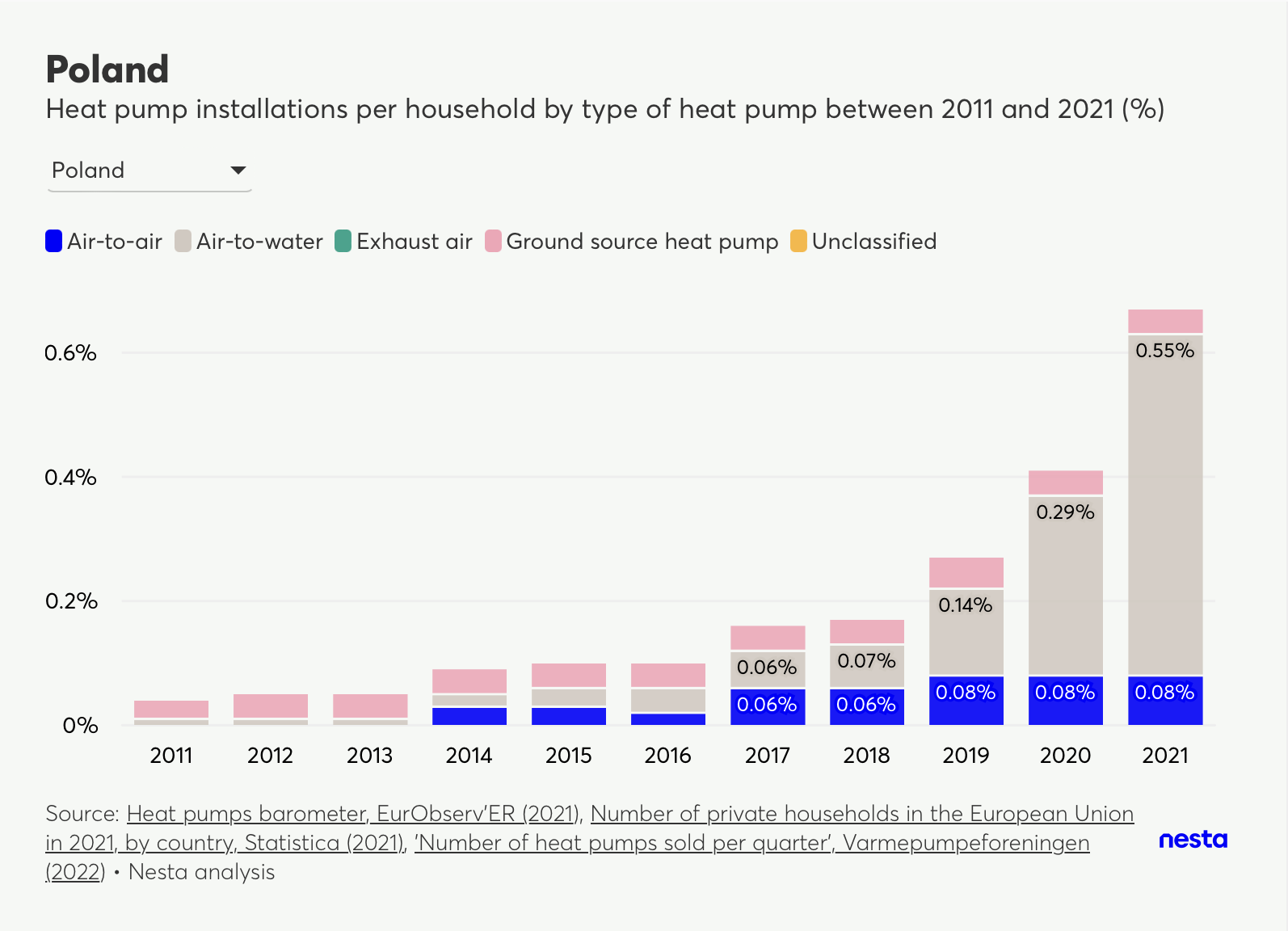
- Gas in 2020 had a 15.9% share in the final energy consumption in the residential sector for space heating.
- Between 2011 and 2021, electricity was 3.2 times more expensive on average than gas, compared to 3.1 times more expensive in other European countries for the same period.
- In 2022, 28% of homes were heated through district heating networks (most of which burn fossil fuels), 46% with coal stoves, and 28% through oil, gas, and electric heating.
2018-2029: Clean Air Programme aims to improve air quality by replacing old inefficient heating systems such as coal stoves. It provides loans and subsidies that depend on the income level and upgrades chosen. For the lowest income levels, the 2023 edition of the programme may cover 100% of the costs.
2019-2023: My Electricity aims at helping homeowners co-finance domestic small-scale renewable energy systems like heat pumps and photovoltaic installations. For the 2023 programme, My Electricity covers 50% of the cost of an air-to-water heat pump, up to €2,812.
2022-2027: My Heat helps finance heat pumps in newbuild single-family properties. The subsidy is up to 30% of the cost, or up to €1,562 for an air-source heat pump.
Heat pump latecomers
Austria
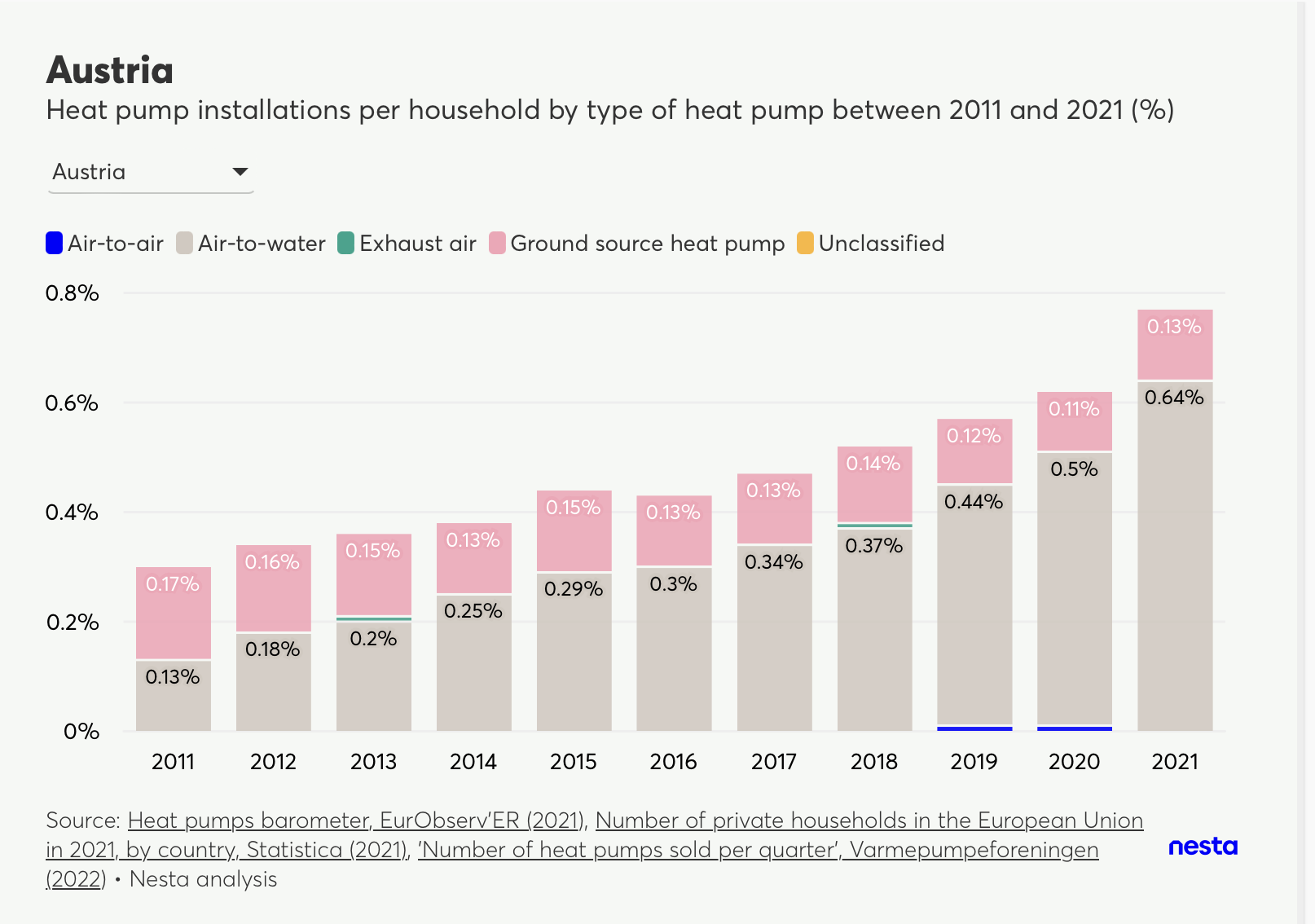
- Between 2011 and 2021, electricity was 2.9 times more expensive on average than gas, compared to 3.1 times more expensive in other European countries for the same period.
- Gas in 2020 had a 26.8% share in the final energy consumption in the residential sector for space heating.
- Federal states can also implement their own subsidies and programmes to support heat pumps in addition to the Federal Government's schemes.
2020: ban on the installation of oil and coil heating systems in new buildings.
2020-2026: Raus aus Öl und Gas (get out of oil and gas) offers subsidies at a 20% rate (or up to €7,500) for newbuilds and at a 35% rate (or up to 5,000€) for retrofitted buildings.
2023: ban on the installation of oil and coal heating systems in existing buildings to replace existing systems. Also, a ban on gas boiler installations in new buildings (was going to take place in 2025 but was brought forward because of the war in Ukraine).
2025-2035: mandatory replacement of coal and oil heating systems installed before 1980 and replaced with renewable heating systems.
2040: all gas heating systems have to be replaced with renewable heating systems or biogenic gas.
Czechia
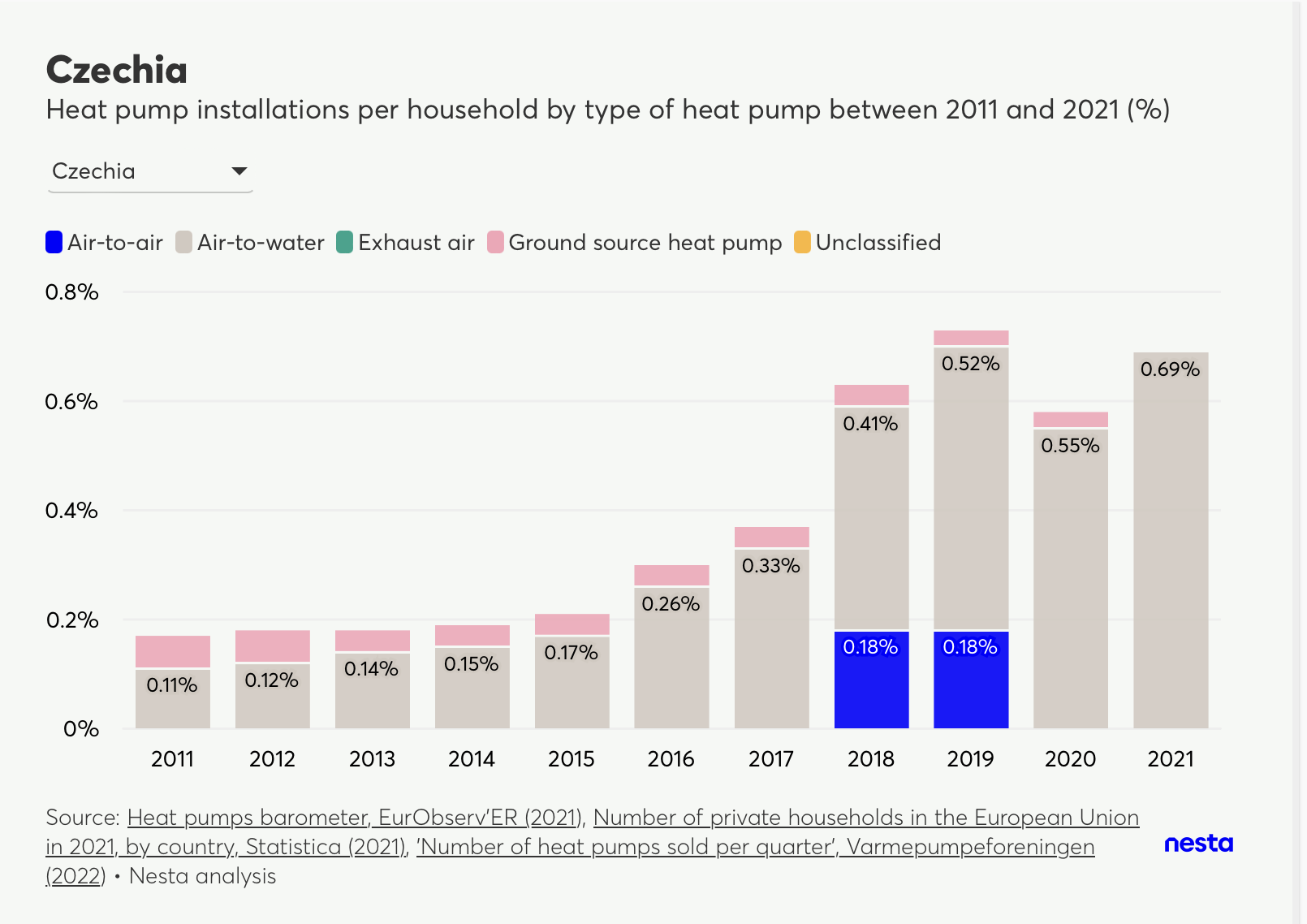
- Between 2011 and 2021, electricity was 2.8 times more expensive on average than gas, compared to 3.1 times more expensive in other European countries for the same period.
- Gas in 2020 had a 24.8% share in the final energy consumption in the residential sector for space heating.
2014-2025: Nová Zelená Usporám (New Green Savings) programme launched to support energy efficiency upgrades. The scheme was rebooted in 2021 with some changes such as the scheme's extension to apartment buildings, merging with some other programmes, and including the bonus system whereby householders receive additional subsidies for more ambitious improvements. The subsidy can cover up to 50% of the costs of the measures, such as installing a heat pump. The subsidy's exact amount depends on other factors like the type of building, insulation, etc.
2022: end of the subsidies for gas boilers for people switching from coal heating to gas. The grant covered up to 50% of the cost or up to €1,050 approximately.
2024: ban on heating with old coal or wood boilers that do not reach the third emission class.
2025: ban on the sale of solid fuel (coal) boilers. Existing boilers can continue operating if they meet the legal requirements (i.e., meeting at least the third emission class).
Germany
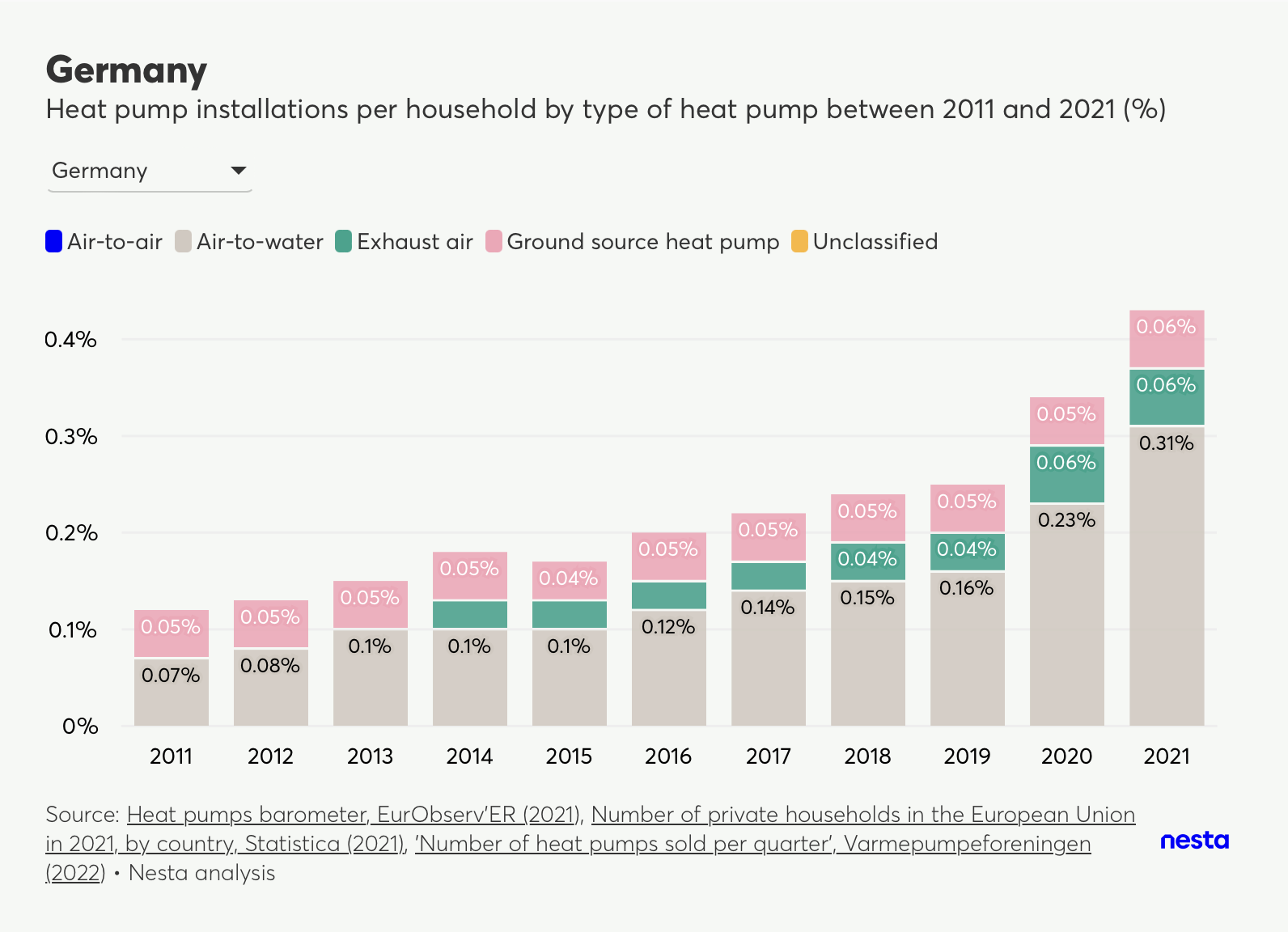
- Between 2011 and 2021, electricity was 4.6 times more expensive on average than gas, compared to 3.1 times more expensive in other European countries for the same period. Germany has the highest electricity-to-gas ratio of all countries examined.
- Gas in 2020 had a 43.8% share in the final energy consumption in the residential sector for space heating.
- Germany's federal system allows individual federal states to implement their own subsidy programmes for heat pumps. Some of these measures can be combined with federal government funding to get an even higher subsidy. Some examples include the Energy Bonus Bayern in Bavaria (offering up to €8,000 per residential unit), the Climate Protection Plus in Baden-Württemberg (offering up to €7,500 per residential unit), and the Housing Modernization in Hesse (can cover up to 30% of the costs).
1996 - present: Kreditanstalt für Wiederaufbau (KfW) energy efficiency schemes have been running continuously since 1996, albeit under different names and with various changes. The primary offering of these schemes has been low-interest loans to finance energy efficiency upgrades, coupled with a percentage subsidy in some cases. Under the latest version of the scheme, Energy Efficient Refurbishment Programme running since 2009, KfW has offered loans encouraging a whole-house renovation model. Until 2022, KfW offered loans for individual measures like installing a heat pump, but it has since been discontinued. Alongside the loan, KfW offers a subsidy that writes off a percentage of the loan depending on the carbon savings of the selected measure(s).
2021-2030: Bundesförderung für effiziente Gebäude (BEG) (Federal funding for efficient buildings) offers funding for individual energy efficiency measures like heat pumps. The percentage of the subsidy varies between 25% and 40% for a heat pump.
2024: all new heaters are required to run at 65% renewable energy - a de-facto ban on fossil fuel boilers running on natural gas. The proposed start date of the ban is the 1st of January 2024, but at the time of writing, the matter was being debated. A previous law put the date to 2025.
By 2045: banning fossil fuel heating systems (the exact date has not been announced yet).
Ireland
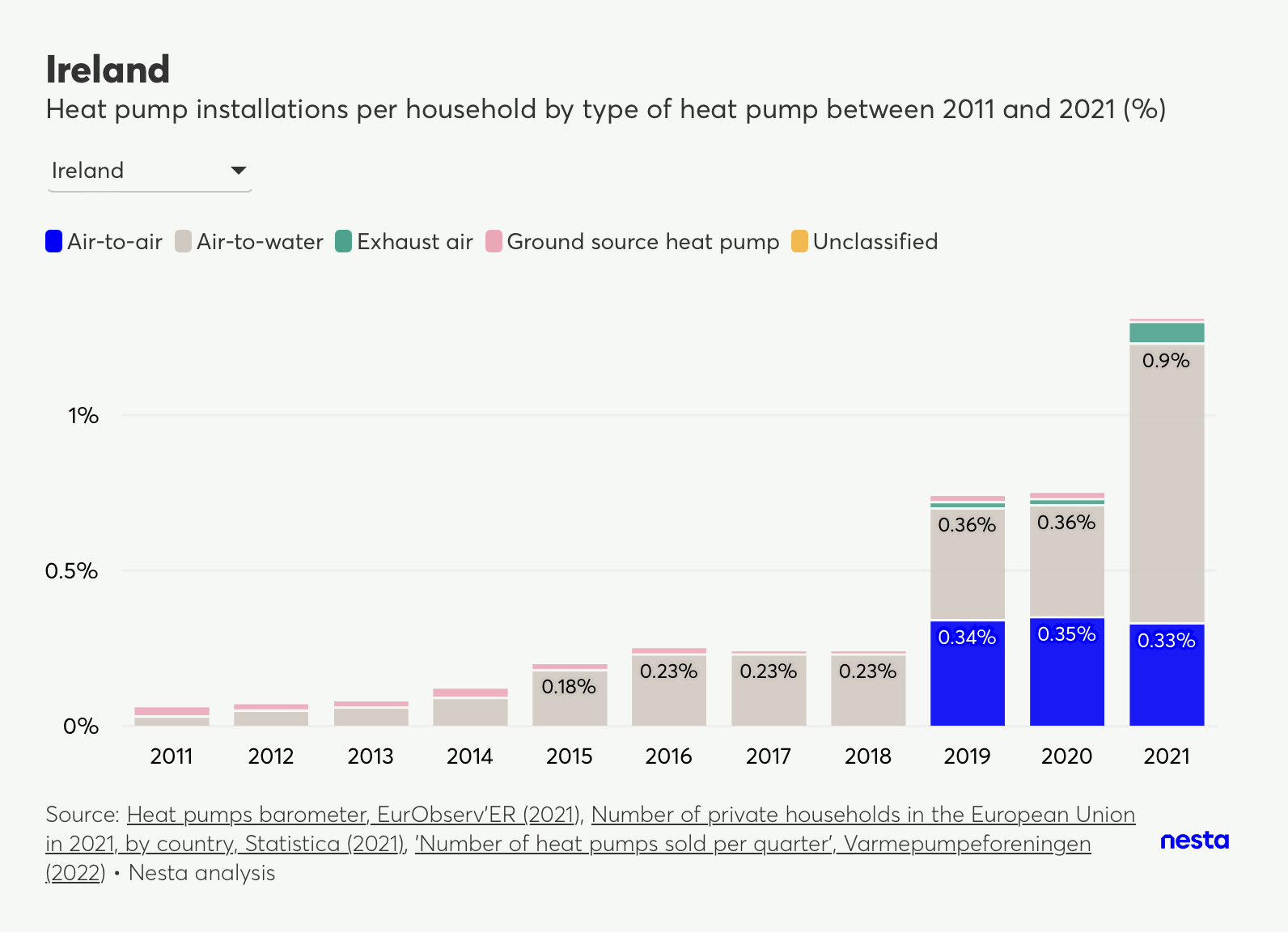
- Between 2011 and 2021, electricity was 3.5 times more expensive on average than gas, compared to 3.1 times more expensive in other European countries for the same period.
- Gas in 2020 had a 21.9% share in the final energy consumption in the residential sector for space heating.
2006-2012: Greener Homes Scheme aimed to incentivise homeowners to upgrade the efficiency of their homes. Heat pumps were one of the measures subsidised through this scheme offering grants from €2,500 to €3,500 for pumps.
2009 - present: Energy Efficiency Retrofitting Grant Scheme (previously known as Better Energy Homes) has been offering funding for energy efficiency improvements, including heat pumps, since 2009. The latest iteration, the Heat Pump System Grant, available since 2018, supports the deployment of heat pumps in domestic settings. The grant subsidises air-to-air, air-to-water, water-to, water, exhaust-air, and air-to-air heat pumps and the technical assessment required. The size of the grant depends on the property type and technology chosen but ranges between €3,500 and €6,500.
2023: ban on oil and gas boilers in newbuilds.
2025: ban on new oil and gas boilers in existing buildings.
UK
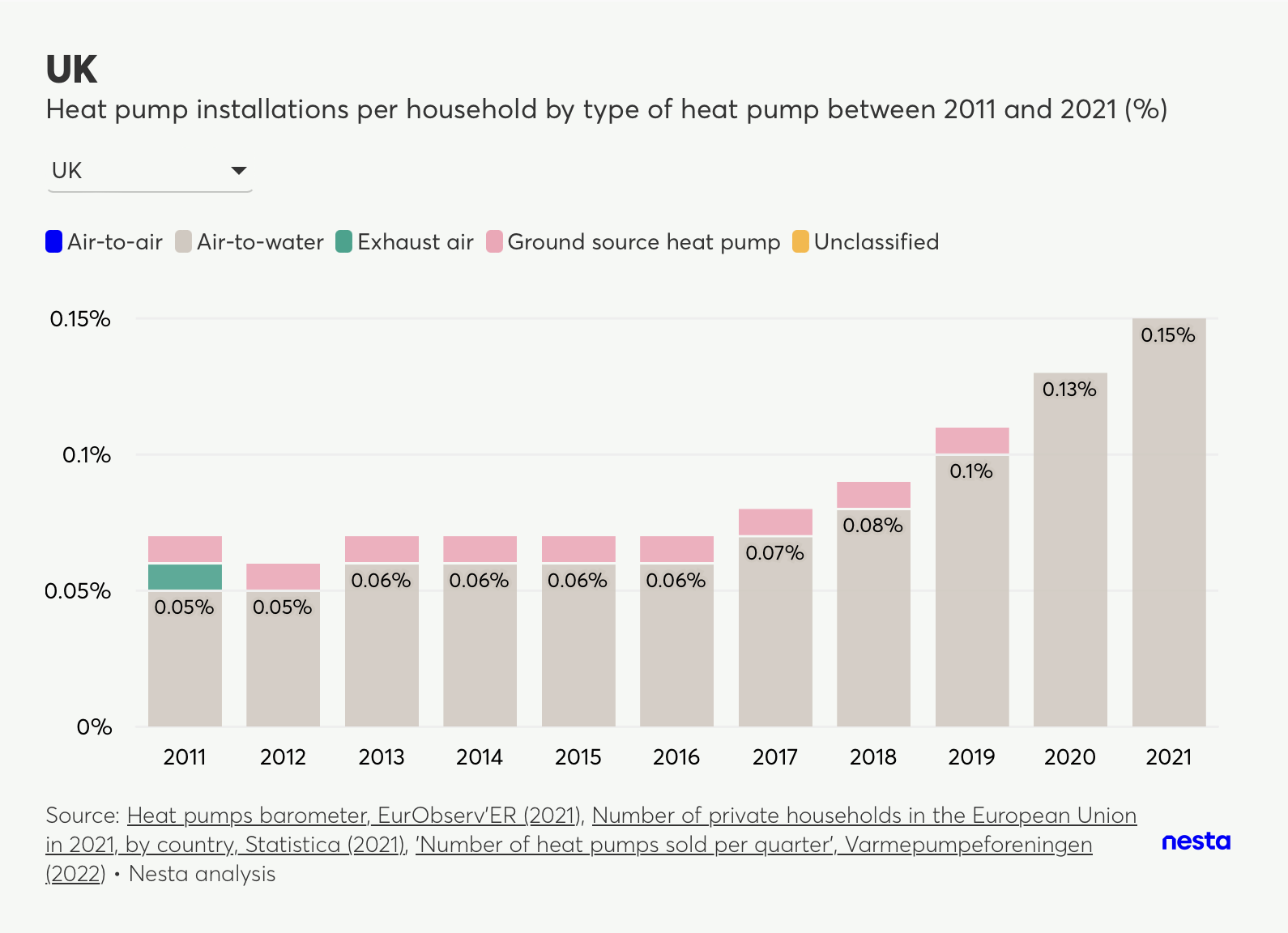
- Very high penetration of the gas grid; in a 2022 survey by BEIS 78% answered that gas central heating is their main way to heat their property during the winter.
- Higher than average electricity-to-gas ratio; between 2011 and 2021, electricity was on average 3.8 times more expensive than gas. On average, in Europe for the same period, electricity was 3.1 times more expensive than gas.
2012-2015: UK Green Deal to provide financing for home energy efficiency upgrades (including heat pumps). The scheme had limited take-up and was scrapped.
2020-2021: Green Homes Grant to provide financing for home energy efficiency upgrades (including heat pumps). The scheme was beset with problems and limited take-up and was scrapped.
2022 - 2028: Boiler Upgrade Scheme offering £5,000 off the cost and installation of heat pumps.
2025: ban on gas and oil in newbuilds.
2035: phasing out the installation of gas boilers in existing buildings (possibility).
Endnotes