## About Nesta
We are Nesta, the UK's innovation agency for social good. We design, test and scale solutions to society's biggest problems. Our three missions are to give every child a fair start, help people live healthy lives and create a sustainable future where the economy works for both people and the planet.
For over 20 years, we have worked to support, encourage and inspire innovation. We work in three roles: as an innovation partner working with frontline organisations to design and test new solutions, as a venture builder supporting new and early stage businesses and as a system shaper creating the conditions for innovation. Harnessing the rigour of science and the creativity of design, we work relentlessly to change millions of lives for the better.
Find out more at [nesta.org.uk](https://www.nesta.org.uk)
If you'd like this publication in an alternative format such as Braille or large print please contact us at [[email protected]](mailto:[email protected])
## About The Behavioural Insights Team
The Behavioural Insights Team (BIT) is one of the world's leading behavioural science consultancies, working around the world to improve people's lives. BIT works in partnership with governments, local authorities, businesses and NGOs in over 30 countries, often using simple changes to tackle major policy problems and deliver improved public services and social outcomes.
BIT was established by the UK government in 2010. In 2014 it became an independent social purpose company, part owned by the Cabinet Office and innovation agency Nesta, and since 2021 has been entirely owned by Nesta.
## Authors
Shoshana Davidson, Sujatha Krishnan-Barman, Ed Whincup
[TOC]
## Introduction
The UK's commitment to achieve net zero carbon emissions by 2050 will have a widespread impact on the country's economy. [^1] To meet these targets, the UK will need to reduce its reliance on fossil fuels, turn towards renewable energy and place a greater emphasis on protecting and conserving the natural environment. Effectively, the UK will need to undertake a **green transition**. This is likely to [transform the economic landscape](https://www.nesta.org.uk/report/green-jobs-rapid-evidence-review/), reshaping existing industries. Some industries will disappear and new ones will emerge.
The green transition will have a profound [impact on employment](https://www.nesta.org.uk/report/green-jobs-rapid-evidence-review/). Some jobs in traditional, carbon-intensive industries, such as in oil and gas, will decline, other jobs will be transformed as green practices become more prevalent, and a wave of new green jobs will appear.
In addition to helping the UK meet its environmental targets, **green jobs are also touted as a crucial way to [plug the UK's productivity gap](https://www.nesta.org.uk/report/green-jobs-rapid-evidence-review/).** [^2] Productivity is a key determinant of a country's standard of living yet, in the UK, productivity has been declining at a faster rate than other G7 nations since the global financial crisis of 2008. Green jobs are one way to attempt to reverse this trend.
The UK government's [Ten Point Plan](https://www.gov.uk/government/publications/the-ten-point-plan-for-a-green-industrial-revolution), unveiled in 2020, aims to create and support up to 250,000 green jobs by 2030. In parallel, the UK government has established the Green Jobs Taskforce (GJT) – a government initiative comprising ministers, members from industry, trade unions and the skills sector with the directive of growing the UK's green jobs and addressing challenges relating to that ambition. More recently, the UK government has doubled down on its commitment to support green jobs by pledging to [create two million green jobs](https://www.gov.uk/government/news/government-doubles-down-on-commitment-to-create-two-million-green-jobs-by-2030) by 2030.
However, there are several open questions to be addressed, including what exactly we mean by green jobs, where the gaps are in terms of creating and filling these jobs, and what policymakers and employers can do to fill these gaps.
This evidence review aims to summarise what we know in terms of the drivers and barriers to getting more people into green jobs and sketch out some initial ideas for how policymakers and employers can intervene. First, we explore the definitional issues around what makes a job green and how these jobs are measured. Second, we identify key barriers and drivers to having more more people in green jobs, including factors specific to certain sectors. Third, we build on evidence of what has worked elsewhere or what could work to address the key barriers. Finally, we include some recommendations on what could come next.
### Evidence considered
Our review was wide ranging, including sources from academic literature, government research reports and other reports published by non-governmental sources. The academic literature on green jobs is sparse, and there is a lack of evidence around tried-and-tested interventions to boost the uptake of green jobs. In this review we focused on capturing a breadth of perspectives rather than assessing the quality and credentials of specific pieces of evidence.
## Definitions and typologies of green jobs
There is significant ambiguity over what a green job means, and how to measure the number of green jobs in the economy. The term green job is increasing in popularity amid recognition of its importance, and the increased attention paid to it in academic literature and the media. However, there is no standard definition of what a green job means. In the broadest sense, green jobs can be [defined as jobs “associated with environmental objectives and policies”](https://www.nesta.org.uk/report/green-jobs-rapid-evidence-review/). However, planning, designing and evaluating environmental and labour market policies depends on a shared and agreed idea of what a green job is, and the lack of clarity or standardisation is a problem.
There are a number of ways in which green jobs are defined. One approach involves identifying industries or sectors of the economy that are 'green'. This may involve identifying sectors that will play a significant part in decarbonising the economy, or that account for lower levels of greenhouse gas (GHG) emissions. Green jobs are then defined as the jobs that sit within these sectors (in the literature, this is referred to as a top-down approach).
A second approach to defining green jobs is at the organisational level, whereby jobs are defined as being green if they are connected to an organisation's creation of green goods and services. A third approach to defining green jobs involves looking at the characteristics of specific jobs themselves and using the tasks and activities involved in occupations to determine whether a job is green or not. (In the literature, these are both considered to be a bottom-up approach to defining green jobs.)
These approaches vary in their granularity and overall purpose. Approaches that classify jobs based on sectors estimate that around 1%-2% of jobs in the UK would be classified as green jobs. Approaches that classify jobs as green based on more in-depth typologies estimate that [more than 20% of jobs could be considered directly or indirectly green](https://www.nesta.org.uk/report/green-jobs-rapid-evidence-review/). Below, we review the main definitions used to classify jobs as green before discussing the strengths and limitations of each approach.
### Green job definitions
#### The International Labour Organization (ILO) definition
<blockquote markdown="1">
The [ILO definition of green jobs](https://www.ilo.org/global/topics/green-jobs/lang--en/index.htm), which was developed in partnership with the United Nations Environment Programme, the International Organisation of Employers and the International Trade Union Confederation, defines green jobs as those that “reduce the consumption of energy and raw materials, limit greenhouse gas emissions, minimise waste and pollution, protect and restore ecosystems and enable enterprises and communities to adapt to climate change. In addition, green jobs have to be decent..." .
</blockquote>
In including climate adaptation, the definition establishes broad parameters in terms of what constitutes a green job in comparison to other prominent definitions. Another unique aspect of the ILO definition is the notion that green jobs must also be "decent”. Although the term is not defined, the [ONS notes](https://www.ons.gov.uk/economy/environmentalaccounts/articles/whataresomeofthedefinitionsforgreenjobs/2021-04-20) that "decent” typically infers the quality of pay and working conditions associated with the job. This concept of job quality is consistent with the [Paris Agreement](https://unfccc.int/process-and-meetings/the-paris-agreement), which holds that signatory countries must consider "...the imperatives of a just transition of the workforce and the creation of decent work and quality jobs in accordance with nationally defined development priorities".
While useful to recognise the importance of job quality, this definition conflates several aspects of a job (ie, pay, working conditions etc) into one term. Further, in the context of developing countries, [some critics argue](https://www.nesta.org.uk/report/green-jobs-rapid-evidence-review/) that it may be desirable to maximise employment and productivity rather than focusing on job quality.
#### The UN System of Environmental Economic Accounting definition
<blockquote markdown="1">
The [UN System of Environmental Economic Accounting](https://unstats.un.org/unsd/envaccounting/seea.asp) sets a definition for measuring the relationship between the environment and the economy. As part of this definition, the Environmental Goods and Services Sector (EGSS) is defined as “areas of the economy engaged in producing goods and services for environmental protection purposes, as well as those engaged in conserving and maintaining natural resources”. [^3] In this context, a green job is therefore considered to be any job related to these areas of the economy.
</blockquote>
This definition sets out a broad and comprehensive definition of green jobs by accounting for activities relating to the conservation of natural resources as well as waste removal and recycling. Further, it derives from an [international statistical standard](https://unstats.un.org/unsd/envaccounting/seea.asp) adopted by other countries, allowing inter-country comparisons to be made.
According to one study that has applied the [EGSS definition to EU countries](https://ec.europa.eu/eurostat/statistics-explained/index.php?title=Environmental_economy_%E2%80%93_statistics_on_employment_and_growth), there are a total of 4.5 million green jobs which translate to an approximate 2% share of total employment across the EU.
#### The ONS Low Carbon and Renewable Energy (LCREE) survey definition
<blockquote markdown="1">
In 2015, the UK Office for National Statistics (ONS) launched LCREE, a survey designed to collect information from all businesses relating to 17 low-carbon sectors. [^4] The [specific definition](https://www.ons.gov.uk/economy/environmentalaccounts/articles/whataresomeofthedefinitionsforgreenjobs/2021-04-20) of these sectors is: "economic activities that deliver goods and services that are likely to help the UK generate lower emissions of greenhouse gases". LCREE therefore defines green jobs as jobs that sit within these 17 sectors.
</blockquote>
The LCREE survey definition captures green jobs within organisations whose primary purpose may sit outside traditionally green industries, and as such is [more fine-grained than some other definitions](https://www.nesta.org.uk/report/green-jobs-rapid-evidence-review/). However, it places a strong emphasis on activities relating to renewable energy while omitting other activities that may be considered green, such as the protection and management of natural resources and recycling.
As of 2020, [LCREE estimates](https://www.ons.gov.uk/economy/environmentalaccounts/articles/whataresomeofthedefinitionsforgreenjobs/2021-04-20) that there were 207,800 full-time equivalent green jobs in the UK, accounting for 1% of total employment.
#### The Green Jobs Taskforce definition
<blockquote markdown="1">
The Green Jobs Taskforce (GJT), which is a UK government initiative comprising of ministers from the Department for Business, Energy and Industrial Strategy (BEIS) and Department for Education (DfE), and is made up of members from industry, trade unions and the skills sector, [defines green jobs](https://www.gov.uk/government/publications/green-jobs-taskforce-report-to-government/green-jobs-taskforce-report-to-government) as “Employment in an activity that directly contributes to – or indirectly supports – the achievement of the UK's net zero emissions target and other environmental goals, such as nature restoration and mitigation against risk”.
</blockquote>
The GJT's definition introduces nuance, acknowledging that green jobs can be either directly or indirectly green. It is also sector-agnostic. Together, this allows for a comprehensive and broad account of what jobs are green. However, in doing so it introduces subjectivity, particularly on whether a job is directly or indirectly green.
### Organisation-level classification
A more granular approach to classifying jobs as green involves looking at the share of an organisation's total employment that is connected to the creation of green goods and services and then classifying those jobs as green. Where this is not easy to identify, [some studies](https://www.nesta.org.uk/report/green-jobs-rapid-evidence-review/) have used the share of an organisation's revenue related to the creation of green goods and services as an alternative way of estimating green job employment figures.
In theory, this approach provides a relatively simple way to classify green jobs while taking into account the activities of specific organisations. This is important given that jobs can vary significantly from organisation to organisation. However, there is ambiguity around how jobs are connected to the production of green goods and services which may make this classification hard to apply practically. For example, it is unclear whether this definition includes jobs that are indirectly green.
### Occupational-level classification
A third approach to defining and identifying green jobs is to consider occupation-specific characteristics, such as a role's specific tasks and activities, in order to determine the greenness of a job. Below, we outline two separate definitions that employ this occupation-specific approach to defining green jobs.
#### O*NET typologies
The literature that employs an occupation-specific definition of green jobs is largely based on classifications of jobs developed by O*NET, an occupational classification database that has been applied to the United States labour market.
<blockquote markdown="1">
To create its classifications, O*NET firstly [defines the green economy](https://www.onetcenter.org/green/definitions.html) in broad terms, as; “economic activity related to reducing the use of fossil fuels, decreasing pollution and greenhouse gas emissions, increasing the efficiency of energy usage, recycling materials, and developing and adopting renewable sources of energy". Within this definition of the green economy, O*NET then identifies 12 sectors of activity, for example energy efficiency, green construction and transportation, which together comprise this green economy. [^5]
</blockquote>
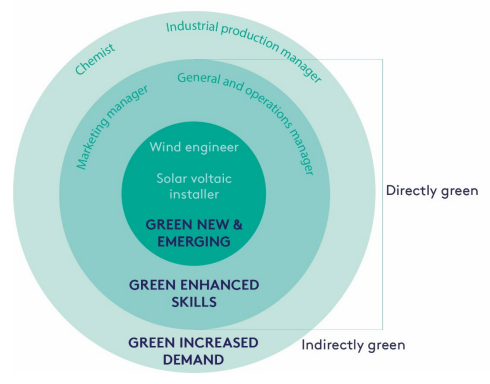
O*NET then assesses the levels of greenness of occupations within the parameters of these 12 sectors, [identifying three occupational typologies](https://www.nesta.org.uk/report/green-jobs-rapid-evidence-review/) of green jobs based on how the green transition will affect these jobs, as well as the skills needed to fulfil them. The three typologies of green jobs are illustrated in Figure 1 and described in Table 1 below.
<div class="diagram-description" markdown="1">
**Figure 1. Varying greenness of O*NET typologies** [^6]
Concentric circle diagram showing green job classifications: Green New & Emerging, Green Enhanced Skills, Green Increased Demand, with example roles, categorized as Directly Green or Indirectly Green.
</div>
<div class="table-container" markdown="1">
| Typology of green job | Description | Examples of jobs |
|-----------------------|-------------|------------------|
| Green new and emerging <br> (*The narrowest definition of 'green job'*) | The transition to a sustainable economy leads to the creation of new occupations with unique tasks and worker requirements. | Solar or wind energy engineers, for whom all tasks are 'green'. |
| Green enhanced skills | The transition to a sustainable economy significantly alters tasks, skills and knowledge requirements for these occupations. As with green new and emerging jobs, these can be considered directly green, since they involve explicitly green tasks as defined by O*NET. | A marketing manager for whom a new green task might be developing business cases for environmental marketing strategies.<br><br>A heat pump technician specialising in the installation of ground-source heat pumps.<br><br>A construction labourer specialising in retrofitting buildings to increase their energy efficiency. |
| Green increased demand | The transition to a sustainable economy creates higher demand for these occupations but there are no significant changes in tasks or worker requirements due to greening. Such jobs are considered indirectly green because they support green economic activity but do not involve any green tasks. | Chemists, materials scientists, industrial production managers. [^7] |
</div>
The granularity of the O*NET typology is one of its key strengths. O*NET recognises that jobs can be both directly or indirectly green by considering the context of the wider economic transition and the implications of this transition on worker skills.
The O*NET typologies were created in 2010 and based on the US labour market. Therefore, there are questions about how applicable it is to the UK environment, and how relevant it remains more than 12 years on. Nevertheless, O*NET remains popular in the literature due to the thoroughness of the approach and has been applied extensively in the UK labour market. The classification involves identifying green occupations based on an extensive and highly systematic [occupation task list](https://www.nesta.org.uk/report/green-jobs-rapid-evidence-review/) of more than 1,300 distinct 'green' tasks.
Another limitation of this typology is that it does not distinguish between jobs in terms of their greenness based on the organisation. For example, a green increased demand job in a carbon-neutral organisation may have a very different impact on carbon emissions compared with an equivalent job in a heavily polluting organisation. It is not possible to capture these differences through the O*NET typologies.
<a id="section-french-ministry-of-employment-s-office-for-research-studies-and-statistics-dares-definition" href="#section-french-ministry-of-employment-s-office-for-research-studies-and-statistics-dares-definition" class="section__global-number"></a>
#### French Ministry of Employment's Office for Research, Studies and Statistics (DARES) definition
<blockquote markdown="1">
The definition provided by DARES also employs an occupation-specific approach to defining green jobs whereby the purpose and nature of specific roles is considered to identify two distinct types of green jobs. [According to DARES](https://travail-emploi.gouv.fr/IMG/pdf/dares_analyse_definitions_metiers_verts.pdf), 'green jobs' are those “whose purpose is to measure, prevent, control or correct negative impacts on the environment”, meanwhile 'greening jobs' are defined as those that “are not directly linked to the environment, but integrate new competences that take into account the ‘environmental dimension' to a significant and measurable extent".
</blockquote>
As with the O*NET approach, a strength of the DARES definition is that it recognises that jobs can be green to a varying degree through its distinction of 'green' and 'greening jobs'. While the definition provides a relatively concrete definition of what constitutes a green job, the concept of greening jobs (describing jobs that are indirectly green) is vague and open to interpretation.
<a id="section-overall-strengths-and-limitations-of-various-approaches" href="#section-overall-strengths-and-limitations-of-various-approaches" class="section__global-number"></a>
### Overall strengths and limitations of various approaches
**Sector-specific approaches can be easy to apply and measure but lack nuance.** The sector-specific definitions provide simple and practical ways of dividing green jobs from non-green jobs (eg, by identifying green jobs based on the sectors they sit within). As noted above, some of these definitions allow more objective measurements of green jobs, such as the LCREE definition, while others intend to provide more descriptive accounts of what a green job is, such as the GJT definition. The choice of approach depends on what it is being used to measure.
However, taking a sectoral approach means that we could overestimate the number of green jobs by counting jobs as green simply because they are within a sector, or ignoring jobs that are green but occur in other sectors. This approach would be useful if the objective is simply to increase the supply of jobs in green sectors, or increase demand for them by making their benefits more salient. However, without knowing job vacancy rates across the green sectors, it is difficult to determine whether there are benefits to directing workers to these jobs, ie, increasing demand for these jobs may not increase their supply. Additionally, by excluding organisations in non-green sectors, these organisations may lack the motivation to create more green jobs or make their existing jobs greener.
**Organisational and occupational approaches are more granular but can be subjective.** These approaches give us a richer view of the green jobs available in an economy, how these differ compared to non-green jobs, where skills need to be developed, and can help feed into building a view on where supply-demand mismatches may be occurring. However, they introduce elements of subjectivity in categorising green jobs, they are more resource-intensive to apply, and may not be practical on an ongoing basis.
### Implications for the rapid review
The decision on which definition and approach to use to define green jobs as part of any future projects to connect more people to green jobs is contingent on the project's objectives. For this review, in the interests of maximising the breadth of evidence and insights, we will not constrain our search for evidence to any single definition. However, we will note which definition or approach is used when reporting on findings throughout the review. When it comes to designing an eventual intervention, we will choose the most suitable approach at that stage.
---
[^1]: Green Jobs Taskforce
[^2]: Productivity is the second focus of Nesta's sustainable future mission
[^3]: These sectors of activity have been identified by the ONS in the UK and include: wastewater, recycling, water quantity, production of renewable energy, in-house environmental activities, management of forests, organic agriculture, insulation activities, environment-related education, managerial activities of government bodies, environmental charities, energy saving and sustainable systems, environmental construction, environmental consultancy and engineering, environmental low emissions vehicles, carbon capture and inspection and control and, finally, production of industrial environmental equipment
[^4]: These sectors are: alternative fuels; bioenergy; carbon capture and storage; energy efficient lighting; energy efficient products; energy monitoring, saving or control systems; fuel cells and energy storage systems; hydropower; low carbon financial and advisory services; low emission vehicles and infrastructure; nuclear power; offshore wind; onshore wind; other renewable electricity; renewable combined heat and power; renewable heat; and solar photovoltaic.
[^5]: A study by the [LSE](https://www.nesta.org.uk/report/green-jobs-rapid-evidence-review/) sought to apply the O*NET typologies to EU economies and reported that, in 2016, green increased demand jobs accounted for approximately 22.5% of total employment across EU countries, while green enhanced skills and green new and emerging jobs accounted for 20% and 17.4% respectively. [In a study that applied the typologies to the UK economy](https://www.nesta.org.uk/report/green-jobs-rapid-evidence-review/), it was estimated that, in 2019, between 17% and 39% of all jobs were green in some capacity. [^8] Further, it was estimated that between 16% and 5% of jobs classified as green new and emerging, between 24% and 7% classified as green enhanced skills and between 18% and 5% of jobs classified as green increased demand.
[^6]: [Are 'green' jobs good jobs?](https://www.nesta.org.uk/report/green-jobs-rapid-evidence-review/)
[^7]: [O*NET Online](https://www.onetonline.org/help/green)
[^8]: Variance between estimates is due to differing matching criteria between O*NET occupations and tasks and UK occupations. The study employs two differing criteria to achieve a generous estimation, as well as a more conservative estimation.
Barriers and drivers to more of the UK workforce being in green jobs
We found four main categories of barriers and drivers to more people in the UK being in green jobs.
- Availability of green jobs: the supply of green roles in the labour market.
- Ability to undertake green jobs: whether people have the skills necessary to fulfil these roles.
- Awareness of green jobs: how well people understand what green jobs are.
- Attractiveness of green jobs: attitudes towards green jobs and how these jobs compare to other roles in terms of salary, location and other features.
In the section below, we explore how each of these factors relate to green jobs by looking at the UK economy as a whole. Where relevant, we have also included sector-specific factors that influence the availability of green jobs and the ability to undertake them since some parts of the economy are more advanced in their decarbonisation journeys than others.
Availability of green jobs
The first question when it comes to getting more people into green jobs is whether there are enough green jobs available. If there are not enough green jobs available, then the focus of interventions should be on increasing supply. However, if many green jobs are unfilled with employers struggling to find suitable candidates, this would imply that awareness, attraction or skills are the key barriers.
This distinction between supply- and demand-side factors is critical to policymakers as it has a strong bearing on the types of interventions and policies required to ensure a well-functioning green jobs market. For example, there may be little use in developing interventions to boost the creation of green jobs if demand for these jobs is low, and conversely, there is little to gain in increasing demand for green jobs if these jobs are in short supply. However, there is limited evidence around how many green jobs are available in the UK and it is unclear whether their availability is a barrier to more people being in green jobs in the UK.
A recent study by LSE that applied O*NET typologies to 53.9 million job advertisements posted between 2014 and 2020 across the UK found that the share of green jobs being advertised over this period was largely stable with only minor variations. While this data suggests that the supply of green jobs was consistent over this period, it gives no indication of demand for green jobs, or indeed how supply has been affected by demand. A separate study tracking green job vacancies from various UK online job portals in 2019-20 found that the supply for green jobs seemed to follow the supply for jobs across the labour market more broadly. For example, vacancies for green and non-green jobs rose following the first Covid-19 lockdown, with green job vacancies rising at a slightly slower rate than vacancies for non-green jobs. A study carried out at Warwick University also found that there was no proportionate increase in the supply for green jobs compared with non-green jobs, suggesting that supply for green jobs was relatively stable over this period. In 2019, the percentage of green job vacancies was 32% of total jobs and 30% of total jobs in 2020. It is important to note that this study used its own (vaguely defined and broad) definition of green jobs, leading to a much higher proportion of jobs being classified as green. In comparison, analysis by the consulting firm PWC found that between July 2020 and July 2021, only 1.2% of total advertised jobs were green jobs (equating to 124,600 unique green job adverts).
This suggests that green jobs' share of the overall UK job market has remained relatively stable. However, this does not tell us if these vacancies are easy to fill (in which case it may be worthwhile to focus on generating more green jobs) or hard to fill (in which case the barriers may lie elsewhere). Two pieces of evidence offer some initial suggestions to parse this. Some evidence from employer surveys suggests that more than two thirds of employers (67%) who need green skills have struggled to fill these roles. This could mean that the challenge is more around ensuring the workforce has the necessary skills rather than the availability of green jobs themselves. Second, we know that green jobs are concentrated more heavily in certain regions of the UK. This is discussed in more detail below, but suggests that we may need a more granular approach when ascertaining availability. Overall, there is no strong evidence that this is a key barrier, but more data is needed to make a more definitive conclusion.
Sectoral analysis: availability of green jobs across sectors
There is evidence to suggest that there are sectoral differences in the supply of green jobs.
Analysis of green job advertisement data by PWC revealed that the UK sector with the highest share of green job creation is the professional, scientific and technical sector (sector accounts for roughly 8.5% of UK's total workforce), accounting for 44% of all green job adverts between June 2020 and July 2021. PWC's findings also reveal that green jobs have the highest proportional representation in the electricity and gas, and water and sewage sectors (sectors account for roughly 1.7% of UK's total workforce), accounting for 21.1% and 19.4% of their total advertised jobs respectively. Meanwhile, the education (sector accounts for roughly 10% of UK's total workforce), human health and social work sectors (sectors account for roughly 13.5% of UK's total workforce) have the lowest proportion of green jobs (green jobs represent just 0.1% of all jobs advertised in these sectors). The low proportion of green jobs advertised in sectors that employ large portions of the UK's workforce suggest that it would be worthwhile to pay particular attention to these sectors when it comes to considering how to make more existing jobs green.
When looking at the number of green hires rather than the number of green job adverts created, research by Linkedin revealed that the sectors with the highest share of green talent hires in 2021, based on job adverts on their platform, were the construction, manufacturing, corporate services, education and software and IT services sectors. While it is not possible to compare these studies since they use different definitions of green jobs, the differences between the sectors with the highest shares of job adverts, and the sectors reporting the highest hiring of people in green jobs raises some interesting questions. In a well-functioning labour market, we would expect that a sector with the highest number of vacancies would place the most number of candidates; the differences could potentially reflect skills shortages in certain sectors which may in turn be a barrier. We explore these differences in the demand for skills and related skills gaps across sectors in the following section.
The UK labour market as a whole is experiencing a skills shortage. The ONS reports that job vacancies in the UK have hit record highs in recent years with the current number of job vacancies exceeding 1.2 million. According to current projections, the UK will have a shortfall of 2.6 million workers by 2030. Beyond the sheer number of workers, there is a critical shortage of skills with data from the Employer skills survey revealing that UK businesses consistently report skills shortages as a barrier to recruiting workers for open roles. It has been estimated that the skills shortage will cost the UK economy £120 billion by 2030 and will result in a shortfall of 2.5 million high-skilled workers.
Green jobs are likely to require higher levels of skills and specialisation when compared with non-green jobs. A series of studies in the US that used O*NET typologies to examine skills differences and requirements across jobs found that green jobs require higher levels of education, work experience and on-the-job training, compared with non-green jobs. Further, they are also more likely to require regular creative problem solving. This skills differential, when compared to non-green jobs, is likely to be more pronounced for directly green jobs (green new and emerging and green enhanced skills jobs), while there is a smaller skills differential between the requirements for non-green jobs and indirectly green jobs (green increased demand jobs).
The skills shortages are felt most in science, technology, engineering and mathematics (STEM) subjects. Among the 17 low-carbon sectors identified by LCREE, 11 of these have a strong reliance on STEM skills. Additionally, a think tank, Onward, predicts that, of the 1.7 million jobs that could be created among green sectors by 2030, 1.3 million are in jobs that currently require strong technical qualifications. Analysis conducted by Onward found that, among workers in green jobs (as defined by the LCREE) 32% hold university degrees, of which 56% are in STEM subjects. By comparison, among the UK's working population, 26% hold a university degree, of which approximately 34% are in STEM subjects.
However, the UK lags behind other OECD countries when it comes to the share of students studying subjects related to engineering, manufacturing and construction; on this, the UK ranks 30th among 38 other OECD countries. The share of adults with an upper secondary vocational qualification in the UK is 18% for 55-64 year-olds and 19% of 25-34 year-olds in 2019 compared to 26% and 21% respectively across the OECD. There is a particularly worrying trend among STEM technical qualifications. Since 2012, the number of vocational qualification certificates awarded has fallen by 33%. Further, the number of certificates awarded has fallen in many of the key subject areas for net zero such as science and engineering, with the exception of building and construction and horticulture and forestry. Between 2016 and 2020, the UK's apprenticeship starts in engineering and manufacturing fell from 75,000 to 52,000. The UK government's 2017 Industrial Strategy noted that 40% of employers reported a shortage of STEM graduates.
This is exacerbated by other high-tech sectors also competing for candidates with STEM skills. High-level STEM skills are in high demand across engineering, IT and scientist occupations and the proportion of workers with high-level STEM skills is highest in sectors such as information technology, oil and gas and civil engineering. Additionally, the data suggests that occupations that require high-level STEM skills are well-remunerated, as salaries for these roles are typically significantly higher compared with national averages. It is possible some of these jobs are already green and that many of these occupations and industries will become more green (and house more green jobs) as the economy moves towards decarbonisation. However, at present, the demand for STEM skills across these other occupations and industries may be in direct competition with the demand for STEM skills in green jobs.
The UK workforce will also need a multitude of other skills to keep up with the demands of green jobs, according to the Green Jobs Taskforce. Digital and data analytics skills, for example, will be critical in ensuring the optimal operation of the energy sector as it becomes increasingly reliant on intermittent energy generated from renewables. Further, the Taskforce emphasises the importance of project and change management skills, leadership skills to drive the adoption of new green technologies and practices and communication skills needed for educators tasked with upskilling and promoting the use of green skills.
There is some evidence that suggests that, in the UK, the creation of green jobs may already be outpacing the ability of the workforce to meet this need. A recent study by LinkedIn found that between 2016 and 2021, job adverts requiring green skills grew by 35% while green skills grew 26%. The study also suggests that this gap is on course to continue to grow, with a 12% increase in job adverts requiring green skills in 2021, amid a 9% rise in green talent.
While these skills gaps will act as a key barrier in funnelling future workers into green jobs, it is also important to consider the implications of the green jobs and green skills transition on the current workforce. Analysis conducted by the International Monetary Fund (IMF) has found that the probability of switching to a green-intensive job is significantly lower for workers coming from pollution-intensive (5% for workers coming from employment and 4% for workers coming from unemployment) and neutral jobs (10% for workers coming from employment and 7% for workers coming from unemployment), compared with workers who already come from green-intensive jobs (54% for workers coming from employment and 40% for workers coming from unemployment). Although it is important to note that the IMF operationalised a relatively narrow definition of green jobs, which relates to the greenhouse gas emissions related to jobs, the findings suggest a lack of mobility between green and non-green jobs, particularly for workers who are currently working in carbon-intensive jobs and sectors, which the IMF stipulates is at least in part due to a lack of transferability of skills.
Confidence, upskilling costs and risk
Given that green jobs will require a shift in the skillset of the workforce, how attractive it is to reskill or upskill will be a critical factor in getting more workers into green jobs. Qualitative research conducted with heat pump installers across the UK, for example, found that the most significant barrier preventing them from taking up retraining is the perception of low consumer demand for heat pumps, paired with a perceived lack of commitment from the government on related policy resulting in low confidence that the retraining will be worthwhile.
It is difficult to parse whether low consumer demand is the cause for workers being unmotivated to take up training, or if in fact the lack of trained workers is artificially dampening demand. To resolve this chicken-and-egg situation will need support from policymakers to increase confidence among workers that taking up training opportunities will be worthwhile, through subsidies and grants as well as other forms of support. These could also address the other barriers to the take up of training, including the high cost of enrolling in training programmes as well as the opportunity cost of missing out on work in order to reskill.
These costs, and associated risks, of training and upskilling are not specific to sole traders and contractors. These factors can also deter employers from investing in developing their workers' skills and offering apprenticeships. This is particularly true within organisations or sectors with high employee turnover rates, which may further disincentivise employers from investing in their employees given that the benefits of training may not necessarily accrue to them.
Sectoral analysis: ability of workers across sectors
Green jobs, and the skills they require, vary significantly across occupations, organisations and sectors. For this reason, taking a sectoral approach to analysing green jobs and skills gaps within sectors can provide a more granular view of the specific challenges relating to skill shortages. Below, we summarise these green skills gaps across UK sectors that are projected to be impacted most by the green transition. These sectors are: construction, waste / circular economy, transport, agriculture and land use, energy and heavy industry / manufacturing, as outlined in Green Alliance's recent report, Closing the UK's green skills gap.
Construction
The UK's construction sector will play a key role in decarbonising the UK's economy by ensuring that the UK's building stock is as energy efficient as possible. This will involve ensuring the energy efficiency of new builds, as well as retrofitting the existing building stock. The sector currently employs 1.3 million people in the UK. These jobs are primarily distributed across London (209,300), the South East (209,500), the East (171,900) and Yorkshire and the Humber (106,100). Green jobs within the sector involve roles relating to the installation of low carbon heating, such as heat pumps, and home energy efficiency improvements such as cavity wall and attic insulation. Other jobs within the sector include the manufacturing and maintenance of these home energy efficiency products.
Due to the UK's ambitions to retrofit all homes to a minimum EPC band C energy rating standard and phase out the sale of gas boilers, the demand for green jobs within the sector is high and is expected to grow further. Analysis from Green Alliance indicates that there is a current shortfall of 300,000 workers across the sector. Further, the skills shortage in the sector is believed to be one reason for the postponement of the Future Home Standard – a planned mandate on energy efficiency standards for new-build homes.
Projections estimate that the skills gap within the sector is due to rise further. Analysis by the Institute for Public Policy Research indicates that 750,000 workers could retire, or be on the verge of retirement, by 2035, placing significant strain on the workforce. Furthermore, the Heat Pump Association estimates that 12,400 installers will be needed by 2025, and 50,200 will be needed by 2030. In parallel, it is estimated that 230,000 new retrofit installers will be needed by 2030. Overall, the skills gaps within this sector means it is poorly equipped to respond to increased demand and growth.
Waste / circular economy
The waste sector currently employs approximately 145,000 workers across the UK and accounts for 4% of the country's total GHG emissions. Green jobs within this sector include recycling plant and waste operatives, as well as roles oriented towards the repairing and reuse of goods such as technical, electrical and mechanical engineers responsible for repairs and mechanical and technology engineers responsible for remanufacturing.
Green Alliance estimates that the sector will grow by between 40,000 and 472,000 new jobs by 2035. It is believed that some of the current skills gaps within the sector are in waste sorting and reprocessing, repair and manufacturing, circular economy business planning and the material sciences.
Transport
Given that transport is the UK's highest-emitting sector in terms of GHG emissions (24% of total emissions), the sector is likely to undergo a significant transformation in coming years in terms of changes to modes of transport, as well as changes to supply chain dependencies – for example, in transitioning away from fossil fuels towards lithium batteries and hydrogen. The sector currently employs 1.4 million people across the UK. Green jobs within the sector include jobs in sustainable aviation, green public transport, electric vehicles (charging infrastructure designers, battery manufacturers) and jobs that encourage active travel, such as urban designers.
The Green Alliance estimated that the green transformation of the sector will require an additional 175,000 workers by 2035. More specifically, the transition to electric vehicles will drive demand for 50,000 automotive manufacturing workers to be reskilled by 2025, increasing to 100,000 reskilled workers by 2035–2040. Further, 10,000 new workers could be needed in battery cell manufacturing by 2030. It is also estimated that 45,000 new jobs will be needed in aviation (green and non-green), and increased demand on rail transport will lead to the need for approximately 10,000 new workers per year up to 2030.
According to Green Alliance, the primary skills gaps in the transport sector are in vehicle chargepoint installers and operators, vehicle recycling experts, battery manufacturers and operators and electrification engineers.
Agriculture and land use
The agricultural sector accounts for approximately 11% of the UK's total GHG emissions.
The majority of these come from livestock (60%), while the use of machinery, fuel and fertilisers account for the remainder of emissions. The agricultural sector is of particular importance to the UK's net zero ambitions as it can help generate negative carbon emissions – for example, through the expansion of forestry which can act as carbon sinks, thus helping to remove carbon from the atmosphere. Green jobs types in this sector include nature restoration, agroforestry and sustainable farming.
The agricultural sector currently employs around 475,000 people in the UK and, compared with other sectors, the workforce has a higher proportion of workers with no formal qualifications. Moving forwards, the majority of green jobs generated within this sector will be in sustainable food systems, conservation, forestry and environmental restoration. For instance, it is estimated that environmental enhancement through improving woodlands, peatlands and urban parks could create 16,000 green jobs. The sector will also be highly dependent on upskilling its current workforce. For example, many farmers will need training to maximise the efficiency of their practices and reduce emissions. According to Green Alliance, the main skills gaps in agriculture are in soil husbandry, carbon auditing and advice, tree and biomass management, conservation and biodiversity expertise. Meanwhile, in land use, further skills are needed by surveyors, land managers and farmers to plan woodlands and manage habitat restoration.
Energy
The energy sector is the UK's second largest in terms of emissions, accounting for 21% of the country's total GHG emissions. Given that the UK's net zero ambitions are underpinned by the necessity to produce clean, renewable energy, the energy sector and its transition from fossil fuels to renewables will be of critical importance and will help generate thousands of new jobs. Green jobs within the sector include jobs in data analysis (eg, in grid optimisation), manufacturing renewable energy technology, construction and engineering jobs revolving around the implementation and maintenance of renewable energy infrastructure.

The sector employs 700,000 workers and, according to ONS data, 7,200 of these workers work in offshore wind and 4,400 work in onshore wind. Meanwhile, the solar energy sector employs around 5,500 workers and the nuclear energy sector employs just under 60,000 workers. Despite the large number of green jobs already within this sector, jobs are projected to increase further by roughly 80,000 workers by 2030. Driving this increase will be growth in offshore wind and tidal power, as well as jobs in hydrogen and carbon capture storage.
According to Green Alliance, there are likely already skills gaps within the hydrogen and carbon capture storage sub-sectors given that these are reliant on new and emerging technologies. However, there are currently less pronounced skills gaps across this sector compared with others due to the fact that the wind, nuclear and solar industries are all established in the UK. It is also possible that skills gaps within this sector could be filled by workers transitioning from the oil and gas industry. However, it is important to note that a significant barrier to entry and lateral shifts from the oil and gas sector to the renewable energy sector, is the need to upskill/reskill, which places significant costs on workers. For example, a study conducted by Friends of the Earth Scotland, which surveyed offshore oil workers, found that 97% were concerned with the cost of reskilling, given that this is something they had to finance.
Heavy industry / manufacturing
Heavy industry and manufacturing accounts for 15% of the UK's greenhouse gas emissions. Around 50% of these emissions are concentrated in specific regions with high concentration of industry, such as London and the Midlands. This means that those working in this sector and within these regions may be disproportionately impacted as the sector continues to transition to renewable energy sources and more energy efficient manufacturing processes. For these workers, upskilling will be critical to ensure they are not left behind by the transition.
At present, the sector provides 2.5 million direct jobs across the UK (approximately 8.3% of the UK's total workforce). In the future, a large number of new green jobs could be created in the sector depending on government investment. For instance, it is estimated that 43,000 new jobs could be created through the decarbonisation of the sector as focus shifts towards hydrogen and creating carbon capture storage technology. However, the number of new jobs in the sector could be as high as 220,000 if the UK does become a major hydrogen exporter.
Green Alliance identified the main skills gaps in this sector as those revolving around green hydrogen production and carbon capture storage technologies. However, they also note that workers in other sectors such as oil and gas, and fossil fuel electricity generation, may already possess some of the necessary skills to fill the gaps in this sector as jobs in their industries may be displaced.
Awareness of green jobs
Many workers, including younger workers, do not know what green jobs entail, what green skills are, or how to get more information on how to get a green job. Research carried out by Groundwork UK with young people aged 16 to 25 found that, despite 32% indicating they were interested in pursuing an environmental career, many young people reported that they did not know where to look to find opportunities. More than a third (33%) of respondents said they wanted resources that would increase their awareness of environmental careers and the pathways available to them. A separate survey carried out by WorldSkillsUK, found that 87% of young people (aged 16 to 24) did not know what green skills were. Their findings also highlighted a gender gap in the level of understanding of green skills, with 72% of young women indicating they had never heard of green skills compared with 53% among young men.
Low levels of awareness and understanding of green jobs are not exclusive to younger people. A series of focus groups commissioned by Green Alliance revealed low levels of understanding towards green jobs and the green transition, among members of the general workforce. More specifically, it was found that individuals lacked understanding of the term 'green job', with researchers noting that the term was conceptual to many and individuals lacked concrete examples of what green jobs were. The research also suggests that the low levels of understanding are ubiquitous across worker groups with higher levels of educational attainment, for example, not being associated with a higher level of understanding of green jobs. These findings suggest that tackling awareness of green jobs could be a logical first step to connecting workers to these roles. Furthermore, the findings around the levels of understanding of green skills suggest that workers lack the knowledge around which skills they should be investing in, in the absence of a clear roadmap of how their skills need to adapt to green jobs.
Finally, there is research suggesting that a lack of awareness and understanding is a barrier which affects employers too, particularly where it pertains to providing their workers with access to green skill development opportunities. Research by Deloitte and the Institute of Environmental Management and Assessment (IMEA) found that 41% of survey respondents identified the lack of experience and knowledge among leaders as a key blocker to developing green skills within their organisation. Further qualitative research conducted by Deloitte and IMEA with sustainability leaders across organisations revealed that a lack of urgency and misperceptions about the value that green skills can provide contribute to this challenge. These findings suggest that increasing understanding among employers themselves could also improve accessibility to green skills (and potentially to green jobs) for workers.
Attractiveness of green jobs
There are a number of aspects of green jobs that can affect how they are perceived by workers. These aspects can either act as barriers or drivers toward the demand for green jobs among workers. We explore these in detail below.
Attitudes towards green jobs
Despite low levels of understanding around what green jobs are, attitudes towards green jobs appear to be largely favourable among workers. Qualitative research from Green Alliance found that workers were generally interested in green jobs and, more importantly, that their 'cleanliness and greenness' were appealing to workers. The researchers noted that enthusiasm for green jobs appeared to be more evident among younger demographics, reflecting their values and desire to work towards something that is meaningful and can make a difference.
While there is a lack of quantitative research exploring attitudes towards green jobs, the evidence that does exist corroborates these findings. Attitudes towards green jobs appear to be largely positive among the general population. A survey conducted by Ipsos with working age adults (people aged 16+) found that 65% said they would be interested to work in a range of green sectors that included renewable energy, energy efficiency, science, nature conservation and clean transport. Another survey of 1,000 people aged between 18 and 34 found that 50% of respondents indicated they want a job in the ‘green economy'. In parallel, research from WorldSkills UK supports these findings. Its survey found that 55% of young people (aged 16 to 24) felt inspired to develop green skills and pursue a green career. Further, among those who said they feel inspired to pursue a green career, 71% said this because they want to combat climate change. It was also found that 80% of young people said it was either very or quite important that they work in an organisation that is committed to tackling climate change.
In addition to these studies, BIT also conducted our own survey exploring attitudes to green jobs. The findings from our survey corroborate those shared above and are presented in the box below.
BIT mini survey exploring attitudes towards green jobs
Between November and December 2022, BIT conducted a mini survey with an online representative sample of 4,458 A/T level students (or equivalent), university students and recent graduates from across England with the aim of surveying attitudes towards green jobs. The main findings from the survey are summarised below.
Overall, attitudes towards green jobs were positive:
- around 70% said it is important that their career benefits the environment
- this figure was 70% for A/T level or equivalent students and 66% for university students and recent graduates
- only 11% stated that they don't care whether their job benefits the environment or not.
However, salary is a key consideration:
- 55% would only take a green job on the condition that it pays the same or more than a non-green job
- 11% indicated they would only work in a green job (regardless of salary), and 23% indicated that they would accept a lower salary to work in a green job.
The majority did not feel confident looking for green jobs:
- only 38% of respondents indicated that they feel confident looking for green jobs
- this figure was 43% for A/T level or equivalent students and just 33% for university students or recent graduates.
Overall, there were few differences in responses between A/T level students (or equivalent), university students and recent graduates. However, we do note that younger students tended to respond more optimistically compared with older students, eg, in terms of their sentiment towards green jobs and their willingness to accept lower salaries to work in green jobs. This may be due to older students being in positions where they are actively seeking jobs and are perhaps thinking about work and salaries in more practical terms.
Taken together, this research not only reveals a high demand for green jobs among younger demographics but also that the desire to play a role in tackling climate change, and the desire to work for organisations with green credentials, are key drivers to connecting young workers with green jobs.
Salary
One aspect of green jobs which may act as a driver to more of the workforce being in them is their salaries. A Nesta study which applied the EGSS definition of green jobs to online job adverts found that the median of both minimum and maximum salary
offers for jobs in green sectors is slightly higher than for jobs in non-green sectors. Additionally, a separate study that applied the O*NET typologies found that green jobs (particularly green new and emerging and enhanced skills jobs) have higher hourly wages than non-green jobs. Further, this was found to be the case even when controlling for variables such as gender, education levels and work experience. This could be because green jobs tend to require higher skills compared with non-green jobs, or it could be a function of excess demand for green skills relative to supply. However, irrespective of the reasoning, the higher wages associated with green jobs could act as a key driver to increase demand for these jobs among workers.
Geographical barriers
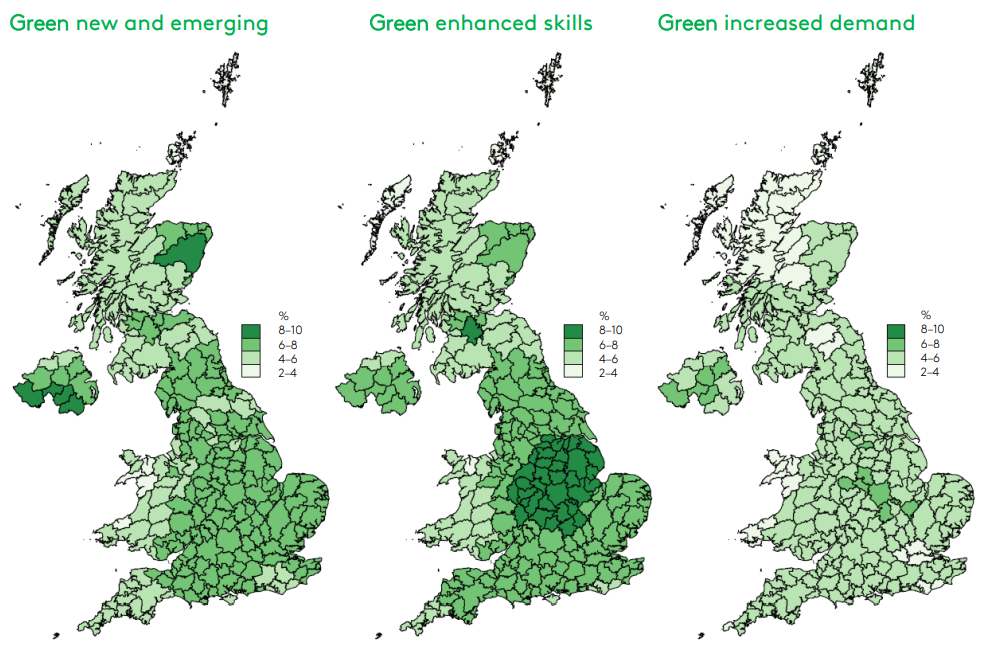
Analysis that has examined the prevalence of green jobs across the UK has found that, at present, green jobs are concentrated within specific regions of the country. For example, a study which mapped green jobs based on the O*NET typologies found that green enhanced skills jobs tend to be slightly more prevalent across Wales, the West Midlands and the South East. Meanwhile, green new and emerging jobs are concentrated in the South of England but with relatively high shares in Scotland and the North West in Scotland and the North West. Lastly, green increased demand jobs are more concentrated in Northern Ireland, the North of England and the Midlands than in other regions (see Figure 2 for an illustrative breakdown). In a separate study by Nesta, that instead operationalised the EGSS definition of green jobs, the analysis found that the regions with the highest number of jobs in green sectors includes the Scottish Highlands/Islands, Devon, Cornwall/Isles of Scilly, Tees Valley/Durham and the Gloucestershire/Wiltshire/Bristol/Bath area.
In parallel to this, analysis conducted by Onward suggests that some of the regions that have the highest exposure to green jobs also tend to have the widest skills gaps. For instance, it highlights that Scotland, as well as the East and North East regions of England, all have green skill deficits compared to the green jobs available in those regions. This implies that the geographical location of the work could act as a barrier to workers getting green jobs, particularly in circumstances where green jobs are in regions which have relevant skill shortages. The mobility of skills across these regions not only represents a logistical challenge, but also raises important considerations relating to achieving a just transition that takes into account the economy as a whole.
Prioritising barriers
Despite the multitude of barriers affecting green jobs, we believe the most significant barrier relates to the ability to perform green jobs, given the deficit in green skills across the UK's workforce. While it is hard to determine the urgency of addressing this barrier due to the lack of evidence detailing how many green jobs are being created and how quickly these jobs are being filled, the projections for the increasing demand for green jobs over the coming decade and beyond, paired with the lack of corresponding workforce skills, raises significant concerns around worker shortfalls. This could carry severe implications, such as unemployment, underemployment and related challenges concerning productivity.
Additionally, given that attitudes towards green jobs seem to be positive (particularly among younger people), despite low levels of understanding among workers, we also believe that there is a need to provide more clarity around what green jobs are, as well as the skills needed to perform these roles. With this in mind, in the subsequent section we pay particular attention to these barriers when considering possible interventions.
Possible interventions to help move people into green jobs
| Factor |
Policy/regulatory interventions |
Employer/employee interventions |
| Availability of green jobs |
- Create new green jobs through direct green investment into green projects and infrastructure.
- Introduce hiring subsidies to stimulate green job creation.
- Introduce a green employer ranking system to indicate the top green job employers. |
|
| Ability (capacity for green jobs) |
- Provide financial support to workers to incentivise green upskilling and education.
- Encourage the take up of STEM subjects in secondary and tertiary education.
- Establish green apprenticeship schemes to upskill and funnel workers into green jobs.
- Include essential green skills in educational curricula.
- Develop localised green skills plans.
- Emphasise green skills and jobs through Jobcentres.
- Create a network of national and regional centres of excellence for green skills. |
- Use communications campaigns to encourage workers to take up training/education.
- Increase training participation among employees by changing defaults and improving accessibility. |
| Awareness of green jobs |
- Introduce a framework for green jobs and skills to inform and reassure relevant stakeholders about the next steps in the green transition.
- Make green jobs more salient and identifiable through the introduction of green job badges/certifications and by improving their searchability. |
- Design matchmaking services that connect workers to green jobs/green skill training/education based on their skills and experience.
- Implement job referral programmes to increase applications to green jobs. |
| Attractiveness of green jobs |
- Provide incentives, such as tax credits, to encourage the take up of green jobs, particularly for green jobs in rural areas where local skills may not be available. |
- Run promotional campaigns that outline the benefits of green jobs.
- Encourage employers to advertise green jobs in a way that appeals to the preferences and needs of workers. |
Interventions to increase the availability of green jobs
As noted in the previous section, without data on the number of green jobs available relative to demand for these jobs, it is impossible to conclude whether the availability of green jobs is low, and whether workers are having a hard time securing green jobs. Despite this, below we present interventions that could increase the availability of green jobs should that be a desired outcome.
Policy/regulatory interventions
Create new green jobs through direct green investment:
one way the government can boost green job creation directly is through investments in green projects and infrastructure, which, in turn, can create new job opportunities for workers. A prevalent method of creating jobs is through the use of public works programmes, which are designed to compensate for shortcomings in job creation in the private sector by providing state-sponsored employment through public works [projects.sup.31] Although meta-analyses of public works programmes call the effectiveness of these interventions into question due to their small effects on improving some employment outcomes, these programmes do have some merit when it comes to poverty alleviation in certain contexts, for example, when they are implemented in remote areas that suffer from long-term unemployment, as well as when implemented during times of financial crisis. These programmes remain a popular strategy when it comes to increasing the availability of work across many OECD countries. For example, Japan, Ireland, South Korea and New Zealand have all implemented public works programmes to stimulate job creation in response to the Covid-19 pandemic.
Public works programmes, and other forms of direct investment to generate work, represent possible avenues for the government to consider if the aim is to directly create new green jobs. For example, the government could consider launching public works programmes in deprived areas or areas that could suffer from job displacements due to the green transition, with the dual aim of building green infrastructure while also providing employment to local workers.
Case studies
The Indonesian government has recently launched a Green Recovery roadmap which specifically focuses on the waste management, energy and crop plantation sectors. The roadmap provides stimulus for 7,500 small and medium-sized businesses to improve waste management practices, involves the installation of solar panels across a range of government buildings and invests in plantation rejuvenation to increase crop productivity and farmer incomes while reducing emissions through avoided deforestation. Together, these projects are estimated to create more than 300,000 new jobs in the next three years (many of which will be green jobs), while also reducing carbon emissions and strengthening climate resilience.
In Canada, the country's US$270 billion recovery programme includes a US$1.3 billion stimulus package dedicated to an inactive oil well clean-up initiative. The initiative is anticipated to create more than 5,000 new green jobs while also enabling a just transition by hiring workers from communities who were previously dependent on the oil and gas industry.
Introduce hiring subsidies to incentivise green job creation:
targeted and time-limited hiring subsidies have been shown to be a cost-effective way of stimulating labour demand, reducing unemployment, strengthening the employability of workers and can also be effective at supporting vulnerable population groups. These subsidies can take a number of forms but typically involve governments either partially or fully subsidising new employee wages (as well as other employee-related costs such as social security contributions) to incentivise employers to create more jobs and hire more workers. Similar subsidies could be implemented to stimulate growth in green jobs, either through the subsidisation of jobs within green sectors, or by specifically subsidising certain green occupations. In the context of the UK, for example, an intervention could involve the government subsidising employer national insurance contributions for green jobs, thus incentivising employers to either improve the ‘greenness’ of existing non-green jobs or create new green jobs (provided there is a concrete and standardised threshold to determine greenness in place).
However, it should be noted that the way these hiring schemes are communicated and framed also matters. In a project with the Australian Department of Jobs and Small Business, BIT ran a trial to improve the uptake of a wage subsidy whereby Australian businesses could receive a subsidy of up to AUD$6,500 for hiring eligible job seekers. Despite the availability of incentives, the trial revealed that take up was relatively low. Our fieldwork found that this was driven by a series of behavioural bottlenecks from both employers and providers. Both employers and job seekers reported concerns with the use of the incentive: it appeared that offering the subsidy was sometimes perceived by a potential employer to mean that the job seeker was of poor quality. This prompted employers to wonder why the job seeker's wage was subsidised and to be wary.
Introduce a 'green employer' ranking system to indicate the top green job employers:
the government could work with industry regulators to introduce a system of ranking the top green job employers across the UK. This ranking could then be published to the public to help highlight the sectors and employers where green jobs are most prevalent. In addition to aiding job seekers to identify green jobs, this ranking could also incentivise employers to compete on the quantity and quality of green jobs.
Interventions that boost transparency and competition in this way can be effective. For example, early evaluations of the mandatory reporting of gender pay gap information in the UK suggests that it has been effective in narrowing the gap. One study by the LSE found that the introduction of mandatory reporting had increased women's hourly wages by 1.6 percentage points relative to those of men, corresponding to around 20% of the total pay gap within the particular sample used in the study.
Employer/employee interventions
Increasing the availability of green jobs will be closely tied to the overall growth and prospects of employers. However, initiatives that work to get employers to focus on greening new and existing roles will be important. There is little information available in the public domain on initiatives being undertaken by employers and, while an important factor, greening roles is outside the scope of this review.
Given that we believe the most significant barrier to connecting workers with green jobs is the lack of required skills, interventions that focus on educating and upskilling the current and future workforce may be the most promising avenue for intervention. Training interventions that seek to educate and upskill are generally viewed as being highly effective policy instruments when it pertains to shifting workforce patterns and having long-term effects. For example, an ILO review of OECD and non-OECD economies found that training interventions are among the most effective active labour market policy tools when it comes to significantly reducing unemployment rates. In the context of the UK, education and training interventions could be of particular interest to policymakers given the aforementioned skills gap that exists among the current workforce as well as the workforce of tomorrow.
With this in mind, below we outline a number of training interventions that have the potential to educate and upskill the workforce, thus enabling them to meet the growing demand for green jobs. It is also worth noting that the interventions outlined below can all be made more effective if targeted at workers who are currently in industries that will experience job losses and displacements, either due to the green transition itself, or due to other factors such as automation.
Policy/regulatory interventions
Provide financial support to workers to incentivise green upskilling and education:
given that workers and employers alike may be apprehensive to invest in green upskilling due to financial constraints and missed opportunity costs, further financial support is needed to encourage investment into upskilling. With this in mind, the government should consider a range of incentives in the form of grants and subsidies that help reduce the financial risks of investing in skill development. For example, the new bursary scheme launched by the government to financially support workers looking to retrain and upskill could be expanded with a focus on developing green skills with additional benefits to incentivise this. Additionally, the government could also consider expanding and increasing the scope of the Lifetime Skills Guarantee scheme to offer more courses that focus on developing green skills. Equally, financial schemes should also be designed to specifically incentivise employers to support the upskilling of their workers. For example, the government could consider expanding the help to grow scheme to incorporate green skills; alternatively, tax credits could also be introduced for employers who invest in the upskilling of their workforce.
Encouraging the take up of STEM subjects in secondary and tertiary education:
the government should consider ways of funnelling more young people into STEM subjects at secondary and tertiary education levels to better equip the workforce of tomorrow with the skills needed for green jobs. One way the government could achieve this is by identifying trusted messengers that appeal to young people directly, or to their parents, who can play an important role in influencing their children's education. These messengers could promote and advocate for the uptake of STEM subjects at A-levels or at university, and they could focus on emphasising the utility of STEM subjects and drawing clear links between STEM and green jobs, taking advantage of the enthusiasm towards green jobs among younger people. These interventions could be targeted towards all younger people, or they could specifically focus on young women, given that they are much less likely than their male counterparts to take STEM subjects at A-levels and at university.
We know that messenger effects can be effective in guiding educational choices. In a trial with the Department for Education (DfE), BIT delivered an intervention whereby relatable messengers – undergraduate role models – wrote letters to students from disadvantaged backgrounds encouraging them to consider more selective universities. The most effective condition, where both students and parents were sent a letter, increased application and acceptance rates (by 16.2% and 34.1% respectively).
Establishing green apprenticeship schemes:
apprenticeships can be an effective way of helping to stimulate employment by upskilling workers and are known to carry a series of benefits. For instance, from the perspective of the worker, they allow for the development of generic, as well as job-specific, skills by combining learning and work thus helping to bridge this gap while also offering pay. Evidence on 'what works' in terms of creating effective apprenticeship schemes is limited due to various methodological challenges. However, there is evidence that, on completing apprenticeship programmes, workers face better labour market outcomes including lower job search times, shorter period of unemployment and higher wages compared to those who choose alternative types of upper secondary education.
From the government's perspective, another benefit of apprenticeships is that they are a cost-effective way of delivering vocational skills compared to delivering these skills through educational or vocational courses, particularly for jobs that involve specialised equipment and machinery.
The UK government could consider creating new green apprenticeship programmes and pathways (or expanding the scope of existing schemes, such as the Kickstart programme), to target both the current and future workforce and help bridge the gap between educational and technical qualifications and work. These schemes would require the government to work closely with educational institutions and industry, as well as other relevant stakeholders, to ensure the schemes are appropriately targeting in-demand skills needed for green jobs. While various green apprenticeship schemes could be created to funnel workers into a range of green jobs, these schemes may be particularly effective ways of preparing workers for jobs that require a high degree of technical skills such as heat pump technicians and retrofit installers, both of which are currently in short supply in the UK labour market. Given that apprenticeship schemes would rely on the participation of employers, the government could incentivise employer participation by partly or fully subsidising apprentice wages. Meanwhile, one possible lever to further incentivise workers to take up these schemes could be by introducing a green opportunity guarantee, whereby the entry into apprenticeship schemes is guaranteed for individuals who take up certain training schemes or modules. Creating further guarantees, such as guaranteeing work or further opportunities on completion of the apprenticeship schemes, could further boost interest and take up among workers. This could be achieved by mandating that large employers within sectors that already have high levels of demand for green skills, such as the construction and renewable energy sectors, hire certain numbers of apprentices in permanent roles each year. Similarly, national and local government procurement programmes could also require the employment of a certain number of apprenticeship hires.
How Nesta/BIT could advance/support this idea
Nesta/BIT could create a series of behaviourally informed communications designed to encourage the take up of a hypothetical green apprenticeship scheme. These communications could test a variety of message framings (eg, financial framings, environmental framings, job security framings etc) and/or could test a variety of incentives (eg, a green job guarantee). An online trial could then be used to test the most effective versions of the communications.
Including essential green skills in educational curricula by default:
given that green skills, such as STEM skills, digital and data skills and project management skills, are not exclusive to green jobs, education and vocational training providers could integrate green and environmental modules into their courses and programmes by default. For example, the government could take the lead on this by incorporating green skills into existing vocational training courses provided through the National Careers Service, as well as courses that are part of the Lifetime Skills Guarantee scheme. This would not only ensure that the general workforce has a higher base level of knowledge and skills for green jobs, but, by including green modules into educational curricula, this could send a strong signal to businesses and individual workers that green skills investment is an essential and long-term commitment from the government. In turn, this could boost confidence and encourage employers and workers alike to invest in green upskilling.
Develop localised green skills plans:
given the geographical spread of green jobs across the UK, and the diversity of green jobs between regions, there is a need for the government to work with local authorities and councils to create tailored skills plans suited for local workforces. These skills plans should identify green job opportunities within regions and create localised green skill frameworks, identifying the specific skills that are most in demand. This would require local authorities to work closely with local industries to identify specific skills gaps, and then to work with industries, as well as local Jobcentres and educational institutions, to reflect the demand for specific skills within that region.
Emphasise green skills and jobs through Jobcentres:
programmes such as Jobcentres, which focus on supporting the unemployed and re-integrating them into the workforce, could be re-oriented to increase emphasis on green skill development and helping jobseekers find green jobs. This could involve ensuring that green skills are included in Jobcentre training programmes or, alternatively, working with Jobcentre work coaches to better equip them with knowledge around green jobs and regional variations so that they can disseminate this information to jobseekers and better support them in finding green jobs.
Working with Jobcentre coaches has been effective in improving labour market outcomes in the past. In a project with the Department for Work and Pensions (DWP), we worked with work coaches to focus more on clear job search goals than on compliance with requirements. This same approach has been replicated in other countries to help get jobseekers back into work faster. In Moldova it led to nearly 8% more jobseekers moving off unemployment benefits within five months. In a separate project with a similar focus, we worked with the Australian Department of Jobs and Small Business to create a website called 'My Job Goals' which contained instructions and templates for creating a CV and cover letter, and 10 job search tips. The site was disseminated to around 4,000 job seekers through emails with a link to the site, through the use of posters and by encouraging employment advisors to share it directly with job seekers. Through a randomised control trial, we found that the website was most effective for the least disadvantaged job seekers. In this group, our intervention increased the number of job seekers finding employment during the four months of the trial by 45%, a 3.1 percentage point advantage over the control group.
Case study
The State of Mexico City has developed a training manual for its Public Employment Service on Green Jobs and Just Transition. The manual offers practical recommendations and guidance to help the employment service better support job seekers in finding green jobs.
Create a network of national and regional centres of excellence for green skills:
as recommended by Friends of the Earth, the government should consider creating centres of excellence at further education colleges, serving as hubs for green apprenticeship and traineeship training. The centres should be tasked with developing updates to existing vocational training, instituting new courses, and supporting schools to incorporate low carbon skills into the school curriculum so that students are more equipped and informed to start green careers. The existing Skills Bootcamp programme should be expanded, targeting provision of green skills to unemployed young people.
Case study
As part of its Climate Emergency Skills Action Plan, the Scottish Government has established a Green Jobs Workforce Academy. The role of the Academy will be to support workers and job seekers by assessing their existing skills and recommending areas for upskilling (or reskilling) in order to secure green jobs. The Scottish Government has also established a Green Jobs Skills Hub that will provide data to the Academy on the numbers and types of green jobs that are needed with the aim of adapting support based on labour market needs.
Employer/employee interventions
Tailor training and educational opportunities for workers to make them attractive and encourage takeup:
given that workers' willingness to take up and invest in the necessary training/education for performing green jobs is also a barrier (eg, due to financial and opportunity costs of training), communication campaigns could focus on motivating workers to train and develop green skills. Further, these campaigns could leverage messenger effects by using green skill or green training champions within organisations, or relatable role models, such as members of senior leadership teams, to model participation in training and encourage other workers to follow suit.
BIT has conducted a number of projects to help adults invest in their development. In one project, we used text message notifications to increase jobseeker attendance at job fairs. The text messages, which harnessed personalisation and reciprocity effects, increased attendance rates by over 250%. In a separate project, BIT targeted students' social networks, recognising that motivation to learn is inherently interpersonal. The social networks of students were provided with personalised information about upcoming exams and course content and 'study supporter' roles were created where individuals were tasked with supporting students through their studies. This intervention was found to have positive effects in increasing student success rates, attendance and attainment in further education colleges, boosting adult learners' GCSE pass rates by 27% in one project, for instance.
How Nesta/BIT could advance/support this idea
Nesta/BIT could test various communications aimed at workers to test how varying framings of green jobs and green skills affect a worker's willingness to take up training/education programmes and courses. The trial could involve existing green skills courses, or alternatively we could design a hypothetical course outline and test appetite towards that. This could be evaluated through our online job platform, Predictiv.
Increase training participation by changing defaults and improving accessibility:
there are additional ways employers may consider increasing employee participation in green skill training courses. One option could be for employers to auto-enrol their employees into training that develops green skills by default given that auto-enrollment has been shown to significantly increase take up of programmes across a multitude of contexts. Another consideration for employers should be to make training as accessible to staff as possible, thus removing possible points of friction that may prevent employees from attending training. For instance, this might involve ensuring training is available irrespective of working patterns (ie, making training available online and in-person, and ensuring it is equally accessible for those working part-time).
Interventions to address awareness of green jobs
As previously noted, there is a lack of understanding around what constitutes a green job, and by extension a lack of understanding around the specific skills that green jobs require. In parallel, the UK government has done little to inform and reassure employers and workers about the importance of green jobs and the need for green skills. Below, we outline a number of interventions that seek to inform the public about how green jobs instill confidence in the need to invest in green skills now.
Policy/regulatory interventions
Introduce a framework for green jobs and skills: while the government's Ten Point Plan for a Green Industrial Revolution and the Green Jobs Taskforce have laid the foundation in outlining the short-term objectives for the growth of green jobs, more concrete plans are needed to guide and reassure stakeholders towards the green economic transition. As recommended by Green Alliance, there is a need for the UK government to take the lead by publishing a comprehensive framework that outlines clearly what green jobs are, the green skills that will be necessary to fill these green jobs and the specific roles of relevant stakeholders from government, industry and unions in supporting the growth of green jobs. The framework would provide necessary guidance to stakeholders, informing them on how they can support the transition to green jobs. Crucially, a framework could also help to provide employers and workers with reassurances around the value of investing in the transition.
Case study
In Argentina, the Ministry of Labour launched its Green Jobs Strategy in 2021. The strategy outlines options and scenarios about the steps that should be taken in the transition towards a greener economy and, more specifically, how these steps relate to various stakeholders such as government departments, regulators and employers. Additionally, the strategy involved an in-depth look at steps based on specific sectors of the economy. It is hoped that the strategy will provide a shared directive to set the economy on course towards the green transition and the creation of new green jobs.
Make green jobs more salient and identifiable
Make green jobs more salient and identifiable: there are a number of ways in which job seekers could be better supported to find green job opportunities. One option is to consider introducing labels or badges to green job adverts to make them more salient and more easily identifiable compared with non-green job adverts. Evidence around the use of badges as a means of supporting jobseekers is promising. In a project with the French government unemployment agency Pôle Emploi, we tested whether job advert badges that indicated that firms were disability friendly encouraged disabled job seekers to apply for roles. We found that, among employers who adopted the badges, the number of applications received from disabled job seekers per job advert doubled. Although these findings were not causal because employers who chose to adopt the badges may already be motivated to hire disabled job seekers, this trial indicated that job advert badges could have strong effects in encouraging job applications. In the context of green job adverts, this solution idea could be further enhanced if the labels/badges also indicated the green credentials of the role or the specific organisation in question, though this would require the labels/badges to be tied to a standardised framework that outlines what does and does not constitute a green job.
A second way of making green jobs more identifiable could be to boost their searchability, thus making it easier to find green job adverts. A possible way of achieving this could involve working with job sites to introduce search filters that allow job seekers to filter their search based on the 'greenness' of a specific job, organisation or sector.
How Nesta/BIT could advance/support this idea
Nesta/BIT could partner with a large employer or with a job platform to introduce 'green employer' or 'green job' certification badges on job adverts to make them more identifiable to job seekers. A field trial could then be used to evaluate the effectiveness of these badges in encouraging site visits or job applications compared to a baseline.
Employer/employee interventions
Design matchmaking services that connect workers to green jobs/green skill training/education based on their skills and experience
Matchmaking tools that help workers connect with green jobs can be an effective way of raising awareness, and potentially funnel more workers towards green jobs. These tools could help support job seekers by recommending green jobs or green training/education courses that are specifically tailored to job seekers based on their unique skills, experience and goals.
There is some evidence that suggests this type of intervention could be effective. One study found that using an online platform to show job seekers vacancies related to their career interests that they might have missed led to a 50% increase in call backs for job interviews. Interestingly, this effect was even more pronounced for people who had been unemployed for longer and searched more 'narrowly'.
How Nesta/BIT could advance/support this idea
Nesta/BIT could build on the previous work developing a career matchmaker tool to develop a tool specifically designed for matching workers to green job/green skill opportunities. The tool could be enhanced with behavioural insights such as personalisation, social norms and various framings which could then be tested though BIT's online experiment platform, Predictiv.
Implement job referral programmes to increase applications to green jobs
Employers could implement green job referral challenges where current employers are encouraged to refer people within their networks for open job roles. Not only could this raise awareness of green jobs, but the referral system could be targeted to encourage referrals and applications from people with certain characteristics (eg, gender, age, ethnicity), potentially creating a more balanced and diverse workforce.
This type of job referral scheme has shown promise in other contexts. In a project with the Ministry of Defence, we implemented a similar job referral scheme with the aim of increasing job referrals, applications and hires of women. The referral scheme, which was evaluated through a randomised control trial, improved the gender balance of referrals and increased the number of applications and job offers made to women.
How Nesta/BIT could advance/support this idea
Nesta/BIT could partner with a large employer within an existing green sector to test the effectiveness of a job referral scheme in increasing applications to green jobs. Further, the scheme could be targeted to specifically encourage referrals of underrepresented workers to test whether these interventions can increase diversity among green job applicants/workers.
Interventions to address the attractiveness of green jobs
Interventions that seek to boost the attractiveness of green jobs all share the common aim of making green jobs (or green skills) more appealing, with the aim of ultimately increasing demand for green jobs among workers. Examples of some of these interventions are presented below.
Policy/regulatory interventions
Provide incentives, such as tax credits, to encourage the take up of green jobs
The government could introduce financial incentives to make green jobs more attractive. This type of intervention may be of particular benefit when it comes to attracting workers into rural/remote regions with a high concentration of green jobs, where these jobs may be harder to fill due to a lack of supply in skills in the local workforce. Similar incentive schemes designed to attract workers to rural regions are commonplace and have been implemented in a number of countries, such as Portugal, Ireland, Australia and Italy, with the aim of countering the trend of rapid urbanisation.
In terms of possible incentives that could attract talent to fill green roles, one possibility could be the introduction of tax credits, for example, a holiday on stamp duty applied to specific areas where the demand for green jobs exceeds local skills supply. This could be a strong incentive that encourages workers to consider relocating to these areas.
Employer/employee interventions
Employers could collaborate together and work with industry bodies to develop campaigns that promote the benefits of green jobs. There is evidence to suggest that promotional campaigns can increase the attractiveness of jobs and lead to more applications, particularly when targeting underrepresented groups. For example, on a project with the Chattanooga Police Department in the US, we aimed to increase diversity when hiring new recruits. As part of the project, we designed job advertisement postcards that systematically varied certain aspects of police work and used a randomised control trial to evaluate our results. The findings revealed that postcards featuring traditional police recruitment messages about 'serving' and 'having an impact' did not attract any more applicants than not sending the postcard at all. In contrast, postcards that emphasised the 'challenging' nature or career prospects of the job tripled the number of applicants. The intervention was also found to be particularly effective for women and people of colour. In addition to illustrating the potential effectiveness that changes to framing can have on application, these findings also emphasise the importance of evaluating these framings in order to determine what specific messaging could be most effective.
In the context of promoting green jobs, promotional campaigns could focus on the specific advantages that green jobs can have over non-green jobs. For example, campaigns could focus on the salary benefits of green jobs. Messaging that focuses on financial benefits may particularly resonate with workers given the current cost of living crisis. Relatedly, given that green jobs are concentrated in specific regions, green job campaigns could also involve messaging around the lower cost of living in these regions. Alternative messaging that could be considered to promote green jobs includes emphasising their job security and the training opportunities that may be available, as well as emphasising social impact as an intrinsic motivator.
These campaigns should be targeted both in terms of the green jobs they aim to promote as well as the applicants they intend to attract. For example, a recent recommendation from the Social Market Foundation involved creating a 'Climate Heroes' campaign to attract plumbers by making them feel valued as key workers and encouraging them to take up heat pump installation training.
How Nesta/BIT could advance/support this idea
Nesta/BIT could test various communications aimed at general workers to test how varying framings affect engagement with green jobs and/or how they affect willingness to take up green skill training. These could be tested through BIT's online experiment platform, Predictiv.
Encourage employers to advertise green jobs in a way that appeals to the preferences and needs of workers
The way a job advert is framed and advertised can significantly affect who applies. For example, in a trial we conducted with the job platform Indeed, which included more than 10 million participants, we found that by prompting employers to advertise job listings to allow flexible working, employers were 20% more likely to advertise their job to include flexible working options. Adverts offering flexible working were also found to attract up to 30% more applicants. Another study found that including a statement that salary is negotiable and explicitly welcoming negotiation within job adverts, can encourage an increased number of women to negotiate job salary.
With this in mind, employers could provide more information about green job quality factors (eg, pay, job security, training opportunities etc) within their job adverts. Making this information clear and salient is likely to motivate a larger and more diverse pool of jobseekers to apply, as well as drive positive competition between employers. Additionally, research suggests that, when it comes to attracting workers to green jobs through job adverts, aspects such as the organisation's reputation and credentials relating to greenness and environmental impact also affect perceived attractiveness. This raises considerations around how specific organisations should communicate their green reputation, and is particularly relevant to organisations who are either known to not be traditionally green, or organisations whose green credentials are perhaps not as intuitive.
How Nesta/BIT could advance/support this idea
Nesta/BIT could test a variety of hypothetical green job adverts to determine how framings of the benefits of green jobs, as well as how details relating to the job and the organisation's green credentials affect willingness to apply/interest in the job among jobseekers. These could be tested through BIT's online experiment platform, Predictiv.
Conclusions and key recommendations
The UK will need to undertake a green transition to meet its commitment to net zero carbon emissions by 2050. This is likely to have a profound impact on employment, with a need to move more people into green jobs.
A fundamental and existential challenge here is first defining what we mean by green jobs and how to measure them. This review looked at top-down sectoral approaches that are relatively easy to apply, but risk under- or over-estimating the actual number of jobs that have a beneficial impact on the environment. Bottom-up or granular approaches allow for more nuance, but can also be subjective and difficult to operationalise. At the risk of mismeasurement though, we recommend choosing a top-down definition for practical reasons and to ensure comparability.
This review identified four main categories of barriers to more people being in green jobs: how many green jobs are available, worker's ability to fill these roles, how aware workers are about green roles, and how attractive these jobs are to jobseekers. While evidence is relatively limited on all fronts, we believe the skill shortage is a crucial barrier to getting more people into green jobs given the overall skill shortage in the UK. There are also sector-specific nuances in terms of where the barriers lie within sectors. More research is needed here to prioritise barriers both across the labour market and within individual sectors.
The review highlights various types of interventions that could help address these four barriers. Two promising ideas are:
- Work with employers to test the effectiveness of various framings designed to encourage the uptake of green skill training or education opportunities among current and future workers.
- Develop an index of green employers: there is a gap in the market and this can work to boost worker's awareness of what a green job is, make a job potentially more attractive if it is accredited as green, as well as incentivise employers to green more jobs and improve their environmental practices to raise their rankings.
Nesta and BIT are keen to work with partners to test and evaluate some of these ideas.

58 Victoria Embankment
London EC4Y 0DS
+44 (0)20 7438 2500
[email protected]
@nesta_uk
f nesta.uk
www.nesta.org.uk
ISBN: 978-1-913095-83-3
Nesta is a registered charity in England and Wales with company number 7706036 and charity number 1144091. Registered as a charity in Scotland number SCO42833. Registered office: 58 Victoria Embankment, London EC4Y 0DS.