About Nesta
We are Nesta. The UK's innovation agency for social good. We confront challenges that affect millions of people, from inequality and ill-health to the climate crisis.
We believe that innovation offers more potential now than ever before. We see opportunities to mobilise citizens and influence behaviour. Private and public capital that can be used more creatively. A wealth of data to mine.
And so we draw on these rich resources by bringing together diverse teams. Data scientists, designers and behavioural scientists. Practitioners, academics, entrepreneurs and people with lived experience.
Together, we design, test and scale new solutions to society's biggest problems. We partner with frontline organisations, build new businesses and work to change whole systems. Harnessing the rigour of science and the creativity of design, we work relentlessly to put new ideas to the test.
We'll keep going until we change millions of lives, for the better. Find out more at www.nesta.org.uk
About Nesta's Centre for Collective Intelligence Design
Nesta's Centre for Collective Intelligence Design helps create new ways for communities to use technology to harness their insights, ideas and power to act on the problems that matter to them and create the futures they want. We design tools and projects that allow communities to respond collectively to challenges, and that help public and and voluntary sector institutions strengthen trust and collaboration with citizens. We use rigorous research methods to test, learn and evaluate each solution. Our flagship Collective Intelligence Design Playbook helped to define the field and is used by practitioners around the world. We have worked with organisations from the UN to the BBC.
To learn more, see nesta.org.uk/project/centre-collective-intelligence-design or email the team at [email protected]
About Agence Française de Développement Group
AFD Group implements France's policy in the areas of development and international solidarity. The Group includes Agence Française de Développement (AFD), which finances the public sector and NGOs, as well as research and education in sustainable development; its subsidiary Proparco, which is dedicated to private sector financing; and Expertise France, a technical cooperation agency. The Group finances, supports and accelerates transitions towards a fairer, more resilient world.
With our partners, we are building shared solutions with and for the people of the Global South. Our teams are at work on more than 4,000 projects in the field, in the French Overseas Departments and Territories, in 115 countries and in regions in crisis. We strive to protect global public goods – promoting a stable climate, biodiversity and peace, as well as gender equality, education and healthcare. In this way, we contribute to the commitment of France and the French people to achieve the Sustainable Development Goals (SDGs). Towards a world in common.
Authors
Issy Gill, Peter Baeck and Oli Whittington.
Published October 2022
ISBN: 978-1-913095-73-4
If you'd like this publication in an alternative format, such as Braille or large-print, please contact us at: [email protected]
The publication is licensed under Creative Commons Attribution-NonCommercial-ShareAlike (CC BY NC SA).
Foreword
To achieve the Sustainable Development Goals (SDGs) we have to mobilise both funding and our collective intelligence.
The digital commons can play a vital role in this. With the right investment, open data, software, hardware and content can provide the infrastructure that enables the development of projects such as Open Street Map (OSM), Wikipedia and thousands of other innovations that help mobilise our collective knowledge and resources to solve some of our biggest social challenges.
The Agence Française de Développement (AFD) is committed to this vision and recently released a report highlighting collective intelligence as one of the key intelligence paradigms in the emerging uses of technology for development. It is with no surprise that AFD has made the digital commons a key part of its Digital Transition strategy (2021-2025). We are implementing this through a number of projects, including a recent initiative to map the use of the digital commons in Sub-Saharan Africa to understand current and future opportunities in the region. One example opportunity is a recent AFD supported project in Accra, Ghana, which used OSM to work with local communities to create a crowdsourced map of the City's Minibus transport routes. The first of its kind. It illustrates the benefits of having access to a free and open tool such as OSM and being able to adapt it to a specific local challenge.
We are delighted to have worked with the Centre for Collective Intelligence design at Nesta on this project which explores the benefits of investing in the development of the collective intelligence commons – the open infrastructure for developing and scaling collective intelligence projects. As highlighted by the research and the workshops with AFD teams, there is a real opportunity for development funders to build this infrastructure and help increase the diversity, scale, and most importantly local ownership of collective intelligence projects that can help us make vital progress towards the SDGs.
Thomas Melonio,
Executive Director, Innovation Strategy and Research (ISR),
Agence Française de Développement (AFD).
Executive summary
The digital commons, including thousands of standards and tools for open hardware, data, software and content, play a vital role in the development of many of the worlds most impactful collective intelligence projects. Greater consideration by donors of the importance of digital common goods in the design of projects could play a vital role in achieving the SDGs and increase local ownership of solutions.
This report by the Centre for Collective Intelligence Design at Nesta for Agence française de développement (AFD) explores the benefits of investing in the development of the collective intelligence commons the open infrastructure for developing and scaling collective intelligence projects.
Collective intelligence (CI) can, at its simplest, be understood as the enhanced capacity that is created when people work together, often with the help of technology, to mobilise a wider range of information, ideas and insights.
It is increasingly being used to develop innovative solutions that can help us meet the UN's Sustainable Development Goals (SDGs). However, we are far from making the most of this opportunity. Much of the infrastructure that we need to mobilise our CI is fragmented and hard to access. Part of the answer to this challenge is investing in a stronger open digital infrastructure, built on the principles of the digital commons. This could sustain CI projects and allow them to function on a bigger scale.
This report identifies six benefits of designing CI in the digital commons:
- Expands the reach and impact of CI through open and interoperable data and software.
- Enables successful CI projects to scale more quickly through adapting innovations to new contexts and need.
- Lowers cost and increases sustainability.
- Enables more sustainable and trustworthy CI projects.
- Democratises innovation, making it more inclusive and helping to shift power through diverse and locally led CI projects.
- Empowering communities with tools, data and knowledge to hold those in power to account.
To help social public innovators make the most of CI, this report also presents six emerging opportunities:
- Help maintain and upgrade the commons.
- Fund and provide access to large sets of data relevant to the SDGs and AFD's thematic priorities.
- Draw on local knowledge and see the commons as an opportunity for local communities to develop and own products that fit their needs.
- Prioritise funding integration and collaboration over competition.
- Back startups, but take an 'ecosystem approach' to investment and invest in scalable open platforms over products.
- Build the future of the commons: open AI.
This diagram illustrates the benefits of designing Collective Intelligence (CI) in the digital commons. It shows a layered infrastructure, starting from OPEN HARDWARE & PHYSICAL INFRASTRUCTURE at the base, leading up through OPEN SOFTWARE, OPEN DATA, OPEN STANDARDS AND GUIDELINES, and OPEN CONTENT.
Connected to this infrastructure are six key benefits:
- REACH AND IMPACT: Represented by expanding documents and influence.
- SCALE AND ADAPT: Illustrated by evolving shapes and forms.
- LOWERS COST: Indicated by a pound sign (£) decreasing in size.
- INCREASES TRUST: Shown with a shield icon.
- DEMOCRATISES INNOVATION: Depicted by a gear symbol with people interacting.
- EMPOWERS COMMUNITIES: Visualized by a group of people raising their hands in unison.
The diagram shows how the open infrastructure enables and supports these benefits, creating a more accessible, adaptable, and impactful collective intelligence ecosystem.
1. Introduction
From crowdsourcing farming solutions that increase crop yield to using citizen science to track the impact of climate change, data and technology are already being used in innovative ways to tap into our collective intelligence (CI) and make vital progress towards the UN's Sustainable Development Goals (SDGs).
When designed well, and with the right resources in place, CI-based approaches give communities new tools and approaches that enable them to identify challenges, develop solutions and learn together in new ways. However, we can only realise the full potential of these methods if we invest in the necessary foundational infrastructure for CI projects: the free and open data sets, hardware, AI models, standards, software and content. All this infrastructure is what we call the CI commons.
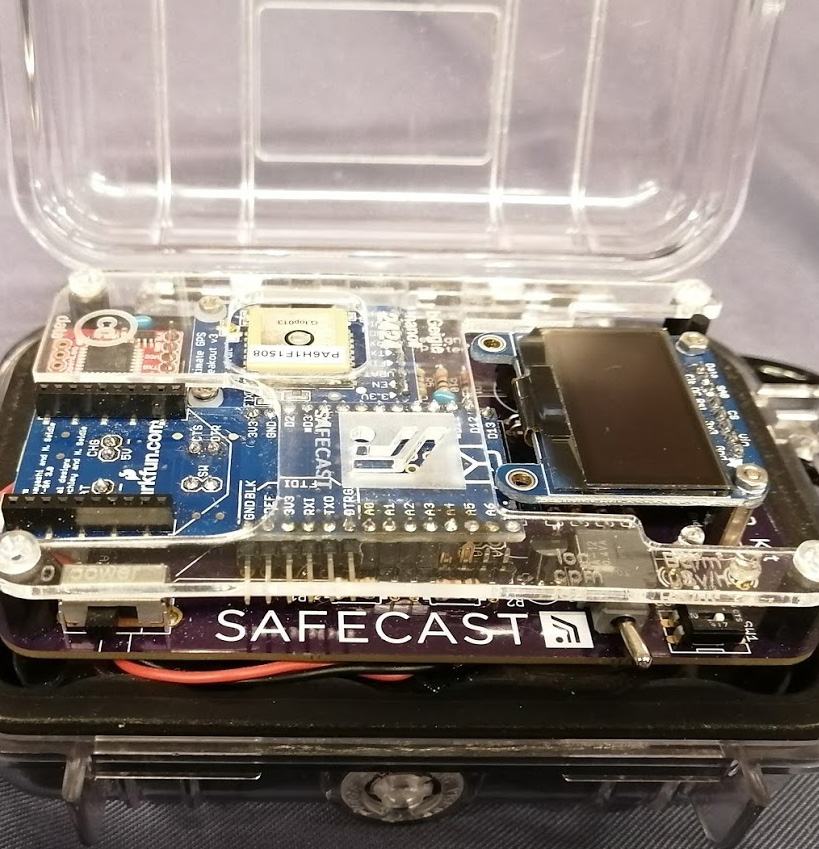
With the right infrastructure, funders will be able to increase their impact. Rather than funding individual projects, investing in the CI commons can help lay the groundwork for a multitude of CI projects that can be adapted to different needs and local contexts. It will also make it easier for citizens and communities to build and scale their own solutions. The spread and adaptation of the software behind the CONSUL digital democracy platform is one example of this. Since it's first development it has been used in 130 projects in more than 30 countries. Because it is open source developers have been able to work together to develop the tool and create new features that enable different forms of participation such as citizen proposals, voting, participatory budgeting and collaborative legislation. Another example is the development of Safecast, one of the world's largest citizen-driven environmental monitoring projects: it uses open hardware design to enable volunteers to monitor their environments and has over 150 million readings to date.
Just as importantly, developing the CI commons could help to address fundamental challenges in digital development, such as digital colonialism and the influence of big technology companies. The right open digital infrastructure paired with access to the internet and digital skills could help shift power towards local communities, enabling them to build the internet and digital products that reflect their needs and aspirations, so they aren't locked into closed digital systems and services often developed by tech companies and other institutions in the West and China.
About this report
This report, by Nesta and Agence française de développement (AFD) explores how development funders can make the most of the opportunity to support the CI commons. It analyses the environment necessary to sustain and scale CI initiatives that will work towards meeting the SDGs, considering the role of both funders and open technical and social infrastructure.
The report primarily aims to help development funders use the CI commons, particularly stakeholders who are working on digital strategy and innovation. However, we also hope it will be relevant to a wider audience of officials within national governments, international agencies and development organisations who want to support open technical and social infrastructure and CI initiatives as part of national SDG strategies.
The report is structured in four parts:
- In the second and third chapters, we define CI and detail the opportunity for CI and sustainable development.
- Chapter four explores the concept of digital commons and its key features.
- Chapter five explores the relationship between CI, sustainable development and the commons.
- In the sixth and final chapter we offer recommendations for funding and supporting open infrastructure for CI.
The research is based on a review of literature and best practices for CI and open infrastructure and interviews with 17 domain experts working on development and the digital commons. Alongside literature review and experts interviews, a number of collaborative workshops with AFD have helped further explore opportunities for implementing and supporting the CI commons and the potential role of funders.
Case study
OpenStreetMap
Creating the open infrastructure for crowdmapping
For 15 years, thousands of volunteers have helped create an open map of the world using the online platform OpenStreetMap (OSM). Volunteers build OSM by adding manually captured data, reviewing open public data (such as satellite images) and annotating features like roads, highways and bridges using the platform. From new roads to forest paths, OSM has helped map many areas of the world for the first time.
Anyone can download OSM data, which in one file now totals 1.543 terabytes. As an open-source tool, the OSM's maps have been adopted by hundreds of organisations and institutions – from governments to social media companies. In turn, these organisations can use OSM basemaps to build new layers, tools, applications and functionalities.
One example of a platform that uses OSM is Ushahidi (meaning 'testimony' in Swahili): a crowdsourcing tool that combines social activism, citizen journalism and geographic information. It was born out of the violence that followed the 2007 Kenyan elections to collect eyewitness reports of election-related incidents. Today, Ushahidi collects crowdsourced data and targeted survey responses from multiple data sources and displays the results on a live map.
Like OSM, Ushahidi is an open-source product, and it has been replicated in over 160 countries for a wide range of crowdsourcing purposes, including supporting crisis relief, human rights advocacy and transparency and accountability campaigns. One notable deployment of Ushahidi is HarassMap, a non-profit initiative which crowdsources reports of sexual harassment and abuse against women in Egypt. By reporting these incidents through an open, live map, HarassMap sheds light on the scale of underreported crime and helps ensure that action is targeted to where it is needed most.




OSM and the many projects its technology has enabled illustrate the potential of the CI commons.
The OSM's crowdsourcing and crowdmapping are well-established CI methods: they bring together diverse groups of people, new sources of data and digital technologies to tackle complex social problems. Not only does OSM use these CI methods, but it also enables other organisations to adopt them too.
Because OSM is built on an open-source code, it can be used as a free 'building block' for other crowdsourcing and crowdmapping services, enabling a multitude of other organisations and projects to use and modify it to meet new or different needs, such as Ushahidi and HarassMap.
This is just one example of how the CI commons can work.
2. Collective intelligence and development
Open Street Map and the many projects it has enabled demonstrate how different sources of intelligence are being harnessed to drive sustainable development. From citizens' insights to grassroots solutions, from mobile phone data to satellite imagery and AI, new sources of intelligence are being mobilised by organisations around the world to understand complex problems, make better decisions and find new solutions.
By seeking out intelligence of all kinds – from advanced technologies to human experience and insight – CI methods are essential to making progress towards the SDGs, as highlighted by a 2021 report by Nesta and the United Nations Development Programme (UNDP). For instance one CI method, citizen science – where the public voluntarily helps conduct scientific research, has broad application across the SDGs but particularly in supporting the real-time monitoring of environmental conditions.
The following section introduces the concept of CI and outlines key CI methods and design principles as well as development opportunities.
Defining CI
At its simplest, CI can be understood as the enhanced capacity that is created when people work together. Often, this capacity is enabled by technology to mobilise a wider range of information, ideas and insights to address a social challenge. Crucially, CI is created when these contributions combine to become more than the sum of their parts.
As an idea, CI isn't new. It's based on the theory that groups of diverse people are collectively smarter than any individual on their own. For centuries, every society has relied on CI – such as sharing knowledge, culture and tools to better manage crops, combat diseases and anticipate weather patterns.
However, CI has evolved much further since the start of the digital age. Thousands of digital tools can now help us to pool ideas and knowledge in entirely new ways and connect people across huge distances. Wikipedia is perhaps the best illustration of this: with two new edits every second, Wikipedia uses crowdsourcing via an online platform to constantly add new layers to our collective knowledge.
Digital technologies are also enabling us to generate new sources of data. Satellite imagery or mobile phone data, for example, can give us new insights into our world and societies – and, paired with citizen data and ideas, they can help increase our understanding of problems and their potential solutions.
Artificial intelligence (AI) is increasingly being applied in combination with CI methods to help us improve and develop how we use human intelligence. For example, AI tools such as machine learning can help us analyse and understand trends in the often vast amounts of data generated on CI platforms.
CI methods and design principles
In practice, CI is multidisciplinary and covers a wide range of participatory methods, including crowdsourcing, open data, predictive analytics, citizen science and microsurveys, among many others. A review (see Figure 1) by Nesta identified 15 of the most commonly used methods on CI projects focusing on the SDGs.
| The 15 most common CI methods used in projects focusing on the SDGs |
| Citizen-generated data |
| Citizen-generated data is a broad category that includes any information that can be collected from people either actively (e.g. videos, reports or ideas, usually using digital platforms) or passively (e.g. transactions data, call detail records or from wearables). |
| Citizen science |
| Citizen science is any process in which scientists and (usually unpaid) volunteers work together to collect or process scientific data or observations. Citizen science unlocks new resources for research, experimentation and analysis by opening the process to anyone. |
| Combining data sources |
| Combining data is a process of bringing together two or more different datasets to unlock new value or generate new insights that would not otherwise be exploited. This may include datasets that are passively generated by people (e.g. call detail records), or actively contributed (e.g. citizen reporting). |
| Computer vision |
| Computer vision is the ability of a computer to understand, analyse or generate images and/or videos. Computer vision is frequently used to help classify drone, satellite or user-generated images. |
| Crowd forecasting |
| Crowd forecasting asks groups to make predictions. Individual predictions are then aggregated using statistics into a consensus crowd forecast. This technique is inspired by research which showed that small crowds of non-experts can often forecast political events more successfully than individual experts. |
| Crowdmapping |
| Crowdmapping is a type of crowdsourcing which gathers data from different sources (including social media, text messages or geographic data) to provide real-time, interactive information about issues on the ground. Crowdmapping can create detailed, almost real-time data in a way that a top-down, centrally curated map may struggle to replicate. |
| Crowdsourcing |
| Crowdsourcing is an umbrella term for a variety of approaches that source data, information, opinions or ideas from large crowds of people, often by issuing open calls for contribution. This method can help bring new ideas to light that hadn't been considered, or to gather expertise from people who have specialised knowledge or understanding of an issue. |
| Microsurveys |
| A microsurvey is a short, abbreviated form of survey which typically takes the respondent only a few minutes to complete. These surveys are often delivered by mobile phone, text message or a digital platform. Benefits include a much faster turnaround time and higher frequency of results compared to traditional surveys. |
| Natural language processing (NLP) |
| NLP is the ability of a computer to understand, interpret and extract key information from human language. NLP techniques can be used to carry out automated analysis of user-generated text, such as from social media, to better understand what issues matter to people, to translate languages or to simulate language. |
| Open data |
| Open data is the raw data that is gathered by people or organisations and published in an electronic format that machines can read. Rather than keeping it private, this data is shared online and can be reused by others. |
| Open-source repository |
| An open-source repository is a digital place where content (e.g. code, text or DIY designs) can be stored and freely downloaded with few restrictions on use. Many open-source repositories help collaboration by providing a space for uploading documentation, monitoring and version control. |
| Peer-to-peer exchange |
| Peer-to-peer exchange refers to the process of sharing information between peers to build and maintain a community, to collect data, connect people or send alerts. Platforms that enable this kind of exchange range from messaging or collaborative platforms to online forums. Some rely on the internet, but others – such as SMS or mesh networks – do not. |
| Predictive analytics |
| Predictive analytics encompasses a variety of statistical techniques that enable a computer to analyse structured data using numerical and machine-readable data. It typically relies on algorithms from classical machine learning. Predictive analytics can be used to make predictions about the future or otherwise unknown events. |
| Remote or in-situ sensing |
| Remote or in-situ sensing involves collecting information from satellites or physical sensors that are recording actions and physical changes (e.g. traffic cameras, weather sensors, ambient sensors, wearables or drones). This data can provide cheap, real-time measurements of anything from pollution to crop yields. |
| Web scraping |
| Web scraping is a method for extracting unstructured data from across the web, such as company websites or social media. While official data sets are expensive to create and infrequently updated, web scraping can provide more timely insights into social or economic trends. |
Figure 1: The 15 most common CI methods used in projects focusing on the SDGs
Collective Intelligence for Sustainable Development: Getting Smarter Together (London: Nesta, 2021).
How these methods are carried out matters just as much as what is done. Done well, CI design should draw on diverse perspectives and opinions, enable people to contribute views and ideas independently and freely, and be mindful of power relations and biases. It should integrate different types of data to unlock fresh insights, and at the same time it should seek to empower people through data rather than be extractive – in other words, it should give and not just take. These fundamental design principles underpin successful CI initiatives.
Figure 2: CI design principles as described in Nesta's Collective Intelligence Design Playbook
- Increase the diversity of the people you involve and the opinions you listen to.
- Enable people to contribute views and ideas independently and freely.
- Integrate different types of data to unlock fresh insights.
- Be citizen-centred: data empowerment, not data extraction.
3. Development challenges and opportunities for collective intelligence
While there are many challenges facing development and progress towards the SDGs, four areas are most relevant to using CI to solve social challenges.
Four development challenges
Worsening, converging and complex crises
From the climate crisis and the displacement and migration of human groups to rising socio-economic inequality, the world currently faces worsening and protracted crises. These types of challenges are critical and complex: they are interconnected, cut across boundaries and require change at multiple levels, from policies and institutions to individual behaviour. The impact of many of these crises — the climate crisis in particular — will be disproportionately borne by those who are already vulnerable. Due to their economic status, the rural and urban poor and remote groups and communities have limited capacity to adapt to change.
Progress is too slow
The 2030 Agenda for Sustainable Development and the SDGs, adopted by all UN Member States in 2015, delivered a shared plan to stimulate action over the following 15 years in areas of critical importance. However, the 2020 progress report highlighted that, even before the COVID-19 pandemic, the world was not on track to achieve the SDGs – and coronavirus has thrown progress on the SDGs even further off track.
COVID-19 has halted or reversed years, or even decades, of progress towards the SDGs. In 2020, the global poverty rate rose for the first time in over 20 years, with about 100 million additional people living in poverty as a result of the pandemic. Middle-income countries such as India and Nigeria have been particularly affected. Despite the temporary reduction in greenhouse gas emissions during lockdowns, concentrations of emissions continue to increase and COP26 has barely kept alive hopes of limiting global warming to 1.5°C. New solutions are urgently needed to advance progress towards the SDGs.
Persistent data gaps
Significant data gaps still persist across the SDGs in terms of geographic coverage, timeliness and how far the data can be broken down. For example, for 5 of the 17 SDGs, fewer than half of the 193 countries or areas have internationally comparable data. The pandemic has also impacted data collection, as many traditional data collection methods, such as surveying, have been halted. A lack of data limits the ability to reach those in need and to coordinate effective and targeted responses. Intensified efforts need to be made to fill data gaps and to respond to the insufficiency of country-level data.
Recognising the need for more inclusive and participatory approaches to development
It is widely accepted that mainstream, top-down development models can only get us so far when it comes to achieving the SDGs, particularly given the lack of progress made so far and rising discontent among citizens around the world. To create fairer societies and more sustainable progress, we need transformational, inclusive and empowering approaches that challenge existing norms and practices. Strategies for development that are inclusive in their formulation, vision and implementation, and grassroots strategies that are community-driven, place-based and participatory, offer the double benefit of better development outcomes and more collaborative and cohesive societies.
The opportunity to address these challenges through CI
Nesta's 2021 report Collective Intelligence for Sustainable Development, conducted and published in collaboration with the UNDP, highlights three main opportunities to use CI to help advance the SDGs.
New sources of data: CI approaches can help us tap into new sources of data and insight to fill SDG data gaps and understand emerging problems more quickly. In addition, by involving marginalised communities in generating, analysing and using data, CI can enable us to stop replicating existing prejudices and inequalities, and ensure fairer data governance.
Solving problems through collective knowledge: CI can accelerate progress by tapping into the collective knowledge of citizens, drawing on a wider network of innovators or seeking and sharing tested ideas and solutions from elsewhere.
A route for navigating complexity and disagreement: CI approaches can help in complex or uncertain situations where there is disagreement about how to proceed, where the way forward is unclear or where the nature of the problem is contested. CI can ensure that diverse views and perspectives are included, not just those of the vocal minority or the 'usual suspects' already taking part in existing projects and conversations.
The Collective Intelligence for Sustainable Development report analysed over 250 case studies of organisations using CI methods for sustainable development. The study demonstrated the potential of using CI to make progress on the SDGs: from using eyewitness videos and crowdmapping to document violence or human rights abuse, like Syrian Archive, to applying citizen science and in-situ or remote sensing methods to provide real-time monitoring of the environment, like Regen Network.
Through case studies analysis, the research found that current practices tend to fall into six key categories:
- New forms of accountability and governance: For example, eyewitness videos and crowdmapping are being used to document violence or human rights abuses.
- Anticipating, monitoring and adapting to systemic risks: On-the-ground volunteers provide data about emerging issues or work with crowdmappers to capture location information to help prepare for crises.
- Real-time monitoring of the environment: Methods like citizen science monitor the state of environments – from air quality to deforestation.
- Understanding and working with complex systems: For example, crowdsourcing ideas and opinions of citizens helps us understand the different needs or experiences of diverse or changing populations.
- Inclusive development and technologies: CI methods like crowdmapping, citizen reporting and mobile phone surveys can be used to engage people whose voices are often not counted.
- Distributed problem-solving: Various CI methods can be used to solve problems, such as: crowdsourcing solutions; convening peer-to-peer crowdsourcing of knowledge and experience; using open-source repositories to share solutions for others to adapt and use; and crowd labelling data to train machine-learning models.
The barriers to applying CI to sustainable development
Despite the many examples of CI being applied in a development context, its uses are often fragmented and ad hoc. The main challenge is to leverage CI for sustainable development strategically and at scale, but there are numerous barriers.
Some CI methods require individuals to have niche skills, supported through specialised and technical training, which can be difficult to access. Specifically, a lack of digital skills and digital access in lower- and middle-income countries limits the ability to scale CI approaches because digital platforms, technology and data are pivotal components of CI. Limited technical infrastructure, including insufficient computational resources, in lower- and middle-income countries can also limit the application of some CI methods, particularly those drawing on AI. CI is also hampered by the lack of high-quality data in the development sector, which can limit its potential uses. Overall, funding CI can be costly due to the need for skilled personnel, digital technologies and hardware. Financing these types of projects is challenging in the context of uncertain funding streams for sustainable development.
4. The (digital) commons
At its core the 'commons' is an idea of shared ownership and access by the collective, rather than ownership by an individual or entity. This idea has evolved over thousands of years, often centred on the most valued resource in society – whether that be common land in the 9th century, knowledge commons through public libraries in the 19th century, or the emergence of the digital commons over the last few decades.
As a legal and political concept, a common good is a resource governed by the community of its users according to shared ownership rules that it defines and applies itself. The community governing a common good protects its free access and use as well as its sustainability. It defends the general interest through common ownership. These self-organised social systems are independent of markets (or private-led ownership) and the state (or government-led ownership); because of this, they distribute the cost and value of owning, maintaining and developing these assets between anyone who is willing to contribute. Based on this premise, the 'commons' have been described as a socially progressive alternative to producing and sharing resources and to organising collective action across a wide range of domains.
The digital commons
The digital commons are a subset of the commons. They represent a virtual environment in which the ownership and access of software, data and content is open for all and created and maintained online.
At the heart of the digital commons is the users' right and opportunity to freely modify and adapt digital tools and platforms to their needs, enabling projects to evolve and be designed for any given challenge or need. This approach to access and use in many ways contrasts with the increased privatisation and monopolisation of digital tools and data and the nationalisation of the digital realm by states, alongside the concentration of power and wealth that is often a result of this.
The digital commons have been shaped by movements such as the free software movement, FLOSS (Free, Libre and Open-Source Software) in the 1980s, the free culture (or open content) movement (e.g. Wikis and GLAM – Galleries, Libraries, Archives and Museums), and the movement for open science and scientific commons, which includes open access and FAIR (Findable, Accessible, Interoperable and Reusable) data.
As technology and digital development advances the boundaries of the digital commons continue to change. A more recent evolution has seen new movements focus on the concept of Open AI, including open-source data sets that can be used to train AI models. One example of this is ImageNet, a largely crowdsourced data set of 14 million images that can be used to train AI models for everything from self-driving cars to image recognition. In addition, open-source software has been key in developing and using AI more broadly: open-source programming languages such as Python, R, C++ and Java are some of the most popular tools for machine learning.
But although it is constantly evolving, the digital commons can be defined broadly through five core components: content; standards and guidelines; data; software and AI, and hardware and physical infrastructure'. The central principle for all five is that they can be accessed, modified and released freely by anyone.
Key components of the digital commons
Open content
Content that is created, shared and accessible online and that can be freely accessed with minimum digital skills. Examples include reports, articles, tools, videos and images. Open content is the most widely used and accessible open protocol, and it can enable people to learn, act and make decisions based on the output of the associated content created. Open content can also be used to generate new knowledge or digital tools. Wikipedia is perhaps the most well-known example of open content.
Open standards and guidelines
Standards and guidelines that enable a consistent approach to developing tools, running software and collecting information. Examples include data standards, content standards and platform developer guidelines. By creating consistent and standardised content, data and software, and hardware, tools can become interoperable, replicable and scalable. It also improves the quality of the tool and enables easier scrutiny and analysis of the component, from its data to its content. A frequently used example of open standards and guidelines is a Creative Commons licence.
Open data
Data sets and repositories that are free and open for use by anyone. Examples include environmental or population data. Data is one of the most widely recognised components in the digital realm. Its value is both non-rival (it can be used several times without losing its intrinsic value) and non-fungible (it cannot be replaced by another piece of data), making it complex to manage. Open data is owned collectively, which means its value can benefit everyone. One example of open data is the World Bank's country data, which is available to everyone. It includes more than 3,000 data sets and 14,000 indicators encompassing microdata, time series statistics and geospatial data.
Open software
Code for software, algorithms and AI that is published and available for free use and adaptation. Open software and AI can distribute the value of any piece of code, as well as the cost or resources required to build and maintain it. It also allows others to build on or add new features to it. Software or code that is open can be replicated for testing and robust evaluation. Examples of open software include the software behind OSM. GitHub is one of the largest platforms for sharing open code.
Open hardware and physical infrastructure
Design specifications of a physical object that are licensed in such a way that the object can be studied, modified, created and distributed by anyone. Examples include schematics, blueprints, logic designs and computer-aided design (CAD) drawings or files. Open hardware enables people to experiment and develop their own tools, products or services. Without open hardware, such as low cost sensors for measuring pollution, it may not be financially viable for some communities to utilise other elements of the open system.
Case study
Safecast
Using open hardware, data and software to build a large scale environmental monitoring project
Safecast is an international, volunteer-centred organisation devoted to open citizen science for environmental monitoring that was established shortly after the Fukushima nuclear disaster in Japan. It manages a global open data network for radiation and air quality monitoring and supports accessible environmental monitoring for citizens.
The Geiger Counters users by volunteer citizen scientist are made using open hardware. This means that it is easy for new volunteers and monitoring networks to either buy or build their own monitors or use the existing designs to modify and create new versions of the counters. Since it was initially created as a handheld device, there are now several different tools for volunteers to capture data, including car mounted sensors and drones.
Open source software and data is used to enable collection, sharing and visualisation of radiation data.
This combination of different components of the digital commons has enabled the platform and its large network of volunteers to gather the largest open data set of background radiation measurements ever collected, with over 150 million readings to date and growing daily.
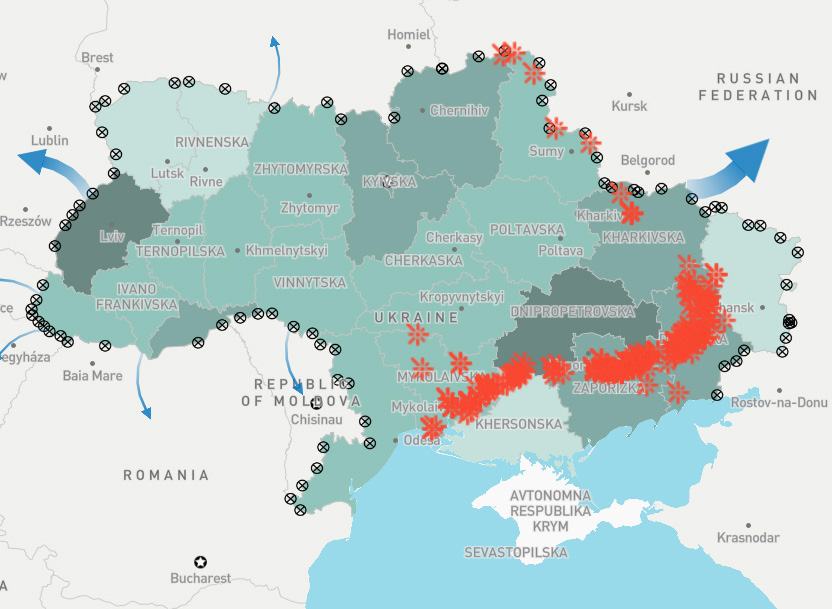
More recently the project has been adapted to the conflict in Ukraine. The #bGeigies4Ukraine campaign has sent bGeigies to participants in Ukraine to map radiation across the country. Since May 2022 over 300,000 new radiation data measurements for Ukraine have been uploaded to the Safecast database and online map.
Organising and managing the digital commons
By nature, the digital commons are defined by their communities of users. Each have unique cultures, motivations and operating models. However, a number of principles govern the structure of the digital commons. Most importantly, the digital commons rely on several laws, rules and standards to enable the open production and sharing of information and to ensure that digital shared assets - such as content, software and code - remain open and free. Some of the most prominent standards and licences used to ensure this include GNU free software licences, Creative Commons licences and open standards for data.
Most digital commons rely on communities of volunteers for production, development and maintenance; however, these communities are not legal entities. To manage their resources, most large digital commons are governed by a hybrid community foundation structure, which performs legal, financial, technological and governance functions. The Wikimedia Foundation and the OSM Foundation are two prominent examples.
The digital commons and development
There is increasing recognition of the value of digital commons in international development. A landmark moment in this recognition was the establishment in 2019 of the Digital Public Goods Alliance, a multi-stakeholder initiative that aims to accelerate progress towards the SDGs by investing in, developing and using digital public goods. Digital public goods and related concepts, such as open digital public infrastructure, are based on the idea that the digital commons can be building blocks in the development of 21st-century public services and new public and social innovations.
At the core of this movement is the argument that much of the knowledge and technologies needed to overcome the challenges of sustainable development are known but not accessible to those who need it. For example, they are made inaccessible by intellectual property law (e.g. patents, copyrights and trademarks) and paywalls. A global commons based on digital public goods would both lower the cost of access to existing solutions and make it easier to modify or develop new services and solutions.
Just as importantly, it has been argued that the digital commons can provide part of the solution to the challenges of digital colonialism. Despite the large impact of digital technology on the lives and future of all people on the planet, many people, especially from the Global South, are not included in the debates about the future of the digital society. Most digital solutions deployed by both public and private organisations in poorer countries have been developed without the involvement of those people and therefore may not reflect their needs or cultures. One example is Free Basics, Facebook's free, limited internet service for developing markets, which has been criticised for violating net neutrality and not serving local needs. Development that is 'rooted in the local, in the decentralised and in the digital commons logic' has the opportunity to address global digital inequalities and 'digital colonialism' by providing a way to develop digital solutions that are locally owned and reflect diverse cultural and social needs.
Recognising the value in digital commons
Not only do the digital commons play a significant role in helping develop innovative solutions to social challenges, but there is also a well-established argument for the economic value of the digital commons. For example, recent studies focused on the EU have found that open-source software contributes between €65 and €95 billion to the EU's GDP and that the European open-data market is estimated to be worth around €184 billion. Another example is a recent feasibility study by the German government and the Open Knowledge Foundation, which explored setting up a Sovereign Tech Fund with the explicit aim of sustainably strengthening the open-source ecosystem, focusing on security, resilience, technological diversity and the people behind the code. An idea that has since received initial backing of €3.5 million per annum from the government.
The UN has long advocated for countries to use open-source technology in the public sector, citing benefits including lower costs, reduced dependence on specific technologies or vendors and meeting local needs through customisability (e.g. using local languages). These factors also apply to the development sector. Similarly, the European Commission has committed to furthering investment in and use of open-source technologies through its open-source software strategy.
Challenges in the digital commons
Unlike 'tangible commons', such as land and assets, the digital commons are 'not affected by overuse or material exclusivity. However, their existence can still be threatened by undersupply, inadequate legal frameworks, pollution, and lack of quality or findability'. Diversity in participation also remains a challenge for the digital commons. Although they are open for everyone to access and contribute, many of the most popular platforms and products that form part of the digital commons struggle with diversity in participation. For example, women only make up 10% of all Wikipedia Editors, and up to 98% of all OSM contributors are men.
The challenge of diversity extends to the growing impact of private companies on open-source tools and how the influence of corporate interests in particular types of data, content and functionality shapes common digital assets. One study of OSM for example found that 17% of all edits came from corporations, including companies such as Apple, Amazon and Facebook. On the one hand, increased corporate participation adds more data and therefore value to common resources; however, on the other, volunteer communities have expressed concerns that this can skew the data. For instance, OSM volunteers tend to focus more on hyperlocal infrastructure such as paths and benches in their local areas, whereas corporations focus on key infrastructure such as roads and buildings. Similarly, companies may not be sharing data that could add value to the map if they could gain a competitive advantage by withholding it - something that goes against commons principles.
More broadly, one of the most fundamental challenges to the sustainability of the digital commons is funding for vital backend costs, such as maintenance. Most funds are generated through small one-off donations, crowdfunding or small grants, making it hard for digital commons projects such as open-source software initiatives to plan for the long term. Even large companies such as Google have called for public funding to protect and maintain vital open-source projects, demonstrating how acute this challenge is.
5. Collective intelligence and the digital commons
In many ways, mobilising our human collective intelligence and the digital commons are inextricably linked. The digital commons are a cornerstone of many CI tools, acting as a framework that enables CI projects to be developed and delivered. At the same time, many CI tools enrich the commons; for example, they provide large-scale data crowdsourcing, input into shared content platforms and release open-source software that can be used in other applications.
Many of the principles that underpin the digital commons – such as the focus on decentralisation, shared resources, transparency and alternative incentive models – are also a key component of good CI design. However, despite these strong links, there have been few attempts to understand them in detail and to help others understand how to strategically invest and support in the digital commons as a foundational infrastructure for CI projects.
The relationship between the digital commons and CI
CI relies on sourcing data and insights from large groups of diverse people. The digital commons, meanwhile, provide the foundations for doing this. This interrelationship can be observed in many of the world's largest and best-known examples of CI, such as Wikipedia, Linux and OSM, which utilise components of the digital commons like open content and open software.
The relationship between CI and the commons can be explained with reference to each component of the digital commons.
| Digital commons |
Use in CI |
| Open content |
Content that is produced through or for a CI tool that can help people understand or solve problems. |
| Open standards |
Helping to standardise how CI projects are operated, tools are developed and data is collected. |
| Open data |
Using open data to build CI tools, sharing the data that tools or AI were built on, or sharing the outputs of CI tools openly for further use. |
| Open software |
Code used for CI tools that can be reviewed, deployed or adapted by others openly. |
| Open hardware |
The physical hardware and design instructions that can be used openly to enable others to access and develop CI tools. |
Six benefits of designing CI in the digital commons
The open and distributed nature of the digital commons can help address some of the main challenges in scaling CI for development. Through case study analysis and expert interviews, we identified six key benefits of designing and deploying CI tools and projects in the digital commons:
- Expands the reach and impact of CI through open and interoperable data and software.
- Enables successful CI projects to scale more quickly through adapting innovations to new contexts and need.
- Lowers cost and increases sustainability.
- Enables more sustainable and trustworthy CI projects.
- Democratises innovation, making it more inclusive and helping to shift power through diverse and locally led CI projects.
- Empowering communities with tools, data and knowledge to hold those in power to account.
Below, we explore each of these in more detail, with examples of what these benefits look like in practice.
This diagram illustrates the benefits of designing CI in the digital commons, showing how various factors such as Reach and Impact, Scale and Adapt, Lowers Cost, Increases Trust, Democratises Innovation, and Empowers Communities are facilitated by the five key components of the digital commons. It visually represents the flow from Open Content, Open Standards and Guidelines, Open Data, Open Software, to Open Hardware & Physical Infrastructure, highlighting their interconnectedness in achieving these benefits.
1. Expands the reach and impact of CI through open and interoperable data and software
A core feature of high-impact CI projects is their ability to bring together insights from diverse groups of people and new sources of data. Integrating different types of information provides a multitude of benefits for CI projects, including providing a more complete view of a particular problem, as well as unlocking fresh insights and perspectives.
The digital commons provide a structure to enhance these benefits further by creating more diverse, rich and interoperable data and software. These open assets can be used and connected across myriad projects and communities, helping CI projects to expand their reach and impact.
In other words, through the digital commons, open data and software can enable better coordination across CI projects. Projects can build on and leverage existing data and software, speed up the rate at which CI tools and projects are deployed, and provide opportunities for shared learning across projects.
In addition, by coordinating, connecting and sharing data, the digital commons enable further exploration and analysis which, in turn, generates new value.
One example of expanding reach and impact in this way is MetaSUB. A global project that seeks to understand the genetic material in subways and urban environments around the world, MetaSUB builds 'microbial portraits' of urban transit systems. A network of volunteers and scientists takes swabs from trains and escalators to identify pathogens and any markers of antibiotic resistance. This microbial surveillance, carried out by the MetaSUB community in over 100 cities, helped add to the research that found that the longer COVID-19 was on a surface, the less likely it was to make someone sick. The web platform used, MetaGenScope, is open source and permissively licensed. By using open-source software and sharing a version-controlled pipeline of MetaSUB, the project was able to expand the reach and therefore capacity of the platform's analysis to various contexts, enriching the data and increasing our ability to understand pathogen and antibiotic resistance around the world.
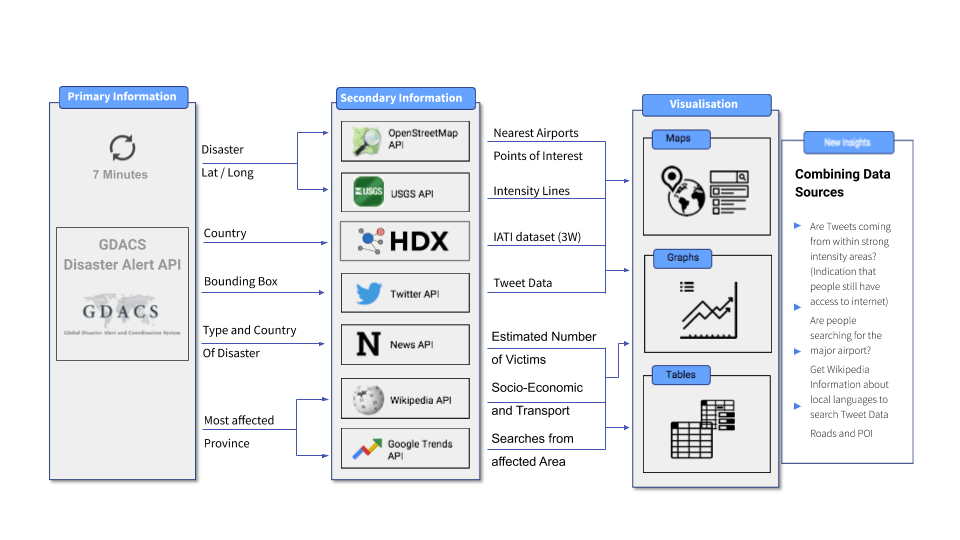
Another example of how CI could be used to understand emerging issues by integrating multiple data sources is the Managing Information for Natural Disasters (MIND) project by UN Global Pulse. Currently still operating as a prototype, the MIND open-source platform is built on an automated data pipeline (using several APIs), allowing it to stream and analyse several non-traditional open and closed data sets all in one place. This includes data generated by affected communities that are local to the incident, data scraped from Twitter and Google searches, as well as information from other open data sources such as Wikipedia and OSM. Data is collected and processed automatically based on disaster alerts received from the Global Disaster Alert and Coordination System (GDACS). As an open-source platform, MIND publicly provides stakeholders with timely insights on affected areas and the needs of communities, among other things.
Similarly, the range of CI tools that are based on the digital commons enables CI projects to build on and integrate different components of the digital commons, such as combining the use of open hardware and open data, thereby expanding the reach of individual assets. A prominent example of a tool that integrates these different components is Bellingcat. A fact-checking and open-source intelligence network, Bellingcat has developed a open-source online investigation toolkit which comprises many open-source tools – from text analysis to crowdmapping – that volunteer investigators can utilise.
As these examples show, the open nature of the digital commons can be used by CI projects to expand the function and application of tools, and hence the complexity of the challenges they can address. Working 'in the open' enables us to create larger, connected data sets that can enhance existing CI tools, including by improving machine learning and AI elements.
2. Enables successful CI projects to scale more quickly through adapting innovations to new contexts and needs
CI works best when functionality and good digital product design combine to tap into the CI of crowds. These tools can then scale to more contexts or wider audiences and new needs when adapted on the digital commons to reflect local or different cultural contexts.
While scale and adaptation are possible through traditional product development, developing CI projects in the digital commons enables adaptation of code, software and data in low-resource environments. Similarly, open-source software avoids vendor lock-in and allows for local communities to adopt and develop culture- and need-specific versions of existing solutions.
The ability to adapt and develop solutions to different needs has proven to be of particularly high value during crises, when CI tools can quickly be tailored to address new urgent needs. This is perhaps best illustrated by Wikipedia. During the 2014 Ebola outbreak in West Africa, for example, Wikipedia's Ebola content was extensively updated and translated into more than 100 different languages. The content was viewed more than 89 million times that year. Similarly, in the first week of December 2019, 6,950 articles about COVID-19 were created on Wikipedia in response to early news about the disease.
By enabling others to reproduce, build upon and enhance content, data and software, open base code can be developed to create new capabilities and functionalities. Open-source CI platforms such as OSM enable communities around the world to build on and adapt features and functionality for different countries with different purposes. Each of these additional features has expanded the reach, including data collection, and impact of the original products. OSM's many innovations, such as the Humanitarian OpenStreetMap Team (HOT) and Ushahidi, illustrate this effect.
While OSM enables scale by providing the foundation for a range of new crowdmapping tools, the open nature of individual CI tools can generate scale by enabling users to add new features to the product. Used by more than 130 institutions in 30 countries, CONSUL is one of the world's largest digital democracy platforms. Because it is open source, CONSUL enables developers from all over the world to work together to add any new process or modality they think the tool needs. Added features now include citizen proposals, voting, participatory budgeting, collaborative legislation and debates. The scale of CONSUL, a project developed on a relative shoestring, illustrates the power of the digital commons in creating the tools and infrastructure needed to generate new methods for citizen engagement.
Footnotes
3. Lowers cost and increases sustainability
CI projects can be difficult to finance and generate valid business models for, as value and ownership is often distributed between many individuals and organisations. The digital commons therefore provide a framework for developing and delivering CI projects sustainably through distributed communities of ownership, development and management, where traditional funding mechanisms may fail.
A key benefit of developing CI tools and solutions in the commons is that doing so ensures sustainable access for communities. The low-cost solutions provided by projects such as the KoBoToolbox, a free suite of tools for collecting field data in challenging environments mostly used by people working in humanitarian crises, aid workers or researchers working in developing countries, is one example of this.
However, perhaps the clearest illustration of this benefit is OSM, which was set up as a direct response to the closed and expensive geographic data owned by the Ordnance Survey in the UK.
While the digital commons provide open access to all and therefore benefit wider groups of people, a large community of people also provide the resources needed to build a CI project - from developing open-source software to contributing to open data repositories. In addition, making hardware 'open' enables individuals or communities who do not have access to digital technologies to benefit from CI projects,
Allowing tools to be adapted by different groups and applied in different contexts also means tools can be continuously and sustainably maintained and improved (such as fixing bugs, adding features and so on).
4. Enables more sustainable and trustworthy CI projects
One of the most compelling benefits of the digital commons is the simple promise of transparency. When everyone has access to source code and data, everything is out in the open.
For CI projects, working in the digital commons can ensure transparency, robustness and fairness by enabling interrogation, replication and validation of data and software. For example, scientific testing and validation of experiments can be conducted by replicating experiments in a virtual environment and interrogating the results. The team behind the MetaSUB citizen science project, for instance, published all the databases used in the project. This allowed other researchers to replicate the project results and figures. Similarly, everyone can see changes made to open content such as Wikipedia pages or edits to open-source code, which can lead to new discoveries or a deeper understanding of results.
The digital commons can also support the creation of more diverse and less biased data for CI projects. One purpose of this is the development of more transparent and fair AI, an approach often described as 'participatory AI': the involvement of a wider range of stakeholders (beyond technology developers) in the creation of an AI system, model, tool or application. AI has the potential to enhance and advance CI, but many AI systems are developed using private data sets that have inbuilt biases, and this risks exaggerating existing societal inequalities. These data sets are often not published in their codebase, which can have damaging implications for their use or limit the uptake of AI by CI initiatives. Increasingly, open AI libraries, publicly available training data sets and good documentation are opening up access to AI so that existing models can be adapted or new models can be developed in more transparent and fair ways.
The Common Voice project by the Mozilla Foundation demonstrates the value of the digital commons for the development of AI models. Most of the software and voice data that power automated personal assistants are locked up in privately owned systems and are less effective for some groups, such as people who speak regional dialects or non-native speakers of certain languages. The Common Voice project aims to build a diverse and publicly available voice data set of crowdsourced contributions to create opportunities for training new AI models. These AI models will be built on the voices of the thousands of open access contributions that are transparent and represent a broader diversity of accents and languages.
5. Democratises innovation, making it more inclusive and helping to shift power through diverse and locally led CI projects
Many digital products and tools are developed in Western countries and in places where there is easier access to funding and more established capabilities. For example, studies have shown that most tech projects that aim to create social good start in places such as Silicon Valley or London, where tech skills and investment are already concentrated. However, the tools that are developed through these projects are often applied in different locations, without consideration for the local context. At best, this can limit the tool's efficacy; at worst, it can lead to more damaging consequences, such as discrimination, rights violations or holding back the development of more sustainable local solutions. Digital commons, however, can increase the diversity of ownership, development and management of CI solutions for local contexts.
Many citizen-led CI initiatives that operate with low resources rely on open protocols and DIY hardware that can be easily assembled using readily available, low-cost materials. When these resources are shared in online repositories, they can serve a global community of users who adapt and update them based on their own contextual needs. Democratising access to information or services through the digital commons in this way can lower the cost of entry for diverse groups to design or lead CI projects in localised settings.
One example of democratising access to information is Public Lab, a global network that collaboratively develops accessible, open-source DIY technologies for environmental monitoring and advocacy. Inspired by the lack of information given to the communities affected by the 2010 BP oil disaster in the Gulf of Mexico, the network was set up for participants to develop, use and share open hardware, open protocols and open-source software to monitor environmental damage and advocate for action against polluters. In the case of the BP oil spill, volunteers used MapKnitter, an open-source platform created by Public Lab, to analyse more than 100,000 crowdsourced images of the coastline to map the impact of the spill.
Groups from around the world can adapt MapKnitter and other low-cost open solutions developed by the community to address their local issues. Each group then updates the open Public Lab repositories, documenting their approach and any changes they made to the shared tools. Public Lab's open hardware, protocols and software are developed through participatory methods to ensure that they serve the needs of specific contexts as well as a global network.
CI can shift power away from those who traditionally hold it, towards the collective. CI content, data and tools that are developed and collected on the digital commons - often by large groups of volunteers - can be used, owned and adapted by the collective to hold authorities, institutions or corporations to account.
The Syrian Archive project illustrates the potential for holding power to account using shared data. It was initially launched in 2014 to preserve footage that was being shared online to document events taking place in Syria during the war. It has since developed open-source, automated tools that scrape social media every day for citizen-generated video content. Combining this data with a smaller subset of active submissions from citizens and journalists, the project assembled a vast archive - 3,314,265 sources of digital contributions as of January 2020 - and standardised the data into a format that could be accessed by a global community of human rights practitioners.
Another example of holding power to account is the work by Bellingcat on the Global Authentication Project, which crowdmaps incidents of civilian harm during the war in Ukraine.
This accountability can be achieved across all components of the digital commons, from the open hardware shared by Public Lab to track the damage caused by the BP oil spill to open content shared by Restor, which enables activists to campaign for nature regeneration.
Empowering communities with the tools, data and knowledge to hold power to account can be seen across several CI commons case studies as described below.
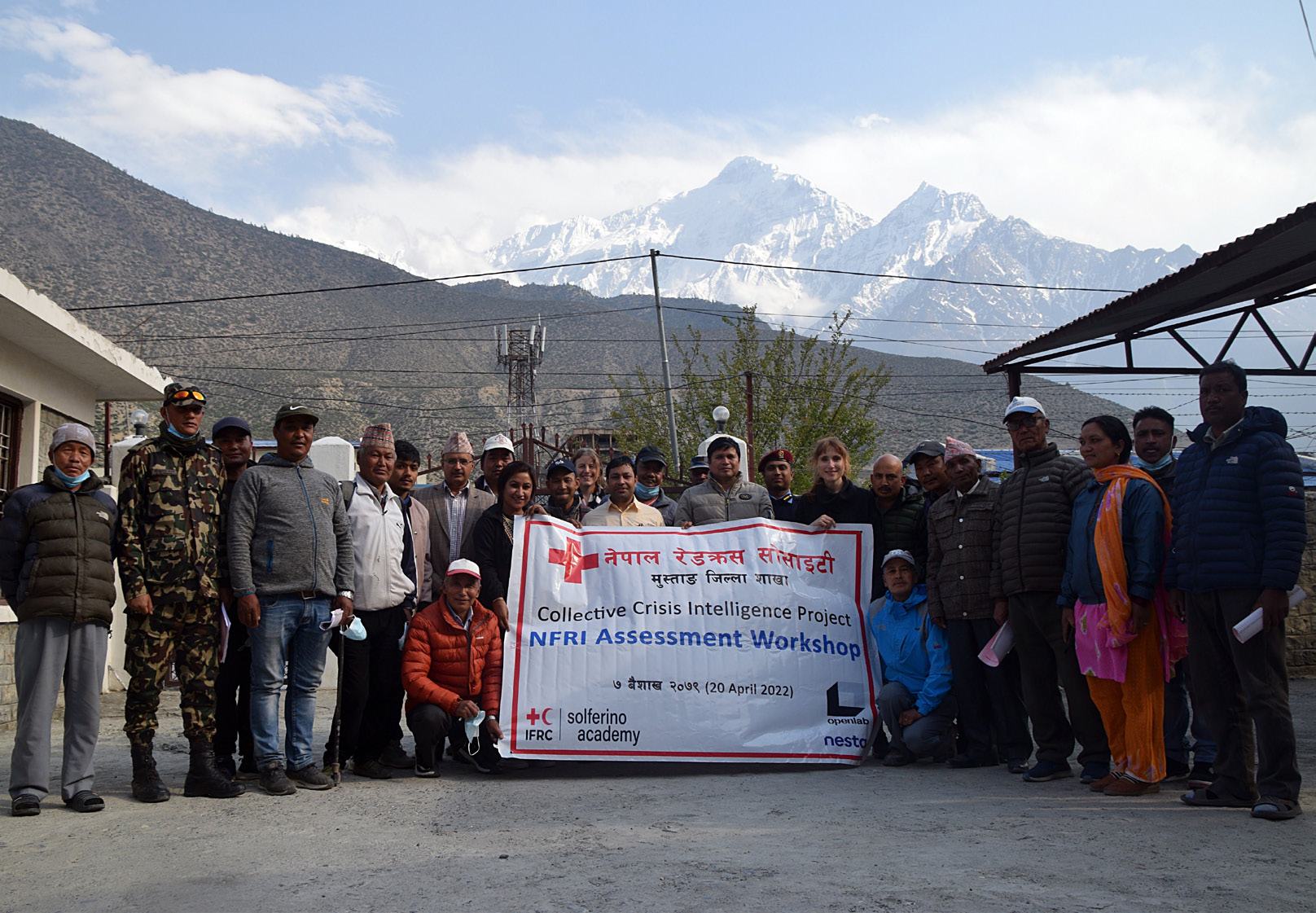
The banner text reads: नेपाल रेडक्रस सोसाइटी मुस्ताङ जिल्ला शाखा Collective Crisis Intelligence Project NFRI Assessment Workshop ७ वैशाख २०७९ (20 April 2022) +C solferino IFRC academy nesta
Four case studies of creating the open infrastructure for collective intelligence projects
Landsat
Open satellite data for monitoring projects
What is the open foundational layer?
The Landsat Program is a series of Earth-observing satellite missions jointly managed by NASA and the U.S. Geological Survey (USGS). Landsat satellites provide high-quality images of the surface of the Earth. In 2008, the USGS stopped charging for Landsat data and made products from its suite of earth observation satellites free and open.
The CI deployments enabled by the open foundational layer
Landsat satellites, and the images and data produced, can be used for a wide range of purposes including to track land use and to document land change due to climate change, urbanisation, drought, wildfire, biomass changes (carbon assessments).
Global Forest Watch (GFW) is an an example of an initiative that provides real-time monitoring for the environment through an open-source web application. The GFW partnership comprises over 100 organisations who contribute data, technology, expertise and action to ensure that transparency drives greater accountability for how the world's remaining forest landscapes are managed and used. It uses satellite data (including Landsat data), advanced computer algorithms and cloud computing power, to offer an openly accessible suite of tools designed to help conservation groups and policy makers monitor deforestation.
Powered by GFW, Forest Watcher is a mobile app that is open source, free to use, and global in scope. It is designed to allow easy, offline access to data about forest change from Global Forest Watch. The app displays forest change straight on the mobile devices in the hands of forest managers, indigenous communities and law enforcement anywhere in the world, regardless of connectivity.

Public Lab
A global network for sharing open designs for environmental projects
What is the open foundational layer?
Public Lab is a global network that shares open hardware, open protocols and open-source software to monitor environmental damage and advocate for action against polluters. Public Lab grew out of a grassroots effort to take aerial photographs of the BP Oil Spill in the Gulf of Mexico in 2010. Since then, they have launched a range of projects, including an open source spectrometer multi-spectral camera, and low-cost microscope. Groups from around the world can adapt the open solutions developed by the community to address their local issues. Each group then updates the open Public Lab repositories, documenting their approach and any changes they made to the shared tools.
The CI deployments enabled by the open foundational layer
In the case of the BP oil spill, volunteers developed 'community satellites,' made from balloons, kites and digital cameras, to collect real time data about the spill. They then used MapKnitter, an open-source platform created by Public Lab, to stitch these together and analyse more than 100,000 crowdsourced images of the coastline to map the impact of the spill. The Public lab website host tools and forums where people can ask questions and find collaborators. One example of modifying the tools is how citizens from a craft market in a slum area near Kampala in Uganda who were at threat of eviction worked with a member of the Public Lab communtiy on adapting the community satellite approach and mapknitter to create a high-resolution aerial map of their market. The women from the market were able to use the data they collected to campaign against their eviction from the area and achieve some successes in influencing the Ugandan government.
Humanitarian Data Exchange
What is the open foundational layer?
The Humanitarian Data Exchange (HDX) is an open platform for sharing data across crises and organizations managed by the Centre for Humanitarian Data. The goal of HDX is to make humanitarian data easy to find and use for analysis. It brings together more than 19,000 datasets from 255 partner organisations, covering everything from the Armed Conflict Location & Event Data Project (ACLED) and the United Nations World Food Programme (WFP) to Ebola outbreak data such as treatment centre locations. In 2021 alone HDX was used by 1.4 million people in 236 countries and territories.
The CI deployments enabled by the open foundational layer
With 1.8 million downloads a year HDX has been used to power a wide variety of crisis response projects. Many of these rely on being able to search across multiple data sets within the exchange to better understand a local problem. The OCHA HDX Ukraine data explorer for example brings together data from multiple partners on the humanitarian impact following the war in Ukraine to provive an overview of issues ranging from civilian casualties, attacks on education facilities and number of internally displaced people.
Other projects build on and integrate data collected by HDX. One of these is MIND (Managing Information for Natural Disasters) is a tool developed by UN Global Pulse to better inform humanitarian response planning and logistics after natural disasters. It's built on an automated data pipeline that analyses several non-traditional datasets all in one place. The tool combines information from HDX with Twitter and Google searches in the affected areas, as well as information from Wikipedia and OpenStreetMap about the location, casualty reports from news sources, and data from the International Aid Transparency Initiative
Common Voice
Diverse open data for voice assistants
What is the open foundational layer?
Common Voice is a Mozilla foundation initiative that aims to develop the world's first open-source voice dataset and a speech recognition engine, called Deep Speech. The concept is simple. Common Voice crowdsources voice contributions through an online platform where users are invited to record themselves reading sentences. All sentences are sourced from texts that are under a Creative Commons license, to ensure they can be freely reused by researchers and entrepreneurs in the future. Users can also listen to and validate the contributions from others to ensure that the data is of high enough quality to train an AI algorithm. It is now the world's largest multi-language public domain voice data set, with more than 12,000 hours of voice data covering 75 different languages, with contributions from around 400,000 people worldwide.
The CI deployments enabled by the open foundational layer
The personal assistants in our smart devices are limited by the data and closed models they are trained on. As a result they risk excluding or discriminating against large groups of people and communities. For example voice technology remains largely closed off to Africa's more than 1,000 languages. Neither Siri, Alexa and Google Assistant, some of the world's most popular voice assistants, support any African languages. Common Voice covers three languages from Africa: Luganda (Uganda), Kabyle (Algeria) and Kinyarwanda (Rwanda). In 2021 Common Voice received $3.4 Million Investment to further Democratize and Diversify Voice Tech in East Africa, with a focus on creating an open voice data for to Swahili, a language spoken by an estimated 100 million people. Highlighting the opportunity in using an open model to address inequality in data and future applications.
The Kinyarwanda dataset, which has 1,800 hours of voice, illustrates the potential in this data. It is being used by a startup called Digital Umuganda to develop an AI chatbot, Mbaza, with speech-to-text and text-to-speech functionality that provides Covid-19 information in the language.
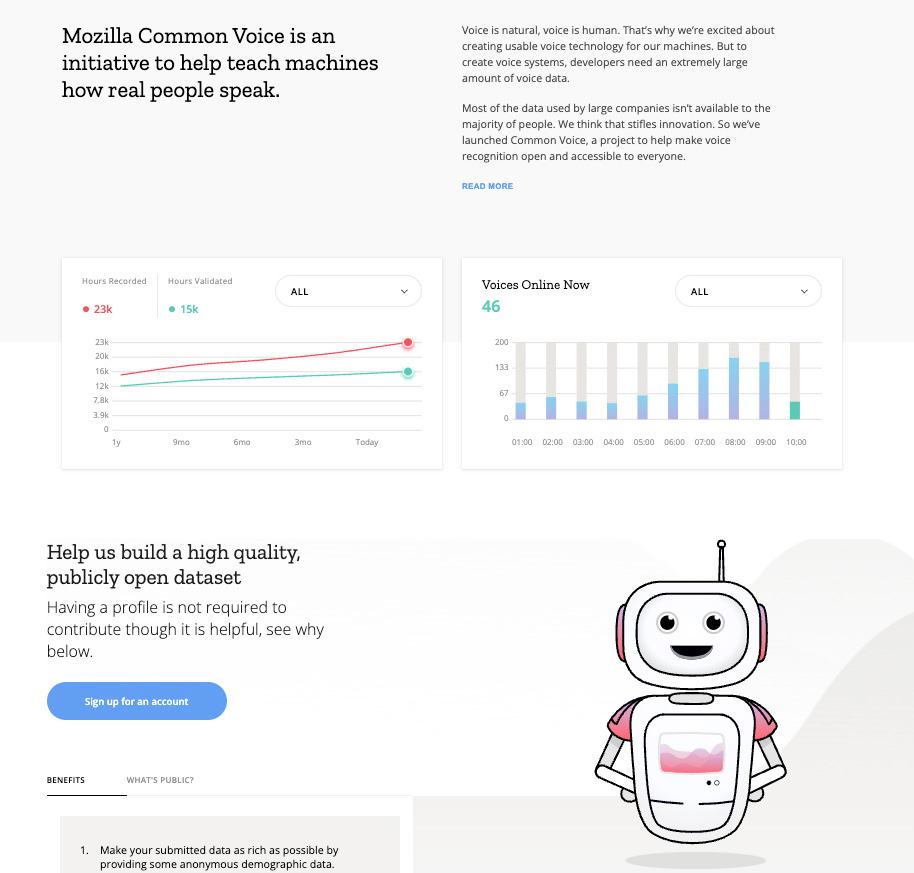
Image content description: The screenshot shows a dashboard with "Mozilla Common Voice is an initiative to help teach machines how real people speak." text. Below are two charts: a line chart showing "recorded voice hours" and "validated hours" over time (values in thousands), and a bar chart showing "voices online now" (values up to 46). Other text includes: "Voice is natural, voice is human. That's why we're excited about creating usable voice technology for our machines. But to create voice systems, developers need an extremely large amount of voice data." "Most of the data used by large companies isn't available to the majority of people. We think that stifles innovation. So we've launched Common Voice, a project to help make voice recognition open and accessible to everyone." "READ MORE". A section titled "Help us build a high quality, publicly open dataset" invites users to sign up, with "WHAT'S PUBLIC?" and "our submitted data as rich as possible by anonymous donation data" text.
7. Funding and scaling the collective intelligence commons
In the following section, we present six recommendations for how funders could invest in the open technical and social infrastructure to help develop and scale CI projects.
- Help maintain and upgrade the commons.
- Fund and provide access to large sets of data relevant to the SDGs and AFD's thematic priorities.
- Draw on local knowledge and see the commons as an opportunity for local communities to develop and own products that fit their needs.
- Prioritise funding integration and collaboration over competition.
- Back startups, but take an 'ecosystem approach' to investment and invest in scalable open platforms over products.
- Build the future of the commons: open AI.
The recommendations are primarily based on insights from expert interviews and analysis of opportunities for using the digital commons to enable CI.
The recommendations focus specifically on funding and scaling the CI commons through investment in technical open infrastructure and doesn't include a focus on digital skills and capabilities. However, a lack of digital skills and access to hardware and basic resources, such as internet access, was highlighted in both the literature and interviews as the most substantial challenge to making the most of the opportunities in the digital commons (and by extension, the CI commons). While this is a well-established challenge in development - documented by the Alliance for Affordable Internet among others - it is still important to highlight that this was perceived to be the most important area for investment among almost all experts.
Without resolving this fundamental challenge, the opportunities in the CI commons cannot be taken. Although this paper doesn't include recommendations for how to improve this, digital skills development initiatives could more clearly target areas related to the digital commons, such as working with and contributing to open data and open-source software.
Another obstacle facing the digital commons is a lack of good business cases. This poses a challenge for any funding based on loans or investment instead of grants. The expert interviews confirmed this challenge and highlighted a need to shift towards a better understanding of the added value from strong digital commons, similar to the impact of clean drinking water on health outcomes or access to energy on educational outcomes.
1. Help maintain and upgrade the commons
'The biggest gap is around maintenance; you don't build bridges and then neglect them.'
Stakeholder interview
'Maintenance and everything that's not connected with innovation is underfunded. But it's so hard to assess what tools are used and at what scale, so you need to gain an overview of the field first. (..) so investment in maintenance is becoming skewed towards private sector needs. More research is needed on issues that are not connected to everyday services, like banking.'
Stakeholder interview
Alongside supporting digital skills, maintenance was perhaps the most commonly mentioned challenge or barrier in the literature and expert interviews. There was a widespread recognition that most digital platforms, tools and applications are built off or reliant on open infrastructure, and that this foundational open layer is growing increasingly fragile. Recent 'sabotage' incidents targeting open-source software have led the tech industry to scramble to address software supply chain security issues connected with open source. However, it seems that the same concerns around maintenance aren't being addressed in the public and development sector in the same way.
The perception among practitioners and experts is that funders are too focused on funding innovation and either are not aware of or ignore the many hidden costs of open infrastructure, such as legal or staffing costs. There was a sense that funders are generally reluctant to support maintenance needs. This contributes significantly to making open infrastructure fragile.
Experts also highlighted that a key challenge was a lack of investment in upgrading and improving existing open-source tools. As a result, tools often have bugs and are unnecessarily hard to use or work with. Relatedly, experts pointed out that most large investments in upgrades and maintenance are from big tech companies. The risk here is that, despite being open, common assets will be developed to suit the interests of the companies rather than, for example, social innovators in low-income countries. Recent debates over the growing corporate influence over OSM illustrate this tension.
A few funds and initiatives have explored how to fund maintenance. In 2019 The Chan Zuckerberg launched the Essential Open Source Software for Science (EOSS) programme to provide some of the most widely used scientific open-source tools with much-needed support to address traditionally underfunded maintenance activities. Though this work is focused on supporting the needs of the biomedical sciences community, their contribution is significant, providing $22.9 million across four funding cycles so far. Similarly the US National Science Foundation set up a $21 Million fund to grow the community of researchers who develop and contribute to open source and enable pathways for collaboration that lead to new technologies that have broad impacts on society. The aim is specifically for each funded organization to create and maintain the infrastructure for a specific OS product or class of products.
Another example of a government backed programme is the Sovereign Tech Fund which has been set up to support the development, improvement and maintenance of open digital infrastructure, with funding from the German Ministry for Economic Affairs and Climate Action.
2. Fund and provide access to large sets of data relevant to the SDGs and AFD's thematic priorities
To maintain open infrastructure properly, a full assessment of the ecosystem is needed, as this will help focus and target investment where there are real needs. One stakeholder even deemed it a moral responsibility for funders to ensure that digital projects and services they set up are sustainable, due to the dependence that may be created. As such, funding maintenance is nothing less than essential. In particular, as large tech organisations are increasingly paying heed to and funding the maintenance needs of the open ecosystem, stakeholders urge funders to focus on supporting the maintenance of existing tools, services and platforms that they have already set up (rather than turning to new digital projects).
'Providing access to data sets is an enabling role. Just making things accessible makes so many more things possible.'
Stakeholder interview
Most of the data needed by CI projects working on the SDGs is still not a common resource. By helping make large amounts of data relevant to the SDGs and the social challenges they are seeking to address, funders can help build a key part of the digital infrastructure required for CI projects. Work on this challenge should build on the Open Data Institutes' work on data infrastructure for common challenges, which is based on a detailed analysis identifying four main areas of focus for funders: creating new data sets; developing open standards for using and sharing data; guidance for how to use open data; and building tools that will enable the better use of open data.
One example of creating 'new' data is the Norwegian government's International Climate and Forests Initiative. The programme, which seeks to address issues around deforestation, has funded access to Planet Labs' high-resolution satellite imagery of tropical forests, with the aim to help organisations monitor the tropics to reduce and reverse tropical forest loss. Anyone with an interest in understanding how trees are being managed can sign up to access the platform, API and integration for free.
Another approach to addressing data gaps is the Lacuna Fund. The fund is the world's first collaborative effort to provide resources to data scientists, researchers and social entrepreneurs in low- and middle-income contexts to create new data sets or strengthen existing ones. With a focus on three domain areas - agriculture, health and languages - the aim of the fund is to: produce new labelled data sets to address an underserved population or problem; augment existing data sets to make them more representative; or to update old data sets to make them more sustainable. Organisations that have identified either a data gap or need for maintenance of existing data can apply for support from the fund. All data sets produced will be locally developed and owned, and they will be openly accessible to the international community.
3. Draw on local knowledge and see the commons as an opportunity for local communities to develop and own products that fit their needs
'Focus on local adaptation and integration. Funders need to invest in programmes that allow local communities to adapt and use existing tools. It's about uptake.'
Stakeholder interview
'The role of funders should be to try to learn about and understand the field. Often, as a funder, you set incentives, have goals, then hand out money accordingly, but this isn't always grounded in how the field works and how the communities work.'
Stakeholder interview
While the SDGs are global in scope, their achievement will depend on our ability to find solutions and make them a reality locally: in communities, towns, cities and regions around the world. This wholly depends on the process of localisation. All aspects of the commons need to be connected to local knowledge in order to enable locally relevant adoption and implementation. Importantly, experts agreed that funders should not see the digital commons as an opportunity to reach scale by simply copying existing solutions in a different context, but focus on local adaptation and integration.
Funders can support localisation in this context by driving community and local engagement to understand community knowledge, needs and preferences and ensure these are reflected in common resources. The work done by Public Lab on training adaption of open source tools is one example of this.
Another role for funders includes providing training and support for local translation and adoption of open resources. This might be something as simple as ensuring Wikipedia resources are translated and communities are trained in updating local maps. It could also include more complex tasks such as ensuring that the data used to develop algorithms is collected from local communities to ensure fairness and representation. Stakeholders noted that documentation of resources is essential for enabling adoption and implementation; however, translation of resources, and ensuring that they are made available in indigenous languages, underpins this.
4. Prioritise funding integration and collaboration over competition
'There are lots of islands of good work on the commons, for example around data and creating domain knowledge expertise. But bringing the pieces together around applications is missing. There is not a lot of work on bringing it all together; it's missing the big picture.'
Stakeholder interview
Projects on the commons need to be connected, coordinated and aligned. There is a general sense that the commons have pockets of promising work but still lack integration and a high level vision for collaboration and integration. As a result, the field is dominated by a significant number of small-scale projects, often with high degrees of duplication. At the same time, integration across different commons projects remains a challenge in part due to competition but also because projects often work on slightly different standards and measures in term of how they collect and work with data.
Experts highlighted that funders often bear part of the responsibility for this challenge, as the vast majority of funding available for commons projects is focused on competition and investing in innovative projects. Very little funding is aimed at fostering collaboration and integration between projects.
One stakeholder, however, cautioned that a focus on integration should not come at the expense of support for local efforts, which must be retained and expanded.
'Centralising local efforts often takes attention away from local resources. Integration also relies on work on the ground being continuous and reliable, so funders should consider whether they are also investing in communities on the ground sufficiently. I haven't seen this in the global development field.'
Stakeholder interview
Examples from citizen science that help projects integrate
Citizen science enables citizens to capture and share data about everyday observations, ranging from air quality to bird populations. It is one of the most popular CI methods and is used by communities all over the world.
Recent debates have focused on how to make the most of the many (often disconnected) data collection efforts related to the same issue, such as measuring air pollution, to create a better link to monitoring global progress towards the SDGs.
The EU-funded WeObserve project is currently mapping existing contributions of citizen science to SDG indicators and identifying the indicators that projects could potentially contribute to in the future. This mapping could help inform activities taking place at the global level.
Similarly, the UN-Habitat launched the world's largest air quality data platform, bringing together real-time air pollution data from over 4,000 contributors, including citizens, communities, governments and the private sector.
5. Back startups, but take an 'ecosystem approach' to investment and invest in scalable open platforms over products
'The complexity of how everything relates to other elements in the tech stack, and how new projects are related to existing tech stacks, means it becomes very complex for new players to get into.'
Stakeholder interview
'Don't build a platform or tool; let other people build a platform. Building a platform is easy. Don't be something that you are not.'
Stakeholder interview
Primary efforts for investing in open infrastructure should centre around maintenance and making the most of developing, integrating and scaling existing resources. However, the literature and expert interviews also emphasised the importance of securing more startups in the field. Experts highlighted three main priorities for funders of the CI commons:
- Invest in scalable platforms rather than 'just' products - can what you fund be easily built on, forked or integrated into other products?
- Assess the ecosystem to understand where to focus, and target investment where there are real needs or gaps, rather where needs for new services and products are just perceived. For example, where are there data gaps? Where does the influence of big tech in open-source development need to be countered by more diverse input from civil society? Or are there any mission products or tools that could make an ecosystem of tools function better?
- Resist the temptation to set up your own platform or product and back others instead.
However, experts also urged greater consideration for the types of startups that are being supported. As the startup landscape has become increasingly dominated by those in positions of authority, more needs to be done to level the playing field and help those from diverse backgrounds enter the space.
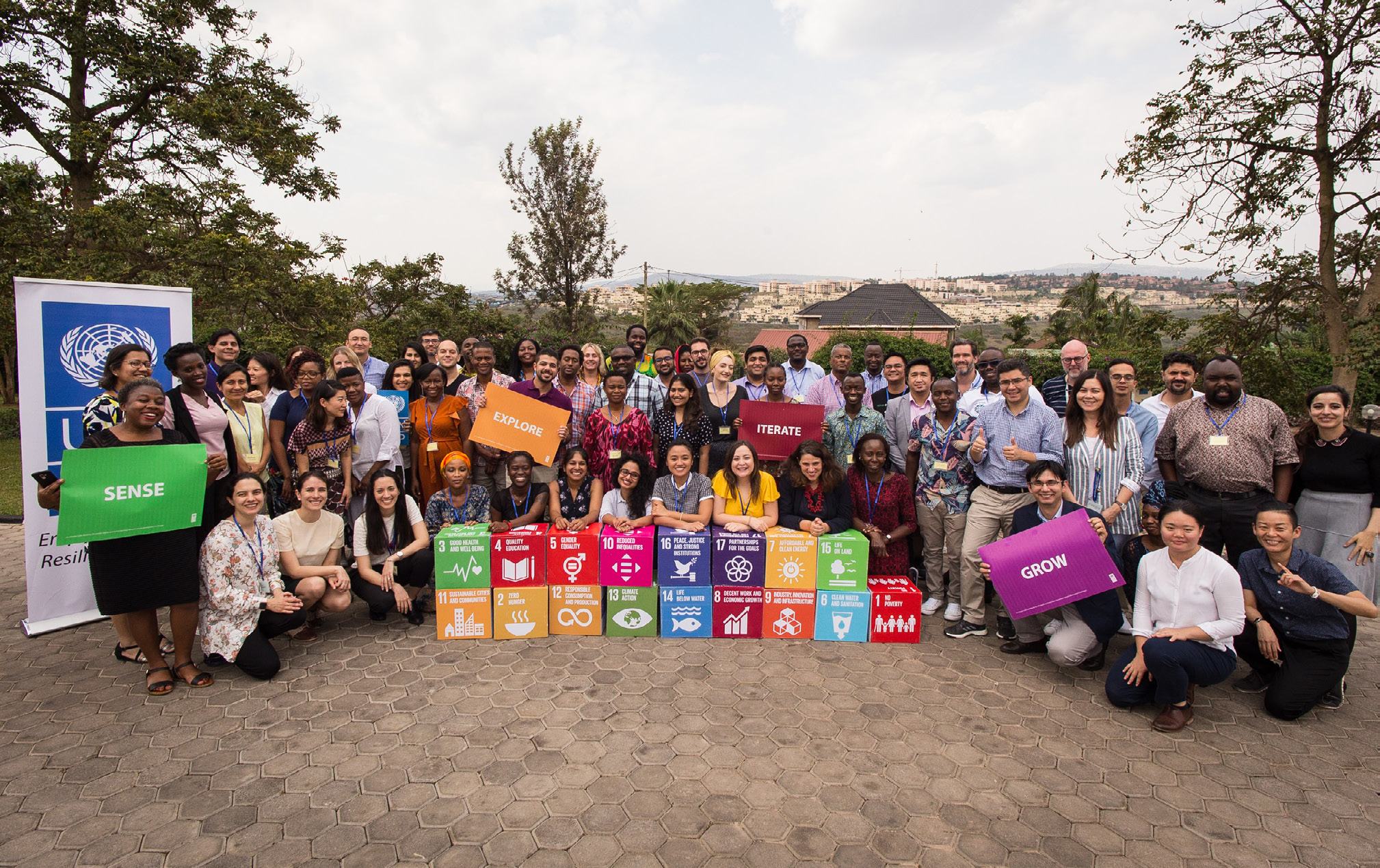
6. Build the future of the commons: open AI
Alongside the many immediate opportunities in the CI commons, funders also need to focus on shaping the future infrastructure that is and will be increasingly needed by CI initiatives.
The most impactful future infrastructure is AI. There is a real risk that many of the data sets and algorithms that power the AI solutions that will be used to meet the SDGs don't reflect the communities they are trying to serve.
Funders are uniquely placed to enable a more positive alternative trajectory for the future of AI. As 'AI for good' narratives become increasingly popular among both the public and private sector, it has never been more important to ensure that AI is developed in the public interest.
Making funding conditional on the participatory design and open documentation of AI systems can help to address concerns about lack of accountability, oversight and the risk of bias. It can also improve the technology itself by better tailoring models to local contexts. A more ambitious approach would be to create a dedicated funding programme for experiments that test new ways of putting the principles of responsible and ethical AI into practice in the development context.
The Mozilla Common voice project (see case study) to create an an open-source voice dataset and a speech recognition engine is one example of this. The Nesta collective crisis intelligence project, funded by the UK Humanitarian Innovation Hub, which aimed to address some of the risks associated with humanitarian AI is another example of changing involvement in AI development. The project created tools that combine data from crisis-affected communities in Nepal and Cameroon with the processing power of AI to improve humanitarian action and involved local communities and other stakeholders in the development process using Participatory AI methods to try to mitigate the main concerns about humanitarian AI.
Appendix
Acknowledgements
A large part of the research has been shaped through interviews and workshops with AFD teams. We are especially grateful for the valuable insight and feedback from Peter Addo, Pierre-Arnaud Barthel, Eric Beugnot, Aymeric Blanc, Lola Blanc, Sandrine Boucher, Elisabeth Krempp, Lola Mercier, Jean Millerat, Gwenael Prie and Samantha Richard.
From Nesta we would also like to thank Kathy Peach, Meera Shah, Aleksandra Berditchevskaia and Eirini Malliaraki for all their feedback and help in shaping the project.
The framework illustration in the report were created by Blindsalida represented by Meiklejohn.
This report is based on the insights and experiences of a whole range of projects and researchers working at the forefront of exploring the collective intelligence commons through research and practice. We would like to thank the following people and organisations for taking part in the research through interviews
| Name |
Role/title |
Organisation |
| Michel Bauwens |
Founder & Director |
P2P Foundation |
| Kirstie Whitaker |
Programme Director for Tools, Practices and Systems |
Alan Turing Institute |
| Christina Rebel Moya |
Co-founder & Chief Innovation Officer |
Wikifactory |
| Kaitlin Thaney |
Executive Director |
Invest In Open Infrastructure |
| Elisa Lindinger |
Joint Managing Director |
Superrr Lab (previously Open Knowledge Foundation) |
| Nicolas Miailhe |
Founder & President |
The Future Society |
| Eamon O'Hara |
Executive Director |
ECOLISE (European network for community-led initiatives on climate change and sustainability) |
| Xavier Damman |
Co-founder |
Open Collective |
| Konstantinos Karachalios |
Managing Director |
IEEE Standards |
| Alpesh Shah |
Senior Director of Global Business Strategy & Intelligence |
IEEE Standards |
| Giulio Quaggiotto |
Head of Strategic Innovation |
UNDP |
| Robert Opp |
Chief Digital Officer |
UNDP |
| Adriana Groh |
Project Lead |
The New Institute (previously Open Knowledge Foundation) |
| Katharina Myers |
Project Lead |
The New Institute |
| Ian Gray |
Director |
Gray Dot Catalyst |
| Heath Arensen |
Director |
Open Source Centre at Digital Impact Alliance |
| Siddhartha Jha |
AI/Digital Program Manager |
Fondation Botnar |
Endnotes
About this report
This report, by Nesta and Agence Française de Développement (AFD) explores how development funders can make the most of the opportunity to support the CI commons. It analyses the environment necessary to sustain and scale CI initiatives that will work towards meeting the SDGs, considering the role of both funders and open technical and social Infrastructure.
It primarily aims to help development funders use the CI commons, particularly stakeholders who are working on digital strategy and innovation. However, we also hope it will be relevant to a wider audienceof officials within national governments, international agencies and development organisations who want tosupport open technical and social infrastructure and CI initiatives as part of national SDG strategies.
The research is based on a review of literature and best practices for CI and open infrastructure and interviews with 17 domain experts working on development and the digital commons. Alongside literature review and experts interviews, a number of collaborative workshops with AFD have helped further explore opportunities for implementing and supporting the CI commons and the potential role of funders.
58 Victoria Embankment
London EC4Y 0DS
+44 (0)20 7438 2500
[email protected]
@nesta_uk
nesta.uk
www.nesta.org.uk
Nesta is a registered charity in England and Wales with company number 7706036 and charity number 1144091. Registered as a charity in Scotland number SCO42833. Registered office: 58 Victoria Embankment, London EC4Y 0DS.
ISBN: 978-1-913095-73-4
Creative Commons BY NC SA