This paper looks at why the UK needs one million new creative jobs by 2030 and offers five sets of policy recommendations for government to achieve this.
This paper looks at why the UK needs one million new creative jobs by 2030 and offers five sets of policy recommendations for government to achieve this.
Key Recommendations
- The government should end the bias against multi–disciplinary education in our education system – turning STEM into STEAM (Science, Technology, Engineering, Arts and Mathematics).
- BIS and DCMS should establish a competitive £100 million strategic fund using Regional Growth Fund money to develop creative clusters outside London, with matched funding from the private sector, local authorities and cultural funders.
- The government should ensure that the UK’s digital infrastructure allows creative businesses to develop the next generation of world–beating content, services and apps by creating a £100 million Ultrafast Digital Infrastructure Demonstrator fund.
- Public funders should make their arts funding go further by promoting new and innovative financing models.
- The government should establish a National Lottery distributor for the video games industry, following the model of the BFI.
Authors
Hasan Bakhshi and George Windsor
The Creative Economy and the Future of Employment
The UK's strong current growth performance compared with other countries must not detract from her deep-seated structural problems: namely, her low investment in skills, infrastructure and innovation. As a consequence of these problems, productivity – output per hour worked - is 17 per cent lower than the average for the rest of the G7 nations, the widest gap for over 20 years.1 At the same time, there is growing evidence that technological progress has created a 'sagging middle' in the labour market, with machines and computers replacing employees in many routine jobs in the middle of the income distribution, contributing to record increases in income inequality.2 And in all countries the evidence is mounting of high levels of worker dissatisfaction and disengagement with low levels of intrinsic motivation across the workforce.3
The Creative Economy stands out as a shining light. One of the UK's unsung success stories, making up almost a tenth of value added, it is deeply rooted in national history and accounts for 2.6 million jobs, making it bigger than sectors like Advanced Manufacturing, Financial Services and Construction. 1.8 million of these jobs are in creative occupations (Figure 1) - from advertising professionals to computer programmers, and from actors to video games developers - who are highly educated,4 skilled5 and drivers of innovation.6
Figure 1 Who hires the Creatives?
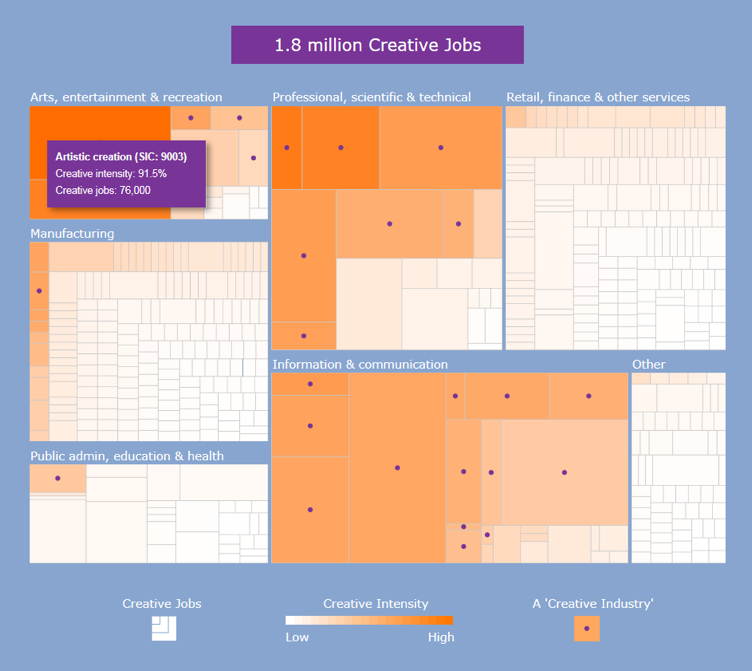
Figure 1 (http://www.nesta.org.uk/blog/who-hires-creatives) shows how the UK's 1.8 million creative jobs are spread across different industries. The size of each box captures the number of creative jobs within an industry. The colour of each box shows the industry's 'creative intensity', which is the percentage of jobs in creative occupations. The purple dots denote the 'Creative Industries', as classified by the Department for Culture, Media and Sport. The arts, entertainment and recreation segment contains the industrial code with the highest percentage of jobs in creative occupations: 'Artistic creation'. The information and communication segment contains the two industrial codes that have the largest number of jobs in creative occupations: 'Computer programming activities' and 'Computer consultancy activities'. Approximately one-half of all creative jobs are found outside the 'Creative Industries'. Seven of these industries each contain at least 20,000 creative jobs.
Creativity vs. Robots
Crucially, new research from Nesta shows that in the future creative jobs will also be more resistant to automation.7 In Creativity vs. Robots we show that creativity is inversely related to computerisability: 87 per cent of highly creative workers are at low or no risk of automation, compared with 40 per cent of jobs in the UK workforce as a whole.8 At the regional level, we see that places with a higher proportion of the workforce in creative jobs, most obviously London, are also more immune to automation.
Such findings should not be surprising: they reflect the fact that machines can most successfully emulate humans when a problem is well specified in advance - that is, when performance can be straightforwardly quantified and evaluated - and when the work task environment is sufficiently simple to enable autonomous control. They will struggle when tasks are highly interpretive, geared at 'products whose final form is not fully specified in advance',9 and when work task environments are complex a good description of most creative occupations.
Creative jobs, 'good' jobs
A further new study for Nesta, undertaken by Slmetrica, shows that creative occupations tend to be characterised by higher than average levels of life satisfaction, worthwhileness and happiness - but also higher levels of anxiety.10 Once other factors that affect subjective wellbeing are controlled for - including wages, which are higher than average for creative occupations like computer programmers and advertising professionals but lower for artists, musicians and actors - jobs in arts, crafts and design occupations are generally associated with higher levels of wellbeing, whereas jobs in advertising, film, TV and radio, publishing and IT are associated with lower wellbeing levels.
One million new creative jobs
Projecting forward the higher than average growth rate of creative jobs since 1997 would imply roughly one million new creative jobs by 2030. Nesta believes that to capitalise on our creative strengths, and to invest in the wellbeing of the workforce, the next government should commit the UK to achieving this.
To realise this ambition, we make five sets of recommendations for policy, building on the comprehensive strategy for government we set out in A Manifesto for the Creative Economy:11
Recommendations
1. The government should end the bias against multi-disciplinary education in our education system – turning STEM into STEAM (Science, Technology, Engineering, Arts and Mathematics).
Nesta first called on the Department for Education to include an arts subject in the English Baccalaureate in its Next Gen12 report in January 2011. (This was the report that led to the introduction of Computing in the National Curriculum.) At present, young people who are strong in sciences are perversely discouraged from considering the arts as a valuable component of their education. Yet it is precisely this multi-disciplinary mix of science and arts that creative businesses are crying out for.13
It is still important that the Department for Education includes an arts subject in the English Baccalaureate. (We note the differences in educational practice that exist in Scotland and to a lesser extent in Wales and Northern Ireland and Scotland.) Multi-disciplinary learning must also be enabled outside the classroom, by giving all young people access to grassroots digital making opportunities for which research has shown there is huge unmet demand.14
Government should challenge The Russell Group of universities to include the arts in their list of 'facilitating subjects' that students are advised to choose to keep their university options open.
The Research Councils should boost the technological capabilities of art schools (and their demand for students studying a mix of arts and science in schools) by setting up centres of excellence based on the ESRC and Nuffield Foundation's Q-Step Model.15
More generally, bodies including the Creative Industries Federation, the Cultural Learning Alliance, the Arts Councils, sector skills agencies and Nesta should work together towards effecting the system-wide changes needed to address the disciplinary silos that characterise the education we offer young people.
2. BIS and DCMS should establish a competitive £100 million strategic fund using Regional Growth Fund money to develop creative clusters outside London, with matched funding from the private sector, local authorities and cultural funders.
Recent Nesta research shows that creative employment is highly unevenly distributed around the country (Figure 2). The Geography of the UK's Creative and High-Tech Economies shows that London and the South-East of England account for 43 per cent of creative economy jobs compared with 28 per cent of the workforce as a whole, making the creative economy the most unequally distributed part of the economy outside agriculture and finance and insurance.16
Nonetheless, hotspots of creative activity are to be found across the UK. Growing these clusters requires strategic investment by Local Enterprise Partnerships, local authorities, universities and cultural funders, and a targeted public fund should be set up using Regional Growth Fund money to incentivise this investment.
Figure 2 Where are the Creative and High-tech economies?
The colour and size of each region in Figure 2 (http://data.nesta.org.uk/creativity/Cartogram.html) shows the concentration of jobs in the Creative and High-tech Economies respectively within that region. The higher the concentration, the larger the area and brighter the colour. Concentration is measured by a 'location quotient'. This is the share of the region's workforce in the Creative (High-tech) Economy divided by the national share. A location quotient greater than one indicates that the region has a higher concentration of jobs in the Creative (High-tech) Economy than the UK as a whole. Data for Northern Ireland at NUTS 3 level was not available.
3. The government should ensure that the UK's digital infrastructure allows creative businesses to develop the next generation of world-beating content, services and apps by creating a £100 million Ultrafast Digital Infrastructure Demonstrator fund.
By 'ultrafast' we refer to the highest speeds, in the hundreds of Mbps and approaching 1Gbps, which can be delivered by pure fibre as well as hybrid technologies like G.fast.
The Demonstrator's activities would cover Research & Development in a broad sense, including: testing methods for reducing the costs of 'civils' (installing fibre into the ground and into people's homes) which can represent 80 per cent of total costs; tracking the development of new commercial applications and services; monitoring development of new civic applications (including innovative delivery of public services) which may not be sustainable on purely commercial grounds; and analysis of the behaviour of households moving to higher speed connections.17
The Demonstrator would work with smaller, innovative suppliers of ultrafast broadband services (Alt Nets such as B4RN, Hyperoptic and CityFibre) as well as the large incumbent companies.
4. Public funders should make their arts funding go further by promoting new and innovative financing models.
Arts and culture funders like Arts Council England, Creative Scotland and the British Film Institute (BFI) should devote at least 1 per cent of their budgets to Research & Development in their sectors. The largest funders should in addition between them commit £10 million each year to piloting innovative financing schemes like venture funding and accelerators. Nesta suggests that, with plausible assumptions for co-funding, these measures alone could attract up to £72 million in additional funding for the arts through matched funding.18
5. The government should establish a National Lottery distributor for the video games industry, following the model of the BFI.
The government has already recognised the cultural significance of video games through providing tax relief for video games development. It should now follow through its logic by setting up a separate video games National Lottery distributor which, following the example of the BFI, would champion ‘a breadth of bold and distinctive games development across the UK, nurturing new talent and enriching UK culture'.19
Endnotes
Contact Information
Nesta 1 Plough Place London EC4A 1DE [email protected] @nesta_uk www.facebook.com/nesta.uk www.nesta.org.uk April 2015
Nesta is a registered charity in England and Wales with company number 7706036 and charity number 1144091. Registered as a charity in Scotland number SCO42833. Registered office: 1 Plough Place, London, EC4A 1DE. CC BY NC SA
-
ONS (2015) 'International Comparisons of Productivity - Final Estimates, 2013.' See: http://www.ons.gov.uk/ons/rel/icp/international-comparisos-of-productivity/2013---final-estimates/stb-icp0215.html ↩
-
Manning (2013) 'Lovely and lousy jobs.' CentrePiece Autumn 2013, Centre for Economic Performance. See: http://cep.lse.ac.uk/pubs/download/cp398.pdf ↩
-
Gallup (2013) 'State of the workplace.' See: http://ihrim.org/Pubonline/Wire/Dec13/GlobalWorkplaceReport_2013.pdf ↩
-
Universities UK (2010), 'Creating Prosperity: the role of higher education in driving the UK's creative economy', Universities UK http://www.universitiesuk.ac.uk/highereducation/Documents/2010/CreatingProsperityTheRoleOfHigherEducation.pdf ↩
-
Nesta (2011) 'Next Gen.: Transforming the UK into the world's leading talent hub for the video games and visual effects industries: A Review by Ian Livingstone and Alex Hope.' London: Nesta. See: http://www.nesta.org.uk/sites/default/files/next_gen_wv.pdf ↩
-
Lee and Rodriguez-Pose (2014) 'Creativity, cities and innovation.' Environment and Planning A, 46(5): 1139-1159 ↩
-
Bakhshi, Frey and Osborne (2015) 'Creativity vs. Robots: The creative economy and the future of employment.' London: Nesta. www.nesta.org.uk/publications/creativity-vs-robots ↩
-
Knowles-Cutler, Frey and Osborne (2014) 'Agiletown: the relentless march of technology and London's response.' London: Deloitte. ↩
-
Bakhshi, Freeman and Higgs (2013) 'A Dynamic Mapping of the UK's Creative Industries.' London: Nesta. See: https://www.nesta.org.uk/sites/default/files/a_dynamic_mapping_of_the_creative_industries.pdf ↩
-
Fujiwara, Dolan and Lawton (2015) 'Creative Occupations and Subjective Wellbeing.' London: Nesta. See: http://www.nesta.org.uk/publications/creative-occupations-and-subjective-wellbeing ↩
-
Bakhshi, Hargreaves and Mateos-Garcia (2013) 'A Manifesto for the Creative Economy.' London: Nesta. See: http://www.nesta.org.uk/sites/default/files/a-manifesto-for-the-creative-economy-april13.pdf ↩
-
Ibid. ↩
-
Warwick Commission on the Future of Cultural Value (2015) 'Enriching Britain: Culture, Creativity and Growth.' University of Warwick. See: http://www2.warwick.ac.uk/research/warwickcommission/futureculture/finalreport/warwick_commission_final_report.pdf ↩
-
Quinlan (2015) 'Young Digital Makers: Surveying attitudes and opportunities for digital creativity across the UK.' Report Summary. London: Nesta. See: http://www.nesta.org.uk/sites/default/files/young-digital-makers-summary.pdf ↩
-
Bakhshi, Davies, Freeman and Higgs (2015) 'The Geography of the UK's Creative and High-Tech Economies.' London: Nesta. See: http://www.nesta.org.uk/sites/default/files/geography_uks_creative_high-tech_economieswv20151.pdf ↩
-
Bakhshi, H. and Windsor, G. (2015) 'Ultra-fast digital infrastructure in the UK: are we missing a trick?' London: Nesta. ↩
-
Nesta (2014) 'The new art of finance: making money work harder for the arts.' London: Nesta. See: http://www.nesta.org.uk/sites/default/files/the_new_art_of_finance_wv.pdf ↩
-
Bakhshi, H. and Mateos-Garcia, J. (2014) 'The time has come for a new Lottery distributor for the video games industry.' London: Nesta. http://www.nesta.org.uk/blog/time-has-come-new-lottery-distributor-video-games-industry#sthash.ca6TILXz.dpuf ↩