Acknowledgements
First, and most importantly, we would like to acknowledge and thank all those members of the general public in Scotland who participated in the quantitative polling, qualitative research and focus group engagement and who willingly shared their views, experiences and opinions to inform the findings of this report.
We are extremely grateful to the team at Mark Diffley Consultancy and Research, in particular to Mark Diffley and Sanah Saeed Zubairi, who ensured the work performed for this report was carried out to the highest professional standards and delivered despite working in the challenging context of a global public health crisis.
Thank you to Gillian Docherty OBE, Catherine Stihler OBE and Dr Poonam Malik FRSB for sharing their expert opinions on the findings of this report and what these might mean for future policy priorities and opportunities for action in Scotland. Thanks also to Jamie Cook, Head of RSA Scotland, for supporting the delivery of one of the deliberative workshop sessions for this research.
We would like to thank Grant Collinson from Nesta in Scotland for coordinating production, The Proofreading Company for their support in proofreading this report and Green Doe Graphic Design for the illustration, design and production.
About Nesta
Nesta is an innovation foundation. For us, innovation means turning bold ideas into reality and changing lives for the better.
We use our expertise, skills and funding in areas where there are big challenges facing society.
Nesta is based in the UK and supported by a financial endowment. We work with partners around the globe to bring bold ideas to life to change the world for good.
www.nesta.org.uk
If you'd like this publication in an alternative format such as Braille or large print, please contact us at: [email protected]
Introduction
We are living through the Fourth Industrial Revolution - the fourth period of intense technological advancement that humans have experienced. This revolution is already dramatically shaping our world and has the potential to define the future of our society, economy and public services.
These issues have been brought into sharper focus during the COVID-19 pandemic as many companies, public services, voluntary organisations and community engagement programmes have been forced to rapidly shift towards digital-led services. In many cases, it is the technologies of the Fourth Industrial Revolution that are powering the innovations, platforms, apps and services ensuring communities can stay connected, vital public services can be accessed and businesses can keep working.
However, to date, little has been done to really understand in detail how much people in Scotland know about the technological advances shaping our lives, and how the public feels about their potential to disrupt - and improve – our society.
This research represents some of the most in-depth analysis of the opinions, aspirations and concerns of people in Scotland in relation to the technologies driving the Fourth Industrial Revolution. It lays bare the challenges we face as we recover and rebuild our society after the COVID-19 pandemic.
This report reveals that people in Scotland see these technologies as instrumental in improving many aspects of their lives - for instance by making public services more effective. However, people also share concerns about the possibility of jobs being lost and the potential encroachment on personal privacy and digital security. It also shows that these technologies are seen by many as elitist, unobtainable and obscured by technical language and jargon.
Social inequality is at the forefront of people's minds in relation to how these technologies will be used in Scotland. Many are worried that the benefits they might bring will not be evenly spread across the population and they will exacerbate existing inequalities. As such, there is a clear desire for a proactive approach from the government and other agencies in Scotland to address these potential imbalances. People also want to have more say in how these technologies are developed and used. Increasing knowledge, education and training on new technologies, and democratising access to them, are recurring themes throughout the research.
Previous industrial revolutions have undoubtedly advanced society forward in significant leaps, but they have almost always initially come with a considerable human cost. In Scotland, we can use the findings from this report to support inclusive innovation and prioritise equality, access and empowerment in our approach to harnessing the Fourth Industrial Revolution for social good.
Jessica Clark and Adam Lang
Nesta in Scotland
Mark Diffley and Sanah Saeed Zubairi
Mark Diffley Consultancy and Research
Key findings
The research conducted in this study, which we outline in this report, gives a robust insight into the views of people in Scotland on the new technologies that will play an increasing role in our personal and professional lives and the public services we all value and consume.
This is the first time that the views of the public in Scotland have been captured on these issues in such detail. The findings should therefore give policymakers, businesses, innovators and elected officials the confidence needed to align important decisions, services and products with public attitudes on these increasingly important issues.
The key messages from this research can be grouped into 'broad' and 'specific' conclusions:
Broad conclusions
- The public sees clear benefits and potential drawbacks to the growth of technologies in the fourth industrial revolution (4IR).
- They see technologies as instrumental in improving the effectiveness of public services and many aspects of their lives, but are concerned particularly about the possibility of jobs being lost and the potential encroachment on personal privacy and digital security.
- The technologies powering the 4IR are seen by many as elitist and unobtainable for ordinary people. This is not just visible in people's ability to own or use these technologies but in the language and terminology used to talk about them.
- Issues of social inequality are at the forefront of people's minds; many are worried that the benefits of technology will not be evenly spread across the population and are looking to the government and other agencies to address these potential imbalances.
Specific conclusions
Relationship between knowledge and attitudes towards 4IR technologies
- There is a clear relationship in the quantitative and qualitative data which shows that the more people know about new technologies, the more favourable their attitudes are towards them. This would point to the potential benefits of a large-scale information campaign.
- Furthermore, a lack of knowledge contributes to concern among some around perceived negative impacts of new technologies, including potential job losses.
- The research highlights some misinformation among participants, reflecting that their views on new technologies come primarily from news reports and social media.
Impact of COVID-19 on the adoption and use of technologies
- There was increased use of new technologies to help facilitate contact with family and friends, to work, study and learn during lockdown.
- However, people expressed concern that technology would replace human contact after the easing of lockdown measures.
- Some expressed the view that technologies should help to support essential workers who are propping up society during the pandemic - and that the benefits resulting from the adoption of new technologies should be more evenly distributed.
Technology for public good
- The majority agree that new technologies will impact positively on public services overall and many aspects of their delivery, reinforcing this as being the major positive outcome from the research. Personal testimony among those who use technologies to manage health conditions would appear to be a powerful means by which to communicate these benefits.
- However, there is less public confidence that new technologies will reduce the costs of delivering public services and significant anxiety about the potential for job losses in the public sector.
- In line with the broad conclusion about the relationship between knowledge and attitudes, the research highlights that, when the public considers certain scenarios about the use of technology in public services, positivity around the delivery of services increases.
The future of work: Technology that enhances and supports the work of humans
- It is clear that a key area of concern for the public is the future of work and the possibility that new technologies will replace humans in the workplace and lead to job losses.
- It is really important to understand human and emotional reactions on this issue, particularly in some former industrial heartlands in Scotland that have suffered significant job losses in the past.
- Related to this, there is widespread concern that the impact on jobs, including the ability to find new jobs or not, will fall disproportionately on the most disadvantaged and policymakers must be alive to these issues when making important decisions.
Continuous skills development
- There is widespread support for programmes aimed at improving skills in using and understanding new technologies. Given what we know from the research about the link between knowledge and attitudes, this conclusion should be acted upon as a priority.
- Given public concern at the potential of new technologies to diminish social skills, it is clear that these programmes should include work to nurture 'soft skills' to ensure these are not lost in future generations.
Equality, accessibility and transparency
- Alongside potential job losses, the main source of public anxiety is around personal privacy and the handling of personal data - there is widespread concern that needs to be addressed.
- In line with other themes in the research, many people are unaware of how their personal data is used, particularly by large corporations. As well as being a knowledge deficit, this also leads to feelings of disempowerment and distrust, and these issues need to be addressed.
Regulation
- Given the public's anxiety about the loss of control over data, it is unsurprising that there is broad support for more regulation in this area, with the majority seeing government as having the primary role in that regulation.
Call for increased citizen engagement
- The recurring theme of knowledge, education and training around new technologies is further boosted by the finding that the public wants to see citizens becoming more engaged in their development. This suggests that any moves to empower citizens in this regard will be well received.
- With that in mind, it is up to decision-makers and other stakeholders to commit to creative ways of engaging the public; this may include forums and initiatives like Citizens' Assemblies to address current deficits in knowledge, understanding and empowerment.
Glossary
4IR is the fourth period of technological advancement that humans have lived through and has the power to reshape almost every sector in all corners of the globe. It is characterised by technologies such as artificial intelligence, robotics and augmented reality.
Key technologies driving the 4IR
Artificial intelligence (AI)
Artificial intelligence (AI) uses computer processing power to solve problems and carry out tasks that would usually use human intelligence. AI systems mimic humans and learn through the experience of successes and errors. Examples of AI are autocorrect on your phone or spam filters on email.
Diagram illustrating Artificial Intelligence: A robot head with a glowing brain, surrounded by icons representing data, cloud storage, a lightbulb (idea), and a shield (security), connected by lines within a circular flow.
Machine learning
Machine learning can be used by AI systems to improve the way they work by extracting patterns from very large volumes of data. As humans, our ability to learn and improve at a task comes from experience and computers can do the same. Image recognition and speech-to-text recognition are examples of machine learning.
Diagram illustrating Machine Learning: A human head with a gear inside, connected to a magnifying glass over data, a lightbulb, and cloud storage icons, suggesting data processing and insight generation.
Virtual reality (VR)
Virtual reality (VR) offers immersive digital experiences (using a VR headset) that simulate the real world, while augmented reality (AR) merges the digital and physical worlds by overlaying digital images on a real-world environment. Examples include L'Oréal's makeup app, which allows users to digitally experiment with makeup products before buying them, and the Google Translate phone app, which allows users to scan and instantly translate street signs, menus and other text.
Diagram illustrating Virtual Reality: A person wearing a VR headset, with various icons around them representing immersive experiences like a game controller, data, and settings gears.
Self-driving cars
Self-driving cars use an array of sensors and AI systems to analyse information from the environment around them in order to move through this environment safely without human interaction. Several companies are developing self-driving vehicles for commercial and public use, including a self-driving taxi service which has been operating as a pilot since 2018.
Diagram illustrating Self-driving cars: An orange car with sensors, surrounded by icons for GPS, data, and network connectivity, indicating autonomous navigation.
Robotics
Robotics refers to the use of robots for personal and commercial use. Robotics - combined with AI - can improve on basic programming, making 'intelligent robots' increasingly complex and sophisticated. They are used in fields as wide-ranging as manufacturing, health and safety, and human assistance.
Diagram illustrating Robotics: A robotic arm, with gears and other mechanical components, connected to icons representing manufacturing, a lightbulb, and a human figure, symbolizing automation and assistance.
3D printing
3D printing enables the creation of customised, three-dimensional solid objects from a digital file, and has the potential to completely change our manufacturing methods. Innovative materials could transform multiple sectors, such as manufacturing, renewable energy, construction and healthcare.
Diagram illustrating 3D printing: A 3D printer head creating an object, surrounded by icons representing design, material, and a finished product, signifying additive manufacturing.
Cloud computing
Cloud computing is a way of storing and accessing data over the internet, allowing the user access to virtual resources or information on demand. The provider fulfils those requests using advanced automation rather than manual provisioning.
Diagram illustrating Cloud computing: A person interacting with a cloud icon, with data and network symbols, representing remote data storage and access.
The Internet of Things (IoT)
The Internet of Things (IoT) is the concept of being able to connect everyday items and devices to the internet. The potential of the IoT is huge - some examples of its uses include: helping farmers decide when to fertilise land, tracking your physical health using a medical wearable device, helping businesses to better understand their customers, or assisting with the design of a 'smart city'.
Diagram illustrating The Internet of Things (IoT): A collection of connected everyday objects like a house, a car, a lightbulb, and a phone, all linked to a central network hub, representing interconnected devices.
Background and aims
Mark Diffley Consultancy and Research was commissioned by Nesta in Scotland to undertake a research study that explores public attitudes in Scotland towards the technologies of the 4IR.
To situate the 4IR, it is important to understand prior industrial revolutions and the transformative impact each of these has had.
Since the First Industrial Revolution, the invention and development of machines have transformed the way services are delivered, and the way we live, work and relate to one another. The First Industrial Revolution focused on the use of coal, water and steam to enable the large-scale manufacturing of goods and products, much of which was facilitated by access to raw material supplies and global markets. The Second Industrial Revolution brought about the invention of electricity and the development of the automobile, while the Third Industrial Revolution focused on computers and digital systems that enabled new ways of processing and sharing information.
Technological change has been continuous, and many believe we are now in the middle of the 4IR with increased technological developments in the digital, physical and biological domains. The term 'Fourth Industrial Revolution' was first coined by Klaus Schwab in 2016. Schwab distinguishes the Fourth Industrial Revolution from those that preceded it by the velocity and breadth and depth of developments as well as their transformative impact on whole systems including countries, governments, businesses and society.
In this context, it is important to understand public attitudes to the technologies of the 4IR, and to learn about how we can engage citizens in conversation about these developments, while recognising their disruptive potential as well as the opportunities that may be conferred from technological progress.
Current events have brought some of the issues related to new technologies into sharper focus.
The current COVID-19 pandemic has prompted discussion around the role of new technologies such as AI, the IoT and Big Data in the public health response to the virus, including the opportunity to support the development of personal protective equipment using 3D printing.
The International Labour Organization published a global unemployment estimate of 24.7 million as a result of COVID-19 in mid-March, which has implications for the future of work post-COVID. This is in addition to significant increase in homeworking made possible by new technologies such as cloud computing and videoconferencing software.
Furthermore, the measures taken to contain the spread of the virus impact our collective human rights: by protecting our right to life, inevitable trade-offs are made in terms of our rights to liberty and the preservation of family life.
In scoping the research study, we identified three key themes to explore, which are timely given the current circumstances, as indicated above. These are:
- The impact of new technologies on the delivery of public services.
- The future of work, skills and education in light of new technologies.
- The implications of new technologies on human rights, ethics, privacy and data sharing.
1. Relationship between knowledge and attitudes towards 4IR technologies
Headline findings
- Those who are more knowledgeable about new technologies are more likely to hold a favourable view of their impact on the economy and society. There are benefits stemming from discussion and learning on the issue of new technologies. In particular, demonstrating shared benefits like employment opportunities and access to public services are key to building optimism about the 4IR in Scotland. However, there are concerns about the distribution of benefits resulting from the adoption of new technologies: there is a view that the 4IR is an 'elitist realm'. Therefore, more work is required to build public trust that communities across Scotland will benefit from these developments, particularly in rural areas where people feel they have not benefited from economic development opportunities in the past.
Detailed findings
There were mixed levels of knowledge regarding the technologies of the 4IR, with comparatively higher levels of knowledge of AI (70 per cent know at least a little), 3D printing (68 per cent) and cloud computing (61 per cent). In contrast, machine learning (where 33 per cent know at least a little) and the IoT (28 per cent) were lesser known technologies.
The most significant predictors of knowledge of 4IR technologies are gender and social grade.
Men and those in the ABC1 social grade category are more likely to know a lot or a little about the technologies of the 4IR compared to women and C2DEs. These results have implications for different equality groups when we consider the penetration of new technologies in society.
There is a correlation between knowledge and attitudes towards new technologies: those who are more knowledgeable are more likely to hold a favourable view. This relationship in the data is further substantiated by our observation that the three technologies most commonly known among the population – namely, 3D printing, cloud computing and AI - correspond with higher levels of agreement that these technologies will be more positive than negative for the future of Scotland (58 per cent, 56 per cent and 50 per cent respectively).
Figure 1.1. Knowledge of new technologies: A horizontal bar chart showing the percentage of respondents who know "a lot", "a little", "heard of", or "never heard of" various technologies.
Key insights:
* Artificial intelligence: 12% know a lot, 58% know a little, 24% heard of, 6% never heard of.
* Cloud computing: 12% know a lot, 49% know a little, 23% heard of, 15% never heard of.
* Automation: 11% know a lot, 47% know a little, 24% heard of, 18% never heard of.
* 3D printing: 10% know a lot, 58% know a little, 28% heard of, 4% never heard of.
* Self-driving cars: 8% know a lot, 56% know a little, 34% heard of, 2% never heard of.
* Augmented reality: 8% know a lot, 32% know a little, 24% heard of, 35% never heard of.
* Internet of Things: 7% know a lot, 21% know a little, 18% heard of, 53% never heard of.
* Machine learning: 6% know a lot, 27% know a little, 25% heard of, 42% never heard of.
* Base: All respondents to the national survey (1,034).
Figure 1.2. Views on whether new technologies will be more positive than negative for the future of Scotland: A horizontal bar chart showing the percentage of respondents who "Agree", "Neither agree nor disagree", "Disagree", or "Don't know" regarding the positive impact of various technologies.
Key insights:
* 3D printing: 58% Agree, 23% Neither, 5% Disagree, 15% Don't know.
* Cloud computing: 56% Agree, 22% Neither, 3% Disagree, 19% Don't know.
* Artificial intelligence: 50% Agree, 25% Neither, 12% Disagree, 13% Don't know.
* Automation: 47% Agree, 24% Neither, 13% Disagree, 16% Don't know.
* Machine learning: 44% Agree, 30% Neither, 9% Disagree, 17% Don't know.
* Internet of Things: 41% Agree, 30% Neither, 8% Disagree, 21% Don't know.
* Augmented reality: 37% Agree, 31% Neither, 8% Disagree, 23% Don't know.
* Self-driving cars: 27% Agree, 26% Neither, 35% Disagree, 12% Don't know.
* Base: All respondents to the national survey (1,034).
This relationship between knowledge and attitudes was further observed within the discussion groups. In particular, participants became more positive about new technologies through increased knowledge and personal testimony regarding their use.
At the beginning of discussions, there was some scepticism concerning new technologies that stemmed from a lack of knowledge about 4IR technologies, and a perception that those mentioned were 'too futuristic' and therefore did not apply to them.
'Never heard of automation, cloud computing...'
'We don't know what 5G means, and there is all talk about what damage the waves can do. We've been through this before with mobile phones but how damaging are the frequencies if they are damaging at all?'
A lack of knowledge contributed to participants' concern around the perceived negative impacts of new technologies at the outset of discussions. In particular, there was concern around the potential risks to jobs from automation and the impact of social isolation stemming from technology replacing human interaction – to individual and societal wellbeing. There was also specific mention of the loss of privacy that results from using technology which collects data about individuals. This view cut across the range of technologies mentioned, as it was felt that technologies are 'intelligent' by virtue of the collection and mining of mass amounts of personal data.
'How safe is new technology? What is it going to be used for? We load technology on our phones, but we don't know how it impacts us.'
'With globalisation many jobs went abroad, but now technology is taking over and replacing jobs, the high street is dead now.'
'Artificial intelligence can have potentially very scary effects in politics and in terms of spying on individuals.'
There was sustained discussion around the issue of self-driving cars, in particular.
'We are moving away from reality... Self-drive cars terrify me.'
'I have heard of an accident in America from self-driving cars and it resulted in deaths.'
The qualitative discussions reflect the results found in the national survey which show low levels of agreement that self-driving cars will be more positive than negative for the future of Scotland (27 per cent). Furthermore, the data from this report is consistent with public attitudes research on the issue, and in particular, the perceived safety issues arising from this technology.
Some participants expressed the view that self-driving cars were too futuristic: 'our road infrastructure isn't set up for them so it will be 10 years away'. Moreover, there was discussion concerning the ethical dilemma that can occur through the use of self-driving cars when accidents occur on the road, and the machine intelligence is forced to choose between the lesser of two evils. Concerns around this moral issue were amplified by the view that 'hackers' could potentially interfere with the decision-making technology used for the operation of self-driving cars and distort such processes further.
Participants appreciated the potential for misinformation as they reflected on the sources of information from which they were imparting their views on new technologies – primarily news reports and social media.
For example, there were misunderstandings around machine learning, as participants thought this meant learning from machines and that this could potentially lead to 'brainwashing' if individuals rely on singular sources of information.
Moreover, there was a view that environmental hazards are linked to cloud computing, as the software was perceived as taking a considerable time to 'cool off'.
Concerns arising from a lack of information were also cited when considering a range of scenarios related to new technologies.
Figure 1.3. Results of scenario exercise exploring initial views on new technologies
Scenario: Machine learning to allocate funding to schools
- View that technology can analyse vast range of data to make decisions; saves time.
- May reduce 'bias' in categorization of 'bad schools' and historic underfunding of specific schools - although technology may reinforce existing biases.
- May help to target funding where it is needed the most.
- Could overlook information that can be gleaned from human interaction - speaking to someone.

Scenario: Drones delivering medical supplies
- Quicker as it avoids road traffic, and more accurate and can therefore help to save lives.
- Danger it falls into the wrong hands and is diverted away from site of accident.
- Question around how bad weather might affect drones as well as other objects in the sky such as helicopters, birds.
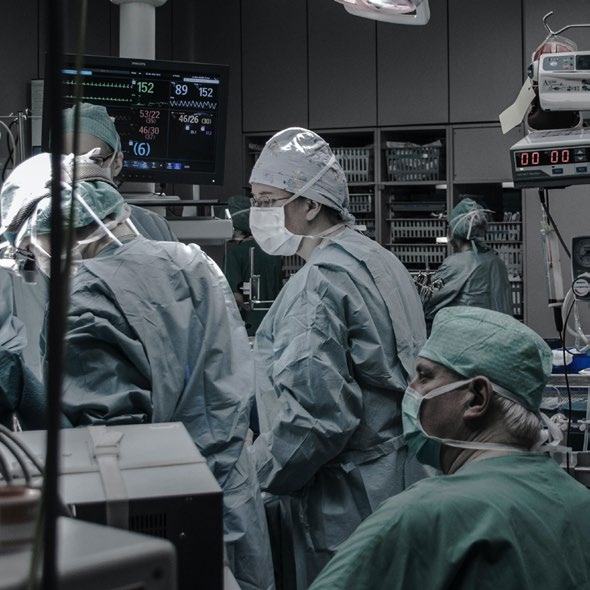
Scenario: Robot assisting doctor in medical operation
- Question around who is in charge of the procedure, doctor or robot?
- Could help to reduce fatigue by providing support to doctors - offer doctors respite when NHS staff are stretched.
- The robot could help to to reduce human error in the operation by supporting the doctor's judgements.
- Saves money for the NHS.
The reactions of participants to the various scenarios show that there is broad approval of the use of technology when it supports public service or the work of humans. For example, when machine learning is used to complement other sources of evidence to make decisions about the allocation of funding to schools, or when robots assist and support the work of doctors, with humans playing a leading role in the scenarios.
Moreover, not all technologies were discounted because of safety and privacy concerns. In particular, 3D printing was favoured in the qualitative discussions as it was felt that this technology could help to facilitate community production and ownership of resources and goods. In this sense, views on 3D printing differed from those on other technologies, which were felt to benefit relatively small numbers of people in society and exacerbate existing socio-demographic inequalities.
Furthermore, there was discussion concerning how the internet more generally had improved the accessibility of information: 'we have so much more knowledge now at our fingertips'.
Personal testimony was shared in relation to the benefits of new technologies in healthcare. One participant in Edinburgh wore healthcare kit containing sensors which alert social care/healthcare providers if he fell or if his blood pressure increased/decreased at an accelerated pace. The participant described how the technology helped him maintain his personal independence while assuring him that help was there when he needed it. This personal testimony was particularly effective in building trust and positivity about new technologies within the Edinburgh group.
Similar examples were cited in the other discussion groups, with specific mention of how bionic limbs support individuals to get their life back (e.g. 'my husband has a bionic limb that has changed his life, it is a piece of metal but now he can get out and about as normal') and how technology is used to find preventative cures for illnesses and to improve overall population health.
Through discussion and learning on the issue of new technologies, there was a subtle shift in opinion in the groups towards a more optimistic view of technology's impact on society.
'I am more positive than ever! Scotland is a great country to be in, and it has so much potential. Therefore, if universities and companies pull together and create real jobs, then we're sorted.'
The linchpin in terms of overall positivity is that there are shared benefits for individuals and communities both in terms of employment opportunities and access to public services.
In particular, there was a view that the benefits of new technologies that are already being used - such as AI and 3D printing - should be better communicated and publicised among the public. Furthermore, there was an acceptance that new technology encompasses all aspects of society, for people young and old. Therefore, individuals should embrace rather than reject these technologies so that their concerns and views can be incorporated within the development of the 4IR.
This shift in opinion is demonstrated by higher levels of agreement across a range of attitudinal statements concerning 4IR technologies compared to the results obtained in the national survey. It should be noted that a high number of respondents to the national survey participated in the focus group discussions, so these results indicate a shift in opinion through increased knowledge and discussion of new technologies among a broadly similar sample pool.
|
Agree % |
Neither agree nor disagree % |
Disagree % |
Don't know % |
Base (N) |
| National survey |
41 |
27 |
12 |
20 |
1,034 |
| Focus group discussions (post-discussion poll) |
93 |
4 |
2 |
0 |
47 |
Table 1.1. New technologies will have a positive impact on the Scottish economy
Another noticeable observation is the lower numbers of 'don't know' responses at the close of discussions.
|
Agree % |
Neither agree nor disagree % |
Disagree % |
Don't know % |
Base (N) |
| National survey |
43 |
26 |
13 |
18 |
1,034 |
| Focus group discussions (post-discussion poll) |
89 |
7 |
4 |
0 |
47 |
Table 1.2. New technologies will help those who run public services in Scotland
|
Agree % |
Neither agree nor disagree % |
Disagree % |
Don't know % |
Base (N) |
| National survey |
45 |
26 |
12 |
17 |
1,034 |
| Focus group discussions (post-discussion poll) |
76 |
13 |
9 |
2 |
47 |
Table 1.3 New technologies will be more positive than negative for the future of Scotland
|
Agree % |
Neither agree nor disagree % |
Disagree % |
Don't know % |
Base (N) |
| National survey |
39 |
29 |
15 |
18 |
1,034 |
| Focus group discussions (post-discussion poll) |
59 |
33 |
9 |
0 |
47 |
Table 1.3 New technologies will improve the quality of life for all those in Scotland
The above results - related to improving the quality of life for all those in Scotland - show a modest direction of travel compared to the other attitudinal statements. This is in part explained by the consensus view that new technologies remain in an 'elitist realm'. While the majority of participants recognised the benefits of new technologies, they could not always envisage how these would affect their own lives, and were not entirely convinced that the benefits would be equally distributed among all segments of society.
'Access for everyone is too aspirational and won't happen.'
Another point of variation in the results is that, compared with the other discussion groups, the group in Peebles remained sceptical about new technologies at the close of the discussion. The discussion group in Peebles focused on the future of work. This variation in attitudes can be explained by regional inequalities in terms of employment opportunities and economic growth. Compared to participants at the discussion groups in other locations, those in Peebles felt that the job creation or economic growth stemming from new technologies would not be geographically spread; after all, previous growth opportunities in Scotland had not always been distributed to the South of Scotland.
It is only recently that the issue of regional economic development has been addressed through the development of regional economic partnerships such as South of Scotland Enterprise. Therefore, there is still more work to do to build public confidence in growth opportunities - when it comes to both technology and other sectors - in different regions of Scotland.
Similar results were observed in Elgin where there was concern expressed regarding the distribution of benefits from new technologies. As this group was convened during lockdown, there was a view that the pandemic could be used as a catalyst for change to harness the direction and use of new technologies so that they could be used for public benefit.
'There are enough resources in the world, but we need more redistribution - the not-for-profit sector should be influencing the development and use of new technologies in the future.'
2. Impact of COVID-19 on the adoption and use of technologies
Headline findings
In Elgin, the discussion group was convened during lockdown. Participants had increased their adoption of new technologies to study, work and stay in touch with friends and family. While there was increased use of new technologies during this time, there was also scepticism that technologies would replace conventional ways of studying, working and socialising after the easing of lockdown restrictions. Participants placed a premium on human contact, which is perhaps unsurprising given the social distancing requirements in place during this period.
Detailed findings
The discussion group in Elgin was convened during the lockdown and, therefore, the impact of COVID-19 on the use of new technologies was explored.
Participants reported that lockdown had increased their use of technology, particularly to stay in touch with friends and family: 'I am using Zoom now but had never heard of it before lockdown.' Others described using social media applications such as WhatsApp and Facebook Messenger to stay connected with family. One participant mentioned that as these applications enable you to see the person you are speaking with, they helped to check in on each other's mental health.
There was discussion of online learning tools for school and exercise classes, as well as participants accessing healthcare services and ordering meals online.
'My initial GP consultation was online. This helped me to avoid going to hospital or a GP waiting room which is the last place you want to be during a pandemic.'
However, participants expressed the view that the increase in 'contactless' or 'faceless' services during the pandemic meant limited valuable human interaction with service providers.
'That 20 minutes of chat when you get "meals on wheels" delivery is crucial but now they just drop it outside with a contactless delivery.'
This view was felt to be relevant not only to services, but also to social contact with friends and family.
'Social engagement is important, it's in the genes. FaceTime and Zoom with family is not the same as giving someone a hug.'
There was concern expressed among the group that as businesses have successfully employed a model of online working – through online shops for goods or services and office work being undertaken at home - these practices would continue after the relaxation of social distancing measures. Similarly, it was felt that universities and colleges would also continue to provide online learning classrooms as this will be a more cost-effective model. Participants favoured a hybrid approach that does not entirely replace human interaction and face-to-face meetings.
'I am concerned that this becomes the “norm”. I don't want this to curtail people going to work or university.'
'Online learning is good in rural areas, but we need to have connection and human contact, we cannot just have people on screens.'
Another theme during the discussion was rising inequality, which was seen to be compounded by the coronavirus pandemic. The group talked about the paradox of the importance of key and essential workers, and how little these workers are valued in monetary terms. There was a feeling that new technologies may further compound inequalities as 'new technologies are helping someone else along the lines, but not the essential workers that are propping up our society'. Participants also expressed the view that new technologies should be redirected to help essential workers rather than preserve the status quo and market interests.
The group felt that the pandemic had prompted discussion around what is essential in life and therefore rendered many issues concerning new and futuristic technologies inconsequential by comparison. While participants accepted that new technologies were featuring more prominently in their lives during lockdown, this did not necessarily result in more favourable attitudes as they felt that tech would continue to replace essential human contact beyond lockdown. Of course, lockdown is an artificial experience in which any human contact outside of the immediate household is restricted. Therefore, it is perhaps unsurprising that participants placed a premium on human contact during this time.
3. Technology for public good
Headline findings
Over half (57 per cent) of respondents agreed that new technologies will support smarter public services. A similar proportion (56 per cent) agreed that new technologies will have a positive impact on public services, overall. Fifty-five per cent agreed that lots of people who work in the public sector will lose their jobs to new technologies.
Therefore, while there was an appreciation that new technologies can support public services, particularly in ensuring they are more targeted and efficient, participants recognised that this needed to be weighed up against potential job losses in public sector employment and social isolation caused by the decreased human contact in the delivery of services.
Furthermore, there was a view that there is already a 'postcode lottery' in relation to services, and that new technologies may exacerbate unequal provision of services in different areas.
Overall, it was felt that the advantages would outweigh the risks if there was a demonstrable public benefit from the use of new technologies. There was broad support for new technologies complementing and supporting the work of trusted public institutions such as the health service.
Detailed findings
A key topic from the research was the use of new technology for public good. This was related to both the delivery of public services as there was broad agreement that new technologies will impact how public services are delivered in Scotland in the next 10 years and to how new technologies will affect individuals and communities more generally.
Figure 3.1. Public good key messages identified by participants at a group discussion
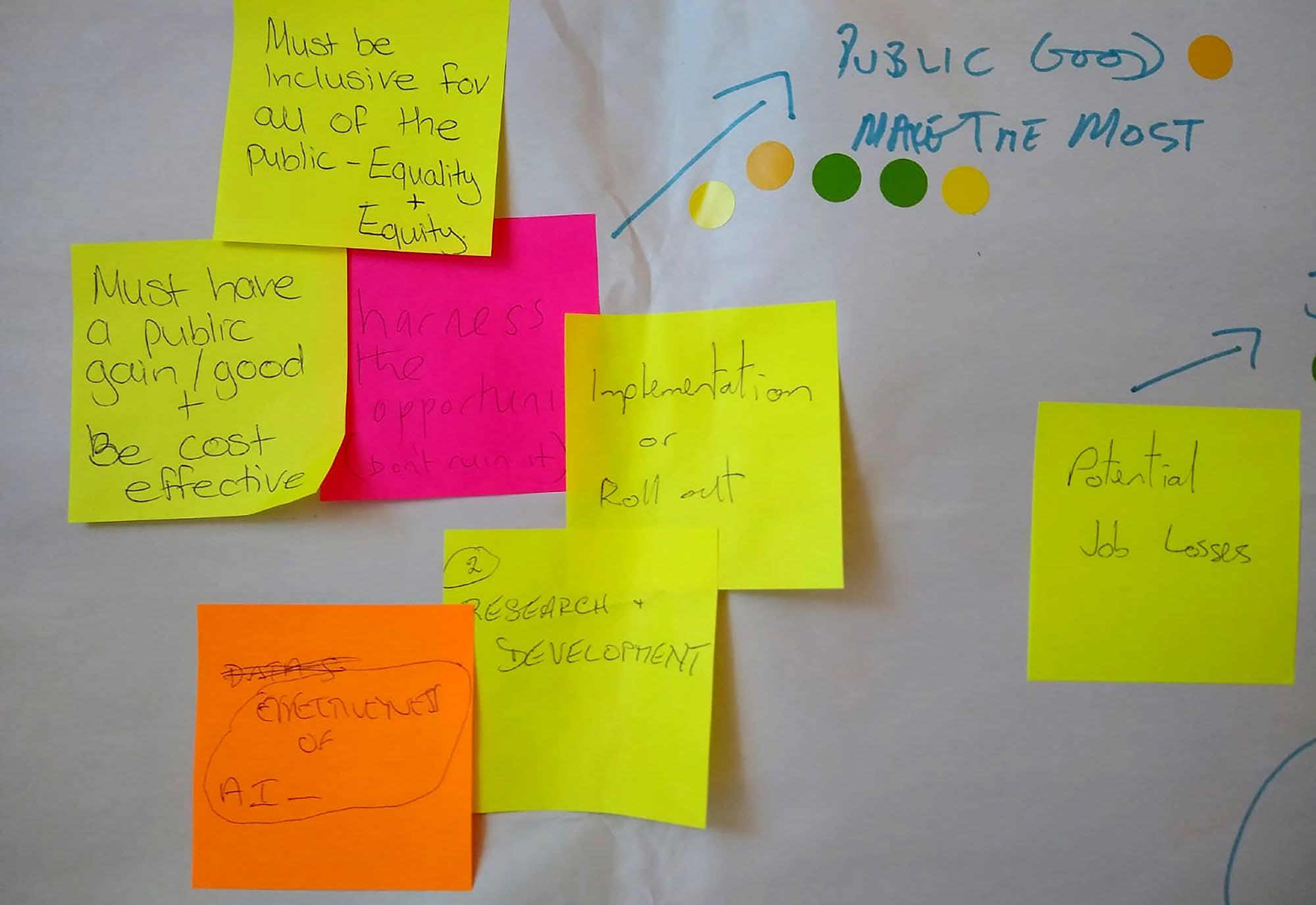
Over half (57 per cent) of respondents agreed that new technologies will support smarter public services. A similar proportion (56 per cent) agreed that new technologies will have a positive impact on public services, overall.
However, there were more mixed results in terms of whether delivering public services through the use of new technologies will lead to cost savings - with 38 per cent in agreement with this statement, compared to 26 per cent who disagreed. Furthermore, there was concern regarding potential job losses arising from the use of new technologies to deliver public services - 55 per cent agreed that lots of people who work in the public sector will lose their job to new technologies.
Figure 3.2. Attitudes to new technologies and public services
The chart shows survey responses regarding attitudes to new technologies and public services.
| Statement |
Agree % |
Neither agree nor disagree % |
Disagree % |
Don't know % |
| New technologies will support smarter public services |
57% |
20% |
14% |
9% |
| New technologies will broadly have a positive impact on public services |
56% |
21% |
14% |
9% |
| Lots of people who currently work to deliver public services will lose their jobs to new technologies |
55% |
18% |
18% |
9% |
| New technologies will reduce the cost of delivering public services |
38% |
22% |
26% |
14% |
| New technologies will make no difference to how public services are delivered in Scotland in the next 10 years |
19% |
16% |
55% |
9% |
Base: All respondents to the national survey (1,034)
These mixed results were reinforced by a range of views regarding the potential improvements new technology could make to different contexts of public service delivery. The table below illustrates results, where 0 signals no anticipated improvement and 10 signals a significant improvement to services.
|
Mean score (N) |
| Getting an appointment with a GP more quickly |
5.70 |
| Receiving a more personalised health check-up |
5.72 |
| Helping children learn at school |
6.84 |
| Helping the police tackle crime |
6.90 |
| Helping improve hospital waiting times |
5.85 |
| Helping students in further and higher education have the right skills for work in the future |
6.69 |
| Helping local councils improve key services like waste collection, recycling and local transport |
6.06 |
Table 3.1. Anticipated improvements to public services by new technologies
Mean scores across the range of scenarios are at the mid-point on the 0 to 10 improvement scale. Significant improvements are expected to be made in terms of new technologies helping the police tackle crime, which is in part related to the expansion of CCTV and GPS tracking, which has supported the work of the police. There were, however, concerns raised regarding facial recognition used in criminal justice settings and the potential for bias and distortion of video recordings.
Furthermore, there were higher levels of expected improvements to be made in education, both in terms of helping children learn at school and providing children with the right skills for the future of work. Education is an area where there has been an early adoption of online methods for teaching and learning. Therefore, it is perhaps unsurprising that there is agreement that this is an area where significant gains can be made through new technologies.
As a baseline from the survey data, therefore, it is evident that there is support for new technologies to deliver public services. There was a view that we must 'harness the opportunities presented by new technologies' – particularly in sectors where improvements can already be seen such as education, healthcare and tackling crime.
It was felt that there are opportunities for new technologies to provide services in rural areas, particularly the Highlands and Islands where the population is sparse and geographically dispersed.
To unpack attitudes in more depth among the same cohort of respondents, and explore a variety of trade-offs in relation to the role of new technologies in public service delivery, we undertook a scenario-based exercise within the discussion groups. The exercise was preceded by a presentation and discussion on the subject and offered tangible examples in which new technologies could be used to deliver public services, such as: AR being used in town planning and infrastructure development; the IoT being used in homes to monitor the needs of those who require social care and help support the needs of an ageing population; and AI to support teachers with mass marking.
While there was an appreciation that new technologies can support public services, particularly in ensuring they are more targeted and efficient, participants recognised that this needed to be weighed up against potential job losses in public sector employment and social isolation caused by decreased human contact.
Furthermore, one of the views expressed was that there is already a 'postcode lottery' where services are concerned, and that new technologies may exacerbate unequal provision of these services in different areas. The perspective that new technologies may help to equalise service provision – particularly in rural areas – was not spontaneously considered within the discussions that took place in urban areas. However, there was an appreciation of this within the group convened in Elgin. Data from the scenarios are shown overleaf - these are taken from small group discussions on public services that took place in Edinburgh and Glasgow.
Scenario 1: Google using anonymised patient data from the NHS to analyse and identify risk factors for disease
Benefits
- Broadly supportive if there are benefits to public, patients and NHS staff.
- Recognise the expertise that Google and private sector companies can offer to public sector.
- Value for money, may result in efficiency savings.
- Anonymised data protects the individual's privacy and data.
Risks
- What is the reason behind this, is there a 'hidden agenda'?
- Concerns around private sector interests superseding public interest.
- Taxpayer money going to private companies for profit.
- How does the anonymised data support better patient care?
Standpoint
- Would like to be able to give consent before this is done - not in small print but active consent.
- Support if benefits public interest, and the work/expertise cannot be derived from public sector.
In relation to this scenario, there was also discussion concerning how much the NHS already collaborates with the private sector, and therefore the scenario does not signal a sea change in how the institution operates already.
Scenario 2: Postal services replaced by AI and robotics, including sorting mail, helping customers to track missing parcels and delivering mail
Benefits
- Might offer reliable service and better/more accurate tracking of parcels in terms of time of arrival.
- Will be cost-effective and efficient once it is up and running.
- Opportunity to retrain the postman to undertake other forms of employment/work in Post Office.
Risks
- House numbers, street numbers, places are inconsistent and can result in errors in the mail sorting process.
- Loss of human contact as postman is sometimes the only person you interact with – would rather speak to someone directly.
- No track record to ensure reliability.
Standpoint
- Could be beneficial if this is trialled and there was evidence that it was more cost-effective but offered a better service to households.
- Need a commitment to retrain staff at Post Office who currently work in this area and have jobs that they can do instead.
Scenario 3: Social care services replaced by sensors, monitors and devices in-home/worn by the person
Benefits
- Helps to provide a 24-hour service, monitors safety at all times and good for emergencies.
- Removes staff from potentially dangerous circumstances whereby they may suffer abuse.
- Benefits the most vulnerable people including disabled, elderly, those with neurological conditions - could also be used to encourage nutrition and movement.
Risks
- Lack of physical touch/human contact and can result in social isolation for vulnerable groups.
- What will be the wait time when someone is called for help from outside?
- Have to encourage people to wear monitor at all times - only works if they wear them.
- What about privacy, what other information is the monitor/sensor collecting?
Standpoint
- On balance, more risks than benefits identified for this scenario.
- The loss of human contact was felt strongly as well as the time taken to provide face-to-face support when issues arise.
Scenario 4: Text- and voice-based chatbot services used by councils to handle customer queries out of hours
Benefits
- Providing service out of hours works for those who are working: can call in their own time.
- Highlands and Islands would definitely benefit more from this as it makes things more accessible.
- Less staff required and therefore cost savings.
Risks
- Would be difficult for older people or vulnerable people.
- Preference to speak to someone over the phone.
- Queries are often more complex and assume that chatbot would have limited repertoire.
Standpoint
- On balance, supportive of this, but with the proviso that more complex cases are followed up with a phone call.
With the exception of some reservations on the use of sensors and monitors to provide support in a social care context, there was broad support for the use of new technologies within the scenarios discussed. The main concerns around the social care example were related to privacy and how much data the sensor/monitor would collect – particularly if worn at all times - and the time it would take for help to be provided if urgent assistance were needed. This is in line with privacy being a more general area of public concern with new technologies.
For the remaining scenarios, it was felt that the benefits would outweigh the risks if there were a demonstrable public benefit from the use of new technologies – though not just in terms of cost savings, as this needs to be balanced against potential job losses. Participants thought that simple cases could be managed by new technologies, with provision for more complex queries and case handling to be dealt with by a human.
Moreover, there is established trust in institutions such as the NHS, and therefore there was a view that new technologies complementing and supporting the work of trusted public institutions such as the health service would have the public's backing.
'We fear that all the power lies with private companies like Amazon and Google; there should be more control among the public sectors.'
Moreover, it was felt that through public service buy-in, there would be increased equity in terms of accessing the benefits of new technologies instead of them being reserved to those who can purchase them privately. These perspectives allude to the tensions between public and private sector collaboration to support the adoption of new technologies.
'Those with physical disabilities can become more independent with new tech, however, can people on PIP [Personal Independence Payments] afford to make these modifications in their homes?'
There was a positive direction of travel in overall views regarding the impact of new technologies on the delivery of public services at the close of discussions: most participants agreed that there would be a broadly positive impact.
Figure 3.3. Views on whether new technologies will have a broadly positive impact on public services
This pie chart illustrates views on whether new technologies will have a broadly positive impact on public services.
- Agree: 17
- Neither agree nor disagree: 2
- Disagree: 2
Base: All those who participated in the public service discussion group (21)
Expert response
Gillian Docherty OBE, Chief Executive Officer of The Data Lab
Nesta's work in exploring and understanding public attitudes in Scotland to the technologies of the 4IR should play a key part in how we approach the opportunities and manage the potential negative societal impacts it could bring. As the report suggests, the potential for our economy and society is significant, from the enablement of new technologies to their adoption across our commercial and public sector landscapes. However, as we implement and adopt these technologies, we must do so with a broad spectrum of views and contributions from our citizens and society.
At The Data Lab, we see opportunity every day for data-driven innovation, one of the key elements of the 4IR. Realising these opportunities across all sectors is not easy to do quickly but I believe these technologies could be implemented in Scotland to drive significant economic and social benefit. I was particularly encouraged to see the broad agreement following the focus group discussions on the potential benefits for Scotland which highlights the importance of having an informed and open dialogue across the country.
The importance of learning and skills is also drawn out in this report and is one of the fundamental ways we can deliver innovation more broadly. It is important to consider the risk that 4IR technologies will widen inequalities if implemented in the wrong ways. Reskilling and upskilling our workforce will help us take advantage of opportunity. And the importance of investing in our children becomes even more important to enable them to thrive in a world where 4IR technologies are embedded in our everyday lives.
I would love to see Scotland become one of the most data-literate countries in the world and to do that we need to empower our citizens and build accessibility and awareness through our entire systems. The onus is on all of us who work in technology areas of the 4IR to communicate broadly and effectively on the work we do and the impact it is having and could have in the future.
I am excited about this opportunity for Scotland, but it is critical we act to shape a future which helps every citizen, rather than have a different future imposed on us by inaction.
4. The future of work: Technology that enhances and supports the work of humans
Headline findings
Three-quarters (76 per cent) agreed that lots of workers will lose skills as a result of automation, and a similar proportion (75 per cent) agreed that there will be more jobs lost than gained as a result of automation over the next 15 years.
The vast majority (89 per cent) agreed that businesses should have to inform their workforce if jobs are at risk of automation.
A third (32 per cent) of those who are in employment and expect to be in the next 15 years, were 'very' or 'fairly concerned' that they would personally lose their job to automation in the next 15 years. In contrast, 51 per cent reported that it will be 'very difficult' or 'fairly difficult' to find another job as good as their current one.
These discussions are significant during the coronavirus pandemic, which has caused an increase in unemployment rates globally. This prompted discussion of an increased need for the protection of workers' rights through workers' unions, a rethinking of the skills system in Scotland to meet future demand for jobs in the tech sector and consideration of alternative social systems including a citizens basic income.
Overall, there was a recognition that new technologies will transform the future of work. However, there was a desire for technologies to enhance and support the work of humans rather than replace them. It was felt that there should be a preservation of the empathetic and human aspects of work and that only the mundane, repetitive and potentially dangerous work should be allocated to new technologies to create a new division of labour.
Detailed findings
A key area of concern, for respondents both in the national survey and the discussion groups, was the future of work and the potential loss of jobs that could result from the adoption of new technologies. In particular, it was feared that new technologies would replace humans in the workplace as opposed to new technologies supporting the work of humans in roles that were dull, dirty, dangerous, demanding, distant and distributed.
This view was reinforced by the framing of the emergence and adoption of new technologies as the 'Fourth Industrial Revolution'. This language resonates in the mind of participants with the historical job losses and disruption that resulted from previous industrial revolutions.
'The loss of the old industries left so many people without a job, and demoralised communities... I had a role in employing people after the decline of the mining industries and there were 50 people up for one job vacancy. How do you bring a community up from that?'
'You will get a permanent underclass by leaving people behind to new technologies.'
There was a perception that during previous industrial revolutions, or other similar disruptive changes, little effort had been made to rebuild communities and offer alternative employment opportunities, such as within the former mining or shipbuilding communities in Fife and Glasgow.
Figure 4.1. 'Job losses' key message identified by participants at discussion groups
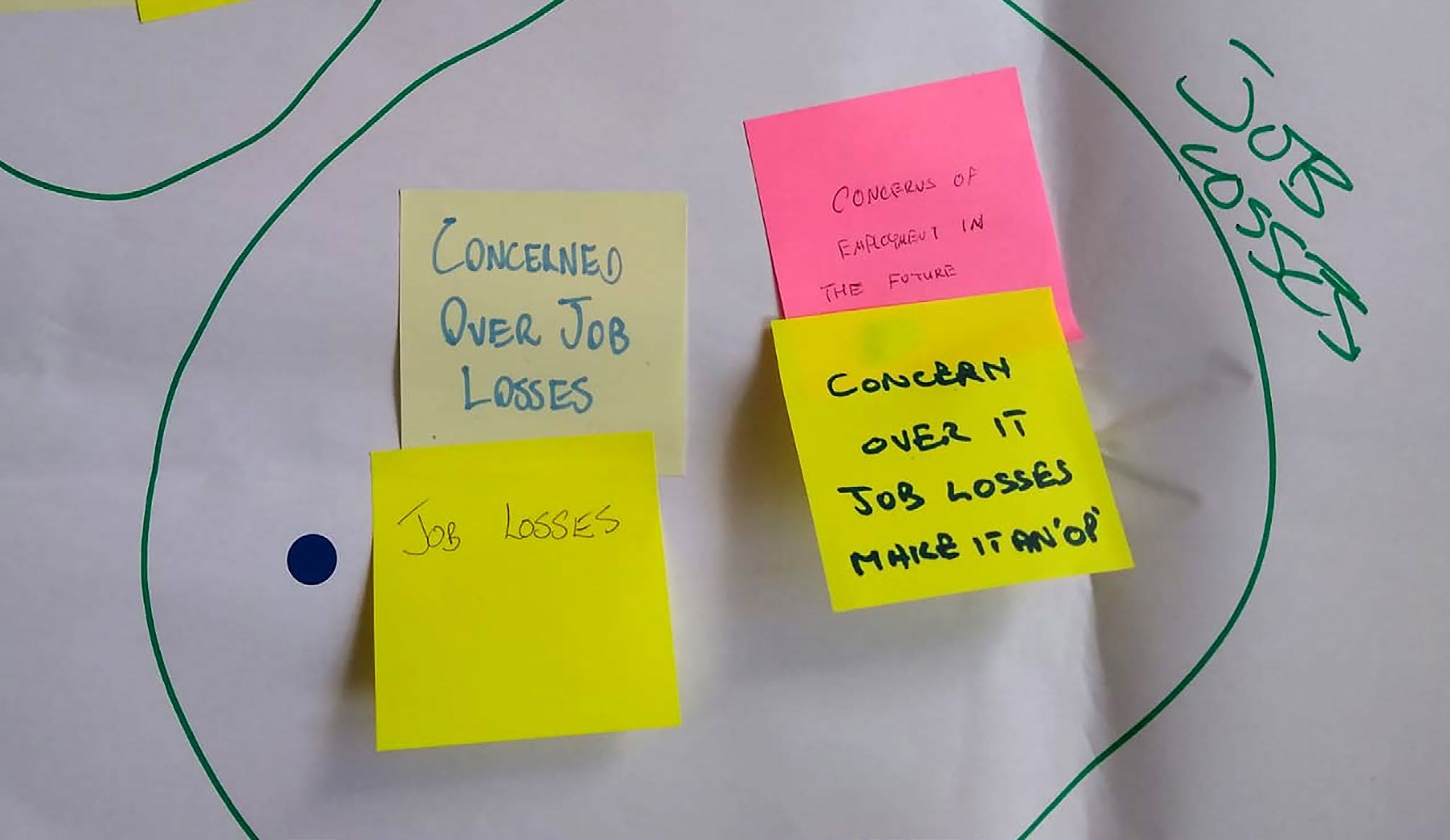
Furthermore, it was argued that when new technologies were first introduced, they were conceived to reduce the work undertaken by humans, but that in the last 50 years leisure time has not increased and working hours have not decreased. Therefore the benefits to society have not already been felt, resulting in scepticism regarding the purported benefits of the 4IR.
The results of the national survey echo these findings. Importantly, three-quarters (76 per cent) of respondents agreed that many workers will lose skills as a result of automation, and a similar proportion (75 per cent) agreed that there will be more jobs lost than gained as a result of automation over the next 15 years.
What is perhaps most interesting from the results is that the vast majority (89 per cent) agreed that businesses should have to inform their workforce if jobs are at risk of automation. This point of view was reinforced in the discussion groups, as there was a view that while traditional forms of employment are being replaced by jobs in the gig economy, there should still be a moral and contractual obligation to employees to keep them abreast of automation plans and how this might affect them.
Considering the foregoing discussion, it is perhaps unsurprising that only half (51 per cent) of respondents agreed that businesses should continue to develop and use AI and robotics to automate repetitive work tasks. This may reflect the broad balanced view of the public on new technologies, as people are anxious about the possible impact on, for example, employment, while acknowledging their potential benefits.
Figure 4.2. Views on new technologies affecting the future of work
A stacked bar chart showing agreement levels on new technologies affecting the future of work, based on 1,034 respondents.
- Businesses should be obliged to inform their workforce if jobs are at risk from automation:
- Agree: 89%
- Neither agree nor disagree: 5%
- Disagree: 2%
- Don't know: 4%
- Lots of workers will lose skills as a result of automation:
- Agree: 76%
- Neither agree nor disagree: 10%
- Disagree: 9%
- Don't know: 5%
- There will be more jobs lost than gained as a result of automation over the next 15 years:
- Agree: 75%
- Neither agree nor disagree: 10%
- Disagree: 7%
- Don't know: 7%
- Business should continue developing and using AI and robotics to automate repetitive work tasks:
- Agree: 51%
- Neither agree nor disagree: 22%
- Disagree: 19%
- Don't know: 8%
Base: All respondents to the national survey (1,034)
There is variation in the data depending on social grade: C2DEs are more likely to express concern regarding potential job losses as a result of automation than ABC1s.
Table 4.1. Differences in attitudes by social grade
|
Overall % |
C2DE % |
ABC1% |
| Businesses should be obliged to inform their workforce if jobs are at risk from automation |
89 |
90 |
88 |
| Lots of workers will lose skills as a result of automation |
76 |
79 |
73 |
| There will be more jobs lost than gained as a result of automation over the next 15 years |
75 |
77 |
73 |
| Business should continue developing and using AI and robotics to automate repetitive work tasks |
51 |
40 |
61 |
When considering the wider labour market, there was evident concern expressed by a majority of respondents. However, few were concerned that technological change would personally affect them. A third (32 per cent) of those who are in employment and expect to be in the next 15 years were 'very' or 'fairly concerned' that they would personally lose their job to automation in the next 15 years, and there were no significant variations in the results.
Figure 4.3. Concern regarding the loss of employment to automation
A donut chart showing concern regarding job loss.
* Concerned: 32%
* Not concerned: 54%
* Don't know: 5%
Base: All those working (694)
These results are consistent with similar studies conducted internationally. For instance, a Gallup survey carried out in the United States in 2017 found that nearly three-quarters (73 per cent) of US adults believe AI will eliminate more jobs than it creates. However, the same survey found that less than a quarter (23 per cent) of people were 'worried' or 'very worried' automation would affect them personally.
This pattern of results could in part be explained by the mixed thoughts on the types of jobs that will be impacted by AI and automation, resulting in the opinion that these changes would not impact individuals personally.
However, the converse is true, when we consider the ease with which people expect to find another job which is at least as good as their current one, if their job is under threat of being lost to automation. Seventeen per cent report that it will be 'very easy' or 'fairly easy' to find another job as good as their current one: this figure decreases to 12 per cent among C2DEs. In contrast, 51 per cent report that it will be 'very difficult' or 'fairly difficult' to find another job as good as their current one: this figure decreases to 41 per cent among ABC1s.
Figure 4.4. Perceived ease with which a new job can be found, if current job is lost to automation
A donut chart showing the perceived ease of finding a new job if the current one is lost to automation, based on 694 respondents.
* Easy: 17%
* Difficult: 51%
* Don't know/n/a: 22% (This appears to be the remaining portion to make 100%, though it's displayed as a segment.)
Base: All those working (694)
There was concern about the impact of automation on large swathes of the population.
'What happens to the displaced people, it is always assumed that the market will take care of this, however I think we are splitting into two classes of people, highly educated who can contribute to robotics and automation and the low-skilled workers who can't pay their bills.'
A view was raised regarding the development of alternative systems to support individuals when there are drastic changes to the future of work.
'I am fascinated by the basic income trials in Sweden. We need a different type of society where working is not a necessity if all this automation kicks in.'
To unpack views in more depth, we undertook a scenario-based exercise to explore which facets of work may be affected by the adoption of new technologies and reviewed perspectives on each.
Participants were invited to consider how citizens' needs can be met when there are changes to their wages and the entitlements they receive through traditional forms of employment. This question was framed using the following scenario:
Scenario: Certain tasks performed by an office administrator have been automated (e.g. sorting and responding to emails), leading them to undertake more challenging work. Should they be entitled to a higher salary now their role and responsibilities have changed? How can/should they be supported?
The ensuing discussion was illuminating in many respects. There was a view that changes to the nature of work, including roles and responsibilities, should be agreed with employees - which is in line with the widespread agreement (89 per cent) that businesses should have to inform employees about changes/risk to their job as a result of automation.
Furthermore, there was support for employees to be 'unionised' and for support to be provided from sectoral unions to assist with discussions concerning wages and entitlements. Some felt that with drastic changes to the nature of work brought by the adoption of new and emerging technologies, union-type organisations are needed to represent and negotiate on behalf of employees.
Moreover, while it was recognised that employee interests need to be advocated when there are changes implemented within the workplace, respondents also felt this scenario may lead to increased job satisfaction and skills development as the office administrator takes on more challenging work. Therefore, there should be an evaluation of the work undertaken and this should inform changes to salary and entitlements.
These results are important when we consider the discourse around 'fair work' in Scotland. However, it is worth mentioning that levels of unionisation differ by sector. Moreover, compared to countries such as Belgium, Scotland has comparatively lower levels of organised collective bargaining.
A similar discussion took place when the issue of individualised work was considered, through the gig economy and expansion of online platforms to deliver goods and services. In addition, recent circumstances – such as the social distancing measures introduced to help mitigate the spread of COVID-19 – have brought about increased levels of homeworking, in part made possible through new technologies, which gives this issue increased significance.
Figure 4.5. Participant views regarding the protection of workers' rights at discussion groups
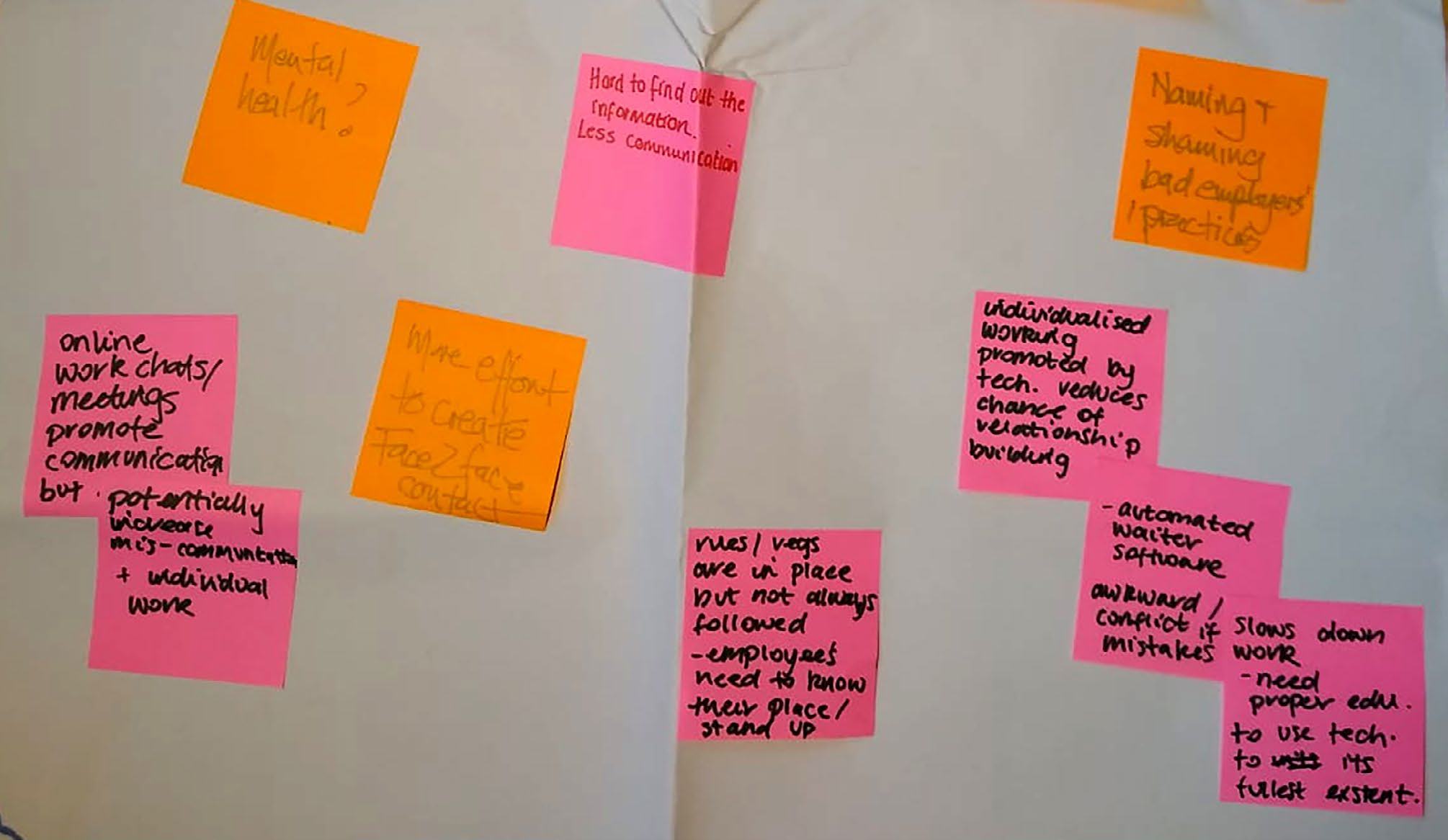
There were mixed views on this topic. In certain contexts, there was a view that employee rights could be compromised as there is less communication among the team and with employers as a result of individualised working. People would therefore not know where to obtain the necessary information to uphold their rights.
Furthermore, there was discussion concerning the impact of individualised working on mental health and the view that reduced social contact may lead to poorer mental health outcomes.
By contrast, there was an appreciation that the changing nature of work can help to improve quality of life and support those who have caring responsibilities and need to work flexible hours.
'Work-life balance is important and not everyone is the same, some people are more productive in different environments.'
This view was reinforced when it was considered that through changes to the future of work, there would be more free time for individuals to pursue their interests or specialised areas of work, as automation, robots and AI would undertake certain mundane, repetitive tasks instead of humans.
There was consensus that new technologies would inevitably transform the future of work, but that humans should develop and programme these technologies so that they support the work of humans as opposed to replacing them.
'When you have new technologies, you need more technicians who can programme the technology... I am excited about new technologies from being the only person in a factory who knew how to use a computer.'
Moreover, it was felt that there should be a preservation of the empathetic and human aspects of work and that only the mundane, repetitive and potentially dangerous work should be allocated to new technologies to create a new division of labour.
To enable this, it was felt that new technologies should be used to support the work of humans but not detract from the social skills that are unique to humans, and that more work needs to be done to protect and preserve these skills in the digital age.
It is worth considering the implications of this view, based on what we already know from the data. Men are more likely than women to know about and hold a favourable view of new technologies. As these attitudes play out in the job market, there is potential for a disproportionate level of emotional labour to be placed on women as they are over-represented in care-giving sectors, such as education, health and social care, where there is a desire to limit the role of new technologies and maintain human and social contact.
Research conducted by Skills Development Scotland found an under-representation of women within digital technology roles in Scotland, which is an important growth sector for the economy. This is related to the finding that women are less likely than men to study science, technology, engineering and mathematics (STEM) subjects in school and university, leading to a lower probability of pursuing a career in technology.
5. Continuous skills development
Headline findings
There was appetite for a national skills (re)training programme to equip citizens with the skills to use new technologies and take up employment opportunities that will arise as these technologies become more integrated in the workplace and wider society. It was felt that this skills training programme should not only be available to those in school or full-time education, but also to those already in work to support career transitions.
Detailed findings
There was broad support for continuous skills development to enable citizens to keep abreast of the latest technological innovations.
'The norm was that you do years of education which would set you up for a job for life... but now people are doing multiple, different jobs, so training and education needs to be changed to support that.'
In particular, participants thought that there should be more horizon scanning to identify 'what the jobs of the future will be'.
There was appetite for a national skills (re)training programme that is aligned with the outcomes of the horizon scanning, to equip citizens with the skills to use new technologies and take up employment opportunities that will arise as these technologies become more integrated in the workplace and wider society.
One of the aims of the national skills (re)training programme would be to support mid-career transitions, targeted particularly at those who risk losing their job to automation. Moreover, there was a view that this training should be provided to people in deprived communities to ensure the benefits of the 4IR are more equally distributed.
Participants thought that this form of training should be implemented at a national level and supported and funded by the Scottish Government, with training capacity spread across the regions of Scotland.
Figure 5.1. 'Skills development' key messages identified at discussion groups
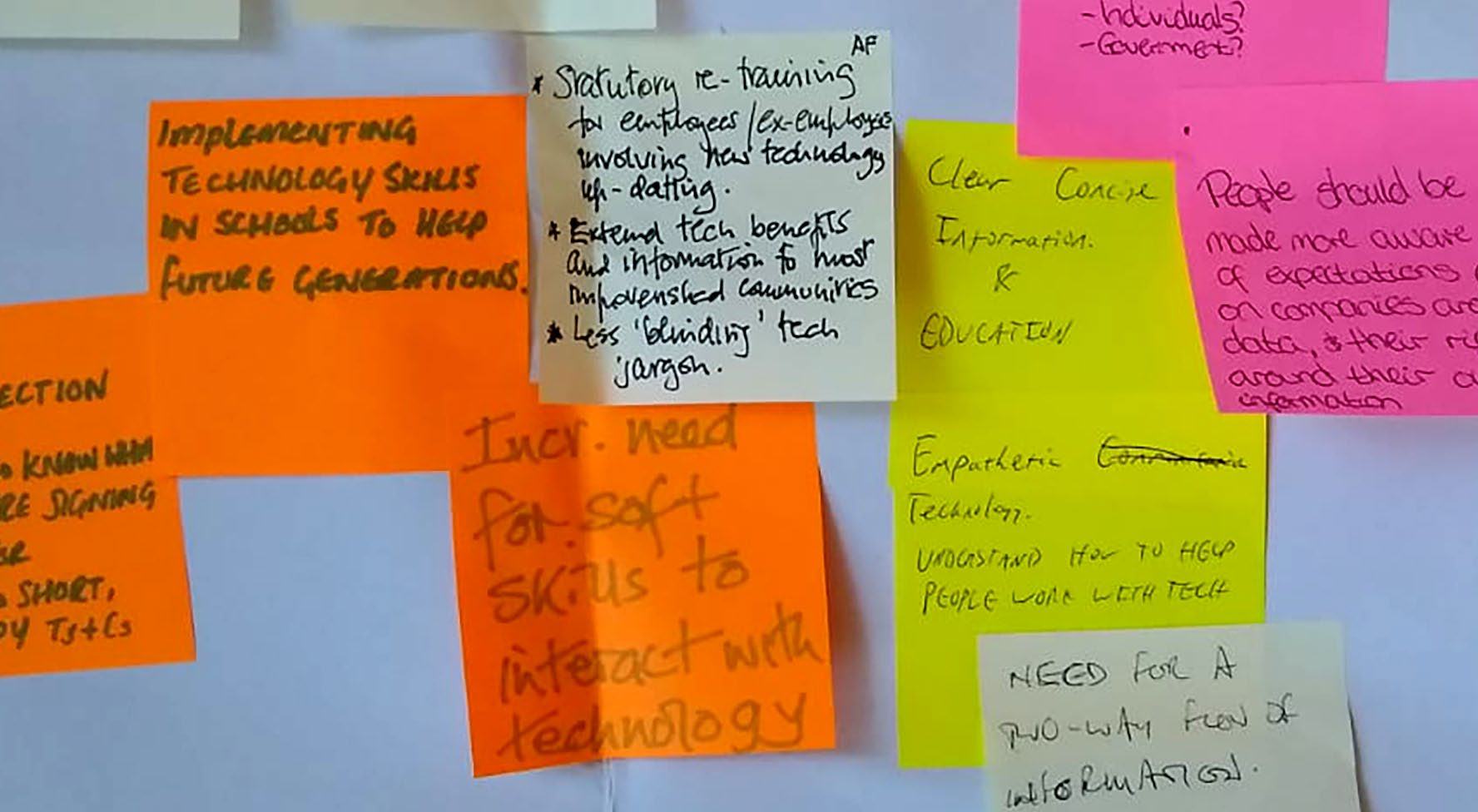
In addition to supporting those already in work, there was a view that the education system needs to support younger generations to learn the skills required to use new technologies so that they are equipped for future employment opportunities.
This view is aligned with the work undertaken by the Scottish National Skills Implementation Board which recognises that the education system needs to be better aligned with the future job market to enable improved use of skills in Scotland.
In this respect, there was optimism among participants regarding the future prospects for learning, skills development and job opportunities that may arise from the adoption of new technologies.
Aside from developing skills to understand and use new technologies, participants felt there should be continued development and nurture of soft skills that are essential parts of human contact to ensure that these are not reduced through our collective dependence on new technology.
'One concern is the loss of humanity; humans are social beings and thrive in communication and interaction.'
At the beginning of discussions, there was a view that new technologies have the potential to reduce social skills and attention spans. Therefore, more work is needed - especially within early years and primary and secondary education – to nurture these skills and ensure these are not lost for future generations.
Expert response

Dr Poonam Malik FRSB, Board Member of Skills Development Scotland, Scottish Enterprise and Firstport
'Robots are here to take our jobs!' This has been the worry in workplaces for some time. And, no doubt about it, the nature of work is changing remarkably. The COVID-19 crisis is only expediting the digital transition. For some, it has changed how we work, where we work and even what we work on overnight. The workplace will never be the same again. However, the worries highlighted in this report about digital technologies disrupting our lives and displacing humans in the workplace, while not surprising, are not fully substantiated.
Yes, technology has become an integral part of our lives. Yesterday, computers and technology were just another tool to help with tasks. Today, automation has taken over swathes of boring, repetitive tasks and a small device in the palm of our hand is capable of analysing vast amounts of data, making predictions and helping us make decisions. We can anticipate that in tomorrow's world machine learning and AI will have progressed sufficiently to make some of those decisions themselves. In a future where machines participate in the most sapient endeavour of decision-making, what is left for humans to do?
Today's technology learns through analysis of information already available – knowledge generated in the first instance by millennia of human creativity. What is not available to machines is the human power to envision, be creative beyond what is evident and imagine what does not exist. Nor are the emotions that we feel for others, which motivate the acts of kindness and collaboration that are the glue of our society.
It is this imaginative power and empathy that we must nurture. And, with bold, brave, positive, transparent, trusting and innovative leadership, we can reimagine and reinvent a vision for new types of work. Work that we do not yet know exists. As leaders, thinkers, policymakers, economic development and skills agencies and governments, we should nonetheless prepare for it so that we can benefit from the opportunities of the 4IR and not react adversely to it.
For societies not to suffer in the aftermath of the 4IR we must put effective collective, ethical and transformative measures in place.
We must shift our mindset from school-college-university directional learning to a 'growth mindset'. This means investing heavily in continuous skills development, lifelong learning models and reskilling of employees to take on different roles as new kinds of jobs evolve.
We must overhaul early years school education to make computers and technology an integral part of innovative education and skills expansion, rather than these being just one subject or a tool.
We must empower the underserved and disadvantaged populations by creating more and better opportunities to learn, train and have equal access to digital skills and technology usage to build a just, gender-balanced and inclusive society.
I have no doubt that with our collective human intelligence, and our learning and emotional skills, we will design imaginative businesses, marketplaces and models that will overcome many challenges posed by the 4IR as long as we are kinder to each other, work collaboratively and look after our planet.
6. Equality, accessibility and transparency
Headline findings
There was an overall perception that people's human rights might be compromised as a result of the adoption of new technologies (73 per cent). There was particular concern expressed about personal data, as participants reported that they are unaware of their digital footprint and how they might be able to retrieve data about them that is held by private companies or that can be accessed online. This view contributed to a sense of disempowerment among participants regarding their lack of knowledge about how their data is collected, shared and used. One example was their response to the contact tracing app proposed to support the public health response to COVID-19. While there was broad support for the app in terms of supporting the mitigation and preventing the spread of the virus, there was concern raised about how the app may continue to collect data about individuals post-Covid, and how the data might be used to target minority groups.
Overall, there was consensus that more legislation needs to be enacted to respond to new technologies before they come into place to safeguard privacy and human rights.
In addition to privacy concerns, there were considerations around equality and accessibility. It was felt that there is unequal access to new technologies at present as a consequence of poorer digital infrastructure in certain parts of Scotland, as well as lower digital literacy or unequal access to a computer among certain groups in the country. Participants expressed the view that more work should be done to support the distribution of benefits from new technologies to everyone in Scotland to avoid compounding issues of exclusion.
Detailed findings
There were rich discussions about the implications of adopting new technologies on our human rights. The starkest findings were observed in the national survey, where there was evident concern expressed by a majority of respondents regarding privacy and the handling of personal data.
There is little variation in views on big companies/governments collecting information about individuals without their knowledge: a large majority are 'very/fairly concerned' about companies (85 per cent) or governments (80 per cent) doing this. Moreover, there is an overall perception that people's human rights might be reduced as a result of adopting new technologies (73 per cent).
Figure 6.1. Attitudes to human rights issues arising as a result of new technologies
A stacked bar chart showing attitudes to human rights issues arising from new technologies, based on 1,034 respondents.
- Private information might be shared without my knowledge:
- Very/fairly concerned: 88%
- Not very/at all concerned: 10%
- Don't know: 2%
- People's human rights might be reduced:
- Very/fairly concerned: 73%
- Not very/at all concerned: 21%
- Don't know: 6%
- Big companies might collect data about me without my knowledge:
- Very/fairly concerned: 85%
- Not very/at all concerned: 13%
- Don't know: 2%
- The government might use information about me without my knowledge:
- Very/fairly concerned: 80%
- Not very/at all concerned: 18%
- Don't know: 2%
- More data and information is being shared without people being aware or able to prevent it:
- Very/fairly concerned: 87%
- Not very/at all concerned: 11%
- Don't know: 2%
Base: All respondents to the national survey (1,034)
These views were reinforced at the discussion groups, where participants – many of whom had also taken part in the survey – were 'not at all surprised' by the results.
'It's a massive concern. We don't know what's happening with our data and there's a lot of unanswered questions.'
'We are living in a Big Brother culture.'
'As there is a camera installed in the computers I feel a little uneasy... I could be watched at any moment and not realise.'
The main areas for concern were the lack of awareness regarding the use of personal data and how sharing personal data was often a prerequisite to accessing information online.
'We just accept cookies, and give our data away willy nilly.'
'Our personal data is a commodity.'
There was concern that since people are blasé about giving away their personal data, they are unaware of their digital footprint and how they might be able to retrieve data that is held by private companies or that can be accessed about them online. This view was compounded by the recognition that information can remain online indefinitely.
A significant point of contention was observed about the use of personal data for marketing purposes, as most participants were familiar with tailored and individualised adverts that they had received on their internet browser and found them 'scary'.
There was heightened concern about this issue due to interference in elections, as exhibited by the Cambridge Analytica scandal which involved harvesting personal data from Facebook for the purposes of political advertising. Participants were also aware of the proliferation of fake news through the internet, which has quickly become the main source of information for many individuals.
'There is too much disinformation and fake news – fast communications are destroying integrity with little peer review and fact-checking.'
These discussions contributed to a sense of disempowerment among participants regarding their lack of knowledge about how their data is collected, shared and used.
'It's quite technocratic, we need more information about our own rights!'
'We are getting tracked at every turn – how do I stop it? They make it purposefully difficult.'
Figure 6.2. Key messages on privacy identified at discussion groups
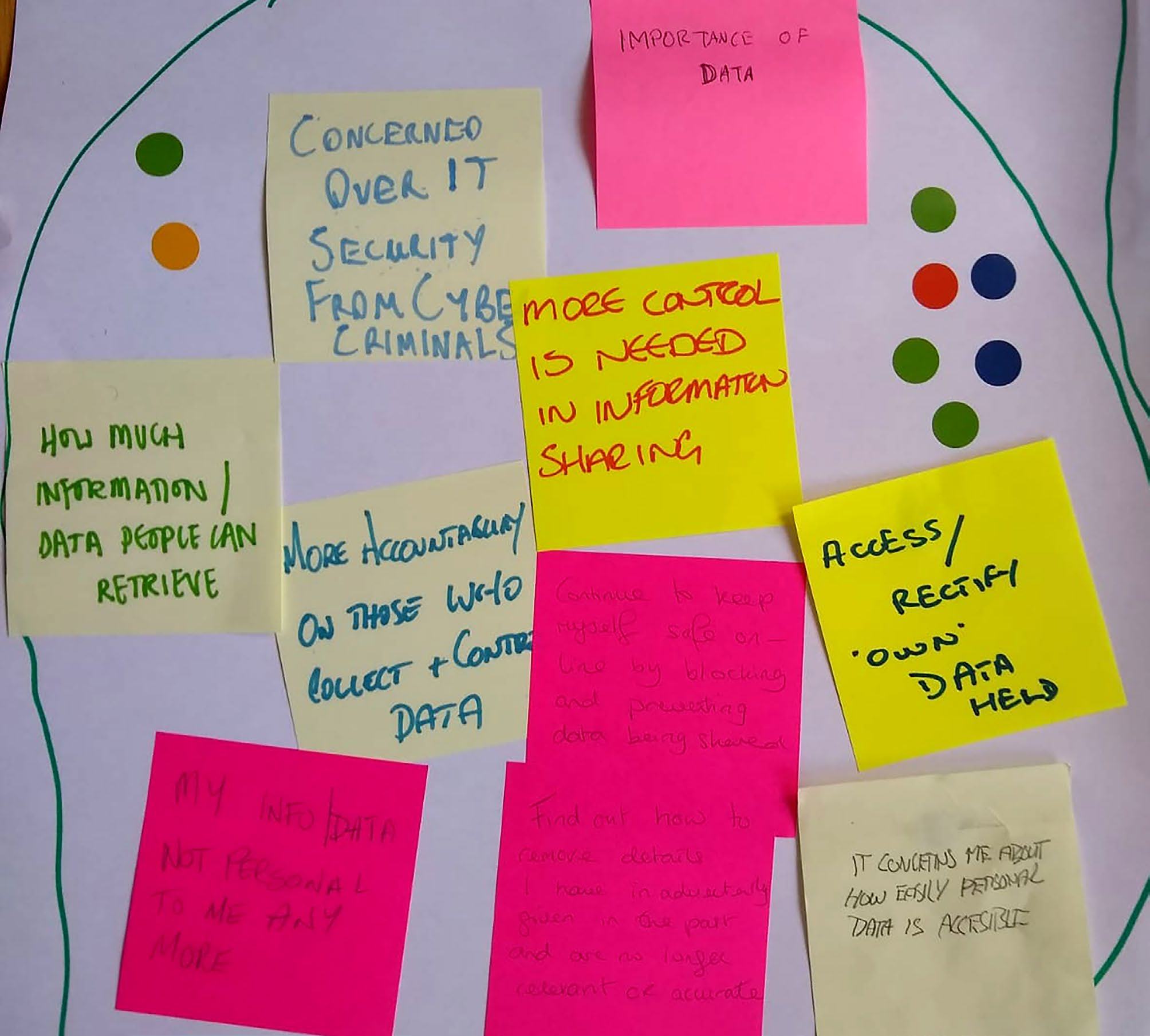
Participants expressed the view that banks are efficient at alerting you about important information, especially when it relates to, say, suspected fraud. These kinds of alerts should be extended to personal data so that people are more conscious of how they might be sharing their data. In particular, participants were keen that information about data be shared with them not as 'small print' but in a clear, unambiguous and accessible format. They felt that this was important to support them to make informed choices about their data. Making information more accessible, it was felt, would prompt behaviour change in terms of how people give away their data and would avoid the apathy that was previously described.
Participants expressed the opinion that if people were more aware of how their data is used, there might be circumstances in which data sharing is permissible. This was felt to be particularly relevant for the trade-off between the right to privacy and the objective of protecting national security.
'If there's some transparency about why governments want data, and to share data, then we might be more willing to participate.'
In relation to this, there was a view that there should be more transparency when the government is working with private companies and that additional consent should be given when information is transferred in this context. The foregoing illustrates that when participants consider issues such as new technology, there is a conflation of human rights in a broad sense with the right to privacy. These concerns remained with participants at the close of discussions, with high levels of concern cited across the range of privacy issues.
Figure 6.3. Concern regarding human rights issues at discussion groups
This horizontal bar chart shows the percentage of discussion group participants concerned about various human rights issues:
- Private information might be shared without my knowledge: 95%
- More data and information is being shared without people being aware or able to prevent it: 95%
- Big companies might collect data about me without my knowledge: 93%
- People's human rights might be reduced: 93%
- The government might use information about me without my knowledge: 91%
Base: All discussion group participants (47)
As the discussion group in Elgin was convened during the coronavirus lockdown, the issues of privacy and human rights were considered in the midst of issues arising from the pandemic. In particular, there was spontaneous discussion regarding the use of technologies to track and trace those displaying symptoms of the coronavirus, such as has been done in South Korea. Participants noted that similar approaches were being developed in the UK with the trial of an app for contact tracing purposes. While there was broad agreement that the app is useful in terms of the public health response to the virus, there was concern that the adoption of these technologies may lead to increased use beyond the scope of virus mitigation.
'Sometimes technologies are used for the worst possible things... like facial recognition used against the Uighurs in China.'
'If it's about saving lives then it's worthwhile, but once track and trace was over then if it automatically deletes itself then it would be more acceptable.'
In particular, participants observed that the contact tracing app may, like other applications, collect more data about individuals than what is required for the purposes of the public health response. Furthermore, they felt that such means of tracing individual behaviours could result in insidious targeting of minority groups. Recent data has shown that Black, Asian and minority ethnic people in England are 54 per cent more likely to be fined under coronavirus rules than their White counterparts.
'To what extent are minorities tracked in the UK? I don't trust government to collect personal data, I don't feel they have the right.'
It was suggested that trust in the app would depend on trust in the government designing and administering the technology.
Overall, there was consensus that more legislation needs to be enacted to respond to new technologies before they come into place to safeguard human rights. This prompted conversation around how legislation is 'reactive' to the development of new technologies and needs to keep pace with the 4IR. Participants expressed the view that people should have the right to know what data is held on them by companies and to amend or delete their personal data. Some of these rights may be protected by the General Data Protection Regulation – yet discussion concerning these issues highlights that citizens might not be aware of their rights as part of this regulation.
As well as considerations regarding transparency and accessibility, there was a broader theme in the research concerning equality, which is touched on throughout the report. In particular, it was felt that there is unequal access to new technologies at present as a consequence of poorer digital infrastructure in some parts of Scotland. Participants also cited issues such as lower digital literacy or unequal access to a computer among certain groups in Scotland, which has become apparent as services have moved online as part of the digital by default strategy.
'You can see all the havoc caused by universal credit, and the benefits system moving online.'
'There are significant socio-demographic differences, young people have grown up with technologies throughout their life, we are only being introduced to them now.'
Therefore, it was felt that the adoption of new technologies has the 'potential for exclusion' of already deprived and disadvantaged groups. There was a view that more work should be done to support the distribution of benefits from new technologies to everyone in Scotland. Furthermore, there should be more awareness-raising or education about new technologies for all segments of society to limit the possibility of leaving population groups behind in the 4IR.
There was also discussion regarding the global dimension of the manufacturing and production of new technologies. The issue of cobalt - used in lithium-ion batteries in mobile phones was raised in the discussion groups. The cobalt is extracted from hand-dug mines in the Democratic Republic of Congo. As field research undertaken by Siddharth Kara' has shown, this work is dangerous, life-threatening and involves child labour. Participants felt that if new technologies are going to encompass all aspects of human life, there should be more sustainable and ethical ways of manufacturing new technological products.
'There should be more responsible sourcing of products and parts.'
Expert response

Catherine Stihler OBE, Chief Executive Officer of the Open Knowledge Foundation
Technology and its impact on our day-to-day lives brings benefits and challenges.
The reflections and insights of those participating in this report shines a welcome light on the realities of this 4IR for many Scots.
The perception that technology remains elitist illustrates the importance of equity and inclusion, particularly through a gender and social status lens. It remains the case in Scotland that those who are most disadvantaged doubly lose out by not being able to afford to access new technology nor acquire the digital and literacy skills needed to pursue the new jobs created by this technology.
Scotland is already a world leader in video game production, and could be a world leader in coding, but those skills must be available to all.
The concerns around the future of work and the experience of deindustrialisation in Central Scotland - where many communities are still recovering are echoed by those in Southern and Northern Scotland. This challenge, combined with the economic fallout across Scotland from the COVID-19 pandemic, will require unprecedented intervention by the government in both the public and private sectors.
Several themes surface in this report which can help address the challenges around equity and inclusion. One theme is the importance of language and communication, especially at a time when we are facing an 'infodemic' of fake news and misinformation. Another theme is the human hand of care when technology is used in public service, such as a robot helping a doctor perform an operation or drones delivering medicines. The report shows that the more positive experiences people have of technology in improving the quality of their day-to-day lives, the more favourable they will feel towards 4IR interventions.
The growing use of algorithms in our public services and their lack of transparency and accountability, particularly as these decisions disproportionately affect the most disadvantaged in our communities, requires analysis and review.
The concerns around privacy and trust and the need for regulation is important to note from the report. Almost two-thirds reported that the Scottish Government should be responsible for regulating the impacts of new technology, whereas 57 per cent reported that the UK Government should be responsible. There was clear recognition of the importance of EU and UN interventions, but as concerns grow over the use of personal data, we may require a revisiting of where devolved power rests given that data is currently a non-devolved area.
There is also recognition of the limitations of technology. The need for human contact was neatly summed up during lockdown by one participant: 'FaceTime and Zoom with family is not the same as giving someone a hug.'
This report shines a light on the challenges for Scotland during the 4IR, illustrating the importance of communication, inclusion and trust. We are living through a changing world and for Scotland to succeed we cannot afford to leave anyone behind.
7. Regulation
Headline findings
There was agreement that given the pace of change, there is a need to be responsive to new technologies and develop regulatory frameworks accordingly. Almost two-thirds (65 per cent) reported that the Scottish Government should be responsible for regulating the impacts of new technology; whereas over half (57 per cent) reported that the UK Government should be responsible for regulation.
While there was consensus regarding the need for regulation, there were particular aspects of the impact of new technologies where it was felt there should be increased oversight. In particular, there should be more protection for workers' rights through collective action and workers' co-operatives to support interests in the labour market.
Detailed findings
The topic of regulation was spontaneously raised by participants at the discussion groups. In particular, there was agreement that given the pace of change, there is a need to be responsive to these developments and develop regulatory frameworks accordingly: 'technologies can really help humanity, but regulation is fundamental'.
Views differed regarding who should be responsible for regulating new technologies and their impact on individuals and society. Almost two-thirds (65 per cent) reported that the Scottish Government should be responsible for regulating the impacts of new technology; whereas over half (57 per cent) reported that the UK Government should be responsible for regulation.
Figure 7.1. Views on responsibility for regulation
This horizontal bar chart illustrates public opinion on who should be responsible for regulating new technologies:
- Scottish Government: 65%
- UK Government: 57%
- Civil society: 23%
- Businesses: 20%
Base: All respondents to the national survey (1,034)
In addition to this, there was the view that regulation should be overseen by multilateral organisations with a broader remit, to ensure that Scotland is aligned with international standards.
'Higher legislation such as the EU or UN to ensure equal standards globally.'
There were suggestions that a new independent body needs to be set up, akin to an ombudsman to regulate new technologies.
'There needs to be a special digital rights overseer scrutinising the development of new tech, with power to halt or amend practice.'
'An independent organisation with power.'
'A separate entity that has reps from business, third sector, education and government as the government needs to be audited and held responsible too.'
While there was consensus regarding the need for regulation, there were particular aspects of the impact of new technologies where it was felt that there should be increased oversight.
Discussions about regulation related to participants' concerns that jobs will be lost. In particular, there was a view that workers' rights need to be upheld and that regulation needs to adapt and change to the future of work so that it can respond to issues as they emerge. For instance, participants suggested that there should be fair redundancy packages for those who lose their jobs to automation, and support for individuals to find alternative employment. It was felt that there should also be 'naming and shaming of bad employers, who do not respect workers' rights', and regulatory powers to take action against such firms.
There was also the view that workers should take more collective action to uphold their rights, and in particular, that there should be workers' co-operatives to provide a forum for collective action, particularly in the face of increased individualised working.
There was agreement that regulation should extend to data privacy and cyber security, and that the Information Commissioner's Office should have oversight of this.
8. Call for increased citizen engagement
Headline findings
There was a strong willingness and appetite to engage in decision-making on the future adoption of new technologies in Scotland. Participants suggested an important first step to facilitate engagement would be to provide clearer information to individuals about new technologies and dispel misinformation concerning the 4IR. Once information is more readily available, it was felt that there should be forums, such as discussion groups or community meetings, in which citizens are encouraged to discuss and deliberate on the issues.
In addition to engagement, there was a view that there needs to be more community ownership of new technologies to ensure greater distribution of benefits from technologies among communities in Scotland.
Detailed findings
From the discussions, there was a strong sense that new technologies will increasingly affect individuals, society, the workplace and public services. Therefore, there was a collective view that citizens should be more engaged in the development of new technologies, so that they can help inform decision-makers and ensure their views are represented. Overall, this indicates an appetite among the public to engage with the issues.
'We need more direct democracy. If this is going to affect us, we need to embrace it and get involved in shaping the direction of it.'
It was felt that an important first step to facilitate this engagement would be to provide clearer information to individuals. In particular, it was felt that there is misinformation concerning new technologies and technical jargon that needs to be debunked for lay citizens: 'certified' and 'trustworthy' sources should be providing 'correct and factual information available to all'.
Participants recognised the importance of teaching younger generations 'critical thinking skills' so that they are not passive in the transmission of information and can challenge misinformation.
Moreover, it was noted that people engage with an issue in different ways, and that there should be variety in the provision of information regarding new technologies using social media, leaflets and advertisements to share information.
Once information is more readily available, it was felt that there should be forums, such as discussion groups or community meetings, in which citizens are encouraged to discuss and deliberate on the issues and share their views in a way which helps to inform decision-making.
'I think there should be a co-operative group of people with different backgrounds who can scrutinise tech companies.'
As well as increased information, participants saw the need for more community ownership of new technologies to ensure greater distribution of benefits resulting from these technologies. In particular, there was interest in the not-for-profit sector taking on a facilitating role in ensuring more citizen involvement and benefit from new technologies.
'We need more community ownership and distribution benefits of new technologies.'
'There needs to be empowerment from outside the tech sector, we need the not-for-profit sector influencing the development and use of new technologies.'
Arnstein Participation Ladder (1969)
This diagram illustrates different levels of citizen participation, structured as a ladder with 8 rungs from bottom to top, categorized into "Nonparticipation", "Tokenism", and "Citizen power":
- Nonparticipation:
- Rung 1: Manipulation
- Rung 2: Therapy
- Tokenism:
- Rung 3: Informing
- Rung 4: Consultation
- Rung 5: Placation
- Citizen power:
- Rung 6: Partnership
- Rung 7: Delegated power
- Rung 8: Citizen control
Source: Arnstein Participation Ladder (1969)
The form of engagement advocated by participants closely follows the process detailed in Arnstein's Participation Ladder (1969), which moves from an informing and consultation stage through to more active forms of engagement such as working in partnership.
Given how technocratic the topic of new technologies and the 4IR was felt to be, there was a sense that increased citizen engagement would be important to ensure better understanding of these technologies and involvement of citizens in their future direction and application. Moreover, this would ensure that benefits are more equally distributed and citizen interests are promoted.
The discussion groups conducted as part of this study, which included expert witnesses, are a positive test for providing information and a platform for citizens to discuss the implications of new technologies on individuals and society. The impacts of convening such discussions were observed in follow-ups which were conducted with two of the discussion group participants. Below we show participant journeys of engagement on the issue of new technologies.
Participant journey 1
'I didn't really know what to expect because I hadn't done a discussion on this topic. I wanted my voice to [be] heard when I felt appropriate.'
'There were certainly technologies which I had never heard of before, so I found this to [a] certain extent surprising, i.e. 3D printing. I feel Scotland is a country that will allow new things to happen and become a benefit to the economy in the next 5-8 years.'
'I really enjoyed attending; it was really good for me to hear the views of others as well as my own opinions. I look forward to [...] discussions hopefully in the future and the research that has been conducted overall.'
Participant journey 2
'I was extremely interested especially as I work for a company that lives in the stone age, with tons of paperwork, which will make it very difficult to work from [home] if we go into isolation, which meantime has happened.'
'I wrongly thought machine learning was humans learning from an automated teaching system, so I was quite surprised to find out it was just a machine learning upon its experience.'
'I am more positive than ever. Particularly with Covid, my conservative boss has organised us working from home, and even the GP can diagnose things over the phone or online.'
Appendix A: Methodology
The research study comprised two strands:
- A nationally representative survey of 1,034 Scottish adults (16+) conducted online to determine a baseline of public attitudes to the technologies of the 4IR.
- Five deliberative focus group discussions of which four were conducted face to face (lasting 3.5 hours in length) and one online (lasting 1.5 hours) across Scotland.
Given the complexity and scope of the subject matter, the research design enabled time and space for research participants to consider the respective issues and come to an informed view. This was important to facilitate meaningful engagement and dialogue on the broad concepts for discussion. This was in part made possible by the recruitment approach, as detailed later in this chapter. Importantly, many of those who took part in the survey also participated in the group discussions, enabling continuity and sustained learning and consideration of the issues.
We also divided the topics for discussion across the five focus groups, as shown in the figure below. This meant that meaningful consideration could be given to public services and the future of work in the respective discussions.
Appendix figure A.1. Participant feedback on the discussion groups
This diagram illustrates how discussion topics were allocated among focus groups:
- Groups 1 and 4: Focused on the future of work, skills and education in light of new technologies such as AI, gene editing and advanced robotics.
- Groups 2, 3 and 5: Focused on the impact of newer technologies to deliver public services.
- All groups: Considered the implications of new technologies on human rights, ethics, privacy and data sharing.
The discussion groups were designed to offer participants a variety of ways to consider the issues in scope:
- Participants balanced time working individually, in small facilitated groups and as a plenary to get a sense of a 'whole room' view of the discussions.
- A balance was struck between hearing from and questioning experts and group discussions.
- Each exercise built on the previous ones (both in terms of the learning and the topics for exploration).
Group discussions were convened face to face in Edinburgh, Glasgow, Stirling and Peebles. The fifth group discussion – with participants in Elgin was convened online due to social distancing measures to contain the spread of the coronavirus.
Our rationale for selecting the locations for the research was based on the following considerations:
- Glasgow and Edinburgh are densely populated areas and both have City and Region Deals.
- Peebles, which is within the Scottish Borders, is important in terms of achieving geographical spread, but also because of the distinct regional focus of the South of Scotland, with the formation of the South of Scotland Economic Partnership/South of Scotland Enterprise.
- Stirling enabled inclusion of participants from the Forth Valley and neighbouring Falkirk where there are distinct non-City Region partnerships such as the Longannet Task Force and Falkirk Economic Partnership. Participants in this group were recruited from the wider catchment as described.
- Elgin (in Moray) was selected to include a rurality dimension to the research and to consider opportunities resulting from new technologies in terms of the provision of public services. Moray is also a local authority area with lower levels of digital connectivity than the rest of Scotland.
Participants were primarily recruited from the people who responded to the national survey, where an option to indicate interest and availability for future research involvement was included. When the responses to the survey did not provide a significantly diverse sample within the target geography, additional participants were invited to supplement the sample group using targeted 'free-find' recruitment methods. Participants were overrecruited to ensure a minimum of 10 attendees at each face-to-face group discussion. In contrast, six participants were recruited for the online discussion group convened in Elgin. This resulted in the five group discussions involving a total of 53 participants.
Appendix table A.1. Breakdown of group membership
| Gender |
Target demographics |
Attendees overall |
| Female |
24 |
26 |
| Male |
22 |
27 |
| Age |
|
|
| 16-34 |
9 |
9 |
| 35-44 |
9 |
10 |
| 45-54 |
9 |
10 |
| 55-64 |
10 |
12 |
| 65+ |
9 |
12 |
| Social grade |
|
|
| ABC1 |
23 |
26 |
| C2DE |
23 |
27 |
| Total |
46 |
53 |
Interpreting the findings
Quantitative data
Quantitative data identifies the prevalence of particular views among the population group and identifies differences in opinion by key demographic variables.
Throughout the report, differences between variables are commented upon only where we are sure these are statistically significant (i.e. where we can be 95 per cent certain that they have not occurred by chance).
Where percentages do not sum to 100 per cent, this may be due to rounding, the exclusion of 'don't know' categories or multiple answers.
Aggregate percentages (e.g. 'satisfied/not satisfied') are calculated from the absolute values. Therefore, aggregate percentages may differ from the sum of the individual scores due to rounding of percentage totals. Throughout the report, an asterisk (*) denotes any value of less than half a per cent and a dash (-) denotes zero.
Results from the survey conducted at the focus groups are shown as percentages (%) and are compared with the national survey results to indicate the direction of travel between pre- and post-discussion preferences on the issues. These results are indicative and we cannot attribute statistical significance to the values given.
Qualitative data
When considering the findings from the qualitative elements of the research it should be borne in mind that qualitative samples are designed to ensure that a range of different views and experiences is captured. It is not appropriate to draw conclusions from qualitative data about the prevalence of views or experiences among the population group. As such, quantifying language, such as 'all', 'most' or 'a few' is avoided as far as possible when discussing qualitative findings throughout the report.
Appendix B: Discussion group methodology
Deliberative focus groups are discussion groups in which a small sample of citizens are invited to express and explore their views in a supportive environment. Rather than allow citizens to reach conclusions purely on the basis of discussions between themselves, this method introduces oral and written information.
The deliberative focus groups convened as part of this research study each lasted 3.5 hours in length and involved a range of sequenced exercises, discussions and presentations of information, as detailed in the table below.
Appendix table B.1. Session plan for the deliberative focus groups
| Time |
Title |
Type of activity |
Purpose |
| 10 minutes |
Welcome |
Introduction from facilitator |
Explain the topic and purpose of the session and allow participants to introduce themselves |
| 30 minutes |
Exploration of broad concepts |
Facilitated discussion and scenario exercise to stimulate discussion |
Consider a range of new technologies, and explore broad attitudes to 4IR technologies and levels of comfort with technological change |
| 40 minutes |
Presentation on new technologies and public services or future of work, depending on focus of group |
Information presentation by expert witness and opportunity to reflect and ask questions |
Explain what is meant by the 4IR and provide examples of new technologies and their application in the delivery of public services or how they might affect the future of work. Neutral presentation covering opportunities and risks |
| 40 minutes |
Exercise exploring opportunities and risks of new technologies |
Station exercises: participants self-facilitate in small groups with facilitators rotating around stations to provide support |
Consider the opportunities and risks of new technologies with respect to public services or the future of work and discuss trade-offs |
| 30 minutes |
Lunch |
Break |
Break |
| 30 minutes |
Presentation on human rights |
Information presentation by expert witness and opportunity to reflect and ask questions |
Consider the human rights issues that need to be explored when thinking about the 4IR |
| 30 minutes |
Human rights discussion |
Facilitated discussion based on the information received earlier |
Consider privacy issues and more general ethical concerns that arise as a result of the adoption of new technologies; explore what more is needed to engage citizens on these issues in the future |
| 20 minutes |
Key messages |
Participants identify key messages to feed back to Nesta |
Participants identify three key messages each and share in plenary; Facilitators develop meta-plan and major themes; participants vote on top priorities |
| 10 minutes |
Conclusions and wrap-up |
Research questionnaire and hand out participant incentives |
Research questionnaire to track opinion against the national survey results; Provide information on next steps |
At the end of each forum, we collected participant feedback on the facilitation and organisation of the sessions. There was consensus across the groups that participants' opinions were listened to (91 per cent 'strongly agree'), they could ask questions (89 per cent 'strongly agree') and that the information presented was clear and easy to understand (87 per cent 'strongly agree').
Appendix B
This bar chart illustrates participant feedback on discussion groups. The results are based on all 47 participants.
- I felt my opinions were listened to: 91% Strongly agree, 9% Tend to agree.
- I would take part in something like this again: 89% Strongly agree, 11% Tend to agree.
- I felt like I could ask questions: 89% Strongly agree, 11% Tend to agree.
- The information presented was clear and easy to understand: 87% Strongly agree, 13% Tend to agree.
- I understood the purpose of the discussion group and my role: 83% Strongly agree, 17% Tend to agree.
- I was given enough information to form opinions on new subjects: 73% Strongly agree, 27% Tend to agree.
Compared to feedback about the running of the sessions, there were more mixed views regarding the extent to which participants agreed that their views changed by virtue of listening to the views of their fellow participants.
This bar chart shows participant views on whether their opinions changed through listening to others, based on all 47 participants.
- Strongly agree: 30%
- Tend to agree: 43%
- Neither agree nor disagree: 15%
- Tend to disagree: 9%
- Strongly disagree: 2%
Nesta in Scotland
The Bayes Centre
47 Potterrow
Edinburgh EH8 9BT
@Nesta_Scotland
www.facebook.com/nesta.uk
www.nesta.org.uk
Nesta is a registered charity in England and Wales with company number 7706036 and charity number 1144091.
Registered as a charity in Scotland number SCO42833. Registered office: 58 Victoria Embankment, London, EC4Y ODS.