About Nesta
Nesta is an innovation foundation. For us, innovation means turning bold ideas into reality and changing lives for the better. We use our expertise, skills and funding in areas where there are big challenges facing society. Nesta is based in the UK and supported by a financial endowment. We work with partners around the globe to bring bold ideas to life to change the world for good.
nesta.org.uk
Published September 2020
nesta.org.uk/new-operating-models-handbook
Design: Joana Pereira
Editor: Emily Reynolds
Nesta is a registered charity in England and Wales with company number 7706036 and charity number 1144091. Registered as a charity in Scotland number SCO42833. Registered office: 58 Victoria Embankment, London, EC4Y 0DS.
Author
Codrina Cretu.
Contributors
Jonathan Bone, Tom Symons.
Thanks to our colleagues Carrie Deacon, Jenni Lloyd, Marc Newall and Vicki Sellick for their input and help with reviewing and editing this paper and to Katherine Zscharnagk for her support.
About the New Operating Models Handbook
'A catalyst for change' is the final part of the New Operating Models Handbook, a set of learning products which explore the new operating models emerging in local government – how they work, what they look like and the key features needed to promote success elsewhere. The Handbook is made up of six parts:
Introducing New Operating Models for Local Government
From the Margins to the Mainstream:
How to create the conditions for new operating models to thrive
Reframing Risk:
How to adopt new mindsets around risk that enable innovation
Asset-Based Community Development for Local Authorities:
How to rebuild relationships with communities through asset-based approaches
Meaningful Measurement:
How a new mindset around measurement can support a culture of continual learning – notes from the field
A Catalyst for Change:
What COVID-19 has taught us about the future of local government
What are new operating models?
New operating models describe a new way of working for local authorities that acknowledges the complexity and interconnectedness of social issues and the people and organisations that aim to tackle them. The work of the local authorities participating in the Upstream Collaborative, and the experiences of the communities they serve, has informed the development of a framework that characterises what new operating models look like in practice. The framework incorporates the often 'hidden' qualities which underpin this work, such as mindset, values and behaviours, alongside new practical capabilities and enabling infrastructure.
Find out more in ‘Introducing New Operating Models for Local Government', part one of this Handbook.
If you'd like this publication in an alternative format such as Braille or large print, please contact us at: [email protected]
00. Executive summary
Local authorities were at the forefront of the COVID-19 response. With direct links to communities, voluntary and public sector organisations and businesses, they worked tirelessly to protect the safety and wellbeing of residents, continuing to deliver on existing commitments while quickly setting up new services, protecting the local economy and supporting the voluntary and community sector, businesses and staff.
To deliver on these priorities at speed while dealing with increased pressures on public services, local authorities had to change the way they operate. A shared sense of purpose emerged across the system, bringing local authorities, communities, businesses and partners together like never before. They worked in more agile, streamlined ways to respond quickly to demand, and shared power with communities and staff in new ways.
For the past decade, councils have been adopting new operating models that reflect a shift away from a conception of local government as a delivery system and towards one of government as a key player in a local system that creates the conditions for people and place to flourish. COVID-19 has greatly accelerated this shift towards new operating models, demonstrating the potential of working in this way. Those who had invested into these approaches before the pandemic were able to respond from a position of relative strength; others were able to quickly scale up and consolidate new operating models by working in new ways, forging new relationships and strengthening existing partnerships. Local authorities are now faced with the opportunity to embed the positive changes catalysed by the crisis and lay the foundations for a radically different local government.
This paper draws together insights from the experiences of local authorities in England, Wales and Scotland during the first six months of the COVID-19 crisis, providing an overview of their response, and of the changes needed to meet the demands of the pandemic. We discuss the upcoming challenges that could hamper the efforts of councils to embed and build upon these positive changes and set a positive vision for the future of local government in the aftermath of this crisis. This vision illustrates what local government could look like in ten years if it is able to preserve and build upon the progress made during the pandemic.
We hope that this paper provides local authority leaders, as well as central government, with the opportunity to reflect on the many positive changes that emerged out of this crisis, and that it supports the transition towards new operating models and a new future for local government.
01. Introduction
The COVID-19 crisis is one of the greatest global challenges we have faced in our lifetime. It has dramatically changed the world as we know it and put immense pressure on people, communities, public services and governments all over the world. In the UK, local authorities were at the forefront of responding to the crisis, bearing the colossal responsibility of protecting the wellbeing of communities and staff while keeping services running.
As with many other organisations, COVID-19 was completely uncharted territory for local authorities, with no roadmap or instructions for how best to deliver existing commitments while also dealing with a rapidly changing situation. The pressures created by COVID-19 pushed councils to rethink the ways they work: they moved at pace and were agile, they innovated in their approaches, collaborated with the wider system and worked tirelessly and flexibly to meet demand.
These ways of working aren't specific to COVID-19. For the past decade, some councils have been developing new operating models born of a renewed understanding of local government's role and purpose. Despite impressive strides in adopting these new ways of working before COVID-19, most local authorities were not yet at the stage where they were part of business as usual. COVID-19 accelerated this process of adoption, showcasing their potential.
This is the biggest call to action since WW2. We'll be going back to day-to-day soon enough, so how do we ensure that we maintain these changes long term? How do we ensure that we capture the learning that is emerging and that we preserve what is needed beyond the crisis?
Andrew Donaldson, Staffordshire County Council
1.1 New Operating Models
A decade of budget cuts from central government has led to a 17 per cent fall in councils' spending , with obvious consequences for the services they can provide. These changes were thrown into stark relief by the COVID-19 crisis. The decline in income from central government came alongside other challenges: rising demand, changing expectations of government services, ageing populations, the rapid rise of new technologies, large scale shifts in our economies, changes to the way we work, and existential threats such as the climate crisis. These complex, interconnected challenges have demanded that local authorities respond in new ways.
Many of these new approaches were represented by local authorities who took part in Nesta and Collaborate's Upstream Collaborative. This was a year-long programme, running from September 2019, which formed an active learning network of twenty pioneering local authorities in England and Wales.
Nesta undertook research and observation with the Collaborative to capture and gather insights into what was happening on the ground in local authorities and in the communities they aim to serve. We called these new ways of working new operating models for local government and through our research identified the following common features:
- A renewed sense of purpose orientated around thriving communities and places.
- A focus on moving upstream of social and economic challenges creating conditions in which people and places thrive, and responding to signs of need early rather than focusing on reacting to crisis.
- Acknowledgement of the complexity and interconnectedness of social issues.
-
A collaborative approach to change in which local government acts through relationships and trust, and seeks to build a sense of shared purpose across a place-based ecosystem of organisations and sectors.
-
A new understanding of local government as an enabler of, or platform for, the action of citizens and partners as well as an actor itself to achieve that shared purpose.
- A view of public services as porous, collaborating with people, communities and partners to improve outcomes, responding to people's strengths as well as needs and guided by understanding, not assessments.
- The creation of learning cultures and practices, experimentation and adaptation.
We pulled these common characteristics together into a framework that characterises what new operating models look like in practice (Fig 1).
Figure 1: New Operating Models for Local Government (v2), Nesta (July 2020)
This diagram illustrates the framework for new operating models in local government, categorized into "BEING" and "DOING".
BEING encompasses:
* Values: Openness, Collaboration, Curiosity, Empathy and kindness, Equity, Agility, Agency.
* Principles: Share power, Collaborate across the system, Do with, not to, Seek out and act on learning, Build relationships, Head upstream.
* Central interlocking circles representing:
* Purpose: Create the conditions for people and place to thrive.
* Mindset: Collaborative, systemic, long-term.
* Outcomes: Thriving people, thriving place.
DOING comprises:
* Infrastructure: Structure, Legal powers and regulation, Physical assets, Data & technology, Funding, Governance.
* Capabilities: People, Processes, Technology, Systems leadership, Methods.
1.2 COVID-19
As the COVID-19 crisis worsened, we wanted to observe and understand how it was changing the local government landscape and what that said about new operating models. We explored what the crisis could teach us about the future of local government, and how we might hold on to the positive changes that emerged in the first six months of the pandemic.
We worked with six local authorities – Staffordshire County Council, London Borough of Newham, Leeds City Council, City of York Council, Oldham Council and Kirklees Council – who took part in 30 minute, fortnightly interviews between April and July, sharing their experience of working through COVID-19.
At the end of each interview round, we summarised emerging findings, presented them back to the local authorities in our cohort and published updates on the Nesta website. We also interviewed additional councils, voluntary and community sector organisations, and public sector bodies towards the end of the research .
This paper summarises our findings in four parts. The first will provide an overview of the stages and types of local government response. The second will discuss the positive changes that occurred during the COVID-19 crisis. The third and fourth explore the upcoming challenges for local authorities and what the future of local government might be if the positive changes were to persist.
02. Local government response to COVID-19
The local government response to COVID-19 evolved at different rates within different services and departments across the country, depending on variables such as infection rates, level of need, pressure on public service and type of service. Six months into the crisis, for example, health and social care departments were still under significant pressure, while services like libraries were able to reopen with more modest changes to how they operate. Councils also had to respond against a backdrop of increasing infection rates and rapidly changing national government advice and legislation (see Fig. 2).
While there was no standard COVID-19 journey experienced by all councils at the same time, there were a number of important commonalities. The basic structure of councils' response was the rollout of gold/silver/bronze command structures , enabling quicker decision-making, implementation and reporting. The shape of the pandemic also followed the same three broad stages for most, if not all councils.
01. Emergency Response
Addressing immediate need, maintaining essential services and scaling down other operations was the main focus of local government in the first weeks of the COVID-19 crisis. During this stage, the response was largely reactive and driven by the shared goal of meeting the immediate needs of communities in terms of health and wellbeing, scaling down many council-provided services and operations, and implementing lockdown measures.
This stage involved identifying vulnerable people, communicating essential information, coordinating volunteering services, delivering food and support packages, housing rough sleepers, reducing or transitioning services to online, and shifting to remote working for the vast majority of roles.
Figure 2: Local Government & COVID-19 timeline
This timeline outlines key events related to local government and the COVID-19 pandemic from January to July, 2020.
January
* 31st January: First two cases of COVID-19 are confirmed in the UK.
March
* 17th March: UK government provides a £3.2 million emergency support package to help rough sleepers into accommodation.
* 19th March: The government announces £1.6 billion for local authorities to help with the cost of adult social care and support for the homeless and £1.3 billion to the NHS and social care to allow up to 15,000 people to be discharged from hospital.
* 20th March: The government tells cafes, pubs, and restaurants to close; all schools shut in England and Wales except for those looking after the children of key workers and vulnerable children.
* 23rd March: Beginning of lockdown: people are instructed that they must stay at home except for certain “very limited purposes". The government starts contacting around 1.5 million NHS patients by letter with guidance and information on shielding.
* 25th March: The Coronavirus Act 2020 comes into force, making extensive changes to Local Authority powers and duties under the Care Act 2014.
April
* 18th April: The government announces a further £1.6 billion of support for local authorities.
May
* 11th May: The government publishes its COVID-19 recovery strategy.
* 13th May: Some restrictions start being lifted in England and Northern Ireland.
* 28th May: NHS Test and Trace goes live in England, and Test and Protect in Scotland.
* 29 May: Lockdown measures are eased in Scotland.
June
* 16th June: PHE publishes a report into the COVID-19 impact on BAME communities.
* 18th June: The Bank of England announces plans to inject an extra £100 billion into the UK economy to help fight downturn precipitated by the pandemic.
July
* 18th July: Local authorities in England get new powers to close shops and outdoor public spaces and to cancel events to control COVID-19.
02. Living with the virus
Strengthening the resilience of the system and communities became the priority of councils once immediate need and safety concerns were addressed.
This stage involved preparations for the easing of lockdown, supporting economies to re-open, controlling the spread of the virus, and planning for a potential second wave, while providing staff, residents, community and voluntary groups and businesses with financial and non-financial support.
03. Supporting the recovery
Ensuring the next months and years see a fair and sustainable recovery came to the forefront of local government agendas.
This process has involved planning for the recovery of the local economy, social care and education sector, while also accounting for a potentially significant budget deficit.
Through our interviews we identified multiple ways local governments responded to COVID-19, helping paint a picture of the effort that went into dealing with the crisis and its effects at the local government level. These activities could be categorised into eight broad groupings:
- Ensuring the safety and wellbeing of communities
- Securing the ongoing delivery of services
- Supporting the voluntary and community sector
- Gathering and analysing data
- Fostering digital skills and inclusion
- Prioritising communication
- Supporting staff
- Supporting economic recovery.
2.1 Safety and wellbeing of communities
Ensuring the safety and wellbeing of communities was the most urgent priority of local authorities across the country.
Coordinating support and recruiting volunteers was essential early on in the crisis. Large numbers of volunteers stepped up to the challenge all over the country and offered invaluable support to members of their communities: an Ipsos MORI surveys revealed that in April one-third of respondents received some kind of support from people outside of their household. 80 per cent of those had received help with shopping, 12 per cent with cooking meals and 6 per cent with online tasks.
The challenge for councils was not just recruiting volunteers – millions across the UK volunteered in their communities, with many places having more volunteers than there were tasks to give them - but to make sure they were supported and could be quickly deployed where they were needed. Councils were able to do this effectively through a combination of public campaigns, partnerships and the use of technology. Staffordshire County Council provided support and necessary training for the volunteers that signed up for their 'iCare' campaign , while City of York Council used trusted volunteering organisations they already had relationships with such as GoodGym and Move the Masses , allowing them to rapidly deliver support – by the start of August, the latter had delivered more than 4,000 prescriptions.
In Kirklees, the council set up multidisciplinary Community Response teams based in four Early Intervention and Prevention hubs. These hubs worked with the nine VCS anchors leading the response in their areas, covering the whole district and working with more local neighbourhood mutual aid groups. Direct requests for council support were assessed and, wherever possible, support requests were passed to VCS partners and mutual aid groups.
Many councils used digital platforms to help connect people who need support with individuals and organisations that can provide it. In less than 48 hours, Adur and Worthing Council designed and built their own digital platform to log requests for community support, register volunteers and match them based on urgency of need and geographic proximity. Staffordshire County Council also used technology to recruit and coordinate volunteers, taking a different approach and using the pre-existing 'do-it.org " platform.
In Leeds, a working group on volunteering was set up early on in the crisis, bringing together the council with the voluntary and community sector, represented by Voluntary Action Leeds and Forum Central. This working group took on the responsibility for coordinating volunteering support and identified one lead third sector organisation for each of the 33 wards in the city.
The group also identified two tiers of formal volunteers: volunteers with DBS checks who can provide more complex support and new volunteers who were matched up to perform tasks such as picking up shopping and dog walking. Together, the two categories attracted over 8,000 volunteers.
However, because of their asset-based community development approach, the council were also aware that the most effective support would come locally and informally from neighbours and communities. They therefore set up a third tier linked to volunteering – that of neighbours and communities of interest supporting one another outside of organisations. By encouraging citizen action, many people were able to access personalised and long-lasting support within their communities without having to escalate the situation further.
Coordinating food deliveries and making sure no-one goes hungry
Coordinating food deliveries and making sure no-one goes hungry was the focus of many local authorities in the early days of the crisis, again made possible through the creation of effective networks and the use of digital technology.
Staffordshire Council set up a [county-wide food distribution network] to supply 20,000 parcels to vulnerable people who were isolating. The local authority took bulk consignments of essential supplies to a centre in a repurposed showground, packaging them for individual delivery. The parcels then travelled to local distribution centres across Staffordshire and were delivered to individual addresses by community organisations and volunteers. Similarly, councils such as Leeds, York and Tower Hamlets [worked with groups] including Fareshare, Food Aid Network, Rethink Food and The Felix Project as well as corporate partners to increase their food supply.
In Oldham, a digital stock management system was implemented to keep track of donations, product lifecycle and storage requirements: by scanning item barcodes, volunteers were able to keep track of exactly how much and what types of food came in and out. In Sutton, the council partnered with ViaVan, a ride-sharing app, to [introduce a technology-driven solution to support the council's food delivery efforts], coordinating deliveries and routing volunteer drivers through the app. Kingston Council [joined efforts with GoodGym] through the Street Champs initiative to enable residents to drop off food donations to secure, designated locations close to their homes.
While some councils led in these efforts, "community leaders did most of what they did on their own initiative; it was a case of taking a step back and offering support where needed", as City of York Council noted. For example, London North Eastern Railway donated thousands of sandwiches and snacks each week through the [Business in the Community] network; these were distributed around informal community food banks, providing important supplementation to the hubs and Trussell Trust food parcels, which mainly consist of non-perishable, standardised items.
Housing rough sleepers during the pandemic
Housing rough sleepers during the pandemic was important – not only in limiting the spread of the disease, but also because rough sleepers are significantly more likely to have underlying health conditions making them vulnerable to the disease. In May alone, [government published data] shows that over 14,500 people were provided emergency accommodation, nearly a third of whom were in London.
Councils in Manchester, Liverpool and Derby among others [worked with hotels] to secure rooms for rough sleepers, as well as providing them with welfare packages of food and hygiene products. London Borough of Newham decided [to temporarily close the Stratford Shopping Centre], previously a hub for rough sleepers, and provide them with alternative accommodation, food, medicine and assistance.
Providing mental health support and tackling loneliness
Providing mental health support and tackling loneliness was an essential part of protecting the wellbeing of communities, particularly given the high numbers of people isolating and shielding or who had lost their jobs. A study into the [wellbeing costs of COVID-19] revealed measures of wellbeing were at the lowest they had ever been since records began in the UK, with psychological distress being particularly high for women, ethnic minority groups and key workers.
Many local authorities set up mental health and wellbeing support services: Cambridge County Council's ['Now we're talking'21] mental health campaign or London Borough of Hackney's ['Let's talk'] helpline. Others set up befriending services, such as Kirklees Council's partnership with Community Connections and Age UK Calderdale & Kirklees, designed to tackle isolation through a telephone service set up to support older people and vulnerable adults. Volunteers were matched with residents needing contact to make sure they were doing well and to help reduce feelings of isolation, and received training from the befriending partnership to help identify if someone needed other kinds of support. They fed back this information via a new app, with some referrals made to more formal support services.
2.2 Ongoing delivery of services
In addition to setting up new support services to protect the safety and wellbeing of communities, councils worked to reshape and adapt many of their existing services in response to COVID-19. They worked closely with the education sector, for example, to ensure that schools remained open for the children of key workers and vulnerable children, and also transitioned many services online, ensuring access to expert care, advice and support in a safe way and allowing staff to carry out their work both safely and around personal caring responsibilities.
The large-scale digitisation of services
The large-scale digitisation of services was accelerated by COVID-19 for many councils. Staffordshire County Council, for example, reported that: “We're having online conferences with vulnerable children and adults, we're registering deaths online, doing online hospital appointments. It has moved us forward 3-5 years in terms of digital."
Another powerful example of digital tools meeting demand comes from Dorset Council, who together with Bournemouth, Christchurch and Poole Council and health partners deployed [Lyra, a flexible, wireless and cloud-based nurse call system]. They turned forty-nine hotel rooms into care-home style accommodation for people medically fit to leave hospital but unable to go directly home, allowing residents to make immediate contact with support staff from their rooms.
Collaboration with partners
Collaboration with partners helped meet demand in new ways. In Kirklees, the council collaborated with voluntary organisations to support foster carers and children with complex needs. This included online, phone and socially distanced sessions outdoors for children who weren't able to access their usual activities because of social isolation: it provided “contact, some informal learning and fun for the child, and a short break for carers."
In York, many GPs with patients on the shielding list couldn't get out and support them face-to-face. In response, the council worked with partners in primary care and the voluntary sector to mobilise volunteers to support patients with COVID-19 symptoms at home. Welfare calls and equipping older citizens with devices to connect them to their GP online helped support health and wellbeing.
2.3 Supporting the voluntary and community sector
The coordinated efforts of community and voluntary groups made a hugely positive difference in how people were supported through the pandemic, and councils across the country supported the work of the voluntary and community sector through funding and practical support.
Staffordshire County Council helped both newly created and more established community groups to thrive through their [COVID-19 Support Fund], allocating £2,500 to each of their county councillors to support eligible groups in their local area or jointly fund projects working across multiple wards. Similarly, Kirklees Council increased the budgets available for each of their wards from [£20,000 to £50,000], allowing councillors to proactively and visibly provide community leadership to the citizens they represent.
Other councils gage voluntary and community sector organisations non-financial support such as [providing volunteers with mental health support].
2.4 Gathering and analysing data
Councils collected new types of data to better understand: how the crisis affected communities and exacerbated [patterns of need and inequality]; offers and requests of support; safety in public spaces; and the breadth and impact of their COVID-19 response.
In Newham, the council crowdsourced data from citizens about [walking and cycling safety in the borough]: people were encouraged to flag concerns, tag them to a specific location and propose solutions to help with safe socially distanced walking and cycling at that location. This was developed in just a week, and by July had over one thousand responses. Newcastle City Council, in partnership with NE1 and the National Innovation Centre for Data, used CCTV data to provide [real-time information about the number of people in the city centre]. The information was shared via a [website], where a traffic light system indicated how easy it was to socially distance at any given time.
Collecting more information meant that councils had to find ways of centralising and analysing it in real-time. Using data mapping and visualisation tools such as Tableau, Power BI and ArcGIS to create live dashboards and data visualisations helped staff better understand what can be learned, where demand was coming from and how better to tailor responses to different patterns of need. Whilst these kinds of dashboards are by no means new, "the fact that they were set up very quickly and the scale and breadth of information has been really impressive", as Staffordshire Council pointed out.
In Newham, Power BI dashboards were developed to share accessible information on the community impact of COVID-19, infection rates and hot spots, and the delivery of food parcels, prescriptions and more. Oxford City Council also published a wide range of data via a [live public dashboard], including volume and types of referrals and requests for support.
In Kirklees, the council's information on requests for help and offers of support was analysed using Tableau dashboards. “In three weeks we implemented a back-end IT system to route requests and offers of help through to the hubs, and it also feeds our dashboard to give us intelligence about demand. Previously a lot of our data was held in spreadsheets, so being able to see it in Tableau has made a huge difference. It has helped us understand where demand is coming from and the different types of demand, and helped us match need and assets." Richmond and Wandsworth councils used Power BI to pull together [public dashboards] providing data on population groups considered vulnerable and mapping information on health and economic vulnerability.
The first six months of the pandemic also saw a great deal of data being shared between public sector organisations, enabling local authorities to build a more comprehensive picture of what was needed locally. In March, the NHS shared data on their [shielded patient list], which helped protect those who needed to self isolate. In London, willingness to share local authority data enabled [LOTI to identify vulnerable children] using eligibility for free school meals as a vulnerability indicator and to create an Information Sharing Agreement in just three days – instead of the usual six months.
2.5 Digital skills and inclusion
Digital channels became increasingly important during the lockdown as local authorities provided more services online to self-isolating residents. However, with 6.6 per cent of homes in England and Wales without a decent internet connection and around 5 million Britons not using the internet at all, [COVID-19 also increased digital inequality]. Digital skills and digital inclusion were particularly important in ensuring an effective, fair and inclusive transition to digital. Councils, therefore, worked to support staff and residents by ensuring everyone had the equipment and skills required to use digital services and stay involved.
Leeds, Croydon and Eastbourne councils, with support from the Ministry of Housing, Communities and Local Government (MHCLG) worked to [develop a digital inclusion toolkit] to help prevent the negative impacts of sustained social isolation in vulnerable communities. In York, the council's hardship fund included a digital inclusion pathway: unwanted household or business devices were donated, upcycled and distributed to those who identified as digitally excluded, including through the [Making Every Adult Matter Coalition]. Similarly, in Leeds, the council supplied rough sleepers in hotel accommodation with tablets, giving them access to additional support online.
2.6 Communication
Sharing up-to-date information about available support and COVID-19 responses, and positive, uplifting stories with staff and communities was essential in ensuring that everyone was aware, informed and included. As one interviewee from Midlothian Council put it, communications were “vital for people to feel reassured that they get the most up to date information. Over the past months, the focus has changed from messages of assurance to communicating a sense of local pride and empowering residents to do more voluntary work; to sharing a sense of a new beginning and an opportunity for businesses to adapt and diversify."
City of York Council collected and shared data about their response to the crisis via infographics, including the numbers of volunteers deployed, communications, free school meals, grants and more. They also made information about food provision, deliveries and supermarket arrangements available online, with printed and personalised information booklets sent out to those without access to the internet.
Furthermore, they set up pages with information on other common queries such as cleaning and domestic services and mental health and wellbeing, empowering people to help themselves and each other. The pandemic also accelerated their customer response team efforts to change how they talk to and support people: less transactional and more relational.
"Our Coronavirus response in numbers" infographic – City of York Council
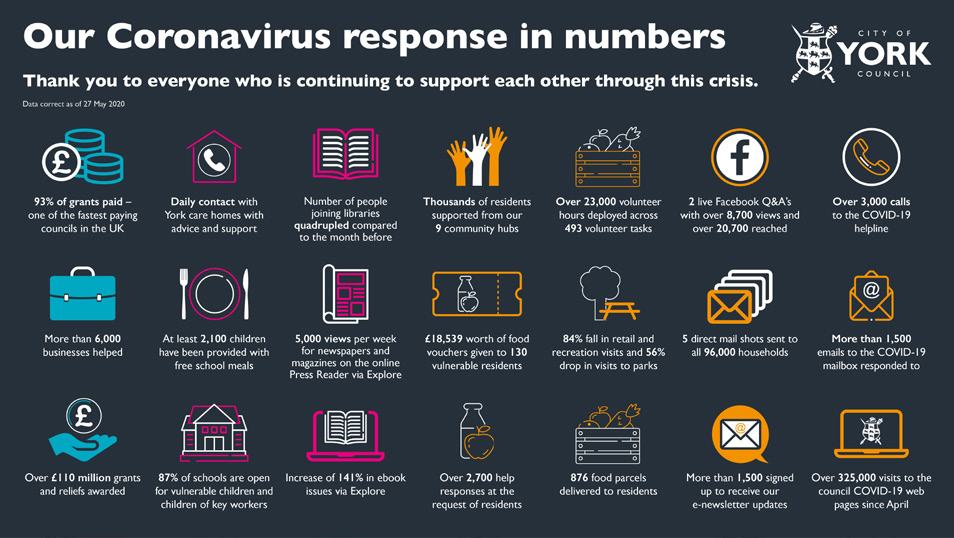
Most councils communicated information via social media, emergency contact numbers and helplines, council websites and chatbots. [MHCLG research] revealed that 90 per cent of councils advertised a dedicated phone line, an email address, or webforms for people needing support, while 61 per cent advertised a dedicated phone line, an email address, and a web form on their website for people wanting to volunteer.
Technology also enabled more personal communication. Staffordshire County Council used the WhatsApp messaging app to communicate with colleagues and residents. They also used Facebook Portals – a video-calling device that integrates with WhatsApp – to keep in contact with residents.
Other councils mapped and shared essential information about existing community initiatives and support available. Kirklees Council [set up a separate website] together with voluntary sector partners specifically to provide information about community response. They did this as part of a wider commitment to stewardship of community response rather than ownership and control.
2.7 Supporting staff
One of the greatest changes faced by local authorities was the mass transition to working remotely. Overnight, council staff had to be supplied with the necessary equipment and started using online collaboration and meeting tools that previously seemed years away.
In Newham, 2,900 staff members received new technology to enable home working in the space of a fortnight, including shifting call centre duties to staff working from home. This transition was enabled through tools such as Microsoft 365, Teams, Zoom and WhatsApp. York and Staffordshire made changes to their IT systems to speed up internet access for remote workers, including a move to 'switch tunnelling', meaning that only some information had to go through council servers while others could be accessed through the internet.
Midlothian Council [set up local hubs] to enable key workers to continue working, providing childcare for those working in emergency services, the NHS, health and social care, education and the council who requested assistance with childcare while they delivered critical services.
The volume of work, speed of response and tremendous responsibility for the wellbeing of communities took a toll on many council staff's mental health. To help with this, councils provided mental health and wellbeing support to staff, opening access to counselling and employee assistance programmes, setting up dedicated wellbeing support pages for staff and sharing positive stories demonstrating the positive impact of their work.
2.8 Economic recovery
Councils provided essential financial and employment support for people and businesses and, given their understanding of local economies, laid out the path for long term economic recovery. They were central in distributing the £12.3 billion in government small business grants and retail, hospitality and leisure business grants and, as of 16 August 2020, [had paid out £10.91 billion to over 889,800 business properties]. Some councils set up their own grant schemes for businesses that could not get support from other initiatives: in Staffordshire, the council [allocated their £500,000 micro-business support budget in just one week]. They also launched a [start-up programme] to aid the creation of two hundred businesses in key sectors in Staffordshire each year for three years.
The pandemic also put many residents under financial strain, with [23 per cent of the population reporting losses of more than 20 per cent] of household earnings in April alone. Within two weeks of lockdown Oldham Council had realised that the support they offered had to go beyond providing food and medical supplies, stating that "there's no point providing food if people have nothing to cook on”.
Councils ran financial support schemes, reduced council tax bills and provided residents with financial advice: City of York Council increased the amount of financial support available through its York Financial Assistance Scheme, providing food vouchers, fuel costs, exceptional travel expenses and necessities like cookers, fridges and beds. York also ran a pilot Opportunity Fund which allowed staff to buy goods on their corporate credit card, and loaded cash onto cards for citizens in need. This allowed choice and control to sit with the person applying for assistance, often leading to a more cost-effective, person-centred solution.
Local authorities also laid out their long term economic recovery strategies, redefining their economic priorities, rethinking traditional economic models and reviewing the opportunities offered by digital innovation, the green economy, and the levelling up agenda.
Many of the councils we interviewed have put community wealth building at the heart of their economic recovery strategy. Some included communities and partners in decision making about priorities for upcoming years: Bristol City Council brought together over 300 business, public and voluntary sector leaders to [update the city's COVID-19 recovery priorities]. The group agreed on four new priorities: setting up a new Mayoral Commission on Domestic Abuse, establishing a new One City Culture Board, building a remembrance project focusing on loss and hope, and creating a One City Children's Board.
Others were using COVID-19 as an opportunity to measure outcomes differently. In Newham, the council committed to using the livelihood, wellbeing and happiness of local people as a way to measure progress in their COVID-19 recovery strategy.
3. COVID-19: a catalyst for change
The COVID-19 crisis provided an opportunity to do things differently, fundamentally altering the operating environment for local government and creating a highly challenging but unique setting for rapid innovation and change. This section explores the positive changes that occurred in the first six months of the councils' COVID-19 crisis response.
Faced with the monumental task of responding to COVID-19, the mindset, values and principles of new operating models came to the forefront to shape how many local authorities responded to the crisis. Although some top-down command and control structures were essential in managing the emergency, collaboration with partners and communities flourished, staff felt empowered to take charge of decision-making and work in more agile ways, and flexibility around individual and team roles brought staff together in new ways.
Local government's response to COVID-19 matches the collaborative and systemic approaches outlined in the New Operating Models Framework through:
- A renewed and shared sense of purpose orientated around ensuring the safety and wellbeing of communities.
- A collaborative approach to the crisis response in which local government acted through relationships with the wider system.
- An understanding of local government as an enabler of, or platform for, the action of empowered communities, staff and partners as well as an actor itself to achieve that shared purpose.
- A view of public services as porous, collaborating with people, communities and partners such as the voluntary and community sector to improve outcomes, responding to people's strengths as well as needs.
- The creation of learning cultures and practices, agile working and adaptation to enable learning from the crisis.
The mindset, values, behaviours, capabilities and infrastructure described in the New Operating Models Framework were resources the councils we interviewed drew on in their COVID-19 response. This meant that those who had invested into new operating model approaches before the pandemic were able to respond from a position of relative strength.
The foundations for these responses were laid long before COVID-19 hit: they were able to quickly access trusting relationships with partners and communities and collaborate across the system, transition their staff to remote working overnight, share power within the system with those best placed to act (particularly with frontline staff and communities) and work from a mindset that is collaborative, systemic, long term and conscious of power. This helped them provide support for their communities in a swift and agile way and freed up time to focus on other aspects of crisis response.
For example, the London Borough of Camden felt that their investment into strengthening their voluntary sector meant that it was resilient and empowered to provide independent support to residents. Similarly, Leeds City Council shared that their commitment to asset-based community development approaches that focus on the values and assets present within communities as opposed to their vulnerabilities meant that more personal support was provided from residents for residents and reduced some of the demand for formal volunteering.
In addition to being able to access existing assets, the COVID-19 environment provided an opportunity to quickly scale up and consolidate new operating models by working in new ways, forging new relationships and strengthening existing partnerships. It also demonstrated the value of new operating models approaches to colleagues and helped build a critical mass of allies within councils to help ensure that positive changes are preserved for years to come. For example, one of our interviewees said that the past few months had finally helped convince a more senior colleagues of the benefits of asset-based approaches.
Through our research, we sought to identify the positive changes that occurred at the local government level during COVID-19 and identify behaviours and practices that local authorities may want to hold on to. In sharing these practices, we are hoping to help build a vision for what local government could look like in ten years.
3.1 Shared purpose
COVID-19 is one of the greatest collective challenges that local authorities have ever dealt with, bringing staff and organisations together like never before. Teams were quickly put together from across organisations and the wider system; organisational boundaries became blurred and silos were broken down. A shared sense of purpose emerged: one which encouraged staff to come together to pursue the same goal without other competing priorities. The issue of siloed working has been a stubborn problem in local government, so this represents a very positive shift – one which councils are keen to preserve. A sense of shared purpose will also be particularly important in building shared plans beyond COVID-19.
Maintaining flexibility around individual and team roles also helped nourish a shared sense of purpose. In the first weeks of the crisis, multi-disciplinary teams were created quickly from across the system and many staff were redeployed and assigned new responsibilities.
Leeds City Council attributed their capacity to resolve complex problems and respond quickly to working with partners and people to reconceive, broaden or focus roles as needed during the crisis. “Everyone knows what they are there to do and their prime focus is protecting people, ensuring quality of service, and of course saving lives. Moving away from the formal job description means people are working to key outcomes and from a strong values base."
Kirklees Council shared a similar experience. “It didn't matter what team you were in. You could be a librarian triaging calls. People could come along and learn things quickly, which helped shift some of the organisational silos."
In Denbighshire Council, new roles emerged in the early days of the crisis, with no job description or established hierarchies. This allowed for more junior staff to step up and take on responsibilities above their pay grade. “It would be useful in the future if we would be able to redeploy people within our organisation rather than hiring people for 6-month contracts."
Lending a helping hand
During the pandemic, many Midlothian Council staff temporarily left their regular office jobs and stepped into frontline services to support the most vulnerable residents.
This is the case for Marni, Allan and Dee, who before COVID-19 were working in the council's Sport and Leisure and Children's Services teams. In the first months of the crisis they joined the care home team at Highbank Intermediate Care, giving them a chance to step outside their comfort zone and gain first-hand experience of working in care. Although this was drastically different from her regular job as Planning Policy and Project Officer in the National Lottery Mental Health team, Dee felt the experience helped her appreciate how challenging the work of a carer is and wants better recognition for the work that they do.
Care home manager Katherine shared her appreciation.
"It just means so much to the staff at Highbank that people are coming out of a job they know so well to help us continue to provide an important service. It is such a challenging and scary time for everyone and the fact that this has not put people off helping so appreciated."
This is also the case for Heather, who took on a new role as COVID-19 Wellbeing and Equity Manager, supporting education hub managers to identify those most in need. The role involved coordinating appropriate help to families facing difficulties, ensuring no one is without food, electricity or medication, signposting to financial assistance supports and helping people access distance learning. She said: “This is a challenging time for all of us but even more so for people already living in poverty. We want our families to know we care and that we are there for them during these unpredictable and stressful times."
Working on the frontlines for the first time while dealing with the effects of the pandemic on a personal level also helped consolidate a shared sense of purpose, with many staff gaining personal experience of issues like poverty or food insecurity. Leeds City Council stated that many more of their staff gained deeper insight into the impacts of poverty, something they hope will be taken with them post-COVID. For Kirklees Council, the shared purpose of no one going hungry, as well as direct feedback from communities, made it more 'real' for many of their staff, who better understood “what it was like to be the person on the other end of the telephone”. Working from home while managing household and caring responsibilities also helped staff see colleagues as people and not as representing a team or an institution.
The alignment of purpose and values across organisations and collaboration across teams helped accelerate the adoption of place-based models and provided fertile ground for systems leadership to emerge. Oldham Council believes that multidisciplinary teams led by people across the system blurred organisational boundaries and allowed for systems leadership to flourish. Similarly, Kirklees Council pointed out that this felt “like the beginning of what place-based working should be”. Leeds City Council suspects that one of the reasons people might be recognising place as a unit of change in a way they weren't before is because staff were spending a lot more time where they live.
The crisis also brought organisational values and principles into sharp focus. Before COVID-19, York Council were undergoing a cultural values assessment process, which the crisis helped them advance. It highlighted where in the organisation people weren't working well, giving direction about where things need to be improved.
Moreover, as our research into new operating models before the pandemic revealed, much of the desire to work in new ways has a strong moral underpinning. Prior to the crisis, councils repeatedly stated that they are simply "the right things to do", driven by wanting people to live happier, more fulfilling lives. COVID-19 only highlighted this further: empathy and the desire to do whatever it takes to help out further united staff under the same purpose.
Kindness and compassion
Jennie Cox, Local Area Coordinator for City of York Council, [shared a story][47] that highlights the kindness and compassion that underpinned much of the COVID-19 crisis response.
"I was dropping off a prescription for a lady I have known for over two years. She lives alone and is self-isolating as she has COPD along with other health conditions; she also struggles with her mental health related to a brain injury. This means she only sleeps for a couple of hours a day and has found the isolation hard as the days are long."
“Whilst I was chatting to her on the doorstep, the postman arrived at her block of flats. She thanked him for his duty as a key worker and started becoming emotional, reflecting she didn't know what she would do if key workers like him and myself weren't around continuing to do what we do. It was a Friday and she went on to tell us she had been taking part in the 'clapping for carers' campaign every Thursday. She told us she had clapped so hard the previous week she had hurt her hand and felt she just didn't make enough noise to reflect her appreciation, so had been out on her balcony the night before armed with a wooden spoon and a pan."
"She told us, now with tears running down her face, that she had been out there in appreciation for us and all our colleagues who were working hard and braving the frontline. The postman thanked her and excused himself before she made him cry. I followed shortly after him with teary eyes – before she could go and get the pan to show me the dent she had made in it!”
3.2 Agile working
To act quickly on their shared purpose, ensuring communities were safe and people were not going hungry, some processes and behaviours had to scale back to allow for new, more agile ways of working to emerge. Having to make decisions fast due to a rapidly changing situation posing serious risks for wellbeing dramatically changed risk-benefit calculations. In the first few months of the crisis people felt that all bets were off and perceptions of what was risky shifted; the risk of not doing anything was the greatest.
Because of this, councils were able to move more quickly than usual, redeploying staff to different parts of the organisation, setting up new services and closing down others, and shortening and streamlining lengthy bureaucratic processes such as procurement to enable a swift and agile response. For example, not having to carry out the detailed assessments of people's care and support needs required by the Care Act due to the [suspension of regulatory obligations][48] also allowed councils to prioritise more effectively and take decisions faster.
Although lengthy discussions about tackling homelessness had been ongoing before the pandemic, in March the London Borough of Newham decided to [close the Stratford Shopping Centre][49] overnight and provide rough sleepers with alternative accommodation, food, medicine and assistance. They were also able to quickly [set up temporary mortuary facilities][50] on land owned by the City of London. These actions would have taken much longer to plan and implement before the pandemic, but urgency helped move things along much quicker.
The streamlining of bureaucratic processes meant that, in many cases, frontline staff were given the space to do what they judged to be best for those individuals without seeking permission. In York, drug and alcohol services received official COVID-19 guidance too late into the crisis and therefore had to develop their own guidance to put proactive measures into place. This meant pushing through measures that would have previously taken a long time to get approved such as allowing key workers to buy alcohol for alcohol-dependent people to avoid putting their health at risk in other, potentially more damaging ways.
In Leeds, more streamlined bureaucratic processes enabled the quick establishment of new community responses, allowing for volunteers and citizens to provide support through diverse actions such as digital inclusion initiatives, keep fit classes or buying shopping.
3.4 Collaboration
Collaboration between local authorities, other public sector bodies, citizens and the voluntary and private sectors was at the centre of COVID-19 responses across the country. No single organisation, team or person could work through this crisis alone and local authorities stepped into their role as conveners, leveraged their existing relationships and partnerships, and forged new ones to dynamically address key issues. This allowed organisations to link up volunteers with vulnerable people, support businesses, deliver food parcels or find temporary accommodation for rough sleepers.
In York, the council used their links with the community to consult residents about what should be prioritised during the pandemic (e.g. in the process of creating a hardship fund). They were also able to rely upon existing networks of volunteers to deliver over 500 prescriptions before the NHS volunteering scheme and Good Sam were up and running. Having a strong network of relationships helped put things into place, streamlined bureaucratic and procurement processes and got things done in days, not months.
In Staffordshire, the council saw their aspirations around systems leadership and collaboration come to life during the pandemic, with partners coming together under the shared purpose of protecting communities. One of the biggest shifts was developing and deploying a model for supporting vulnerable self-isolators with partners, the community, the voluntary sector and a new group of volunteers. This collaborative approach was hugely successful and accelerated the council's Supportive Communities programme.
Tackling the stigma around accessing council support
Many councils reported existing stigma around residents accessing council support such as food parcels or even calling helplines. People were sometimes hesitant to ask for help out of fear of being included on council databases and would therefore not get the support they needed. "Many people prefer to go directly to food banks,” said Kirklees Council, "Because of the stigma of accessing councils services and fear of being referred for social care intervention."
Collaborating with voluntary and community partners on service delivery was essential in ensuring everyone received the help they needed, despite the stigma associated with accessing council support. Residents were more likely to accept support from these organisations, who are often more flexible with their eligibility criteria.
“There are individuals who would not have accessed support or services if it had only been provided by the council as they can be fearful of being visible to the council, or of the stigma of needing help. Community groups can offer help in a way that the council cannot, using local knowledge to identify those in need. Service delivery spread across different groups, working to different geographical footprints, has helped us all work more systemically and assume appropriate roles."
For many, accessing existing relationships helped them find solutions faster. In Leeds, many GP practices were unable to work remotely due to a shortage of laptops; the existing supplier was also unable to take new orders within the required timescales. Meanwhile, there were many hundreds of new laptops within the city destined to replace existing Leeds City Council laptops. Through collaboration between the council and the CCG, a decision was made to repurpose and refit 600 of these to fit NHS requirements and enable Leeds GP practices to work remotely. As the council put it: "You need to build these relationships before you need them."
Working alongside residents
City of York Council's Local Area Coordination model was a valuable resource during the pandemic due to their established community links:
"Throughout the COVID-19 pandemic, our team of Local Area Coordinators have demonstrated just how valuable they are. In York they were already well established in their communities with plenty of local connections, which was just what was needed to be able to respond to the many issues they met. 'Walking alongside' residents to support them to solve problems themselves, [they] saved precious time for specialist services, enabling efforts to be focussed on those in greatest need."
"In many cases, some low-level help was exactly what was needed to stop small problems getting bigger, and that's what Local Area Coordinators really do well. Hard-working, flexible, adaptable and kind, Local Area Coordinators are just what are needed to help bring our divided society back together again." - [Councillor Carol Runciman][51], City of York Executive Member for Adult Social Care and Health and Chair of York Health and Wellbeing Board.
In situations where the local infrastructure of relationships was weak before the pandemic, councils were able to quickly consolidate relationships with partners, work with them in new ways and strengthen the local network.
In Kirklees, some of the bigger and more established mutual aid groups did not want involvement from the council out of fear that the local authority might take over and set up their own referral system for people wanting support. A few weeks into lockdown, and as the relationship between the mutual aid group and the council strengthened, at least one group closed down their referral system because they trusted the council's process and wanted to avoid duplication.
Another council shared that recent political and leadership changes meant that their systems infrastructure was not as established as that of other councils and their relationships with the wider systems were still shifting. Increased collaboration with partners helped stabilize fragile relationships and helped them progress their place-based aspirations.
3.5 Empowered communities
Working in collaboration with the rest of the system also involved the council sharing decision-making power and lending trust to communities.
The first months of the crisis saw unprecedented levels of volunteer and community mobilisation all over the country. [NLGN][52] research found that 95 per cent of council chiefs believe that community volunteering contributed significantly to their council's efforts in responding to the crisis. Local authorities worked with community groups, civil society organisations and anchor institutions to keep or transition some of the support into the community and to ensure that no one falls through the cracks.
Neighbours helping neighbours
A local area coordinator in Wiltshire was able to connect an older woman with the support she needed from the community. The woman had recently returned home after being admitted to the hospital for radiotherapy treatment. As she was experiencing extreme fatigue and was shielding, she was unable to cook herself a hot meal, pick up shopping or collect her prescriptions. The local area coordinator reached out to a local community group, which then organised for neighbours to provide support for her for as long as needed. Neighbours brought her a different hot meal every night and provided new social connections. By finding support for her within her own community, there was no need to escalate the situation into a formal intervention.
It is important to note that in putting a pandemic response into place quickly, some aspects of the local government response, such as centralising and managing the delivery of food parcels, managing volunteers and providing support to vulnerable people, took a more traditional top-down approach to service delivery. Leeds City Council shared with us their concern that this approach might erode the work of asset-based teams: “In the rush to respond, we've seen a lot of 'doing to' rather than 'working with'. It is hard to hold your nerve and to give space to communities."
This was confirmed by [NLGN research into the rise of mutual aid groups][54] during the pandemic. They found that many groups struggled either with micromanagement or lack of interest and support from councils. Many mutual aid volunteers reported that councils were "getting in the way" of their efforts or setting up similar support systems in parallel. On the other hand, the best examples of functioning mutual aid group and council relationships were underpinned by a mindset that "sees community action as important and worthy of support, rather than as a source of amateurism and needless challenge".
3.6 Empowered staff
The urgency and severity of the crisis meant that, in addition to lending trust to and sharing power with partners and communities, more power was also distributed within councils to deliver on their shared purpose. This enabled those with practical, first-hand knowledge, who are often best placed to act and manage risk locally, to take decisions quickly and adapt to a rapidly changing situation while still maintaining adequate safeguarding. This shift of power happened concurrently with the centralisation of more strategic decision making within [command and control structures.][55]
In some cases, the sharing of power was intentional. In others, the lack of clear, official guidance from the top meant that frontline teams had to make decisions quickly and independently. In the case of York's drug and alcohol team, who were able to provide alcohol-dependent people with alcohol, the lack of official guidance meant key workers could go ahead and do what they judged to be best for those individuals.
As frontline staff had to react to the crisis quickly, risk was often managed at a local level. As Kirklees Council shared: “we had to trust that people know how to manage risk locally and do a dynamic risk assessment rather than a formal one. By necessity we had to put more power in the frontline – people don't need to ask permission because they have to react and respond and have done that really well".
Leeds City Council's ability to swiftly respond to the crisis was intrinsically linked to their trust and confidence that everyone wanted to achieve the best possible outcome. Similarly, City of York Council shared that the trust and culture of permission, particularly heightened during COVID-19, empowered staff and enabled responsive and nimble decision-making. On the other hand, they identified that the pressure that frontline staff and officers experience both from communities and top-down directives often produces anxiety and risk-averse behaviours in teams such as adult social care.
In turn, the ecosystem of trust and relationships relied upon transparent and open decision-making processes. For Newham, the council's approach to enabling staff to take initiative involved encouraging transparency and openness when things went wrong so that they can focus on prototyping and learning from mistakes, not blaming. Similarly, Leeds City Council was able to lower their level of risk for staff "not by not doing risky things, but doing them more transparently and engaging others more. It doesn't mean we're forgetting about risk. We're just approaching it in a new way."
Leadership was also essential in creating and nurturing a protective environment built on trust, which took some of the risk management pressures away from frontline staff and managers. Without an authorising environment that protects staff, the [levels of risk involved were simply too great for most of them to take on][56].
04. A challenging path forward
As councils are moving out of the crisis towards the recovery stage of the COVID-19 response, their ability to hold on to the progress they have made in the first months of the pandemic is dependent on their capacity to overcome upcoming challenges.
The crisis required public sector organisations to quickly rethink how they operate to ensure they can provide support to residents and work in new ways with communities, businesses and partners. This significantly accelerated the adoption of new operating models. However, while councils were working to crystalise their learning from the crisis and maintain positive changes, they also noticed the gravitational pull of pre-COVID behaviours and ways of working.
Many were seeing signs of losing the momentum behind the changes that occurred in the first months of the crisis. As councils lose some of their unity of purpose, staff are moving out of multidisciplinary response teams, and more processes and procedures are being put into place, councils are worried that the strides made in the past six months are at risk.
The ability to work fast, with streamlined bureaucratic processes and procurement rules, has receded in many places. Streamlined bureaucracy allowed councils to be responsive and flexible, quickly standing up new systems and processes. But as these processes and systems mature and are being refined, rules and pathways are being implemented that get in the way of speed and responsiveness.
In York, the council managed to set up effective food distribution hubs to respond to community needs in a matter of weeks, and as the processes around food distribution were refined, new rules and eligibility criteria were put into place to ensure the food reaches the most vulnerable citizens. However, in practice, this interrogation of need and stricter eligibility criteria makes it difficult for people to access the service and lets people slip through the cracks. “It's the instinctive organisational muscle memory kicking in. How do we resist clinging on to the comfort blanket of old ways of working?"
Agreeing with this sentiment, Fife Council shared that while in emergency mode "the 'balloon poppers' that come and burst your bubble about the good things you are doing went quiet – but they're about again now."
A study conducted by the [Institute for Fiscal Studies][57] revealed that despite the £3.6 billion of additional funding from central government, local authorities are still £2 billion short of covering the £7.2 billion in losses they incurred during 2020-21. Many councils are worried that as they move out of the crisis and the reality of their financial situation becomes clear, financial security considerations might take precedence and the focus on holding on to the positive changes might slip away.
It is no wonder that councils such as Staffordshire were concerned that "the budgets we are expecting might be less than we thought. We've spent the last few years dealing with the effects of the financial crisis and we're just starting to see the light at the end of the tunnel. Dealing with money scarcity is hardly a space for innovation.” Similarly, Oldham Council shared that they were under significant financial pressure before COVID-19 and the future of their financial situation is unclear. If they face additional financial pressures going forward, then the capacity to reform further will become more difficult.
It is also worth taking into account the many challenges communities will be facing in the years to come, which will impact how local authorities plan for the future. Many people were facing inequality, employment insecurity and poverty before COVID-19, which will now be even greater. The pandemic has highlighted and exacerbated existing inequalities, but it has also identified new people in need of support, which could be further exacerbated by an impending recession. It is increasingly clear that the economic impacts of the crisis will be most acutely felt by those with the fewest resources: people who are unemployed, in low paid or insecure jobs, people with chronic illnesses or those experiencing housing insecurity.
05. Local government: 2030
It is easy to look at this foreboding list of challenges and forget that this is also a moment of great opportunity. Local authorities have achieved an incredible amount in their responses to the pandemic. COVID-19 has accelerated the shift towards new operating models faster than any previous efforts and helped achieve things that seemed out of reach six months ago. Many interviewees reported this period as one of the most rewarding of their careers. Moreover, as [LGA research][58] discovered, residents are trusting councils to make decisions for them more than ever before, with polling conducted in June 2020 revealing that 71 per cent of residents trust their council – a 12 per cent increase from February.
It is important, therefore, to set out an optimistic vision for the 10-year trajectory of local government in the aftermath of this crisis. It is crucial to propose alternatives and build positive visions – by imagining the future we want to see, we stand a better chance of reaching it.
We developed three scenarios that bring together the learnings that emerged from the first six months of the pandemic and trends that will shape the future of public services. Together, these scenarios illustrate what local government could look like in ten years, if it is able to preserve and build upon the progress made during the crisis. We hope that they serve as inspiration and encouragement for those working to embed these positive changes and lay the foundations for a radically different future local government.
5.1 Local government trends
The opportunity local government faces is to embed the positive changes catalysed by the crisis, and to use other key trends as the foundation for a radically different future local government. There are several trends we believe are of particular significance to local government over the coming years:
- Remote working will be retained by a large proportion of staff, including frontline staff.
- Digital tools will enable a large proportion of council-run services to be delivered remotely.
- Increased and enhanced public participation and engagement will lead to improved decision-making and better outcomes for communities.
- Sharing power with local communities across design, delivery and ownership of services and assets will enhance their quality and produce wider benefits to communities in the form of empowerment, resilience and cohesion.
- Greater and new types of collaboration between councils, statutory partners, the third and private sectors and communities will achieve better outcomes for their people and places.
- Greater devolution from central government will provide local areas with longer-term funding commitments and greater flexibility to design policy for their local context.
5.2 The future in practice
Jane
Jane is 75 years old and living alone. She was very independent until she fell in the supermarket, badly injuring her shoulder and back. This made it difficult for her to complete daily tasks on her own, and being homebound for a long period of time made her feel depressed and isolated.
Jane had been attending regular health check-ups at her community health centre. At her request, her GP put her in contact with her community connections coordinator, Adnan, who works for Thamestown Council. She didn't know what to expect of the first meeting with Adnan and was worried she might be referred in for formal support arrangements, a system of forms and assessments she did not want. She was pleasantly surprised when she was given complete control over the types of support she wanted based on the things she was good at, her goals and priorities. She found the process empowering and personalised as she was able to tailor her care plan according to her wishes and needs, and didn't need to complete any assessments.
Adnan told her about the different forms of support available, most of which were provided by her community. That's when she found out that her local mutual aid group could provide the support she needed. Created during the COVID-19 pandemic almost ten years earlier, the group continued to flourish and provide hyper-local support to residents. Through the mutual aid group, she was connected to two of her neighbours, who have been helping her with some of her daily chores and with whom she shares a passion for reading. They quickly became close friends and have now started a book club, which has been keeping Jane busy and helped her connect with others.
Adnan also recommended she join an online peer support group, where she met people going through similar experiences. The group was particularly helpful for her in the beginning, as it provided her with the encouragement and information she needed from peers she could relate to. Now she is feeling confident managing her mobility issues, Jane is providing support and mentorship to others, giving her a sense of purpose and helping with her mental health.
Using the confidence and experience she gained through being a mentor, she has been an active voice in shaping up Thamestown's Shared Outcomes Framework for Loneliness and Isolation. Together with other residents, voluntary and community organisations and professionals, she has been able to contribute to strategy and budgeting decisions by regularly attending Loneliness and Isolation strategy meetings facilitated by Thamestown Council.
Adnan
Adnan works as a community connections coordinator for Thamestown Council. His role is embedded within the community and involves working in collaboration with adults in need of support alongside the voluntary and community sector, council and community service providers and organisations, to design and coordinate a personalised package of support to help people maximise their potential for independence. Residents are referred to Adnan through a “no wrong door" approach via many channels, including GP surgeries and voluntary and community organisations.
It is important to Adnan that he works in a way that empowers people and encourages them to build on their strengths and natural support networks. He takes time to get to know them, understanding their capabilities and the types of support they want, and together they reassess this regularly through online and in-person meetings. When people do not have the skills or equipment to access online services he provides training and is able to lend equipment from the council.
Adnan has been working with Jane for the past year, supporting her after she sustained a fall that affected her mobility and ability to complete daily tasks on her own. After an initial conversation with Jane about her goals and priorities, Adnan put together a list of support and service options, which he then discussed with her, building a support plan with her input.
The support plan typically involves bringing together a diverse range of organisations, services and professionals, including physical and mental health professionals, resident groups, voluntary sector organisations and peer support networks, with priority given to finding support within people's local community. Jane was able to access most of the support she needed within her own community, which has helped her regain independence and build strong community bonds. This approach has blurred the lines between public services, the voluntary sector and communities.
Adnan himself has lived experience of mobility issues, having suffered a sporting injury fifteen years ago, and has close personal ties with the community he has lived in more than a decade. He is often assigned people facing similar issues, young or old, as he can easily relate to their situation. When his injury flared up in the past he found the local mutual aid group particularly helpful by doing his grocery shopping for him, and he often refers clients to them for support and even volunteers with them himself when he is able to.
When not on visits, Adnan is able to work flexibly either at home or in the council's offices, which has helped him better fit his work around childcare responsibilities. Working in this way was made much easier when the council upgraded their IT infrastructure nearly a decade ago.
Today, Adnan will be attending a Loneliness and Isolation working group review meeting in the local community centre. He is looking forward to sharing his experiences and ideas, and having a say in the broader strategic decisions the council needs to make.
Mark
Mark works as the Head of Strategy and Planning in the Adult Care and Support team at Thamestown Council, leading on commissioning of a range of services for adults with care and support needs. Mark's priority for today is facilitating a review meeting assessing the service provision for tackling loneliness and social isolation.
The foundations of Thamestown's Loneliness and Social isolation Strategy is a Shared Outcomes Framework co-produced and validated by residents, professionals, public service leaders and voluntary and community sector organisations using a range of deliberation and decision-making tools. The Framework is a collective statement of the outcomes communities, professionals and the council are striving to achieve, and has been an important phase of the council's transition towards new operating models. It has enabled the council to cement much stronger relationships and unity of purpose within the wider system and share power with partners and communities, and means the council now has a plurality of roles depending on the outcome in question. Sometimes it is a funder, sometimes a convener, other times a direct service provider.
The Loneliness and Isolation working group, made up of council staff, residents, public sector partners and voluntary and community sector organisations, is meeting today to assess their work towards increasing social connections, one of the five outcomes chosen within the Shared Outcomes Framework. The processes during these meetings bear some resemblance to the processes of the past – contracted services will be evaluated for their contribution to the overarching outcome, with decisions made afterwards about whether they should be continued, adapted or stopped.
06. Conclusion
Local authorities are at a crossroads: to take forward and build upon the changes that have occurred during the crisis, or to revert back to business as usual. While the gravitational pull towards the latter may feel stronger, this endangers the opportunity to use the crisis to build towards a radically different future government.
At this juncture, leaders at all levels of government should commit to a thorough review of the successes and failures of their collective COVID-19 response. This process should aim to identify what worked and why so that innovative and effective practices can be retained and integrated into the mainstream. If this does not happen, progress made over the past six months may be lost.
The New Operating Models Framework can be used as a tool to embed the learning and success from the first six months of the crisis. Leaders should aim to identify their key leverage points for change and scope out initiatives to accelerate their transition. This could mean concrete investments in new infrastructure and capabilities, but could also mean more fundamental shifts in mindsets, values and principles.
The above scenarios aim to illustrate the benefits of building on the progress that has been made in recent months. They illustrate the changes that can come from remaining focused on prevention, increasing resilience and strengthening wellbeing whilst continuing to prioritise partnerships, community assets and place based leadership. They also illustrate the benefits these approaches could have on the wellbeing of residents, communities and staff.
This is vital in light of the potential for COVID-19 to exacerbate existing inequalities, especially in conjunction with an impending recession. Locally-led action and inclusive economic strategies will be essential in ensuring that inequality and economic disparity are addressed for fair economic recovery to occur. Moreover, as the LGA highlights in their Rethinking Local report , councils cannot choose between the economy and the environment and must support a sustainable economic model that can deliver the changes we need to tackle the climate crisis while also delivering fair and sustained economic growth.
We hope that this paper provides the opportunity to reflect on the lessons that COVID-19 has taught us about the future of local government: that embracing the mindset, values and principles of new operating models – sharing power, being open and collaborating across the system are at the heart of a new, radical future for local government. Councils will need to not only preserve these positive changes but make a long-term commitment to continuous learning and progress.
07. Acknowledgements
Many thanks to our interviewees for being generous with their time, feedback and invaluable expertise:
- City of York Council
- Joe Micheli (Head of Commissioning – Early Intervention, Prevention & Community Development)
- Jennie Cox (Senior Local Area Coordinator)
- Denbighshire Council
- Nicola Kneale (Strategic Planning Team Manager)
- Fife Council
- Paul Vaughan (Head of Communities and Neighbourhoods)
- Kirklees Council
- Jill Greenfield (Service Director – Communities and Customers)
- Hannah Eliott (Transformation Lead)
- Leeds City Council
- Mick Ward (Chief Officer – Transformation and Innovation)
- Lisa Keenan (Enterprise Development Officer)
- James Woodhead (Head of Commissioning, Adults and Health Directorate)
- Local Government Association
- Juliet Whitworth (Research and Information Manager)
- London Borough of Camden
- Noel Hatch (Head Of Strategy)
- London Borough of Newham
- Rebecca Eligon (Director of Transformation)
- Emma Brunskill Powell (Senior Policy Officer)
- Robert Cayzer (Head of Policy)
- London Office of Technology and Innovation
- Eddie Copeland (Director)
- Midlothian Council
- Derek Oliver (Chief Officer - Place)
- Grace Vickers (Chief Executive)
- Dawn Farquhar (HR Manager)
- Ministry of Housing, Communities & Local Government, Local Digital team
- May-N Leow (Head of the Local Digital Collaboration Unit)
- Ben Cheetham (Cyber and Tech Lead)
- New Local Government Network
- Charlotte Morgan (Senior Policy Researcher)
- Oldham Council
- Vicky Sugars (Head of Reform)
- Staffordshire County Council
- Andrew Donaldson (Assistant Director Strategy, Public Health and Prevention)
08. Endnotes
- Harris, T., Hodge, L., Phillips, D. (2019). "English local government funding: trends and challenges in 2019 and beyond". Institute for Fiscal Studie https://www.ifs.org.uk/publications/14563
- https://www.nesta.org.uk/search/?search=%22New+operating+models+and+COVID-19%3A+A+catalyst+for+change%3F%22&area_of_work=12
- A complete list of interviewees is listed in the acknowledgement section at the back of this paper.
- "The Gold-Silver-Bronze command structure". FutureLearn https://www.futurelearn.com/courses/systems-thinking-complexity/0/steps/20392
- "Covid-19 Survey: Health and wellbeing". (2020). Understanding Society https://www.understandingsociety.ac.uk/sites/default/files/downloads/working-papers/2020-11.pdf
- "Coronavirus: NHS volunteers to start receiving tasks". (2020). BBC. https://www.bbc.co.uk/news/uk-52196459
- "People asked to 'step up and help out' vulnerable residents with personal care needs". (2020). Staffordshire Newsroom. https://www.staffordshire.gov.uk/Newsroom/Articles/2020/03-March/People-asked-to-'step-up-and-help-out'-vulnerable-residents-with-personal-care-needs.aspx
- https://www.goodgym.org/
- https://www.movethemasses.org.uk/
- Brewer, P. (2020). "Coronavirus: coordinating local support for the vulnerable". Medium https://medium.com/@paul.brewer/coronavirus-coordinating-local-support-for-the-vulnerable-f49c5518eea5
- https://do-it.org/
- "1,000th food parcel delivered to vulnerable without support". (2020). Staffordshire Newsroom. https://www.staffordshire.gov.uk/Newsroom/Articles/2020/04-April/1000th-food-parcel-delivered-to-vulnerable-without-support.aspx
- "COVID-19: good council practice". (2020). Local Government Association. https://www.local.gov.uk/covid-19-good-council-practice
- "Borough's most vulnerable supported by Sutton Council's use of delivery and transport software by ViaVan". (2020). Sutton Council. https://www.sutton.gov.uk/news/article/543/borough_s_most_vulnerable_supported_by_sutton_council_s_use_of_delivery_and_transport_software_by_viavan
- https://twitter.com/RBKingston/status/1261310908757946370
- https://www.bitc.org.uk/
- "Coronavirus (COVID-19) emergency accommodation survey data." (2020). Ministry of Housing, Communities and Local Government. https://www.gov.uk/government/publications/coronavirus-covid-19-rough-sleeper-accommodation-survey-data-may-2020
- "Manchester and Liverpool rough sleepers to be housed in hotels during coronavirus outbreak". (2020). Care Appointments. https://careappointments.com/care-news/england/143184/manchester-and-liverpool-rough-sleepers-to-be-housed-in-hotels-during-coronavirus-outbreak/
- "Stratford Centre to close from 8pm to 5am for 28 days in response to pandemic". (2020). Newham London Borough Council. https://www.newham.gov.uk/news/article/336/update-about-coronavirus-covid-19-stratford-centre-to-close-from-8pm-to-5am-for-28-days-in-response-to-pandemic-from-mayor-rokhsana-fiaz-28-march-2020
- "The Wellbeing Costs of COVID-19 in the UK". 2020. Simetrica Jacobs, London School of Economics and Political Science. https://www.jacobs.com/sites/default/files/2020-05/jacobs-wellbeing-costs-of-covid-19-uk.pdf
- "Wellbeing plan launched as part of 'Now We're Talking' mental health campaign". (2020). Cambridgeshire County Council. https://www.cambridgeshire.gov.uk/news/wellbeing-plan-launched-as-part-of-now-were-talking-mental-health-campaign
- "Let's Talk – supporting vulnerable Council residents through the coronavirus pandemic". (2020). Hackney London Borough Council. https://news.hackney.gov.uk/lets-talk--supporting-vulnerable-council-residents-through-the-coronavirus-pandemic/
- Prosser, M., Rees, D. (2020). "Through COVID and beyond: Using tech in local government". Open Access Government. https://www.openaccessgovernment.org/tech-in-local-government/92741/
- "COVID-19 Support Fund". (2020). Staffordshire County Council. https://www.staffordshire.gov.uk/Coronavirus/I-can-help/COVID-19-Support-Fund/COVID-19-support-fund.aspx
- "More Money To Help Our Communities". (2020). Kirklees Council. https://kirkleestogether.co.uk/2020/03/24/more-money-to-help-our-communities/
- Morgan, B. (2020). "Free helpline - St Albans volunteers". Counselling Foundation. https://counsellingfoundation.org/free-helpline-st-albans-volunteers/
- Cretu, C. (2020). "New operating models and COVID-19: A catalyst for change? (Part III: Inequality)". Nesta. https://www.nesta.org.uk/project-updates/noms-and-covid-3/
- "Coronavirus information and advice for residents". (2020). Newham London Borough Council. https://www.newham.gov.uk/coronavirus-covid-19/c19-information-advice/5
- Bishop, R. (2020). “Howbusyistoon.com – helping you stay safe in the city centre". Newcastle City Council. https://www.newcastle.gov.uk/citylife-news/lifestyle/howbusyistooncom-helping-you-stay-safe-city-centre
- http://www.howbusyistoon.com
- https://app.powerbi.com/view?r=eyJrljoiZDAzMzljNGQtNzYwNSOOMDk0LWExODUtOTQyYzE5ZDDRIOTkxliwidCI6IjlmM2QwZjM5LTVIMmItNGY4OC05ZDQzLWU5MzQ0ZjIhYTAyZCIsImMiOjh9
- https://www.datarich.info/covid-19/#COVID19dashboard
- https://digital.nhs.uk/dashboards/shielded-patient-list-open-data-set
- Hajri, G. (2020). "Here's what we learned from two data collaboration initiatives during the Coronavirus crisis." Medium. https://medium.com/loti/heres-what-we-learned-from-two-data-collaboration-initiatives-during-the-coronavirus-crisis-98ae60a8e4ff
- Allman, K. (2020). Covid-19 is increasing digital inequality: We need human connectivity to close the digital divide. The Oxfordshire Digital Inclusion Project. https://www.law.ox.ac.uk/research-and-subject-groups/oxfordshire-digital-inclusion-project/blog/2020/04/covid-19-increasing
- "We've funded 11 collaborative projects through the Local Digital COVID-19 Challenge". (2020). Local Digital Collaboration Unit. https://mhclgdigital.blog.gov.uk/2020/07/27/11-projects-funded-through-local-digital-covid-19-challenge/
- http://meam.org.uk/
- "Our research to help councils with their coronavirus response". (2020). Local Digital Collaboration Unit. https://mhclgdigital.blog.gov.uk/2020/05/27/our-research-to-help-councils-with-their-coronavirus-response/
- https://communityresponsekirklees.com/
- "Covid-19: What are the plans for our Key Worker Hub?". (2020). Lasswade High. http://lasswadehsc.mgfl.net/uncategorized/covid-19-what-are-the-plans-for-our-key-worker-hub/
- "COVID-19 workforce survey research reports". (2020). Local Government Association. https://www.local.gov.uk/covid-19-workforce-survey-research-reports
- "Coronavirus grant funding: local authority payments to small and medium businesses". (2020). Department for Business, Energy & Industrial Strategy. https://www.gov.uk/government/publications/coronavirus-grant-funding-local-authority-payments-to-small-and-medium-businesses
- https://www.staffordshire.gov.uk/Newsroom/Articles/2020/05-May/Huge-demand-for-grants-scheme-sees-1600-calls-in-first-week.aspx
- "Staffordshire support scheme launched ready for county start-ups". (2020). Staffordshire Newsroom https://www.staffordshire.gov.uk/Newsroom/Articles/2020/06-June/Staffordshire-support-scheme-launched-ready-for-county-start-ups.aspx
- "COVID-19 Survey: The Economic Effects". (2020). Understanding Society. https://www.understandingsociety.ac.uk/sites/default/files/downloads/working-papers/2020-10.pdf
- "Bristol's One City partners to take action together to support Bristol's recovery". (2020). Bristol City Council. https://news.bristol.gov.uk/news/bristols-one-city-partners-to-take-action-together-to-support-bristols-recovery
- Cox, J. (2020). "Local Area Coordination: it's all about people and relationships". Local Area Coordination Network. https://lacnetwork.org/local-area-coordination-its-all-about-people-and-relationships-article-by-jennie-cox/
- "Care Act easements: guidance for local authorities". (2020). Department of Health and Social Care. https://www.gov.uk/government/publications/coronavirus-covid-19-changes-to-the-care-act-2014/care-act-easements-guidance-for-local-authorities
- "Stratford Centre to close from 8pm to 5am for 28 days in response to pandemic". (2020). Newham London Borough Council. https://www.newham.gov.uk/news/article/336/update-about-coronavirus-covid-19-stratford-centre-to-close-from-8pm-to-5am-for-28-days-in-response-to-pandemic-from-mayor-rokhsana-fiaz-28-march-2020
- "Temporary mortuary facilities to be built on land owned by the City of London Corporation on Wanstead Flats in Manor Park”. (2020). Newham London Borough Council. https://www.newham.gov.uk/news/article/338/update-about-coronavirus-covid-19-temporary-mortuary-facilities-to-be-built-on-land-owned-by-the-city-of-london-corporation-on-wanstead-flats-in-manor-park-from-mayor-rokhsana-fiaz-31-march-2020
- "Which Way Next? How Local Area Coordination can help us beyond this crisis towards a better future for all". (2020). Community Catalysts, Local Area Coordination Network. https://www.housinglin.org.uk/Topics/type/Which-Way-Next-How-Local-Area-Coordination-can-help-us-beyond-this-crisis-towards-a-better-future-for-all/
- Tjoa, P. (2020). "Confidence in the time of Covid-19". NLGN. http://www.nlgn.org.uk/public/2020/confidence-in-the-time-of-covid-19-three-take-aways-from-nlgns-latest-leadership-index-survey/
- "Which Way Next? How Local Area Coordination can help us beyond this crisis towards a better future for all". (2020). Community Catalysts, Local Area Coordination Network. https://www.housinglin.org.uk/Topics/type/Which-Way-Next-How-Local-Area-Coordination-can-help-us-beyond-this-crisis-towards-a-better-future-for-all/
- Kaye, S., Tiratelli, L. (2020). "Communities vs Coronavirus: the Rise of Mutual Aid". NLGN. http://www.nlgn.org.uk/public/wp-content/uploads/Communities-Vs-Corona-Virus-The-Rise-of-Mutual-Aid.pdf
- "Responding to Emergencies: the UK Central Government Response." (2020). Cabinet Office. https://assets.publishing.service.gov.uk/government/uploads/system/uploads/attachment_data/file/192425/CONOPs_incl_revised_chapter_24_Apr-13.pdf
- Creative Councils. Nesta. https://www.nesta.org.uk/project/creative-councils/
- Ogden, K., Phillips, D. (2020). "COVID-19 and English council funding: how are budgets being hit in 2020-21?". Institute for Fiscal Studies. https://www.ifs.org.uk/publications/14977
- "Re-thinking local". (2020). Local Government Association. https://www.local.gov.uk/sites/default/files/documents/3.70%20Rethinking%20local_%23councilscan_landscape_FINAL.pdf
nesta
58 Victoria Embankment
London EC4Y ODS
+44 (0)20 7438 2500
[email protected]
facebook.com/nesta.uk
nesta.org.uk
@nesta_uk