Acknowledgements
The creation of this collection was truly a collaborative effort and there are a lot of people whose hard work has made this possible.
We are extremely grateful to this project's panel of advisors, Lawrence Lundy-Bryan, Rob van Kranenburg, Alice Casey and Katja Bejo, who played an invaluable role as judges for the essay competition as well as giving invaluable feedback on early drafts of the finalist's essays.
Special thanks goes to each of the ten writers whose essays are featured in this collection, many of whom have worked on this in their spare time on weekends and evenings.
Thanks are also due to everyone at Nesta who offered their help and feedback over the past couple of months, and to Joana Pereira for her wonderful design work on this publication.
Finally, our thanks to everyone who participated in the open call.
About Nesta
Nesta is an innovation foundation. For us, innovation means turning bold ideas into reality and changing lives for the better. We use our expertise, skills and funding in areas where there are big challenges facing society. Nesta is based in the UK and supported by a financial endowment. We work with partners around the globe to bring bold ideas to life to change the world for good.
If you'd like this publication in an alternative format such as Braille or large print, please contact us at: [email protected].
September 2020
Design: Joana Pereira
This work is licensed under a Creative Commons Attribution-NonCommercial-ShareAlike 4.0 International License (CC BY-NC-SA 4.0).
Nesta is a registered charity in England and Wales with company number 7706036 and charity number 1144091. Registered as a charity in Scotland number SCO42833. Registered office: 58 Victoria Embankment, London, EC4Y ODS.
Introduction
Human civilisation is, in large part, a story about human organisation. From hunter-gatherer bands to nation states, our societies have been fundamentally shaped by the organisational forms we have adopted; whether that be democratic government or dictatorship, army battalion or resistance movement, worker cooperative or multinational corporation. Organisational structures have typically developed as a means of tackling specific problems, such as speeding up decision-making or ensuring resources are distributed fairly among group members; however, it is clear that those we have developed to date are inadequate when managing common-pool resources like our environment. Our future will thus be determined, to a great extent, by how effectively we can design organisational forms which deal with the challenges ahead.
This collection of essays discusses new organisational forms which are emerging, enabled by digital technologies like blockchain. These organisations are allowing people to self-organise and collaborate as part of decentralised networks. Such decentralised networks have several novel features, perhaps the most important of which is that, unlike many organisations, they are designed to function without the need to trust other members of the group – that is, with trust in people replaced by a different kind of trust, in the technology itself. This has the potential to change radically what people think an organisation can be and what it means to work for one.
In addition, by providing lower-friction ways of bringing people together, enabling their input and rewarding their effort, these organisational forms present novel means of value creation and resource distribution. They may also enable more flexible forms of governance, offering a solution to some of the numerous 'problems of the commons' which afflict humankind.
These are grand ideas which this collection is intended to illustrate and explain. The featured essays expand on how decentralised technology will affect society, organisations and people, and they explore decentralisation through many different lenses - from what it means for democracy to how it could help transform our relationship with nature. The writers include a diverse range of people: academics, lawyers, developers, entrepreneurs, activists and artists; and while the essays are intended to illustrate the potential of blockchain and other decentralising technologies, the report also includes several contrarian views.
We hope the collection will be of interest to innovators, policymakers, investors and anyone else who is interested in how technology will shape our future. It is intended to help demystify some of the complex ideas being discussed in this space while also giving a glimpse into how, over the coming decades, decentralised digital organisations could change every aspect of how we live and work.
Why now?
The launch of Bitcoin in 2009 showed how blockchain technology could be used to build a completely decentralised cash system not merely 'digital cash', but a system that does not rely upon banks and other intermediaries. A decade on, there has been a digital 'Cambrian explosion' of innovative ventures trying to do what Bitcoin did for money - that is, provide resilient, secure and transparent decentralised systems that can function largely autonomously – in just about every other area of our lives from how we fall in love to how we pay our taxes. While uptake of these technologies has taken longer than some expected, advocates believe that we are approaching a turning point as they gain traction and acceptance in more industries and as more organisations – such as DAOstack, Colony and Aragon – have started to provide tools which make it simpler for others; in much the same way as Ebay, Amazon and Etsy made it easier for anyone to set up an online shop.
The essays in this collection were written amid the COVID-19 pandemic. Before the pandemic, remote working was primarily an optional benefit for affluent workers in the 'knowledge economy'. However, the crisis has triggered an immense shift towards remote work in all sectors, forcing every organisation to think about whether people really need to be geographically close in order to work together effectively. It has been suggested by many that this shift in working habits will endure beyond the current crisis. This, we believe, will result in more people asking questions about what organisations are really for, what it can mean to work for one and how we should structure them in the future. Thus questions of decentralisation, and the governance structures and technologies which best enable this, are more relevant than ever.
This collection also builds on Nesta's work over the last few years in the related fields of collective intelligence, crowdfunding, the peer-to-peer or sharing economy and digital democracy – and how innovations in these areas can help us overcome some of the world's most pressing societal challenges. In the private sector, too, we have seen how the dominant mode of innovation for the past few decades has arguably been organisational innovation enabled by digital technologies: the advantage of Airbnb and Uber, for example, is that they replaced asset-laden organisations with much looser networks featuring distributed asset ownership (although the networks themselves are still centralised, with the company at the core; the essays in this volume describe what happens if we go a step further – that is, if we have both distributed assets and a distributed network which facilitates a market without the burden of central coordination).
Despite the possible benefits, however, the public image of blockchain and related decentralised technology remains tainted by the large number of fraudulent sales of cryptocurrencies and other digital tokens (also known at ICOs). Similarly, many policymakers are still focused on the negative aspects, such as the risk of money laundering. One of the purposes of this collection, therefore, is to highlight some of the potential positive impacts of decentralisation – including greater resilience, increased transparency and democracy, reduced transaction costs and vastly more new opportunities for value creation.
What you will find in the collection
This collection is made up of the ten finalists from the Decentralised Futures essay competition which Nesta ran. While readers might not agree with all of their conclusions, each of the finalists makes a compelling case and brings a fresh perspective to how we think about the future of decentralised organisations.
The Last, Best Hope for Open Data
In our winning essay, Kevin Werbach argues that big tech platforms like Facebook, Google and Amazon will not be replaced by decentralised alternatives, because few people will accept significantly worse functionality or user experience in return for better privacy. Rather, he suggests, blockchain will see mass adoption 'behind the scenes' in the infrastructural foundations of digital identity and hardware, and big tech will participate in the new decentralised data economy because it provides benefits for them as well.
DAO: Mismatch of Technology and Objectives
Our second prize winner, Grace (Rebecca) Rachmany, presents a slightly contrarian perspective, making the case that decentralisation is not a better way to run businesses and that many developers have been blinded by a naïve techno-optimism. Instead, she argues, the principles of decentralisation should be applied to areas such as climate change, preservation of cultures and cross-border disputes where centralised organisations are failing, where collective intelligence is needed and where everyone's interest is at stake and therefore everyone should have a say.
How DAOs Can Revive Local Communities
In our third prize winning essay, Rhian Lewis explores how decentralised technology can not only help global tech organisations, but also support the growth of local initiatives, such as community-owned pubs, shops and cafés. In this way, Lewis argues that decentralised digital organisations can craft a future where individuals can decide the shape of their own communities and build the lives they want, centred around vibrant high streets where everyone feels a sense of ownership and pride.
The Web of Commons: Rethinking the Status Quo from the Data Up
In this essay, Karissa McKelvey draws parallels between the historical enclosures of common land and the gatekeeping of current knowledge commons, such as scientific papers. She then draws on Elinor Ostrom's seminal work to describe a framework for what a fairer, more secure and more private web might look like and argues why blockchain is not the right tool for this.
Cooperation Across Difference
Jack Henderson also explores the tragedy of the commons. He argues that if we want sustainably egalitarian decentralised societies, then the rules and mechanisms that govern them are as important as the data structures that enable them. He then highlights how some of the ideas put forward by the RadicalxChange movement are being applied in this space.
How the Blockchain's Internet of Transactions Can Ensure a New Contract with Nature
Michel Bauwens takes a centuries-long historical view of systems of control and paradigm shifts in social models. He makes the case that we are currently undergoing another transitional phase of human history, from one stable system to another. He hypotheses about where we are heading, what changes we will make to get there and what technologies and tools we might need to achieve such ends.
The Illusion of Blockchain Democracy: One Coin Equals One Vote
In this essay, Dionysis Zindros argues why the consensus mechanisms used by current blockchains unavoidably favour the wealthy and are thus not the answer to more democratic corporations and governments.
The Future Is a Safe And Dark Web: This is What It Will Look Like
Joshua Tobkin asks how we can reconcile privacy preservation with the need to coordinate and exchange value with others, concluding that 'self-sovereign' distributed identity is the only way forward. He makes the case that over the next decade, increasing internet surveillance will drive us to encrypt everything and communicate online on a purely need-to-know basis. He discusses the role that blockchain will play in allowing us to coordinate and exchange value in such a world.
Taking the Power Back
Ziri Rideaux and Brendan Miller offer a vision in which decentralised autonomous organisations (DAOs) replace both corporations and governments as the preferred type of human organisation. Like Bauwens, they see modern representative democracy and nation states as being incapable of solving various problems, which instead require global collective action, and envisage what a global direct democracy platform might look like.
Earth 2030
Primavera De Filippi and Tony Lai take a different tack, exploring a fictional post-COVID future through the eyes of Leia, whose community embraced decentralised technology following the crisis, as she talks to others from different communities which followed different paths.
Why Decentralisation Matters
Decentralisation is not a new idea, particularly within government. Cycles of centralisation and decentralisation have been an integral part of human history: it is often argued that it was the decentralisation of the city states which led to the success of ancient Greece and that the political centralisation of ancient Rome contributed to its downfall. More recently, and closer to home, the UK has been grappling with decentralisation in the form of devolution and the introduction of elected 'metro mayors'.
But what do we really mean by decentralisation? It describes the process of distributing power away from a central authority or location so that no single individual or group makes decisions on behalf of all the parties. Decentralisation or centralisation is not a binary option; rather they lie on a spectrum, with nearly all systems and organisations falling somewhere between being totally centralised and totally decentralised. So when something is described as being 'decentralised', this is often in comparison to what existed beforehand. While in this collection we use the terms 'decentralised' and 'distributed' interchangeably, some use 'distributed' only to refer to systems that are totally decentralised.
The re-decentralisation of the internet
While the idea of decentralisation is not new, it is being given fresh impetus and new possibilities by innovations in technological decentralisation. The physical internet and the World Wide Web which runs on top of it were both originally conceived as a decentralised ecosystem where users connected directly with one another and where no single organisation had ownership or control. As the Web's inventor put it, it was intended to be a democratic 'place where we can all meet and read and write'.
Figure 1: Decentralised Networks
This diagram illustrates three levels of network decentralisation:
- Totally centralised: A single central node connects to all other nodes.
- Partially decentralised: Multiple central nodes (hubs) connect to groups of other nodes, which in turn connect to each other.
- Totally decentralised: All nodes are interconnected directly, forming a mesh network.
This lack of a centralised authority made the web resilient and democratic, ripe for 'permissionless' innovation. Interoperability depended on common standards, but these were agreed by consensus rather than imposed by authority. Many early pioneers in the 1970s and 1980s were motivated by a utopian vision of the internet as being detached from traditional structures, with the potential to democratise knowledge and power.
However, this vision didn't last long: within the last few decades, the internet has undergone significant centralisation, with most information now flowing through just a handful of tech corporations. Whilst such centralisation has had some positive aspects, such as making the internet more user-friendly, it has come at a significant cost.
First, centralisation has placed unaccountable organisations in powerful positions as information gatekeepers. The majority of people now access their news and other information through a small number of web platforms. This puts the companies that run these platforms in the position of gatekeeper or even censor, with the ability to control what people hear, read and watch. While this may improve relevance or quality of content, it also gives firms the power to make certain pieces of information effectively invisible to the world. Even if not intentionally malevolent, this gives these organisations unparalleled control over us and our democracies.
Second, centralisation threatens privacy. Because so much flows through relatively few channels, big tech firms possess vast amounts of information about us and our private lives. Moreover, since the business models of many of these firms are based on their ability to collect user data and sell it to third parties, there are strong incentives for them to aggregate and interlink such data. Recent abuses, like the Cambridge Analytica scandal in which Facebook data was illegally harvested to build psychographic profiles of potential voters, have increased calls for users to have more control over their personal data. There have also been multiple instances of employees of centralised systems abusing their position to access private content.
Third, centralised systems create fragility and single points of failure. For example, by centralising records in one database, Equifax made itself an attractive target for hackers; the data breach of their system in 2017 exposed the personal data of up to 143 million people. In the same year, a typo by an engineer at AWS (Amazon Web Service Amazon's web hosting service) created an outage which brought several other large web services down with them.
Fourth, centralised platforms do not equitably distribute the value captured among those that create them. It has often been argued that the free use of these web platforms does not come close to compensating people fairly for the value of the data and content created by users, and that users - not just shareholders and executives - should be financially rewarded for their contributions.
Alongside these issues, the 'winner takes all' dynamic of the centralised web – which is reinforced by network effects and the costs associated with migrating to a different provider (e.g. losing all your personal information held by the incumbent) sometimes prevents small new firms from getting a foothold, thus limiting competition, consumer choice and innovation. While critics might argue that decentralised platforms would monopolise in the same way, this may not be the case; your information would be held in a decentralised, open-source database, making it easier to switch to an alternative provider if they offered a more attractive service or if your current provider did something you did not like.
For these reasons, there is a large movement of people supporting the 're-decentralisation' of the internet. This movement, which includes the Web's inventor, Sir Tim Berners-Lee, envisages an internet that, once again, is not reliant on centralised operators or intermediaries; where users own and control their own data and interact directly with one another, free from surveillance or censorship, while still having access to the same breadth and quality of services.
Peer-to-peer (or 'P2P') file-sharing
services, such as Napster, LimeWire and BitTorrent, have been popular since the late 1990s. These allow people to download data directly from people who already have the file, rather than from a single centralised server. Participants in the network typically act as both suppliers and providers of resources so that once a file has been downloaded by a user, the user's computer then hosts it for others to access. The fact that there is no central server makes the system resistant to censorship, which is why such systems have been used to distribute pirate movies, music and software.
The Decentralised Web (DWeb) takes the idea of peer-to-peer connectivity and applies it to websites and web applications too. There are two key ways in which the DWeb differs from the traditional web. First, as with other peer-to-peer services, it typically requires all computers to provide services as well as access them. Second, to navigate this distributed network, it uses a different address system to the traditional Web: whereas we currently find information by specifying a particular web address or URL, the decentralised web stores information based on its content - i.e. it is found by what it is rather than where it is.
As an analogy, finding information on the traditional web can be likened to directing someone to a book by saying that it is 'in the British Library, in a specific reading room, third bookcase, top shelf, first from the left'; whereas with the distributed web you would tell them how to find it by giving them the title and author, so they can find it in any library or bookshop or even borrow it from a friend. This means that information can be stored in multiple places at once and passed around from computer to computer rather than relying on a single server, which makes the system more resilient.
Distributed applications are computer applications which run on distributed computing systems. Such programs are being developed for many of the common services found on the traditional web, from web browsing and file storage to video streaming and social media.
The decentralisation of organisations
Just as the government or the web are systems that can become more decentralised, so too are individual organisations. In general, businesses and other organisations have stuck relatively closely to the traditional corporate structure which has dominated for more than a century. Unfortunately, in many contexts, this may no longer be the most effective way of organising work.
Centralised organisations are typically more hierarchical in their decision-making. Such structures are well-suited to rapid implementation of directions from the leadership, which is why most armed forces are strongly hierarchical. However, they are quite poorly suited to generating new ideas and enabling 'bottom-up' innovation, which is important in the knowledge economy. The lack of peer-to-peer networks is often visible in organisational silos, where information has to flow up (i.e. towards the centre) and then back down to other units.
In order to encourage innovation, therefore, many organisations have consciously tried encourage more decentralised, peer-to-peer connection: for instance, according to Elon Musk, 'Anyone at Tesla can and should email/ talk to anyone else according to what they think is the fastest way to solve a problem for the benefit of the whole company'. Together with advances in information and communication technology, this is one reason behind the trend towards flatter corporate hierarchies over the last 20 years.
Interest in more decentralised organisational forms has also been motivated by the desire to create fairer work conditions. Historically, worker cooperatives – businesses that are owned and self-managed by their workers were first started in reaction to the poor and insecure work conditions of the Industrial Revolution. More recently, there has been growing interest in using the cooperative model to create alternatives to the precarious 'gig economy'. For example, TaxiApp provides an alternative to Uber which is owned and run by its drivers. (However, as we have described elsewhere, although these platform cooperatives may provide an exciting and potentially fairer model, their non-profit nature often means that they struggle to raise finance, which means it is difficult for them to invest the resources required to reach the critical mass of customers and vendors needed to compete with incumbents.)
A more recent development, decentralised autonomous organisations (DAOs) may be able to overcome this challenge while still creating a more equitable structure for workers. As discussed below DAOs take the idea of a decentralised organisation even further, utilising blockchain technology to essentially create leaderless organisations.
What is the blockchain?
A blockchain is a type of database or ledger in which the information, rather than being stored on one particular computer or server, is duplicated thousands of times across a network of computers. As with other peer-to-peer file-sharing, this means that there is no single centralised 'original' - it is a decentralised system, or 'distributed ledger'. Whenever a new record is added to the database or ledger, every computer on the network updates its blockchain to reflect the change. This much is common to many other peer-to-peer file-sharing systems. However, the other crucial feature of blockchains is that information is only ever added, never deleted, with new data being added in 'blocks' that are cryptographically 'chained' to old ones. This means that once data is recorded in a block, it can never be changed. Blockchains are thus said to be 'immutable'. The fact that the information stored on a blockchain is public and verifiable means that it can be trusted (or as some people say, it is 'trustless', meaning no trust is required). In addition, since the information exists simultaneously in multiple places, it is secure and reliable.
We've managed to get this far without talking about blockchain. However, it is really this new technology that has been responsible for the recent explosion in interest in the decentralised web and decentralised organisations.
The first ever application of blockchain was Bitcoin, which used the technology for monetary transactions. However, blockchain is useful for much more than currency. In 2015, the range of applications was significantly expanded by the creation of Ethereum. Rather than just holding information on financial transactions, in the Ethereum system, the blocks can contain computer code that executes on every computer in the network. This means that Ethereum can be thought of not just as a decentralised ledger, but a decentralised operating system – a globally distributed 'virtual machine'.
Importantly, this has allowed the creation of 'smart contracts' – irrevocable computer programs that automatically execute when specific conditions are met. It is this ability to deploy smart contracts that is at the heart of the majority of suggested use cases for blockchain technology, including the development of DAOs.
Smart contracts are simply computer programs. However, they can be linked to digital assets via cryptographic keys, thus allowing digital assets to be controlled by arbitrary rules. Moreover, because of the immutable nature of the Ethereum blockchain (and similar systems), their execution can be guaranteed.
As an example, a smart contract might be established to run a virtual casino. Because the contracts are transparent - that is, anyone can inspect the code and verify that the transactions took place - such a casino would be provably fair.
Figure 2: How smart contracts work
This diagram illustrates the four-step process of how smart contracts function:
- Parties agree terms, rules and conditions of the contract.
- The contract is translated into code and uploaded onto a blockchain.
- If the events specified by the contract occurs then the code automatically executes.
- Once executed, the terms of the contract are enforced e.g. value may be transferred from one party to another or access to a service may be granted. The execution of the contract is recorded on the blockchain transparent to all blockchain users.
Decentralised autonomous organisations
The development of DAOs is based on the idea that an organisation can essentially be described as being made up of people (i.e. its staff) and a set of rules which determine how it will operate (e.g. the appointment, removal and powers of directors, rules for meetings and shareholder rights). DAOs translate these organisational rules into automatically enforced smart contracts which run on a blockchain.
Decentralised autonomous organisations (DAOs) are organisations whose operations are governed by smart contracts. The DAO's rules and transactions are maintained on a blockchain, making them fully transparent.
DAOs can, in essence, be thought of as a collective of people in pursuit of some common goal – which could be just about anything – who are trying to do for organisations what Bitcoin can do for money: provide resilient, decentralised systems of governance which do not require centralised authority to achieve consensus; are 'trustless' (minimising the trust required of any single actor in the system and resilient to a minority of bad actors); and can function largely autonomously. One good analogy of how a DAO works is as follows:
Imagine a vending machine that not only takes money from you and gives you a snack in return but also uses that money to automatically re-order the goods. This machine also orders cleaning services and pays its rent all by itself. Moreover, as you put money into that machine, you and its other users have a say in what snacks it will order and how often should it be cleaned. It has no managers, all of those processes were pre-written into code.
Figure 3: Evolution of decentralised autonomous organisations
This diagram illustrates the three phases of the evolution of decentralised autonomous organisations:
- Phase 1: Peer-to-peer file-sharing services (e.g. Napster, LimeWire and BitTorrent). Visually represented by a network of interconnected music note icons.
- Phase 2: Digital currencies using a distributed ledger (i.e. blockchain) to prevent double spending (e.g. Bitcoin). Visually represented by a network of interconnected 'B' icons (for Bitcoin) with arrows indicating transactions.
- Phase 3: Development of stack of technologies (e.g. distributed virtual machines, smart contracts, utility tokens) combine to give rise to decentralised autonomous organisations. Visually represented by a complex network of interconnected icons including 'A', 'B', 'S', and dollar signs, indicating a multifaceted system.
Though this vending machine DAO does not really exist (yet), it illustrates how many organisational processes - such as reordering stock, requesting cleaning services, paying rent - are relatively routine and could potentially be automated.
But what about organisational processes which cannot be codified? In the above example, how would the DAO decide which cleaning service provider to use or determine whether the cleaner was doing a good job? Aren't most organisations considerably more complex than vending machines, making countless strategic decisions that are fundamentally impossible to codify?
Clearly, there are many functions that can only be performed by people, not by the code itself. Where human decisions are needed, such decisions may be broadly divided into 'on-chain' and 'off-chain' governance.
With 'on-chain' governance, decisions are made through the DAO; in the example above, every user of the vending machine might receive a token which allows them a vote on the choice of what the machine dispenses and how often it should be cleaned (perhaps informed by how this might change prices). This 'on-chain' governance could potentially be broadened so that users could also nominate cleaners, vote on those nominations, be paid to verify that the machine has been cleaned, and so on. It could also be used to hire other (human) contractors, such as repair engineers, manage (human) verification of contractors' work and ensure swift payment.
However, to stick with the example above, if the original code did not include the facility to propose new cleaners or new features, how would that be introduced? This is a matter of 'off-chain' governance, where humans are operating outside the DAO. This 'off-chain' governance may or may not be decentralised: for instance, the community which is developing the cryptocurrency Decred uses a blockchain-based public proposal system called Politeia for its off-chain governance, as do numerous other systems.
To date, many DAOs have focused on providing a mechanism for raising and distributing funding for open-source software projects. However, they could be used to manage a broad range of projects that involve people working together towards a common goal, be that scientists working on a climate initiative, artists on a film project or journalists on a collaborative media network. With a growing number of organisations such as DAOstack, Colony and Aragon – now developing tools for building DAOs, we expect to see a proliferation of this model in the next few years.
Tokens and tokenomics
Organisations require incentives. Whereas traditional organisations use mainstream fiat currencies for many activities, many DAOs and other distributed organisations use their own digital tokens.
A token is just another word for a type of privately issued currency. Outside of the blockchain world, examples of tokens include air miles or store credit. However, in combination with smart contracts, digital tokens can be utilised for a wide range of purposes – including fundraising, enabling micropayments, encouraging early adopters and voting.
Fundraising is possible when tokens are created and sold for other cryptocurrency or fiat currency. This often takes place through a 'crowdsale' process akin to crowdfunding. This process was originally known as an initial coin offering (ICO); however, this term has fallen into disfavour in reaction to the large number of ICO scams and legal issues related to issuing securities. Where the token represents equity, many people now prefer the term security token offering (STO), removing any ambiguity that they must be issued in accordance with investor protection regulations.
Unlike traditional crowdfunding, however, the new tokens are typically available globally and tradeable via online secondary markets shortly after being issued; this greatly increases liquidity, encouraging investment. Whereas, as noted earlier, platform cooperatives sometimes struggle to raise investment, tokenised securities have been used to raise hundreds of millions of pounds.
Tokens can also serve as a micropayment system. For instance, Filecoin is a decentralised cloud data storage system in which people can earn tokens by contributing their storage capacity to the network, or use tokens to pay for storage of their own files. Tokens can be swapped for fiat currency at various exchanges.
However, thinking of digital tokens simply as a novel funding mechanism misses their transformative potential. For one thing, tokens can help solve the problem of how to encourage early adopters. Many platforms depend on network effects: the utility of sites like eBay and Twitter clearly increases with the number of users. However, the converse is also true: like an empty nightclub, the first person using a new auction site or social media platform will find it of little utility until others have joined. How, then, can early users be enticed?
Tokens can help resolve this chicken-and-egg problem. If tokens are required in order to use the system – for instance, if the Filecoin network only allows users to pay for storage with the Filecoin token - then demand for tokens will rise as the system gains users, and hence if the number of tokens is fixed, then the price of the tokens should also rise. Thus, knowing that tokens are likely to become more valuable, there is an incentive for potential users to buy or start earning them earlier on. This also ensures that users have 'skin in the game' and will therefore act in the best interest of the organisation.
Tokens may also discourage bad actors and unwanted behaviour by requiring a fee to be paid in tokens ('gas') to conduct a transaction or execute a contract; this is used to mitigate spam and help allocate resources across the network. In addition, tokens can be used to bestow a right (e.g. the right to vote on how a DAO is run or the right to access a service like file storage space).
These functions can be combined in clever ways to enable an almost infinite number of innovative business and governance models. The study of how tokens can be used in this way is sometimes called 'tokenomics'. This overlaps with the term 'cryptoeconomics' - the study of 'protocols that govern the production, distribution and consumption of goods and services in a decentralised digital economy'.
Nevertheless, despite the huge potential, questions remain around what the most valuable use cases are for DAOs and how the token systems they run on can be optimally designed to create and distribute the most value. The essays in this collection explore these issues, alongside broader questions related to the social and economic impacts of decentralisation, and whether blockchain really is the best technology for the job, from the viewpoint of both supporters and sceptics.
Abstract illustration depicting concepts of data, security, and human-machine interaction, featuring a large eye, binary code, a gear, a padlock, and stylized human figures.
Blockchain: The Last, Best Hope for Open Data
By Kevin Werbach
The next 10 years will witness the systematic manipulation of human life at a scale unrivaled in history. For all the recent controversies over privacy and surveillance, the real threat is ahead of us. Unless new approaches to online identity and data management take hold, both governments and private actors will move inexorably from knowing you to shaping you. Blockchain-enabled decentralisation will develop as the only viable response to the iron logic of data centralisation.
Blockchain believers often talk as though today's early-adopter use cases, such as cryptocurrency trading and decentralised finance, will lead straight to mass-market adoption. As the inevitable 'killer apps' appear, so the story goes, blockchain-based systems will conquer the mainstream. One might imagine that we'll all soon be trading digital collectibles and relying on token-curated registries for accurate information. Governments will lose control over money, and blockchain-based smart contracts will replace court-enforced legal agreements. Uber, Facebook and the banks will wither away in the face of tokenised alternatives.
This narrative is wishful thinking. In most markets, intermediaries will endure for the same reasons they always have: they provide value. The Ubers and Facebooks – and yes, even the banks – tame complexity and produce coherent, convenient, de-risked experiences that no decentralised community can ever match. Early adopters use blockchain-based systems for ideological reasons or to get rich on cryptocurrency speculation. The billions behind them in the mainstream will not. The lock-in power of network effects creates high barriers for alternative economic systems. And the need for trust disqualifies decentralised solutions that are havens for criminals, incapable of effective compliance or vulnerable to catastrophic attacks – which, regrettably, means virtually all of them today.
Truly decentralised blockchain systems will reach critical mass not out of hope but out of necessity. Powerful actors and mainstream users will adopt blockchain as a counterbalance to digital behaviour-shaping by governments and private platforms. Dramatic innovations such as decentralised autonomous organisations (DAOs), which manage activity automatically through smart contracts, will become significant at the end point of this process, once the foundations are in place.
Big data and artificial intelligence, pitched as freeing us from human frailties, are becoming powerful tools for social control. This is occurring along two parallel tracks: surveillance authoritarianism and surveillance capitalism. Through massive data collection and aggregation, China's social credit system envisions an airtight regime of perfect compliance with legal and social obligations. Many other governments, including liberal democracies, are adopting similar techniques. The potential for catching terrorists, child predators and tax evaders is simply too appealing – whether it's the real objective or a cover story. Meanwhile, private digital platforms are using troves of data to shape online experiences consistent with their business models. What you see online is, increasingly, what maximises their profits.
Companies such as Google, Amazon, Tencent and Alibaba can build the best algorithms because they have the most data. And they aren't interested in sharing.
Regulatory interventions will fail to derail the self-reinforcing momentum for ever more centralised data repositories. They may even accelerate it by creating layers of compliance obligations that only the largest firms can meet. Europe's General Data Protection Regulation, for example, actually increased the market share of Google and Facebook in online advertising, and so it is not surprising to see such incumbents actively welcoming the prospect of more regulation.
The only lasting solution is to change the economics of data, not to impose private property rights; that would accelerate the market forces promoting data centralisation. Giving you 'ownership' over your data means giving you legal cover to sell it, by clicking 'OK' to a one-sided contract you'll never read. The problem is not ownership, but control. In today's algorithm-driven world, sharing and aggregating data increases its value, producing better models and better predictions. The trouble is that once we share, we lose control to centralised data hogs.
What we need is a technology that allows for sharing without giving up control. Fortunately, it exists. It is called blockchain. Blockchain technology is, fundamentally, a revolution in trust. In the past, trust required ceding control to counterparties, government authorities or intermediaries who occupied the essential validating roles in transaction networks. Blockchain allows participants to trust the results they see without necessarily trusting any actor to verify them. That's why major global firms in health care, finance, transportation, international trade and other fields are actively developing cross-organisational platforms based on blockchain and related technologies. No database can provide a trusted view of information across an entire transactional network without empowering a central intermediary. Blockchain can.
Adopting any new platform at scale, along with the necessary software integration and process changes, takes time – especially when the technology is so immature. But today's incremental deployments will serve as proofs-of-concept for the more radical innovations to come. Chinese blockchain networks are already managing tens of billions of dollars of trade-finance transactions. Pharmaceutical companies are tracking drugs from manufacturing to pharmacies using the MediLedger platform. Boeing is selling a billion dollars of airline parts on Honeywell's blockchain-based marketplace. Car insurance companies are processing accident claims in a unified environment for the first time. These and other enterprise consortia are doing the essential technical and operational groundwork to handle valuable transactions at scale.
The need for transformative approaches to data will become acute in the next five years. Every week, it seems, another outrage comes to light. For instance, users who posted photos under Creative Commons licenses or default-public settings were shocked they were sucked into databases used to train facial-recognition systems. Some were even used in China's horrific campaign against Uighur Muslims. Clearview AI, an unknown startup, scraped three billion social media images for a face identification tool it provided, with no oversight, to law enforcement, corporations and wealthy individuals. The examples will only get worse as firms and nations learn new ways to exploit data. The core problem is there is no way to share information while retaining control over how it gets used.
Abstract illustration depicting concepts of data, security, and human-machine interaction, featuring a large eye, binary code, a gear, a padlock, and stylized human figures.
Blockchain offers a solution. It will be widely adopted because, behind the scenes, the current data economy is reaching its breaking point. Outrage over abuses is building throughout the world. The immensely valuable online advertising economy attracts so much fraud that the accuracy of its numbers is coming into question. Communities are looking for new ways to collaborate. Governments are realising the current system is an impediment to effective service delivery.
The technologist Bill Joy famously stated that no matter how many geniuses a company employs, most smart people work somewhere else. The same is true of data. Even giants such as Google, Facebook and Chinese government agencies need to obtain information from elsewhere in their quest for perfect real-time models of every individual. These arrangements work mostly through contracts and interfaces that ease the flow of data between organisations. As Facebook discovered when Cambridge Analytica extracted massive quantities of user data for voter targeting, these connection points are also vulnerabilities. As tighter limits are placed on data-sharing, even the big players will look for ways to rebuild trust.
The blockchain alternative will begin innocuously. Government authorities at the subnational level are deploying self-sovereign identity to pull together information securely across disparate data stores. This technology allows anyone to share private information in a fine-grained way while still retaining control. You shouldn't have to reveal your address to confirm your age, or your full tax return to verify your stated income. The necessary cryptography doesn't require a blockchain, but the desired trust relationships do.
Once people have identities that belong to them, not to banks or social media services, they will use them as the basis for other interactions. Imagine a world where you never need to give a third party unnecessary data in order to log into a website, apply for a job, refinance a mortgage or link your bank account to a mobile payment app. Where you can keep your personal and professional profiles completely separate if you choose. Where you can be confident in the reputation of a car mechanic or an Airbnb or a product made in China without intermediaries warping ratings for their own gain. The convenience of user experiences we enjoy within the walled gardens of digital platforms will become the norm across the vastness of independent services.
We will gradually come to view access to our personal information as an episodic, focused interaction, rather than fatalistically accepting an open season based on preliminary formal consent. Major hardware companies such as Apple, which don't depend on targeted advertising, will build decentralised identity capabilities into their devices. They will add cryptocurrency wallets linked behind the scenes to existing payment and messaging applications. Stablecoins - cryptocurrencies pegged to the dollar, pound or other assets – will help tame volatility and facilitate movement between tokens and traditional currencies. Privately created stablecoins will coexist with central bank digital currencies, which are under development in most major countries throughout the world.
Once this baseline infrastructure is widely available, the real changes will start to occur. DAOs will begin to attract assets as efficient ways for communities to achieve their goals. These entities won't replace state-backed legal systems; they will operate within them. As numerous controversies, crashes and hacks have already demonstrated, software code is too rigid for the range of situations in the real world, absent backstops for human dispute resolution. Fortunately, there are solutions under development to connect legal and digital entities, such as OpenLaw's Limited Liability Autonomous Organisations and Mattereum's Asset Passports.
Today, the legal machinery of contracts strengthens the power of centralised platforms. User agreements and privacy policies enforce their control over data and limit individuals' power to challenge it. Blockchain-based systems will flip that relationship, with the legal system deployed to protect technology-backed user empowerment. Large aggregations of information will be structured formally as 'data trusts' which exercise independent stewardship over assets. They will operate as DAOs, with smart contracts defining the terms of data usage. Users will benefit from sharing while retaining the ability to opt out.
Many significant applications require aggregation of data to drive algorithms, including traffic monitoring (and eventually autonomous vehicles); insurance and lending products serving previously excluded or overcharged customer groups; diagnosis and drug dosing in health care; and demand forecasting for economic modelling.
Collective action problems can prevent constructive developments even when rights in data are well defined. DAOs will gradually find market opportunities, from patronage of independent artists to mortgage securitisation.
The big data aggregators won't go away. They will participate in the decentralised data economy because it provides benefits for them as well, cutting down on fraud and reinforcing user trust, which is in increasingly scarce supply. Over time, those who provide benefits of personalisation and targeting will more and more be expected to pay for it. A wide range of brokering and filtering providers will offer users a choice of analytics, some embedded in applications or devices and some providing services virtually in the cloud. Governments will focus on making data available and defining policy objectives for services that take advantage of the flow of information. Data will be treated not as property but as a renewable resource, with the competition for economic value in the applications built on top of it.
Abstract illustration in a similar style, featuring a prominent eye, a padlock, and binary code elements, interconnected with various graphical shapes, symbolising concepts of data privacy, security, and digital architecture.
The most powerful benefit of open data built on blockchain-based decentralised control is that it will allow for new applications we can't yet envision. If startups can take advantage of the power of data aggregation that today is limited to large incumbents, they are bound to build innovations those incumbents miss.
The surveillance economy took hold because few appreciated what was happening with their data until it was too late. And the cold reality is that few will accept significantly worse functionality or user experience in return for better privacy. That is why the blockchain-powered revolution will make its way up from infrastructural foundations of digital identity and hardware, rather than down from novel user-facing applications.
This vision is far from certain to be realised. Business decisions and government policies could make blockchain-based data decentralisation more or less likely. The greatest reason for optimism is that the problem blockchain addresses – gaining trust without giving up control – is becoming ever more critical. The world runs on trust. Blockchain offers hope for recasting trust in the networked digital era.
About the author
Kevin Werbach is Professor of Legal Studies and Business Ethics at the Wharton School, University of Pennsylvania, where his research focuses on business and policy implications of emerging technologies such as AI and blockchain. He organises the Wharton Cryptogovernance Workshop and the Reg@ Tech Roundtable. Previously, Werbach served on the Obama Administration's Presidential Transition Team, founded the Supernova Group (a technology conference and consulting firm), helped develop the U.S. approach to internet policy during the Clinton Administration and created one of the most successful massive open online courses, with over 500,000 enrollments. His books include For the Win (2015), The Blockchain and the New Architecture of Trust (2018) and After the Digital Tornado (2020). Follow him on Twitter @kwerb.
DAO: Mismatch of Technology and Objectives
By Grace (Rebecca) Rachmany
The enthusiasm for decentralised autonomous organisations (DAOs) continues to gain momentum as the crypto industry recognises that monetary systems need governance; yet the gap between promise and implementation is demonstrated by the incidence of rage quitting, forking (where a blockchain splits in two because the existing protocol is changed) and abandonment of DAOs. Despite millions of dollars having been invested in development, DAOs suffer from a failure to find product – market fit. How did this happen?
It starts with the emphasis on revenue and profit-making.
DAO technology is not a better way to run businesses. Businesses are running just fine. It's not a better way to raise or allocate money. People know how to raise and allocate money. DAO technology should be applied to areas we haven't solved yet, areas where everyone's interest is at stake and therefore everyone should have a say.
People are seeking new forms of organisation in areas where hierarchical organisations are failing: public health, climate change, preservation of cultures, inequality, etc. DAOs offer the potential to organise collective intelligence to address complex questions and manage shared resources. In a recent talk at ETHDenver, DAOstack Founder Matan Field announced the move towards governance of common resources rather than businesses, and The Commons Stack has the word 'commons' in its name, signalling a clear aim of creating tools to maintain the commons. Yet the actual tech still falls short.
In 2019 and early 2020, the blockchain industry observed dozens of attempts at creating DAOs, most of them ending in failures or partial solutions, as reviewed in recent DAO case study research by the author, funded through the Genesis DAO. The source of these failures was twofold: application of DAO technology to organisations that don't need a DAO; and limiting the capabilities to budget allocation and voting. Because of their myopic focus on 'on-chain' governance of blockchains, the DAO technologists have failed to create compelling technology for the problems that society is facing.
Moving beyond money and voting
To date, technologies such as Aragon, Colony, DAOstack, GovBlocks, Moloch and other DAO tech projects have had one primary function: allocation of funds, more specifically, cryptocurrency (usually Ethereum or Dai). In some way, this is the only function you can implement on a group that has not preformed. If you start with a neighbourhood, a political party, gamers playing a specific game or other group with a common interest, you can implement and enforce decisions. If all you have is a random group of participants, you can't impose much of anything on the group behaviour other than allocation of budget. If you want automated allocation through a smart contract, the budget needs to be in Ethereum.
In other words, the technologists have built systems that are close to useless for anyone outside of their small circle. As a result, there are dozens of 'zombie' DAOs, organisations that were created but are no longer active. These failures contribute to the outside perception that DAOs are just a fad or scam.
What is needed for collective governance?
The appeal of the DAO movement is fuelled by the sense that almost all of the democratic processes are broken in today's society - in that, despite ever greater interconnection, our national and international governance structures are failing to solve problems of the commons. Mismanagement of public health, food supply, water and air quality has dire impacts worldwide. Whether we like it or not, the actions of one person in Wuhan can have global ramifications.
Organisations such as the United Nations, World Health Organization and World Bank are neither democratic nor designed to collect intelligence and respond efficiently and effectively to complex issues. The problems with these control-and-command structures have become painfully evident in the current health crisis. On every level, citizens' interests are pushed aside for the interests of big business, political heavyweights and even foreign interests who have captured the media. The idea of a DAO appeals to people because the current systems are simply inadequate to meet complex global challenges.
Unfortunately, DAO technologists have tried to map simple systems onto complex issues, rather than referring to historically successful models for governing commons. The current public health crisis is an example of the failure of centralised systems to govern a common good.
While we don't have large-scale models for commons governance, we do have examples of how commons are managed on a small to medium scale.
Examples include neighbourhood and community councils, cooperatives and traditions of Indigenous peoples for preserving the environment as well as justice and social cohesion. A neighbourhood committee may require people to keep their lawns mowed and their sidewalks shovelled, and if you do not, someone will knock on your door and let you know. In Indigenous communities, rituals and traditions are enforced through storytelling and social norms.
In other words, social norms and social enforcement are the proven methodologies for commons governance. Incentives are proven to polarise and exploit public goods. Whether the incentive comes in the form of financial compensation, attention to a social media post or improved page ranking, all types of incentive are distorting behaviours in undesirable ways. In a commons, decisions tend to be reached by deliberation, mutual respect, consideration of environmental carrying capacity and consensus.
Collective governance: Opportunities
It is possible to use technology to govern common resources for large communities. To facilitate better commons-based intelligence and decision-making, DAO technology needs to address the following aspects of collective governance:
Diagram illustrating the five key aspects of collective governance that DAO technology needs to address:
- Inclusive discussion and respectful discourse
- Recognition of facts and perspectives
- Problem definition and prioritisation
- Proposal-making and selection
- Accountability
01. Inclusive discussion and respectful discourse
To make good decisions on complex issues (e.g. public health), participants need to feel safe to express divisive perspectives and have the listening skills and willingness to consider opposing opinions. During the COVID-19 crisis, the WHO implemented wholesale censorship across both traditional media and social media. Even within the scientific community, open discussion is censored.,, This top-down control is reducing the variety of discussion and proposals that could potentially be considered. In a healthy ecosystem, multiple perspectives could be considered and tested. The structure of a DAO has potential for better sense-making and richer discussion.
While many social media platforms have caused increased antisocial behaviour, well-designed systems can cause better sense-making. One of the earliest and most long-standing threaded chat platforms, Slashdot.org, included mechanisms for people to indicate the quality of others' responses to discussions and to acquire reputation over time. Loomio offers a discussion platform with mechanisms that encourage collaboration and safety. More work needs to be done to develop platforms and mechanisms for inclusion that are not driven by market incentives, but rather designed to provide psychologically safe places for thoughtful discussion and deep consideration of alternative viewpoints and ideas. Recently, the emergence of channels such as Rebel Wisdom and The Stoa have shown the public's desire for in-depth discussion, but these are generally moderated discussions between experts and not designed for the general public to engage in such discourse.
Identity and reputation are key elements as well, but these are beyond the scope of this paper.
Abstract illustration featuring an eye motif, chat bubbles, a magnifying glass, and interlocking patterns, conveying themes of data analysis, communication, and oversight in digital systems.
02. Recognition of facts and perspectives
The focus on 'signalling' and 'preferences' ignores facts and expertise. Intelligent decisions include both facts and perspectives. Factual information must be presented as factual, along with information about the clarity or reliability of the information. Scientific studies and known use cases are different from people's opinions and perspectives. Perspectives are equally important, however. It may be factual that an infectious disease is fatal, and it may be factual that social distancing is causing a rise in suicide and addiction and having a long-term impact on mental health., Facts and statistics can be presented to decision-makers about all of these impacts, but facts are not sufficient: people's values determine what result is 'best' for them. Different cultures and segments of the population have different values about the importance of these impacts. Decision-makers require both reliable facts and multiple perspectives.
Contemporary research of Dr Anna De Liddo of the Knowledge Management Institute has led to a number of demonstrations of collaboration platforms that help people form better opinions and improve critical thinking. By developing a platform where people must discuss evidence for their claims, her team is looking at how to create a safe environment that allows recognition of expertise and encourages people to understand the content of a claim as well as its source. The Consider.it platform developed by Dr Travis Kriplean offers a discussion platform designed to help people reach a deeper understanding of each others' viewpoints and provide visualisation to describe the reasoning behind those opinions.
03. Problem definition and prioritisation
The problems we face as humanity affect different populations in different ways. Depending on your perspective, damming a river could have positive or negative effects. Almost every interesting problem has paradoxes. Problem definition needs to take into account multiple perspectives, and problem definition must be a prerequisite to proposal-making.
None of the DAO platforms to date have capabilities for problem definition. Yet without problem definition, how can a community determine if a proposal has merit?
Communities need a way to define and prioritise the issues to address. Some platforms, such as Canonizer, identify issues based on the volume of discussion and provide intelligence about how divisive the issues are to a community. However, just because an issue is interesting and divisive doesn't make it a priority. People may feel very strongly about the gender denomination of bathrooms, but most would agree that it is not as important as the curriculum of the school in which the bathroom is located.
04. Proposal-making and selection
If a ballot has only bad or mediocre options, democracy is meaningless. Organisations use multiple methodologies to brainstorm, compose and revise propositions. DAOs today allow anyone to propose anything, but they don't recognise or reward collaboration or creativity. While platforms such as Aragon and DAOstack encourage a period of informal discussion and deliberation on proposals, it's not required.
Aragon enables periodic voting schedules, so discussion is conducted over a period of time, and then voting is on a tranche of proposals together. The DAOstack paradigm allows ongoing proposal-making, so people are voting on proposals as they appear, without comparison to past (or future) proposals. This type of yes/no, 'first come, first served' proposal-making favours speed and competition over collaboration, deep thought or consideration of minority perspectives. Making decisions this way is like walking down a street and deciding whether to eat at a restaurant without knowing what restaurants are around the corner. You must make a yes/no decision for one option at a time, and if a majority always wins, the person who is vegan may go hungry.
The Holographic Consensus mechanism on DAOstack prioritises popular proposals, but more testing is needed to see if it's effective. The most popular proposal isn't always the wisest one.
Distributed technologies have the promise to create a wide variety of solutions for inclusion, but so far, none of the systems in place have demonstrated sufficient capacity for inclusion of minority interests or interests of people with less (or no) capital to invest in the DAO.
Quadratic voting, such as that implemented by Democracy Earth, allows people to express strong preferences for specific issues in situations where there is equality of representation to begin with. However, when it comes to cryptocurrency and funding of DAOs, representation is always relative to the amount of money that someone donates, even in quadratic funding, and the funding is independent of the people who are affected by the voting and funding.
For example, Black Girls Code recently raised funding on the Gitcoin grants platform through quadratic funding. The voters are the funders, not the black girls who will be affected by the grant. While there is nothing intrinsically wrong with that, it isn't a form of democracy where those affected by a decision are those who make the decision. Similarly in the Colorado example of quadratic voting, by the way. The democratic representatives of the people participated in the quadratic voting; the people they represent did not.
05. Accountability
One of the great failures of democracy is the disconnect between law-making and results being accomplished. Laws are implemented and continued for decades without review of whether their execution and implementation has accomplished the desired outcome; and when they do come under review, there often is no mechanism for repealing the law, but only to improve or adjust the execution of the law. DAO technology needs to include feedback mechanisms that will allow rapid adjustment when the measures are not met.
DAO technology has excelled in automated execution of decisions. For code changes, this is a complete process. Aragon and GovBlocks include mechanisms that allow code to be integrated automatically into the blockchain. However, this approach falls short when it comes to distribution of funds. Groups and individuals receive funds upon approval of their proposals, but none of the DAO systems to date include an accountability process. If the funds are misused or absconded with, there is no mechanism for holding the group accountable for the work. Recent work by the SEEDS project on Hypha DAO technology is developing a mechanism for escrow and then a release mechanism, which will increase accountability.
Accountability for more complex problems is even more difficult to track. For example, to improve the water quality of a river, it's not enough to just execute a proposal; the water quality needs to be measured. It's quite possible that the idea doesn't prove itself in reality or that additional measures are required. Feedback loops should be developed to identify when decisions are incorrect, and adjustments made.
Conclusions
The promise of DAOs has been to create more advanced decision-making systems. Yet, to date, the DAO technology has provided little more than voting and funds allocation mechanisms. To govern at a global level has become an imperative in the pandemic, which affects all human beings on earth. Managing this crisis and those to come requires the development of technologies that cover all aspects of discussion, collaboration, proposal-making and accountability.
About the author
Grace (Rebecca) Rachmany is the founder of DAO Leadership and is the co-author of So You've Got a DAO: Leadership for the 21st Century. As part of her participation in the Genesis Alpha DAO, she interviewed more than 30 initiators of DAOs in 2019. Grace has worked with more than 100 ICOs and blockchain companies as a consultant. She leads a weekly DGOV Foundation call on DAO and distributed government. Grace contributes to several projects in the DAO, self-sovereign identity and blockchain spaces, and she leads workshops on re-envisioning the future of economies and governments.
How DAOs Can Revive Local Communities
By Rhian Lewis
What do blockchains have to do with boarded-up shops on Britain's high streets? When we talk about decentralisation, it is usually in the context of cryptocurrencies such as Bitcoin or enterprise software designed to improve shipping supply chains or audits. These are seemingly abstract topics related to economics or business processes, remote from the practical concerns most people have about their everyday lives.
Yet decentralisation can also be political. The UK is one of the most centralised of Western economies in terms of the proportion of public expenditure controlled by central government. However, there is much to be said for allowing local communities to build ways of living that are specific to their circumstances, rather than suffering the one-size-fits-all consequences of decisions made by remote government departments – or indeed by large corporations who open faceless chain stores and then close them down once they are unprofitable.
We need an imaginative new approach to our high streets. Rather than trying and failing to stem the tide of online shopping, we should be bold and be prepared to repurpose bricks-and-mortar assets as mixed-use spaces for living, working and community socialising - and this is where initiatives such as community-owned pubs, shops and cafés can provide an answer. This essay sets out how decentralised autonomous organisations (DAOs) can replace the existing business models used by community pubs, shops and cafés, and offer advantages that induce more people to start their own social enterprises.
Communities coming together to run enterprises for themselves is not a new idea. The Co-op supermarket in Britain started in 1844 as a cooperative society to allow local people in Rochdale to group together to buy food in bulk which could be shared by the rest of the community. While community shops are growing in number, community pubs are proliferating even faster. By September 2019, there were 120 community pubs in Britain, many of them registered through the Asset of Community Value scheme. These pubs play an important role in the communities they serve: they 'foster social relationships among residents, strengthening the level of cohesion in villages and positively contributing to communal well-being'.
Shops and pubs are not the only examples of community enterprises: Totnes Cinema in Devon is a social enterprise providing a cultural focal point in a town that would be too small to support a cinema owned by one of the big chains. Such initiatives are not, of course, limited to Britain. In 2019, Jean-Pierre Desmoulins, the 73-year-old mayor of Saintines, a village in northern France, addressed the closure of the local bakery by turning a corner of the town hall into a bread shop and post office: '[Desmoulins] has turned bread into a public service, and the little town hall into a social hub. 'It creates a meeting place, a point of social contact', he says.
Sadly, the good news does not tell the whole story. To put the numbers in context, the 120 existing community pubs are a mere drop in the ocean compared to those that have closed: between 2008 and 2018, the UK lost more than a quarter of its 50,000 pubs. Given the success of the community-owned pubs, shops, cafés and cinemas that have been started, and their popularity with local people, why are they not on every high street?
One obstacle to community ownership and governance is the sheer amount of red tape and organisation that is needed to get something like this off the ground, even though the UK government has worked with the Financial Conduct Authority to simplify the process and the costs.
There are many legal vehicles available to people wanting to combine their efforts in a social venture, but the most popular is the Community Benefit Societies model, which was made possible by the 2014 Co-operative and Community Benefit Societies Act.
Nearly half of Britain's community pubs are registered as CBEs, and each has an average of 220 members. CBEs formalise the process of crowdfunding for non-profits and enshrine in law principles such as asset-locking, which means that any capital that is transferred out of the company must either be replaced by new capital or passed to another community organisation to which asset-locking applies.
This model works relatively well when the participants are happy to use a one-size-fits-all structure, but there is little room for variation. Additionally, the bookkeeping requirements can be onerous, with the management committee required to keep the details (both physical and electronic addresses) of participants updated and also to keep duplicate copies of the enterprise's records so that they can be submitted to the relevant government bodies. The services of solicitors and accountants are often required.
The management committee personally shoulder the burden of deciding whether the business is sufficiently solvent for departing members to be able to withdraw equity, and for deciding how profits should be spent, either on reinvestment or by supporting other local charitable initiatives. Many decisions are taken at an annual general meeting, which is usually held in person.
It is no surprise that many social enterprises of this nature are to be found in relatively affluent areas, where residents may already have experience of running businesses or dealing with lawyers and accountants. The 2018 Plunkett report into community pubs shows that the majority were concentrated in the South East and South West, two of the UK's most prosperous regions. The existing legal structures also lack flexibility: modern populations tend to be transient, and if you move into an area where other residents own shares in a community pub and would like to participate, it may then be difficult for you to become a stakeholder retrospectively. Most schemes also lack a route for lower-income people to build up their own stake in the organisation by contributing time, rather than money.
How might decentralised technologies support the growth of these initiatives and provide a people-focused move away from centralised decision-making towards a future where individuals can decide the future of their own communities and build the lives they want, centred around vibrant high streets where everyone feels a sense of ownership and pride?
This is where DAOs come in. By using blockchain technology, DAOs can automate the decision-making processes that are pain points for many organisations, as well as simplifying record-keeping and removing the need for a small group of people within the organisation to take on responsibility for these time-consuming tasks. So, what are DAOs, and how do they work?
By now, most people have heard of Bitcoin, and many people will also have heard of blockchain technology, which is the innovation that underpins Bitcoin and other cryptocurrencies. Blockchains are a way of storing information in many places at once, in a form that can be verified by anyone who wants. If a payment is made through the banking system, ordinary people cannot go online and look at the Barclays or HSBC database and see that their payment has been transferred. But with Bitcoin, anyone in the world can see the transactions, in real time.
A smart contract goes one step further than simply allowing for transparent payments, and allows code to be executed that represents agreements between people or organisations. Working on the principle that 'I see what you see', this means that these agreements and records can be kept in a format that is always accessible by everyone who needs to see them. A DAO is simply a smart contract that sets certain conditions which are agreed by everyone at the organisation's inception, and which allows members to vote periodically to decide the direction of the enterprise.
In 2016, the first DAO was created. It was intended as an open venture capital fund, where people could contribute cash for investment and vote to finance the projects they wanted to invest in. How might something like this work for community ownership? One answer could be to provide simple legal templates for co-owned enterprises, with an easy-to-use web or mobile interface to allow new investments or subscriptions and simplified voting on governance issues. Instead of a community pub, café or shop being run and operated by humans within a CBE, it could be run by a DAO, with the costs and agreed rules codified in code running on a blockchain.
So, how would a DAO be an improvement over the existing model? Simplicity and low cost are key elements, and it is easy to envisage how founders would be able to choose from a set of open-source templates a solution that would be most suitable for their business case (such as those offered by organisations like Colony, DAOstack and Aragon). The savings in money and effort would be considerable, particularly in the area of record-keeping; no need for duplicate sets of records that need to be maintained by hand or audited by third parties, for example.
Voting and decision-making are other areas where DAOs can improve processes. Instead of annual meetings where, despite the best efforts of participants, proceedings tend to be dominated by those who are used to having their voices heard and who understand legal and accounting matters, every participant in a DAO has an equal voice. In other words, DAOs can depersonalise decision-making so that when tough calls have to be made (such as telling a departing member that there is not enough equity to release their stake immediately), members can place their vote in private and without being influenced by more vocal elements.
Governance can be fine-tuned by voting incrementally rather than in a 'big bang' once a year, and this process of ongoing participation helps keep members engaged. While there is an obvious need for improved user experience in the current world of decentralised applications and DAOs, most within the ecosystem predict that soon, easy-to-use website and mobile app interfaces will make the whole process of participation and decision-making easier.
DAOs go much further in democratising shared ownership and governance and offer far greater flexibility than existing structures, fitting into our modern, transient societies far more easily than existing models. A DAO can be a living entity in which participants are able to sell their stake at any time without the legal overheads of having to get a solicitor involved for every change, and where the ownership parameters could flex according to individual requirements.
The current community shares legislation allows people to either volunteer their time or be paid by the enterprise: in other words, a binary choice. However, one of the most interesting advantages of replacing a CBE with a DAO is the idea of tokenisation, where volunteers could build up a stake in the enterprise by contributing their time. This is an ideal way to keep capital within the organisation and allow anyone wishing to exit to be refunded easily. To record employee stakeholdings and allocate shares in exchange for labour on an ongoing basis would be costly and onerous under the current structures, but a smart contract based on something like the Employee Stock Options Plan idea proposed by investment specialists Neufund would allow, for example, the person working behind the bar in a community pub to convert each hour worked into equity, in a seamless and almost free process.
Projects such as Aragon have been set up specifically to allow communities to govern themselves in a decentralised manner, but the precise technologies that could be used matter less than the principles. Community pubs are a simplified example, but by examining how DAOs might improve their operations and encourage more people to participate, we gain a clue about how whole networks of interlocking community-focused organisations might spring up, putting modern tools into the hands of individuals so that they can self-organise in a transparent, low-effort, low-cost environment and decide for themselves how to shape their neighbourhoods and their futures.
About the author
Rhian Lewis has been thinking and writing about blockchain technology since 2013. She received a BSc in Economics from University College London and, after becoming obsessed by the transformative possibilities of Bitcoin, co-founded the London Women in Bitcoin meetup group in 2014. In 2016, she co-founded a decentralised proof-of-ownership concept based on Ethereum, which was chosen to participate in the inaugural NexusLabs accelerator, the first blockchain-specific startup incubator in Europe. Rhian is a software developer at Unboxed and is also an instructor for blockchain educators B9lab Academy. Rhian's book, The Cryptocurrency Revolution, will be published by Kogan Page later this year.
The Web of Commons: Rethinking the Status Quo from the Data Up
By Karissa McKelvey
The struggle to ensure universal access to information is one of the most critical challenges of our time. Within an organisation or government, access to information is especially crucial to build shared knowledge and take informed actions. This knowledge is at the heart of equitable societies, functioning democracies and prosperous economies. But in our digital world, knowledge is increasingly becoming owned and controlled by a few large players. They hold personal, scholarly and civic communications as an asset which is bought and sold on marketplaces. This Silicon Valley – pioneered business model is based on maintaining ownership of information, packaging it up in derivative forms and selling it on a digital marketplace – similar to how financial securities are bundled and sold on the stock market.
Today, we are witnessing a battle for knowledge surrounding pandemics. At the start of the pandemic in early 2020, archivists illegally published over 5,000 scientific studies about coronaviruses that anyone can read without encountering a paywall. Although scientific publishers including Elsevier, Wiley and Springer Nature removed some paywalls in late January, activists wonder what informed decisions could have been made if universal access to these articles was prioritised earlier. In 2015, Liberian public health officials encountered a similar issue with monetised articles during the Ebola epidemic, when each article cost 45 US dollars, or about half a week's salary. Corporate monopolies are poorly positioned to manage these critical knowledge commons, as their bottom line prioritises profit, not access to information.
When the data is held by a third-party platform, users are exposed to threats to their autonomy and decision-making, such as censorship, surveillance and access restriction. In Fall 2019, a change in export law required that US companies block users connecting from Syria, Iran, Venezuela, Crimea and Cuba., Without warning, users effectively had access to their data cut off. Companies also make mistakes with the data – for example, Facebook accidentally gave third-party access to data, Google didn't disclose a major breach, and Yahoo! collaborated with China to incriminate political dissidents. These acts set a dangerous precedent, where knowledge can disappear or be inaccessible permanently and without warning. This is a power dynamic that creates information security vulnerabilities and is especially dangerous for organisations with sensitive or mission-critical information.
This practice is not new. For over seven centuries, the legal practice of enclosure reassigned common resources (such as pastures and forests) to a single owner. In the 18th century, this was further justified with the coining of 'the tragedy of the commons' – the notion that isolated, autonomous individuals will always deplete the commons, and privatisation is the only way to prevent that inevitability. Elinor Ostrom disproved this idea and won the Nobel prize by showing how communities are able to collectively and sustainably manage resources.
In her book Understanding Knowledge as a Commons,” she laid the groundwork for also thinking about digital knowledge as a commons – that is, the digital artifacts in libraries, wikis, maps, open-source code, scientific articles, and everything in between. One of the key tenets of Ostrom's Nobel-winning framework is that the managers of a resource are able to make decisions free from interference from outside authorities. In other words, third parties and outside authorities need to respect the rights of those who manage the commons. This is simply not possible today, as users don't have the legal right to own data that they generate on platforms.
To manage the web as a commons, we need to make progress on new legal frameworks that respect users' intellectual property rights. Technologists also need new architectures that encode the values of cooperation and access into the data and code. Thankfully, these technical infrastructures are not only possible, they've been around for a long time. A growing number of technologists are challenging the consolidation of power over information systems by creating decentralised protocols and applications. Where government and corporate control are causing harm, decentralised technologies could bring about resilience, self-determination and long-term access.
Lots of Copies Keep Stuff Safe
In these 'decentralised' applications, users are integral actors in a system that they have control and choice over. Since the original Bitcoin paper, over a decade ago, included 'peer-to-peer' in its title, we've seen an immense growth in investment, research and development into new applications. 'Peer-to-peer' flips scaling on its head – the more people use it, the faster it gets, as everyone in the network can receive a copy of content from anyone else. These architectures can also make it difficult for any central party to censor, delete or tamper with content. BitTorrent is the most popular example of the disruptive effect of peer-to-peer models on 'data ownership' in the digital age.
One exemplary digital commons using peer-to-peer architecture is the LOCKSS (Lots of Copies Keep Stuff Safe) Program, based at Stanford Libraries. They manage one of the longest-running digital preservation initiatives. There is a trusted community that manages and supports the commons, called the LOCKSS Alliance. There is also a governance structure, which decides what content counts within the boundaries of the Global LOCKSS Network. Each participating library can choose to collect its own copy of information in which it is interested.
Where BitTorrent made peer-to-peer popular for piracy, LOCKSS uses peer-to-peer to build a commons. The difference that makes LOCKSS a commons is active management of the resource. BitTorrent by itself is not designed for managing the information commons, but instead for large-scale availability where the type of document or user group involved is not of concern. To put Ostrom's first principle into practice, managers keep clearly defined boundaries by naming both the users (e.g. participants of the LOCKSS Network) and the resource itself (e.g. curated articles).
Managing a web of commons
These technologies put Ostrom's theory into practice, using peer-to-peer protocols paired with a 'web of trust'. In practice, this often looks like a trusted group of devices, uniquely identified and verified by public key cryptography. These devices can be included or excluded from editing and adding to the common dataset. The web of trust was originally coined the 'web of confidence' by Phil Zimmermann in 1992:
everyone will gradually accumulate and distribute [...] a collection of certifying signatures from other people, with the expectation that anyone receiving it will trust at least one or two of the signatures. This will cause the emergence of a decentralised fault-tolerant web of confidence for all public keys.
This pattern is distinct from both the centralised platform model as well as the blockchain consensus model. Data ownership and decision-making is based on networks of trust, with clearly defined boundaries and an organised governance structure that manages those boundaries.
Diagram illustrating interconnected concepts of security, data, and community, featuring a padlock, key, documents, a hand in chains, a network of nodes, and laptops with security icons.
When discussing the concept of decentralised governance, blockchain is often proposed as a solution. It has proved to be a clever mechanism that facilitates transactions, like money, designed for a scenario where participants are all potentially malicious. These 'trustless' transactions are the key assumption baked within blockchains that distinguish them from digital knowledge commons.
In contrast, commons assume the resource is managed – and some of that data may never be publicly accessible. This is a closed group, where data creators are also data stewards, managing the information in the commons. There are self-governing procedures for making rules, ways of monitoring of users and resources, and graduated sanctions for rule breakers.
This does not require using a machine-facilitated consensus model. It does depend, however, on an human-centred governance model to manage what data, devices and users are part of the network.
Local-first principles for data ownership
Decentralisation is not just a cool idea – for some, it's necessary to protect critical information and ensure long-term access to data. The non-profit Digital Democracy works in solidarity with marginalised communities to use technology to defend their rights. They are innovators of decentralised knowledge commons, using principles called 'local-first' technology. Their flagship product MAPEO is an open-source toolkit designed in partnership with Indigenous communities for documenting human rights abuses linked with geographic information. MAPEO is currently deployed in 12 rural project areas across Guyana, Ecuador, Colombia, Panama, Vietnam and Peru, involving over 100 local communities, many of whom do not have access to the internet. Front-line communities that use MAPEO collect very sensitive data that needs to be held securely and privately. Stories from Indigenous elders, locations of sacred sites and herbal medicines, hunting paths and photos of illegal mining – these are all sensitive pieces of knowledge that we don't want to get into the wrong hands.
Data in MAPEO is a common-pool resource, and communities decide which devices get access to synchronise, edit and add to their local knowledge map. When a new project is created, an encryption key is generated for that group. When a user is ready to share the data to another device, MAPEO synchronises only with others that also have access to this shared secret key. The point here is consent over which devices have access to the community's data over the peer-to-peer network. This creates a closed group of devices participating in a web of commons.
Empowered with this information, communities then leverage it in legal, advocacy and campaign work to hold human rights offenders to account, engage in development policy decisions and effectively manage their resources. For example, in Ecuador, the Indigenous Waorani people won a landmark legal challenge over oil concessions illegally created over their territory without consultation, enabling them to protect half a million acres of their territory.
On the surface, this use case seems strikingly different than that of librarians in Silicon Valley's Stanford University. However, both are ensuring resilience of critical information in the face of uncertainty – whether that is unforgiving rural rainforest weather conditions or earthquakes – and managing that data using a socially defined governance structure that exists outside of the technology itself.
A web of commons near you
A web of commons is about prioritising long-term access to and ownership of data, regardless of income or ability to pay. This design pattern does not necessitate the use of a 'trustless' blockchain token marketplace or exchange. If users need to participate in a marketplace to access knowledge, how is that different from the centralised Silicon Valley platform model that dominates the Web today? Who benefits when a new market is created, and who is enriched by that market? There may be some important uses for blockchain for other use cases, but it's not well-suited to a knowledge commons.
It's about understanding that trust is inherent in all of the technology we use and that there is no such thing as a 'trustless' technical system. We know that technology is not neutral, which in practice means that you have to trust someone at some point. Any technology requires its users to trust the rules set by the software engineers, designers and investors. Those able to participate in these technical discussions represent existing power imbalances – mainly computer experts, white, male and from the US, China and Europe. To learn more, read the report by Article 19 about blockchain and freedom of expression.
The web of commons applies the theories and practices of digital knowledge as a commons, pioneered by Elinor Ostrom. If she were alive today, she might agree that many of our digital knowledge commons are facing severe privatisation. By learning from her work, we know that common resources can be managed by a group of trusted individuals. The web of commons design puts this theory into practice.
About the author
Karissa McKelvey is a public interest technologist and researcher working in solidarity with marginalised communities to defend their rights. Her work has been depended upon by at-risk users including environmental and human rights defenders, journalists and civil society activists living within repressive environments. She combines her backgrounds in political science, complex systems research and software engineering to deliver public interest initiatives that leverage emerging technologies. Karissa's perspectives and works have been featured in high-profile news outlets such as The New York Times, The Wall Street Journal and NPR. Since 2014, she has focused on developing distributed technology to re-engineer the Internet and build applications that prioritise security and access. She is a Technologist at Digital Democracy and a Research Fellow at Simply Secure.
Cooperation Across Difference
By Jack Henderson
In a post-COVID world in which we will depend more than ever on technology to cooperate with one another, blockchains offer us the hope of overcoming some of the limitations of early internet systems. However, blockchain communities have struggled to govern themselves fairly and efficiently and are realising that they need to think more carefully about the rules of these systems. If we want sustainably free and equal, pluralistic and self-governing societies, the rules or 'mechanisms' might be as important for the future of technology as the data structures that enable them.
Thus the increasing interest from the blockchain space in questions of political economy – a field best known by the work of 19th-century radicals like Adam Smith, Karl Marx and Henry George and which gave rise to modern economics, sociology and political science – and especially in the work rediscovering this tradition in the RadicalxChange movement founded by Glen Weyl. The movement's many proposals are the result of reimagining social institutions, like free markets and constitutional democracy, as technologies to be carefully built and improved like physical technology, a viewpoint the blockchain space has embraced. Given that every advancement from the telegraph to modern video conferencing has more truthfully conveyed across physical distance the way we communicate in person, one might then ask: What is it about our intimate social lives that is missed in the ways we interact politically and economically?
In small and informal circles, we can form strong relations, meanings and priorities through a complex process of signalling and communication; but this is slow and inefficient and thus cannot be sustained with large numbers of people. Early social technologies like money and private property can be considered first attempts to simulate the richness of social life beyond tight-knit circles and give socially distant people reasons to collaborate. Money works fine modelling and incentivising the exchange of 'private goods', which are goods that benefit only the person that has them. But the model is concerned with scarcity and assumes that most value emerges from these mutually beneficial trades.
In our newly interconnected and interdependent world, where most value is created in rich and diverse social networks, money is a thin and reductive representation of value. With new transport and communication technologies, most of our actions are not simple trades but bring value to many others, for which we gain status and influence over future collective decisions. There are countless examples of people doing more together than they could on their own, which creates so much value because of the concentrated costs and widely distributed benefits across large groups of people. In a physical context, think of cities and environmental preservation. But especially on the Internet, which is much less commoditised than the physical world, it is difficult to quantify the value of particular actions that benefit many others; consider scientific research, high-quality journalism and open-source software (blockchains!).
The use of standard money, which fails to measure value in our social lives beyond basic reciprocity, to organise these interactions is how we get a 'tragedy of the commons' or 'free-rider problem' – when many people benefit from a public good and no one wants to contribute because they must pay the full cost of their contribution but receive a small part of the benefit. These tragedies are ubiquitous and excessively fragment our collective organisation. The success of platforms like Patreon and Kickstarter, on which people simply receive in a linear way the sum of voluntary contributions to their work, suggests that optimal funding for public goods should be much higher and that any further movement in this direction will find immediate traction. We can facilitate greater cooperation across social distance if we develop formal systems of value that more closely approximate the complexity of our social and economic relations with one another.
Figure 4: Quadratic finance
A chart illustrating "Quadratic finance" with rows of dollar signs and rows of simplified person icons, suggesting that as more people contribute (more person icons), the 'amount raised' (dollar signs) increases significantly, showing the non-linear benefit of collective contributions.
Amount raised = number of people contributing x amount contributed per person
Quadratic Finance, one of RadicalxChange's proposals, is a deeply transformative social technology that aims to capture more of the richness of modern interdependent relations. The innovation is in accounting for the tragedy of the commons: each contribution to a project gets multiplied by the total number of people who contribute (N) because the benefit of every contribution is spread across all N people. The result is that the project receives the square of the sum of the square roots of all contributions to it. The system promises a more dynamic and dignified world of work and collaboration where we spend less time worrying about monetisation and more time creating value for users. Indeed, there would be fewer conflicts between what satisfies the goals of the individual or collective and what is good for the world.
Still, the more we come to rely on this imperfect formalism, we must recognise its limitations if we are to avoid 'overfitting' it and, to use the analogy of progress of communications technology, move beyond just a leap to the telephone. Namely, relying on individual revealed preferences is an imprecise way of figuring out what people actually want because it loses track of the reasons for their preferences. For one, this means Quadratic Finance cannot combine and reconcile different reasons and thus requires complementary deliberative tools. We see an early example of such tools in Taiwan, the most active digital democracy in the world, where they use social and information technologies to reach consensus among diverse perspectives. Further, it means Quadratic Finance ought to account for the fact that we are not atomised individuals and our goals and preferences only emerge in a social context. Our evolution from tribal communities to the diversity and interdependence of modern social life has meant that each of us are now part of many groups that mediate different elements of our lives and give us meaning. Our preferences are partial to our own perspective, groups and causes, which makes cooperation natural among people already in relationship to each other, but leads to conflict among those whose commitments do not overlap.
Rather than accept harmony within our various groups at the expense of global discord, Quadratic Finance, with some representation of multilevel social organisation and the extent to which people's commitments (i.e. the values and reasons behind their preferences) are viewed to be different, can help encourage cooperation across our differences.
It is also only by ensuring that none of these diverse groups come to dominate the others that we can preserve and empower individuality. This suggests a duality between individuals and groups, where individuals are viewed as the collective actions of groups and vice versa. Through this lens, problems with the nation states and corporations we depend on today for large-scale organisation can be seen as two sides of the same coin. On one side, nation states, which have the potential to be fair and democratic, instantiate a collectivist notion that a group can isolate and monopolise an individual, excluding them from all other groups – a severe problem since most of our interdependencies cut across national boundaries. On the other side, corporations, which have the potential to be more flexible and efficient, allow individuals to dominate groups, as their incentives for profit and market power tend to trump the democratic interests of the people they serve.
This lens also makes clear that the common promise of some blockchain rhetoric, to break down existing institutions and globally validate truth, would paradoxically undermine individuality and freedom rather than enable them. Alternative data structures based on the social nature of identity, in which paths of trust proving particular claims are constructed to support the social validation of truth on many intersecting levels of social organisation, may be more promising digital infrastructure for building a pluralistic society.,
Blockchains nonetheless continue to be an exciting testing ground for RadicalxChange ideas. Gitcoin has used Quadratic Finance in several successful rounds to fund open-source software. Quadratic Voting, which has been deployed in the Colorado State House of Representatives with the help of Democracy Earth, as well as in several other countries and companies, shows significant signs of delivering in practice on its theoretical promise of generating more consensual governance than other methods. This experimental approach, attempting to move from an elegant mathematical model to its implementation in the world, is crucial for discovering the new institutional policies and social norms and practices that will make these new rules legible and intuitive – with the hope that by nurturing and scaling up this niche reorganisation of interaction, it will gain broadly shared legitimacy and eventually transform the systems through which power is organised.,
With the continuing decline of legitimacy in the institutions of much of Western world, the future of technology and liberal democracy will be determined by how we collectively choose to imagine it. In this moment, we are offered two competing visions. We have the Chinese Communist Party and their vision around centralised artificial intelligence and automated decision-making, where the powers of the state are thrown behind technological innovation without any focus on democratic governance of those powers, and where the power to solve complex social problems is deferred to technocratic experts with little feedback from the rest of society.
We see throughout history that this leads to devastation. The alternative can be found next door in Taiwan, a beacon of hope for democratic and pluralistic society, where technology is harnessed by civic hackers to build new ways for people to determine their own future. The choice is ours to make together.
A diagram showing a hand shaking, a document with checkboxes, a bank-like building, and various interconnected shapes representing processes, data, and wealth.
About the author
Jack Henderson is an independent researcher and writer who works with city governments and non-profit leaders to implement Quadratic Finance. Jack is also a recent graduate from Princeton University where he studied economics and co-founded RadicalxChange Students. Twitter @jacklandonh.
How the Blockchain's Internet of Transactions Can Ensure a New Contract with Nature
By Michel Bauwens
Chaotic transitions
The recent Coronavirus crisis has been a great revealer of the weaknesses of the current global system, but also a great accelerator of the changes within it. Many people will agree with the famous quote attributed to the Italian thinker Antonio Gramsci that 'The old world is dying and the new world struggles to be born: now is the time of monsters'.
Although Gramsci died in 1937, he was in many senses a contemporary, since he lived precisely in a time of transition. His epoch was sandwiched between what existed before World War I, the 'Smithian' capitalist system, and what would emerge after World War II. Before WWI, western society was, in Gramsci's view, characterised by the domination of capital over labour, and it did not have any multilateral system that could keep the peace between warring coalitions of competing nation states.
Out of this transition period, and at the cost of two world wars, came a new system which was based on two pillars: the first pillar was a new compact between the world of capital and the world of labour – the welfare state model, which became dominant at least in Western countries; the second pillar was the creation of multilateral institutions, such as the International Monetary Fund, the United Nations and the World Bank, tasked with protecting the new world system and mediating its conflicts.
We argue that we are in a similar period, a 'chaotic transition' between one stable system and another, as described by the fairly unknown Hungarian thinker Peter Pogany. We argue that the post-WWII transformations came with a price tag and were incomplete; that the compact between capital and labour, and the fairly weak multilateral institutions we created after WWII, are no longer enough. The questions are: What can we expect now? What needs to happen this time? We venture some hypotheses about the next system to which we must transition.
First, the next stable system will be a compact between humanity and nature – that is, a recognition of the interdependent nature of all life and that non-human beings are partner species. One weakness is that the systems developed to date largely ignore the huge environmental costs of intense industrial production. Clearly, human economic society can only exist with the ecological system of the Earth, but the fact that many environmental costs are often considered 'externalities' illustrates that our current economic systems struggle to take them into account. Communist systems of central control have fared no better than market-based systems.
Second, we suggest that this cannot be done without reinventing the 'social compact' and extending this to the whole planet as well. In other words, both the ecological and the social transition are interconnected and interdependent; we can only be successful if we combine both and give all of humanity a stake in the future.
Third, to be successful in this new compact, we will need stronger multilateral organisations which can represent the needs of the whole planet. This means learning, but also 'forcing ourselves' in some ways, to live within planetary boundaries. Yes, we need human freedom and initiative, but our freedom stops when we endanger the life conditions of other peoples and natural beings. How to achieve this transition without ecological fascism and dictatorship is going to be the great challenge.
Let us now address what kind of technologies and tools we might need to achieve such ends, and inquire whether the blockchain – that is, our capacity to coordinate human activity through shared ledgers – can help us.
Technological affordances
The internet at first represented a powerful 'peer to peer' technology – that is, a system which not only allowed potentially all computers in the world to interact directly with each other, but also, as a consequence, connected people in the same way, allowing global cooperation through peer to peer associations. This 'internet of communication' has profoundly altered our world, for good and for ill. It made citizens and knowledge workers potentially nomadic; it created the possibility of global coordination of human projects in a way that was not previously possible – but primarily it connected people at the level of ideas.
More recently, the invention of blockchain technology, as a technology of universal trust, has ushered in an 'internet of transactions'. Every possible transaction between humans can now be verified and recorded. With the blockchain, we can link to the world of things and physical production. It is now not only immaterial 'knowledge work' which can be globally coordinated, but – through shared accounting on distributed ledgers – physical production as well. For example Holo-REA is now working on an open and shared ledger of transactions that would allow eco-systemic coordination of physical production.
This means that organisation and production of human society is increasingly taking place through 'open collaborative systems' rather than closed corporations. The first expression of these global, open-source knowledge communities gave us innovations such as Wikipedia, Linux and Arduino.
The second expression of these open and collaborative systems came after the financial crisis of 2008, when we saw a tenfold increase in 'urban commons'. These are cooperative systems intended to help meet the needs of members – such as collective purchasing groups that connect consumers to producers, or village cooperatives to create renewable energy. We also see the emergence of more and more shared enterprise models, such as SMart.coop, which create solidarity for freelancers, and of the multi-factory model, where craftspeople who work on metal, wood or textiles or with 3D printing devices mutualise their place of production.
These trends are global and can be seen in action in Asia, Latin America and Africa, where they are even more important. Enzio Manzini characterised such commons as being, at the same time, 'small, local, open, and connected'. All combine similar aspects: they are 'peer to peer'; open and collaborative; based on contributions and not closed systems; and involve the creation of commons – that is, shared resources that are produced or maintained by a community ('there are no commons without commoning') according to their own rules and norms. Commons are much-forgotten institutions, but we argue that they are poised for a return to prominence as the only human institution that can maintain a stable level of resource use over long periods of time. Indeed, one could see human history as a 'pulsation of the commons', as they wax and wane in popularity.
Illustration depicting a calculator with various abstract financial and transactional symbols such as currency exchange, percentages, and numerical flows, set against a backdrop of connected abstract blocks.
Several scholars have argued that societies regularly undergo periods of exaggerated extraction of natural resources, followed by regenerative periods, when religious and spiritual reforms bring back a measure of balance to heal destroyed habitats. This 'ecological overshoot' may be the key reason why civilisations have come and gone. Capitalism and communism alike failed to escape this cycle; almost all now accept that we have a global overuse of planetary resources. This means one thing: we have to transcend this cycle and create a steady-state economy and civilisation.
So how can decentralisation help? The invention of distributed ledgers is a very important invention because accounting is how we 'see' the world. The invention and synthesis of double-entry accounting (by a Franciscan monk in Florence, Lucia Pacio) co-emerged with capitalism. In this type of accounting, collective entities only see what comes in and out of their entity, hopefully showing a profit; what is invisible are both the ecosystem and 'externalities'.
However, now that we see collaborative open systems emerging, we also see new forms of accounting which aim to internalise externalities in order to develop fully ecological economics. These include various 'contributive accounting' schemes used by open-source and peer production communities to recognise not only paid labour, but also all kinds of other non-market contributions; 'flow accounting', which aims to present every transaction as part of a holistic and common ecosystem; and 'thermodynamic' accounting schemes, which aim to integrate matter and energy into the logistical flows of a company or territory.
Following the Belgian monetary theorist Bernard Lietaer, we contend that we will need to reinvent not just extractive currencies ('cold currencies'), but also 'current-sees' that let us see the generative work that needs to be done ('warm currencies'), as many traditional societies used to have (including the western medieval world). So let's recap, and see the two worlds that are interacting in this transition period.
One world is that of national communities, the inter-state system and states' currently weakening multilateral systems. We contend that this world will not simply disappear. After all, the commons, the gift economy, hierarchical or state-based redistribution and market systems have all existed for thousands of years; and the current crisis shows that majorities are still very attached to the 'imagined communities' that are represented by the nation state. Capital, state and nation are interlocked. That system is, however, in deep crisis, and it can no longer, on its own, solve major world problems. It may evolve towards more bio-regionally (defined by ecological or geographic rather than by man-made boundaries) managed territories that seek more balance with the resources at their disposal.
On the other hand, we have a thriving world of trans-local, trans-national collaboration, with myriads of regenerative projects. Someone doing even very local permaculture, they are now connected to global learning communities organised at the trans-local, trans-national scale.
This is the new world, striving to be born. Cities for example, can interconnect directly with each other, sharing their advances on shared transportation and habitat models, not having to reinvent the wheel separately but also not necessarily linking to nation states to cooperate in this way.
What we need to imagine therefore is neither a purely vertical world of competing nation states, self-destroying in their quest for ever more scarce resources and unable to solve global problems on their own; nor a purely decentralised and horizontal world, as all these collective projects cannot act for the public good on their own.
What we need to imagine is a diagonal world, combining the best of both. Given what we know of history, it would be a mistake to equate decentralisation with what is good and free, and centralisation with what is bad. The fully decentralised Middle Ages co-existed with the most hierarchical feudal relations!
Illustration of an interconnected ecosystem showing a bear, a large thermometer, factories emitting smoke, and various abstract blocks representing different entities, symbolizing the complex relationship between nature, industry, and interconnected systems.
Towards a possible integration of the horizontal and the vertical
The three main modalities for allocating resources are: 1) free and mutual coordination, the modality of allocation used by the commons and open-source communities; 2) pricing, the mechanism used by the market; and 3) orchestrated planning, the modality offered by the state. The three could be integrated in the following way.
Imagine a first layer of global coordination of free and voluntary projects, undertaken by organised citizens; i.e. peer production communities. These commons-centric projects align through mutual signalling. For example, in the same way that bees and ants actually do not have a hierarchical monarch (the queen) deciding on everything – but in reality coordinate through chemical signals or a 'dancing language' – open-source developers are able to coordinate through shared accounting and logistics.
Imagine a second layer of regenerative market practices; i.e markets that work for both communities and nature and which take into account 'externalities' and non-market contributions. For example, the Fishcoin cryptocurrency carries information on the reproduction cycles of fish, setting limits to the amounts of fish that can be traded.
Finally, imagine a third layer of new transnational institutions which take care of the planetary boundaries and unsolved human needs. These limitations would be visible and integrated in our accounting systems. This is what is proposed by the R30 project through their Global Thresholds and Allocations Council.
As a bonus, imagine public authorities, rather than encouraging decarbonisation through competitive bidding, opening a public ledger which allows any individual or collective to have their decarbonisation efforts verified. These verified contributions are tokenised and then financed, through public funding but also by large institutions that directly benefit from these positive externalities, creating a 'circular finance' to permanently fund such regenerative work.
The world today seems to be facing some very stark choices. On one side of the equation stands those that prefer business as usual and want to preserve the neoliberal form of globalisation, with a free flow of capital and labor. However, this choice does not seem to be sustainable in ecological terms while migration is now a very contentious political subject, creating powerful political alliances that are opposed to it. The reaction to globalisation therefore takes the form of a return to the nation state, sometimes accompanied by a desire for local closure. What our model is proposing is a third possibility: cosmo-localisation. In this model, 'all that is light is global and shared' – scientific and technological cooperation takes place through global open design communities and the world does not lose its globalised culture of mutual learning – while 'all that is heavy is as local as possible'. The latter is an argument for the 'subsidiarity of material production'; i.e. to produce closer to human need, not in fanatical way, but in a reasonable way that still remains open to trade and exchange. The model is certainly technically feasible; the future will tell us if it is also desirable.
About the author
Michel Bauwens is the founder of the P2P Foundation, a global network of researchers on P2P and commons-based dynamics enabled by digital networks. In the summer of 2019, he co-wrote a report, P2P Accounting for Planetary Survival, which surveys three new forms of accounting that are emerging and enabled through the blockchain and other distributed ledger technologies, allowing a shift towards 'cosmo-local modes of value creation'. In this modality, knowledge is shared globally through open collaborative systems that allow for massive mutual coordination of human productive activity. Their P2P Theory is based on a mutual transformation of commons-centric civil society, a generative economy that works for communities and nature, and an enabling state form, the Partner State, which supports individual and collective autonomy.
Complex illustration representing various aspects of digital transactions and blockchain technology, including a laptop, a passport, a money bill with a dollar sign, binary code, a document with a seal, a bank building, a Bitcoin symbol, a hand holding a checklist, and people around a table.
The Illusion of Blockchain Democracy: One Coin Equals One Vote
By Dionysis Zindros
'The Messiah has come!' proclaim business analysts and cryptographers alike when it comes to blockchain technology, the cryptographic technique used to secure cryptocurrencies like Bitcoin. They believe that once this technology is sufficiently advanced – enabling 'smart contracts' powering the newer cryptocurrency Ethereum - it will form the bedrock for rewriting corporate law and restructuring organisations into so-called decentralised autonomous organisations (DAOs), and these DAOs will democratise corporations and governments alike.
How did we arrive at this widely held belief, that blockchain systems are somehow democratic and egalitarian, and certainly more democratic and more egalitarian than the current system?
Blockchain systems are categorised into 'permissioned' and 'permissionless'. In permissioned systems, there exists a closed committee, sitting in a walled garden, entrusted with taking decisions for the rest of the participants. This committee takes decisions about transaction history, is able to censor transactions, holds the power to establish the macroeconomic policy of the system and, among other responsibilities, can print money. In a permissioned system, instead of an open network in which anyone can join and participate freely, voting is performed by this oligarchy – the ruling of few. One example of permissioned blockchains are blockchains that banks are currently experimenting with to support behind-the-scenes transaction clearance. In such systems, the committee taking decisions consists of the participating banks; each bank gets one vote. It is a closed, opaque system controlled by a selected few. Permissioned blockchains are inherently limited in their number of participants and cannot enable an open society. Clearly, permissioned blockchains are not the democracy we're looking for. Perhaps we can find democracy in permissionless blockchains?
Permissionless blockchains are open and decentralised. In a decentralised system, there is no central party like a central bank applying macroeconomic policy. There is no single party, nor committee, authorised to print new money or judge when it is wise to apply quantitative easing. In an open system, anyone is free to join or leave the network. How, then, can money be created and rules be enforced? The answer is collectively. Money can be created by anyone as long as they follow the protocol rules. These protocols mean that any participant in the blockchain system – which could be you – can attempt to create new money. The system then, using complicated probabilistic methods, chooses one leader out of the participants at random and blesses them with the privilege of creating a specific sum of money, for themselves. Like a wheel of fortune spinning over and over, a different participant is chosen every so often, and this is how new money is injected into the system. However, the chances of being chosen are not evenly distributed – so how does this work in more detail?
How the chances are distributed are defined by a so-called 'consensus mechanism'. In Bitcoin's case, the consensus mechanism is 'proof-of-work' and the probability of being chosen as leader is proportional to one's computational power, namely how many and how powerful are the computers one has allocated towards money creation. Another technique, 'proof-of-stake', algorithmically elects a leader with probability proportional to how much money one already owns in the system; i.e. how much of the system's particular cryptocurrency they have. Leaders are responsible for enforcing the system rules. Both proof-of-work and proof-of-stake are open and decentralised, because anyone can join by entering the race using their computational power or their stake in the system, and there is no central party to prevent them from doing so. Democracy, right?
Not so fast. Did we forget what democracy entails? What about the principles of universal suffrage? One person, one vote? Let's consider whether proof-of-work and proof-of-stake live up to this ideal in terms of maintaining the system's consensus rules. In the case of proof-of-stake, one coin, one vote takes the place of one person, one vote. This is far removed from universal suffrage and widens the gap between rich and poor.
What about proof-of-work? It may seem that it is a fairer to allocate votes based on computational power than on how rich someone is. Here, one computer, one vote takes the role of one person, one vote. Not every person owns a computer; and some people own multiple or substantially more powerful computers than others. By purchasing more computational power, one can increase their available votes in the system. In fact, proof-of-work is even less egalitarian than proof-of-stake: $10,000 can buy a supercomputer which much surpasses the combined power of 10 lower-end computers bought at $1,000 each. In short, each rich person's dollar goes further than each poor person's dollar.
One could hope to overcome these limitations of consensus protocols by attempting to prove the humanity of each participant. Once this humanity is established, it can be associated with a cryptographic key. One key among these could then be selected at random and elected leader. Using this process, the leader can be recycled every so often. As long as we can ensure each human receives only one such verification, one human, one vote should be possible. However, the problem of establishing who is human is extremely difficult to tackle in a decentralised manner. Who will verify these humans? If it comes down to the decision of yet another committee or centralised party, even if this process is publicly auditable, the voting is again controlled by one entity or group of entities. Should these entities turn malicious, they can subvert the voting process, whether it is detected or not.
What if we could use some of our existing mechanisms to establish identity? We could allow a government-issued passport to be used to verify someone's humanity. Modern passports could actually be used for this purpose, as they contain a chip which can be leveraged to provide a cryptographic signature, and the authenticity of a passport is ensured by the issuing country. It's easy to validate these signatures within a blockchain system. Nevertheless, this introduces the same problems as a trusted third party: A country that wishes to subvert the democratic process – for example, under the subpoena of a court of law in a totalitarian regime - could secretly issue as many passports as it likes, allowing itself to create ghost voters. The ability of an adversary to create an unbounded number of identities to subvert the decision-making of a system in this manner even has a name: a Sybil attack, also known as 'sockpuppetry'. As existing governments are central parties, we could not hope to rely on them for the transition into a blockchain-based decentralised democracy.
Illustration depicting various blockchain and financial symbols, including currency exchange, a checklist with a checkmark, and a document, all against a backdrop of abstract geometric patterns.
So far, this essay has discussed consensus mechanisms, which allocate temporary leader privileges to an entity drawn out of a population. Naturally, this is different from real elections and voting. However, the consensus mechanism has been used as a proxy for real elections. In several instances, these elections have taken place within blockchain systems to take decisions about the systems themselves. In a process known as 'signalling', consensus participants can indicate if they are willing to support a change in the blockchain protocol (a 'fork' in the blockchain). Such signalling has occurred in many popular cryptocurrencies, including Bitcoin, Ethereum and Monero. Decisions taken in this manner typically concern technical questions within their respective projects; for example, voting on increasing the size of a blockchain block beyond the one-megabyte cap. Cryptocurrencies with more advanced decentralised governance, such as Decred, use consensus-based voting to decide on much more complex issues, including funding allocation. Decred's voting protocol, a scheme known as Politeia, comes quite close to real elections. In an impressive technical feat, it provides a system in which referenda can be initiated by any participant and put to vote, and many issues are being vibrantly discussed in a continuous fruitful exchange of ideas. While the blockchain consensus mechanism is doomed to work under the limitation of one coin, one vote, perhaps one could hope that a more democratic voting protocol is developed on top of existing blockchain schemes.
Imagine for a moment that we trust that the underlying consensus mechanism works correctly, be it proof-of-work or proof-of-stake. Blockchain systems can be used to program smart contracts, pieces of software code that establish the financial relationships and obligations between participants in a complex manner. These smart contracts can be used to establish and run DAOS. The financial and governance decisions of these organisations are managed by the smart contract, which maintains control of the organisations' funds, in the form of cryptocurrency. The participants have voting rights enforced not through a court of law, but through software code. Such companies do not have a traditional legal form; they exist only by means of smart contracts.
The stakeholders of such a decentralised company vote using their private cryptographic keys, akin to the way the board of directors in a traditional company can vote on decisions in a board meeting. Decisions voted on using a smart contract can involve allocation of money towards investments and payroll, the payout of dividends and the restructuring of stock in the form of a split or a dilution. Any modifications to the smart contract itself must be approved by the board. Furthermore, shares can be bought and sold as usual, treating them like native blockchain tokens. DAOs enjoy sovereignty in that they are not bound by any laws beyond what their founders specify in the computer code that gives birth to the decentralised organisation. A DAO only lives in a blockchain, and it does not have an associated legal entity. In a series of experiments, the Ethereum community has already explored their creation, maintenance and dissolution. In one infamous example from 2016 known as 'TheDAO', more than $50 million was stolen when it was allocated to a smart contract whose participants did not understand the precise technical terms.
DAOs enjoy a multitude of benefits. They are uncensorable, allow fast transactions, are not bound to the confines of any legal system beyond what is encoded in their software and are cryptographically secure. It is quite likely that more exploration towards such a corporate structure will take place within the next 10 years, with a promise of significantly improving the efficiency and security of older structures. If not for other reasons, economic efficiency will push traditional corporations to trial blockchain-based solutions. Additionally, the ability to securely and transparently conduct board meetings and voting remotely by making use of cryptographic signing keys can be lucrative in itself, accompanied by the capacity of smart contracts to leave an auditable trail of their election decisions.
We should remain cautious about these experiments. These premises rely on the assumption that the underlying consensus mechanism behaves as expected. While voting can be implemented on top of a blockchain, the faithful execution of the voting rules encoded in a smart contract remains in the hands of the consensus population. As such, even if a fair voting protocol is developed for a DAO, it can always be subverted by this underlying population. In the end, it all comes down to plutocracy – the ruling of a rich elite. If the majority of the money participating in the blockchain consensus dislikes a decision taken by the stakeholders of a DAO, they can roll it back or censor its progress by disallowing voting altogether.
We are hearing proposals to replace existing social, legal and corporate structures with a new technocratic blockchain system under the pretense of democracy. Within the next 10 years, we may see the adoption of such a structure in corporate governance, and we may even see some experimentation of these schemes in political governance. However, with the understanding that blockchain consensus is necessarily and unavoidably plutocratic and not democratic, one very reasonable question remains: Why should we alter our good old ways?
About the author
Dionysis Zindros is a cryptographer and software engineer focusing on blockchain research and with a particular interest in the cryptographic design and analysis of the consensus layer for blockchain interoperability. His research enables the decentralised communication of proof-of-work and proof-of-stake blockchains, building bridges between different cryptocurrency systems. He holds a PhD in Computer Science from the University of Athens and an MEng in Electrical and Computer Engineering from the National Technical University of Athens. In the past, he has worked as a software engineer in the Incidence Response Development team of Google in Zürich and in the Product Security team of Twitter in San Francisco. He has published academic papers in top-tier peer-reviewed security and cryptography conferences such as IEEE Security & Privacy, ESORICS and Financial Cryptography, and presented his work in popular community conventions including Black Hat Asia, Black Hat Europe and the Chaos Computer Congress.
Complex illustration representing digital security and identity management, featuring locked cloud icons, a globe with interconnected nodes, a USB drive, eyes monitoring screens, a magnifying glass with a checkmark, a smartphone with a lock and password input, and a stylized head with a neural network pattern.
The Future Is A Safe And Dark Web: This Is What It Will Look Like
By Joshua D. Tobkin
Mass surveillance by governments and corporations will become normal and expected this decade and people will increasingly turn to new products and services to protect themselves from surveillance. The biggest consumer technology successes of this decade will be in the area of privacy.
-Fred Wilson, Co-Founder of Union Square Ventures
Already, the physical world is being tracked by cameras, mobile and Internet of Things (IoT) devices at high density. With the recent COVID-19 outbreak, this is only going to accelerate as contact tracing may become accepted as one of the viable ways to keep the virus abated. As a consequence, in the next five years, most major cities of the world will be fully surveilled in the physical realm, and this will be instigated and sold to the public as a necessary means to protect the population from terrorists, pandemics and more. Humankind will yearn for privacy as the powers that be inevitably overuse their privilege. Naturally, the public at large will seek refuge in an 'end-to-end-encrypt everything way', and the internet will go 'dark', as Vitalik so starkly put it, in our attempt to resist the prying eye of corporations and government-run internet service providers.
The solution to an overbearing governing authority indeed resides with leveraged cryptography in order to preserve some semblance of privacy. However, on this 'dark internet', where everything is encrypted and we communicate with each other on a purely need-to-know basis, how are we to coordinate and exchange value?
Just like Satoshi Nakamoto suggested in his groundbreaking white paper, the random shuffling and usage of public keys and Bitcoin addresses as an additional security measure for privacy preservation will become more of the norm. On the 'dark internet' we will hide in plain sight through multiple different decentralised Identities. We will use Zero-Knowledge attestations, which are cryptographic proofs of ownership or knowledge that don't reveal otherwise unnecessary or sensitive details, in order to prove we are who we say we are and that we have the correct rights to access or participate in certain private online community activities. These access rights or restrictions will be dictated by our various Verifiable Credentials, which are cryptographically signed messages issued by other parties to the holder to stipulate permissions and approvals.
Universal Reputation Scores tied to decentralised identities will be used as a basis for facilitating trade and even issuing credit and access to assets, facilities, resources and more – without transacting parties having to necessarily expose their personally identifiable information (PII). In this decentralised future, data breaches will naturally be limited as a result, since even if one's data somehow becomes exposed, in the 'dark internet' everything remains encrypted anyway, so there is nothing even worth stealing in the first place, except of course for illegible ciphertext.
You may be thinking: 'This is all well and good; however, where will one actually hold all of this digital collateral to facilitate a privacy-preserving internet? A third-party provider?'
The answer is no.
In the next 5 to 10 years, it will be commonplace that each of us has our little private piece of the cloud totally and wholly owned by us, fortified by quantum-resistant encryption schemes so strong that neither the infrastructure providers we decide to host with nor the cyber-security arms of our global militaries will be able to fully ascertain our online activities or invade our privacy.
The Encrypted Internet will be used to manage some of the most important aspects of our lives, automating otherwise incredibly complex systems in the cloud directly, unbeknownst to the physical layer of everyday reality. Our data will be fortified, fully-owned and blockchain-verified in such a way that transaction fluidity is fully engendered and maximised – with blockchain as the trust layer, we can commerce with each other without fear. In that world, I don't need to know your legal name in order to be of service to you, and you don't need to know mine.
This next-generation internet is an amalgam of the existing internet and a global peer-to-peer structure that spans all corners of the Earth, composed of millions of individuals running their own private cloud instances and physical hardware stacks as home appliances. Following specific mathematical and computer science protocols, these countless individuals will contribute their independent or leased hardware resources to provide look-up, routing, storage, consensus, security and computing services for the various causes and networks they support and believe in.
With this upcoming fully-encrypted, end-to-end Internet, we will manage our personal digital assets and data through personally owned private-portals in the cloud. The software that powers this private-portal can be referred to as a 'Value Management System', or VMS for short. This author hypothesises that in the near future it will become a human right to own and have access to a VMS, as sure as it is a human right to own one's identity and to have access to financial services. Once an individual has an owned decentralised identity, as a natural corollary he or she will also immediately have access to banking services through decentralised financial systems via cyber-currencies. One's VMS will be the operating interface users use to manage their digital identity, assets, personal data and even their own node analytics.
Sir Tim Berners-Lee, the inventor of the World Wide Web, is currently working on such a VMS platform developed in collaboration with MIT, called Solid (Social Linked Data). Solid personal online data stores (PODs) can be described as your 'secure USB sticks for the web'. There is a focus on personal data ownership and the benefits of structured data for interoperability among third-party applications – instead of giving your data to corporations and having the data siloed with them, third-party applications integrate your POD into their system, while only you can control what others can see.
A related system is being developed by Urbit, a movement seeded in San Francisco seeking to build a decentralised peer-to-peer network of personal servers. Their core tenets revolve around identity management and peer-to-peer federated networking forming an alternative internetting infrastructure. One of their stated goals is 'to leave behind a world of apps and services for one where we can bring everything together in one place. And, in doing so, ordinary users can create customised digital environments for their friends and communities'. Likewise, they are building their own interfaces and system architectures for the decentralised web.
Solid and Urbit are projects paving the way for how the next internet and computing paradigms are shifting from a client-server model to a wholly end-to-end, peer-to-peer, networking model. Through identity management and secure data storage, one can connect his or her owned 'personal server' or 'private POD' into digital ecosystems to engage with applications privately and with permission, only as deeply as necessary to achieve the desired results, and not further.
Unitychain is also building a VMS to help users navigate this encroaching safe, dark, encrypted Internet. Imagine a server you control which exists redundantly and securely on multiple cloud infrastructures, which only takes a few minutes to set up, automatically encrypts all your personal data, intuitively lets you manage your Verifiable Credentials and is designed to help you easily generate and exchange Zero-Knowledge Proofs with others within your web of trust and beyond.
With emerging VMS designs like this, you can choose a network you would like to provide your compute and storage resources to and receive full analytics on your node's performance and contributions, and you also can visually manage your earned and owned digital assets. The mock-ups below illustrate what such a platform would allow users to do and what it would look like to use.
Manage your node analytics: Choose a network you would like to dedicate your compute and storage resources towards and see your node's analytics and performance earnings.
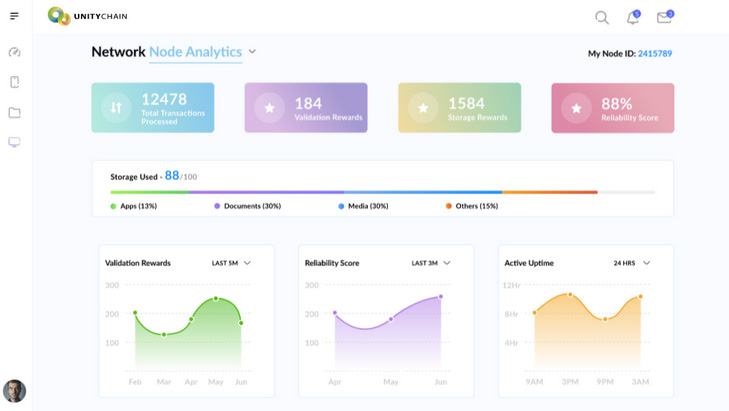
Manage your digital assets: Securely access multiple wallets with user-friendly interfaces to manage your contacts.
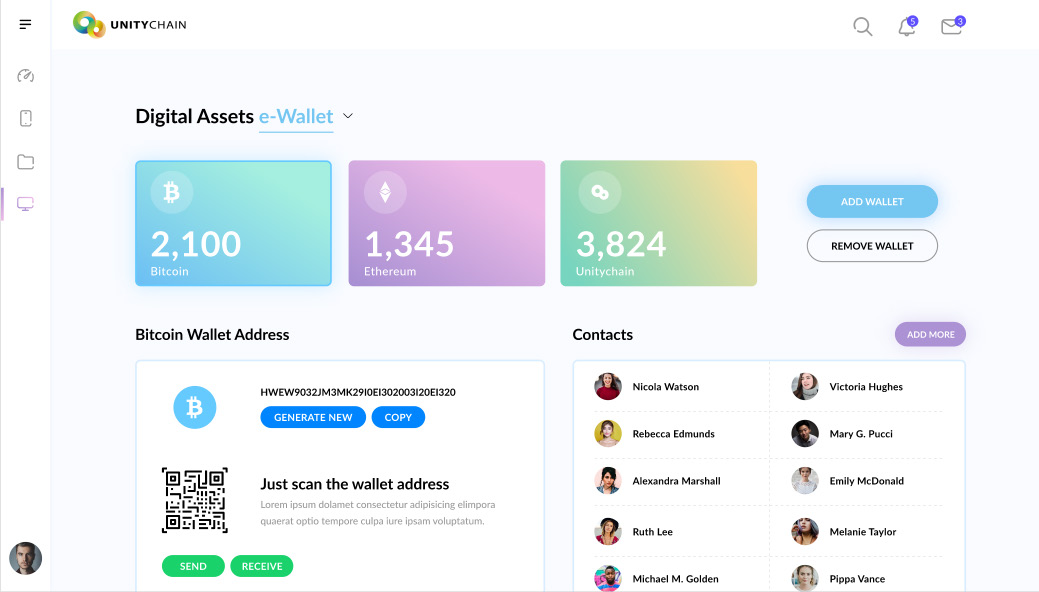
Manage your personal data: Securely access and share personal data across multiple third-party applications.
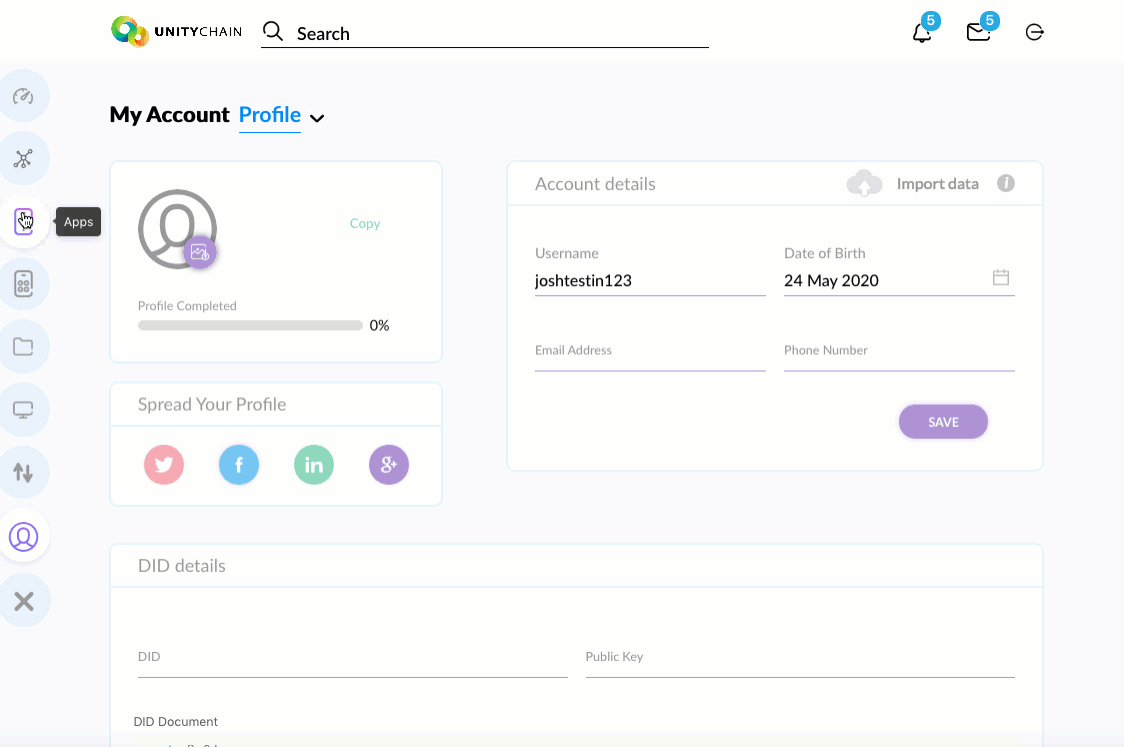
About the author
Similar in vision to Solid PODs and Urbit, the author envisions a future in which users don't need to visit multiple third-party applications directly to access services - rather, third-party developers will build open bridges from their applications into your personal VMS through permissioned modules and add-ons using highly vetted Software Development Kits and Application Programming Interfaces, which are tools that help developers to easily integrate specific functionalities between their application and yours.
Joshua D. Tobkin is a co-founder and Chief Executive Officer of Unitychain.io, a blockchain venture studio and lab focused on ushering in a next generation of decentralised Internet products and protocols. His venture studio is building novel online publishing platforms that enable ownership, distribution and novel monetisation models, data exchange protocols, privacy-preserving techniques for Zero-Knowledge Voting and governance, Central Bank Digital Currency solutions and supply chain platforms that integrate with IoT and blockchain. Joshua has a particular passion for online fintech-enabled marketplaces that facilitate new forms of commerce that are only possible with SaaS and Web 3.0 value exchange. Feel free to engage him on Twitter @JoshuaTobkin to learn more about his venture studio at Unitychain.io and to collaborate on research and development.
Imagine being able to book a telemedicine doctor appointment directly through your VMS and paying for the doctor's consultation with the digital assets you earned by contributing your compute and storage resources to secure blockchain networks. Moreover, consider an in-built access control mechanism to decrypt or revoke access to your Electronic Medical Record that you safely host in the cloud at your full control, always a few clicks away in case of need. This is merely the tip of the iceberg of where the future is inevitably headed. This is the general direction all of the aforementioned projects are aiming for, before a total clampdown of both our physical and internet realities without the protections of privacy.
In the near future, private citizens will run their own nodes, whether on the cloud or their personally managed hardware stack, and communicate peer-to-peer with each other without centralised intermediaries. User data will be highly protected through military-grade encryption and randomised public keys and browser fingerprints162 to provide greater privacy guarantees from prying eyes. Smart contracts will automatically handle a lot of functionalities under the hood providing individuals empowerment, privacy and dignity - while our physical lives become more fully monitored and tracked.
With self-sovereign identity, leveraged cryptography and decentralised blockchain and storage infrastructures, the future of the web will be both safer and 'darker' than ever before. This is the future the author and others are building towards, and this is where the future of the web must head for the sake of preservation of liberty.
Illustration of Decentralised Futures Concept:
A complex, interconnected diagram depicting various elements related to decentralised digital technologies and their impact on organisations and society. Key elements include:
- Top Left: Scales of justice, stacked blocks representing data/resources, a dollar sign, and city buildings, suggesting economic and legal frameworks.
- Top Center: Radar, brain with neural connections, Bitcoin (B) and Ethereum (Ξ) symbols, indicating data analysis, AI, and cryptocurrency.
- Top Right: Smartphone with server racks, a locked padlock, and social media icons, representing digital platforms, security, and communication.
- Mid-Left: Robotic arm, percentage signs, and banknotes, symbolising automation and financial transactions.
- Mid-Right: Shopping cart, hand holding banknotes, and a parachute with a box, illustrating commerce, funding, and delivery.
- Bottom Left: A group of people (community/governance), indicating collective action.
- Bottom Center: A circular petri dish with a virus-like graphic, representing health and biological threats.
- Bottom Right: Multiple hands in different colours and barbed wire, symbolising diversity, engagement, and potential barriers or conflicts.
- Overall, the illustration uses a vibrant colour palette of greens, pinks, and yellows against a grid background, suggesting interconnectedness and a structured future.
Taking the Power Back
By Ziri Rideaux and Brendan Miller
In 5 to 10 years, decentralised autonomous organisations163 (DAOs) will increasingly outcompete corporations and representative governments as the preferred way to organise human endeavors, because they solve collective action problems better. This will lead to a renaissance of the democratic commons, by restoring ownership and control to the people, and usher in new forms of global stewardship.
Established institutions are failing
Modern governance is currently stuck at a developmental stage known as 'representative democracy'. Insufficient controls over representatives' actions have fostered corrupt governments unwilling to regulate corporations or themselves. The electoral process has been hijacked by special interests,164 and populations have become increasingly powerless, underserved and exploited.165 The growing popular mistrust in centralised power166 indicates that the time for decentralised, non-hierarchical self-governance has finally arrived.
Vision for a new society
Learning from nature: Coorganisms
Humans are struggling to clear the next evolutionary hurdle that microorganisms surmounted billions of years ago: to cooperate in leaderless self-organising groups and form multicellular organisms to avert colony collapse driven by competition for survival.167 Learning from nature, successful decentralised autonomous organisations (DAOs) could function more like living, multicellular organisms. In this essay, they will be referred to as 'coorganisms'.168
These coorganisms will coordinate humanity's resources, services and consumption streams better than existing structures. Trustworthy delegation of daily roles and responsibilities will happen bottom-up rather than top-down by tracking the reliability of participants over time. Corrupt delegates can be replaced quickly and easily through a democratic process.
Decision-making will follow direct democracy principles, which is now technically possible on a global scale using decentralised, incorruptible blockchain software.169 Randomly chosen subgroups will deliberate, research and collectively decide on issues, similar to the jury duty process.170
The future of work: Non-hierarchical 'coorganisms' instead of Corporations
The future of work lies in diverse, participatory, stakeholder-owned and -operated structures, shorter working hours and more hours for developing social intelligence (e.g. sharing, caregiving, creating and learning). Repetitive work will be performed by robots, software and AI.171 It is therefore crucial that their ownership be held in common so that inequalities are not perpetuated into the future. Individuals will increasingly work from home or virtual offices,172 connected to coorganisms through digital platforms.
The decoupling of 'work' from 'income' will be necessary. Societal values will shift, as we collectively move from having to 'earn our keep' to each person's right to be sustained unconditionally via a Universal Basic Income (UBI).173 The UBI will ease the transition from for-profit models to cooperatively-owned and operated zero-sum game business models. A paradigm shift towards sustainable, improved living standards for all will eventually make the current priority of 'shareholder's value' redundant.174
The future of governance: Transparency and accountability
Decentralised, self-organising government is simply an ecology of coorganism platforms that cooperatively facilitate decisions, coordinate activities and collect and distribute moneys to provide services. The goal is to enrich the commons and return power and ownership to the community. Smart process design for example, using randomly selected deliberation groups rather than elected boards, and automated software safeguards can continuously decentralise control and guarantee the basic needs of all. The role of experts will be to inform, not to unilaterally decide.
Decentralised technology can guarantee the global population access to commerce, through their cell phones.175 This way, the 1.7 billion people around the world who are currently still excluded from the international banking system176 and commerce can participate equitably in the global economy.
Cryptocurrencies will help to decentralise methods of exchange and trade. Platform members will be able to make payments directly to each other.177 This will eliminate reliance on banks and debt-based money.178
Democratic decision-making requires equal access and a fair and consistent process. Within three years, 7.3 billion people will be mobile phone users179 and thus able to participate in such a global democratic process. Software will enable weekly deliberation and polling/voting on current political, economic, social and environmental issues at scale.
All communications will be private by default, using end-to-end encryption, to protect citizens from data misuse and government overreach. In the interest of trust and accountability, all money streams will be transparent on request by a sufficient number of coorganism participants. This will be made possible by smart contracts on the blockchain, that cannot be altered.180
Urgently needed infrastructure programmes like the Green New Deal181 can be initiated using self-organizing coorganisms even when corrupted elected officials refuse to act. These coorganisms can form a parallel power base outside of local governments to undertake mutual aid projects on various scales as well as pressure governments into action.
The future of ownership: Rediscovering the commons
The idea of the commons is as old as humanity. Only since the onset of agriculture did humans question the wisdom that nature belongs to all of us, together – and that the fruits of our labour (hunting, gathering, child-rearing, etc.) must be equally shared. We argue that there should be a cap on personal ownership introduced in order to re-establish public ownership of common lands, of natural resources, and to create a trustworthy contract between generations, sexes, creeds, races and species that share this planet.182
We currently face several serious global collective action problems. There is a need to:
- Stabilise our climate, rein in pollution and relocate climate refugees183
- Establish effective regulatory controls over corporations globally184
- Deal collectively with hunger and health threats (like tuberculosis, COVID-19, etc.).185
- Rebuild the common infrastructure, including energy, transportation and telecommunications/internet, in public ownership186
These global challenges cannot be tackled by local governments or organizations but need global frameworks, legislation and enforcement across jurisdictions, which decentralised blockchain technology can provide.187
Decentralised technology and coorganisms could help with these challenges, offering:
- Global mobility coordination: A decentralised platform could poll and determine the wishes of populations for increased mobility and help balance labour and other markets. Coorganisms can respond to the global crises of climate change refugees and victims of war or epidemics like COVID-19 by tracking populations and supply levels, and facilitating redistribution of resources and relocation of people as needed. Using a decentralised blockchain and private 'secret contracts'188 prevents the manipulation and abuses of data that are prevalent under current centralised schemes. The United Nations High Commissioner for Refugees is already using a blockchain pilot program to track refugees and their necessary supplies in Jordan.189
- From local law to global law: An enforceable, worldwide declaration of human rights could be adopted and ratified directly by the people using a digital, global direct democracy platform. Additionally, nature rights, pressing issues of tax law, business law and copyright law, etc. could be voted on in order to create new global regulations. The will of the people is revealed and can influence existing national governments and the United Nations. If disregarded, this parallel emerging self-government can deny legitimacy to non-responsive representative governments. Political bodies that have been deadlocked, like the UN, where the General Assembly is rendered powerless against the Security Council, will be replaced with more democratic systems that guarantee per capita representation of the world's populations.
- Decentralised commerce: A new, commonly owned platform could enable people to offer person-to-person services that can replace corporations like Uber, Facebook, Airbnb and even banks, which extract value from our 'Common's Wealth' by serving as gatekeepers and intermediaries. Initially, for-profit companies might be necessary to provide some commodity services; for example, credential checks. The eventual vision is to offer a reputation system on the decentralised platform itself that guarantees safe transactions. This empowers bottom-up individual entrepreneurship instead of top-down, capital-controlled190 corporation-building or monopolies.191 Content creators and service providers will be more fairly paid, because private platforms no longer control access to audiences. Open-source, decentralised technology can provide the same services directly, better, faster and for a fraction of the cost.192
Illustration of Decentralised Futures Concept:
A complex, interconnected diagram depicting various elements related to decentralised digital technologies and their impact on organisations and society. Key elements include:
- Top Left: Scales of justice, stacked blocks representing data/resources, a dollar sign, and city buildings, suggesting economic and legal frameworks.
- Top Center: Radar, brain with neural connections, Bitcoin (B) and Ethereum (Ξ) symbols, indicating data analysis, AI, and cryptocurrency.
- Top Right: Smartphone with server racks, a locked padlock, and social media icons, representing digital platforms, security, and communication.
- Mid-Left: Robotic arm, percentage signs, and banknotes, symbolising automation and financial transactions.
- Mid-Right: Shopping cart, hand holding banknotes, and a parachute with a box, illustrating commerce, funding, and delivery.
- Bottom Left: A group of people (community/governance), indicating collective action.
- Bottom Center: A circular petri dish with a virus-like graphic, representing health and biological threats.
- Bottom Right: Multiple hands in different colours and barbed wire, symbolising diversity, engagement, and potential barriers or conflicts.
- Overall, the illustration uses a vibrant colour palette of greens, pinks, and yellows against a grid background, suggesting interconnectedness and a structured future.
How do we get from here to there?
The authors suggest the development of a safe, open-source, blockchain-based platform, similar to WeChat,193 that provides comprehensive and extendable communication tools, banking, shopping, voting and organizing for the global population: a transparent, global public utility that is owned and controlled democratically by all of its users.
There are three key commitments we must make to ensure that this coorganism platform can reach its full potential:
- Self-sovereign identity and decentralised reputation: Each person's proof of membership, credentials and reputation must be under their ultimate control, partly in the form of advanced social verifications.194 It is essential to ensure that each person has one, and only one, verified identity on the system. Neither corporations nor governments will be allowed an identity or voting rights on this platform.
- Common ownership and non-profit principle: The digital platform must be controlled commonly by all participants.195 Similar to Wikipedia, it will be created as an open-source system through a participatory process, which evolves as our societies do. Different from other platforms like Bitcoin or Ethereum, the initiators cannot own stakes in the platform and private profit must not be the motive behind building this platform. This platform can never be sold or bought.196
- Decentralised, democratic infrastructure: The commonly owned blockchain and communication servers cannot be stored in centralised, and therefore vulnerable, locations but must be spread out all over the world.197 In theory, every citizen could run a 'micro-server' on their computer, mobile phone or a cloud server under their control, creating a mesh network.198 The eventual goal is the common ownership of all hardware (e.g. cables, satellites) needed to operate the platform.199
If these commitments are pursued, the membership numbers and impact of the platform will grow quickly. The lack of private ownership will foster a mindset of co-creative participation and stewardship rather than self-interested consumerism.
Fending off bad actors
Initially, this platform could be developed as a non-profit alternative to existing social media, chat and collaboration apps like Facebook. While it gathers participants, it could offer 'opinion polling' instead of official voting. This way, it could grow a large user base without threatening entrenched political and economic interests. (Large corporations and their captured government representatives will work hard to undermine a direct democracy that is designed to limit their disproportionate influence.)
For that reason, it is important that the platform allows encrypted, safe communication and organizing. Members could use the platform to arrange funding streams to worthwhile endeavours, form unions, organise referendums and general strikes, etc. Attempts to compromise, divide and conquer this platform would be detected within the transparent, open-source system and would be fought against by empowered participants. A sophisticated open-source reputation system would guarantee transparency, help detect bad actors and temporarily block their access to certain participation.
Conclusion
We can not solve our problems with the same level of thinking that created them.
-Albert Einstein 200
Bold innovations and big goals necessitate an epic paradigm shift. For about 500 years, a European, male-dominated elite has been at liberty to experiment with the populations and resources of our planet. Despite technological progress in some areas, the 21st century has been defined by existential crises regarding every aspect of human and natural survival. It is the conclusion of the authors that managerial capitalism and representative governments have failed the world's inhabitants. The underlying logic of value extraction and exploitation that has led to today's environmental crisis and staggering wealth inequality, propped up by the biggest military and police apparatus in history, must end. While we are aware that ingrained capitalist patterns will not dissolve overnight, it is essential to shift the public narrative from a masculine, conflict-dominance model to a feminine, social-sharing model to guarantee human survival on this planet.
Our global direct democracy platform would not only provide a better user experience for the world's people but it would also produce better outcomes for humanity and our planet. It will be superior to both representative government and hierarchical corporations, in the same way that representative democracies have replaced monarchies, and thus will eventually supersede them.
About the authors
Brendan Miller is the Chief Technical Officer for 2Gather. He has been a professional full-stack web developer for the past seven years and is currently the Chief Technology Officer and Lead Developer for The Branding Farm, a digital creative agency serving clients like NBC Universal, Warner Brothers, Skechers and University of California, Los Angeles. Brendan is also a certified Ethereum Smart Contract Developer. Previously, Brendan served as the Director of the Office of Science, Technology and Energy for the State of New Mexico Economic Development Department. He is the co-founder of two previous businesses and has also worked in the non-profit sector. He has a ScB in Mathematics-Computer Science from Brown University, an MBA from MIT and an MPA from Harvard University. Brendan is passionate about 2Gather's mission because he believes in direct democracy and wants to create the digital tools to support robust democracy globally.
Ziri Rideaux is the Chief Strategy Officer of 2Gather. She has been a political analyst and foreign correspondent for German television for over 20 years, covering conflicts in Afghanistan, Iraq, Bosnia, Rwanda and South Africa among others. She focuses on the challenges to developing democracies under pressure from international corporations and outside foreign interests. She is a serial entrepreneur, having started a successful multinational photography agency and innovated a first-of-its-kind digital distribution system. She has also started service companies providing industry-leading customer satisfaction through the adoption of virtualization and dematerialization strategies. Ziri has two master's degrees from Munich University, in political science and investigative journalism.
Illustration of Decentralised Digital Ecosystem:
An abstract and colourful illustration depicting an interconnected network of elements representing a decentralised digital future. Key visual motifs include:
- Top Left: A surveillance camera (eye icon) with lines connecting to a flag, suggesting monitoring or governance.
- Top Center: Clusters of small trees or plants, indicating growth, nature, or managed resources. Speech bubbles above human-like figures suggest communication and interaction.
- Top Right: A calculator with percentage and dollar signs, representing financial calculations and economic aspects.
- Mid-Left: Lightbulb (idea/innovation), books (knowledge/learning), and an eye icon.
- Mid Center: A locked padlock (security), a document with a seal (contracts/agreements), and a microscope with a chart, symbolising research, verification, and legal frameworks.
- Mid Right: Rows of small circular tokens or data points, resembling digital assets or information units.
- Bottom: Abstract patterns and connecting lines throughout, conveying the complexity and interconnectedness of the decentralised system.
- The palette is dominated by reds, greens, and ochre, creating a modern and structured feel.
Earth 2030
By Primavera De Filippi and Tony Lai
Hope is a slighter, tougher thing even than trust. ... In a good season one trusts life; in a bad season one only hopes, but they are of the same essence: they are the mind's indispensable relationship with other minds, with the world, and with time.
-Ursula Le Gui
Leia looked back at the wildflowers blooming across the rolling hills, shepherded by trees with branches laden low with fruit. The trees drew nourishment from the rich soil of the local Learning Site. Although invisible to many a visitor's eyes, a closer look would have revealed the myriad of sensors carefully camouflaged within the natural landscape. Mimicking the mycelial networks that nourished and connected the roots of each living thing, the local bioregion simulator gathered data from both the sensors and local community member input, monitoring each plant to ensure its needs were satisfied. Leia smiled, and wondered if tonight's community cooking crew had mushrooms on the menu.
In a few seconds, the handshakes between her credentials management system and the Learning Site were completed, and the doors swung open. The procedure seemed straightforward, yet what just happened in those few seconds represented over a decade of work by millions of contributors building the open-source software and legal infrastructure of Leia's world in 2030.
During the 2020s pandemics, Leia's family had watched public officials fall into patterns of denial and blame, as the public health crisis had become a global economic crisis, eradicating trust in public institutions. In the midst of the uncertainty and chaos unleashed by the pandemics, many families had started organising into communities for resilience and support. Mutual aid groups had formed, with neighbours reconnecting, offering a helping hand to one other. Leia's family had gathered in one of these communities, special in that it actually grew stronger and more resilient over time, and all members were responsible for sharing their learnings and best practices with other communities, wherever possible. Today's meeting at the Learning Site was for precisely this purpose.
An image of an open hand, offered in friendship, hung over the entranceway. Walking into the Learning Site's main hall, Leia looked across to the adults and children clustered at various stations around the room. Some were gathered around tables, planning new irrigation projects to support the grow sites nestled into the three-dimensionally rendered topography of her local bioregion. Others were engrossed in their own learning programs, specially tailored for them from a combination of template programs collectively shared and maintained among all the connected Learning Sites.
Branching out from the main hall was a series of collaboration and storytelling facilities, rooms decked out with cameras and recording equipment to log every brainstorm and workshop within. Leia was not bothered by any of these sensors: her data trust interfaced with the Learning Site systems to keep any data carefully protected and managed on her behalf. Whenever she was recorded, specific licensing agreements were created, ensuring that the benefits of her ideas were always shared within the community. And if an idea had the potential to address a global challenge, it was made available to the global commons, with legal engineering ensuring proper recognition and fair distribution of royalties.
People contributed to the Learning Commons because the very act of learning and teaching was treasured as a collaborative endeavour: 'The more you give, the more you get', was the adage. During the years of lockdown in the aftermath of the pandemic, parents working from home had discovered, to their surprise, that learning had radically changed since their school days. Kids were taking online classes from their teachers and then switching to the internet to dig deeper into their interests, learning at their own pace. They engaged with their peers, often creating their own videos on what they had been learning, for their friends and the wider world.
The open-source movement that had galvanised the internet and the protocols that ensured interoperability among multiple sites had begun to transform education too. Millions joined in building out the open-source Learning Commons, the infrastructure which empowered the people of Leia's world. After the pandemics hit, contributions to the Learning Commons came in public health; pandemic response protocols from triage to treatment were constantly updated by volunteer nurses and front-line workers. Areas where learning had been undergoing rapid change benefited particularly from such an open and adaptive approach, epitomised by law and its transformation as a practice into legal engineering.
Earlier that year, after turning 16, Leia chose to start learning about governance and complex adaptive systems. She had begun gathering the materials and contacting peers and mentors who would help on her learning journey. Permaculture was her favourite topic. Focusing not only on farming and gardening, it also extended towards the notion of 'social permaculture': how the complex, interconnected communities of people, animals or plants can be organised in a broader ecosystem so they all contribute to helping, rather than exploiting, one another. She learnt how to design a sustainable ecosystem for the Regenerative Agriculture Site and gained new knowledge in political theory, legal engineering and economics.
For Leia, markets had always been such a natural and valuable component of society. She learnt from stories the elders told and from digging into the work of Elinor Ostrom that the 'goodness' of markets was a relatively recent development and that properly functioning markets are only possible through extensive and proactive intervention. While growing up, she had associated joy and generosity with the open hand she saw crossing the doorsill into the Learning Site each day. Since her governance studies, she had learnt how that open hand, known as the Visible Hand, had emerged as the symbol of the new covenant, the latest testament created among all the communities around the world who opted in.
Unlike Adam Smith's 'invisible hand', adopted as gospel by the free market neo-liberal consensus of the late 20th century, the new covenant promised markets embedded not only with transparency but also with a more communitarian system of governance based on mutual trust, recognition and respect, to ensure a more sustainable, regenerative distribution of power and social equality. Yet this response was by no means universal.
Karen and James awaited Leia in one of the storytelling rooms. They had planned their meeting to compare how governments around the world had reacted differently to the pandemic.
'Welcome. Thank you both for joining me here', Leia greeted them both, holding her hand to her heart, then extending it open, palm up, fingers out towards them both.
'Thank you for coming to share with us', James responded, mimicking the gesture.
'Yes, thank you', added Karen in a meek but respectful voice.
Illustration of Digital Interaction and Surveillance:
An abstract and stylised illustration that combines human figures with technological elements, conveying themes of digital interaction, data flow, and oversight.
- Center: A large, central circular motif with radiating lines and interconnected nodes, resembling a decentralised network or a core data system. An eye symbol is prominent at the bottom.
- Left: A human head silhouette connected to the central network, indicating individual participation.
- Right: Two human figures in profile, interacting within speech bubbles, representing communication or dialogue. Their connection to the central network suggests digital communication platforms.
- Overarching Elements: Lines and arrows crisscross the illustration, indicating data flow and connectivity.
- Colours: A palette of reds, greens, and muted yellows creates a vibrant yet somewhat controlled atmosphere.
- The overall impression is one of a digitally enhanced social environment, potentially with elements of observation or control.
Karen was a refugee from a former democracy turned into an authoritarian system during the pandemics, which was trying to limit the spread of the virus by tracking every move of every citizen and punishing anyone who violated their quarantine by reducing their social credit score and limiting their access to public services.
'In my country, they justified surveillance and control because of the crisis', Karen said, glancing up nervously at the cameras, 'then they were recast as generic public protection measures'.
'You're safe here', Leia reassured her, explaining how by coming here Karen and her family had their own protected identities and data trusts set up already.
'We went the other way', said James. 'You could say we sacrificed our weakest citizens for the sake of keeping the economy alive and building a more robust population with herd immunity, but I think we ultimately failed to recognise that our economy was for the most part grounded on the work of the most vulnerable people.'
James was an exchange student visiting from another country, enjoying the sharing and reconciling of opposing perspectives. 'I suspect it was no coincidence that the private sector had to step in to take care of all the things that our government couldn't handle', James added. 'All communications, searches, locations and purchases were already managed through private online platforms, resulting in greater market efficiencies. Why not health and education too? In one sense we resolved the crisis faster and better than everyone else thanks to tech companies providing contact tracing and access control systems to all the population.'
Leia was especially curious about interactions with students from neo-liberal communities; she knew that many of them were starting to acknowledge the inherent failures of a non-regulated market system and the unavoidable inequalities that emerge from it.
'Tech solutions driven by market dynamics, fuelled by huge amounts of personal data'. she offered. 'It's not that technological solutions are bad; it's just that both governments and private companies have misaligned incentives. Any participation and engagement in creating a society for the common good gets sacrificed at the altar of power, efficiency and profits.'
'Would we rather live in a world without technology', mused James, 'like those others in your community, who reject all technological advances?'
Leia smiled before diving into the history of the last decade with them: The few governments who had relied on grass-roots citizen engagement for fighting the pandemic had done so by rejecting the use of technology, regarded as the root of all evils. Technology was only necessary to scale up production and consumption, they had thought, and it was this constant desire to scale up that was destroying our planet. They had rejected the use of technology, advocating instead for the establishment of resilient communities focusing on local bioregions that did not need to import any foreign products or technologies.
Leia's community had been an exception to its kind. While promoting local resilience, her community had also acknowledged the value of technology, which – if properly governed – could help achieve that end. Over the years, Leia's community attracted activists, intellectuals, social scientists, artists, engineers and many advocates of the decentralised technologies that emerged after the 2008 financial crash. Inspired by Ostrom's research, they experimented with commons-based governance mechanisms for local communities and an interdependent global system.
While they knew that decentralised yet coordinated action was hard without monitoring or enforcement, they found in blockchain technology a solution to precisely both of these challenges: distributed ledger technology that enabled monitoring in a decentralised, transparent and tamper-resistant manner; smart contracts for the automated and decentralised enforcement of codified agreements. It was thanks to these technologies that Leia's community fought the pandemic, using technology to empower people rather than subjecting them to a dominant superpower.
'The seeds of our community were sown 10 years ago through a series of gatherings where we grew our relationships, built a shared pool of solutions and laid our plans to make them available to all', Leia added.
The visitors kept asking questions of Leia, eager to understand whether and how these solutions could be transposed into their communities. Hours later, exhausted but excited from this new knowledge, they requested to become members of the Learning Commons to continue studying Leia's community from home.
Leia instructed her data trust to share access to her personal selections and annotations of the Learning Commons, saying 'I hope and trust we'll interoperate again soon!'
About the authors
Primavera De Filippi is a Permanent Researcher at the National Centre of Scientific Research (CNRS) in Paris, a Faculty Associate at the Berkman-Klein Center for Internet & Society at Harvard University and a Visiting Fellow at the European University Institute. Her research focuses on the legal challenges and opportunities of blockchain technology and artificial intelligence, with specific focus on trust and governance. She is the author of Blockchain and the Law, published by Harvard University Press. She was awarded a €2 million grant from the European Research Council to investigate the implications of blockchain technology on institutional governance and global governance. Primavera is also an artist and legal expert for Creative Commons in France. She was a founding member of the Global Future Council on Blockchain Technologies at the World Economic Forum and co-founder of the Internet Governance Forum's dynamic coalitions on blockchain technology.
Tony Lai is a Fellow and Chair of the Blockchain Working Group at CodeX, the Stanford Center for Legal Informatics, and a founding Editor of the Stanford Journal on Blockchain Law and Policy. He is the 2020 Foresight Fellow in Legal Engineering for the Biosphere, and is joining the Edmund Hillary Fellowship to further his applied research on network and data governance systems to support trusted local and global collaboration. Born in England, and now growing roots in California, Singapore, and New Zealand, he co-lives through The Embassy Network, experimenting with commoning in autonomous communities, spaces, and projects.
Illustration of Digital Ecosystem with Nature Elements:
An illustrative graphic featuring a blend of natural and technological elements, indicating a harmonious or integrated future.
- Left: Groups of stylised trees or plants with visible root systems, some flowering, suggesting organic growth and interconnectedness.
- Center: A large lightbulb, symbolising ideas or innovation, integrated into a network of lines and nodes.
- Right: A document with a seal (contracts/agreements) and a locked padlock, representing security, legality, and protected information.
- Overall: The illustration is composed of geometric shapes in a palette of greens, pinks, and yellows, set against a background of interconnected lines, conveying a sense of structured digital growth and secure frameworks, possibly in a natural context.
The Decentralised Future essay competition
In December 2019, Nesta put out an open call for essay pitches exploring how over the next decade decentralised digital organisations could change the way we think about work and the structure of organisations. In total we received over 100 essay pitches covering a broad range of questions and presenting both utopian and dystopian visions of what a decentralised future might look like.
This long list of essays was scored by our panel of six expert advisors, and, with difficulty, a shortlist of ten finalists were chosen. The finalists were asked, with help from our in-house editors, to turn their short pitches into full-length essays. The ten finalists' essays were then judged by the same panel of experts to choose first, second and third prize winners.
Endnotes
- Coase's theorem suggests that lowering transaction friction (or 'costs') will lead to a more efficient allocation of market resources; Coase, Ronald. 'The Problem of Social Cost.' The Journal of Law and Economics 3 (1960):1-44.
- Kryptographe. 'Which are the Top 5 Blockchain based Dating Altcoins?' Accessed 31st July, 2020. https://www.kryptographe.com/top-5-blockchain-based-dating-altcoins/.
- PwC. How blockchain technology could improve the tax system. PwC, 2016. https://www.pwc.co.uk/issues/futuretax/assets/documents/how-blockchain-could-improve-the-tax-system.pdf
- Pawczuk, Linda, Jonathan Holdowsky and Rob Massey. Deloitte's 2019 Global Blockchain Survey. Deloitte, 2019. https://www2.deloitte.com/content/dam/Deloitte/se/Documents/risk/DI_2019-global-blockchain-survey.pdf.
- Desilver, Drew. "Before the coronavirus, telework was an optional benefit, mostly for the affluent few." Pew Research, 20th March 2020. https://www.pewresearch.org/fact-tank/2020/03/20/before-the-coronavirus-telework-was-an-optional-benefit-mostly-for-the-affluent-few/.
- Haley, Christopher, Jack Orlik, Eszter Czibor, Hugo Cuello, Teo Firpo, Marieke Goettsch, Lou-Davina Stouffs, and Laurie Smith. 'There will be no "back to normal".' Nesta, 9th April 2020. https://www.nesta.org.uk/blog/there-will-be-no-back-normal/.
- Nesta. 'Centre for Collective Intelligence Design'. Accessed 31st July, 2020. https://www.nesta.org.uk/project/centre-collective-intelligence-design/.
- Nesta. 'Crowdfunding.' Accessed 31st July, 2020. https://www.nesta.org.uk/feature/innovation-methods/crowdfunding/.
- Nesta.'The Collaborative Economy.' Accessed 31st July, 2020. https://www.nesta.org.uk/project/the-collaborative-economy/#.
- Nesta. 'Democratic Innovations.' Accessed 31st July, 2020. https://www.nesta.org.uk/project/democratic-innovations/.
- Dowlat, Sarah and Michael Hodapp. Cryptoasset Market Coverage Initiation: Network Creation. New York: Satis Group, 2018. https://research.bloomberg.com/pub/res/d28giW28tf6G7T_Wr77aU0gDgFQ.
- Paradlis, Alexander and Thibault Serlet. 'The Economics of a Decentralized Society: An Overview of Capitalism in Ancient Greece.' Startup Societies, 20th August 2017. https://www.startupsocieties.org/blog/the-economics-of-a-decentralized-economy-in-ancient-greece
- Benner, Dave. 'Political Centralization Ended the Roman Republic.' Mises Institute, 25th April, 2019. https://mises.org/wire/political-centralization-ended-roman-republic.
- Cabinet Office. 'Devolution: Factsheet.' Accessed 31st July, 2020. https://assets.publishing.service.gov.uk/government/uploads/system/uploads/attachment_data/file/770709/DevolutionFactsheet.pdf.
- Centre for Cities. 'Everything you need to know about metro mayors.' Centre for Cities, 25th August 2019. https://www.centreforcities.org/publication/everything-need-know-metro-mayors/.
- Touron, Manfred. 'Centralized vs Decentralized vs Distributed Systems. Berty, 20th June, 2019. https://berty.tech/blog/decentralized-distributed-centralized.
- Tabora, Vince. 'The Evolution of the Internet, From Decentralized to Centralized.' Hackernoon, 25th March, 2018. https://hackernoon.com/the-evolution-of-the-internet-from-decentralized-to-centralized-3e2fa65898f5.
- World Wide Web Foundation. 'History of the Web.' Accessed 31st July, 2020. https://webfoundation.org/about/vision/history-of-the-web/.
- Richardson, Will. 'The Read/Write Web.' Blogs, wikis, podcasts, and other powerful web tools for classrooms. Thousand Oaks, California: Corwin, 2010. https://www.corwin.com/sites/default/files/upm-binaries/10848_Chapter_1.pdf.
- World Wide Web Foundation. 'History of the Web.' Accessed 31st July, 2020. https://webfoundation.org/about/vision/history-of-the-web/.
- Staltz, André. 'The Web Began Dying In 2014, Here's How.' Staltz, 30th October 2017 https://staltz.com/the-web-began-dying-in-2014-heres-how.html.
- Gramlich, John. '10 facts about Americans and Facebook.' Pew Research, 16th May, 2019. https://www.pewresearch.org/fact-tank/2019/05/16/facts-about-americans-and-facebook/.
- Llansó, Emma. 'Platforms Want Centralized Censorship. That Should Scare You.' Wired, 18th March 2018. https://www.wired.com/story/platforms-centralized-censorship/.
Decentralised Futures: How digital technologies will change the shape of organisations to come
24 Lapowsky, Issie. 'How Cambridge Analytica Sparked the Great Privacy Awakening.' Wired, 17th March, 2019. https://www.wired.com/story/cambridge-analytica-facebook-privacy-awakening/
25 BBC News. 'Ex-Yahoo engineer hacked accounts seeking pornography.' BBC News, 31st July, 2020. https://www.bbc.co.uk/news/technology-49892760.
26 Newton, Casey. 'How a typo took down S3, the backbone of the internet.' The Verge, 2nd March, 2017. https://www.theverge.com/2017/3/2/14792442/amazon-s3-outage-cause-typo-internet-server.
27 Greene, Tristan. 'We should be getting paid to use Facebook and Google.' TNW, 9th March 2018. https://thenextweb.com/artificial-intelligence/2018/03/09/we-should-be-getting-paid-to-use-facebook-and-google/
28 Belvedere, Berny. 'Breaking Big Tech'. The National Review, 23rd May 2019. https://www.nationalreview.com/2019/05/breaking-big-tech/
29 Clayburgh, Jesse, Matt Zumwalt and Juan Benet. 'Why is decentralized and distributed file storage critical for a better web?.' Coin Centre, 20th June, 2017. https://www.coincenter.org/why-is-decentralized-and-distributed-file-storage-critical-for-a-better-web/.
30 Beaker Browser.
31 Filecoin.
32 DTube.
33 Touch Social.
34 Bariso, Justin. 'This Email From Elon Musk to Tesla Employees Describes What Great Communication Looks Like.' Inc, 30th August 2017. https://www.inc.com/justin-bariso/this-email-from-elon-musk-to-tesla-employees-descr.html
35 Rajan, G Raghuram and Julie Wulf. 'The Flattening Firm: Evidence From Panel Data On The Changing Nature Of Corporate Hierarchies.' The Review of Economics and Statistics 88, no. 4 (2006): 759-773. https://www.nber.org/papers/w9633
36 Borkin, Simon. Platform Co-operatives - Solving the Capital Conundrum. London: Nesta, 2019. https://media.nesta.org.uk/documents/Nesta_Platform_Report_FINAL-WEB_b1qZGj7.pdf
37 Buterin, Vitalik. 'Ethereum white paper.' Accessed 31st July, 2020. https://ethereum.org/en/whitepaper/.
38 Although the term is now intimately connected with the Ethereum system and other virtual machines, it actually predates blockchain, and was coined in the early 1990s by Nick Szabo, who envisaged 'augmenting legal enforcement [of contracts] with technological constraints': Szabo, Nick. 'A Formal Language for Analyzing Contracts'. Accessed 31st July, 2020. https://www.fon.hum.uva.nl/rob/Courses/InformationInSpeech/CDROM/Literature/LOTwinterschool2006/szabo.best.vwh.net/contractlanguage.html.
39 Piasecki, Piotr. 'Gaming Self-Contained Provably Fair Smart Contract Casinos'. Ledger 1 (December 2016): 99-110. https://www.researchgate.net/publication/311864045_Gaming_Self-Contained_Provably_Fair_Smart_Contract_Casinos.
40 Nesta. 'Radical decentralisation and the token economy.' Accessed 31st July, 2020. https://www.nesta.org.uk/feature/innovation-squared/radical-decentralisation-and-token-economy/.
41 Cointelegraph. 'What is DAO.' Accessed 31st July, 2020. https://cointelegraph.com/ethereum-for-beginners/what-is-dao.
42 Mzemel, Josh. 'Re: DAOstack use cases for scalable DAOs [discussion post, April 2018].' Accessed 31st July, 2020. https://daotalk.org/t/daostack-use-cases-for-scalable-daos/141.
43 Dowlat, Sarah and Michael Hodapp. Cryptoasset Market Coverage Initiation: Network Creation. New York: Satis Group, 2018. https://research.bloomberg.com/pub/res/d28giW28tf6G7T_Wr77aU0gDgFQ.
44 Fulmer, Nathan. 'Exploring the Legal Issues of Blockchain Applications.' Akron Law Review 52, no. 1 (2019). https://ideaexchange.uakron.edu/cgi/viewcontent.cgi?article=2449&context=akronlawreview.
45 Rooney, Kate. 'A blockchain start-up just raised $4 billion without a live product.' CNBC, 31st May, 2018. https://www.cnbc.com/2018/05/31/a-blockchain-start-up-just-raised-4-billion-without-a-live-product.html.
46 Filecoin, for instance, will only ever generate two billion tokens: Coinlist. 'Filecoin Token Sale Economics.' Accessed 31st July, 2020. https://coinlist.co/assets/index/filecoin_2017_index/Filecoin-Sale-Economics-e3f703f8cd5f644ecd7ae3860ce932064ce014dd60de115d67ff1e9047ffa8e.pdf.
47 Vamfir, Vlad. 'What is Cryptoeconomics.' Cryptoeconomicon CCRG, 1st Feb, 2015. YouTube video, https://www.youtube.com/watch?v=9lw3s7iGUXQ.
48 Bambrough, Bill. 'Veteran Investor Makes A Bold Prediction About Bitcoin And The Future Of Money.' Forbes, 20th February, 2019. https://www.forbes.com/sites/billybambrough/2019/02/20/a-billionaire-investor-has-made-a-bold-prediction-about-bitcoin-and-the-future-of-money/#31aa02be4711.
49 Swan, Melanie. Blockchain: Blueprint for a New Economy. Sebastopol, CA: O'Reilly, 2015; Tapscott, Don and Alex Tapscott. Blockchain Revolution. New York: Portfolio/Penguin, 2016.
50 Ammous, Saifedean. The Bitcoin Standard: The decentralised Alternative to Central Banking Hoboken, NJ: Wiley, 2018.
51 Marvin Rob. 'Blockchain in 2017: The Year of Smart Contracts.' PC Magazine, 12th December, 2016. http://www.pcmag.com/article/350088/blockchain-in-2017-the-year-of-smart-contract; Savelyev, Alexander. 'Contract Law 2.0: «Smart>> Contracts as the Beginning of the End of Classic Contract Law.' Information & Communications Technology Law 26, no. 2 (2016): 1-19. https://papers.ssrn.com/sol3/papers.cfm?abstractid=2885241; Byrne, Matt. 'Do Lawyers Have a Future?' The Lawyer, 20th September 2016. https://www.thelawyer.com/issues/online-september-2016/do-lawyers-have-a-future-2/.
52 Marr, Bernard. 'Why Blockchain Could Kill Uber.' Forbes, 9th February 2018. https://www.forbes.com/sites/bernardmarr/2018/02/09/why-blockchain-could-kill-uber/#efb7eec4179e; Ward, Matt. 'How Blockchain Will Disrupt Google, Apple, Amazon, and Facebook.' The Next Web, 28th March, 2018. https://thenextweb.com/syndication/2018/03/28/blockchain-will-disrupt-google-apple-amazon-facebook/.
53 Werbach, Kevin. The Blockchain and the New Architecture of Trust. Cambride, MA: MIT Press, 2018. In the book, the author explains how blockchain offers a different form of trust than these intermediaries provide, which may be superior along other dimensions.
54 See Werbach, ibid; Jagati Shiraz, Jagati. 'Crypto Crime on the Rise-Good Odds of 2020 Becoming a Record-Breaker.' CoinTelegraph, 7th June, 2020. https://cointelegraph.com/news/crypto-crime-on-the-rise-good-odds-of-2020-becoming-a-record-breaker; Vigna, Paul and Eun-Young Jeong. 'Cryptocurrency Scams Took in More Than $4 Billion in 2019.' Wall Street Journal, 8th February, 2020. https://www.wsj.com/articles/cryptocurrency-scams-took-in-more-than-4-billion-in-2019-11581184800; Engle, Eric. 'Is Bitcoin Rat Poison? Cryptocurrency, Crime, and Counterfeiting (CCC),' Journal of High Technology Law 16, No. 2 (2016): 340-393. https://heinonline.org/HOL/LandingPage?handle=hein.journals/jhtl16&div=12&id=&page=.
55 Brehm, Stefan and Nicholas Loubere. 'China's Dystopian Social Credit System Is a Harbinger of the Global Age of the Algorithm.' The Conversation, 15th January, 2018. https://theconversation.com/chinas-dystopian-social-credit-system-is-a-harbinger-of-the-global-age-of-the-algorithm-883481; D'Ambrosio, Paul J. 'The Proliferation of Profilicity.' LA Review of Books, 18th January 2020. https://lareviewofbooks.org/article/the-proliferation-of-profilicity; Harris, Shane. 'Giving in to the Surveillance State.' New York Times, 22nd August, 2012. https://www.nytimes.com/2012/08/23/opinion/whos-watching-the-nsa-watchers.html.
56 Asia Blockchain Review, '3 Blockchain Trade Finance Projects in China Pass $63bn in Volume.' Asia Blockchain Review, 8th December, 2016. https://www.asiablockchainreview.com/3-blockchain-trade-finance-projects-in-china-pass-63bn-in-volume/.
57 Chavez-Dreyfuss, Gertrude. 'Companies in Pharmaceutical Supply Chain Develop System to Track Counterfeit Drugs.' Reuters, 21st February, 2020. https://www.reuters.com/article/us-usa-healthcare-blockchain/pharmaceutical-companies-develop-system-to-better-track-counterfeit-drugs-idUSKBN20F29L.
58 del Castillo, Michael. 'Honeywell Is Now Tracking $1 Billion In Boeing Parts On A Blockchain.' Forbes, 7th March, 2020. https://www.forbes.com/sites/michaeldelcastillo/2020/03/07/honeywell-is-now-tracking-1-billion-in-boeing-parts-on-a-blockchain/#7ac1ca3178bf.
59 Sams, Jim. 'RiskStream Hoping Insurers Share FNOL Data on Blockchain.' Claims Journal, 1st November, 2019. https://www.claimsjournal.com/news/national/2019/11/01/293903.htm.
60 Hill, Kashmir and Aaron Krolik. 'How Photos of Your Kids Are Powering Surveillance Technology.' New York Times, 11th October 2019. https://www.nytimes.com/interactive/2019/10/11/technology/flickr-facial-recognition.html.
61 Hill, Kashmir. 'The Secretive Company That Might End Privacy as We Know It.' New York Times, 18th January, 2020. https://www.nytimes.com/2020/01/18/technology/clearview-privacy-facial-recognition.html.
62 Lakhani, Karim and Jill A. Panetta. 'The Principles of Distributed Innovation.' Innovations: Technology, Governance, Globalization 2, no. 3 (2007): 97-112. https://www.mitpressjournals.org/doi/pdf/10.1162/itgg.2007.2.3.97.
63 Palmer, Daniel. 'Catalonia to Build DLT-Based Identity Platform for Citizens.' CoinDesk, 9th September, 2019. https://www.coindesk.com/catalonia-government-to-build-dlt-based-identity-platform-for-citizens; Douglas, Theo. 'Illinois Announces Key Partnership in Birth Registry Blockchain Pilot.' GovTech, 8th September, 2017. https://www.govtech.com/data/Illinois-Announces-Key-Partnership-in-Birth-Registry-Blockchain-Pilot.html.
64 The Lao. 'The LAO: A For-Profit, Limited Liability Autonomous Organization.' Medium, 3rd September 2019. https://medium.com/openlawofficial/the-lao-a-for-profit-limited-liability-autonomous-organization-9eae89c9669c; Hester, James. 'Introducing the Mattereum Asset Passport.' Medium, 19th November 2019. https://medium.com/humanizing-the-singularity/introducing-the-mattereum-asset-passport-72f28c9ba6f1.
65 Mulgan, Geoff and Vincent Straub. 'The New Ecosystem of Trust.' Nesta, 21st February 2019. https://www.nesta.org.uk/blog/new-ecosystem-trust/.
66 DAOstack. 'Matan Field ETHDenver 2020.' Uploaded on February 24, 2020. YouTube video, 18:46 min. https://youtu.be/T2GYW36Crl4.
67 dGov Foundation and Genesis DAO. 'DAO Landscape Research.' Accessed 4th August, 2020. https://daoresearch.dgov.foundation/network-governance/dao-case-study-research.
68 DAOstack, Genesis DAO. Accessed 4th August, 2020. https://daostack.io/genesis.
69 DAOstack. 'Alchemy: All DAOs.' Accessed 4th August, 2020. https://alchemy.daostack.io/daos.
70 Prasad, Vinay and Jeffrey S Flier. 'Scientists Who Express Different Views on COVID-19 Should Be Heard, Not Demonized.' Statnews, 27th April, 2020. https://www.statnews.com/2020/04/27/hear-scientists-different-views-covid-19-dont-attack-them/.
71 Furedi, Frank. 'Dystopian and Disturbing: Big Tech Censorship Lumps Together Conspiracy Loons and Proper Scientists.' RT, 18th May, 2020. https://www.rt.com/op-ed/489002-youtube-censorship-scientists-covid-19/.
72 Reidy, Madison. 'Coronavirus: Health Experts Feel Censored over Alternative Lockdown Plan.' MSN News, 19th April, 2020. https://www.msn.com/en-nz/news/national/coronavirus-health-experts-feel-censored-over-alternative-lockdown-plan/ar-BB12RnCn.
73 Addelman, Mike. 'COVID-19 Social Distancing Having Significant Impacts on Mental Health, Study Shows.' Medical Xpress, 19th April, 2020. https://medicalxpress.com/news/2020-04-covid-social-distancing-significant-impacts.html.
74 De Young, Mariah, Mancuso Amy, Mark Eastberg, et. al. Preparing Michigan for the Behavioral Health Impact of COVID-19. Pine Rest Christian Mental Health Services. 13th June 13, 2020. https://www.pinerest.org/media/Preparing-Michigan-for-the-Behavioral-Health-Impact-of-COVID-19-Report.pdf.
75 Intelligent Decisions. 'Collective Intelligence and Online Deliberation.' Accessed 4th August, 2020. http://idea.kmi.open.ac.uk.
76 Rogers, A. 'Colorado Tried a New Way to Vote: Make People Pay-Quadratically.' Wired, 4th April, 2019. https://www.wired.com/story/colorado-quadratic-voting-experiment/.
77 Gitcoin. Gitcoin Grants. Accessed 4th August, 2020. https://gitcoin.co/grants/.
78 OECD. 'Revenue Statistics - taxes by level of government.' Accessed 4th August, 2020. http://www.oecd.org/tax/tax-policy/revenue-statistics-levels-of-government.htm.
79 Cabras, Ignacio. 'Rural pubs really do make countryside communities happier.' Northumbria University, 14th February 2017. http://newsroom.northumbria.ac.uk/pressreleases/expert-comment-rural-pubs-really-do-make-countryside-communities-happier-but-they-are-closing-at-an-alarming-rate-1806414.
80 Transition Streets. 'Morpheus Group set up new community cinema.' Accessed 4th August, 2020. https://www.transitionstreets.org.uk/totnes-streets/morpheusgroup-communitycinema/.
81 The Economist. 'A septuagenarian mayor is tackling decline in his corner of rural France.' The Economist, 21st November 2019. https://www.economist.com/europe/2019/11/21/a-septuagenarian-mayor-is-tackling-decline-in-his-corner-of-rural-france.
82 ONS. 'Economies of Ale, Office for National Statistics.' ONS, 26th November 2018. https://www.ons.gov.uk/businessindustryandtrade/business/activitysizeandlocation/articles/economiesofalesmallpubscloseaschainsfocusonbigbars/2018-11-26.
83 The Community Shares Unit. The Community Shares Handbook. The Community Shares Unit, 2015. https://communityshares.org.uk/resources/handbook.
84 Plunkett Foundation. Community Pubs: a better form of business. Plunkett Foundation, 2018. https://plunkett.co.uk/wp-content/uploads/Better-Business-2018-Pubs.pdf.
85 Rudolf, Marcin. 'Tokenizing startup equity, Part 1 - Employee Stock Options Plan (ESOP) on Ethereum.' Medium, 17th May, 2017. https://blog.neufund.org/tokenizing-startup-equity-part-1-employee-incentive-options-plan-esop-on-ethereum-blockchain-dce2416f4505.
86 Bender, Maddie 'It's a Moral Imperative: Archivists Made a Directory of 5,000 Coronavirus Studies to Bypass Paywalls,' Vice, 3rd February, 2020. https://www.vice.com/en_us/article/z3b3v5/archivists-are-bypassing-paywalls-to-share-studies-about-coronaviruses.
87 'Novel Coronavirus Information Center,' Elsivier, 27th January, 2020 https://www.elsevier.com/connect/coronavirus-information-center.
88 Wiley. 'Novel Coronavirus-Wiley Online Library.' Accessed 4th August, 2020. https://novel-coronavirus.onlinelibrary.wiley.com/.
89 Springer Nature. 'Coronavirus (COVID-19) Research Highlights.' Accessed 4th August, 2020. https://www.springernature.com/gp/researchers/campaigns/coronavirus.
90 Dahn, Bernice, Vera Mussah, and Cameron Nutt. 'Yes, We Were Warned About Ebola.' The New York Times, April 7, 2015, sec. Opinion. https://www.nytimes.com/2015/04/08/opinion/yes-we-were-warned-about-ebola.html.
91 Rita Liao, Manish Singh, 'GitHub Confirms It Has Blocked Developers in Iran, Syria and Crimea.' TechCrunch, 29th July, 2020. https://techcrunch.com/2019/07/29/github-ban-sanctioned-countries/.
92 Gatlan, Sergiu. 'Adobe To Ban Users From Venezuela Due to U.S. Executive Order.' Bleeping Computer, 7th October, 2019. https://www.bleepingcomputer.com/news/software/adobe-to-ban-users-from-venezuela-due-to-us-executive-order/.
93 Sanders, James. 'Facebook Data Privacy Scandal: A Cheat Sheet.' TechRepublic, 14th May, 2019. https://www.techrepublic.com/article/facebook-data-privacy-scandal-a-cheat-sheet/.
94 MacMillan, Douglas, and Robert McMillan. 'Google Exposed User Data, Feared Repercussions of Disclosing to Public.' Wall Street Journal. 8th October, 2018. https://www.wsj.com/articles/google-exposed-user-data-feared-repercussions-of-disclosing-to-public-1539017194.
95 Kaiman, Jonathan. 'Chinese Activist Jailed over Yahoo Email Is Freed.' The Guardian, 8th September, 2013, sec. World news. https://www.theguardian.com/world/2013/sep/08/chinese-activist-yahoo-email-freed.
96 Nobelprize.org. 'The Sveriges Riksbank Prize in Economic Sciences in Memory of Alfred Nobel 2009. Accessed 4th August, 2020. https://www.nobelprize.org/prizes/economic-sciences/2009/ostrom/facts/.
97 Charlotte Hess and Elinor Ostrom. 'Understanding Knowledge as a Commons | The MIT Press.' Mitpress.Mit.Edu. Accessed 28th July, 2020. https://mitpress.mit.edu/books/understanding-knowledge-commons.
98 On the Commons. 'Magazine | On the Commons.' Accessed 28th July, 2020. https://www.onthecommons.org/magazine/elinor-ostroms-8-principles-managing-commmons.
99 Maniatis, Petros, Mema Roussopoulos, Thomas J. Giuli, David SH Rosenthal, and Mary Baker. 'The LOCKSS peer-to-peer digital preservation system.' ACM Transactions on Computer Systems (TOCS) 23, no. 1 (2005): 2-50. https://dl.acm.org/doi/10.1145/1047915.1047917.
100 Aliya, Ryan. 'Maps in Court and the Waorani Victory,' Digital Democracy, 26th May, 2019, https://www.digital-democracy.org/blog/waorani-victory-in-court/.
101 Ritse, Erumi. 'Technology Is Not Neutral-It's Political,' Ford Foundation, 3rd November, 2017, https://www.fordfoundation.org/ideas/equals-change-blog/posts/technology-is-not-neutral-it-s-political/.
102 Calvão, Filipe. 'Crypto-miners: Digital labor and the power of blockchain technology'. Economic Anthropology, 6 (2018): 123-134. https://www.researchgate.net/publication/328314267_Crypto-miners_Digital_labor_and_the_power_of_blockchain_technology_Crypto-Miners.
103 Pawczuk, Linda, Jonathan Holdowsky and Rob Massey. Deloitte's 2019 Global Blockchain Survey. Deloitte, 2019. https://www2.deloitte.com/content/dam/Deloitte/se/Documents/risk/DI_2019-global-blockchain-survey.pdf.
104 Article 19. 'Blockchain: Technology alone cannot protect freedom of expression.' Article 19, 1st July, 2019. https://www.article19.org/resources/blockchain-technology-alone-cannot-protect-freedom-of-expression/
105 Dunbar, Robert. 'Neocortex size as a constraint on group size in primates.' Journal of Human Evolution 22, no. 6 (June 1992): 469-493. https://www.sciencedirect.com/science/article/abs/pii/004724849290081J.
106 Buterin, Vitalik. 'Quadratic Payments: A Primer.' Vitalik Buterin's website, 7th December, 2019. https://vitalik.ca/general/2019/12/07/quadratic.html.
107 Zelizer, Viviana A. 'The Social Meaning of Money'. Princeton: Princeton University Press, 2019. https://press.princeton.edu/books/paperback/9780691176031/the-social-meaning-of-money.
108 Samuelson, Paul A. 'The Pure Theory of Public Expenditure.' The Review of Economics and Statistics 36, no. 4 (November 1954): 387-389. https://www.jstor.org/stable/1925895.
109 Buterin, Vitalik, Zoë Hitzig, and E. Glen Weyl. 'Liberal Radicalism: A Flexible Design For Philanthropic Matching Funds.' SSRN, 2018. https://ssrn.com/abstract=3243656.
110 Adapted from Snowdrift Coop. 'Intro to Snowdrift.coop'. Accessed 18th August, 2020. https://wiki.snowdrift.coop/about/intro.
111 Buterin, Vitalik and E. Glen Weyl. 'Central Planning As Overfitting.' RadicalxChange, 26th November, 2018. https://blog.radicalxchange.org/blog/posts/2018-11-26-4m9b8b/.
112 Edelman, Joe. 'Radical Redesigns-Are They All About Allocations?.' Medium, 21st February, 2019. https://medium.com/what-to-build/radical-redesigns-709f845c2003.
113 Lanier, Jaron and E. Glen Weyl. 'How Civic Technology Can Help Stop a Pandemic: Taiwan's Initial Success Is a Model for the Rest of the World.' Foreign Affairs, 20th March 2020. https://www.foreignaffairs.com/articles/asia/2020-03-20/how-civic-technology-can-help-stop-pandemic.
114 Dewey, John. Democracy and Education: An Introduction to the Philosophy of Education. New York: Macmillan, 1916.
115 Allen, Danielle. 'Toward a Connected Society.' In Our Compelling Interests, edited by Nancy Cantor and Earl Lewis, 71-105. Princeton: Princeton University Press, 2016.
116 Dewey, John. The Public and Its Problems. New York: Holt, 1927.
117 Hitzig, Zoë and E. Glen Weyl. 'A Crossroads, not an Island: A Response to Hanoch Dagan.' SSRN, 4th January, 2019. https://ssrn.com/abstract=3306738.
118 Immorlica, Nicole, Matthew O. Jackson, and E. Glen Weyl. 'Verifying Identity as a Social Intersection.' SSRN, 20th May 2019. https://ssrn.com/abstract=3375436.
119 Buterin, Vitalik. 'Gitcoin Grants Round 5 Retrospective.' Vitalik Buterin's website, 30th April, 2020. https://vitalik.ca/general/2020/04/30/round5.html.
120 Rogers, Adam. 'Colorado Tried a New Way to Vote: Make People Pay-Quadratically.' Wired, 16th April, 2019. https://www.wired.com/story/colorado-quadratic-voting-experiment/.
121 Wright, Erik Olin. 2015. 'How to Be an Anticapitalist Today.' Jacobin, December 2, 2015. https://www.jacobinmag.com/2015/12/erik-olin-wright-real-utopias-anticapitalism-democracy/.
122 Arendt, Hannah. On Revolution. New York: Viking Press, 1963.
123 Weyl, E. Glen. 'Why I Am Not A Technocrat.' RadicalxChange, 19th August, 2019. https://blog.radicalxchange.org/blog/posts/2019-08-19-bv61r6/.
124 This attribution is common but is acknowledged to be a loose interpretation. Gramsci's actual text was 'La crisi consiste appunto nel fatto che il vecchio muore e il nuovo non può nascere: in questo interregno si verificano i fenomeni morbosi piú svariati.': Gramsci, Antonio and De Giovanni, Gerretana. Quaderni del Carcere. Torino, Giulio Einaudi Editore s.p.a., 2014.
125 Pogany, Peter. Rethinking the World. iUniverse, 2006.
126 For an account of how these operate in the city of Ghent, see: Bauwens, Michel and Vasilis Niaros, Changing Societies through Urban Commons Transitions. P2P Foundation and Heinrich Boll Foundation, 2017. http://commonstransition.org/changing-societies-through-urban-commons-transitions/.
127 There are already 120 such 'multi-factories' in Europe: Salati, Lorenza Victoria and Giulio Focardi, 'The rise of community economy: from coworking spaces to the multifactory model'. Sarajevo: Udruženje Akcija, 2018. https://www.academia.edu/41043179/THE_RISE_OF_COMMUNITY_ECONOMY_From_Coworking_Spaces_to_the_Multifactory_Model.
128 Lai, Tiffany Lai. 'Ezio Manzini: Cosmopolitan Localism'. Medium, 26th February 2017. https://medium.com/@tiffany.lai77/ezio-manzini-cosmopolitan-localism-dd1e1badd12a.
129 Bollier, David. 'New to the Commons?' Accessed 13th August, 2020. http://www.bollier.org/new-to-the-commons.
130 This formula is generally attributed to the historian Peter Linebaugh.
131 This is the hypothesis coming out of the research of Elinor Ostrom, who got the Nobel Prize in Economics in 2009 for her research on the commons, and from scholars affiliated to the International Association for the Study of the Commons.
132 For a preliminary synthesis of the work of macro-historians on this topic, see: Bauwens, Michel and Jose Ramos. 'The pulsation of the commons: The temporal context for the cosmo-local transition' (unpublished essay). https://docs.google.com/document/d/1sHhuecKxfB8HRH809aOfdIKNqaPQ8lc91502FXXv8e4/edit#.
133 This is the domain of 'biophysical economists', who aim to integrate the thermodynamic flows of matter and energy into economics, as well as the 'cliodynamics' of Peter Turchin, see: Turchin, Peter and Sergey A. Nefedov. Secular Cycles. Princeton University Press, 2009.
134 See, for example, Diamond, Jared. Collapse: How Societies Choose to Fail or Survive. London: Penguin, 2005.
135 Lietaer, Bernard. The Mystery of Money. Beyond Greed and Scarcity. Munich: Riemann Verlag, 2000. http://docs.banks-need-boundaries.net/en/Lietaer_Mystery_of_Money.pdf.
136 For an interesting essay-length history of monetary systems which pays attention to the existence of 'warm currencies' throughout history, see Krumm, Paul. 'Money Alternatives Different Kinds of Money: The History of Their Use Relevance in Building a New Economy.' academia.edu, 9th May, 2020. https://www.academia.edu/43088579/Money_Alternatives_Different_Kinds_of_Money_The_History_of_Their_Use_Relevance_in_Building_a_New_Economy.
137 Anderson, Benedict. Imagined Communities: Reflections on the Origin and Spread of Nationalism. London: Verso, 1983.
138 P2P Foundation. 'Global Thresholds and Allocations Council.' Accessed 13th August, 2020. https://wiki.p2pfoundation.net/Global_Thresholds_and_Allocations_Council.
139 Van Saberhagen, Nicolas. 'Cryptonote v2.0.' 'Cryptonote, 2013. https://cryptonote.org/whitepaper.pdf.
140 Ciampi, Michele, Nikos Karayannidis, Aggelos Kiayias and Dionysis Zindros. 'Updatable Blockchains.' Paper presented at the 25th European Symposium on Research in Computer Security (ESORICS), Guildford, United Kingdom, September 14 - 18, 2020. https://eprint.iacr.org/2020/887.pdf.
141 Karakostas, Dimitris, et al. 'Cryptocurrency egalitarianism: a quantitative approach.' Presented at International Conference on Blockchain Economics, Security and Protocols, Paris, France, 6th-7th May, 2019. https://drops.dagstuhl.de/opus/volltexte/2020/11971/pdf/OASIcs-Tokenomics-2019-7.pdf.
142 While there are standards for establishing decentralised identity (e.g. W3C DIDs), there is no practical way of ensuring each participant has exactly one identity and no more.
143 As an example, the decision to activate SegWit, a controversial proposal for a major change within Bitcoin, was done by counting signalling votes, following a tallying mechanism known as BIP-9.
144 Sirer, Emin Gün. 'Thoughts on The DAO Hack.' Hacking Distributed, 17th June, 2016. https://hackingdistributed.com/2016/06/17/thoughts-on-the-dao-hack/.
145 Finley, Klint. 'A $50 Million Hack Just Showed That the DAO Was All Too Human'. Wired, 18th June, 2016.
146 On the flip side, the benefit of uncensorability can often imply the detriment to any accountability.
147 Zhang, Bingsheng, Roman Oliynykov, Hamed Balogun. 'A Treasury System for Cryptocurrencies: Enabling Better Collaborative Intelligence'. Presented at the Network and Distributed System Security Symposium, San Diego, CA, 21st-24th February. https://eprint.iacr.org/2018/435.pdf.
148 Litos, Orfeas Stefanos Thyfronitis, and Dionysis Zindros. 'Trust is risk: a decentralised financial trust platform.' Presented at the International Conference on Financial Cryptography and Data Security, St. Kitts, Saint Kitts and Nevis, 18th-22nd February, 2019. https://eprint.iacr.org/2017/156.pdf.
149 Woebbeking, Maren K. 'The Impact of Smart Contracts on Traditional Concepts of Contract Law.' JIPITEC - Journal of Intellectual Property, Information Technology and E-Commerce Law 105, (2019). https://heinonline.org/HOL/LandingPage?handle=hein.journals/jipitec10&div=12&id=&page=.
150 Arnold, Martin.' Financial Times, 16th October, 2017. https://www.ft.com/content/615b3bd8-97a9-11e7-a652-cde3f882dd7b.
151 Racsko, Peter. 'Blockchain and Democracy.' Society and Economy 41, no 3 (June 2019): 1-17. https://www.researchgate.net/publication/333799254_Blockchain_and_Democracy.
152 Wilson, Fred. 'What Will Happen In The 2020s.' AVC, 1st January, 2020. https://avc.com/2020/01/what-will-happen-in-the-2020s/.
153 CDC. 'Principles of Contact Tracing.' CDC, 29th April, 2020. https://www.cdc.gov/coronavirus/2019-ncov/php/principles-contact-tracing.html.
154 Buterin, Vitalik. 'The Internet Going Dark (in the End-to-End-Encrypt-Everything Way) While the Physical World Goes Transparent to an Unprecedented Extent and There's Nothing We Can Do about It Already Is the Compromise. Https://T.co/KjyojYWdbP.' Twitter. Twitter, 18th January, 2020. https://twitter.com/VitalikButerin/status/1218672969959895041.
155 Nakamoto, Satoshi. 'Bitcoin: A Peer-to-Peer Electronic Cash System.' bitcoin.org, 2008.
156 Wikipedia. 'Zero-knowledge proof'. Accessed 13th August, 2020. https://en.wikipedia.org/wiki/Zero-knowledge_proof.
157 Wikipedia. 'Verifiable_credentials'. Accessed 13th August, 2020. https://en.wikipedia.org/wiki/Verifiable_credentials.
158 Grimes, Roger A. 'What is personally identifiable information (PII)? How to protect it under GDPR'. CSO, 22nd August, 2019. https://www.csoonline.com/article/3215864/how-to-protect-personally-identifiable-information-pii-under-gdpr.html.
159 Solid Project. 'Using Solid apps.' Accessed 14th August, 2020. https://solidproject.org/use-solid/.
160 MIT Solve. 'Solid: Decentralized, Inclusive and User-Centric Digital ID'. Accessed 13th August, 2020. https://solve.mit.edu/challenges/id4d-mission-billion/solutions/5477.
161 Urbit. 'Introduction.' Accessed 14th August, 2020. https://urbit.org/understanding-urbit/.
162 Cimpanu, Catalin. 'Brave to generate random browser fingerprints to preserve user privacy.' ZDNET, 9th March, 2020. https://www.zdnet.com/article/brave-to-generate-random-browser-fingerprints-to-preserve-user-privacy/.
163 Wikipedia. 'Decentralised Autonomous Organization.' Accessed 14th July, 2020. https://en.wikipedia.org/wiki/decentralised_autonomous_organization.
164 Maximino, Martin. 'The influence of elites, interest groups and average voters on American politics.' Journalist's Resource, 14th November, 2014. https://journalistsresource.org/studies/politics/finance-lobbying/the-influence-of-elites-interest-groups-and-average-voters-on-american-politics/.
165 Lührmann, Anna, Seraphine F. Maerz, Sandra Grahn, Nazifa Alizada, Lisa Gastaldi, Sebastian Hellmeier, Garry Hindle and Staffan I. Lindberg. 'Autocratization Surges - Resistance Grows: Democracy Report 2020.' V-Dem Institute at the University of Gothenburg, March 2020. https://www.v-dem.net/en/.
166 Rainie, Lee and Andrew Perrin. 'Key findings about Americans' declining trust in government and each other.' Pew Research Center, July 22, 2019. https://www.pewresearch.org/fact-tank/2019/07/22/key-findings-about-americans-declining-trust-in-government-and-each-other/.
167 Wingreen, Ned S and Simon A Levin. 'Cooperation among Microorganisms.' PLOS Biology 4, no. 9 (4th September 2006). https://www.ncbi.nlm.nih.gov/pmc/articles/PMC1569662/.
168 The authors prefer the term 'coorganism', which vividly evokes the biological parallel, in preference over another alternative, 'coordanism', which would emphasise the coordination aspect of these groups.
169 Sandre, Andreas. 'A look at this technology beyond Bitcoin and cryptocurrencies.' Hackernoon, 16th January, 2018. https://hackernoon.com/blockchain-for-voting-and-elections-9888f3c8bf72.
170 See also literature on Citizens' Assemblies. Citizens' Assemblies. 'Citizens' Assemblies: Democracies that Work.' Accessed 14th August, 2020. https://citizensassemblies.org/; various social movements like Extinction Rebellion are also calling for such reforms to our governance in the face of resistance from entrenched interests.
171 Wikipedia. 'Technological Unemployment.' Accessed 14th August, 2020. https://en.wikipedia.org/wiki/Technological_unemployment.
172 Remoters. 'Remote Work Trends for 2020: The Present & Future of Remote Work.' Accessed 14th August, 2020. https://remoters.net/remote-work-trends-future-insights/.
173 Wikipedia. 'Basic income.' Accessed 14th August, 2020. https://en.wikipedia.org/wiki/Basic_income.
174 Meyerson, Harold. 'How to Really End Shareholder Capitalism.' The American Prospect, 18th September, 2019. https://prospect.org/economy/walmart-go-union-exxon-abandon-fossil-fuels/.
175 Any mobile phone can be sufficient for participation in coorganisms through voice prompts and commands.
176 McCarthy, Niall. '1.7 Billion Adults Worldwide Do Not Have Access To A Bank Account.' Forbes, 8th June, 2018. https://www.forbes.com/sites/niallmccarthy/2018/06/08/1-7-billion-adults-worldwide-do-not-have-access-to-a-bank-account-infographic.
177 Cryptocurrencies like Bitcoin and Ethereum are built on blockchains and inherit their decentralised character.
178 Creating money from debt and a reliance on fractional reserve banking is inherently centralising and not the only way to create money, see: Wikipedia. 'Credit theory of money.' Accessed 14th August, 2020. https://en.wikipedia.org/wiki/Credit_theory_of_money. And existing cryptocurrencies like Bitcoin have a problem in that they act as a measure of value as well as a method of payment. This leads to an undesirable centralisation of ownership of the currency itself. Other approaches, like Taler, from the Gnu Foundation, are exclusively a method of payment, allowing new measures of value to be chosen independently, with the added benefit of being auditable by authorised entities; for example, for tax collection purposes. Taler. For more discussion on innovations in money, see: Greco Jr, Thomas. The End of Money and the Future of Civilization. White River Junction, VT:Chelsea Green, 2010.
179 Milijic, Marko. '29+ Smartphone Usage Statistics: Around the World in 2020.' Leftronic, 7th October, 2019. https://leftronic.com/smartphone-usage-statistics/.
180 Cryptographic techniques are available to keep data private until there is a compelling reason for it to become public. For example, Project Callisto uses these techniques to detect repeat sexual assailants.
181 Wikipedia. 'Green New Deal.' Accessed 14th August, 2020. https://en.wikipedia.org/wiki/Green_New_Deal.
182 A variety of thoughtful observers are also calling for a return to democratic public ownership in the 21st century. Here is one example: Lawrence, Mathew and Thomas M. Hanna. 'Ownership Futures: Towards Democratic Public Ownership in the 21st Century.' Common Wealth, 11th February, 2020. https://www.common-wealth.co.uk/reports/ownership-futures-towards-democratic-public-ownership-in-the-twenty-first-century.
183 High Commission on Refugees-USA. 'Climate change and disaster displacement.' Accessed 14th August, 2020. https://www.unhcr.org/climate-change-and-disasters.html.
184 Wikipedia. 'Race to the bottom.' Accessed 14th August, 2020. https://en.wikipedia.org/wiki/Race_to_the_bottom.
185 World Health Organisation. 'Pandemic preparedness.' Accessed 14th August, 2020. https://www.who.int/influenza/preparedness/pandemic/en/.
186 International Renewable Energy Agency. 'Energy Transition.' Accessed 14th August, 2020. https://www.irena.org/energytransition.
187 Blockchains require no centralised authority and can be trusted by parties who do not trust each other. Smart contracts on the blockchain can automatically enforce mutual contracts and agreements. Wikipedia. 'Smart contract.' Accessed 14th August, 2020. https://en.wikipedia.org/wiki/Smart_contract.
188 The Enigma and Oasis startups are at the forefront of developing practical secret contracts using techniques for 'secure multiparty computation', see: Zyskind, Guy. 'Defining Secret Contracts.' Enigma, 4th April, 2018. https://blog.enigma.co/defining-secret-contracts-f40ddee67ef2 and Raman, Vishwanath. 'Your Secrets are Safe with Me.' Oasis, 16th May, 2019. https://medium.com/oasislabs/your-secrets-are-safe-with-me-4dd7264dbf16.
189 Russ Juskalian. 'Inside the Jordan refugee camp that runs on blockchain.' MIT Technology Review, April 12, 2018. https://www.technologyreview.com/s/610806/inside-the-jordan-refugee-camp-that-runs-on-blockchain/.
190 Venture capital is highly centralised around the globe, and venture capitalists are disproportionately white men. Florida, Richard and Citylab. 'The Global Cities Where Tech Venture Capital Is Concentrated.' The Atlantic. 26th January, 2016. https://www.theatlantic.com/technology/archive/2016/01/global-startup-cities-venture-capital/429255/; Sanchez, Dana. 'Venture Capital Demographics: Why Do We Only Make Up one Percent?' The Moguldom Nation, 7th February, 2017. https://moguldom.com/6036/venture-capital-demographics-why-do-we-only-make-up-1/.
191 The 'network effects' inherent in social tech platforms almost guarantee that for-profit 'walled garden' platforms will be de facto monopolies: Schechter, Asher. 'Google Is as Close to a Natural Monopoly as the Bell System Was in 1956.' Promarket, 9th May, 2017. https://promarket.org/2017/05/09/google-close-natural-monopoly-bell-system-1956/.
192 Open-source software, which is already widely used, is naturally decentralised and returns access and control to the commons at large. Wikipedia. 'Open source. Accessed 14th August, 2020. https://en.wikipedia.org/wiki/Open_source; see also: Mei Douthitt et al. 'Why do most servers run on Linux OS? Accessed 14th August, 2020. https://www.quora.com/Why-do-most-servers-run-on-Linux-OS.
193 WeChat has over 900 million daily users in China. Liao, Shannon. 'How WeChat came to rule China.' The Verge, 1st February, 2018. https://www.theverge.com/2018/2/1/16721230/wechat-china-app-mini-programs-messaging-electronic-id-system.
194 It is possible to rely on the social verification of our peers to prove our identity rather than on biometric or other centrally controlled methods. Facebook already allows users to select several friends to help them restore their identity when needed. Facebook. 'Get Help From Friends.' Accessed 14th August, 2020. https://www.facebook.com/help/215543298568604?helpref=faq_content.
195 See also discussions about 'platform cooperatives'. Wikipedia. 'Platform cooperative.' Accessed 14th August, 2020. https://en.wikipedia.org/wiki/Platform_cooperative.
196 The .org domain, used by most non-profits, was controlled by a non-profit itself for many years, the Public Interest Registry. Recently, a sale of this domain was proposed to a private equity firm. While this has been blocked in the courts, it is still a prime example that true common ownership is essential in the long run. Mak, Aaron. 'Everything You Need to Know About the Potential Sale of.Org.' Slate, 22nd January, 2020. https://slate.com/technology/2020/01/what-to-know-about-the-controversy-over-the-sale-of-org.html.
197 Even though inherently decentralised, blockchains are vulnerable to attack if any one group controls more than 51 per cent of the nodes in the network: Frankenfield, Jake. '51% Attack.' Investopedia. Accessed 14th August, 2020. https://www.investopedia.com/terms/1/51-attack.asp.
198 Blockchain nodes can already be run on a laptop or desktop, and it will be practical to run them on mobile phones soon. Anderrson, Steve. 'Ethereum 2.0 Client Nimbus First To Run The Testnet On Mobile.' The Coin Republic, 5th February, 2020. https://www.thecoinrepublic.com/2020/02/05/ethereum-2-0-client-nimbus-first-to-run-the-testnet-on-mobile/.
199 For a more in-depth discussion of how decentralised technologies like blockchains can be more centralised than they may seem, and how to ensure they are fully democratic, see Miller, Brendan and Ziri Rideaux. 'Don't Let the Blockchain Get Pwned.' United States of Mind, 22nd June, 2018. https://unitedstatesofmind.blog/2018/06/22/dont-let-the-blockchain-get-pwned/.
200 Conifold et al. 'Did Einstein say 'We cannot solve our problems with the same thinking we used to create them'?' History of Science and Math Stack Exchange. Accessed 14th August, 2020. https://hsm.stackexchange.com/a/7753.
58 Victoria Embankment
London EC4Y 0DS
+44 (0)20 7438 2500
[email protected]
facebook.com/nesta.uk
nesta.org.uk
@nesta_uk
ISBN: 978-1-913095-27-7